
Very spooky house. (Image by PollyC.)

A “hoodoo” is a word which dates back to 1875. It means something that brings bad luck, and a Long Island house in the late nineteenth-century apparently had a whole lot of it. An article I found about this forerunner to Amityville originally appeared in the July 20, 1890 of the Brooklyn Daily Eagle. It had the ominous subheading, “Its History is a Record of Eccentricity, Avarice, Disappointment and Death–A Grim Hempstead Dwelling.” There is also watermelon involved. An excerpt:

“It is not often in these degenerate days that one runs across a genuine hoodoo or a Jonah, as the term is more popularly expressed. It is much less often that this peculiar characteristic is embodied in a house. Such a house seems to be standing, however, almost in the center of one of Long Island’s most thrifty villages–Hempstead. Of course the house hasn’t really had anything to do with it. But that is a fact which would require a great deal of argument to establish with any certainty among the residents of that respectable locality. One after the other of the occupants of the house have become the victims of accident, disease, insanity or of the suicidal mania. Avarice, eccentricity, sadness, disappointment have had full sway under the weather-beaten shingles. The shadow of the house seems never to have fallen upon anyone but to leave some of its blackness behind.

This hoodoo house is on the south side of Front street, in Hempstead, within two blocks of the business portion of town. Strange as it may seem, the house was built on honor, stanch and substantial enough to last three centuries. Cannan Doolan was the builder, in 1844. Doolan and his wife Margaret lived in the house for a few years and then died within a few months of each other. This was the first unfriendly act on the part of the house.

A son, Valentine, survived the pair, and took up his home in the house where his father and mother died. He was a stone mason as the father before him had been. Valentine had not lived here very long in solitary state before he became peculiar–‘queer’ as the townspeople said. He worked at his trade, but aside from that came to have little to do with humanity. Extreme avarice was his leading characteristic. He became the miser of Hempstead. While he would wear his clothes till there was not a thread of the original material left, he yet had a weakness which he gratified to the utmost. This was a taste for watermelons in winter. Watermelons were his hobby. Several other varieties of rare fruits he also had in abundance and a choice assortment of old wines. Doonan was a large man weighing about two hundred and twenty-five pounds.

(Image by Johann Jaritz.)

The house made its first real conquest early in 1884, when Valentine Doolan walked out of his back door one night, proceeded to the rear of his lot among the clump of trees, and there and then, with malice aforethought, stuck his face in a foot depth of water and drowned. The events which led to this rash deed were trivial in character, but were enough, as it appeared, to finally upset the unbalanced mind. Valentine had let a house to Levi Mottler, to be occupied by the latter on April 1. It turned out that the then occupants of the house concluded to stay. Yalentine asked Mottler to release him from the bargain, but Mottler would not do it unless Valentine would pay him $50. So Valentine, with much weeping and wailing and perturbation of spirit, went a few days before the 1st of April and paid the sum specified. Doolan returned to his home a mental wreck, all on account of the $50. He took sick abed with grief, escaped from his watchers at midnight and committed suicide.”

More Old Print Articles:

Tags: , , ,

"Seasons Greetings From C.B. Miller, Jupiter, Florida, 33469. "

(Postcard purchased for 25 cents at a Brooklyn flea market.)

“Birdie dear,

It is always so wonderful to hear from you. Margaret called early in November or late October and said the Stephens (Lidia and Sal) were coming over in late November or early December, and they would let us known and we could come down. Knowing Lidia, that may be five years from now or never.

Am going to Duke in February for a repair job or corrective surgery. It seems one operation causes something else to go bad. I still feel fortunate.

Had a wonderful trip to Jed’s. His home is so beautiful. Everything in it is ultra. He is building two office buildings and is buying land to build a third when these are completed. Kids today are really something!

All my love & best wishes for 1986.–Kay.”

More Miscellaneous Media:

  • Jim Otto 1965 Topps football card.
  • Miniature Aircraft Quarterly. (1998)
  • Howeird Stern 50 Ways to Rank Your Mother LP. (1982)
  • A Knight’s Hard Day. (1964)
  • The Lowbrow Reader remembers Ol’ Dirty Bastard. (2004)
  • LP record about the 1972 Oakland A’s.
  • Madison Square Garden professional wrestling program. (1981)
  • Spy magazine. (1989)
  • Artis Gilmore ABA basketball card. (1973-74)
  • San Francisco cable car ticket stub. (1990s)
  • Bronx high school newspaper. (1947)
  • Mad magazine. (1966)
  • Vancouver Blazers hockey guide. (1974-75)
  • John Hummer NBA card. (1973)
  • Carolina Cougars ABA Yearbook. (1970)
  • The Washington Senators MLB Yearbook. (1968)
  • Ugandan currency with Idi Amin’s picture. (1973)
  • Tom Van Arsdale basketball card. (1970)
  • “Okie from Muskogee” sheet music. (1969)
  • California Golden Seals hockey magazine. (1972)
  • Beatles Film Festival Magazine (1978)
  • ABA Pictorial (1968-69)
  • Tom Seaver’s Baseball Is My Life. (1973)
  • Hockey Digest (1973)
  • World’s Fair Guide (1964)
  • World’s Fair Guide (1939)
  • Buffalo Braves Yearbook (1972-73)
  • New York Nets Yearbook (1976-77)
  • “Tom Dooley” sheet music.
  • Tags: , , , , ,

    Afflictor: Making monkeys pay for their lives of crime since 2009. (Image by Frank Wouters.)

    Dear Readers: Sorry there were fewer posts and less original writing this week. Just very busy. Things should return to normal next week.~Darren

    Thanks for all the traffic, Snooks. (Image by Jeff Lewis.)

    It was the sublime and the silly again in September as odd search-engine keyphrases brought readers our way in record numbers. (Well, record numbers by Afflictor’s modest standards, but still.) I already have named the greatest keyword search in our history, but the ten searches below also helped us get traffic this month. (They are linked to the story that drew them to us.)

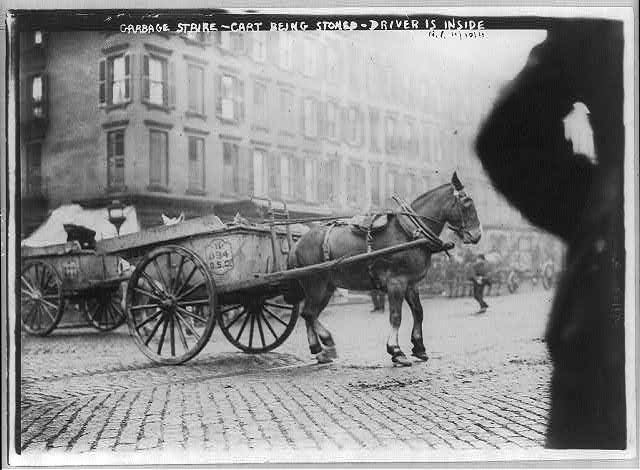
    A New York City garbage cart in 1911. (Image by the Bain News Service.)

    I had no idea that the New York Department of Sanitation had an Anthropologist-in-Residence until I came across a smart interview that Alex Carp did with Robin Nagle in The Believer. Nagle, also an NYU professor, has championed the building of  a Museum of Sanitation in NYC and wants people to think about something they’d rather quickly toss away: trash.  And she also wants the public to respect the important role that sanitation workers play in our lives. An excerpt from the interview:

    The Believer: It seems garbage collection might present this weird moment where, on one hand, you have all of these metaphors and figurative meanings that people react to when they think of garbage, but you also have this very real person, driving the truck and collecting the bins—you, when you’ve been out working with DSNY—just doing her job.

    Robin Nagle: Very much so. One of the categories of garbage has its own word in New York City, but it’s a category found everywhere that there is trash. There are things people will put out for discard: they’re done with it, they don’t want to see it again. Somebody else looks at that same object and says, ‘Whoa, wait a minute. That’s pretty nice. I want to keep that.’ Those two chairs you’re sitting in were on the curb to be thrown out. They’re pretty nice chairs. I’m happy to have them. In New York, that’s called mongo. It’s a noun and a verb: those are mongo. People who take things from the trash to keep are mongoing.

    Which, by the way, is illegal. You’re not supposed to do it, just for the record.

    Past treasures reach their end. (Image by Fruggo.)

    Then I’m also looking at—when I’m on the street wearing my uniform, for example, and when I’m working with people who have worn that uniform for a decade or two decades or longer… What do they put on with the uniform that they don’t necessarily choose to wear, but that the public puts on them? Because there is the stigma of being a sanitation worker and picking up garbage every day…People assume they have low IQs; people assume they’re fake mafiosi, wannabe gangsters; people assume they’re disrespectable. Unlike, say, a cop or a firefighter. And I do believe very strongly it’s the most important uniformed force on the street, because New York City couldn’t be what we are if sanitation wasn’t out there every day doing the job pretty well….

    And the health problems that sanitation’s solved by being out there are very, very real, and we get to forget about them. We don’t live with dysentery and yellow fever and scarlet fever and smallpox and cholera, those horrific diseases that came through in waves. People were out of their minds with terror when these things came through. And one of the ways that the problem was solved—there were several—but one of the most important was to clean the streets. Instances of communicable and preventable diseases dropped precipitously once the streets were cleaned. Childhood diseases that didn’t need to kill children, but did. New York had the highest infant mortality rates in the world for a long time in the middle of the nineteenth century. Those rates dropped. Life expectancy rose. When we cleaned the streets! It seems so simple, but it was never well done until the 1890s, when there was this very dramatic transformation.”

    Tags: ,

    “Run, run, or the cat will get you!” is what a parrot named Lorenzo was taught to squawk by his boss, who happens to be a Colombian drug lord. Police “arrested” the feathered lookout a couple days ago. A story about Lorenzo’s life of crime on The Week. (Thanks to Dangerous Minds.)

    More Videos:

    Tags:

    Craig Newmark bowed to political pressure and closed down his site's Adult Services section. (Image by Sierra Communications.)

    I know I’m a guy and not permitted by law to read Jezebel, but that site has the smartest and most honest take I’ve come across on the recent furor regarding Craigslist’s Adult Services section. The thought of people selling sex on Craigslist is as icky to me as it is anyone else. I think just buying a couch from the site would make me vomit. But here’s the question: Since it’s going to happen anyway, did law-enforcement officials who pressured the site into closing the section actually help or hurt the sex workers? Trying to maximize their safety and well-being should be the goal instead of empty moralizing, shouldn’t it? Jezebel wisely asked someone involved in the trade to write about the matter inA Sex Worker On Life After Craigslist.” An excerpt:

    “Really, the women most affected by the shuttering of Adult Services are all the ‘non-pros’ — college students and young women freelancing in the sex trade for extra money. ‘It was the safest, easiest way for an independent woman to earn a little extra cash doing something she already enjoyed — without the risks or rigmarole that can go along with being a ‘pro,’ explained Vita, a 30-something, Ivy-leaguer who used CL between, and sometimes during, the low-paying ‘real jobs’ her MFA afforded her.

    Despite the fact that the Attorneys General claim the site was a source of ‘misery’ for ‘women and children victimized by these ads,’ I couldn’t find anyone who actually used CL’s Adult Services and agreed. The greatest threat to sex workers is when they don’t have the ability to screen or have a say in the clients they see. This is particularly true for those who work for agencies whose bottom line is money. As independents, while the money can be very important, when it comes to instincts, you put your safety first.”

    Tags:

    The late novelist David Markson gives a reading at the Strand bookstore in 2007. His personal library was sold to the Strand after his death. An Internet sensation ensued. (Image by Sleepyrobot.)

    David Markson, the stubbornly inventive novelist who wrote the brilliant and challenging book, Wittgenstein’s Mistress, sadly passed away in June of this year. Eulogies were written by friends and admirers, but as can happen in our contemporary media landscape where everyone is seemingly connected, Markson has quickly had an unusual posthumous second act.

    Markson’s personal library of 2,500 books was sold to the Strand bookstore in Manhattan, where they are being sold separately to individual customers. But one shopper noticed the name “David Markson” written inside the cover of a copy of Don DeLillo’s White Noise (also a great novel) and researched him. When she subsequently put his amusing notes from inside the book online, it mobilized an online community of book lovers who descended on the Strand to try to snare and share Markson’s other books and notes. Craig Fehrman of Boston.com provides the story:

    A few weeks ago, Annecy Liddell was flipping through a used copy of Don DeLillo’s White Noise when she saw that the previous owner had written his name inside the cover: David Markson. Liddell bought the novel anyway and, when she got home, looked the name up on Wikipedia.

    Markson, she discovered, was an important novelist himself–an experimental writer with a cult following in the literary world. David Foster Wallace considered Markson’s Wittgenstein’s Mistress–a novel that had been rejected by 54 publishers–‘pretty much the high point of experimental fiction in this country.’ When it turned out that Markson had written notes throughout Liddell’s copy of White Noise, she posted a Facebook update about her find. ”i wanted to call him up and tell him his notes are funny, but then i realized he DIED A MONTH AGO. bummer.”

    The news of Liddell’s discovery quickly spread through Facebook and Twitter’s literary districts, and Markson’s fans realized that his personal library, about 2,500 books in all, had been sold off and was now anonymously scattered throughout The Strand, the vast Manhattan bookstore where Liddell had bought her book. And that’s when something remarkable happened: Markson’s fans began trying to reassemble his books. They used the Internet to coordinate trips to The Strand, to compile a list of their purchases, to swap scanned images of his notes, and to share tips. (The easiest way to spot a Markson book, they found, was to look for the high-quality hardcovers.) Markson’s fans told stories about watching strangers buy his books without understanding their origin, even after Strand clerks pointed out Markson’s signature. They also started asking questions, each one a variation on this: How could the books of one of this generation’s most interesting novelists end up on a bookstore’s dollar clearance carts?”


    Tags: , ,

    A September 12, 2010 article in the Los Angeles Times profiles the remarkable Richard J. Bing, a 100-year-old retired California physician and classical music composer who escaped Hitler and knew Lindbergh. An excerpt from the piece by Steve Lopez is followed by a short film about Bing that premiered at Sundance this year. (Thanks to Newmark’s Door.)

    He said he’d retired at 93, as if that were normal. He said that he’d written hundreds of classical music compositions before medical school, that he slipped ‘out the back door’ to Switzerland when Hitler moved into power in Germany and that Charles Lindbergh had persuaded him to move to the U.S. in the 1930s to do heart-related research that might help Lindbergh’s ailing sister.

    I Googled Bing’s name and it was all true. I had a Renaissance man on the line, his breathing labored but his mind sharp.

    ‘You should take a look at my video on YouTube,’ Dr. Bing suggested, and so I did, enjoying a short documentary on an amazing life that included a stint as education director at Huntington Hospital (Bing is still technically on the faculty at Caltech).

    Twice last week, I went to Bing’s home, where he lives with a caretaker who comes running when Bing rings a call bell that plays the start of Beethoven’s Fifth. Bing, who made great contributions in heart research, has a failing heart, of all things, as well as skin cancer.

    Bing said he’s grown mellower and more tolerant with age, which makes you wonder how he handled utility companies at 70 and 90. He said he most values his extended family of children, grandchildren and great-grandchildren. By day, he sits in an easy chair surrounded by great books and photos of loved ones, and he powers up his computer to write for medical journals.

    ‘Life, it’s in you,’ said Bing as his cat, Louis, climbed on top of the piano to catch the warm light coming through from the garden. ‘It’s a composite of all your organ systems telling you you won’t die,’ even as hard evidence to the contrary gathers darkly.

    In one of the more poignant moments of the documentary, Bing says: ‘The time goes like a river with great speed, and all of a sudden you find yourself 100 years old. It seems to me that only a few years ago I was middle-aged, and only a few years ago was a child.'”

    Tags: , , ,

    "In the off season, Jim breeds horses and works in bowling public relations."

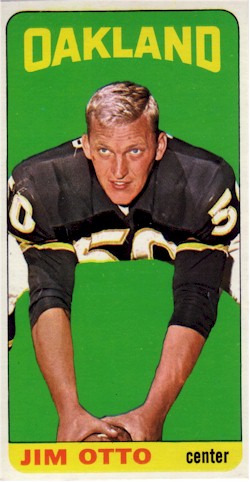
    I briefly got my long, elegant fingers on a 1965 Topps football card of Jim Otto of the Oakland Raiders of the American Football League. The card is kind of strange because the palindromic center is wearing number “50” in the picture even though Otto wore “00” for his entire career after his rookie year in 1960. Otto had a very distinguished career until his retirement in 1974–never missing a single game due to injury or illness–but he never could have envisioned during his playing career that decades later he would become a recurring symbol in the work of Cremaster artist Matthew Barney. It’s funny sometimes how people invent themselves and then are later reinvented in surprising ways by others. Here’s the copy on the reverse side of the card:

    “Jim is one of the three original players still performing for the Oakland Raiders. He is considered to be one of the best all around centers in the in the American Football League. He has been an All-Selection every year. An excellent blocker, Jim handles his position with poise and pride. Jim starred at Miami where he performed as an offensive center and a defensive linebacker. In the off season, Jim breeds horses and works in bowling public relations.”

    More Miscellaneous Media:

  • Miniature Aircraft Quarterly. (1998)
  • Howeird Stern 50 Ways to Rank Your Mother LP. (1982)
  • A Knight’s Hard Day. (1964)
  • The Lowbrow Reader remembers Ol’ Dirty Bastard. (2004)
  • LP record about the 1972 Oakland A’s.
  • Madison Square Garden professional wrestling program. (1981)
  • Spy magazine. (1989)
  • Artis Gilmore ABA basketball card. (1973-74)
  • San Francisco cable car ticket stub. (1990s)
  • Bronx high school newspaper. (1947)
  • Mad magazine. (1966)
  • Vancouver Blazers hockey guide. (1974-75)
  • John Hummer NBA card. (1973)
  • Carolina Cougars ABA Yearbook. (1970)
  • The Washington Senators MLB Yearbook. (1968)
  • Ugandan currency with Idi Amin’s picture. (1973)
  • Tom Van Arsdale basketball card. (1970)
  • “Okie from Muskogee” sheet music. (1969)
  • California Golden Seals hockey magazine. (1972)
  • Beatles Film Festival Magazine (1978)
  • ABA Pictorial (1968-69)
  • Tom Seaver’s Baseball Is My Life. (1973)
  • Hockey Digest (1973)
  • World’s Fair Guide (1964)
  • World’s Fair Guide (1939)
  • Buffalo Braves Yearbook (1972-73)
  • New York Nets Yearbook (1976-77)
  • “Tom Dooley” sheet music.
  • Tags: ,

    Cats, with all their sophistication, can play the piano and shit, but dogs are stupid and wonderful and get confused by escalators. (Thanks to Reddit.)

    More Videos:


    "Now here is a patent labor saving toothpick." (Image by HuttyMcphoo.)

    It was in the June 18, 1885 edition of the Brooklyn Daily Eagle that an article ran about a judge who was subjected to a man who was seemingly arrested for being eccentric, poor and a smartass. “Pontius Pilate,” as the man called himself, had fun with the judge for a while. An excerpt:

    “Considerable commotion was created in Judge Massey’s court room this morning by the entrance of Officer Morris and a prisoner who was struggling in a violent manner and attempting to bite his captor. He was put into a cool cell and in about an hour was ready for trial.

    ‘What was this man doing?’ asked the Judge.

    ‘He had collected a crowd around him on Butler street, and was acting in a manner which led me to believe that he was either intoxicated or insane,’ replied the officer. ‘He was standing on an ash barrel, which he had turned bottom up, and held an open umbrella above his head. He was bidding the people good bye, and said he was going straight up to heaven. He resisted when I arrested him, saying that he had an appointment with the Archangel Gabriel for 11:30 sharp, and that if I interfered with him I would hear of it later.’

    ‘What is your name?’ asked the Judge, addressing the prisoner.

    ‘Pontius Pilate,’ he calmly replied, as he picked cinder out of the lining of his hat.

    ‘Have you any home?’

    ‘Have the birds of the air any home?’ replied Pontius, sarcastically.

    ‘Do anything for a living?’

    ‘I am an inventor, Judge, but capitalists frown on men and refuse me help. Now here is a patent labor saving toothpick,’ continued the prisoner, presenting a three jointed piece of pipe about six inches long. ‘It would be a boon to humanity if I had a few dollars to introduce it. I am also the author of a theological work entitled The Spiritual Snuff Box to Make Souls Sneeze with Devotion, but the publishers won’t touch it.

    ‘I will turn you over to the Commisioners of Charities and you can read your manuscript to them,’ said the Judge, wearily, as he looked over the papers in the next case.”

    Judge Judy: I once found a hamburger guilty of treason. (Image by Susan Roberts.)

    More Old Print Articles:

    Tags: , ,

    ?????????????

    The Divorce case I am about to tell you REALLY happened (Astoria)

    There was a guy I used to work with, he was and still is by the way, a dispatcher in a car service in NYC.

    He was married for 15 or so years to an Asian woman, a bit overweight with large breasts, from that marriage a son was produced, he is 15 years old today.

    The marriage was ok for the first 11 years, they did have their ups and downs but nowhere near what went on during the last 4 years of the marriage. The wife withheld sex from her husband for FOUR YEARS. She continuously turned him down, it got to the point where he she would come to bed in a sexy night gown and lay next to him, he would reach over to hold her, she would complain she’s “not in the mood” or “tired and doesn’t feel sexual” then she would turn over and lay on her side, he would masturbate to release pent-up sexual stress and frustration. Finally he asked for a divorce and even said they didn’t have to drag it through the court. All he wanted her to do was for her to pay for his son to go to private school and that’s it. He didn’t want her money. But she said “no”. So he went and filed for divorce anyway and hired a good divorce lawyer who found out to his amazement, that his wife had already filed for divorce a month ago. What game was his wife playing?? You will soon find out. . . . .

    Speed forward to divorce court, the irreconcilable differences and lack of sex came out and then there was the financial issues.. It came out in court that the wife who worked for a financial company made 120 thousand dollars a year, the husband made 41 thousand a year. The husband paid 90% of the bills in the home! He paid for the rent, utilities, clothing for his son, a car note and insurance and groceries. The only thing the wife paid for each MONTH was the cable bill as she liked to watch the lifetime channel, cooking and reality shows. Oh and the husband recently started paying for his son to go to private school as well. I am not sure how much that costs but I have heard it can cost 1200 and more a month.

    The wife got a 10 thousand dollar Christmas bonus last year while the husband didn’t get a bonus due to the state of the economy and the car service business slowing down.

    The Judge who was a woman by the way, was taken back as to how much the husband was paying for during the marriage as compared to the wife. Which led her to inquire about the whereabouts of the christmas bonus the wife got, where was the money? The wife didn’t have an answer she told her lawyer that there was only about 1 thousand left from it and couldn’t account for the rest as she gave money to her family and friends and lost track of who got how much money.

    Then there’s the issue of the wife as she had a 401k and a pension coming from her employer when she retires.

    The judge was furious. She awarded the husband, the following:

    1) The wife has to give half of the money she received from the Christmas Bonus.

    2) The wife was ordered by the court she has to pay alimony to the husband, how much I am not sure

    3) When the wife retires half of her 401k AND her pension check goes to her husband

    The judge also ordered if there’s any other money found hidden or stashed away by the wife that money will be subject to the divorce proceedings as the husband was straight forward with his financial status, all paperwork and tax returns were in order.

    The wife, as told to me by the husband, broke down and cried in the courtroom.

    Many of you reading this may think I made this up as some kind of imaginary story of the husband coming out better after a divorce. No, I did NOT make this up it is 100% true. I have told other women about what happened and here is the response I would see, they would look out into space, like staring, then say in a low voice, “I am never getting married. . . . .”

    With all the women going to college today and many are making more money than the men they come across and date from time to time this could happen to them all the man or husband would have to do is foot a large percentage of the daily bills. Most of the guys I know make between 25- 60k tops. They are from all nationalities, all backgrounds, but the women such as myself earn far more than they they do. It actually has me rethinking if marriage and having children is even worth it. It’s no wonder more and more women are remaining single.

    More Craigslist ads:

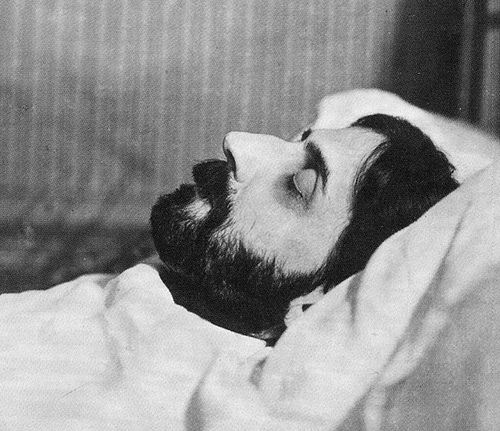
      In A New York Life: Of Friends and Others, Brendan Gill provides a short profile of the artist Man Ray, who was born in Philadelphia in 1890. One of Ray’s most famous photos was of the newly dead writer Marcel Proust. Ray explains to Gill how that photo came about. An excerpt:

      “As one  of those innumerable visitors to the shrine on the rue Férou, I asked Man Ray about his well-known photograph of Proust’s corpse, the eyes lying sunk into his skull, the chin and cheeks unshaven–never had a body looked more intensely (one might even say, Proust being Proust, more intently) dead–and he told me that it was Cocteau who had arranged for him to take it.

      The year was 1922, a short while after Man Ray and Cocteau had met. As Man Ray told the story, surely not for the first time and surely not for the last, his telephone rang one Sunday morning, and it was Cocteau babbling in a high, distressed voice, “Venez toute de suite! Notre petit Marcel est mort!” Man Ray picked up what he called his ‘old shoe’ of a camera and made his way to Proust’s apartment, to which Cocteau admitted him.

      The only available light came from a single electric light bulb of low wattage directly above Proust’s bed. Had that made it difficult, I inquired, to take the picture? The little god in his attic looked at me with good-humored scorn. ‘Certainly not!’ he exclaimed. ‘A corpse is the easiest thing in the world to photograph. The subject being motionless. I was able to set my camera for as long an exposure as I pleased. The results were, let me say, satisfactory.'”

      Tags: , , ,

      Someone told Tyler Cowen to fold his arms like this for the photo. (Image courtesy of Tyler Cowen.)

      The economist Tyler Cowen offers as good a defense of liberal arts education as any on his blog, The Marginal Revolution. An excerpt:

      “Liberal arts education forces us to decode systems of symbols.  We learn how complex systems of symbols can be and what is required to decode them and why that can be a pleasurable process.  That skill will come in handy for a large number of future career paths.  It will even help you enjoy TV shows more.

      For related reasons, I believe that people who learn a second language as adults are especially good at understanding how other people might see things differently.

      I am interested in food (among other topics), not only because of the food itself.  I also view it as an investment in understanding symbolic meaning, cultural codes of excellence, the transmission of ideas, and also how the details of an area fit together to form a coherent whole.  I believe this knowledge makes me smarter and wiser, although I am not sure which mass-produced formal test would pick up any effects.  I view this interest as continuing my liberal arts education, albeit through self-education.”

      Tags:

      Kim Jong-il and his lackeys look to the skies, hoping to prevent the arrival of Afflictor.

      Yesterday’s traffic numbers tell us that Mongolia, Azerbaijan, Estonia, Trinidad and Tobago and Oman had citizens visit the idiot site known as Afflictor for the first time, lowering those countries to our level the way many great nations and some really sketchy ones before them have. Of course, that means there’s pretty much only one goal left for us: North Korea.

      We’ve broken through a lot of walls during the site’s existence, even scoring quite a bit of traffic from that censorship-crazy superpower known as China, but North Korea, which the horrible regime of Kim Jong-il has turned into a godawful hellhole, has evaded us.  Perhaps the one place on Earth where George Orwell’s 1984 came true, North Korea, under the creepy overlord Kim, is unhealthy, dangerous and oppressive in almost every way. Since the country is in near-total lockdown, it is tough for Afflictor to permeate.

      So, if you have a kindly aunt in North Korea with a dial-up modem, please ask her to head for our URL. Sooner or later, you will fall under our spell, North Korea, and become part of Afflictor Nation!

      "You don’t gain any wisdom as the years go by. You fall apart, is what happens." (Image by Colin Swan.)

      In case you missed David Itzkoff’s September 14 New York Times Q&A with Woody Allen in conjunction with the release of You Will Meet A Tall Dark Stranger, here’s an excerpt of the 74-year-old director’s unsurprisingly bleak view of his golden years:

      “Q. How do you feel about the aging process?

      A. Well, I’m against it. [laughs] I think it has nothing to recommend it. You don’t gain any wisdom as the years go by. You fall apart, is what happens. People try and put a nice varnish on it, and say, well, you mellow. You come to understand life and accept things. But you’d trade all of that for being 35 again. I’ve experienced that thing where you wake up in the middle of the night and you start to think about your own mortality and envision it, and it gives you a little shiver. That’s what happens to Anthony Hopkins at the beginning of the movie, and from then on in, he did not want to hear from his more realistic wife, ‘Oh, you can’t keep doing that — you’re not young anymore.’ Yes, she’s right, but nobody wants to hear that.

      Q. Has getting older changed your work in any way? Do you see a certain wistfulness emerging in your later films?

      A. No, it’s too hit or miss. There’s no rhyme or reason to anything that I do. It’s whatever seems right at the time. I’ve never once in my life seen any film of mine after I put it out. Ever. I haven’t seen Take the Money and Run since 1968. I haven’t seen Annie Hall or Manhattan or any film I’ve made afterward. If I’m on the treadmill and I’m scooting through the channels, and I come across one of them, I go right past it instantly, because I feel it could only depress me. I would only feel, ‘Oh God, this is so awful, if I could only do that again.'”

      Tags: ,

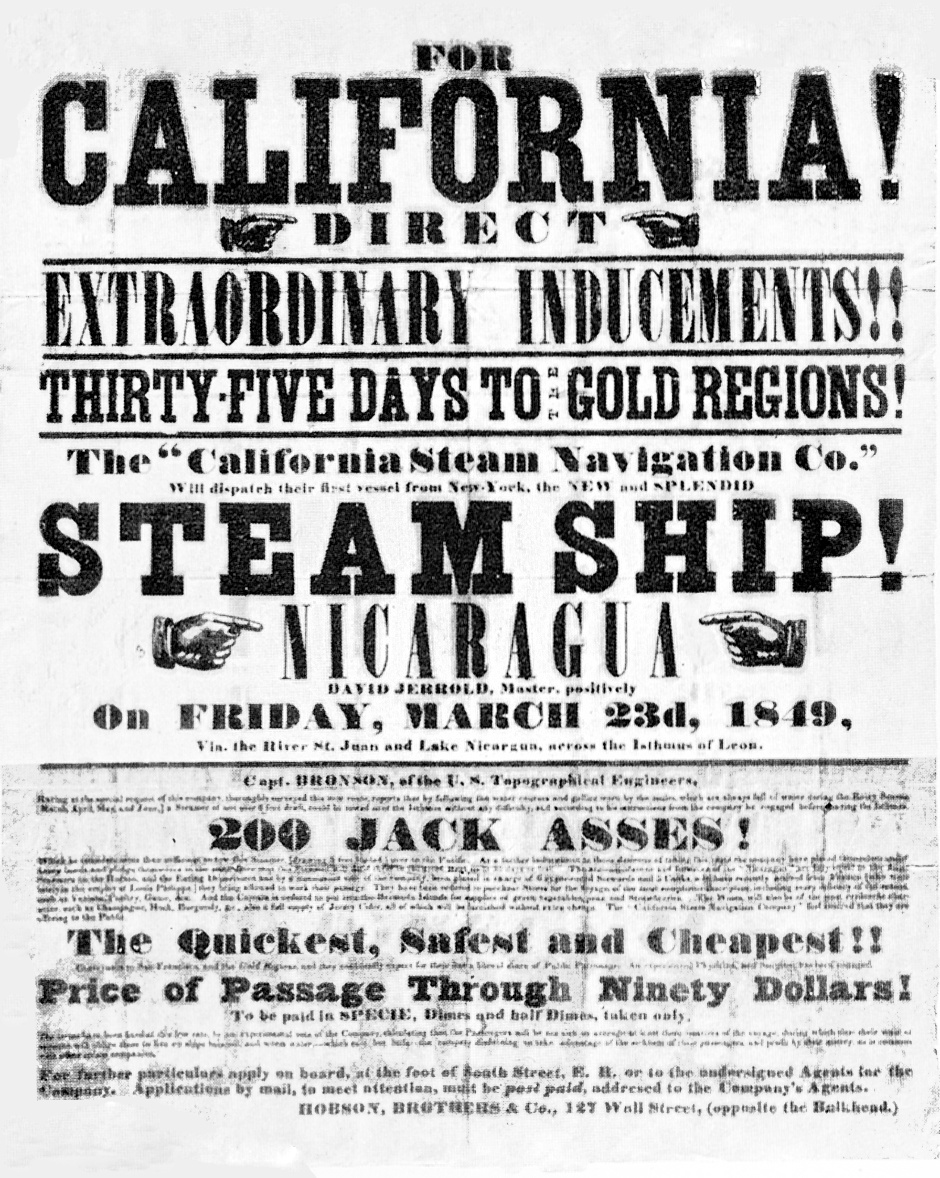
      The California Gold Rush began in earnest in 1848 when James J. Marshall discovered the precious metal at Sutter’s Mill. Most of the hundreds of thousands of wealth seekers who flocked to the state made no real money, which was gobbled up by large gold concerns. Some ancillary wealth was to be had, of course, in setting up businesses to serve the scores of new arrivals. Here are a few archival images of the mad dash. Click on them for larger views.

      The steamship "Nicaragua" could take you from New York to California gold regions in 35 days. Also: The fine print promises there will be "200 Jack Asses!" aboard. That's a lot of jackasses.

      A '49er pans in the American River. (Image by L.C. McClure.)

      San Francisco Harbor in 1850. In just two years, the population had boomed from 1,000 to 25,000.

      San Francisco keeps growing as miners continue to arrive in 1851. Some shops: California Restaurant, Book and Job Printing and Drugs & Medicines.

      Workers use jets of water to excavate a mine in Dutch Flat, California.

      Tags:

      Robert Popper outdoes himself again with this commercial for a walking, talking robot named Newton who resembles a creepy, intrusive washing machine. These lonely, hapless families are thrilled to have Newton in their homes, but in due time he will turn on them and murder them all in their sleep.

      More Videos:

      Tags:

      "The worst part was the BLOOD." (Image by Idlir Fida.)

      CRAIGSLIST HORROR STORY – $100 (Midtown West)

      I just got up at five AM to clean a couch. I woke up in the middle of the night and eventually decided to just get up, because I could not stand the fact that the smell of urine, yes urine, was on that couch.

      I got this couch off craigslist. Buyer beware! It might seem awkward but it might be a good idea to take a sniff of the couch you are going to buy. Or don’t buy a couch secondhand at all. I went to ikea today for the first time and saw a comparable couch for just a little more.

      The urine was not even the worst part. The worst part was the BLOOD. Yes, blood. All over the cushion on the right part, and some on the left. I discovered this when I tried to remove the covers for washing. I was not able to get the covers off because the zipper is too close to the frame on the front right. The left cover I can’t get off either. I know they do come off because there is blood on the cushion, but the cover is white and with no blood on the inside. So the owner must have gotten them off for cleaning.

      When I emailed him about it, he said maybe the blood was from a mover’s hand. (What? And the moving was another headache I won’t even get into) I don’t know how he could possibly own this couch and not know that the entire cushion was covered in BLOOD. And to my question about how exactly to get the cover off, because it is stuck on the bottom right, he replied obtusely “the covers come off for cleaning.” I feel like I am talking to a robot that just spits the same answer at you and only has one line to say. I sent him a clear explanation of the situation- did not even blame him for not telling me about the blood- and he just gives this line back.

      I got this couch on Saturday morning and spent Saturday night cleaning it. I took a break (and let it dry) on Sunday but then woke up in the middle of the night and finally got up to clean the cover as it was, partially unzippered from the couch. I just put some dishwashing soap on a sponge and wiped it over. It absorbed into the microfiber and I dont even know how to rinse it out properly.

      I’ve spent several hours now cleaning this disgusting couch and needless to say it wasn’t worth it. I want to warn people on craigslist not to make my mistake. Don’t let anyone rush you through a purchase, and thoroughly examine the item before buying! Don’t be too polite to ask questions. If at all in doubt, don’t buy it. And if at all possible just buy a new couch. There were couches at ikea for $149 and $200. They may not be the exact or ideal couch you want, but at least they will not be biohazards!!

        The puppets and puppeteers located at Italy’s insane nexus of tawdry television and political power get the wry treatment they deserve in Erik Gardini’s suitably strange 2009 documentary, Videocracy. While most filmmakers would have kept the focus on Italian President and TV magnate Silvio Berlusconi–who’s part Rupert Murdoch, part Joe Francis, but worse than both–Gardini spends plenty of time leering at the overlords and underdogs who strive for money and fame in the wet dream that is the nation’s idiot box.

        Considering that Italian TV is mostly filled with regular people who will do anything for a shot at fame, it’s not surprising that Gardini’s “stars” are a motley crew. One is a mechanic who aspires to be a cross between Jean Claude Van Damme and Ricky Martin. Another is powerful talent scout Lele Mora, an idolmaker and Mussolini fan who can create a star overnight owing to his close friendship with the President. Mora’s erstwhile protege, Fabrizio Corona, is a sour-faced paparazzo who takes embarrassing photos of celebs. After a stint in prison for dubious business practices, Corona emerges as a star himself, replete with a T-shirt line and a full datebook of personal appearances. Amusingly enough, none of the women who jiggle in underwear and less for ratings are profiled. That’s fitting since the first rule for female models on Italian television is that they’re not allowed to talk.

        Berlusconi, who owns ninety percent of the country’s TV holdings, has used the medium to gain political power, building his appeal by broadcasting self-aggrandizing propaganda and by giving the masses all the titillation they desire. But he’s obviously not the film’s only raging ego. Gardini uses simple devices–color schemes, odd camera angles, slo-mo–to lend the film an eerie impressionistic feel, one that applies a sickening gloss to these desperate faces. As the sleazeball Corona says: “Having a super powerful personality pays off in this country ruled by television.”•

        Tags: , , ,

        "...to answer to the charge of sending an improper note in a bouquet of roses to Miss Edith Hall..." (Image by Jebulon.)

        Either there is more than meets the eye to this story in the July 6, 1897 edition of the Brooklyn Daily Eagle, or everyone in the area temporarily lost their minds. The story is about a young dandy who became enamored with a lovely burlesque performer and tried to make her acquaintance. Then everything went haywire. An excerpt:

        “Maurice Butler, a well-groomed and stylishly dressed youth 16 years of age was in the Grant street court this morning, accompanied by his father, Dr. William Butler of 507 Clinton avenue, to answer to the charge of sending an improper note in a bouquet of roses to Miss Edith Hall of 428 West Thirty-fifth street, New York, an actress at Bergen Beach, last night. The youth, when taken before Justice Steers to plead, said that he was guilty of the offense charged, but afterward, by advice of his father, withdrew the plea and the case was then adjourned until Thursday next. Dr. Butler signed the bail bond of $500. If young Butler desires to sow his wild oats and lead a gay life he is not likely to repeat his adventure of last night at the popular short resort. He said it was his first attempt to flirt with an actress and it would, he declared, be his last.

        Young Butler, who was at one time a student in the Polytechnic Institute, went to the Casino at Bergen Beach last night to see Little Miss Brooklyn, the burlesque show in which Miss Hall appears as Miss Brooklyn. He had visited the place several times before and had become infatuated with Miss Hall, who wears white tights and is graceful and pretty. The young man carried a large bouquet of Jack roses in which, appeared later, was hidden a note requesting her to meet him after the show. Butler watched the performance with much interest and did not fail to applaud loudly when Miss Hall appeared on stage. Before the third act came to a close Mr. Butler sent the flowers to Miss Hall and awaited results. In the note alleged to have been written by him was a request that if the actress would meet him as desired she would wear the flowers when she next appeared on stage.

        Not Edith Hall, but a fine representation of the old-timey burleque entertainer. (Image by trialsanderrors.)

        When Miss Hall received the roses and discovered the note and the message therein she was quite overcome, but was not long in making her way to Percy G. Williams, the manager of the beach. She showed him the bouquet and the message and asked how to proceed in order to locate the writer. Mr. Williams called his son and asked if he could point out the person who had sent the bouquet, and when he learned that he told Miss Hall to go on with her part and not to fail to wear the flowers, as requested by the sender. She did so.

        As soon as Miss Hall left the place she was approached by Mr. Butler, who raised his hat and greeted her pleasantly. The actress asked the youth if he had sent the bouquet and the note attached, and when he replied in the affirmative she invited him to walk toward the swimming pool. The couple had barely reached the swimming pool when Mr. Butler was torn from her side by a crowd of men, which he said this morning, he thought numbered fully one hundred, and was thrown into the pool. He was soused up and down for several minutes until Detective Betts of the Twenty-third Precinct appeared on the scene, and the crowd dispersed. He was assisted to the walk, his clothes soaked. Miss Hall promptly charged him with insulting her and he was treated to a ride to the Flatbush station house where he was locked up. That was at midnight.

        Miss Hall was in court this morning to press charges against Mr. Butler. ‘When I left the Casino last night, I did so expecting to horsewhip that boy, but I did not get a chance. I did not know the men expected to give the boy a bath, and my only object in meeting him was to give him a whipping.'”

        More Old Print Articles:

        Tags: , , , , ,

        Afflictor: Making women in burqas smile broadly since 2009. (Image by Rama.)

        If Jane Goodall gets one more stuffed monkey as a gift, she will punch you right in the nose. She's nice, but stop.

        Any list of the most significant people alive today would be incomplete without Jane Goodall’s name. Trained as a secretary in a time when women weren’t exactly encouraged to study science, she became one of the most significant anthropologists of her time. National Geographic has a celebration of Goodall’s five decades of work studying the Kasakela chimpanzee community in Gombe Stream National Park, Tanzania, putting its entire photographic collection of the scientist and her work online. (Thanks to boing boing for pointing me to the piece.) An excerpt from David Quammen’s excellent accompanying article:

        A carving of David Greybeard, the first chimpanzee to befriend Jane Goodall.

        Science history, with the charm of a fairy-tale legend, records some of the high points and iconic details of that saga. Young Miss Goodall had no scientific credentials when she began, not even an undergraduate degree. She was a bright, motivated secretarial school graduate from England who had always loved animals and dreamed of studying them in Africa. She came from a family of strong women, little money, and absent men. During the early weeks at Gombe she struggled, groping for a methodology, losing time to a fever that was probably malaria, hiking many miles in the forested mountains, and glimpsing few chimpanzees, until an elderly male with grizzled chin whiskers extended to her a tentative, startling gesture of trust. She named the old chimp David Greybeard. Thanks partly to him, she made three observations that rattled the comfortable wisdoms of physical anthropology: meat eating by chimps (who had been presumed vegetarian), tool use by chimps (in the form of plant stems probed into termite mounds), and toolmaking (stripping leaves from stems), supposedly a unique trait of human premeditation. Each of those discoveries further narrowed the perceived gap of intelligence and culture between Homo sapiens and Pan troglodytes.

        The toolmaking observation was the most epochal of the three, causing a furor within anthropological circles because “man the toolmaker” held sway as an almost canonical definition of our species. Louis Leakey, thrilled by Jane’s news, wrote to her: “Now we must redefine ‘tool,’ redefine ‘man,’ or accept chimpanzees as humans.” It was a memorable line, marking a very important new stage in thinking about human essence. Another interesting point to remember is that, paradigm shifting or not, all three of those most celebrated discoveries were made by Jane (everyone calls her Jane; there is no sensible way not to call her Jane) within her first four months in the field. She got off to a fast start. But the real measure of her work at Gombe can’t be taken with such a short ruler.”

        Tags: , , ,

        I hardly ever repost anything, but I doubt most of you were readers in the early days of the site when I published this one. It still amuses me.

        My pneumatic tube was destroyed by a tomahawk.

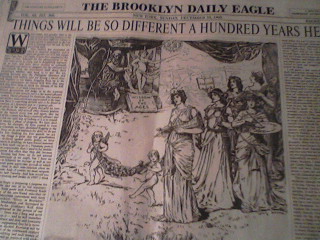
        I got my grubby, ink-stained hands on a special supplement from the December 30, 1900 issue of the Brooklyn Daily Eagle, which bore the headline: Things Will Be So Different A Hundred Years Hence.” The papers’ editors used that section to predict life on Earth in the year 2000. Some of the prognostications worked out better than others, but the whole fascinating thing reads like an Onion parody. Here are the 12 most interesting headlines:

        • Liquid Air Will Open Up A New World of Wonders
        • New York To Be The World’s Metropolis
        • Interest In Music Will Increase Constantly
        • Mail By Pneumatic Tubes A Possibility For All Houses In Future
        • Women To Have The Ballot
        • Women To Be Homemakers
        • Base Ball, The National Game, Is Steadily Declining
        • Automobiles And Airships The Twentieth Century Vehicles
        • Man To Live Longer And Be Happier Owing To Use Of Plant Foods Only
        • Science May Find Means To Bring Dead To Life
        • International Court To Prevent War
        • Wars To Be Waged As Of Old: We Will Revert To Using Tomahawks And Shotguns

        Read other Listeria lists.

        « Older entries § Newer entries »