Steven Pinker, author of The Stuff of Thought among other provocative books, provides a history of violence–and its gradual decline–at Edge. An excerpt about the mitigating effect the printing press had on violence:

“By the 18th century a majority of men in England were literate.

Why should literacy matter? A number of the causes are summed up by the term ‘Enlightenment.’ For one thing, knowledge replaced superstition and ignorance: beliefs such as that Jews poisoned wells, heretics go to hell, witches cause crop failures, children are possessed, and Africans are brutish. As Voltaire said, ‘Those who can make you believe absurdities can make you commit atrocities.’

Also, literacy gives rise to cosmopolitanism. It is plausible that the reading of history, journalism, and fiction puts people into the habit of inhabiting other peoples’ minds, which could increase empathy and therefore make cruelty less appealing. This is a point I’ll return to later in the talk.”

••••••••••

Pinker talks the same topic at TED:

Tags: ,

Marcel Duchamp, that famed finder of urinals, explains the concept of the ready-made. (Thanks Documentarian.)

Tags:

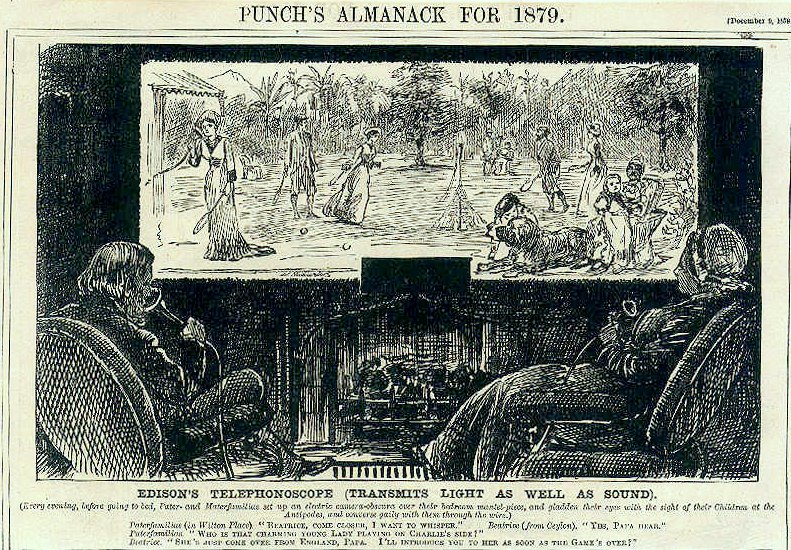
Representation of the Ur-videophone, from Punch’s Almanack.


Tags:

Rats are now becoming cyborgs, getting brain implants, as reported by Linda Geddes in New Scientist:

“AN ARTIFICIAL cerebellum has restored lost brain function in rats, bringing the prospect of cyborg-style brain implants a step closer to reality. Such implants could eventually be used to replace areas of brain tissue damaged by stroke and other conditions, or even to enhance healthy brain function and restore learning processes that decline with age.

Cochlear implants and prosthetic limbs have already proved that it is possible to wire electrical devices into the brain and make sense of them, but such devices involve only one-way communication, either from the device to the brain or vice versa.

Now Matti Mintz of Tel Aviv University in Israel and his colleagues have created a synthetic cerebellum which can receive sensory inputs from the brainstem – a region that acts as a conduit for neuronal information from the rest of the body. Their device can interpret these inputs, and send a signal to a different region of the brainstem that prompts motor neurons to execute the appropriate movement.”

Tags: ,

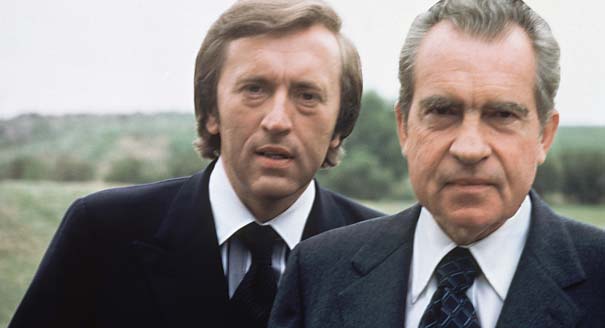
A week before the epic Frost-Nixon interviews were broadcast, David Frost speaks to Mike Wallace on 60 Minutes. Wallace didn’t think Frost had a prayer.

Tags: , ,

David Stern had a great run as NBA Commissioner in the ’80s and most of the ’90s, but he should have been replaced long ago. The record TV ratings that the league experienced last season came about only because players defied his wishes. Stern, somehow the last person to not see how free agency turned baseball from a sport of millions into one of billions as player movement sparked fan excitement and made the game a year-round attraction, has long tried to maneuver the rules to make it much more palatable for NBA stars to spend their whole careers with one team. The fans insisted they wanted this, though it’s not the job of the consumers to know what they want. However gracelessly Lebron brought his talents to South Beach, the superteam concept created a ratings renaissance yet unseen in the post-Jordan era. And that was no thanks to the commissioner. Now even that coup is being threatened because of a needless lockout being spearheaded by Stern and his disingenuous owner poverty campaign.

Over at Grantland, Malcolm Gladwell tears through the commissioner’s lies, explaining how the business of basketball is mostly not about he game itself but the real estate and media deals attached to the sport. In stating his case, Gladwell makes an interesting point about the recent history of American wealth disparity. An excerpt:

“One of the great forgotten facts about the United States is that not very long ago the wealthy weren’t all that wealthy. Up until the 1960s, the gap between rich and poor in the United States was relatively narrow. In fact, in that era marginal tax rates in the highest income bracket were in excess of 90 percent. For every dollar you made above $250,000, you gave the government 90 cents. Today — with good reason — we regard tax rates that high as punitive and economically self-defeating. It is worth noting, though, that in the social and political commentary of the 1950s and 1960s there is scant evidence of wealthy people complaining about their situation. They paid their taxes and went about their business. Perhaps they saw the logic of the government’s policy: There was a huge debt from World War II to be paid off, and interstates, public universities, and other public infrastructure projects to be built for the children of the baby boom. Or perhaps they were simply bashful. Wealth, after all, is as often the gift of good fortune as it is of design. For whatever reason, the wealthy of that era could have pushed for a world that more closely conformed to their self-interest and they chose not to. Today the wealthy have no such qualms. We have moved from a country of relative economic equality to a place where the gap between rich and poor is exceeded by only Singapore and Hong Kong. The rich have gone from being grateful for what they have to pushing for everything they can get. They have mastered the arts of whining and predation, without regard to logic or shame. In the end, this is the lesson of the NBA lockout. A man buys a basketball team as insurance on a real estate project, flips the franchise to a Russian billionaire when he wins the deal, and then — as both parties happily count their winnings — what lesson are we asked to draw? The players are greedy.”

••••••••••

Pistol Pete plays H-O-R-S-E, 1977:

This classic 1963 photo profiles Hangar One at Moffett Federal Airfield in Northern California. The towering hangar looks like something that arrived mysteriously from both the future and the past, a man-made colossus that seems to be the result of some higher creature. One of the world’s largest free-standing structures, Hangar One is 200-feet tall and spans eight acres. It was built during the Depression to house the U.S.S. Macon dirigible, an aircraft carrier that was the biggest airship in the world when it launched in 1933. But damage caused by a storm in 1935 buried the Macon deep in the Pacific Ocean. Today, a restored Hangar One is used by NASA. From a 2006 Spiegel article about the wreck of the Macon:

“The tragedy unfolded unusually slowly for an aviation catastrophe: The crew fought to control the USS Macon for more than an hour. US naval officers threw fuel canisters overboard in an attempt to reduce the weight of their vessel. The canisters imploded on their way to the ocean floor. Meanwhile, the Macon — the largest rigid airship ever constructed in the United States — sank inexorably downward, the safety of the Moffett Field hangar just within reach.

The Macon hit the water surface only five kilometers (three miles) off the Californian coast, along the latitude of the Point Sur lighthouse near Monterey, on Feb. 12, 1935. The zeppelin broke apart and sank into the deep water. Two of the 83 crew members died — the low number of deaths is likely due to the fact that the Macon sank in slow motion.

Neither enemy fire nor sabotage was to blame for the giant airship’s doom (and a giant it was: longer than three 747 jets parked nose to tail). A heavy storm above the picturesque stretch of Californian coast known as Big Sur tore off the Macon’s vertical tail fin. The airship’s structural framework was so badly damaged that the Macon broke apart when it hit the water.”

••••••••••

Trial flight of the Macon, 1933:

"It doesn't get along with my girlfriend."

MONKEY MONKEY MONKEY – $20

I seriously need to get rid of this monkey, it doesnt get along with my girlfriend. (no I cant get rid of the girlfriend). If you want a monkey call today after 6pm

Explaining the phsyics of the riderless bicycle. (Thanks Marginal Revolution.)

In 1970, Dick Cavett and Marshall McLuhan discussed the importance of TV image to politicians, using the Nixon-Kennedy debates as a starting point. Television image means little now, since media culture is 24/7, ubiquitous and HD, and everyone comes off poorly. FYI: The other guests on this Cavett episode were Truman Capote and football player Gale Sayers.

Tags: ,

Architects use ‘bots to build. (Thanks IEEE Spectrum.)

FromSupercomputer Predicts Revolution,” Peter Murray’s Singularity Hub report about the prognosticating powers of software:

“A new type of software has been shown to predict revolutions by mining news reports around the world. Retrospectively mining the news for the past 30 years the software indicates points at which the likelihood for a revolution is high. When put to the test – bingo! – the software showed spikes just before the recent Egyptian and Libyan upheavals. It was also able to sift through world news to retrospectively pinpoint Osama Bin Ladin’s location to within 200 km. In the emerging science of ‘culturomics’ that tracks cultural trends through the written word, the software was the first to demonstrate that news coverage can be used to predict future events.”

Tags:

From Conor Friedersdorf”s Atlantic piece about energy-saving motion sensors, now widely used in Spain:

“In the vast majority of tapas bars and restaurants I patronized, and in train stations and other public places too, I’d open bathroom doors to find it dark inside, start to fumble for a light switch, and remember that practically every last light is now triggered by motion sensors, a cheap alternative to the status quo here: leaving the lights on all the time, whether anyone is in the bathroom or not.

The motion sensor was also put to use in at least one shopping mall that I visited in Valencia. With four or five stories of stores, it had a bunch of escalators to transport shoppers from one level to another. Instead of running them at full speed all the time, however, they slowed down considerably when no one was on the steps. Tripping an invisible beam while walking onto the bottom step, it sped up immediately to normal escalator speed, costing patrons no time and saving energy.”

As the foundering Boston Red Sox attempt to collapse across the finish line and win the American League Wild Card, Steve Wulf of ESPN profiles their genius owner, John Henry, who applied objective analysis in business before bringing it to big-market baseball. An excerpt:

“Henry loves facts — ‘I don’t read fiction’ — so here are some. He was an asthmatic farm boy who grew up worshipping a miner’s son named Stan Musial; a philosophy major who fell under the thrall of Indian individualist Jiddu Krishnamurti; a rock musician who shaved his eyebrows to play a space alien in a rock opera; a mathematical whiz who was banned from Las Vegas blackjack tables; a commodities trader who watched soybeans grow into a beanstalk that eventually yielded ownership of some of the most storied franchises in Major League Baseball, NASCAR (Roush Fenway Racing) and the Premier League (Liverpool FC). You have to make this stuff up.

But it’s not just Henry’s bio that makes him interesting. He’s a whole host of contradictions. He uses dispassionate analysis in pursuit of his own passions. He’s a serious thinker given to practical jokes, a shy fellow who counts Bill Clinton, Michael Douglas and Steven Tyler among his friends, an owner of a 164-foot yacht who will dash from the owner’s box above home plate at Fenway to the first-aid room to check on a fan who’s been hit by a foul ball. He may be a 62-year-old father of two girls (a 14-year-old and a 1-year-old), but he has never lost his own childlike sense of wonder.

He’s also the kind of person who politely declines personal interview requests, then spends hours thoughtfully responding to e-mail questions — at 12:32 a.m. To a query about the major influences in his life, he writes, quoting mythologist Joseph Campbell, ‘If you follow your bliss, you put yourself on a kind of track that has been there all the while, waiting for you …’ That’s what led me into the financial world. I started John W. Henry & Company because I enjoyed applying mathematics to markets, and it was a profound challenge that resonated within me.”

••••••••••

John Henry enters the womb-like studio of wealthy workaholic, Charlie Rose:

Tags: ,

From a smart New York Times Op-Ed piece by Matthew Avery Sutton, about the bizarre and scary intersection of the end of days and the beginning of the political season:

“For some evangelicals, President Obama is troubling. The specious theories about his place of birth, his internationalist tendencies, his measured support for Israel and his Nobel Peace Prize fit their long-held expectations about the Antichrist. So does his commitment to expanding the reach of government in areas like health care.

In 2008, the campaign of Senator John McCain, the Republican nominee, presciently tapped into evangelicals’ apocalyptic fears by producing an ad, ‘The One,’ that sarcastically heralded Mr. Obama as a messiah. Mr. McCain was onto something. Not since Roosevelt have we had a president of charisma and global popularity, who so perfectly fits the evangelicals’ Antichrist mold.”

••••••••••

“The One,” 2008:

Tags: ,

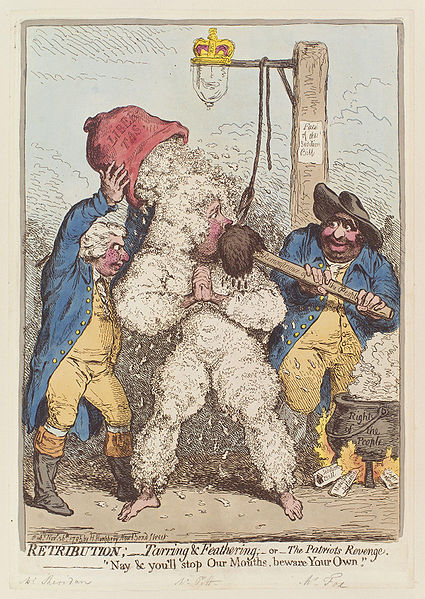
"They took a woman named Jane Longley, who was made the victim of a series of indignities, not the least of which was the application of a coat of tar and feathers."

You have to assume plumage and adhesives were exceedingly cheap during the 19th century, because you could not walk down the street without seeing some poor soul being turned into a makeshift bird. One such case of tarring and feathering was covered in the September 15, 1860 edition of the Brooklyn Daily Eagle, in an article that was reprinted from the Detroit Free Press. An excerpt:

“An occurrence of a disgraceful nature took place a few days since in the town of Romulus, in this county, of which we yesterday received some particulars. A large party consisting of men and boys with a few women, turned out in the night in disguise, and went to the house of a man named Jeremiah Ganung, from which they took a woman named Jane Longley, who was made the victim of a series of indignities, not the least of which was the application of a coat of tar and feathers, and an impromptu ride upon a fence rail. She was banged and knocked about in naked condition, until from the abuse and exposure she nearly fainted, and was thought to be in a dying condition.

While she was in this state the party gathered around her and entered into a conversation in regard to the probable consequences of their conduct, when from the familiar tone of their voices she recognized a number of them. She afterward gave the names of thirty-nine persons, who have been arrested and held to answer. Among them was the daughter of the man with whom she lived, and several other women.

The alleged cause is a disposition on the part of the woman to ill treat the children belonging to the family. She had lived with Ganung several years, and has borne three children by him, having previous to the death of his wife entered the family as a domestic. It is charged the he desired to get rid of her, and took this means, as he offered no resistance when the crowd entered his house, but allowed them to take her from his bed and do what the chose with her. He has been arrested.”

Tags: ,

Leonard Cohen turned 77 this week. Prince Charles is a fan:

“Now my friends are gone and my hair is gray”:

Tags: ,

From “Quantum Leap,” a 2006 Fortune interview with DARPA legend Stuart Wolf, about life in 2030:

“She awakes early on the morning of April 10, 2030, in the capable hands of her suburban Chicago apartment. All night, microscopic sensors in her bedside tables have monitored her breathing, heart rate, and brain activity.

The tiny blood sample she gave her bathroom sink last night has been analyzed for free radicals and precancerous cells; the appropriate preventative drugs will be delivered to her hotel in Atlanta this evening. It’s an expensive service, but as a gene therapist, Sharon Oja knows it’s worth it.

She steps into the shower. The tiles inside detect her presence and start displaying the day’s top headlines. The manned mission to Mars is going to launch ahead of schedule. U.S. military drones have destroyed another terrorist training camp using smart dust. A top Manhattan banker has been found guilty of fraud and sentenced to 10 years of low tech.

And today is the 20th anniversary of the very first quantum computer.

Sharon laughs. It is her 24th birthday, and she has little idea what the world was like before the qubits – the smallest pieces of quantum information – took over.”

Tags:

Sanjhih Pod City in Nothern Tapei, with its abandoned and worn Futuro houses, is like no other place on Earth. Construction began in 1978 on what was supposed to be a vacation paradise for the wealthy. But the project was abandoned while in progress, because of financial problems and the accidental death of many workers, which convinced people the property was haunted. An excerpt from a story about the futuristic ghost town in the Taipei Times:

“One of the designers behind the UFO houses spoke exclusively to the Taipei Times. Lin, who only gave his family name, said that there were lots of rumors about the site, but most of them were false.

‘First of all, the site is definitely not haunted,’ Lin said, in reference to oft-heard rumors that many people have seen ghosts near the complex or the high number of unexplained traffic accidents on the nearby road.

There were also rumors that more than 20,000 skeletons were discovered at the site when construction work began and that it was the scene of several murders.”

••••••••••

LED kite + UFO Houses, Taiwan:

From “Is Facebook Forever?” Rebecca J. Rosen’s Atlantic article about the overwhelming reach of the most popular social-networking site:

“Social-networking sites are fragile, as MySpace and Friendster proved. Unlike Yahoo! and AOL, whose users can get more or less the same experience if there are millions of others like them or if they are the last ones on Earth, social-networking sites can shrivel quickly if the perception rises that people are leaving.  But even if Facebook does someday flag, its reach and its repository may mean a different kind of decline than those of the social networks before it. Those houses, once abandoned, fell apart. But Facebook may be more like the house you moved out of when you went to college — a house you still stop by to check in from time to time, see how the neighborhood is doing, say hi to old friends. It’s no longer where you live, or the place you call home, but it’s never quite gone either.”

Tags:

Walt Disney discusses robotics, 1963.

Tags:

From Jan Hoffman’s new New York Times article about Skype-powered psychiatric sessions:

‘THE event reminder on Melissa Weinblatt’s iPhone buzzed: 15 minutes till her shrink appointment.

She mixed herself a mojito, added a sprig of mint, put on her sunglasses and headed outside to her friend’s pool. Settling into a lounge chair, she tapped the Skype app on her phone. Hundreds of miles away, her face popped up on her therapist’s computer monitor; he smiled back on her phone’s screen.

She took a sip of her cocktail. The session began.

Ms. Weinblatt, a 30-year-old high school teacher in Oregon, used to be in treatment the conventional way — with face-to-face office appointments. Now, with her new doctor, she said: ‘I can have a Skype therapy session with my morning coffee or before a night on the town with the girls. I can take a break from shopping for a session. I took my doctor with me through three states this summer!'”

••••••••••

“The unique service of the future, like the picture phone” (1960s):

Roger and Gene review the Mitsubishi VisiTel Visual Phone, 1988 (at 8:45):

Tags: , , ,


A few search-engine keyphrases bringing traffic to Afflictor this week:

Afflictor: Thinking that even without the hat, it would have been fairly obvious.

  • Jonah Lehrer explains that the mind is not just located in the brain.
  • Paul Dano has already had a remarkable film career.

"You should know who this is so call me."

Its time (Stamford)

Dear secret service,

Please help me win the lottery, I’ve been nothing but good to myself and others around but I continually get shit on by everyone and my life has no direction. I will also accept a job. You should know who this is so call me.

Thanks

« Older entries § Newer entries »