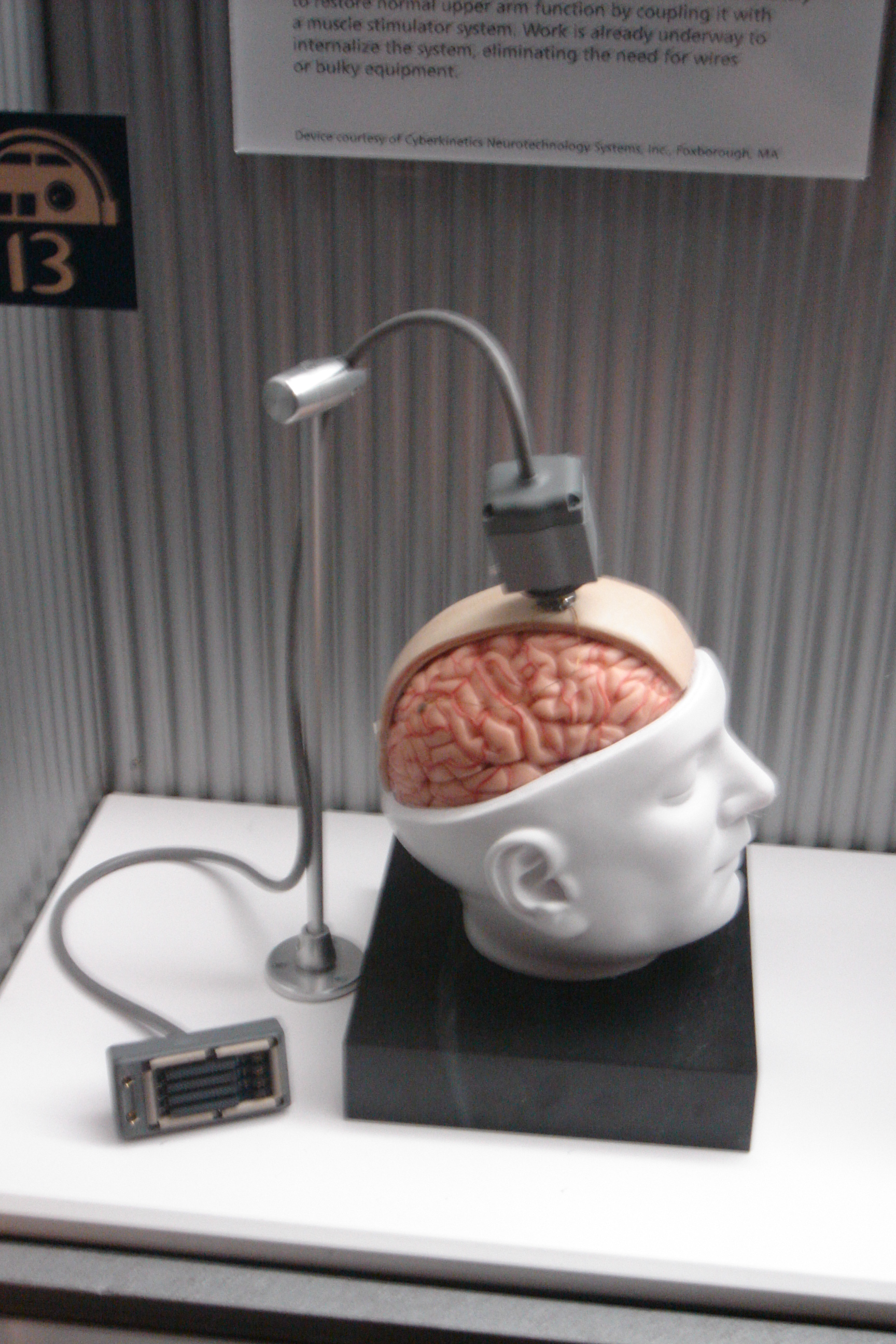
From Kate Moisse and ABC News comes this story about a breakthrough in our ability to visually reconstruct people’s memories:

“California scientists have found a way to see through another person’s eyes.

Researchers from UC Berkeley were able to reconstruct YouTube videos from viewers’ brain activity — a feat that might one day offer a glimpse into our dreams, memories and even fantasies.

‘This is a major leap toward reconstructing internal imagery,’ said Jack Gallant, professor of psychology and coauthor of a study published today in Current Biology. ‘We are opening a window into the movies in our minds.””

••••••••

“Reconstructing visual experiences from brain activities evoked by natural movies”:

Tags: ,

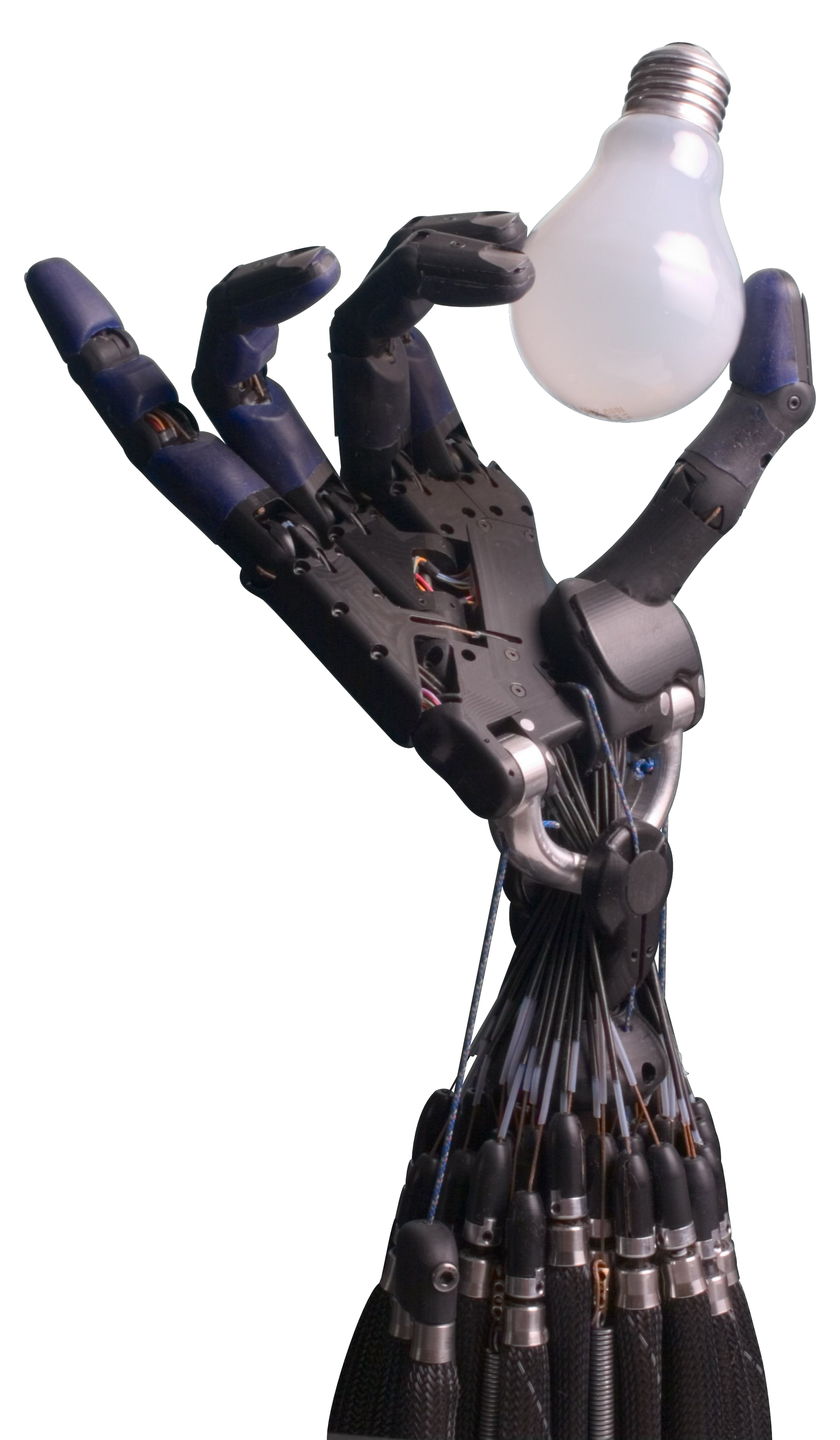
Robots in Singapore are getting fingerprints. From popsci:

“Researchers at the National University of Singapore are enhancing robots’ sense of touch by mimicking the ridged and contoured surfaces of human fingertips. Fingerprints, it turns out, don’t just give humans better grip but also carry out a sensitive type of signal processing. By imparting that same kind of signal processing to robots, we could reduce the processing loads to robots’ CPUs and help them better identify objects through their shapes.

Fingerprints provide a unique identifier and a better means to hold on to objects, but they also shape the ways we sense and perceive the world around us. When we touch something, the ridges alter the vibrations moving through our skin such that nerve endings can better receive them. This serves as a kind of signal processing that allows the skin in our fingertips to provide richer information to our central nervous system than skin on other parts of the body.”

••••••••••

Hymie the Robot, Get Smart:

“Living with Robots,” Honda:

From a 1999 Playboy interview with writer/director Michael Crichton, who fretted, to great financial success, over science outpacing ethics:

Playboy:

In Jurassic Park, you looked at the potential hazards of DNA research. What’s your view of cloning?

Michael Crichton:

I think we’re a long way from cloning people. But I am worried about scientific advances without consideration of their consequences. The history of medicine in my lifetime is one of technological advances that outstrip our ethical systems. We’ve never caught up. When I was in medical school—30-odd years ago—people were struggling to deal with mechanical-respiration systems. They were keeping alive people who a few years earlier would have died of natural causes. Suddenly people weren’t going to die of natural causes. They were either going to get on these machines and never get off or—or what? Were we going to turn the machines off? We had the machines well before we started the debate. Doctors were speaking quietly among themselves with a kind of resentment toward these machines. On the one hand, if somebody had a temporary disability, the machines could help get them over the hump. For accident victims—some of whom were very young—who could be saved if they pulled through the initial crisis, the technology saved lives. You could get them over the hump and then they would recover, and that was terrific.

But on the other hand, there was a category of people who were on their way out but could be kept alive. Before the machine, ‘pulling the plug’ actually meant opening the window too wide one night, and the patient would get pneumonia and die. That wasn’t going to happen now. We were being forced by technology to make decisions about the right to die—whether it’s a legal or religious issue—and many related matters. Some of them contradict longstanding ideas in an ethically protected world; we weren’t being forced to make hard decisions, because those decisions were being made for us—in this case, by the pneumococcus.

This is just one example of an ethical issue raised by technology. Cloning is another. If you’re knowledgeable about biotechnology, it’s possible to think of some terrifying scenarios. I don’t even like to discuss them. I know people doing biotechnology research who have decided not to pursue avenues of research because they think they’re too dangerous. But we go forward without sorting out the issues. I don’t believe that everything new is necessarily better. We go forward with the technology while the ethical issues are still up in the air, whether it’s the genetic variability of crop streams, which is a resource in times of plant plagues, to the assumption that we all have to be connected all the time. The technology is here so you must use it. Do you? Do you have to have your cell phone and your e-mail address and your Internet hookup? I was just on holiday in Scotland without e-mail. I had to notify people that I wouldn’t be checking my e-mail, because there’s an assumption that if I send you an e-mail, you’ll get it. Well, I won’t get it. I’m not plugged in, guys. Some people are horrified: “You’ve gone offline?” People feel so enslaved by technology that they will stop having sex to answer the telephone. What could be so important? Who’s calling, and who cares?•

Tags:

The Statler Brothers performing their 1965 ode to alienation, “Flowers on the Wall,” a favorite of Kurt Vonnegut (see: Palm Sunday) and Quentin Tarantino (see: Pulp Fiction).


I keep hearin’ you’re concerned about my happiness
But all that thought you’re givin’ me is conscience I guess
If I were walkin’ in your shoes I wouldn’t worry none
While you and your friends’re worryin’ bout me I’m havin’ lots of fun 

Countin’ flowers on the wall that don’t bother me at all
Playin’ solitare till dawn with a deck of fifty one
Smokin’ cigarettes and watchin’ Captain Kangaroo
Now don’t tell me I’ve nothing to do

Last night I dressed in tails pretended I was on the town
As long as I can dream it’s hard to slow this swinger down
So please don’t give a thought to me I’m really doin’ fine
You can always find me here I’m havin’ quite a time

Countin’ flowers on the wall that don’t bother me at all
Playin’ solitare till dawn with a deck of fifty one
Smokin’ cigarettes and watchin’ Captain Kangaroo
Now don’t tell me I’ve nothing to do

It’s good to see you I must go I know I look a fright
Anyway my eyes are not accustomed to this light
And my shoes are not accustomed to this hard concrete
So I must go back to my room and make my day complete

Countin’ flowers on the wall that don’t bother me at all
Playin’ solitare till dawn with a deck of fifty one
Smokin’ cigarettes and watchin’ Captain Kangaroo
Now don’t tell me I’ve nothing to do

Don’t tell me I’ve nothing to do

Tags: , ,

"I will blow his brains out in the street, and then I will have satisfaction."

A young Brooklyn woman, wronged by a married man, scalded him with sulfuric acid, according to an article in the August 24, 1891 Brooklyn Daily Eagle. An excerpt:

“Mamie Roach, a young woman who claims to have been wronged by the man whom she trusted, took justice into her own hands last night and marked the man for life by pouring vitriol on his face and neck. She was arrested, locked up over night and she fainted in court this morning, but she was discharged from custody. As she was driven out of the yard of the court in a handsome coach with prancing steeds she appeared, to the unfortunates who were driven through the same gate, to be quite happy, although the flesh of her own hand and arm had been burned by the fluid that she procured for her victim, Charles Gebhardt, a conductor on the Union Avenue car line.

Mamie is 19 years old. She lives with her widowed mother at 27 Maujer Street, and is employed in Thomas’ shoe factory on Hewes Street where she earns $6 a week. She says James Preston, a young man who lives on Manhattan Avenue, near Newton Creek, kept company with her and Gebhardt was Preston’s friend. She quarreled with Preston three weeks ago, and since then she received attentions from Gebhardt. Last Friday, she alleges, he asked her to go to Rockaway with him. She refused, but she did go with him to the Novelty Theater. Her mother sat up all night waiting for her return. At noon on Saturday the mother received the following letter:
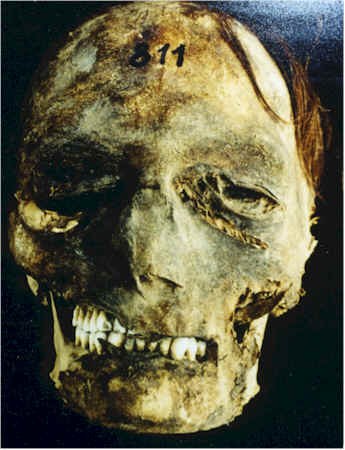
"Gebhardt cried aloud with pain and he ran to Nicot's drug store, where oil was poured on the burns."

DEAR MOTHER–I now write a few lines hoping you will get this note. Last night I met Charles Gebhardt and we went to the theater. After coming out we went through Broadway to a saloon. He made me go in and drink champagne. I had such a feeling come over me that I was not able to walk. Then we took some car, though I don’t know which car, but the first thing I found myself away in some hotel on Myrtle Avenue. When I woke up I was struck dumb. I then told him I would not go home. Then he said, ‘Well, I would tell you the truth.’ He is a married man with three children. Well, you know I did not want to go home. You can’t blame me. Maybe by the time you get this I will have got rid of myself if I can easily do so. Oh, I think that must have been a put-up job between he and Jim, but never mind. I will be out of that. If I can get on his car I will fix him if I can. I will blow his brains out in the street, and then I will have satisfaction. Mamie.

Mrs. Roach hastened to the lower end of Union Avenue as soon as she had read the letter. There she found Mamie weeping on the sidewalk. ‘Mamie wanted me to go with her to see Gebhardt,’ said Mrs. Roach to an Eagle reporter. ‘I went out with her last evening to board his car. I did not know she had any vitriol. We got on his car at Messerole Street and as soon as Gebhardt came to where we sat Mamie screamed and dashed something in his face. She was very nervous and the fluid fell upon her and upon the dresses of several ladies. The poor child did not know what she was doing.’

"When the girl threw the vitriol there was an exciting scene."

When the girl threw the vitriol there was an exciting scene. Gebhardt cried aloud with pain and he ran to Nicot’s drug store, where oil was poured on the burns. Policeman Sweeney arrested Mamie. She and her victim were treated by the same surgeon at St. Catherine’s Hospital, and then Mamie said that Gebhardt had given her drugged champagne in a Broadway saloon and she knew nothing more until she awoke Saturday morning in a strange hotel on Myrtle Avenue, near the city lines. Her mother, she added, had induced her to take the revenge she had. She was searched and a bottle of laudanum was found in her pocket. She said she had intended to poison herself after she burned Gebhardt’s face. The police doubt she had any intention of taking the poison.

Gebhardt went home to his wife and children at 834 Flushing Avenue. He admitted that he had gone out to the Myrtle Avenue hotel with Mamie, but claimed that she had gone willingly and denied that he had drugged her.”
 

Tags: , , ,

Jack Paar and Liberace welcome Cassius Clay, who was known to sometimes be gassy. The future heavyweight champion (and future Muhammad Ali) was three months from his first bout with Sonny Liston. From a PBS Paar doc.


Tags: , , ,

"Platonic things only." (Image by Emergency Brake.)

Free Person (Anywhere)

I am offering my services as a person to help you with anything that you need – for one hour only. This is for an art piece so I will be documenting whatever I end up helping you with. Platonic things only. Feel free to ask me to do absolutely anything! E-mail me a time and place that works for you plus a description of what you would like me to do. 

Taking a spin on the omnidirectional treadmill.

It’s amusing (in a sad way) that the biggest story from the NFL last week was that a couple of New York Giants faked injuries to disrupt The Rams’ hurry-up offense. It was a minor footnote blown up into a huge sensation and the sport’s biggest story, a parallel one, was all but ignored. And that’s because sports reporters are part of the same machinery as the NFL, more concerned with keeping the cash register humming than offering any rational analysis.

Last Sunday, quarterback Michael Vick received a concussion  and bit his tongue so badly that he was spitting up blood on the field. QB Tony Romo was also seriously injured and this (approximate) sentence was uttered on the NFL Network on Tuesday: “It’s been learned that Romo suffered a collapsed lung as well as cracked ribs. It’s not sure if he will play on Monday.”

The question sports reporters are asking: Will Romo play this Monday? The question they should be asking: Why the hell would Romo be playing this Monday? Why would he be playing a brutal car-crash sport just eight days after his lung–a vital organ–stopped working because it was so severely damaged in an on-the-field injury? I’m assuming a couple of talking heads asked these latter questions, but I guarantee they were in the vast minority. That’s because few people care about the players’ health and everyone cares about the violent diversion and, especially, the money. And, yes, Romo was just cleared to play this Monday.

I know there are other people in our society who risk their lives all the time, most notably members of the military, but the military is important and football is certainly not important. My assumption is this insane attitude will continue until a player dies on the field. Does anyone think that’s impossible?•

••••••••••

From Rollerball, 1975: “You know how the game serves us. It has a definite social purpose.”

Tags: , ,

Claude Shannon, who pretty much invented the Information Age, demonstrates one of his juggling machines in 1985.

Tags:

If it wasn’t just so deeply stupid and funny, this 1975 NBC News “special” report about a revival in the popularity of the Three Stooges in the wake of Watergate would be one of the most perplexing wastes of time ever. An emaciated Moe drops by for one of his final interviews. Also on hand: Joe Besser, who was the fifth best Stooge (out of five), and had earlier excelled on the Abbott and Costello Show in the complex role of “Stinky,” a man-child unable to fully adapt to the advances of the Industrial Revolution. Okay, I’ll stop now.

Tags: , ,

In the New York Review of Books, Christian Caryl explains the ramifications of the incredible rise of the drones:

“Drones are not remarkable because of their weaponry. There is nothing especially unusual about the missiles they carry, and even the largest models are relatively lightly armed. They are not fast or nimble. What makes them powerful is their ability to see and think. Most of the bigger drones now operated by the US military can take off, land, and fly by themselves. The operators can program a destination or a desired patrol area and then concentrate on the details of the mission while the aircraft takes care of everything else. Packed with sensors and sophisticated video technology, UAVs can see through clouds or in the dark. They can loiter for hours or even days over a target—just the sort of thing that bores human pilots to tears. Of course, the most significant fact about drones is precisely that they do not have pilots. In the unlikely event that a UAV is shot down, its operator can get up from his or her console and walk away.

So far, so good. But there are also quite a few things about drones that you might not have heard yet. Most Americans are probably unaware, for example, that theUS Air Force now trains more UAV operators each year than traditional pilots. (Indeed, the Air Force insists on referring to drones as “remotely piloted aircraft” in order to dispel any suspicions that it is moving out of the business of putting humans into the air.) As I write this, the US aerospace industry has for all practical purposes ceased research and development work on manned aircraft. All the projects now on the drawing board revolve around pilotless vehicles. Meanwhile, law enforcement agencies around the country eagerly await the moment when they can start operating their own UAVs. The Federal Aviation Administration is considering rules that will allow police departments to start using them within the next few years (perhaps as early as 2014). Soon, much sooner than you realize, your speeding tickets will be issued electronically to your cell phone from a drone hovering somewhere over the interstate. The US Customs Service has already used UAVs to sneak up on drug-smuggling boats that easily evade noisier conventional aircraft.”

Tags:

A 1978 video that shows how the Chinese language, with it s many symbols, works on a typewriter. (Thanks Reddit.)

Mind and body have long been seen as disparate parts with the former located in the brain. But recent research suggests that the mind operates not just in our gray matter but in all our matter. The eloquent opening of Jonah Lehrer’s new Wall Street Journal piece on the topic:

“One of the deepest mysteries of the human mind is that it doesn’t feel like part of the body. Our consciousness seems to exist in an immaterial realm, distinct from the meat on our bones. We feel like the ghost, not like the machine.

This ancient paradox—it’s known as the mind-body problem—has long perplexed philosophers. It has also interested neuroscientists, who have traditionally argued that the three pounds of our brain are a sufficient explanation for the so-called soul. There is no mystery, just anatomy.

In recent years, however, a spate of research has put an interesting twist on this old conundrum. The problem is even more bewildering than we thought, for it’s not just the coiled cortex that gives rise to the mind—it’s the entire body. As the neuroscientist Antonio Damasio writes, ‘The mind is embodied, not just embrained.'”

••••••••••

Lehrer addresses concerns over the brain-changing effects of the Internet:

Tags:

Samantha Smith, a Cold War child from Maine, became an international celebrity at age 10 when she wrote a letter in 1982 to Soviet General Secretary Yuri Andropov voicing her concerns about a nuclear war. Andropov replied, invited her on a goodwill trip to the Soviet Union, and her trek there and back became a media sensation. An articulate child who suddenly possessed an off-the-charts Q rating, Smith was cast in the TV drama, Lime Street. When returning to Maine from filming the a segment of the series, Smith, who was 13, and her father, were killed in a plane crash.

Smith on Nightline:

Tags: ,

Unmentioned in my post on Meek’s Cutoff was that two of its cast members are the great young actors Paul Dano and Zoe Kazan (an off-screen couple as well). Dano came to notice in Little Miss Sunshine and gave a mind-blowing performance in There Will Be Blood. He was the subject of a short profile by Melena Ryzik in the New York Times Magazine in 2009. An excerpt:

“Mr. Dano grew up in Manhattan and Wilton, Conn. He made his Broadway debut at 12 in Inherit the Wind, with George C. Scott and Charles Durning, and a few years later appeared as a troubled teenager preyed upon by a pedophile (played by Brian Cox) in the film L.I.E. Despite the steady work, Mr. Dano wasn’t thinking about building a career. Acting was just fun, he said, on a par with other after-school activities, like basketball.

Little Miss Sunshine, released in 2006, was a turning point. The story of a misfit family’s road trip, it became the toast of Sundance and won two Oscars. Mr. Dano’s character, a misfit among misfits, doesn’t speak for most of the movie, yet manages to be a focal point in a cast including Alan Arkin and Steve Carell.

Mr. Dano auditioned for it two years before it was made. ‘Sometimes when people don’t have a line, they want to mime the line or communicate too much, but he was good at holding it all in,’ Ms. Faris said. ‘His silence was so much more intimidating, in a way, than other actors.'”

••••••••••

“The devil is in your hands and I will suck it out”:

Tags: , ,

From an MSNBC report about the first time the smiley emoticon was used:

“At 11:44 a.m. on September 19, 1982, a man named Scott Fahlman posted a message to an electronic computer-science department bulletin board at Carnegie Mellon University. And with that simple action he did something wonderful: He became the individual who would later be credited as the inventor of :-), an ASCII-based emoticon.”

••••••••••

Ten years after the Smiley was born, Jessica Yu captured a different expression in “Sour Death Balls”:

Tags: ,

Bret Stephens of the Wall Street Jounral arguing that the recent London riots are only a harbinger of things to come for all of Europe:

“What comes next is the explosion of the European project. Given what European leaders have made of that project over the past 30-odd years, it’s not an altogether bad thing. But it will come at a massive cost. The riots of Athens will become those of Milan, Madrid and Marseilles. Parties of the fringe will gain greater sway. Border checkpoints will return. Currencies will be resurrected, then devalued. Countries will choose decay over reform. It’s a long, likely parade of horribles.” (Thanks Browser.)

Tags:

Unlike her Dick Cavett interview from the same year, in which she largely seemed bitter and hard, Lucille Ball is her bright self in this 1974 chat with Phil Donahue.

Tags: ,

"Google wasn't much help." (Image by Coolcaesar.)

What is wrong with me? (33/f)

I’ve been wetting my bed lately. Has anyone been through this? Google wasn’t much help.

From the opening chapter of Thomas Kuhn’s 1957 book, The Copernican Revolution, about the biggest game-changer in science history:

“Even its consequences for science do not exhaust the Revolution’s meanings. Copernicus lived and worked during a period when rapid changes in political, economic, and intellectual life were preparing the bases of modern European and American civilization. His planetary theory and his associated conception of a sun-centered universe were instrumental in the transition from medieval to modern Western society, because they seemed to affect man’s relation to the universe and to God. Initiated as a narrowly technical, highly mathematical revision of classical astronomy, the Copernican theory became one focus for the tremendous controversies in religion, in philosophy, and in social theory, which, during the two centuries following the discovery of America, set the tenor of the modern mind. Men who believed that their terrestrial home was only a planet circulating blindly about one of an infinity of stars evaluated their place in the cosmic scheme quite differently than had their predecessors who saw the earth as the unique and focal center of God’s creation. The Copernican Revolution was therefore also part of a transition in Western Man’s sense of values.”

•••••••••

Explaining Kuhn’s “Paradigm Shift”:

“All I’m offering is the truth”:

Tags: ,

This must have been the most insane episode of the Love Boat ever, one with some sort of fashion-world premise. Designers on board: Geoffrey Beene, Halston, Bob Mackie and Gloria Vanderbilt (designer jeans giant and Anderson Cooper’s mom!). Also on the cruise were Cristina Ferrare, the model who was married  to a midlife-crisis John DeLorean; and Dick Shawn, most famously of The Producers. I’ve always contended that episodes of the series were written by putting 100 monkeys in front of 100 typewriters and 100 bowls of cocaine.

Tags: , , , , ,

Apple claims that Samsung has ripped off design aspects of its iPad; Samsung has countered by charging Apple with lifting the iPad design from 2001: A Space Odyssey. Odd defense, which I doubt will work. From the legal paperwork, via disinfo:

“Attached hereto as Exhibit D is a true and correct copy of a still image taken from Stanley Kubrick’s 1968 film 2001: A Space Odyssey. In a clip from that film lasting about one minute, two astronauts are eating and at the same time using personal tablet computers…As with the design claimed by the D’889 Patent, the tablet disclosed in the clip has an overall rectangular shape with a dominant display screen, narrow borders, a predominately flat front surface, a flat back surface (which is evident because the tablets are lying flat on the table’s surface), and a thin form factor.”

••••••••••

Eating while using table computers:

Tags:

Trash-sport legend Evel Knievel on kids’ show Wonderama in the 1970s.

Tags:

"He was an aristocratic pug, accustomed to select society and would not notice them."

I don’t know if dog catchers in 1890s New York were paid for each mutt that they brought back to the pound, but something strange was going on. During that decade, dog catchers had a habit of luring canines off their owners’ properties so that they could be collared and taken into custody. This strategy backfired sometimes, as can be gleaned from the following July 16, 1894 article in the Brooklyn Daily Eagle. An excerpt:

“The dog catchers paid another visit to the Twenty-ninth Ward this morning and again got into trouble. The new wards are a harvest for those officers and no matter how they are treated, they reappear smiling. About 4:50 this morning William Robertson, a well known and wealthy resident of Clarkson Street, let his pet pug out in the yard. The pug celebrated his release with a sharp yelp. The dog catchers were in the neighborhood, heard the bark and drove up to the Robertson residence. Seven men jumped from the wagon. They tried to coax the dog outside the yard, but he was an aristocratic pug, accustomed to select society and would not notice them. One catcher then, braver than the others, opened the gate and threw in some meat. The dog did not pay attention to that either. The man then went in the yard, chased the animal and, after some time, caught him on the stoop surrounding the house. The dog squealed and Mrs. Robertson ran out of the house to see what was the matter. She grasped the situation at a glance and told the man to drop the dog. He answered in an insulting manner and Mrs. Robertson called her husband, who also ordered the man to drop the dog. The catcher was impudent to Robertson also and the latter drew a revolver from his pocket and shouted, ‘Drop that dog or I will drop you.’

One of the men in the wagon cried out, ‘Drop it, Bill. He means business.’ The man dropped the dog and ran. His seven companions drove on with thirty-five captive dogs in their wagon. This morning Mr. Robertson appeared before Justice Steers and asked for a warrant for the arrest of the man, whose name he did not know. The justice told him first to complain to the mayor and then he would grant the warrant. Mr. Robertson left the court house for the city hall.

••••••••••

Pluto encounters a dog catcher, 1932:

Tags: , ,

« Older entries § Newer entries »