Adam Curtis’ silicon-phobic BBC documentary series, which takes its title from Richard Brautigan’s great poem.
Ideas and technology and politics and journalism and history and humor and some other stuff.
You are currently browsing the archive for the Science/Tech category.
Adam Curtis’ silicon-phobic BBC documentary series, which takes its title from Richard Brautigan’s great poem.
Tags: Adam Curtis, Richard Brautigan
Paleontologist Jack Horner, who wants to use genetic advances to create a living dinosaur so that we can all know the thrill of death by dinosaur, presented this new TED Talk about his Chickensauraus.
Tags: Jack Horner
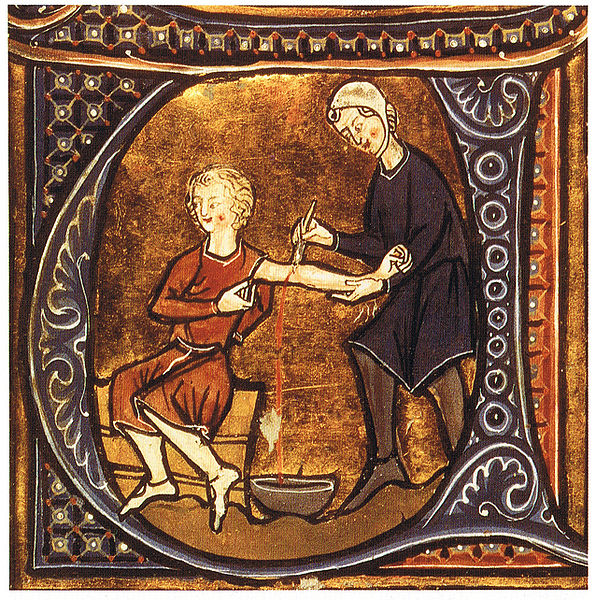
An excerpt (via Wired) from The Red Market, Scott Carney’s horrifying account of contemporary flesh peddlers of all sorts, including an Indian farmer who holds people captive and “milks” them for blood which is sold for profit:
“For the last three years the man had been held captive in a brick-and-tin shed just a few minutes’ walk from where the farmers were drinking tea. The marks on his arms weren’t the tell-tale signs of heroin addiction; they came from where his captor, a ruthless modern-day vampire and also a local dairy farmer and respected landowner named Papu Yadhav, punctured his skin with a hollow syringe. He had kept the man captive so he could drain his blood and sell it to blood banks. The man had managed to slip out when Yadhav had forgotten to lock the door behind him.
The emaciated man brought the officers to his prison of the last three years: a hastily constructed shack sandwiched between Papu Yadhav’s concrete home and a cowshed. A brass padlock hung from the iron door’s solid latch. The officers could hear the muffled sounds of humanity through the quarter inch of metal.
They sprung the lock and revealed a medical ward fit for a horror movie. IV drips hung from makeshift poles and patients moaned as if they were recovering from a delirium. Five emaciated men lying on small woven cots could barely lift their heads to acknowledge the visitors. The sticky air inside was far from sterile. The sun beating down on the tin roof above their heads magnified the heat like a tandoor oven. One man stared at the ceiling with glassy eyes as his blood snaked through a tube and slowly drained into a plastic blood bag on the floor. He was too weak to protest.”
Tags: Papu Yadhav, Scott Carney
Marshall McLuhan, a devout Catholic, on a 1970s religious program.
More McLuhan posts:
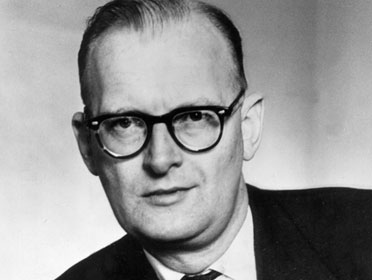 Two excerpts from Arthur C. Clarke’s 1986 Playboy interview.
••••••••••
“PLAYBOY: You’ve said that the famous opening sequence, in which the bone thrown into the air by the prehistoric man-apes becomes the space vehicle Discovery, came about by accident.
CLARKE: Yes, Stanley and I were trying to figure out that crucial transition. We were walking back to the studio in London and, for some reason, Stanley had a broomstick in his hand. He threw it up into the air, in a playful way, and he kept doing it, and it was at that moment that the idea of making the broomstick into the bone that gets turned into Discovery came about. I was afraid it was going to hit me in the head. [Laughs] So later we filmed it with some sort of bone. That shot was the only one in the movie done on location. It was shot just outside the studio. There was a platform built and, just beneath it, all the London buses were going by.”
••••••••••
“PLAYBOY: In the postscript to your book Ascent to Orbit, you talk about technology quite a bit. You have a lot of technology in your own home—your John Deere computer “Archie,” your satellite dish, your Kaypro-II computer. Yet you write, “This power over time and space still seems a marvel to me, even though I have been preaching its advent for decades. But the next generation will take it completely for granted and wonder how we ever managed to run the world without it … which we never did. May these new tools help them to succeed where we failed so badly.” Do you still think that way?
CLARKE: [Pauses] Absolutely. That’s why I’m so delighted that kids these days are not using their computers strictly to play games but are using them to process information. Knowledge really is power, and computer technology has increased an individual’s potential for power considerably. I still think it’s one’s duty to be optimistic about the possibilities of that power, without being unrealistic. It’s just that if one radiates doom and gloom about the possibilities of technology, one is in danger of creating a self-fulfilling prophecy about self-destruction.”
••••••••••
Bone becomes spaceship:
More Arthur C. Clarke posts:
Tags: Arhtur C. Clarke, Stanley Kubrick
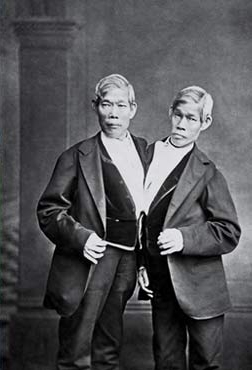
"The features of Chang were partially discolored, those of Eng being quite natural."
The famous 19th-century Siamese twins Chang and Eng, conjoined brothers who were actually born in Siam, passed away in North Carolina at the age of 63 in 1874. The siblings were sideshow and medical curiosities during their lives, so it’s no surprise that they attracted much interest at the time of their death. An article in the February 6, 1874 Brooklyn Daily Eagle reported on the post-mortem. An excerpt:
“On Sunday the Scientific Medical Commission, consisting of Dr. William H. Pancosat, of Jefferson Medical College, Dr. Harrison Allen, of the University of Pennsylvania, and Dr. T.H. Andrews, also of Jefferson Medical College, arrived at the residence of Mrs. Eng, one of the widows of the Siamese twins. A consultation took place between the medical gentlemen and both the widows, the former setting forth the object of their visit and urged the importance to science of an examination of the bodies.
After a brief discussion, during which both the ladies evinced considerable feeling, they consented to the propositions of the commission, on the condition and with the distinct understanding that the bodies should not be injuriously mutilated. This the commission agreed to in a few moments. Afterward they descended to the cellar where the bodies were interred. This was found to be a dark but somewhat spacious apartment, the floor of which was naked earth, the soil of the substrata of rock being of a porous and mouldy nature. Accompanying the commission was a tinner, to open the case in which the bodies had been placed. The scene was now quite a weird and solemn one. The temporary sepulchre was reached by a northwestern door from another basement apartment, and when the commission descended the crowd of neighbors thronged in and stood silently around the improvised tomb of the twins. The darkness being intense, pine wood knots were then lighted in one corner, the flickering glare of which cast ghostly shadows of the spectators athwart the wooden ceiling and along the roughly built granite walls of the room.
The tomb was then opened. There was a cadaveric odor from the coffin. A white gauze muslin covering being drawn off, the faces of the dead twins were exposed. The features of Chang were partially discolored, those of Eng being quite natural.
 The members of the commission, assisted by those present, then disrobed the bodies, and a partial examination was made, no operation being performed, and the result of this was followed by a medical consultation. From what could be learned it was found the bodies, though well preserved so far, would in a few days be in a state of decomposition, and that the surgical operation, if performed now, might endanger the ultimate preservation of the now defunct natural curiosity, a consequence which both the commission and the families were anxious to avoid. It was further decided that the facilities for an autopsy were so meagre and insufficient that it would not be wise to attempt it on the present occasion, and that beside the present examination and efforts to obtain good photographic views of the ligament and the bodies, the operations of the commission would be limited to a partial embalmment to insure the preservation of the bodies. A number fo efforts to obtain photographic views were then made, resulting successfully in one instance only. After which the partial embalmment was performed, and the bodies were once more covered in the coffin. The widows then consented to have the bodies removed to the College of Physicians at Philadelphia.
The commission returned to Mount Airy late Sunday evening. On Monday they left for Salem, in Forsyth County, in a carriage, the wagon containing the coffin following, and behind two buggies with the photographers, making for quite a funeral procession, which attracted the attention of the people all along the route. On Tuesday afternoon the cortege reached Salem, where the bodies were shipped to Greensboro, the commission accompanying them. They arrived at that point this morning and left for Philadelphia this afternoon, where they will arrive to-morrow at half past one o’clock.”
Tags: Chang and Eng, Chang Bunker, Eng Bunker
Thirsty pipes.
Tags: Malcom McLaren
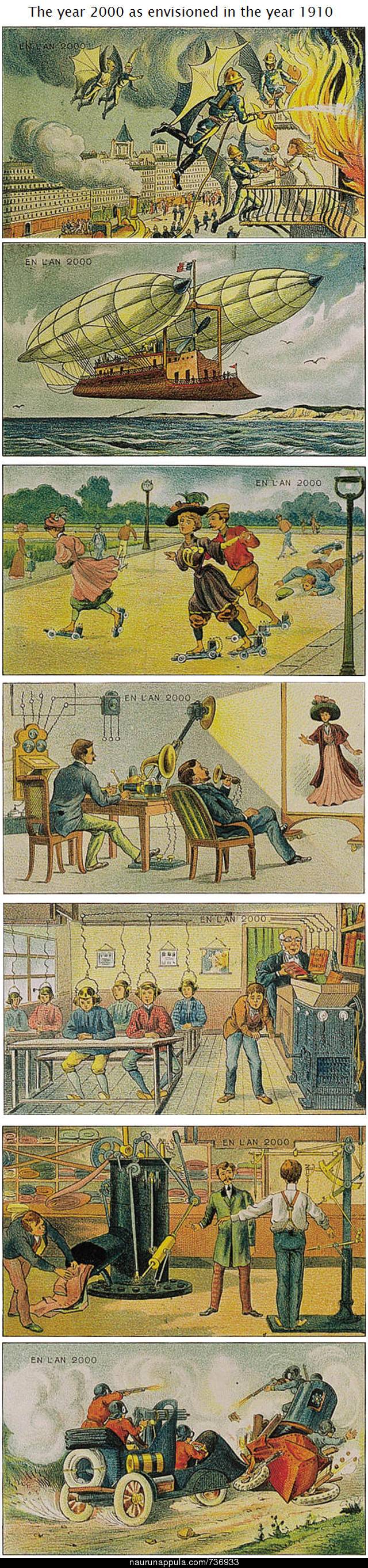
I was noodling around on Reddit when I found this odd series of 1910 drawings which tried to predict what life would be like in 2000. Apparently, firefighters and boats would be able to fly, roller skates would be electric, books would be fed directly to the brain and washing machines would be awesome. Fun stuff.
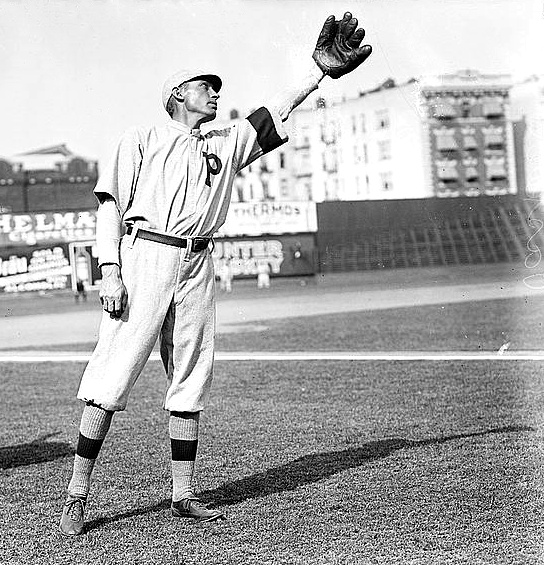 Some people can sense earlier than others that something is being done incorrectly, that methods are amiss, that the whole thing is a sham. Brooklyn baseball fan Walter Lappe was just such a person. I knew about Bill James and Eric Walker and the Moneyball era of advanced baseball statistics that their number-crunching ushered in, but I had never heard of Lappe, who was on the same path years earlier, trying to instill science and objective reasoning into baseball. He teamed with renegade ex-pitcher Jim Bouton to publish something called The Baseball Brain, which was the first attempt by “barbarians” to crash the gate. Lappe and his stats don’t seem to have arrived at a lot of correct answers, but he was asking the right questions before others were. An excerpt from a July 1, 1974 New York magazine article that Bouton penned about their attempt to reinvent baseball:
“If I told you that some nutty baseball fan from Brooklyn held the secret for getting the Mets and Yankees into the World Series, you wouldn’t believe me. It sounds like something from Damn Yankees or like that old movie It Happens Every Spring, where Fred MacMurray or Ray Milland or somebody invents a magic substance which repels wood and when you rub it on baseballs they become unhittable. Our fan from Brooklyn doesn’t have anything that sneaky, but what he does have could be just as revolutionary. I’ve seen his stuff, and I believe. Now, if only Yogi Berra and Bill Virdon (Mets and Yankees managers as of this writing) will read this, we’ll all be rolling in champagne and ticker tape this fall.
The fan from Brooklyn who could cause baseball’s first intra-stadium World Series is Walter Lappe (pronounced ‘Lap’), who believes that big-league managers rarely use the best strategy and players don’t seem to know what they’re doing out there. For the last 20 of his 49 years, Walter as a hobby, has been keeping his own statistics on the New York ball teams. He listens to games on the radio and writes down where each batter hits the ball, who’s pitching, balls and strikes, runners on base, weather conditions, phases of the moon, etc. Now that’s pretty nutty, but so is flying a kite in a rainstorm.
I don’t know if Benjamin Franklin has a brother, but Walter has one named Henry who is always saying, ‘Walter, why don’t you stop wasting your time listening to baseball games and go get a job, Walter?’ But how can someone get a job when you’re unlocking the secrets of the universe?”
_________________________
A 1970s ESPN Sportscenter report on Bouton’s controversial book, Ball Four. What mutton chops, what suits!
Tags: Jim Bouton, Walter Lappe
Ray Bradbury in the late ’60s discussing his cultural role during the adaptation of his short-story collection, The Illustrated Man, which rested (uneasily) at the nexus of technology and psychology.
Tags: Ray Bradbury
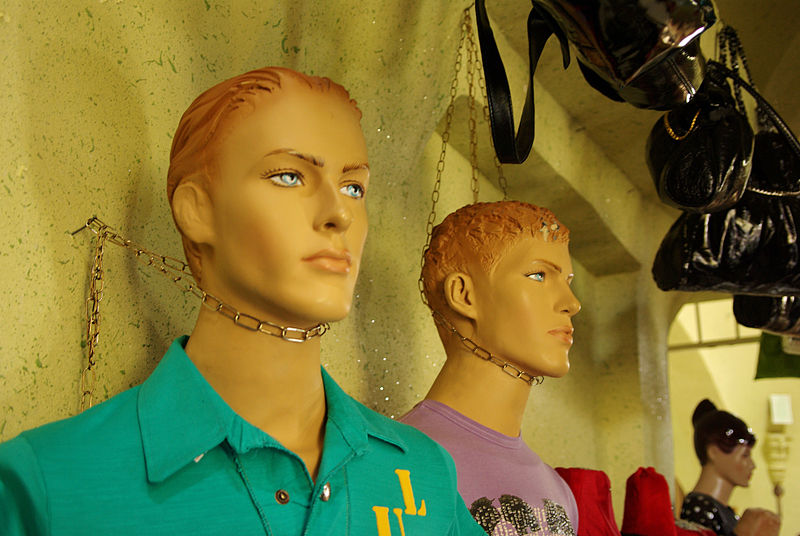
Like reverse product placement, a “shoppable video” is an online video in which models engage in banal activity, a movie of sorts, while showing off products. Susannah Edelbaum of the High Low has an interesting post about a Korean clothing retailer Oki-Ni, which has created an interactive video called “The Game.” Ridley Scott’s production company turned out this very mild “action film” which has dudes playing table tennis in a sprawling and spartan home. Everything they’re wearing can be purchased with a couple of clicks.
It’s strange to see the full extrapolation of product placement, where the clothes are essentially wearing the people, but it’s only a more extreme version of almost every film and TV program we watch. The catalog has come to life, or some denatured semblance of life. And it will likely only grow slicker and more elaborate as time goes by. Because of the interactive element of the video, it can’t be embedded, but watch it here.
Tags: Susannah Edelbaum
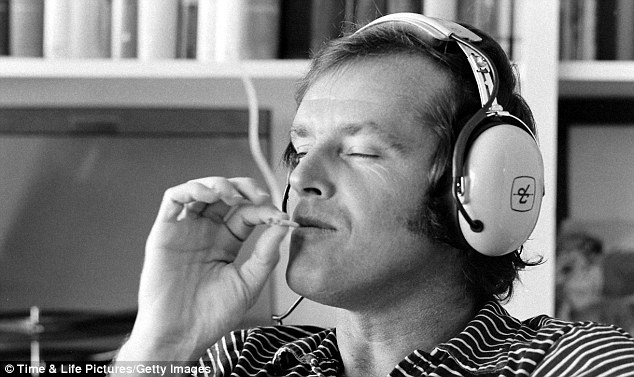
Jack Nicholson was part of a group of ’70s California investors trying to market clean, cheap hydrogen fuel that was created by solar. “There are a lot of good things that can come from using the power of the sun,” Nicholson said. Never panned out, obviously.
Tags: Jack Nicholson
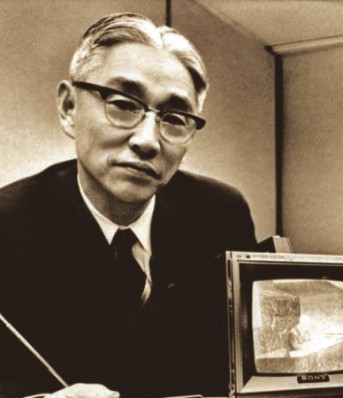
Legendary Sony founder Akio Morita was reputedly the tech titan that Steve Jobs studied most closely. In the 1950s, Morita opened a start-up in the basement of a bombed-out department store and created the world’s first transistor radio. He was more responsible than anyone for Japan emerging as a world leader in consumer electronics. In 1980, he visited Tom Snyder to unveil a line of new products.
From “Akio Morita: Guru of Gadgets,” Kenichi Ohmae’s 1998 Time article about the late-life Morita: “Almost exactly five years ago, Akio Morita–Mr. Sony–fell to the ground during a game of tennis. The co-founder and chairman of the board had suffered a stroke. He has since been in a wheelchair. This is particularly sad, as Morita had never been able to sit still and relax. At 72, he was playing tennis at 7 a.m. each Tuesday. I know this well because I would practice on the court next to him. My tennis, however, was very different from his. I played with an instructor, and if I was tired, I would just take a break. Not him. He challenged everybody, including young athletes.
This was in keeping with a man who created one of the first global corporations. He saw long before his contemporaries that a shrinking world could present enormous opportunities for a company that could think beyond its own borders, both physically and psychologically. And he pursued that strategy with his relentless brand of energy in every market, particularly the U.S. It is notable that this year, according to a Harris survey, Sony is rated the No. 1 brand name by American consumers, ahead of Coca-Cola and General Electric.”
Tags: Akio Morita, Kenichi Ohmae, Tom Snyder
This stuff is crazy. Henrik Ehrsson at Sweden’s Karolinska Institute is able to make people believe that they are giants or barbie dolls with the aid of a virtual reality headset. It’s creepy and odd and sort of spectacular.
From an article about the research in Discover: “In Alice’s Adventures in Wonderland, the titular heroine quaffs a potion that shrinks her down to the size of a doll, and eats a cake that makes her grow to gigantic proportions. Such magic doesn’t exist outside of Lewis Carroll’s imagination, but there are certainly ways of making people thinkthat they have changed in size.
There’s nowhere in the world that’s better at creating such illusions than the lab of Henrik Ehrsson in Sweden’s Karolinska Institute. In a typical experiment, a volunteer is being stroked while wearing a virtual reality headset. She’s lyng down and looking at her feet, but she doesn’t see them. Instead, the headset shows her the legs of a mannequin lying next to her.
As she watches, Bjorn van der Hoort, one of Ehrsson’s former interns, uses two rods to stroke her leg, and the leg of the mannequin, at the same time. This simple trick creates an overwhelming feeling that the mannequin’s legs are her own. If the legs belong to a Barbie, she feels like she’s the size of a doll. If the legs are huge, she feels like a 13-foot giant.”
Tags: Henrik Ehrsson
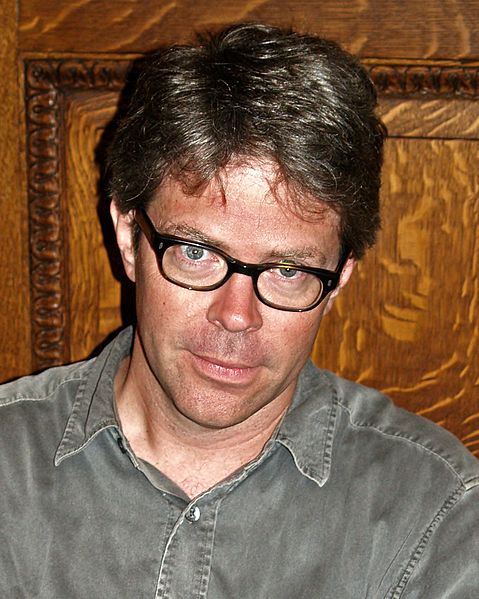
Jonathan Franzen: Loves birds, iffy on Oprah. (Image by David Shankbone.)
Jonathan Franzen has an excellent essay, “Liking Is For Cowards, Go For What Hurts,” in the New York Times, which makes many salient points about the pleasing, dishonest mirror that is consumer electronics:
“Consumer technology products would never do anything this unattractive, because they aren’t people. They are, however, great allies and enablers of narcissism. Alongside their built-in eagerness to be liked is a built-in eagerness to reflect well on us. Our lives look a lot more interesting when they’re filtered through the sexy Facebook interface. We star in our own movies, we photograph ourselves incessantly, we click the mouse and a machine confirms our sense of mastery.
And, since our technology is really just an extension of ourselves, we don’t have to have contempt for its manipulability in the way we might with actual people. It’s all one big endless loop. We like the mirror and the mirror likes us. To friend a person is merely to include the person in our private hall of flattering mirrors.”
••••••••••
Franzen discusses some lesser-known books he loves:
Tags: Jonathan Franzen
Michael Crichton predicts the future (fairly poorly) in 1999: Printed matter will be fine, movies will soon be dead, communications will be consolidated into fewer hands. Well, he did foresee YouTube and large-scale terrorism in NYC.
Crichton, who was fascinated by science and often accused of being anti-science, commenting in a 1997 Playboy interview on technology creating moral quandries we’re not prepared for: “I think we’re a long way from cloning people. But I am worried about scientific advances without consideration of their consequences. The history of medicine in my lifetime is one of technological advances that outstrip our ethical systems. We’ve never caught up. When I was in medical school—30-odd years ago—people were struggling to deal with mechanical-respiration systems. They were keeping alive people who a few years earlier would have died of natural causes. Suddenly people weren’t going to die of natural causes. They were either going to get on these machines and never get off or—or what? Were we going to turn the machines off? We had the machines well before we started the debate. Doctors were speaking quietly among themselves with a kind of resentment toward these machines. On the one hand, if somebody had a temporary disability, the machines could help get them over the hump. For accident victims—some of whom were very young—who could be saved if they pulled through the initial crisis, the technology saved lives. You could get them over the hump and then they would recover, and that was terrific.
But on the other hand, there was a category of people who were on their way out but could be kept alive. Before the machine, ‘pulling the plug’ actually meant opening the window too wide one night, and the patient would get pneumonia and die. That wasn’t going to happen now. We were being forced by technology to make decisions about the right to die—whether it’s a legal or religious issue—and many related matters. Some of them contradict longstanding ideas in an ethically protected world; we weren’t being forced to make hard decisions, because those decisions were being made for us—in this case, by the pneumococcus.
This is just one example of an ethical issue raised by technology. Cloning is another. If you’re knowledgeable about biotechnology, it’s possible to think of some terrifying scenarios. I don’t even like to discuss them. I know people doing biotechnology research who have decided not to pursue avenues of research because they think they’re too dangerous. But we go forward without sorting out the issues. I don’t believe that everything new is necessarily better. We go forward with the technology while the ethical issues are still up in the air, whether it’s the genetic variability of crop streams, which is a resource in times of plant plagues, to the assumption that we all have to be connected all the time. The technology is here so you must use it. Do you? Do you have to have your cell phone and your e-mail address and your Internet hookup? I was just on holiday in Scotland without e-mail. I had to notify people that I wouldn’t be checking my e-mail, because there’s an assumption that if I send you an e-mail, you’ll get it. Well, I won’t get it. I’m not plugged in, guys. Some people are horrified: ‘You’ve gone offline?’ People feel so enslaved by technology that they will stop having sex to answer the telephone. What could be so important? Who’s calling, and who cares?”
Tags: Michael Crichton
Pilkington, idiot savant sidekick to Ricky Gervais and Stephen Merchant, opines on the future. Not so crazy, really.

A boarded-up Montgomery Ward store in Georgia. (Image by Caldorwards4.)
Really good article by David Streitfeld in the New York Times about the phenomenon of Groupon, a company running forward at a breakneck pace but still (wisely) looking over its shoulder. The Internet outfit inhabits the Chicago building made famous by Montgomery Ward, the once-powerful retailer which also changed the face of commerce in its own day. An excerpt:
“CHICAGO has revolutionized retailing before. In 1872, a dry-goods salesman named Aaron Montgomery Ward wearied of visiting far-flung stores, so he mailed descriptions of goods directly to rural residents. The orders were sent by a new delivery system that wreaked havoc on traditional commerce: the railroad.
Ward’s innovation was as much of a cultural achievement as a merchandising one — farmers read his catalogues for pleasure, dreaming of a better world. They were the foundation of a retail empire that lasted more than a century until the management failed one time too often to anticipate a shift in consumer tastes. Ward’s went bust a decade ago.
Groupon’s corporate headquarters are in the old Montgomery Ward building, which should be reminder enough of the dangers of neglecting the customer’s desires. But Mr. Mason, the chief executive, sought to underline the point by putting on the wall certain business magazine covers. They celebrate tech start-ups — the social network Friendster, the music site MySpace — at the moment they seemed poised for greatness, before they irrevocably stumbled.”
••••••••••
Montgomery Ward commercial, 1967:
Montgomery Ward commercial, 1982:
Montgomery Ward going-out-of-business commercial, 2001:
"They really are trying to get at what people think using how they talk."
Since language is available in critical mass all over the Internet, researchers will continue to mine this material to promote more efficient marketing or to determine the nature of our hearts and minds. The Atlantic has a new article about an intelligence branch of the government running a program designed to unravel how people around the globe use metaphors. An excerpt from Alexis Madrigal’s article:
“Every speaker in every language in the world uses them effortlessly, and the Intelligence Advanced Research Projects Activity wants know how what we say reflects our worldviews. They call it The Metaphor Program, and it is a unique effort within the government to probe how a people’s language reveals their mindset.
‘The Metaphor Program will exploit the fact that metaphors are pervasive in everyday talk and reveal the underlying beliefs and worldviews of members of a culture,’ declared an open solicitation for researchers released last week. A spokesperson for IARPA declined to comment at the time.
IARPA wants some computer scientists with experience in processing language in big chunks to come up with methods of pulling out a culture’s relationship with particular concepts. ‘They really are trying to get at what people think using how they talk,’ Benjamin Bergen, a cognitive scientist at the University of California, San Diego, told me. Bergen is one of a dozen or so lead researchers who are expected to vie for a research grant that could be worth tens of millions of dollars over five years, if the team scan show progress towards automatically tagging and processing metaphors across languages.”
Tags: Alexis Madrigal
If you subscribe to the New Yorker, make sure to read the excellent profile of artist Cory Arcangel, which was written by Andrea K. Scott, a smart former colleague from a few years back. Arcangel, whose new show just opened at the Whitney, is a Buffalo native who has gained critical acclaim at a young age for his digital art, especially his tinkerings with video game graphics, reimagining their aesthetic in surprising ways.
••••••••••
The one that made him famous:
A tasteful homage to Andy Warhol:
Cats playing Schoenberg:
Tags: Andrea K. Scott, Cory Arcangel
Open locks and hand out virtual keys with your phone and Lockitron. (Thanks Singularity Hub.)

"He rereads what you probably haven't heard of, like Anton Chekhov's Sakhalin Island."
A couple of passages about the voracious reading habits of economist, excellent blogger and The Great Stagnation author Tyler Cowen, from a new Businessweek profile of him:
“When Tyler Cowen was 15, he became the New Jersey Open Chess Champion, at the time the youngest ever. At around the same age, he began reading seriously in the social sciences; he preferred philosophy. By 16 he had reached a chess rating of 2350, which today would put him close to the top 100 in the U.S. Shortly thereafter he gave up chess and philosophy for the same reason: little stability and poor benefits.
He’d been reading economics, though. He figured that economists were supposed to publish, and by age 19 he had placed two papers in respected journals. As a PhD candidate at Harvard, he published in the Journal of Political Economy and the American Economic Review. ‘They were weird, strange pieces,’ he says, ‘but still in good journals, top journals. That cemented my view that I could, you know, somehow fit in somewhere.’ I ask him what he was like, what made him doubt he could fit in.
‘I was like I am now.’
‘You’ve always been like that?’
‘Always. Age 3. Whatever.’
‘What did you do at age 3?’
‘Read a lot of books.'”
••••••••••
“Tyler Cowen has read what’s listed in Harold Bloom’s The Western Canon, though not, he concedes, every single last one of the Icelandic sagas. He rereads what you probably haven’t heard of, like Anton Chekhov’s Sakhalin Island. For the Brazil trip, in case he runs out of new books, he has also brought Neal Stephenson’s 1,100-page Cryptonomicon, which he has already read. Fiction slows him down, he says, which makes packing easier. He carries a Kindle but reads paper when he can; he says he’s invested too much time on the rhythm of how the eye tracks the page. Several people have told me the same story about Cowen: They have watched him read, and he scans a page as others might scan a headline.”
••••••••••
Cowen visits Big Think to discuss the free market and morality:
Tags: Tyler Cowen
“Incredible Machine” by Bell Labs is a fun, old-school 1968 look the early use of computers in communications research (graphics, film, music).
From New Zealand. (Thanks Endgadget.)
Stewart Brand adapted his 1995 book, How Buildings Learn, into a 1997 BBC TV sepcial.
More Stewart Brand Posts:
Tags: Stewart Brand