From Endgadget: “The material that makes the magic happen is made of flat fibers that bring 35 percent more surface area in contact with your skin than traditional round yarns — and the more cloth touching your dermis, the better it can absorb and dissipate body heat. These flat fibers are bonded with a special compound that activates when wet (by water or sweat) and lowers the temperature of both the garment and the person wearing it.”
You are currently browsing the archive for the Science/Tech category.
Writing about The Truman Show reminded me of Rob Walker’s brilliant, frightening 2004 article, “The Hidden (in Plant Sight) Persuaders,” in the New York Times Magazine. Penned before social media really took off, the article examines how BzzAgent, a Boston-based marketing firm contracts citizens to engage in surreptitious whisper campaigns to promote products. That person in the mall conspicuously reading a just-published book or loudly mentioning a great new band–they may be BzzAgents. Most amazingly, apart from earning a few small rewards which they often don’t bother to collect, these people are unpaid volunteers just wanting to be a part of a stealth machinery, like airport cultists merely trying to plant the idea in your head that flowers are nice to buy. The article’s opening:
“Over the July 4 weekend last summer, at cookouts up and down the East Coast and into the Midwest, guests arrived with packages of Al Fresco chicken sausage for their hosts to throw on the grill. At a family gathering in Kingsley, Mich. At a small barbecue in Sag Harbor, N.Y. At a 60-guest picnic in Philadelphia.
We know that this happened, and we even know how various party guests reacted to their first exposure to Al Fresco, because the Great Sausage Fanout of 2004 did not happen by chance. The sausage-bearers were not official representatives of Al Fresco, showing up in uniforms to hand out samples. They were invited guests, friends or relatives of whoever organized the get-togethers, but they were also — unknown to most all the other attendees — ‘agents,’ and they filed reports. ‘People could not believe they weren’t pork!’ one agent related. ‘I told everyone that they were low in fat and so much better than pork sausages.’ Another wrote, ‘I handed out discount coupons to several people and made sure they knew which grocery stores carried them.” Another noted that ‘my dad will most likely buy the garlic” flavor, before closing, ‘I’ll keep you posted.’
These reports went back to the company that Al Fresco’s owner, Kayem Foods, had hired to execute a ‘word of mouth’ marketing campaign. And while the Fourth of July weekend was busy, it was only a couple of days in an effort that went on for three months and involved not just a handful of agents but 2,000 of them. The agents were sent coupons for free sausage and a set of instructions for the best ways to talk the stuff up, but they did not confine themselves to those ideas, or to obvious events like barbecues. Consider a few scenes from the life of just one agent, named Gabriella.
 At one grocery store, Gabriella asked a manager why there was no Al Fresco sausage available. At a second store, she dropped a card touting the product into the suggestion box. At a third, she talked a stranger into buying a package. She suggested that the organizers of a neighborhood picnic serve Al Fresco. She took some to a friend’s house for dinner and (she reported back) ‘explained to her how the sausage comes in six delicious flavors.’ Talking to another friend whom she had already converted into an Al Fresco customer, she noted that the product is ”not just for barbecues” and would be good at breakfast too. She even wrote to a local priest known for his interest in Italian food, suggesting a recipe for Tuscan white-bean soup that included Al Fresco sausage. The priest wrote back to say he’d give it a try. Gabriella asked me not to use her last name. The Al Fresco campaign is over — having notably boosted sales, by 100 percent in some stores — but she is still spreading word of mouth about a variety of other products, and revealing her identity, she said, would undermine her effectiveness as an agent.
The sausage campaign was organized by a small, three-year-old company in Boston called BzzAgent, but that firm is hardly the only entity to have concluded that the most powerful forum for consumer seduction is not TV ads or billboards but rather the conversations we have in our everyday lives. The thinking is that in a media universe that keeps fracturing into ever-finer segments, consumers are harder and harder to reach; some can use TiVo to block out ads or the TV’s remote control to click away from them, and the rest are simply too saturated with brand messages to absorb another pitch. So corporations frustrated at the apparent limits of ‘traditional’ marketing are increasingly open to word-of-mouth marketing. One result is a growing number of marketers organizing veritable armies of hired ‘trendsetters’ or ‘influencers’ or ‘street teams’ to execute ‘seeding programs,’ ‘viral marketing,’ ‘guerrilla marketing.’ What were once fringe tactics are now increasingly mainstream; there is even a Word of Mouth Marketing Association.”
••••••••••
BzzAgent, the social media machine:
Another Rob Walker post:
Tags: Rob Walker
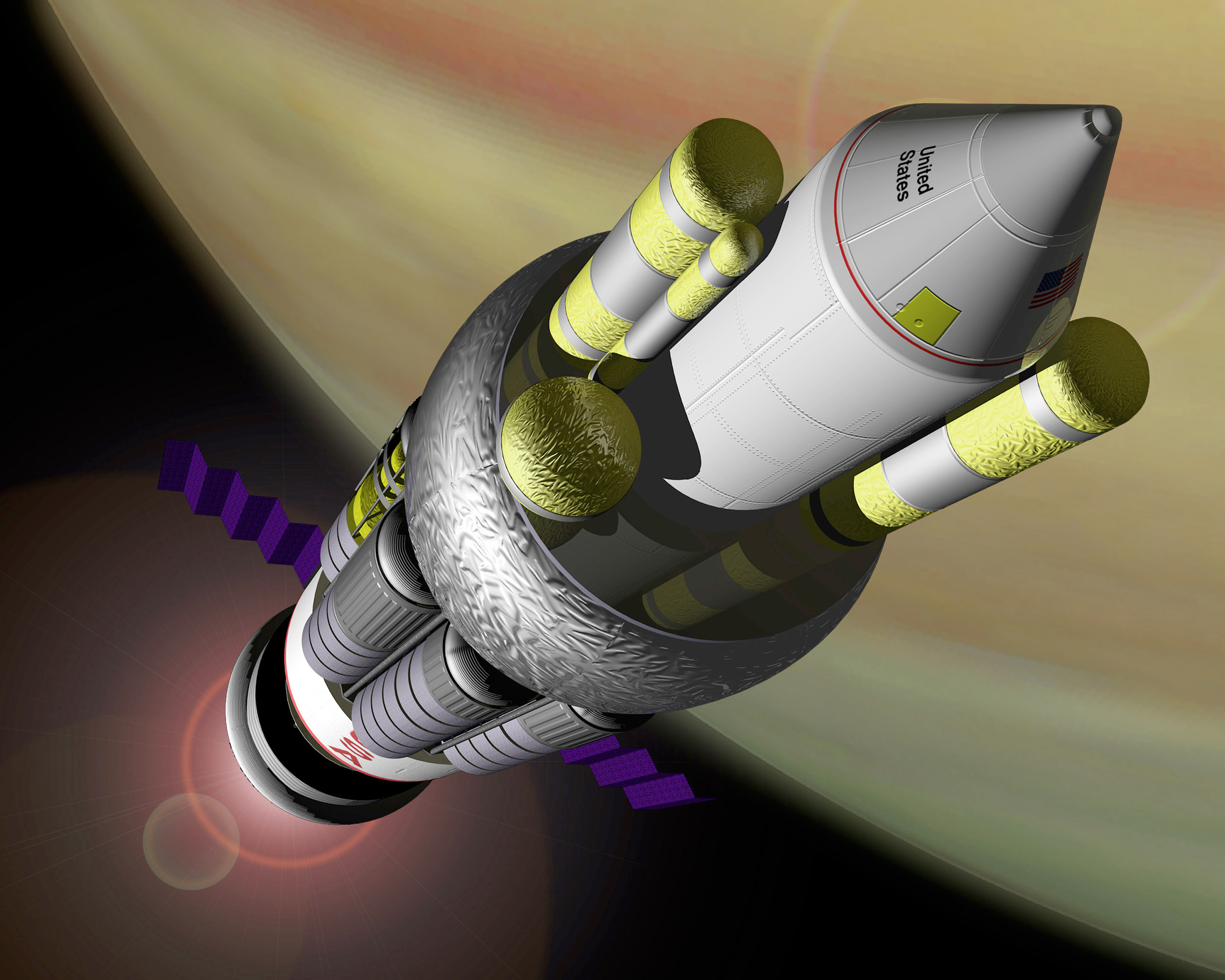
I posted something before about Freeman Dyson’s involvement with Project Orion, a 1950s effort by a group of scientists to use A-bomb explosions to propel ships into outer space. The plan was successful though international treaties preempted its use. Here’s rare footage of what it looked like.
Tags: Freeman Dyson
Jesus. H. Christ. Don’t forget Tony Junod’s excellent Esquire article about ants.
Tags: Jesus H. Christ, Tom Junod
The size of a quarter and able to communicate with one another, Kilobots cost $14 each and display collective behavior. (Thanks IEEE Spectrum.)
Sally Ride became the first American female to travel into space in 1983, and those enlightened designers at Mattel’s Barbie division were ready to pay tribute to the progress of women–well, to a point. Astronaut Barbie was a trailblazer in outer space, but she also enjoyed dancing in high heels under a disco ball. Seemingly intended for young girls with serious cocaine problems.
A brief feature about Germany’s electronic music pioneers on the Brit techie show, Tomorrow’s World, in the 1980s.
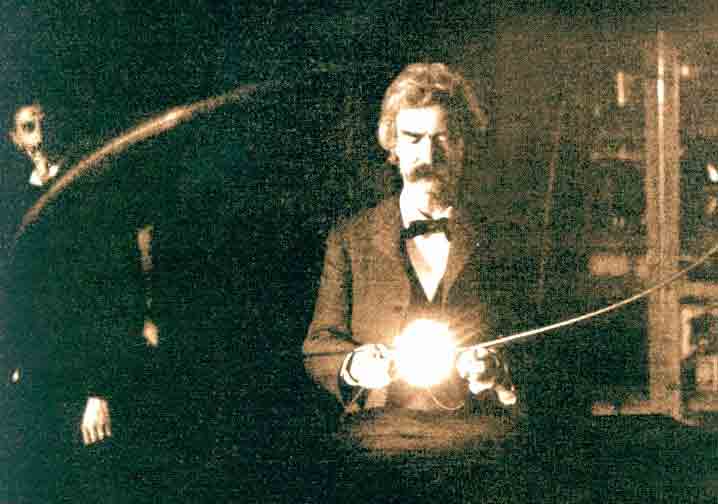
Nikola Tesla, background, with Mark Twain, who desperately needed to use the can.
Mark Twain’s interest in science unsurprisingly brought him into contact with the greatest of all electricians, Nikola Tesla, and the two became friends. During one meeting, a Tesla invention had an unusual affect on the writer. An excerpt from a Katherine Krumme article:
“Yet another excitement awaited Tesla’s visitors at the laboratory. Tesla had been perfecting a mechanical oscillator, a sort of engine that would produce alternating current of a high frequency. The inventor had noticed an interesting effect of the machine: it produced significant vibrations. Tesla wondered if these vibrations might have therapeutic or health benefits, and one day when Mark Twain was at his lab the author asked if he might experience these vibrations himself.
As the story goes, Mr. Twain stood on a platform of the machine while Tesla set the oscillator into operation. Twain was enjoying himself greatly and exclaimed: ‘This gives you vigour and vitality.’ After some time Tesla warned the writer that he should come down, but Twain was having fun and he refused. Tesla again insisted, but Twain stayed on the machine for several minutes more until, suddenly, he exclaimed: ‘Quick, Tesla. Where is it?’ Tesla directed his friend to the restroom. Twain had experienced first hand what had been known to the laboratory workers for some time: the laxative effect of the machine’s vibrations.” (Thanks Marginal Revolution.)
••••••••••
Jack and Meg with a Tesla Coil in Coffee and Cigarettes:
Tags: Katherine Krumme, Mark Twain, Nikola Tesla
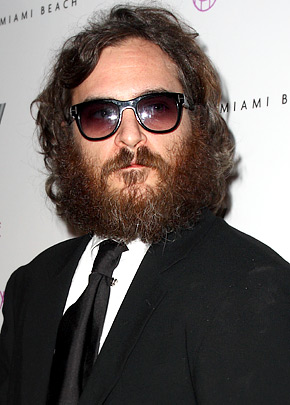
The bold new face of America.
“The Maniac Will Be Televised,” Walter Kirn’s contribution the Atlantic‘s new feature, “The 14 Biggest Ideas of the Year,” is a meditation on how Trump and Sheen and the Tea Party brought the lunatic fringe to the mainstream, realizing that truth was negligible during a suspicious era, outscreaming the white noise of the Digital Age. Joaquin Phoenix’s 2009 attempt to become our ubiquitous madman seemed a failure at the time, but it was really just prelude. An excerpt:
“Sheen was the spilled beaker in the laboratory who proved that in an age of racing connectivity, a cokehead can be a calming presence. His branching, dopamine-flooded neural pathways mirrored those of the Internet itself, and his lips moved at the speed of a Cisco router, creating a perfect merger of form and function. Trump, though his affect is slower and less sloppy, also showed mastery of the Networked Now by speaking chiefly in paranoid innuendo. The Web, after all, is not a web of truths; its very infrastructure is gossip-shaped. The genius of Sheen and Trump and other mediapaths (Michele Bachmann belongs on this list too) is that they seem to understand, intuitively, that the electronic brain of the new media has an affinity for suspicious minds.”
Tags: Charlie Sheen, Donald Trump, Joaquin Phoenix, Michele Bachmann, Walter Kirn
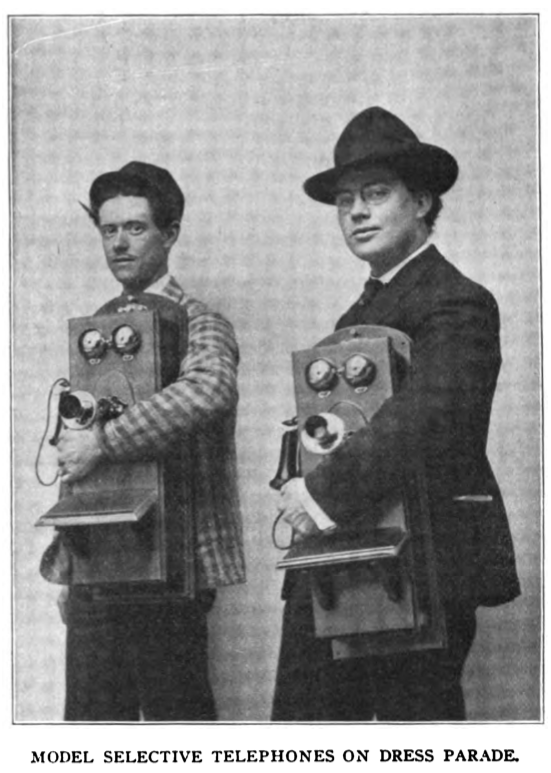
In a 1993 Wired feature, “Seven Wired Wonders,” science writer James Gleick was right on target in identifying the telephone as the tool of the near-future. An excerpt:
“After a century of fading into our bedside tables and kitchen walls, the telephone — both the instrument and its network — is on the march again. As a device shrinking to pocket size, the telephone is subsuming the rest of our technological baggage — the fax machine, the pager, the clock, the compass, the stock ticker, and the television. A sign of the telephone’s power: It is pressing the computer into service as its accessory, not the other way round.
We know now that the telephone is not just a device. It is a network — it is the network, copper or fiber or wireless — sprouting terminals that may just as well be workstations as headsets or Princesses. As the network spreads, it is fostering both the universality and the individuality of human discourse. The Net itself, the world’s fastest-spreading communications medium, is the telephone network in its most liberating, unruly, and fertile new guise.
Thus Bell’s child is freeing our understanding of the possibilities that lie in ancient words: neighborhood and meeting and information and news. It is global; it is democratic; it is the central agent of change in our sense of community. It is how, and why, we are wired.”
Tags: James Gleick
Neurologist V.S. Ramachandran briefly discusses bizarre brain disorders.
Tags: V.S. Ramachandran
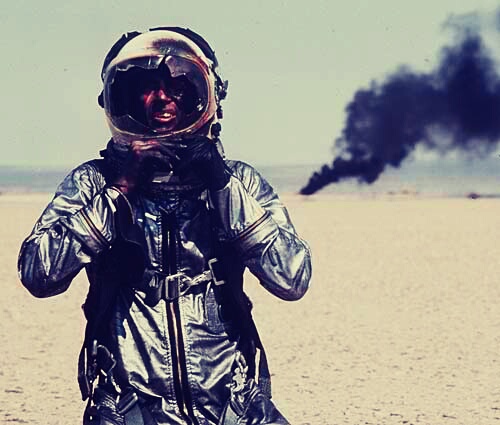
Ray Bradbury explains to Oriana Fallaci why we should travel into space, in the 1966 book, If The Sun Dies:
For the same reason that makes us bring children into the world. Because we’re afraid of death and darkness, and because we want to see our image reflected and perpetuated to immortality. We don’t want to die, but death is there, and because it’s there we give birth to children who’ll give birth to other children and so on to infinity. And this way we are handed down to eternity. Don’t let us forget this: that the Earth can die, explode, the Sun can go out, will go out. And if the Sun dies, if the Earth dies, if our race dies, then so will everything die that we have done up to that moment. Homer will die, Michelangelo will die, Galileo, Leonardo, Shakespeare, Einstein will die, all those will die who now are not dead because we are alive, we are thinking of them, we are carrying them within us. And then every single thing, every memory, will hurtle down into the void with us. So let us save them, let us save ourselves. Let us prepare ourselves to escape, to continue life and rebuild our cities on other planets: we shall not long be of this Earth! And if we really fear the darkness, if we really fight against it, then, for the good of all, let us take our rockets, let us get well used to the great cold and heat, the no water, the no oxygen, let us become Martians on Mars, Venusians on Venus, and when Mars and Venus die, let us go to the other solar systems, to Alpha Centauri, to wherever we manage to go, and let us forget the Earth. Let us forget our solar system and our body, the form it used to have, let us become no matter what, lichens, insects, balls of fire, no matter what, all that matters is that somehow life should continue, and the knowledge of what we were and what we did and learned: the knowledge of Homer and Michelangelo, of Galileo, Leonardo, Shakespeare, of Einstein! And the gift of life will continue.•
More from If The Sun Dies:
Tags: Oriana Fallaci, Ray Bradbury

Predicting the interior of a civilian passenger airplane in 2050. (Image by Airbus.)
The Guardian has a few photos of what Airbus believes passenger planes may look like in 2050: a panoramic view, smart chairs and virtual golf. I think four decades from now people will still prefer the womb-like ignorance of the enclosed cabin to the jaw-dropping view.
Paul Romer’s recent TED Talk about the concept of charter cities.
Tags: Paul Romer
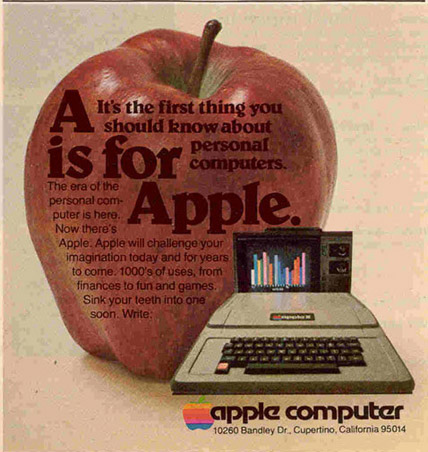
The Atlantic tracked down (most of) Apple’s first ten employees to see what they’re doing today. An excerpt:
“#8 Chris Espinosa
Chris Espinosa was working at Apple part-time in high school.
Chris Espinosa joined Apple when he was 14, and still in high school. He’s still with the company today. On his personal blog he said he ended up with employee number eight because when CEO Michael ‘Scotty’ Scott was giving out numbers, he was at school. He arrived late and ended up with the number.”
Tags: Chris Espinosa
I wonder if the recent economic meltdown would have cooled any of Friedman’s free-market fervor. Doubtful.
Tags: Milton Firedman, Phil Donahue
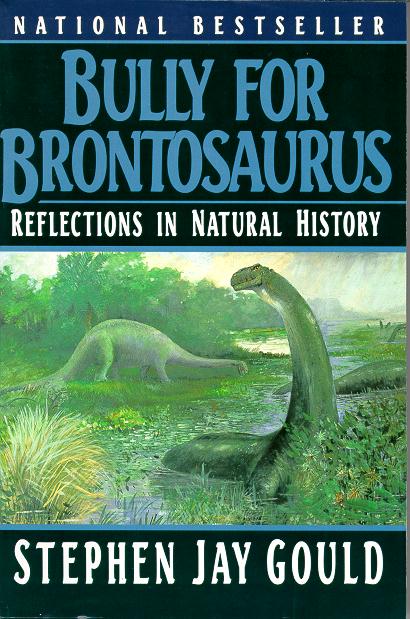
No too many paleontologists make the pages of People magazine, but the late Stephen Jay Gould was a serious academic who crossed over into the mainstream. The Queens-born Harvard professor was a lightning rod for others who disagreed with his theories, but Gould was someone who continually questioned himself, often revising beliefs from early essays in subsequent ones. An excerpt from Michelle Green’s 1986 People profile:
“It is an inviting, vaguely antic enclave that suggests a 19th-century natural history museum turned into a bookish boys’ club. Faded lettering on the drab green walls announces ‘Synopsis of the Animal Kingdom’ and ‘Sponges and Protozoa,’ and in the room’s cluttered depths are a wealth of musty treasures: tall glass cases filled with drawers of trilobites, a towering painting of a tyrannosaurus, hundreds of leather-bound volumes and boxes of snail shells. A worn rattan chair has been pulled up to a worktable that holds fossils, microscopes and a supply of Pepperidge Farm cookies.
Stephen Jay Gould—evolutionary biologist, prolific writer and die-hard Yankees fan—has worked in this office at Harvard’s Museum of Comparative Zoology for 17 years, and many of his books have been spawned here: Ever Since Darwin, The Panda’s Thumb, Hen’s Teeth and Horse’s Toes and now The Flamingo’s Smile (Norton, $17.95). When he arrived with his freshly minted Ph.D. from Columbia, the rumpled, kinetic Gould was an exceptionally promising paleontologist; in the years since, he has become a popular symbol of erudition and scholarship. At 44, he recently completed the final year of a MacArthur Foundation grant that has paid him $38,400 a year since 1981. He was the recipient of an American Book Award in 1981, a National Magazine Award in 1980 and once made the cover of Newsweek. He has done battle with creationists, testified before congressional committees concerning nuclear winter and lectured in South Africa on the history of racism. Students fight to get into his classroom, and assorted crazies send tirades addressed to Mr. Illustrious Historical Professor Jay Gould, University of Harvard.
On this stone-gray afternoon, the illustrious historical professor is finding all the attention a bit of a problem. His secretary is putting through calls approximately every two minutes, and Gould—an ebullient man with a near-perpetual smile—is simultaneously trying to discuss his life’s work and fend off a flood of petitioners. On his desk is the latest batch of correspondence, including a letter from a man who suggests a connection between AIDS and aspirin, and a plea from the husband of a woman who is addicted to Gould’s columns in Discover:: Will the author please send birthday greetings to the following address? This nets the correspondent a hastily scrawled turndown: ‘I am not public property, but a man!'”
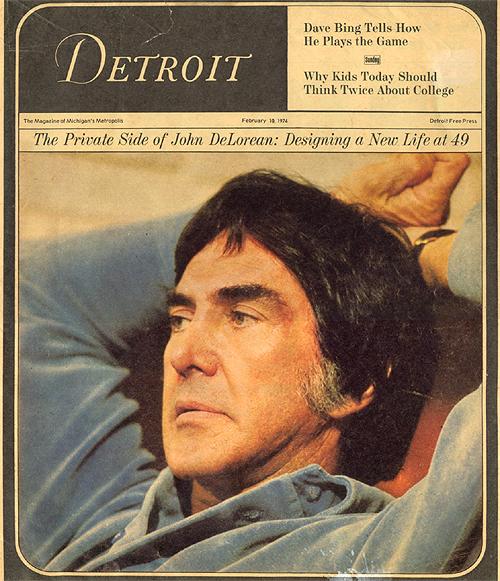
John DeLorean remade the automotive industry, remade himself and eventually made a mess.
The opening of “The Private Side of John DeLorean: A New life at 49,” a great 1974 Detroit magazine cover story written by Paul Hendrickson, which profiled the legendary automaker after he exited the corporate car culture to blaze his own trail but before his head-on collision with hubris:
It begins like a parable. A skinny kid from inner-city Detroit grows up in the ’40s playing Slide the Rock and sandlot baseball and sometimes the clarinet. His father is a set-up man at the Ford foundry. His mother, separated from her husband, lives in California.
The boy is crazy for cars, dreaming of them every day as he rides a trolley down Woodward on his way to Cass Tech. Growing like a weed, he enters Lawrence Institute of Technology, graduates in engineering and, in 1948, begins a 25-year career in the automobile industry. Along the way, he picks up two master’s degrees, a wife from northern Michigan and 200 patents, including the recessed windshield wiper, the hidden radio antenna and the overhead-cam engine.
His rise at General Motors in meteoric. In 1965, at age 40, he is made general manager at Pontaic and a vice president. At 44, he becomes the youngest man ever to direct Chevrolet. Three years later, in October, 1972, he is named head of all GM’s car and truck production. His salary, including bonuses, is said to be $650,000. He is most everybody’s odds-on favorite to one day become president.
But here, the story takes a swerve. For by 1972, John Zachary DeLorean was a different breed of cat than the naive, callow youth who entered the business with the conviction that making cars was his calling to help Americans preserve their fifth freedom, mobility. For one thing, he had drastically changed his lifestyle.
He had taken to turtlenecks and tie-dyed blue jeans by then. His weight was down from 235 to just over 170. His hair was long and sculptured and dyed coal-black. There were well-founded stories that he had undergone a face lift. His three-to-four-pack-a-day cigarette habit was gone, as were the suits that came off the rack, as was the first wife. He had also married and divorced actress-model Kelly Harmon, 24 years his junior, and had popped up around the country in the company of Ursula Andress, Nancy Sinatra and Candice Bergen. When in Detroit, he had been known to roar around in such non-GM models as a Lamborghini and a $19,000 Maserati Ghibli. On occasion, he shocked everybody at the office cold by coming to work in a pickup.
He was playing golf with Arnold Palmer and Gary Player, riding motorcycles in the Mojave Desert, chasing girls with one-time auto racer Roger Penske and collecting real estate as if America were his Monopoly board.
In short as Time magazine put it, by 1972 John DeLorean was standing out from his colleagues at GM like a Corvette Stingray or a showroom full of trucks.
But more than any of that, DeLorean by then was just plain disenchanted with his job. He had said at a press conference two years earlier that he did not intend to spend the rest of his life at GM; few believed him.•
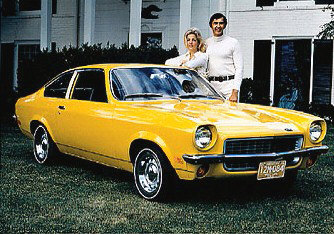
John DeLorean’s combustible 1980s, in four videos.
Mesmerizing 17-minute DeLorean DMC-12 prospectus film that was shown to dealers and investors ahead of the automobile reaching the market in 1981.
From Pennebaker and Hegedus in 1981: “John Zachary DeLorean doesn’t smile very much.”
A 1983 California ad offering DeLoreans at the closeout price of $18,895. “This may be your last chance to live the dream.”
In 1988, his dreams dashed and reputation destroyed, DeLorean was living in Manhattan, now a born-again Christian, still believing he would get another chance. He granted a rare interview to a local TV station from his old stomping grounds in Detroit.
Tags: John DeLorean, Paul Hendrickson
Panasonic and eight other companies plan to build the Fujisawa Sustainable Smart Town, the world’s greenest, cleanest community. However, where you live it will still be very filthy. (Thanks Singularity Hub.)
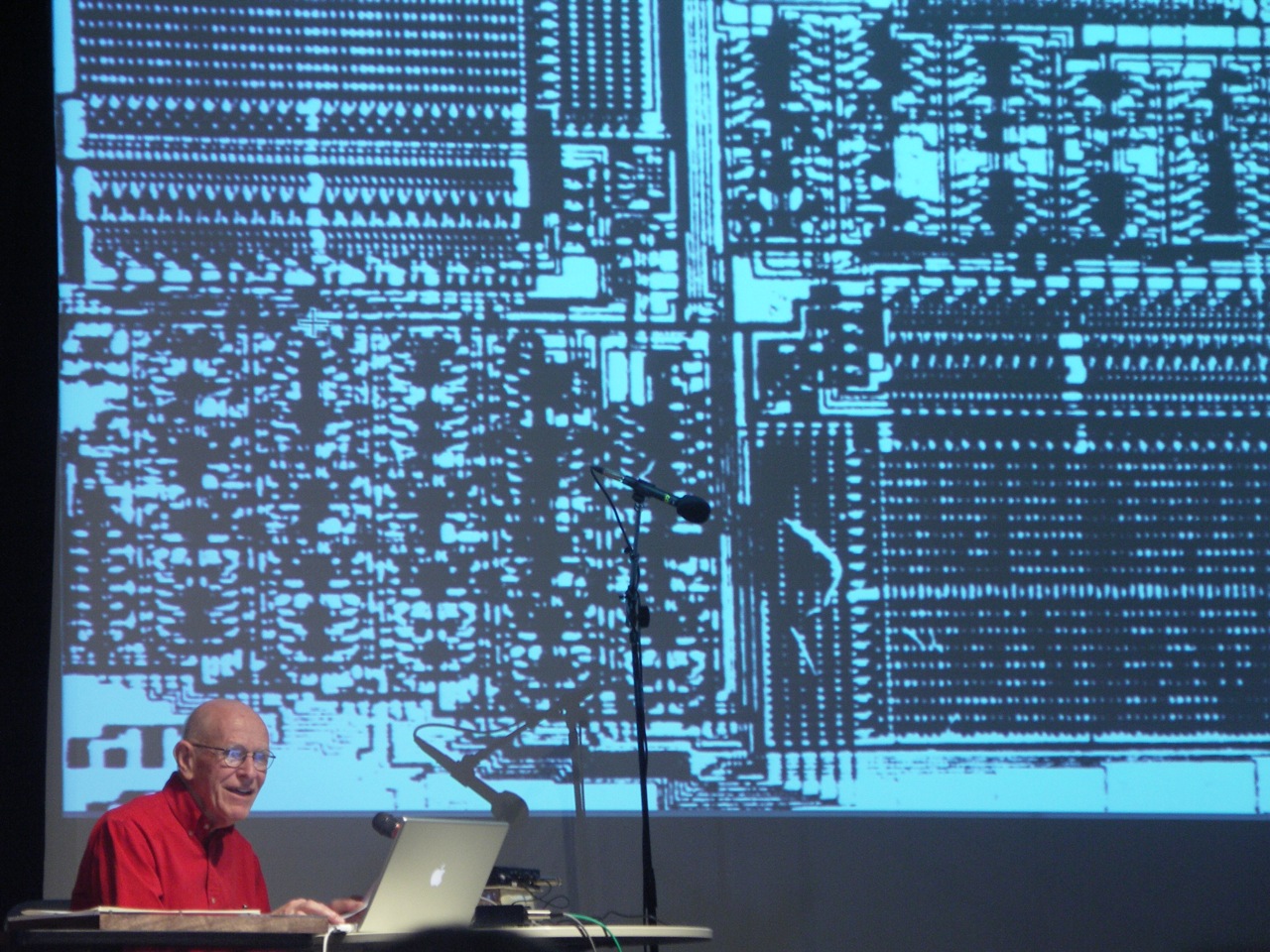
R. Luke Dubois posted “The First Computer Musician,” an excellent piece about Max Mathews, for the Opinionator on the New York Times site a couple days ago. Mathews, a pioneer of wired music, passed away in April. The opening:
“In 1957 a 30-year-old engineer named Max Mathews got an I.B.M. 704 mainframe computer at the Bell Telephone Laboratories in Murray Hill, N. J., to generate 17 seconds of music, then recorded the result for posterity. While not the first person to make sound with a computer, Max was the first one to do so with a replicable combination of hardware and software that allowed the user to specify what tones he wanted to hear. This piece of music, called “The Silver Scale” and composed by a colleague at Bell Labs named Newman Guttman, was never intended to be a masterpiece. It was a proof-of-concept, and it laid the groundwork for a revolutionary advancement in music, the reverberations of which are felt everywhere today.
When Max died in April at the age of 84 he left a world where the idea that computers make sound is noncontroversial; even banal. In 2011, musicians make their recordings using digital audio workstations, and perform with synthesizers, drum machines and laptop computers. As listeners, we tune in to digital broadcasts from satellite radio or the Internet, and as consumers, we download small digital files of music and experience them on portable music players that are, in essence, small computers. Sound recording, developed as a practical invention by Edison in the 1870s, was a technological revolution that forever transformed our relationship to music.”
••••••••••
A bit of Mathews’ “Phosphones”:
Tags: Max Mathews, R. Luke Dubois
From “6 Products That Became Technology Roadkill“: “Back in 1987, GO Corporation was on the vanguard of pen-based computing, and investors handed the enterprise $75 million to make the world eschew the keyboard and mouse. In 1991, GO released its OS, PenPoint, designed specifically for the new market and it included gesture recognition. Not only was GO’s technology well received, but also it was implemented in several IBM computers, including the first ThinkPad.”
••••••••••
“The Woodstock of pen-based computing”:
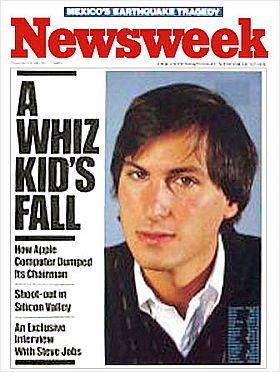
Two excerpts from Steve Jobs’ 1985 Playboy interview, including one in which the Apple visionary predicts his leaving the company and returning to it even stronger, without realizing his departure would be involuntary.
••••••••••
“Playboy: Obviously you believe that computers are going to change our personal lives, but how could you persuade a skeptic? A holdout?
Steve Jobs: A computer is the most incredible tool we’ve ever seen. It can be a writing tool, a communications center, a supercalculator, a planner, a filer and an artistic instrument all in one, just by being given new instructions, or software, to work from. There are no other tools that have the power and the versatility of a computer. We have no idea how far it’s going to go. Right now, computers make our lives easier. They do work for us in fractions of a second that would take us hours. They increase the quality of life, some of that simply by automating drudgery and some of that by broadening our possibilities. As things progress, they’ll be doing more and more for us.”
••••••••••
“Jobs: I’ll always stay connected with Apple. I hope that throughout my life I’ll sort have the thread of my life and the thread of Apple weave in and out of each other like tapestry. There may be a few years when I’m not there, but I’ll always come back. And that’s what I may try to do. The key thing to remember about me is that I’m still a student. I’m still in boot camp. If anyone is reading any of my thoughts, I’d keep that in mind. Don’t take it all too seriously. If you want to live your life in a creative way, as an artist, you have to not look back too much. You have to be willing to take whatever you’ve done and whoever you were and throw it away, What are we anyway? Most of what we think we are is just a collection of likes and dislikes, habits, patterns. At the core of what we are is our values, and what decisions and actions we make reflect those values. That is why it’s hard doing interviews and being visible. As you are growing and changing, the more the outside world tries to reinforce an image of you that it thinks you are, the harder it is to continue to be an artist, which is why a lot of times artists have to go, ‘Bye, I have to go. I’m going crazy and I’m getting out of here.’ And they go and hibernate somewhere. Maybe later they re-emerge a little differently.”
••••••••••
Before Hodgman vs. Long, Dick Cavett was the Apple pitchman. From 1981:
Tags: Steve Jobs
Alexander Calder’s Circus (1955):
“The Sea Horse”:
Tags: Jean Painlevé
From Singularity Hub: “Ever since True Lies I’ve been waiting for an affordable pair of spy glasses that can transmit video in real time. My wait looks like it may be over very soon. Seattle startup ZionEyez is building momentum to launch their Eyez video recording glasses this year. The Roy Orbison looking Eyez will feature a 720p HD recording camera, microphone, Bluetooth and WiFi connectivity, 8 GB flash memory, and three hours of battery life. Using an iPhone or Android app you can transmit what your Eyez record directly to the web.”
This is your life now. Work is scarce so you do what you must when you’re told to. You work the graveyard shift (if you’re lucky enough to be offered it). But what if you can’t stay energetic in the middle of the night? What if you work during the daylight hours but spend half the night digesting your computer screen, trying to keep up with the flow of information, keeping track of the other you? How can you summon the strength? For an age like ours, there’s Nuvigil, a stimulant for “shift work disorder” from the good people at Cephalon. Side effects include (no joke): life threatening allergic reaction, skin rashes, chest pain, dark urine, depression, anxiety, hallucinations, psychosis, mania, thoughts of suicide, aggression, and other mental problems, headache, nausea, dizziness, and trouble sleeping. It costs $300 a month. You will pay.