Theoretical cosmologist Sean Carroll explains to Steven Colbert the idea of the Multiverse, the theory that multiple universes make up all that exists.
•••••••••
The Mulitverse Theory via Family Guy:
Ideas and technology and politics and journalism and history and humor and some other stuff.
You are currently browsing the archive for the Science/Tech category.
Theoretical cosmologist Sean Carroll explains to Steven Colbert the idea of the Multiverse, the theory that multiple universes make up all that exists.
•••••••••
The Mulitverse Theory via Family Guy:
Tags: Sean Carroll, Steven Colbert
There was a ridiculous and popular 1968 book by Erich Von Daniken, called Chariots of the Gods?, that was turned into a 1970 film by Harald Reinl. It proposed that extraterrestrial astronauts visited Earth and influenced history. This video, a TV reedit of the film, is narrated by Rod Serling.
Tags: Erich Von Daniken, Harald Reinl, Rod Serling
Newly opened at the University of Chicago. (Thanks Singularity Hub.)
One of the first machines to convert solar power to electricty. If you’re going to do nothing, do it like this.
Tags: Charles Eames, Ray Eames
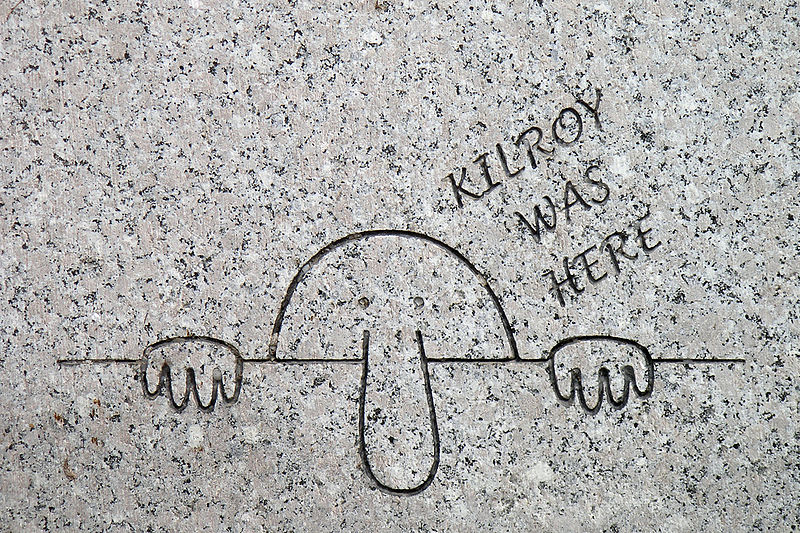
"American troops wrote 'Kilroy was here' on the walls of Europe in World War II in order to prove that somebody had been there." (Image by Luis Rubio.)
Matthew Hahn interviewed Hunter S. Thompson for The Atlantic in 1997, discussing the impact of the Internet on journalism and culture, among other matters. Thompson was particularly prescient about the ego-feeding nature of the Net. An excerpt:
“Matthew Hahn: The Internet has been touted as a new mode of journalism — some even go so far as to say it might democratize journalism. Do you see a future for the Internet as a journalistic medium?
Hunter S. Thompson: Well, I don’t know. There is a line somewhere between democratizing journalism and every man a journalist. You can’t really believe what you read in the papers anyway, but there is at least some spectrum of reliability. Maybe it’s becoming like the TV talk shows or the tabloids where anything’s acceptable as long as it’s interesting.
I believe that the major operating ethic in American society right now, the most universal want and need is to be on TV. I’ve been on TV. I could be on TV all the time if I wanted to. But most people will never get on TV. It has to be a real breakthrough for them. And trouble is, people will do almost anything to get on it. You know, confess to crimes they haven’t committed. You don’t exist unless you’re on TV. Yeah, it’s a validation process. Faulkner said that American troops wrote ‘Kilroy was here’ on the walls of Europe in World War II in order to prove that somebody had been there — ‘I was here’ — and that the whole history of man is just an effort by people, writers, to just write your name on the great wall.
You can get on [the Internet] and all of a sudden you can write a story about me, or you can put it on top of my name. You can have your picture on there too. I don’t know the percentage of the Internet that’s valid, do you? Jesus, it’s scary. I don’t surf the Internet. I did for a while. I thought I’d have a little fun and learn something. I have an e-mail address. No one knows it. But I wouldn’t check it anyway, because it’s just too fucking much. You know, it’s the volume. The Internet is probably the first wave of people who have figured out a different way to catch up with TV — if you can’t be on TV, well at least you can reach 45 million people [on the Internet].”
Tags: Hunter S. Thompson, Matthew Hahn
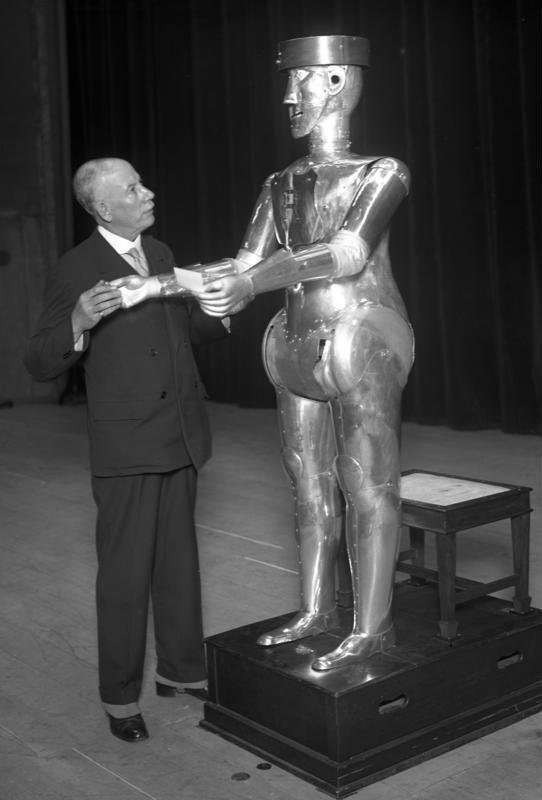
We’re so annoying even machines don’t want to talk to us. According to a BBC article, scientists are encouraging robots to develop their own words. An excerpt:
“The Lingodroid research project lets robots generate random sounds for the places they visit in both simulations and a real office.
The ‘words’ are shared and the robots play games to establish which sound represents which location.
The lexicon has proved so sophisticated that it can be used to help robots find places other robots direct them to.
The machines are being allowed to generate their own words because human language is so loaded with information that robots found it hard to understand, said project leader Dr Ruth Schulz from the University of Queensland.
‘Robot-robot languages take the human out of the loop,’ she said. ‘This is important because the robots demonstrate that they understand the meaning of the words they invent independent of humans.'”
J.G. Ballard speaking the truth in 1986. Seemingly even more spot-on today, though exhibitionism is now as much of a diversion as violence.
Tags: J.G. Ballard
“The Boy in the Bubble”
It was a slow day
And the sun was beating
On the soldiers by the side of the road
There was a bright light
A shattering of shop windows
The bomb in the baby carriage
Was wired to the radio
These are the days of miracle and wonder
This is the long distance call
The way the camera follows us in slo-mo
The way we look to us all
The way we look to a distant constellation
That’s dying in a corner of the sky
These are the days of miracle and wonder
And don’t cry baby, don’t cry
Don’t cry

"The bomb in the baby carriage is wired to the radio." (Image by Malene Thyssen.)
It was a dry wind
And it swept across the desert
And it curled into the circle of birth
And the dead sand
Falling on the children
The mothers and the fathers
And the automatic earth
These are the days of miracle and wonder
This is the long distance call
The way the camera follows us in slo-mo
The way we look to us all
The way we look to a distant constellation
That’s dying in a corner of the sky
These are the days of miracle and wonder
And don’t cry baby, don’t cry
Don’t cry
It’s a turn-around jump shot
It’s everybody jump start
It’s every generation throws a hero up the pop charts
Medicine is magical and magical is art
The boy in the bubble
And the baby with the baboon heart
And I believe
These are the days of lasers in the jungle
Lasers in the jungle somewhere
Staccato signals of constant information
A loose affiliation of millionaires
And billionaires and baby
These are the days of miracle and wonder
This is the long distance call
The way the camera follows us in slo-mo
The way we look to us all
The way we look to a distant constellation
That’s dying in a corner of the sky
These are the days of miracle and wonder
And don’t cry baby, don’t cry
Don’t cry
Tags: Paul Simon
For some reason in 1973, more Americans than usual imagined they were seeing UFOs. Maybe after trips to the moon, we thought we were due a visit of our own? Maybe the Vietnam-and-Watergate era was so surreal that everything felt alien anyway? Governor John Gilligan of Ohio, who thought he saw a saucer, is, of course, the father of Kathleen Sebilius, the current Secretary of Health and Human Services.
Tags: John Gilligan, Kathleen Sebilius, Walter, Walter Cronkite
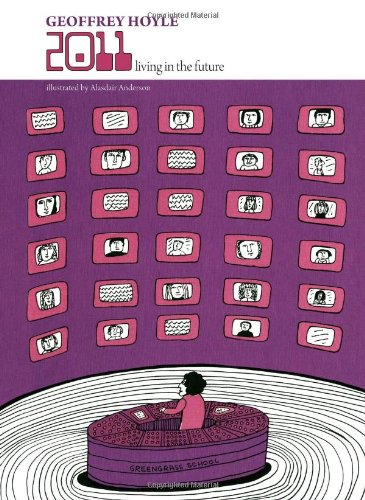
I have no love for science fiction as art or entertainment, but I really like the cultural visionary aspect of it. The Independent feeds that interest with an article by Simmy Richman about a sci-fi writer named Geoffrey Hoyle, who was asked in 1972 to write a book (2011: Living in the Future) for children that would predict what life would be like this year. His prognostications were amazingly correct. In the piece, Hoyle discusses what he got right and the aspects of contemporary life he simply doesn’t understand. An excerpt:
“‘Over the years politicians have added new thing to new thing and nobody has the intellect to wipe the slate clean and say, ‘What do we need?’ What have changed over the decades are the levels of bureaucracy, the control over our lives and the rise of the career politician with pop-star status. We live in a time where there’s a huge amount of disinformation and facts can be twisted to alarm or control. The original draft of the US constitution is 20 pages long; Brussels turns out thousands and thousands of pages – which says to me that no one knows how to make law [any more].’
So while Hoyle predicted both the large (the ubiquity of the computer, the invention of the smartphone and the microwave) and the small (Skype, home supermarket delivery, touchscreens and webcams) ways our lives have changed, he has no idea why the social model of Europe is still ‘tailored to the way people were living in 1947.'”
Tags: Geoffrey Hoyle, Simmy Richman

Long tail. (Image by megan ann.)
The opening of Chris Anderson’s “The Long Tail,” his famous 2004 Wired article about a shift in consumerism, propelled by the Internet, which the author later expanded into a best seller of the same name:
“In 1988, a British mountain climber named Joe Simpson wrote a book called Touching the Void a harrowing account of near death in the Peruvian Andes. It got good reviews but, only a modest success, it was soon forgotten. Then, a decade later, a strange thing happened. Jon Krakauer wrote Into Thin Air, another book about a mountain-climbing tragedy, which became a publishing sensation. Suddenly Touching the Void started to sell again.
Random House rushed out a new edition to keep up with demand. Booksellers began to promote it next to their Into Thin Air displays, and sales rose further. A revised paperback edition, which came out in January, spent 14 weeks on the New York Times bestseller list. That same month, IFC Films released a docudrama of the story to critical acclaim. Now Touching the Void outsells Into Thin Air more than two to one.
What happened? In short, Amazon.com recommendations. The online bookseller’s software noted patterns in buying behavior and suggested that readers who liked Into Thin Air would also like Touching the Void. People took the suggestion, agreed wholeheartedly, wrote rhapsodic reviews. More sales, more algorithm-fueled recommendations, and the positive feedback loop kicked in.
Particularly notable is that when Krakauer’s book hit shelves, Simpson’s was nearly out of print. A few years ago, readers of Krakauer would never even have learned about Simpson’s book – and if they had, they wouldn’t have been able to find it. Amazon changed that. It created the Touching the Void phenomenon by combining infinite shelf space with real-time information about buying trends and public opinion. The result: rising demand for an obscure book.
This is not just a virtue of online booksellers; it is an example of an entirely new economic model for the media and entertainment industries, one that is just beginning to show its power. Unlimited selection is revealing truths about what consumers want and how they want to get it in service after service, from DVDs at Netflix to music videos on Yahoo! Launch to songs in the iTunes Music Store and Rhapsody. People are going deep into the catalog, down the long, long list of available titles, far past what’s available at Blockbuster Video, Tower Records, and Barnes & Noble. And the more they find, the more they like. As they wander further from the beaten path, they discover their taste is not as mainstream as they thought (or as they had been led to believe by marketing, a lack of alternatives, and a hit-driven culture).”
••••••••••
Chris Anderson’s TED Talk about The Long Tail:
Tags: Chris Anderson
Douglas Coupland talking about the allure and repulsion he feels for plastics.
More Douglas Coupland posts:
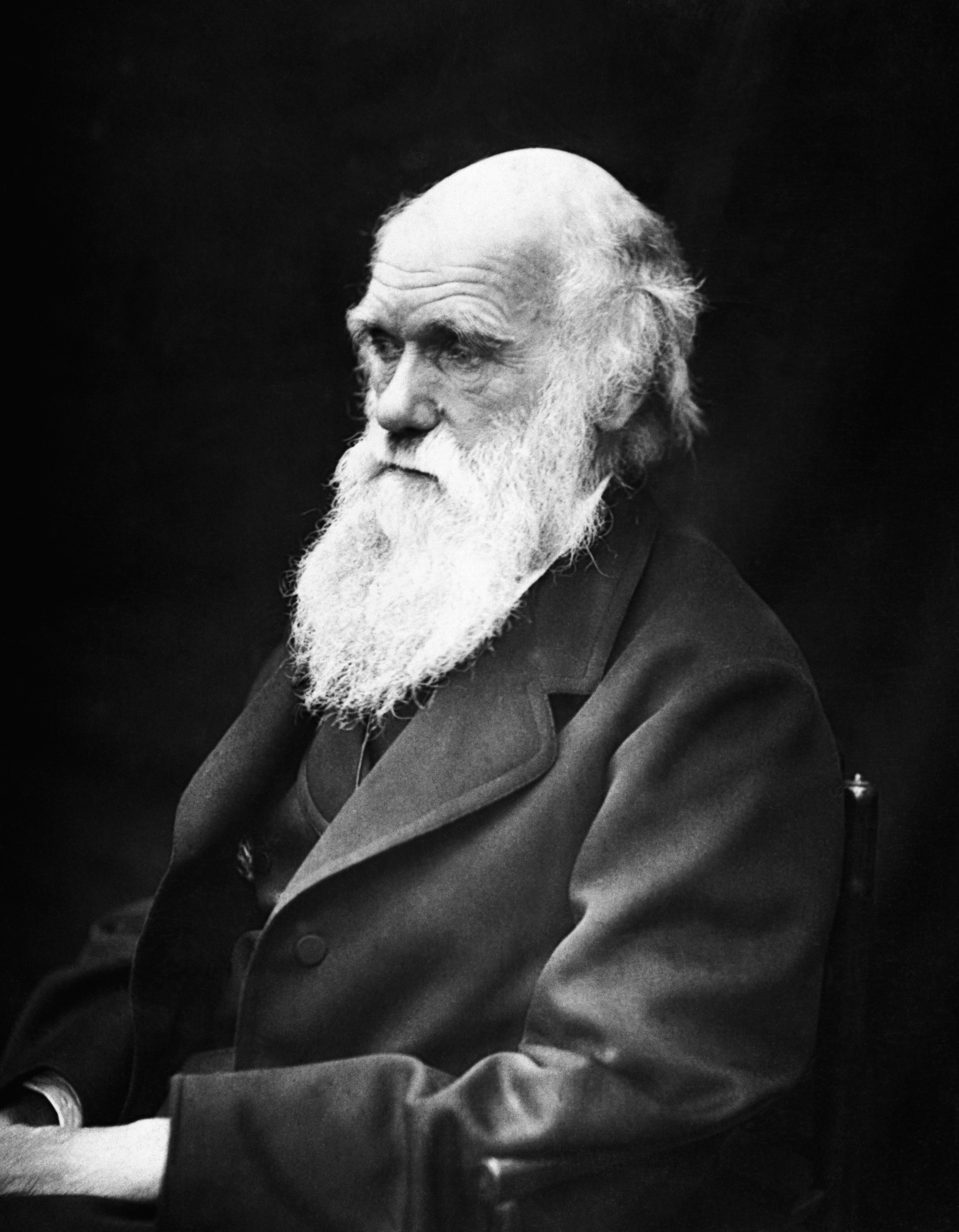
Charles Darwin: gassy mess.
On May 20, 1865, chronically ill Charles Darwin recorded the symptoms of his terrible stomach problems, which may been result of something called Cyclic Vomiting Syndrome:
“For 25 years extreme spasmodic daily & nightly flatulence: occasional vomiting, on two occasions prolonged during months. Vomiting preceded by shivering (hysterical crying) dying sensations (or half-faint). . ringing in ears, treading on air and vision. (focus and black dots) . . . (nervousness when E. [Emma] leaves me)—What I vomit intensely acid slimy (sometimes bitter) consider teeth.” (Thanks Why Evolution Is True.)
Tags: Charles Darwin
Monsanto’s House of the Future was displayed at Disneyland from 1957-67.
Jack Schmitt taking a tumble during the final manned lunar mission in 1972.
Tags: Jack Schmitt

In this week’s Sunday Times Magazine, Andrew Goldman has a smart interview with Jimmy Lai, the Chinese clothing retailer-cum-media mogul behind those insane (and insanely popular) animations of scandalous news stories. Lai’s explanation for what he does is honest and simple and blunt and a little depressing. An excerpt:
“You own magazines and newspapers in Hong Kong and Taiwan and have been called the Rupert Murdoch of Asia — and yet you’re best known here for your company’s very enjoyable and weird animated re-enactments of news events. The one you did for Tiger Woods’s Thanksgiving-weekend car accident got more than five million YouTube views. Why did you get into animation?
I started the animations because print media was going into a sunset business environment. It’s obvious that we have arrived at an era of images. I thought that if I could speed up the production of animation, I could make a big business out of recreating the amazing images of the news, because what we get on TV is always the last bit of image. What happened before that image is always missing.
You mean that all we ever see is the wreckage after the plane crash, not the crash itself?
Exactly. We don’t see the pilot flying the plane drunk and what happened in the cabin. If somebody jumped off a roof, we only see the body even though we know that eight months ago, the guy might have gone to Macau, lost a lot of money in a casino, was chased by a loan shark, so he got depressed and decided to jump off a roof.
So you envision these animations as a substitute for reading news?
Exactly. If I hold an image in front of you, you can right away assimilate a story that may take me 20 minutes to explain or take you 10 minutes to read.”
••••••••••
Tags: Andrew Goldman, Jimmy Lai, Jimmy Lui
I’ve yet to see better etiquette from a gun-wielding, TV-shooting American. He’s like Miss Manners with an ammo belt. Some folks raise their kids right.
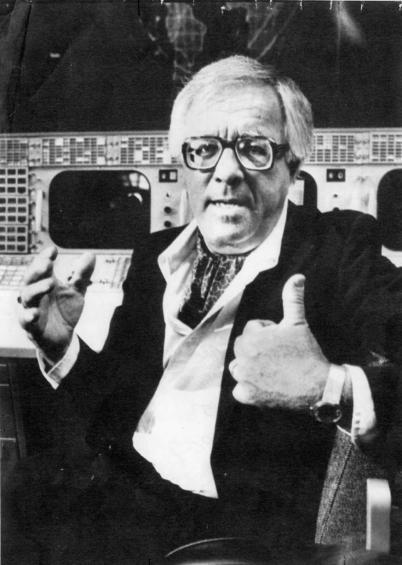
Ray Bradbury interviewed by Mike Wallace on the night of the first moon landing. He was ebullient, of course, but probably somewhat more restrained than Arthur C. Clarke and Robert A. Heinlein.
Tags: Mike Wallace, Ray Bradbury

Excellent new post by Robin Hanson on the Overcoming Bias site explaining why autopsies are conducted so rarely as opposed to a few decades ago. Problems can’t be fixed if they’re disappeared, and our squeamishness on the topic probably allows hospitals to get away with the practice. An excerpt:
“What if the airline industry lobbied to end the practice of routinely investigating the cause of each airline crash? After all, if there is no investigation, it will be hard to show an airline was at fault. You might imagine there’d be a public outcry. But in 1970 the US medical profession did essentially the same thing, and few complained:
Today, hospitals perform autopsies on only about 5 percent of patients who die, down from roughly 50 percent in the 1960s. … Autopsies play a critical role in helping to advance understanding of the progress of a disease and the effectiveness of various treatments. At the same time, they may identify medical conditions that clinicians and high-tech imaging miss or misdiagnose. …
In 1998 the Journal of the American Medical Association reported that autopsy results showed that clinicians misdiagnosed the cause of death up to 40 percent of the time. … Until 1970, hospitals had to autopsy at least 20 percent of their patients in order to remain accredited. Once that requirement was dropped, autopsy rates began to fall, due to lack of direct funding, fear of litigation and increasing reliance on technology as a diagnostic tool, among other reasons. … Today, about 40 percent of hospitals don’t perform autopsies at all.” (Thanks Marginal Revolution.)
Tags: Robin Hanson
A 1988 panel discussion about the origins of our universe and more, with an amazing lineup: Carl Sagan, Arthur C. Clarke and Stephen Hawking.
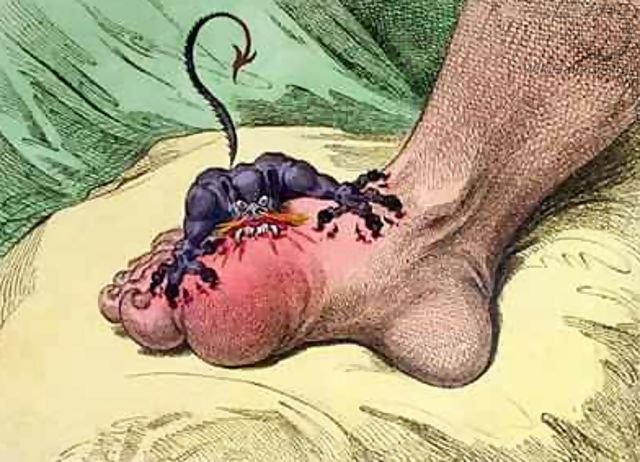
The Gout.
From the August 12, 1877 Brooklyn Daily Eagle:
“Christopher Tenney, aged 35, of No. 70 South Washington Square, New York, has been sick for several days with cholera morbus, and was also troubled with the gout. This morning he took a large dose of gout medicine in a mistake, and soon afterward died. Coroner Flanagan has been called to investigate the case.”
Tags: Christopher Tenney
Treebot–from Hong Kong to your heart. (Thanks IEEE Spectrum.)
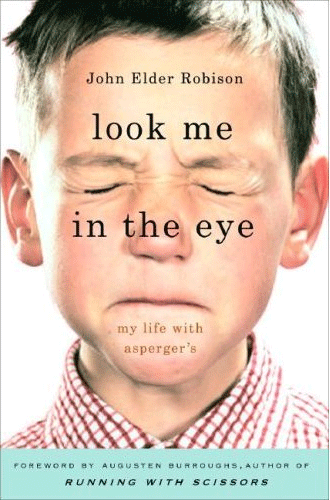
Excellent post on the NeuroTribes blog by Steve Silberman about John Elder Robison, an author and auto mechanic with Asperger syndrome. An excerpt:
“John Elder Robison would stand out in a crowd even if he didn’t have Asperger syndrome. A gruff, powerfully built, tirelessly curious, blue-eyed bear of a man, he hurtles down a San Diego sidewalk toward a promising Mexican restaurant like an unstoppable force of nature. ‘What’s keepin’ you stragglers?’ he calls back to the shorter-legged ambulators dawdling in his wake.
As they catch up, Robison utters his all-purpose sound of approval — ‘Woof!’ — which he utters often, being a man in his middle years who is finally at peace with himself after a difficult coming-of-age. For the acclaimed author of the 2007 New York Times bestseller Look Me in the Eye, a diagnosis of Autism Spectrum Disorder in mid-life was liberating, giving a name to the nagging feeling that he was somehow different from nearly everyone around him.”
••••••••••
Robison speaking at GoogleTalks:
The great Open Culture points out that the much-loved 1963-1988 nature TV program, Mutual of Omaha’s Wild Kingdom, has a Youtube channel with some great footage. Hosted by zoologists Marlin Perkins and Jim Fowler, the show raised environmental awareness and made it perfectly clear that the ecosystem was not something to be tampered with. And in years before cable and the Internet, this program, along with Wide World of Sports, introduced Cold War-era Americans to far-flung corners of the world they were supposed to ignore or fear.
Watch the “Land of Quaking Earth” episode, which features a reel-to-reel tape player and a monkey in a yellow suit slapping the crap out of an owl:
A wild tale about the normally mild-mannered Perkins from the Canadian Broadcasting Corporation site: “Of course, asking the difficult question can be hazardous to a host’s health. In 1982, the fifth estate investigated whether the many nature documentaries interfered with nature for dramatic purposes. Bob McKeown reported how a Disney documentary showing the phenomenon of lemmings plunging to their death over cliffs had in fact been the same film footage spliced together to give the appearance of mass suicide. When McKeown interviewed zoologist Marlin Perkins, host of Wild Kingdom about truth and fiction on wildlife programmes, he clearly hit a raw nerve. The octogenarian Perkins firmly asked for the camera to be turned off, then punched a shocked McKeown in the face.”
Tags: Bob McKeown, Jim Fowler, Marlon Perkins