When acclaimed artist Vanessa Beecroft splatters blood red paint over 30 topless female models who lie sprawled on a canvas, she weds Pollock’s drip-paint method to a genocide motif. It’s disturbing to see, but the models are adults and they will shower the paint off and a provocative sort of large-scale human sculpture has been created. But when Beecroft impetuously decides to adopt twins she encounters during a photo shoot in the Sudan, art meets life in a disturbing way that can’t just be washed away.
Pietra Brettkelly discomfiting documentary, The Art Star and the Sudanese Twins, doggedly traces Beecroft’s African adoption odyssey. The children are living in an orphanage, but they have a father and extended family. Authorities are understandably wary of this intense white woman with serious depression and OCD issues who wants to adopt the twins and move them to New York. Beecroft gives the family thousand-dollar bills as incentive to let her take the children, and this money allows the clan to bring the boys home and raise them in a healthy environment. But Beecroft doesn’t seem to notice that she could be more helpful to the children with small cash gifts to their relatives because her mission has more to do with her dubious needs than the twins’ real ones.
When Beecroft’s exasperated husband acknowledges that his wife is obsessed with the controversial adoptions of African children by Angelina Jolie and Madonna, a revulsion sets in. And since Beecroft travels extensively and often has others raising her birth children, you just feel happy that her spouse isn’t going along with the adoption plans. Brettkelly’s film isn’t easy to watch, but it’s an insightful documentary that stubbornly paints an extreme psychological portrait.
Don't move so fast, Pelé. I have to set up my tripod.
Giants Stadium has had its final football game, but for a brief period in the late ’70s, the stands were packed for the other kind of football. The New York Cosmos of the North American Soccer League was an international glamor team of stars winding down their careers–and no star was bigger than Pelé. The Brazilian sensation, now 69, has curated a slideshow of spectacular photos of his career for Life.com. Of course, there are shots of Pelé making his amazing bicycle kick, scoring spectacular goals and meeting all manner of dignitaries. But there’s also a surprising one of him playing goalie, which he did occasionally in his career. The images are well worth checking out.
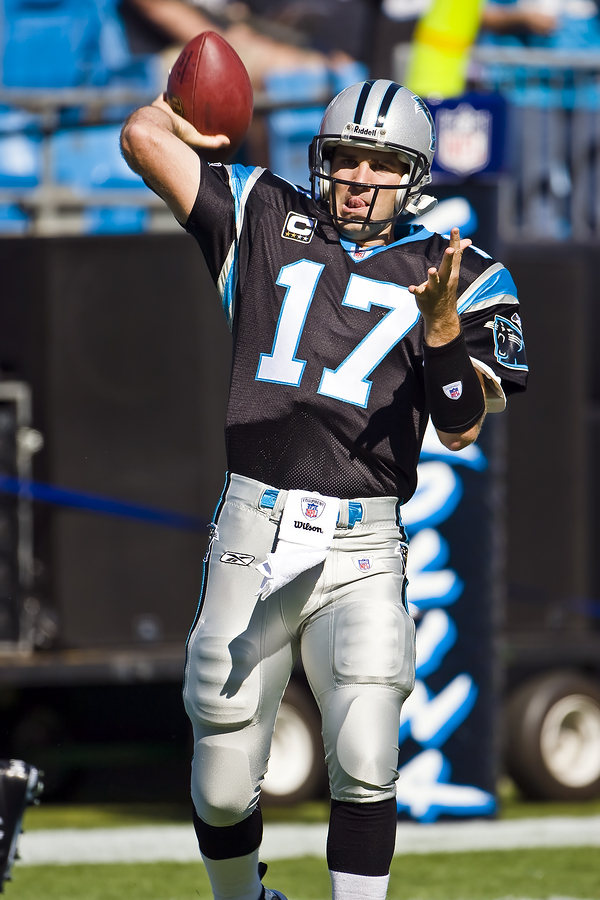
Jake Delhomme: a name as lackluster as his quarterback rating.
As we prepare for the NFL Playoffs, let us celebrate the great player names of the league. It was a brutal competition; even Sen’Derrick Marks couldn’t make the list. Today (in alphabetical order) we focus on the great names of the AFC.
I am angry because my people, the whites, have been oppressed for too long!
Soft-headed demagogues like Sarah Palin try to draw a divide between American small towns and urban centers during election season, but similar problems plague both segments of our society: education, drugs, poverty, health care, etc. I came across The Rural Brain Drain, a smart article by married sociologists Patrick J. Carr and Maria J. Kefalas in a September Chronicle Review that articulately addresses how both the city mouse and the country mouse often end up in the same trap.–though, yes, the problems are more dire in small towns. They also offer some common-sense solutions. An excerpt:
“The Harvard University sociologist William Julius Wilson famously describes how deindustrialization, joblessness, middle-class flight, depopulation, and global market shifts gave rise to the urban hyper-ghettos of the 1970s, and the same forces are now afflicting the nation’s countryside. The differences are just in the details. In urban centers, young men with NBA jerseys sling dime bags from vacant buildings, while in small towns, drug dealers wearing Nascar T-shirts, living in trailer parks, sell and use meth. Young girls in the countryside who become mothers before finishing high school share stories of lost adolescence and despair that differ little from the ones their urban sisters might tell.”
India: a country with lots of free time in between filming Bollywood epics.
From the outside, India would appear to be a fascinating country. But how do you explain the South Asian Republic being the first foreign nation of the year to visit Afflictor.com? Sure, Austria and the Netherlands are bored, but India’s the most populous democracy in the world and do you know how long it takes to count all those votes? Is Rajesh Khanna no longer sufficient entertainment for you and your friends, India? Is Virender Sehwag a batsman who no longer thrills? Whatever it is, you’re already here, so let’s do one of those Jai Ho dance numbers together. I’ll go look for my sherwani.
Because ice hockey, blue jeans and great lyrics never go out of style, I’m posting this classic 1979 video of the disco age. Sasson was a ubiquitous name in that first burst of designer denim during the ’70s, before an ebb in the craze and poor management decisions led to bankruptcy and criminal charges. (In Hebrew, Sasson means “happiness.”)
The Rangers of the ’70s and ’80s never brought a Stanley Cup to the Garden, but they were big celebrities. Ron Duguay was sort of a proto-Bon Jovi on skates–a guy who got by on good looks and okay talent. Phil Esposito, who later became the team’s GM, was inducted into the Hockey Hall of Fame in 1984. And simply put, the man was an exquisite ice dancer.
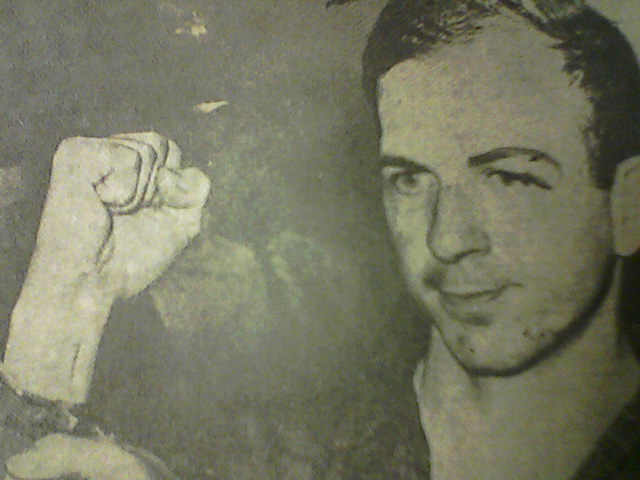
Lee Harvey Oswald shackled and clenched after his arrest in Dallas.
Briefly got my hands on a yellowing copy of the Long Island Press from November 22, 1963, the day after President John F. Kennedy was assassinated. The Press (which cost 5 cents) bore the headline: “Marxist Held As JFK Assassin; Johnson Meets With Rusk, Ike.”
The opening paragraph of the UPI story read: “Lee Harvey Oswald, an avowed Marxist and a Fidel Castro sympathizer, was charged today with the assassination of President Kennedy. Manacled, his face cut and bruised, his manner sullen, the 24-year-old political misfit and Marine reject was booked on a murder charge and jailed without bond. ‘This is ridiculous,’ Oswald said.”
The story unsurprisingly dominated nearly every section of the paper, from local (“Long Islanders React: He Was My Friend”) to sports (“AFL Erases Sunday Slate”). A few pre-packaged elements of the paper were untouched by the tragic events of the day. There was an ad for the Jack Lemmon romantic comedy Under the Yum-Yum Tree, playing at the Prudential Drive-In. In the classifieds, you could rent a 2 1/2 to 4 bedroom apartment for $109 in Jamaica, Queens; and a 2-story split colonial on Long Island cost $13,490. The Help Wanted ads were still openly sexist, with “Help Wanted–Male” clearly marked at the top of most of the advertisements.
The Long Island Press published for 156 years, going out of business in 1977.
From Maren Ade to Terry Zwigoff, there are close to 100 directors who did exceptional work over the past decade yet don’t have a film on Affllictor’s Top 20 Films of the Aughts list. But the difficult paring-down process is complete. In alphabetical order, here are the lucky devils who made the grade:
Reyner Banham was an interesting figure in urban studies in the ’60s, ’70s and ’80s. Born in England, he fell in love with Los Angeles as a child, while devouring Hollywood-set silent movies. As an adult, he became a foremost architecture critic in an age when that profession barely existed, focusing a great deal of his writing on L.A. He died in 1988, just as he was about to move to New York to teach at NYU. At the time of his death, architect Philip Johnson asserted that Banham was “really one of the founders of architecture criticism, which has now become a worldwide profession.”
In 1972, the down-to-earth academic was the subject of a fun 51-minute BBC documentary, Reyner Banham Loves Los Angeles, that had him act as tour guide through the city he loved best. Watch for the amusing scene that has his friend, the artist Ed Ruscha, explain to Banham why the architecture of L.A. gas stations is so great.
The Netherlands: a country devoid of entertainments.
Austria was the first foreign country to have a citizen visit Afflictor.com, so it became widely known as the most bored place on Earth. But a certain parliamentary democratic constitutional monarchy known as the Netherlands rose to the challenge this week when one of its spiritless residents visited Afflictor. Who was the first browser from the Netherlands? Perhaps it was Dutch Interior Minsiter Guusje ter Horst. She doesn’t look like she has a whole lot going on. Maybe high-jump champion Frenke Bolt put her clothes on long enough to surf the web. Regardless, Austria and the Netherlands find themselves on opposite sides of a brutal struggle, much like during WWII. Fight fair, people.
The New York Times Sunday Magazine published its wonderful annual “The Lives They Lived” issue last weekend and Nicholas Davidoff wrote a perfect send-off to the late, briefly great Detroit Tigers pitcher Mark “The Bird” Fidrych. It’s hard to explain the appeal the gangly, eccentric Fidrych held for children of that era. He was athlete, Muppet and rock star all at once. He was the awkward kid who grew to greatness without losing his awkwardness. Because of injuries, his career was sadly brief; because of an accident, his life tragically so. From the article:
“We had sensed how well he understood childhood. I was not the only self-conscious adolescent who on a sad day decided to tell a baseball about it. Seeing an adult acting like a boy also made the promise of growing up seem attractive. That a man could behave strangely and be applauded led you to think that eccentricity might be a virtue.
Any great athlete’s career represents a life span in miniature, an early lesson in mortality. Fidrych’s allotted days were as evanescent as his baseball career. Last spring, at 54, while he was repairing his dump truck, his shirt got caught in the drive shaft and he suffocated. There is something particularly brutal about the pitcher who publicly played with dirt being killed by the vehicle he used to carry it, as there is about a man who died young twice.”
Odd product names always exist, but they usually only seem odd in retrospect. The classic example is the Ayds diet plan, which existed long before the scourge of AIDS began ravaging people. The product line was, of course, discontinued. But ransom existed before J. Dawson Ransome named his commuter airline business in 1966.
Ransome Airlines, a fleet of commuter planes headquartered in Philadelphia, operated for 20 years before being sold to Pan Am and renamed. Ransome, a WWII Air Force vet who passed away in 2002, was apparently a beloved person, as his employees continue to hold reunions and speak highly of him. Still, he probably should have gone with “Dawson” Airlines.
Jurassic Park is fiction but a growing group of paleontologists have their sights set on reanimating dinosaurs. Jack Horner and James Gorman’s book, How to Build a Dinosaurwas featured on 60 Minutes recently. The authors believe that DNA material from prehistoric creatures found on paleontological expeditions can be used to create real dinosaurs. (Unsurprisngly, Horner was the inspiration for the lead paleontologist character in Jurassic Park and served as a technical advisor on the film.)
At the same time, McGill University scientist Hans Larsson, inspired by Horner’s work, is attempting to manipulate chicken embryos to reanimate dinosaur traits that disappeared millions of years ago. Every bird on Earth is a descendant of dinosaurs, so it seems like it may be possible. An excerpt from a recent Telegraph article:
“Larsson believes by flipping certain genetic levers during a chicken embryo’s development, he can reproduce the dinosaur anatomy. Though still in its infancy, the research could eventually lead to hatching live prehistoric animals, but Larsson said there are no plans for that now, for ethical and practical reasons — a dinosaur hatchery is ‘too large an enterprise.'”
I got my designer jeans on, ladies. Let's go boogie at Studio 54.
During a grungier era in New York, Rolling Stone published an issue dedicated to the city. The October 6, 1977 edition bore a cover with a Warhol silkscreen treatment of pioneering female politician Bella Abzug. (It was Abzug who first said “You have to be a little crazy to live in New York.”) Writers fixated on Abzug’s hats the way they do with Hilary’s pantsuits. With female politicians, it always seems to be about the clothes.
There’s an interesting article titled “Elliot Murphy’s New York,” in which the singer-songwriter, novelist and journalist lists some of his favorite places of the moment. Murphy was raised in the city by the family that owned Aquashow. a water ballet arena that was located on the former World’s Fair grounds. During Murphy’s childhood, big-band concerts by Duke Ellington, Count Basie and others took place there.
One of Murphy’s favorite places of the moment was Fiorucci, a designer clothes outlet right near Bloomingdale’s that sold skintight jeans suitable for Studio 54 to Madonna, Cher, Marc Jacobs, etc. (It closed in 1984.) Murphy writes: “I have seen 50-year-old women walk into Fiorucci and ask one of the dancing salesmen (disco music is omnipresent) what is the latest thing. I have seen these same women walk out in gold láme hot pants. When you buy jeans at Fiorucci they fit them as tight as they can. I think this is a form of Italian birth control. Fiorucci clothing is usually very well-made though with the way fashion changes these days, by the time it makes it through the third wash it’s out of style anyway.”
A girl too wary of commitment meets a boy too given to believing that true love conquers all in Marc Webb’s bittersweet Los Angeles-set 2009 romantic comedy (500) Days of Summer.
Zooey Deschanel and Joseph Gordon-Levitt, young royalty of indie cinema, play the couple in question, who meet while working for a greeting card company. The buoyant film shifts back-and-forth to different moments of their tortured 500-day relationship. Deschanel is Summer, wry to the core and phobic about being someone’s girlfriend. Gordon-Levitt is Tom, a lapsed architecture student too in love with Summer to see dark clouds gathering. Because their relationship is presented non-chronologically, a scene in which they watch The Graduate together doesn’t deliver its full emotional impact until later on. That passage feels as mysterious and painful as falling out of love.
The inventive script from Scott Neustadter and Michael H. Weber is too busy and restless for its own good at times, but it is full of personality and warmth. For every voiceover or quirky touch that isn’t necessary, there are impromptu joyous scenes, like the dance sequence to a Hall & Oates tune that works wonderfully. The film may not make your dreams come true, but it feels true.
Jake Delhomme gets his whole body into that interception.
I know the NFL has bigger issues than fixing overtime. The players have non-guaranteed contracts, concussion syndrome has thankfully become a subject du jour and one very geeky journalist is fairly questioning the moral justification for the sport’s existence. But I like trying to solve problems, so I’ll have a go at fixing the inequitable system of NFL overtime.
The problem. In the current system, which started 35 years ago, a coin flip determines which team gets the ball first in OT. Since it”s sudden death, that first possession is key and the team that gets the ball first wins more games by a few percentage points. Chance shouldn’t determine the first and potentially only possession.
The changes I’d make. In order to favor merit over luck, there’d be no more coin toss. If there is a tie at the end of regulation, a 10-minute overtime period would begin from exactly where the action stands at the end of regulation. Even if one team scores, the ten minutes will be played to completion. If the game is tied at the end of this period, a horn will sound and a five-minute sudden-death period will commence from where the action stands. The first team that scores in this period wins. If neither team scores, the game is a tie. In playoffs, the five-minute sudden-death portion continues until there is a winner.
The ass kissing. That pretty boy NFL Commissioner Roger Goodell needn’t thank me if he’s busy. It would be nice, sure.
On Edge, Stanford neuroscientist Robert Sapolsky has a fascinating examination of how parasites can affect the behavior of their hosts, even mammalian hosts like your or I. In particular, he discusses the effects of Toxoplasma or Toxo. This parasite, which grows in the stomachs of cats, can play havoc with the thought process of rats that come into contact with cat feces, but it also seems to be linked to schizophrenia and reckless behavior in humans. Doctors have often reported high levels of Toxo in the organs of people who’ve driven recklessly and gotten into motorcycle and automobile accidents. Sapolsky worries that Toxo’s knack for obliterating rational decision making could be used for nefarious means through bioengineering. An excerpt:
“You want to know something utterly terrifying? Here’s something terrifying and not surprising. Folks who know about Toxo and its affect on behavior are in the U.S. military. They’re interested in Toxo. They’re officially intrigued. And I would think they would be intrigued, studying a parasite that makes mammals perhaps do things that everything in their fiber normally tells them not to because it’s dangerous and ridiculous and stupid and don’t do it. But suddenly with this parasite on board, the mammal is a little bit more likely to go and do it. Who knows? But they are aware of Toxo.”
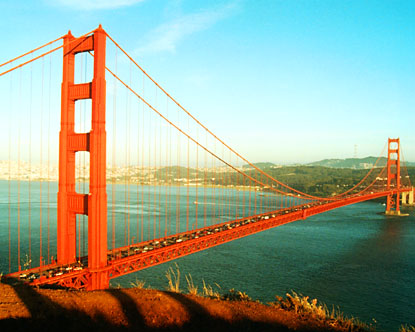
Inept government has never caused the closure of the Golden Gate Bridge, but high winds have shut it down three times.
The resolutely excellent Newmark’s Door pointed me to this devastating article about the utter mismanagement of San Francisco by its corrupt, incompetent government. An excerpt from theSan Francisco Weekly article:
“The city’s ineptitude is no secret. “I have never heard anyone, even among liberals, say, ‘If only [our city] could be run like San Francisco,'” says urbanologist Joel Kotkin. “Even other liberal places wouldn’t put up with the degree of dysfunction they have in San Francisco. In Houston, the exact opposite of San Francisco, I assume you’d get shot.”
Who is to blame for this city’s wretched state of affairs? Yomi Agunbiade, that’s who. Metaphorically, that is.
An engineer by trade, Agunbiade was appointed by Mayor Gavin Newsom to head the San Francisco Recreation and Park Department in 2004. Even before Agunbiade’s tenure, Rec and Park was the department other city departments pointed and laughed at — but under Agunbiade, it became Amy Poehler funny.
During his reign, an audit revealed, rec centers frequently didn’t open, because staff simply didn’t show up — and the department had no process to do anything about it. Good news: New rec centers were slated to open. Bad news: Agunbiade’s department had no plan for how to staff them. But that wasn’t enough to cost Agunbiade his job.”
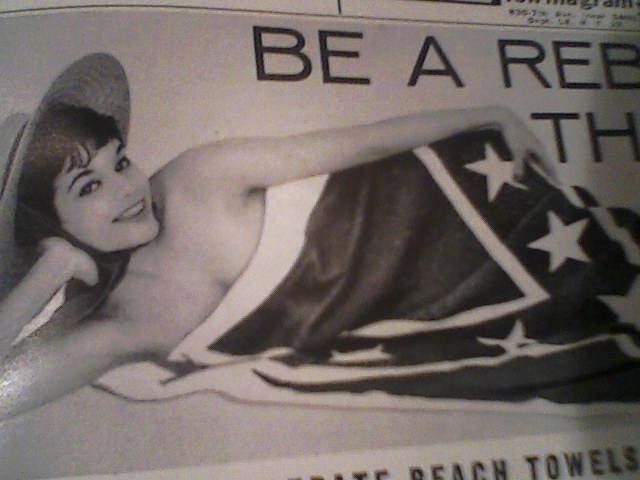
Orders for the towel were processed out of an office at 305 Madison Avenue.
This very non-PC advertisement for Confederate Beach Towels can be seen in the July 1960 issue of Esquire. An appropriate covering for the Jesse Helms Sand Castle Tournament, this wrap cost $4.95. The copy promises: “You don’t have to risk Yankee gunfire to cover yourself with glory on this quality 6′ by 3′ Cannon beach towel with the stars and bars ingrained in blazing red, white and blue.”
Printed on large Life-size paper, this 152-page issue was a special edition that focused exclusively on New York City. Despite a formidable roster on contributors (James Baldwin, Truman Capote, Salvador Dali, etc.), it’s not a particularly inspired issue. Publisher Arnold Gingrich had yet to appoint Harold Hayes as Editor-in-Chief. (Both Hayes and legendary New York magazine founder Clay Felker were already on the masthead.) After Hayes ascension to the top post, he would team with designer George Lois to make Esquire during the ’60s arguably the best American magazine in the history of the business.
It was incredibly exciting this week at the Afflictor.com offices in Brooklyn when we crunched the data and realized our site had its first visitor from Austria. We were mostly excited because we read the info quickly and initially thought it said “Australia.” But still, it’s something, right? Thank you, Austria, for your interest, for your business and for letting us know that you have absolutely nothing to do in your own country. You would think you’d pass time by eating Krapfen or skiing or listening to Mahler, but apparently not. We’re bored, too. God bless.
Maria Onetto actually has a head. The title's just a metaphor.
Psychological horror that is subtle and engrossing, The Headless Woman is just the latest reason why Argentine director Lucretia Martel, earlier of La Ciegna and The Holy Girl, is a major force in contemporary cinema.
In The Headless Woman, Veronica (Maria Onetto) is a bourgeois woman who hits something–a dog? a person?–while driving on a lonely dirt road. She also hit her head on the steering wheel and proceeds to the ER, though she mentions nothing of a possible victim to anyone. When she finally breaks down and tells her overprotective husband that she fears she may have killed someone, he makes sure every trace that could tie her to a possible murder vanishes.
Instead of feeling relieved, Veronica is disquieted by how easy it for her to be disappeared from life. And all the while, her interactions with family and friends expose the frustrations and disappointments hidden within her well-appointed life. Onetto is marvelous as a woman not sure if she is plagued by nightmares or reality. And the slow burn she displays right down to the quietly devastating conclusion is masterful.
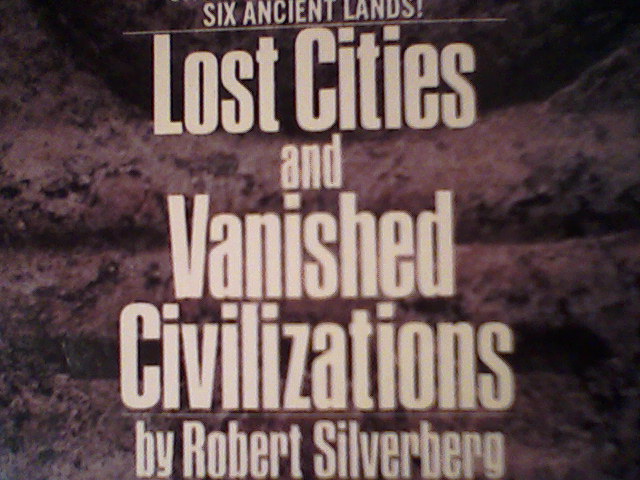
Archaeologists believe they may have discovered the lost city of Atlantis, so it seems appropriate to excerpt Robert Silverberg’s out-of-print 1962 book, Lost Cities and Vanished Civilizations. (Pictured is a 1974 paperback version that cost 95 cents at the time.) Silverberg has enjoyed great success as a science-fiction writer, and this quote about Pompeii sounds very sci-fi but is very real:
“Pompeii was a busy city and a happy one. It died suddenly in a terrible rain of fire and ashes. The tragedy struck on the 24th of August, A.D. 79. Mount Vesuvius, which had slumbered quietly for centuries, exploded with savage violence. Death struck on a hot summer afternoon. Tons of hot ashes fell on Pompeii, smothering it, hiding it from sight. For three years the sun did not break through the cloud of volcanic ash that filled the sky. And when the eruption ended, Pompeii was buried deep. A thriving city had perished in a single day. Centuries passed…Pompeii was forgotten. Then, 1,500 years later, it was discovered again.”
Never enjoyed the market dominance of Connect Four.
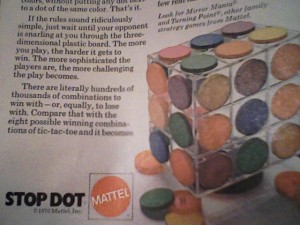
This print ad for a Mattel game called Stop Dot comes from the October 30, 1970 issue of Life magazine. The issue cost 50 cents and had a cover story about Dick Cavett, who was then turning out for ABC what still is the best talk show ever produced on U.S. television. Most of the Cavett article focuses on how nervous he was about performing on TV. There is a gallery of work by Austrian photographer Hans-Peter Klemenz. an advertisement for the unfortunately titled AYDS Diet Plan, an article about Ronald Reagan’s presidential aspirations, a piece about separatist violence in Quebec, a story about an Australian Outback tough guy Larry Dulhunty and a long piece about Double Helix scientist James Watson and his search for a cure for cancer.
The advertisement for Stop Dot game refers to the 3-D toy as “that op-art looking thing.” The instructions are as follows: “To win, you have to make a straight row of five dots in five different colors, without putting any dot next to a dot of the same color.”
The product apparently never caught on. According to Boardgamegeek.com, the game was manufactured by Mattel only in 1969. There are two for sale currently on eBay, one for $7.99 and one for $69.95. This particular issue of Life magazine currently sells on eBay for anywhere from $1.99 and $24.99.
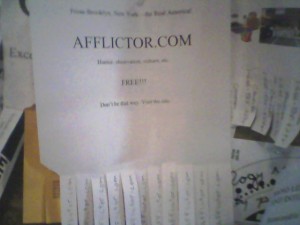
By now you’re probably tired of seeing Afflictor.com’s advertising blitz everywhere. We’ve pretty much saturated TV, radio, billboards, blimps and the web with our brilliant and some would say titillating campaign. In our goal to be the most visited site, we have spared no expense. How is the effort going so far? Pretty well. The first tangible sign of success was seen on Tuesday when somebody tore off a strip of paper bearing the URL from the lower left-hand side of our flyer at the copy shop. Boo-yeah, people! You are the wind beneath our fucking wings!
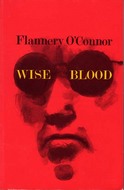
If he had created only the “I ♥ New York” logo or themulticolored Bob Dylan poster, Milton Glaserwould have secured a place in design history. but he’s done so much more in his 80 years, co-founding New York magazine and doing an unbelievable quantity and quality of work in print, environmental and interior design, posters, etc. My single favorite work of his is a rather obscure book cover he created for theFlannery O’Connor novel, Wise Blood.
O’Connor was a master of the short story and this novel never quite reached the level of the three stories she’d written earlier about Hazel Motes and Enoch Emery. But Glaser’s image of a vague thumbprint-ish face under dark glasses is hypnotic and speaks to the book in literal and figurative ways. It’s just about perfect.
Visit Glaser’sofficial siteto see his numerous other designs.