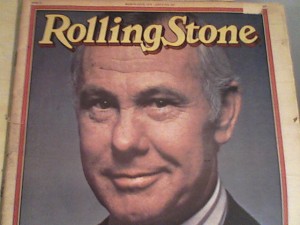
Carson had his own clothing line, which was sold by Sears in 1984-1985.
Rolling Stone still had a paper cover in 1979 and resembled the average alt-weekly in its materials and design. Janet Maslin gave a favorable review to Elvis Costello’s new album, Armed Forces. And Graham Nash was “making a concerted effort to stop nuclear power.” (Thanks for handling that one, Graham.) Johnny Carson had another 13 years to go in his reign as the “King of Late Night.” He touched on one of the reasons for his enduring popularity:
“I like to work with elderly people and children. I don’t know why I respect older people. I like working with kids. Maybe it’s the vulnerability of them. There’s a charm about older people that sometimes is childlike, and I enjoy them, first of all, because they can say anything they want to, which is just great. Age gives you a leg up on what you can say because you don’t have to account to anybody. You’ve lived and learned your right to sound off. They’ll just say. ‘Oh, well, screw that. I don’t like that, that’s a lot of shit.’ And they lay it right out.”
Tags: Elvis Costello, Graham Nash, Janet Maslin, Johnny Carson

Say "cheese," you damned planet Earth.
I don’t know if it was Boing Boing or Kottke that first pointed me in the direction of the great photography site, The Big Picture, but I’m grateful to whichever it was. Currently featured is the amazing “2009 in Photos,” which covers everything from Obama’s inauguration to the June political riots in Tehran. My personal favorites are the eye-popping shots from the Hubble Space Telescope. Feast on the three-part feature.
Tags: 2009, Barack Obama, Boing Boing, Iran, Jason Kottke
Not the "Greatest Mafia Movie Ever Made" but really good.
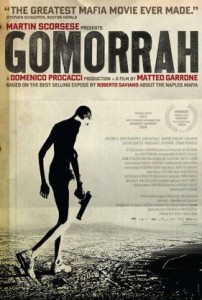
Somewhat overpraised at the the time of its U.S. release in 2008–”Greatest Mafia Movie Ever Made,” declared the Boston Herald–Matteo Garrone’s Gomorrah is nonetheless an accomplished and gritty mob film with superb cinematography. Anchored in a Napoli housing project, Gomorrah uses the very-real exploits of the Camorra crime family to fashion a workaday, hyperviolent world of shakedowns, beatdowns, murders and gang wars. In addition to the usual drugs, guns and extortion rackets, the family members have branched out into the very profitable business of chemical dumping–very profitable for the survivors, at least.
What distinguishes the movie most, however, is color scheme and composition used by Garrone and his cinematographer Marco Onorato. Scenes in tanning parlors and hallways are shot with a sickening green-yellow hue that emanates from fluorescent bulbs like a miasma. Other scenes frame gorgeous architecture and sculpture in the background of mob dealings, juxtaposing a country of brilliant antiquity and modern thuggery. They’re images that persist, refusing to let the mob ugliness fade after the blood dries.
Tags: Gomorrah, Marco Onorato, Matteo Garrone
The chin strap interferes with my smoking.
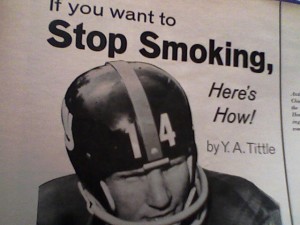
From a March 1968 copy of Life magazine comes this print ad for a smoking-deterrent tablet called Bantron. The spokesperson in the ad is former New York Giants quarterback Y.A. Tittle. From Tittle’s testimonial:
“After my doctor advised me to stop smoking I made many starts–with no success. Just as I needed help on the football field, I found that desire, alone, wasn’t enough to stop smoking. Then Bantron was recommended to me by a friend. Bantron did the job! I stopped smoking completely in 5 days and I’m proud to say I haven’t smoked in well over a year. It’s like quarterbacking my team to a championship. It’s a real accomplishment.”
Bantron, which featured the active ingredient lobeline sulphate, was passed many times from one company to another into the 1980s and is no longer manufactured.
Tittle, who was the subject of perhaps the most famous photo in football history, was elected to the Pro Football Hall of Fame in 1971. He is 83 years old today and was honored earlier this year by LSU, his alma mater.
Tags: Bantron, Y.A. Tittle
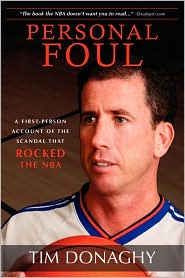
Ed Helms will play Donaghy in the inevitable movie.
NBA official Tim Donaghy bet on basketball, so he automatically must join the Chicago Black Sox and Pete Rose as a pariah forever banned by his sport. That’s the way it is for all pro athletes and officials who are caught gambling on their games. There’s a zero-tolerance policy, right? No, not always.
Prior to the 1963 season, two of the NFL’s better players, Detroit defensive tackle Alex Karras and Green Bay running back Paul Hornung, were caught gambling multiple times on football games. Karras also was proven to have business ties to underworld figures. Pete Rozelle suspended each player for the ’63 season and reinstated them in 1964. No one would have questioned him if he had given both lifetime bans, but he chose not to. Hornung was eventually elected to the Pro Football Hall of Fame and Karras regained All-Pro status in 1965 and became a successful NFL commentator and actor (most notably in Blazing Saddles and Victor/Victoria). How would their lives have turned out differently if they had been banned for life? Difficult to say. That doesn’t mean Rozelle made a right or wrong decision–he just made a different one. And that doesn’t mean that the gamblers deserve any leniency; they don’t.
Donaghy has gone on record saying that he believes Michael Jordan bet on basketball games and that was the real reason he left the NBA in the 1990s to try baseball. Would David Stern really have covered up that type of scandal to protect the NBA? It’s a harsh implication. There’s no proof he did and no reason to treat Donaghy’s word as gospel. But it’s easy to see that even something as seemingly black-and-white as athletes and officials gambling on their sport has some gray area.
Tags: Alex Karras, Chicago Black Sox, David Stern, Paul Hornung, Pete Rose, Pete Rozelle, Tim Donaghy

"I'd like to rest my heavy head tonight/ On a bed of California stars."
For those of us suffering through frigid climates, I came up with the warm-weather excerpt. I found this passage from Charles Bukowski’s novel, Hollywood, in an anthology called Los Angeles Stories: Great Writers on the City. It concerns the efforts of his doppelgänger (Chinaski) to buy a house after years of drifting, drinking, brawling and writing.
“Finally after a few weeks of house hunting, we found the one. After the down payment the monthly payments came to $789.81. There was a huge hedge in front on the street and the yard was also in front so the house sat way back on the lot. It looked like a good place to hide. There was even a stairway, an upstairs with a bedroom, bathroom and what was to become typing room. And there was an old desk left in there, a huge ugly old thing. Now, after decades, I was a writer with a desk. Yes, I felt the fear, the fear of becoming like them. Worse, I had an assignment to write a screenplay. Was I doomed and damned, was I about to be sucked dry? I didn’t feel it would be that way. But does anybody, ever?” Read the rest of this entry »
Tags: Charles Bukowski, Henry Chinaski
Yes, I just photographed a newspaper with my cellphone. Stupid, right?
Plenty of attention will be paid to “Will Big Business Save the Earth?,” Jared Diamond’s contrarian Op-Ed piece in the New York Times. That’s because Diamond is no lobbyist or apologist for big business. He’s a professor of geography at the University of California at Los Angeles and the author of Guns, Germs and Steel: The of Human Societies, which won a Pulitzer. The opening of the article:
“There is a widespread view, particularly among environmentalists and liberals, that big businesses are environmentally destructive, greedy, evil and driven by short-term profits. I know — because I used to share that view. Read the rest of this entry »
Tags: Jared Diamond

It's "Kiss a Ginger Day." Hooray!
On his new Tonight Show, Conan O’Brien has the indescribable William Shatner on as a regular guest, but it’s Adam West who was Conan’s first love. Before Seth MacFarlane got his filthy paws on the self-mocking erstwhile Caped Crusader, the late-night host was sort of obsessed with West. From a 1997 Rolling Stone interview :
“I maintain that the television series Batman is one of the most brilliant pieces of American art in the last 30 years,” says O’Brien. The article recalls how a young Conan and the ever-brilliant Robert Smigel teamed with West on a network television series that never got off the ground.
The article continues: “In 1991, O’Brien and fellow Batman obsessive Robert Smigel, his friend from SNL, made a pilot [called Lookwell] for NBC. Of course, it starred Adam West.
Smigel: “We were so happy. We had to fight so hard to get Adam West to be the guy.”
Read the rest of this entry »
Tags: Batman, Conan O'Brien, Lookwell, Robert Smigel, Seth MacFarlane, William Shatner
Evan R. Goldstein has a really interesting article in The Chronicle of Higher Education about computer-science genius, conservative polemicist, Jewish scholar, Yale professor, artist and Unabomber target David Gelernter. In one passage, Gelernter addresses his odd-duck assortment of ideas and interests:
“‘I’m a misfit,’ he said. ‘Most people fit in a groove and focus on one thing, but I cut across the grain of different areas.’ In conversation, the eclecticism of Gelernter’s mind is immediately apparent. An opinionated raconteur, he seamlessly transitions from literary criticism (‘Deconstructionists destroy texts’), to trends in the art world (‘Modern museums are devoted to diversity as opposed to greatness’), gender roles (‘Women mainly work because of male greed’), contemporary politics (‘Anti-Semitism in Europe is so intense that, I think, Hitler would have an easier time today then he did in 1933’), and earthier topics (‘I am obsessed with sex and sexuality as much as anyone I have ever met’).” Read the rest of this entry »
Tags: 1939 World's Fair, Adolph Hitler, David Gelernter, George W. Bush
 This excerpt from Hard Times, the late Studs Terkel’s oral history of the Great Depression remembers the last time the U.S. economy was actually worse than it is now. The following passage comes from an interview Terkel conducted with Hiram “Chub” Sherman, a Federal Theatre stage actor making his home in New York City at the beginning of the ’30s.
“It was rock bottom living in New York then. It really was. Cats were left on the streets. There were no signs about restricted parking. (Laughs.) If somebody had a jalopy–a few friends you know would have some old car–it would sit there for months on end neither molested nor disturbed. It would just fall apart from old age. You didn’t count your possessions in terms of money in the bank. You counted on the fact that you had a row of empty milk bottles. Because those were cash. They could be turned in for a nickel deposit, and that would get you on the subway. Two bottles: one could get you uptown, one could get you back.” Read the rest of this entry »
Tags: Federal Theatre Project, Hiram "Chub" Sherman, Studs Terkel

The 100th anniversary Katzenjammer stamp.
What American comic strip characters were created in 1897 and are still being syndicated to this very day? No, it’s not that evil temptress Betty Boop or Felix the Cat that cat with the magic bag of tricks who won’t even share his cool magic bag of tricks with anyone ’cause he’s selfish. No, it’s Hans and Fritz Katzenjammer, those irascible Lower East Side German immigrant children who give grief to their Mama with all manner of gentle hi-jinx in the Katzenjammer Kids strip. It first appeared in the “American Humorist” section of William Randolph Hearst’s New York Journal, was adapted as a stage play in 1903 and became the subject of a six-decade feud between original creator Rudolph Dirks and the Hearst organization beginning in 1912. Read the rest of this entry »
Tags: Betty Boop, Felix the Cat, Rudolph Dirks, The Katzenjammer Kids, William Randolph Hearst

Special Ops team with dolphin prop.
Louie Psihoyos’s agitprop documentary, The Cove, about the brutal practice of dolphin hunting in Japan’s Tajii inlet, won the Audience Award at this year’s Sundance festival, and it certainly has its appeal as passionate muckraking. But that very passion ultimately limits the film from being either balanced journalism or a deep consideration of its on-camera subjects (at least the human ones).
The world’s biggest supplier of dolphins–living ones for aqua theme parks and dead ones for mercury-filled meat–this Japanese cove is heavily guarded and has never been filmed. That gives Psihoyos his central plot: follow a group of gung-ho activists as they join forces with Hollywood special-effects gurus to secretly film the kind of horrific mass dolphin slaughter that Japanese functionaries have tried to downplay.
Psihoyos has a great central character in Richard O’Barry, the dolphin trainer who made a mint while working on the Flipper TV series, then grew to rue his role in the fetishization of the sea creature that led to its exploitation. O’Barry leads the team with the restlessness of a reverse Ahab , as it tries to expose the blood-streamed waters of the cove to the world.
Unfortunately, Psihoyos never really stops to examine the obsessive O’Barry in depth. Errol Morris or Werner Herzog would have stayed on him forever, looking for the source of the bottomless reservoir of energy that fuels his mania. But this is a cause-oriented doc, so we never get to know the man beneath the wetsuit. And because the movie so wants to underscore the heinousness of those who participate in the dolphin trade, only the most dishonest, clueless Japanese officials are trotted out to serve as evil counterpoints to our activist white knights. So there goes any semblance of objectivity.
The senseless slaughter of the dolphins should absolutely stop and perhaps this documentary will play some part in that process. But as easy as it is to see its great intentions, it ‘s just as difficult to see it as a great film.
The official site of The Cove.
Tags: Flipper, Louie Psihoyos, Richard O'Barry, The Cove
 I recently came across It’s Never Too Late to Love, a 1956 Royal Pyramid paperback that cost 35 cents when it first rolled off the presses. This time warp of a book, was published originally in 1953 in the wake of Alfred Kinsey’s two landmark volumes on sexual behavior. It’s written by Anna K. Daniels (“one of the most famous women gynecologists in America”) and has long been out of print. It was something of a clarion call to the reconsideration of traditional societal and sexual roles that was to come a decade later, even though it seems quaint at best today. An excerpt from the chapter “The Art of Love”:
“The greatest threat to the happiness of long married people is that intercourse will become weary, stale, flat and unprofitable due to a lack of variety. The common position, in which the woman lies on her back and the man on top of her, which many people regard as the only one sanctioned by law, custom and religion, frequently becomes dull and monotonous. Moreover, there is always the danger that the woman’s body will sink too deeply into the bed, due to sagging mattress or springs, and thus lessen the pleasure for both…”
Tags: Alfred Kinsey, Anna K. Daniels
We’ve all heard the urban legend about the guy who goes out to buy a pack of cigarettes and is never seen again. While it may have largely been a myth, it was possible before the information age to willfully vanish without a trace. But is it still an option in our digital world? In the November Wired cover story, “Vanish: Finding Evan Ratliff,” the magazine attempted to answer the question by offering a $5000 bounty to anyone who could locate their writer, who tried to go underground while staying on the grid. From the article:
“If you are looking to launch a disappearance, I cannot recommend any location more highly than a big-city Greyhound bus station. A mode of transportation Americans have seemingly left to the poor and desperate, it reeks of neglect and disdain. But for anonymity in the post-9/11 world — when the words “I’ll just need to see a photo ID” are as common as a handshake — bus travel remains a sanctuary untouched by security. At the station in Las Vegas, I paid cash for a ticket under the name James Gatz, no ID required. Six cramped hours later I was in Los Angeles.” Read the rest of this entry »
Tags: Evan Ratliff, Wired

A peacock. But proud?
NBC Nightly News anchor Brian Williams seems like an all-around good guy and may be the funniest person on network television, but comments he made on a recent Daily Nightly blog post gave me pause. He wrote the following:
“One internet headline today perfectly summed up the odd mix of stories currently being covered by the media—and the blurring of importance between the two. It read: “Tiger Woods Admits Cheating, No One Knows What Will Happen In Afghanistan.”
That damned media! How dare they confuse the seriousness of important news with tabloid sensationalism. It must be difficult for Brian Williams and his family to sit at home and watch the anchor of NBC Nightly News run Tiger Woods stories ad nauseam and spend precious airtime on the Yale murder case, which taught us nothing, instead of focusing more minutes on health care or Afghanistan. Maybe someday Williams will host a news program and things will be different. Read the rest of this entry »
Tags: Brian Williams, NBC, Tiger Woods, Yale Murder Case

Let's go hit some golf balls, you orange-haired freak.
The extremely bizarre and extremely great Bing Crosby-David Bowie duet of “Peace on Earth/Little Drummer Boy” has become a popular Christmas chestnut. It’s one of the few holiday songs in heavy rotation that doesn’t cause fits of revulsion. But there were plenty of logistical problems that the producers had to circumvent to pull off the odd pairing, not the least of which was Crosby’s failing health. From a 2006 Washington Post article entitled, “Bing and Bowie: An Odd Story of Holiday Harmony”:
“How did this almost surreal mash-up of the mainstream and the avant-garde, of cardigan-clad ’40s-era crooner and glam rocker, happen? It almost didn’t. Bowie, who was 30 at the time, and Crosby, then 73, recorded the duet Sept. 11, 1977, for Crosby’s “Merrie Olde Christmas” TV special. A month later, Crosby was dead of a heart attack. The special was broadcast on CBS about a month after his death.
ALSO:
Read the full Washington Post article.
Watch the original video.
Tags: Bing Crosby, David Bowie, Washington Post

JimMyron Ross.
Lance Hammer’s excellent 2008 drama, Ballast, is a perfect complement to Charles Burnett’s deeply felt 1977 masterpiece Killer of Sheep, but not just because they’re both dramas about struggling African-American families. Hammer, like Burnett, has made an indie film that feels completely authentic, without any of the quirkiness or forced idiosyncrasy that marks such much of American indie filmmaking.
The film follows three members of a Mississippi Delta family as they attempt to inch their lives forward in the wake of tragedy. The trio is played by non-actors JimMyron Ross, Tarra Riggs and Michael J. Smith, Sr. with amazing skill. Smith, in particular, is overwhelming as a man trying to awaken himself from his worst nightmare. Hammer’s vision is uncompromising, and he succeeds not because of plot twists but due to a sheer lack of pretense. One passage near the end is every bit as moving as Vittorio De Sica’s legendarily touching conclusion to Umberto D. Read the rest of this entry »
Tags: Charles Burnett, Lance Hammer, LimMyron Ross, Michael J. Smith, Tarra Riggs, Vittorio De Sica
If you ever wonder where comedians get their material from, an easy answer might be the frontal lobe. At least that seems to be the case with improvisational comics. An interesting article called “Tall Stories” in Prospect examines the plight of patients who have incurred severe brain damage and become incredibly adept at making up fictions that they briefly believe to be 100 percent true. The condition is called “confabulation.” A passage from the article:
“If asked where she has just been, a patient might say that she was in the laundry room (when she wasn’t) or that she’s been visiting Scotland with her sister (who’s been dead for 20 years), or even that she isn’t in the room where you’re talking to her, but in one exactly like it, further down the corridor. And could you fetch her hand cream please? These stories aren’t maintained for long periods, but are sincerely believed.” Read the rest of this entry »
Tags: Amy Poehler

ME WANT PIZZA!
Everyone hates a know-it-all. The kind of person who has the answer for everything and makes the rest of us feel like baboons. Sarah Palin is such a person. She excelled at all 12 colleges she attended, continually moving on in pursuit of greater intellectual challenges. Brainiac. But I think I finally caught her at something less than 100 percent accuracy. No, I swear.
On a recent Fox News appearance, Palin said the following to into the petrified rock that is Greta Van Susteren’s head:
“There’s been a lack of acknowledgment by our president in understanding what it is that the American military provides in terms of, obviously, the safety, the security of our country. I want him to acknowledge the sacrifices that these individual men and women — our sons, our daughters, our moms, our dads, our brothers and sisters — are providing this country to keep us safe.”
Well, smarty pants, you may have whiffed on this one.
Obama praises troops for progress in Iraq.
Obama praises troops during surprise visit to Iraq.
Obama visits wounded U.S. troops in Germany.
Obama praises troops bravery after base attack.
Obama visits wounded soldiers at Walter Reed.
Obama honors fallen soldiers.
Obama praises military during visit to a Florida naval base.
Tags: Barack Obama, Greta Van Susteren, Sarah Palin

A delicious photo shoot.
I fear the Balloon Boy saga has forever given hoaxes a bad name. Well, not forever, but for the time being. The backlash wasn’t the result of a family pretending a child was in peril. You can convince the whole nation its imperiled and emerge a genius. The problem with the Balloon Boy prank was its utter crassness; it signified nothing more than a sloppy attempt at reality-show riches. It taught people nothing and delivered no sense of wonder or fun. In short, you need to have style and understand context to be a respected hoaxer. Someone who fits that bill is Alan Abel, the proudest practitioner of the art.
Since the late 1950s, Abel has been pranking his way into media professionals’ hearts and craws, showing Americans that they are “a nation of sheep” who too readily believe what they are told. And his opinion of the gullible media is no kinder.
There was his campaign for S.I.N.A. (Society for Indecency to Naked Animals.), in which he convinced TV and newspapers that he was a prudish crusader who wanted animals to have to wear pants in public. And who can forget the time he planted audience members at a live taping of Donahue and had them faint on cue. Hoaxes are an important tool that help us maintain a healthy skepticism. Long may they (and Abel) live.
ALSO:
Alan Abel’s official site.
Watch Abel Raises Cain, a documentary about Abel on Hulu.
Esquire interviews Alan Abel.
Jiffy Pop popcorn. Mmm….
Tags: Alan Abel, Balloon Boy
I’ve always marveled that there weren’t two or three hockey goalies killed in every NHL game, back in the days before face masks and helmets. In November 1959, Jacques Plante of the Montreal Canadiens became the first goalie to regularly use the equipment (though it had been tested and discarded decades earlier).
From ESPN Classic: “His coach, Toe Blake, opposed the idea, but relented after Plante was struck in the face by a shot from the Rangers’ Andy Bathgate and balked at returning to the ice unless he could wear a plastic mask that he donned frequently in practice.
The goalie endured taunts about his manhood and questions about the mask’s durability and effect on his vision. Asked if he were scared to play without a mask, Plante replied, “If you jumped out of a plane without a parachute, would that make you brave?” Montreal went 10-0-1 that month with a masked Plante, and the face of hockey was changed forever.” Read the rest of this entry »
Tags: Andy Bathgate, Jacques Plante, Toe Blake
Brendan O’Neill makes some good contrarian points about overpopulation and hand-wringing Malthusians in this article on Spiked, though I think he goes too far.
The article begins: “In the year 200 AD, there were approximately 180 million human beings on the planet Earth. And at that time a Christian philosopher called Tertullian argued: ‘We are burdensome to the world, the resources are scarcely adequate for us… already nature does not sustain us.’ In other words, there were too many people for the planet to cope with and we were bleeding Mother Nature dry.
Well, today, nearly 180 million people live in the Eastern Half of the United States alone, in the 26 states that lie to the east of the Mississippi River. And far from facing hunger or destitution, many of these people – especially the 1.7 million who live on the tiny island of Manhattan – have quite nice lives.” Read the rest of this entry »
Tags: Brendan O'Neill, Malthus

Tommy Reynolds (left) and Homer Nish.
British expat director Kent MacKenzie’s 1961 neorealist drama, The Exiles, played at the Venice and San Francisco film festivals, but it never received a proper threatrical release until 2008. Even now, this story about young Indians (as they were called then) trading in life on an Arizona reservation for a marginal existence in Los Angeles, feels strange enough to deny classification. It’s part ethnography, part urban history. part early-rock-era free-for-all. MacKenzie and his brilliant cinematographer Erik Daarstad follow the characters (all played by Indian non-actors) as they drink, gamble, carouse and brawl their way through a 12-hour night. (Cassavetes was shooting Shadows in Manhattan at roughly the same time, and both films share a freewheeling, improvisational look at hell-raising machismo.) The director refused to idealize his subjects, believing he had made an existential film rather than an Indian one.
MacKenzie died at age 50 and made just one other feature, but this film is an impressive legacy and Milestone has done an excellent job on the DVD. Also included in the extras is MacKenzie’s “Bunker Hill: 1956,” a 17-minute documentary about elderly pensioners gingerly making their way through life in a neighborhood marked for demolition and renovation. It’s an absolute treasure for the urban anthropologist. Just as much as the main feature, it confirms what documentarian Thom Andersen said of Exiles, “It proves that there was once a real city here before they tore it down and built a simulacrum.”
ALSO:
- The Exiles official site.
- Milestone’s official site.
- On Bunker Hill: A Lost Neighborhood Found site.
- Manohla Dargis’ 2008 review of Exiles, The.
- Moreabout Thom Andersen.
Tags: John Cassavetes, Kent MacKenzie, Thom Anderson

In “Brian Cashman: Bad Lieutenant,” his scathing Men’s Journal article from April 2009, Matt Taibbi was none too kind to the New York Yankees General Manager:
“The GM of the New York Yankees may be the worst ever at the best job in the world. Which is why he’ll inevitably fail this year in his shameless attempt to buy a World Series.”
Yes, watching the Yankees spend more than gazillions and win the World Series was as soulless an experience as seeing Mike Bloomberg putting a third term as NYC Mayor on his American Express Black Card. But they did win and Taibbi is wrong. He should have eaten some post-Series crow.
Tags: Brian Cashman, Matt Taibbi, Michael Bloomberg