New DVD: Departures

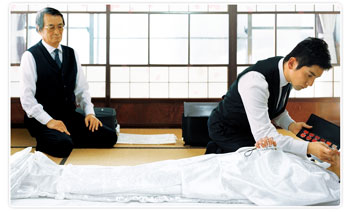
All of Motoki's clients are eternally grateful.

If it hadn’t won the 2009 Oscar for Best Foreign Language Film, Yojiro Takita’s Departures would merely be another manipulative, predictable drama desperate to pound viewers over the head with convenient life lessons. But once it was announced as the owner of a golden statuette, it became the latest indictment on how hit-or-miss Academy voters can be.

The film centers on Daigo (Masahiro Motoki), a young concert cellist of dubious proficiency who must find an alternative career when his orchestra goes bankrupt. One answered advertisement later, he has become a seriously unsteady funeral services employee, preparing dead bodies for their final reward. Dressing corpses is upsetting for Daigo and no less a source of consternation for his adoring wife (Ryoko Hirosue). Teaching him the trade is a philosophical father figure (Tsutomu Yamakazi). Along the way we learn about life, death, love, plot contrivances and how the screenplay for what’s essentially a gentle, well-intentioned movie can wear out the most patient filmgoer. Perhaps the greatest lesson of all is that it’s still possible put one over on Academy voters.

Tags: , , ,

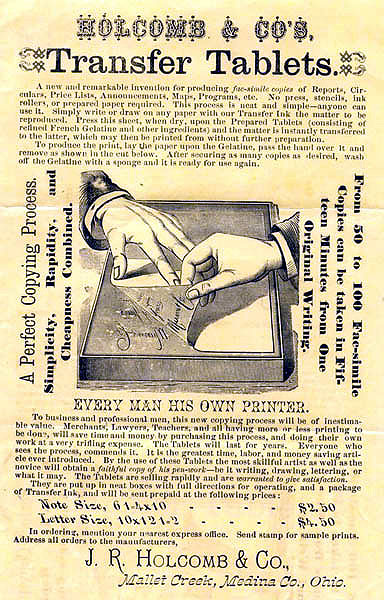
If you sit upon the Transfer Tablet, it will copyeth your ass.

“Multiplicity, Rapidity and Cheapness Combined” boasts this 1876 print advertisement for a hectograph product from the fine folks in Ohio at Holcomb & Co. The ad promises that up to 100 copies can be made in a mere 15 minutes. An excerpt from the ad:

“A new and remarkable invention for producing fac-simile copies of Reports, Circulars, Price Lists, Announcements, Maps, Programs, etc. No press, stencils, ink rollers or prepared paper required. The Process is neat and simple–anyone can do it. Simply write or draw on any paper with our Transfer Ink the matter to be reproduced. Press this sheet, when dry, upon the Prepared Tablets and  the matter is instantly transferred to the latter.”

There is a lot more information about early copying techniques at the Office Museum.

Soon after this photo was taken, Dick Ebersol berated this peacock and spit in its face.

Longtime NBC executive Dick Ebersol today referred to Conan O’Brien in a New York Times article as an “astounding failure” for his brief tenure as Tonight Show host. But what are the most astounding failures of Dick Ebersol’s career? We’ll just examine the top three (without even mentioning the financial debacle the Olympics have become on his watch):

●The XFL: Perhaps the biggest debacle in the history of the network, this horrible football league that Ebersol launched with wrestling kingpin Vince McMahon combined terrible sports with worse sportsmanship. The players, coaches and announcers were encouraged to act like misbehaved children to give the league “attitude.” It was a colossal failure both creatively and ratings-wise. When you further consider that Ebersol has been in business with McMahon for years despite the promoter running a company whose stars consistently die from drug abuse, it’s even more shameful.

Deborah Norville: When Ebersol was Senior Vice President of NBC News, he pushed the popular and intelligent Jane Pauley out of the Today Show to make room for his handpicked successor, the young, hot and vacant Norville. The new host was a flop and Ebersol lost control over the Today Show because of the terrible publicity that ensued.

Saturday Night Live, 1981-1985: The “Tony Rosato Years” as we like to call them. Ebersol presided over an edge-less, dumbed-down SNL that would have been cancelled had Lorne Michaels not returned to run the show in 1986. Say what you will about Michaels, his SNL in any era is markedly better than Ebersol’s brand of lameness.

Tags: ,

Port-au-Prince before the devastating earthquake.

The terrible devastation of the recent earthquake in Haiti has that island nation on all our minds. I found a 65-year-old article called “Haitian Painting” from Life magazine on Google Books. It tells the story of American DeWitt Peters encouraging an art scene to grow in Port-au-Prince. The piece has a strong whiff of condescension (art existed in Haiti long before the 1940s), but Peters sounds like he was a good soul. An excerpt:

“Haiti’s artistic boom started in 1943 when an enthusiastic American artist named DeWitt Peters took a U.S. government-supported job in Port-au-Prince as a teacher of English. Impressed by the talent with which Haitian Negroes decorated the walls of their palm-thatched huts and cafes, Peters wangled the use of an old residence in Port-au-Prince, christened it Centre d’Art and, under the sponsorship of the Haitian government and the U.S. State Department, started to hold public exhibitions of native art. The artists were almost all untrained and, at first, a little bit shy. Peters tactfully lured them into the Centre, bought their paintings for a few dollars, gave them paint and brushes and very little advice. By the time he was through, Haiti was the proud possessor of a school of native primitive painting and the paintings were bringing in as much as $350 each.”

Tags:

New DVD: 24 City

The new China rises above its citizens in "24 City."

There’s probably no contemporary director who is telling the story of his or her nation as well as Chinese filmmaker Jia Zhangke. Zhangke, who made the Afflictor Top 20 Films of the Aughts list with his visionary 2004 drama The World, has the distinct advantage of living in one of the most fascinating places on Earth at a time of great upheaval, but his storytelling chops, his eye for composition and his stellar work with actors would serve him well anywhere.

24 City isn’t a sprawling, large-scale masterwork like The World, but it similarly examines the ramifications of the Chinese government forging forward with rapid cultural modernization. The current transformation may be a lot less bloody than Mao’s Cultural Revolution, but it’s no less discombobulating to the people

The title refers to the name of a five-star hotel that is to replace Factory 420, a real aeronautics complex in the Chengdu province that has been home to hundreds of people for decades. 420 wasn’t just a place to punch a clock; it was a full-blown community with grade schools, cinemas and basketball courts. Against the background of their community being demolished, former workers are interviewed about their memories of their lives there.

These interviews are a mixture of documentary-like Q&As with actual workers and fictional inquiries with actors portraying workers. This odd blend of fiction and nonfiction helps Zhangke create the unsettling affect he seeks. And despite China being like no other place on the planet right now, these reminiscences have a universal feel, perhaps because whether they’re state-sponsored or not, unexpected upheavals are a part of all our lives.

Tags:

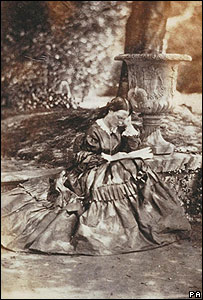
While looking at this photo of Florence Nightingale, I nursed a beer.

I found this strikingly beautiful 1858 image of nursing pioneer Florence Nightingale (1820-1910) on Listverse.com’s feature, “Top 10 Fascinating Recently Discovered Photographs.” According to the piece, the photo of the camera-shy “Lady with the Lamp” was found in 2006. In the picture, the nurse, writer and staistician is reading outside her family home in Embley Park, Hampshire. The picture, only one of eight known photographs of Nightingale, was taken two years after she returned home from the Crimean War. I wish I had a much larger version of it to share because the photo and not only its subject is great.

Tags:

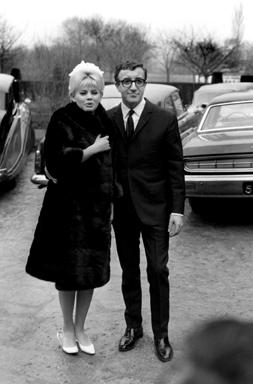
Sellers, with wife Britt Ekland, in 1964, the year of the article.

It might seem odd to find the late, great protean actor Peter Sellers in the pages of a science journal, but he was a perfect subject for the Popular Science piece, Wiring People for Life,” in 1964 because of his heart problems. The actor, known to have serious drug issues, had a series of heart attacks the previous year at age 38. The Popular Science article focused on Sellers being treated with a then-experimental external pacemaker for his severe coronary problems. The piece is subtitled: “Today, miracle electronic devices keep thousands of damaged bodies going. Tomorrow, they may help the paralyzed to walk.”

Pacemakers have never allowed the paralyzed to walk, but technology advanced and Sellers eventually received an internal pacemaker that allowed him two more decades of life. An excerpt:

“Last April film funnyman Peter Sellers lay critically ill in Los Angeles’ Cedar of Lebanon Hospital, his heart weakened and wobbly after a crushing coronary attack. Doctors held no hope for his recovery, but they began hooking up a new medical machine–an external heart ‘pacemaker.’

Fastening two leads on Sellers’ chest with small suction cups, a cardiologist started electrical impulses flowing to the star’s fluttery chest. These helped guide and steady its beat–but the 38-year-old British actor’s condition worsened. Still, the doctors continued to use the pacemaker. Then, slowly, Sellers began to recover.

His heart became steadier and stronger…the pacemaker was used less often…finally not at all. But the leads never left Sellers’ chest for three more days. Then he was taken off the critical list and the machine was disconnected. The pacemaker had once more worked a near-miracle.”

Tags: ,

Mark McGwire finished his career with 583 home runs.

Sports Illustrated has many great articles in its online SI Vault, featuring work by some of the greatest nonfiction writers of the past 65 years. You should check it out. A less-than-great article is one I found by Tom Verducci, who breathlessly brushed aside talk of McGwire’s PED use in the August 16, 1999 issue. This isn’t a knock on Verducci, who is a talented guy and hardly the only one who rushed to believe McGwire’s lies instead of common sense; it’s more a portrait of that time. An excerpt:

“The home run count of Mark McGwire clicks away incessantly, like the spinning numbers on a speeding car’s odometer. Baseball had never seen a 500 like this. Daytona, maybe, but baseball? Not even close. It wasn’t just that McGwire blew away the old record pace of Babe Ruth—after belting No. 499 on Aug. 4, he could have gone 0 for 312 and still hit 500 home runs in fewer at bats than the Bambino—but it was also that McGwire hit the last hundred quicker than the hundred before that, which came quicker than the hundred before that, and so on and so on. Zero to 500 in 5,487 at bats of pure acceleration.

The celebration of 500 seemed all the more joyous because just before hitting it, McGwire revealed that four months ago he stopped taking androstenedione, a substance that the body converts to an anabolic steroid, out of concern that kids were following his lead. ‘This shows that andro is irrelevant,’ he said.”

Tags: ,

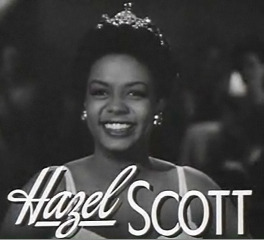
A screen shot from "Rhapsody in Blue" (1945).

Long before Oprah ruled the airwaves, the jazz and classical pianist and singer Hazel Scott was the first woman of color to have her own TV show, which aired in 1950 on the DuMont network. Scott’s show was quickly cancelled, likely because of her outspoken opposition to McCarthyism and segregation. The entertainer was married to Congressman Adam Clayton Powell, Jr., but she was her own strong-willed person. In 1960, she wrote an article for Ebony magazine, explaining why she had spent the past three years living in Paris, during which time she was seriously ill and rumored to be estranged from her husband. An excerpt:

“I learned a lot in Paris about people and about myself. One does not look into the face of death, as I have, and come away worrying about pettiness and cattiness and gossip and conforming. It seems every time I am near death, someone or something is asking me over and over: How stupid can you get? How many changes will you need before you find out what’s important? This last time, when I spent a month or so in bed, I got the message. I am not likely to ever forget it. Love is important. Love. Some people go their whole lives without learning that very simple lesson. My three years out of America were three years of much needed rest not from work but from racial tension.”

Scott and Powell eventually divorced. She passed away from pancreatic cancer in New York on October 2, 1981.

Tags: , , ,

Wouldn't this carriage propel faster if there was a horse afront pulling it?

The Essex automobile was a boom-and-bust story during the nascent days of the horseless carriage. The vehicle was produced by the Hudson Motor Company from 1918-1932. It became popular as a small, affordable car (various versions were priced under $1500) and models made later than the one pictured in this 1919 ad are responsible for popularizing the enclosed automobile. Essex sales helped Hudson become the number three auto company in America (after Ford and Chevrolet) by 1929. Its popularity waned in the early 1930s, however, and the line was permanently retired.

Tags: ,

New DVD: Big Fan

Patton Oswalt as a small man who roots for Giants.

Robert Siegel follows up The Wrestler with this dark comedy about an obsessive football fan, making the screenwriter a patron saint of sorts for emotionally stunted men who can’t express their feelings unless they’re in the presence of organized violence. Siegel also debuts as a director with Big Fan, in which 36-year-old Staten Island parking attendant Paul Aufiero (played perfectly by Patton Oswalt) subsists on a steady diet of sugared drinks, comfort food and nonstop adoration for the New York Giants. Paul’s meager life is thrown into disarray when a chance meeting with his greatest football hero leads to him being brutally beaten by his idol.

The character of Paul, someone who can’t even measure up to the mundane standards of the everyman, isn’t without antecedents. He’s Marty Piletti, but not looking for love. He’s Travis Bickle, but not out for blood. He’s Rupert Pupkin, but without the career goals. He’s just really a very powerless man who lives vicariously through the giants (and Giants) he feels he can never be.

The film, leavened only slightly in the latter stages, is another example of Siegel’s abundant talent and a good reason to fast-track Oswalt into a slew of dramatic roles.

Read Afflictor’s Top 20 Films of the Aughts list.

Tags: ,

I need the "Tonight Show" job to support my wife and chin.

In 2004, Jay Leno announced he would be stepping aside as Tonight Show host in favor of Conan O’Brien: “When I signed my new contract,” Leno said in a press release, “I felt that the timing was right to plan for my successor, and there is no one more qualified than Conan.” He discussed it further on the show, saying he didn’t want there to be an unpleasant transition like there was when he and David Letterman ended their longtime friendship over the awkward struggle to replace Johnny Carson.

When the time came for the baton to be passed, however, Leno was less sanguine about the transfer of late-night power. He still dominated Letterman in the ratings and didn’t want to abdicate the throne. Leno could have done several things. He could have refused the initial overtures in 2004 to step down from his post while he was still on top. He could have gone to another network in 2009 and beaten NBC at its own game. Or he could have tried to do a 10pm show the way he did.

But one thing he shouldn’t have done was to openly campaign to replace Conan just five months after O’Brien took over the Tonight Show. But that’s exactly what Leno did, in passive-aggressive mode, in a November 2 interview with Broadcasting & Cable. An excerpt:

“B&C: Do you want to go back to 11:35?

Jay Leno: If it were offered to me, would I take it? If that’s what they wanted to do, sure. That would be fine if they wanted to.”

During this whole public fiasco, Leno has maintained that no show has ever been cancelled when it was rated number one like his Tonight Show was. Actually it has happened before. It was in 1992, when Johnny Carson’s Tonight Show, which was rated number one, was cancelled when Leno’s manager got NBC brass to push Carson out of the job. Leno, eternally innocent, knew nothing about these machinations. He decided to not immediately relinquish the host’s chair when he found out about the back-room dealings. And even though Leno struggled mightily both creatively and ratings-wise at first, Carson never campaigned to get his job back.

Tags: , , ,

This brief 1918 clip of Theodore Roosevelt comes to us courtesy of the Library of Congress channel on YouTube. The former President was in Manhattan to be an honorary pallbearer at the funeral of onetime New York City Mayor John Purroy Mitchell. I’m pretty sure you could have baked some beans in Roosevelt’s hat.

According to nyc.gov, Mitchell, known as the “Boy Mayor” because he was elected to the post in 1914 at the mere age of 35, was a crusader against corruption and the drafter of the city’s first comprehensive budget. The city won acclaim for his waste-cutting and proper management, but Mitchell was not reelected. He subsequently enlisted in the Army Air Service to fight in WWI and died in a plane crash while doing his military training in Louisiana.

Tags: ,

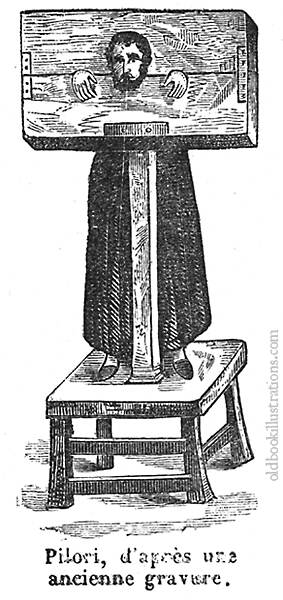
Insert coin into laptop for enhanced viewing.

Books
Booties
Condoms in Vatican City
Eggs
Insects
Oranges
Pizza
Umbrellas
Underpants
Whiskey and M&Ms combo

No, I am not familiar with a talkie called "Caddyshack."

This 1921 print ad touts a concert performance by Irish tenor Billy Murray and seven other recording artists to promote the Victor Talking Machine Company. Murray (1877-1954) was one of the most famous entertainers in the country during the early decades of the century, known for his comical style borne of vaudeville and medicine shows. You really couldn’t go anywhere without hearing “In My Merry Oldsmobile,” and why would you want to? Murray, a Philadelphia native raised in Denver, made his first wax cylinders in San Francisco in 1897. In that less-enlightened era, he recorded songs in ethnic dialects and minstrel-type performances. Murray was a huge fan of the New York Highlanders (later to be renamed the Yankees) and often played right field for them in exhibition games. (So, he really has more in common with Billy Crystal than Bill Murray, despite the name.) The introduction of the microphone to recording studios in 1925 favored subtler stylists who could croon, which pretty much ended Murray’s time in the limelight. He died in 1954 on Jones Beach, Long Island.

Tags:

Arta Dobroshi in the Dardenne brothers' gem.

The Belgian brothers Jean-Pierre and Luc Dardenne have created a number of miracles in the social-realist tradition since their feature debut, La Promesse, in 1996 and Lorna’s Silence is the latest example. In this drama, an Albanian woman (played wonderfully by Arta Dobroshi) has gained citizenship in Belgium through a sham marriage to a junkie. But when the criminals she’s involved with want to off the addict so that she can marry a Russian man also seeking citizenship, Lorna’s life turns from hopeful to heart-wrenching.

Many of the elements of the movie would have been pure melodrama in other less-skilled hands. But the Dardennes have made a quintet of films and they’ve yet to produce a single false scene. Some critics have started to carp that the brothers are treading too much over familiar territory in their work. But if the Dardennes aren’t changing as much as some other directors, perhaps its because they are the rare ones who were born whole.

Tags: , ,

The Library of Congress has a fun YouTube account that has samples of some of the rare videos they possess. I found a 1902 clip by Thomas Edison that shows bathers frolicking at the Sutro Baths in San Francisco. Adolph Sutro built the public bathhouse in 1896; it burned to the ground during its demolition in 1966. Based on this video, it had a 50-foot-high water slide which was all kinds of fun. In a letter published in a 1998 San Francisco Chronicle, an elderly man named Bill Roddy recalls the Sutro Baths when he was a child in the 1930s, when it had started getting a little run down. An excerpt:

“I went outside and walked a few feet to Sutro Baths, a massive Victorian structure that was beginning to show its age. I think I paid 25 cents admission. I was given a swim suit (we could not bring our own) and a meager towel. The suits were not trunks. They covered all of my puny body with straps that went over my shoulders, and they were made of wool with ‘Sutro Baths” across the front in white letters. As if anybody would have wanted to steal one!

I changed into my woolen suit and raced down the stairs to the baths. There were eight or nine pools with temperatures ranging from hot to ice cold. The biggest pool had a waterwheel.”

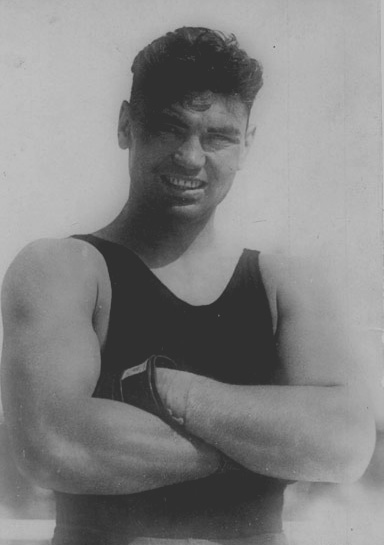
Jack Dempsey: Enjoy the fisticuffs and remember to visit the confection stands.

Temporary stadiums are still built and torn down for some Olympic events, but the practice was pretty common for larger sports gatherings in the early-20th century when few permanent structures of tremendous size existed. No mere hole-in-the-wall could have contained a crowd for a boxing match featuring Jack Dempsey during the 1920s, when as Urban Oyster points out, he was an even bigger star than Babe Ruth.

Boxing promoter Tex Rickard outdid himself in 1921 for the Dempsey-Georges Carpentier fight, spending $250,000 to build an octagonal, wooden 91,000-seat stadium (see photo) called Boyle’s Thirty Acres in Jersey City, the largest such structure in the world to that point. A June 26, 1921 article in the New York Times fills in the details. It covered 300,00 square feet and took two months to complete. Reserved seats cost from $5.50 to $50.

Dempsey dispatched of the Frenchman quickly, knocking him out in the fourth round. According to New Jersey City University, the stands were full, though only 81,000 were paying customers (2,000 were women). The gate was close to $1.8 million. The stadium played host to several other prizefights before being torn down in 1927. A housing project was built on the land in 1950 and remains there today.

Tags:

Investing in the stock system.

There isn’t an abundance of jobs in the country right now, but the Federal Bureau of Prisons is hiring. The department’s website lists numerous positions available in a system that incarcerates millions and employs tens of thousands. Included on the site are informational videos that explain what it takes to work in chaplaincy or food services.

At some point and soon, we need to rethink our entire penal system. What are the systemic problems leading to our being the nation with the highest per-capita level of incarceration? Should we be putting anyone in prison for drug use? What type of incarceration will lead to lower rates of recidivism? We have plenty of talented minds in socioeconomics and they need to be marshaled by Washington to troubleshoot a situation that is bad for us economically and just bad for us, period. It’s a bipartisan problem and their should be a bipartisan solution.

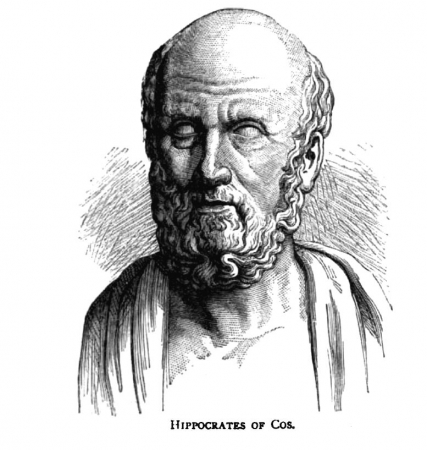
I'm Hippocrates. You've probably heard of my oath, ladies. It's quite popular.

Over on the Boston Globe site, there’s an interesting article by Jonah Lehrer about the value of daydreaming. Lehrer and a good number of doctors believe that daydreaming is the default state of humans not busy with tasks. It’s during this “down time” when they think we do a lot of our most important thinking. It seems that a lot of inspiration comes when we’re actively working on things, but the ability to “float” toward answers seems equally valuable.

Dr. Marcus Raichle, a neurologist and radiologist at Washington University, who was one of the first scientists to locate the default network in the brain, tells Lehrer that “when your brain is supposedly doing nothing and daydreaming, it’s really doing a tremendous amount.”

Lehrer posits that “the ability to think abstractly that flourishes during daydreams also has important social benefits. Mostly, what we daydream about is each other, as the mind retrieves memories, contemplates ‘what if” scenarios, and thinks about how it should behave in the future. In this sense, the content of daydreams often resembles a soap opera, with people reflecting on social interactions both real and make-believe. We can leave behind the world as it is and start imagining the world as it might be, if only we hadn’t lost our temper, or had superpowers, or were sipping a daiquiri on a Caribbean beach. It is this ability to tune out the present moment and contemplate the make-believe that separates the human mind from every other.”

Tags: ,

Coffee: superior to that concoction with boiled leaves and juice of the lemon.

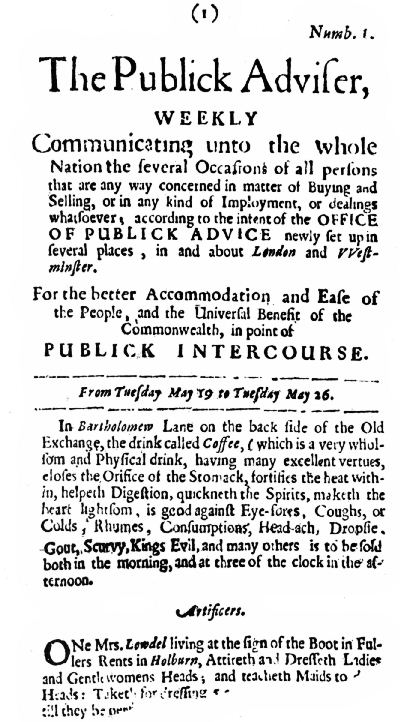
I came across a public domain copy of the very first advertisement for coffee, which was published in the Publick Adviser of London on May 26, 1657. (Click on the image for a somewhat larger version.) The full ad (with numerous words in Middle English) reads:

“On Bartholomew Lane, on the back side of the Old Exchange, the drink called Coffee (which is a very wholsom and Physical drink, having many excellent vertues, closes the Orifice of the Stomack, fortifies the heat within, helpeth Digestion, quickneth the Spirits, maketh the heart lightsom, is good against Eye-sores, Coughs or Colds, Rhumes, Consumptions, Head-ach, Dropsie, Gout, Scurvy, Kings Evil, and many others, is to be sold both in the morning, and at three of the clock in the afternoon.)”

I know ads are often deceptive, but I’m drinking coffee as I write this post and my dropsie is much improved. Although it’s true that as of three of the clock in the afternoon, my Kings Evil is worse than ever.

Tags:

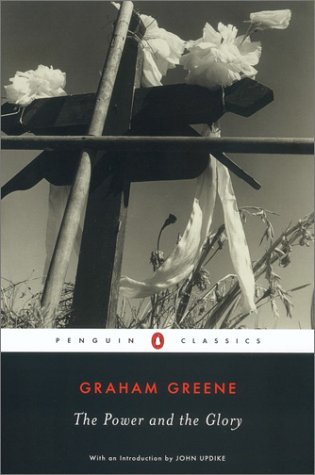
The Power and the Glory made Time's 100 Greatest Novels list.

The Paris Review site has an interesting 1955 interview with Graham Greene (download the full version). This Q&A reveals that while the author had the rare gift to write critically acclaimed work that was also widely popular, he really wanted to try his hand at other things. An excerpt:

Interviewer: Did you always want to be a writer?

Greene: No, I wanted to be a businessman and all sorts of other things; I wanted to prove to myself that I could do something else.

Interviewer: Then the thing that you could always do was write?

Greene: Yes, I suppose it was.

Interviewer: What happened to your business career?

Greene: Initially it lasted for a fortnight. They were a firm, I remember, of tobacco merchants. I was to go up to Leeds to learn the business and then go abroad. I couldn’t stand my companion. He was an insufferable bore. We would play double noughts and crosses and he always won. What finally got me was when he said, “We’ll be able to play this on the way out, won’t we?” I resigned immediately.

Tags:

Just a pawn in the game of life.

Watching the ball drop in Times Square, as many of us recently did, always makes me think of one of my favorite films, Stanley Kubrick’s The Killing. The brilliant 1956 crime story doesn’t have any key scenes that take place on New Year’s Eve, but it has one that’s set right near the New Amsterdam Theatre where the ball drops, in a dingy chess club of yore called the Flea House. For much of its existence (which began during the Great Depression), you could rent a chess board at the dive for 10 cents an hour. Elder chess master Bill Hook recalls the Flea House in Hooked on Chess: A Memoir. Jeremy Silman, an expert on the game, writes about Hook’s book on his site:

“Much of Hook’s twenties and early thirties were spent in abject poverty in New York City. His health precluded steady work and his painting hadn’t taken off but Hook had one good thing that kept him going. Known by different names at different times — The New York Chess and Checker Club, Fischer’s, Fursa’s and finally the Flea House, the game playing establishment on 42nd street near Times Square was  a home away from home for many lost souls. Hooked on Chess has many stories of the characters that passed through this 24-hour New York City institution that ran from the Depression until the early 1970s. Some of the strongest players in the United States like George Treysman and Abe Kupchik were regulars when Hook first started going, but there were also plenty of weak players and odds games for various stakes were always being contested. According to Hooked on Chess, it was the clientele who created the special atmosphere. Certainly it was not the mismatched furniture or smoked stained walls that did. The tables that chess, bridge and various games were played on were frequently covered in a pile of ashes and it was not uncommon to see people sleeping at night in the club. Hook gives a lengthy and moving testimonial to the many people he met daily at the club.”

Tags: , , , , ,

I wouldn't say "no" to a cotton swab.

There’s no one among my friends or relatives who is blind, so I was completely unfamiliar with “echolocation’ until happening onto an article on the topic in New Scientist. Written by a blind psychologist named Daniel Kish, the article details how the author clicks his tongue and listens to the reverberations made as the sound bounces off buildings, trees, people, etc. These echos enable him to “see” his surroundings and walk, run and bicycle on his own. Kish teaches echolocation to others, enabling them to live the full existence he enjoys. An excerpt from the article:

“At the time I went to school, blind kids either waited for people to take us around, or we taught ourselves to strike out on our own. My way was by clicking my tongue and listening for the patterns of reflections from objects around me. By doing this, I could get 3D images of my surroundings. I can’t remember when or how I first started using sonar, because it was when I was very young. I have a memory of climbing over the fence into the neighbour’s yard and clicking to find out what was around me, when I was just 2½ years old.

As a child, while I was pleased to have a guide when someone was willing, I could do a lot by myself. I could ride a bicycle through my neighbourhood in the Los Angeles area, play tag with my friends, find trees to climb, and walk just about anywhere on my own.”

There is also video of Kish’s echolocation education program.

Tags:

Jake Delhomme: Name as lackluster as his quarterback rating.

In preparation for the NFL playoffs, we brought you the Top 10 player names in the AFC earlier this week. Today the NFC gets its due (in alphabetical order):

Tags: , , , , , , , , ,

« Older entries § Newer entries »