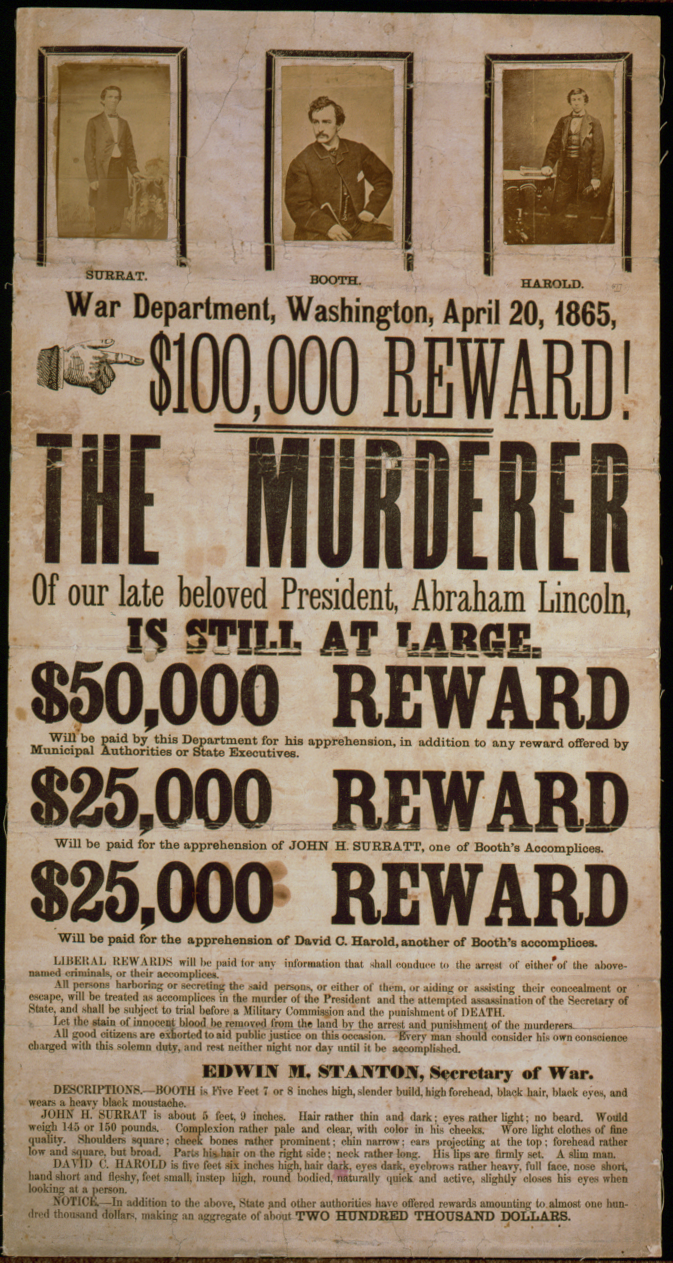
America has suffered numerous shocks to the system in its history, but the assassination of President Abraham Lincoln on April 12, 1865 is still probably as calamitous as any. I came across the “Wanted” poster for Lincoln’s assassin John Wilkes Booth, which was circulated in wake of the shocking crime at Ford’s Theatre, when Booth and his accomplices were still at large. “Wanted For The Murder of our late beloved President, Abraham Lincoln,” the poster declares, offering large sums of money for information leading to capture. An excerpt from the more poetic potions of the poster

“Let the stain of innocent blood be removed from the land by the arrest and punishment of the murderers. All good citizens are exhorted to aid public justice on this occasion. Every man should consider his own conscience charged with this solemn duty, and rest neither night nor day until it is accomplished.”

Booth was fatally wounded two weeks later by U.S. soldiers on a Virginia farm.


Tags: , ,

"Keep that 16mm camera on Diego Rivera's handsome face," says Diego Rivera.

There are tons of great videos on the Internet Archive, including the travelogues of Watson Kintner (1890-1978), a chemical engineer at RCA by trade who sojourned extensively and had a knack with a 16mm camera. The kind folks at the University of Pennsylvania Museum of Archaeology and Anthropology have preserved the movies and shared them online. The particular film I’m linking to in this post is of a vibrant-looking Mexico in either 1933 or 1934. Although most of the people Kintner recorded on his trip were unknown locals, look for the scene of Diego Rivera standing alone in a room. The video embed is causing me havoc, so I have to redirect you to the official site to watch the 7-minute film.

Tags: ,

Lester J. Gillis (aka Babyface Nelson) in a 1931 mug shot. I would pinch his cute face if he would just stop trying to murder me for a minute.

In a post I put up yesterday, I introduced you to my favorite reference book, the 1971 edition of Webster’s New World Thesaurus. Indulge me once again as I post the top 15 synonyms for the word “criminal” from this book filled with colorful language.

  • Big brains
  • Bird dog
  • Black marketeer
  • Buccaneer
  • Check artist
  • Clip artist
  • Fixer
  • Gorilla
  • Greaser
  • Nightrider
  • Ringer
  • Rustler
  • Second-story man
  • Stooge
  • Torpedo plugger

Tags:

Okay, some information wants to be free.

Over at the Rough Type blog, the always probing and questioning Nick Carr has a brief and bitter retort to those who say that in the Internet Age, information wants to be free. In his post titled “Information wants to be free my ass,” he points out that we’re paying plenty of money for delivery systems, so why quibble over tossing in a few pennies for content. An excerpt:

“Never before in history have people paid as much for information as they do today.

Do the math. Sit down right now, and add up what you pay every month for: Internet service, Cable TV service, Cellular telephone service (voice, data, messaging), Landline telephone service, Satellite radio, Netflix, Wi-Fi hotspots, TiVO and other information services

So what’s the total? $100? $200? $300? $400? Gizmodo reports that monthly information subscriptions and fees can easily run to $500 or more nowadays. A lot of people today probably spend more on information than they spend on food.”

There’s a lot of truth to what Carr is saying, but he loses me somewhat with his follow-up argument:

“It’s a strange world we live in. We begrudge the folks who actually create the stuff we enjoy reading, listening to, and watching a few pennies for their labor, and yet at the very same time we casually throw hundreds of hard-earned bucks at the saps who run the stupid networks through which the stuff is delivered. We screw the struggling artist, and pay the suit.”

No one is paying for cable TV for the wires but for the programs. We don’t begrudge the makers of the programs–their work is the attraction. And they receive part of the proceeds from the cable bill. If Carr is saying that the systems are getting too big a slice of the pie, that’s another argument. But content is what we love. Making that content available and navigable are also positives, but they are secondary ones to almost all of us. Perhaps cable TV is a bad point of debate for either Carr or I since its structure was in place before the Internet became the dominant medium, but Carr’s bone of contention may have more to do with self-appointed gurus pushing books than the rest of us. As the paradigm shift sorts itself out, we’ll pay for the content we want and need.

Tags:

I predict Afflictor.com will continue using crappy public domain art.

The Brooklyn Daily Eagle was hit or miss in its predictions about the 20th century, but Forbes blogger Rich Karlgaard tries a more reasonable length of time with his own 20 predictions for the next decade. (A thanks to the great site Newmark’s Door for pointing me to the post.) Here are just a few of his prognostications:

Almost All Cancer Becomes Manageable
The good news about health in the 2010s is that almost all cancers will become manageable events, assuming reasonably early detection.

Dow Hits 36,000
Finally.

One Cloud Company (Or Another) Becomes the Most Valuable Company on Earth
Moore’s Law continues at the pace of 2x every two years. Bandwidth improves 3x every two years. These trends predict ubiquitous cloud cover for planet earth. Who will own the giant fog machine? Google? Cisco? Microsoft? Amazon? Huawei?

Tags: ,

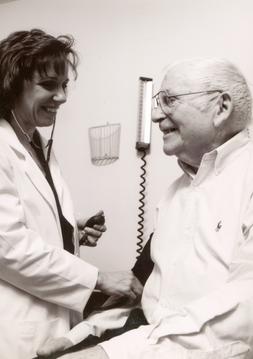
How's my blood pressure looking, you pill bag?

The greatest reference book I have ever come across is the 1971 edition of Webster’s New World Thesauraus. I like its vibrant language and its A-Z listing so much that I have two copies just in case one is struck by lightning (or a “firebolt” as the good book suggests). The English language is a living thing that changes quickly and gets richer in many ways, but I wish we could retain some of the more colorful aspects of its history. Here are the ten best synonyms in this 1971 volume for the word “doctor,” many of which appear in no thesaurus just about 40 years later.

  • Bones
  • Castor-oil artist
  • Doc
  • Fixemup
  • Interne
  • Medicine-dropper
  • Medico
  • Pill bag
  • Sawbones
  • Shaman

Read other lists.

Tags:

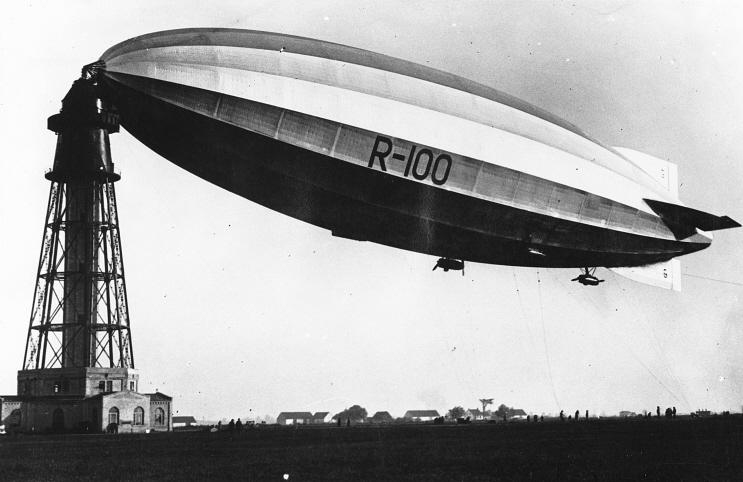
The British airship R-100 docked in Quebec, Canada, in 1930.

Nine  years prior to the 1937 Hindenburg disaster, Popular Science ran a breathless article about the advent of commercial dirigibles, as England and Germany raced to be the first to launch a successful transatlantic flight with passengers. In 1928, the balloons were planned to hold roughly 100 ticket buyers and the price from New York to London was going to be $400. That transatlantic trip was scheduled to take 38 hours to complete. Pictured is the English airship R-100, which the article thought was the favorite in the transatlantic race. It had beds, baths with showers, saloons, an area on deck for dancing and refreshment tables. The only note of caution about this potentially dangerous new mode of transportation–quickly dismissed–comes late in the article. An excerpt:

“To be sure, this history must consider the disaster of the American-built and operated Navy dirigible Shenandoah, broken in two by a storm over Ohio in 1925 and destroyed with the loss of fourteen men. And the fate before that of the German-built, French-operated military dirigible Diamude, lost in the storm over the Mediterranean. And that of the Italian-built, American-operated Roma, military dirigible, which, forced down by rudder trouble, struck a high tension cord and burned when the hydrogen in its gas bags exploded. There have been costly errors in construction and operation of the first great ships. But the builders have profited by all these mistakes. Each disaster has taught a new lesson.”

The German airship, the L7-127, which is given less attention in this piece, won the race with its first commercial passenger transatlantic flight on October 11, 1928. In November 1931, after the disaster of fellow British airship R-101, the R-100 was discontinued. It was flattened and sold for scrap.

Tags:

Mother, I feel so happy and contented when your lady parts are fresh.

This 1926 advertisement would be odd under any circumstances, since it links a mother’s feminine hygiene to the degree of happiness her children will experience. But it seems even more unusual because the feminine hygiene product being sold is Lysol disinfectant. Yup, the stuff we today use today to disinfect toilets and sinks. Maybe everyone else is familiar with the history of this product, but I had no idea that Lysol was used as a douche. And while this ad doesn’t endorse it, a post-ciotal cleansing with Lysol was used for several decades as a birth control method. Ladies, please don’t try any of this at home. An excerpt from the ad copy:

“Just being a mother is a job with twenty-four hour shifts seven days a week.  There are some mothers who succeed so well in this difficult task that their children are happy and contented, proud of their homes, always glad to be there and to bring home their friends.

It is a magic quality in motherhood that works this spell. Always you find in these households a woman who has the charm, gentleness, poise, and a certain untiring vitality which comes from knowing how to take care of herself.

This effective antiseptic is three times stronger than the leading carbolic acid, yet it is so carefully blended that in proper proportion it cannot irritate or harm the most sensitive tissues. Absolutely safe, it provides a perfect protection against infection, and its gentle deodorant qualities are a safeguard of feminine daintiness.”

Tags:

New DVD: Thirst

Nightcrawler Kim Ok-bin needs a good stiff drink.

Death, guilt and regret permeate the oeuvre of Korean director Park Chan-wook, so the vampire genre he investigates in Thirst fits him like a custom-made coffin. Park, who earned a spot on Afflictor’s Top 20 Films of the Aughts list with Oldboy, tells the story of priest Sang-hyeon (Song Kango-ho) who becomes a vampire while somehow surviving a volunteer medical experiment that should have killed him. When he’s not busying sucking down spare platelets at the local hospital, the holy man hooks up with the very unbalanced Tae-ju (Kim Ok-bin), a waifish woman with a seemingly tortured family history. And she’s likely to only get worse–far worse–if she should somehow become a vampire.

Thirst is probably too many things, careering from horror film to romance to dark comedy to erotica to psychodrama with dizzying speed. And the movie has its misogynistic side, fearing a female planet even more than one inhabited by vampires. But Park has the undeniable knack for creating a sense of ruefulness like no other contemporary filmmaker, and he maintains an impressive miasma of mourning right down to the sad, pitch-perfect conclusion.

Tags: , ,

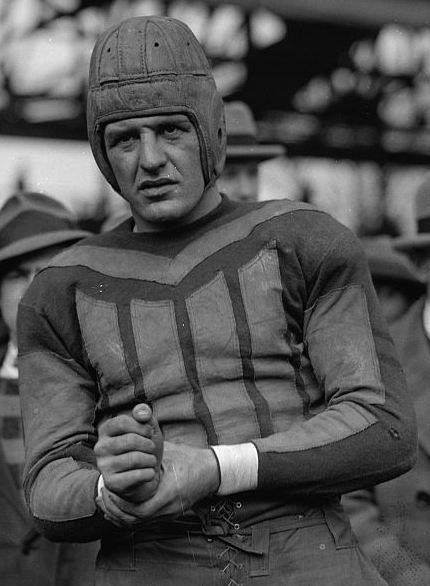
I question the wisdom of this new contraption called the "forward pass."

The Wonderlic Personnel Test is a 12-minute, 50-question exam that is supposed to measure a person’s ability to learn and solve problems. It has become most well known for its association with the NFL, as college football players looking to enter the league are administered the test. It’s not exactly a perfect determinant of a player’s ability, as Dan Marino famously scored very poorly and became one of the greatest QBs in NFL history. (It should be noted that the average score of an offensive tackle is equal to that of a journalist.)

This seems like a new-fangled type of athletic measurement that would never have flown during the sport’s earlier days, but that’s not true. I came across a 1931 Popular Science article that examines how the University of Illinois used a battery of physical and psychological tests to try to find a quarterback who would be as great as the legendary Red Grange. An excerpt from the beginning of “Illinois Seeks New Red Grange by Electric Tests”:

“At the University of Illinois, experts in a pioneer psychological laboratory are seeking a new ‘Red’ Grange by means of flashing colored lights, whirling electronically connected disks, and reels of super-speed films.

The successor to the ‘Galloping Ghost’ of Illinois football teams of a few seasons ago will be picked from gridiron candidates who run the gauntlet of strange electrical testing machines that rate their muscular coordination, nerve control and mental alertness. Even before the athletes don their cleated shoes and leather helmets for the first scrimmage, the coaches thus know the rating of each in the qualities that make for stellar performance in the heat of pigskin battles.

Electrified gameboards, covered with rows of tiny lights like those on Christmas trees, duplicate in running flashes various football players. The candidate records what he would do at each crisis in the play while judges note the time he takes to decide and the correctness of his decision.”

Tags:

Bumped head while jumping turnstile. (Image courtesy of David Shankbone.)

Arts & Letters Daily pointed me in the direction of this excellent Financial Times article by Susanne Sternthal about the 35,000 stray dogs that live in Moscow, several hundred of which reside in the subway. Metro dogs are such a common occurrence that there is a website dedicated to cellphone photographs of such canines. What’s more fascinating is that some of these dogs have learned how to use the subway to get from point A to point B the way human riders do. An excerpt from the article:

“‘The metro dog appeared for the simple reason that it was permitted to enter,’ says Andrei Neuronov, an author and specialist in animal behaviour and psychology. ‘This began in the late 1980s during perestroika,’ he says. ‘When more food appeared, people began to live better and feed strays.’ The dogs started by riding on overground trams and buses, where supervisors were becoming increasingly thin on the ground.

Neuronov says there are some 500 strays that live in the metro stations, especially during the colder months, but only about 20 have learned how to ride the trains. This happened gradually, first as a way to broaden their territory. Later, it became a way of life. ‘Why should they go by foot if they can move around by public transport?’ he asks.

‘They orient themselves in a number of ways,’ Neuronov adds. ‘They figure out where they are by smell, by recognizing the name of the station from the recorded announcer’s voice and by time intervals. If, for example, you come every Monday and feed a dog, that dog will know when it’s Monday and the hour to expect you, based on their sense of time intervals from their biological clocks.’”

Tags: , ,

On June 22, 1897, the Edison Film Company recorded this horse race at the Sheepshead Bay Racing Track in Brooklyn, New York. The track was built by prominent businessmen in 1880 and was popular until Governor Charles Evans Hughes banned all racetrack gambling in the state in 1910. The track was eventually sold and an auto racing track was subsequently built. It eventually ran into financial troubles as well and the land was purchased by real estate concerns.

From what I can gather, there were nine horses competing in this 1897 race. A horse named Clifford, who was then approximately seven years old, was the heavy favorite and easily dispatched of his competitors.

Tags: , ,

Altair BASIC was an early programming language and the first product of Microsoft (then called Micro-Soft). Bill Gates (who was still at Harvard at the time) and Paul Allen apparently read about the Altair personal computer system in a science magazine and thought that making software for it could be a good business. You got that one right, boys.

This 1975 advertisement offers the Altair 8800 computer loaded with the MS guys’ basic language for the relatively inexpensive price of $995. In order to save records, you would hook up this computer to a cassette recorder and store the info on cassette tapes. The MITS (Micro Instruments and Telemetry Systems) company of Albuquerque, NM, distributed the computer and software. MITS was founded in 1971 as a calculator manufacturer and added computers to their inventory in 1975, so this was one of their first attempts at selling PCs. The Altair 8800 was the first commercially successful home computer and the Information Age was off and running. MITS co-founder Ed Roberts, who had earlier served in the Air Force for ten years, sold the company to Pertec Computer Corporation in 1976. He subsequently went to medical school and today practices medicine in a small town in Georgia.

Tags: , , ,

These days, Joe Namath boldly predicts he will be first on line at the early-bird buffet.

As the New York Jets prepare for a shot at only the second Super Bowl appearance in their tortured history, I looked up the first-ever appearance of the name “Joe Namath” in Sports Illustrated. Joe Willie is, of course, the most famous Jet ever and is still one of the best-known sports figures in America. During his playing days, he was the most outspoken athlete this side of Muhammad Ali. He predicted the underdog Jets would win Super Bowl 3 and then quarterbacked them to victory. He parlayed the subsequent fame into everything from pantyhose commercials to sitcoms. Most of it was godawful, but he smiled his way through it the way only a legend can.

The first mention of Namath in SI occurred on September 23, 1963 when the Beaver Falls, Pennsylvania, QB was a sophomore for Coach Bear Bryant at Alabama. Even then he wasn’t exactly lacking in confidence. Here is an excerpt:

“Namath already is the only Yankee on the Alabama team. He came to Tuscaloosa from Beaver Falls, Pa., for two unshakable reasons: he ‘wanted to play football in the South’ and he wanted to play football for Bear Bryant. Known in high school as the ‘Hungarian Howitzer,’ he had offers of football scholarships from 52 colleges, and a Chicago Cubs baseball scout was talking in terms of a ‘$50,000 bonus.’ Once in the South, the talented Namath told Alabama reporters as a freshman that it was ‘nice’ that Bryant had varsity quarterback Jack Hurlbut coming back because ‘I might get hurt.’

The following spring, true to his word, he won the starting job, and one day as he huddled with his cast of upperclassmen he piped: ‘Fellows, this is an option play. But I think old Joe’s going to run with it. Let’s see some blocking. Coach Bryant don’t want to get me hurt.'”

My chin grows when I lie.

Jay Leno is probably no more insincere and greedy than anyone else in show business. But he tries so hard to prove he’s a solid working-class American who’s above the fray that he comes across as passive-aggressive and manipulative. His recent speech about the late-night talk show wars is a good example of his bullshit. The following is a decoded version of the least-honest moments of Leno’s address.

Jay Leno: I said, Well, I’ve been No. 1 for 12 years. They said, We know that, but we don’t think you can sustain that. I said, Okay. How about until I fall to No. 2, then you fire me? No, we made this decision.

Decoder: I actually hadn’t been number one for all 12 years. I struggled mightily during my first couple of years. Thankfully, Johnny Carson wasn’t hovering over me every second, campaigning to get his job back. Especially since he was pushed out of the job in favor of me while he was still number one in the ratings.

Jay Leno: Don’t blame Conan O’Brien. Nice guy, good family guy, great guy.

Decoder: I’m the one everyone is blaming, so I am going to pivot and pretend Conan is somehow the object of scorn. Then I will absolve him of the fictional blame to make myself look magnanimous. Also: I am the kind of solid American who can judge the family values of others. Didn’t you notice my American flag lapel pin?

Jay Leno: I said, All right, can I keep my staff? There are 175 people that work here.

Decoder: It’s not about my ego. It’s about me keeping my staff employed during these difficult economic times. I am very thoughtful that way.

Jay Leno: Conan’s show during the summer…we’re not on…was not doing well.

Decoder: My historically poor lead-in is not responsible for Conan trailing David Letterman. I also trailed Letterman during my first couple of years as Tonight Show host, so I speak from experience.

Jay Leno: They said, Well, look, how about you do a half-hour show at 11:30? Now, where I come from, when your boss gives you a job and you don’t do it, well…

Decoder: I am just a working stiff like Joe Lunchpail. A working stiff with hundreds of millions of dollars and hundreds of vintage cars, but I’ve still got to punch the clock and support my wife because I’m a good family man.

Jay Leno: I said okay. Shake hands, that’s it. I don’t have a manager, I don’t have an agent, that’s my handshake deal.

Decoder: I’m a regular guy like you, not one off these show biz phonies with managers and agents. At one point, I did have a manager and she worked tirelessly to get Carson pushed out of the Tonight Show so I could have the job, even though Johnny was number one in the ratings.

Jay Leno: Yeah, I’ll take the show back. If that’s what he wants to do. This way, we keep our people working, fine.

Decoder: Again, it’s about my staff keeping their jobs, not about my ambitions.

Jay Leno: But through all of this, Conan O’Brien has been a gentleman. He’s a good guy. I have no animosity towards him.

Decoder: In a couple of days, I will make a joke about what an overrated millionaire Conan is. He’s not a working class hero like me.
Tags: , , ,

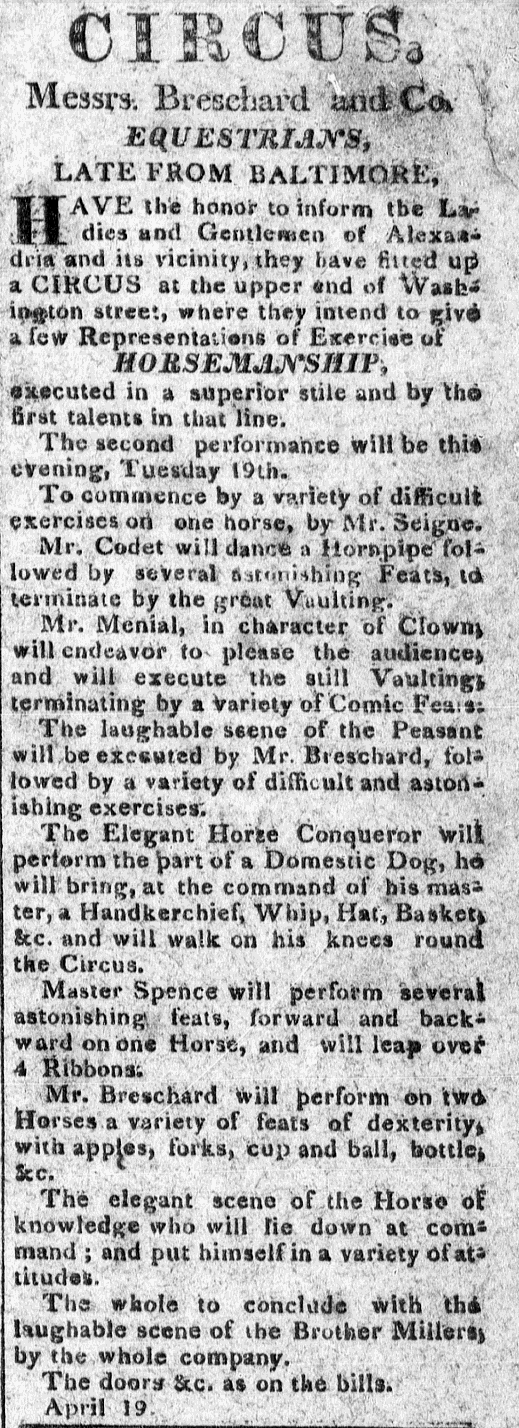
"Horsemanship executed in a superior stile."

How incredibly lucky those people in Alexandria, Virginia, were in 1814 to have a chance to see “Mr. Menial, in the character of Clown, endeavor to please the audience,” at the Breschard and Co. Circus, which had only recently performed in the city of Baltimore. This 1814 newspaper advertisement may not be an example of great copywriting, but it’s hard to pass up on the chance to see horsemanship “executed in a superior stile.” And let’s never forget the Elegant Horse Conqueror. He performed the part of the Domestic Dog, who brought, at the command of his master, a handkerchief, whip, hat, basket and walked on his knees. There is no ticket price listed, but it was a bargain at any price.

Read other old print ads.

Tags: , ,

New DVD: In The Loop

James Gandolfini and Mimi Kennedy are administration officials trying to keep the peace.

British TV director Armando Ianucci, the steady hand behind Steve Coogan’s masterful Alan Partidge shows, presents this warring room comedy about U.K. and U.S. government functionaries working feverishly as the  two nations prepare to invade an unnamed Middle Eastern country. In the Loop may not be a visionary satire of Strangelovian proportions, but it’s brisk, abrasive fun.

The President and the Prime Minister are never present onscreen as their cabinet members, advisers and assistants scurry about trying to start or stop a war (that may not exactly be justified) before an all-important U.N. resolution vote is to be taken. Ego trips and personal relationships are omnipresent, helping to form policy that may result in the deaths of hundreds of thousands of people. The excellent cast with James Gandolfini, Mimi Kennedy, David Rasche, Anna Chlumsky, Tom Hollander, Toby Wright, Coogan and a host of others never misses a beat. But it’s Peter Capaldi, who’s worked for Ianucci in the TV series The Thick of It, who shines the most, tearing through every scene as a rage-filled British official with a brilliant, vicious insult for everyone in his path. He is relentlessly funny as is In the Loop, right down to the closing credits with a great joke about I ♥ Huckabees.

●Read Afflictor’s Top 20 Films of the Aughts list.

Tags: , , , , , , , ,

Somebody destroyed my pneumatic tube with a tomahawk.

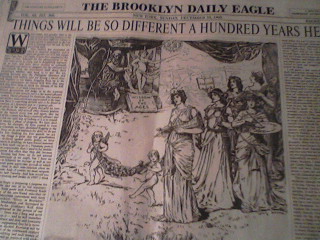
I got my grubby, ink-stained hands on a special supplement from the December 30, 1900 issue of the Brooklyn Daily Eagle, which bore the headline: Things Will Be So Different A Hundred Years Hence.”The papers’ editors used that section to predict life on Earth in the year 2000. Some of the prognostications worked out better than others, but the whole fascinating thing reads like an Onion parody. Here are the 12 most interesting headlines:

  • Liquid Air Will Open Up A New World of Wonders
  • New York To Be The World’s Metropolis
  • Interest In Music Will Increase Constantly
  • Mail By Pneumatic Tubes A Possibility For All Houses In Future
  • Women To Have The Ballot
  • Women To Be Homemakers
  • Base Ball, The National Game, Is Steadily Declining
  • Automobiles And Airships The Twentieth Century Vehicles
  • Man To Live Longer And Be Happier Owing To Use Of Plant Foods Only
  • Science May Find Means To Bring Dead To Life
  • International Court To Prevent War
  • Wars To Be Waged As Of Old: We Will Revert To Using Tomahawks And Shotguns

Read other Listeria lists.

Tags:

Federica is stunned to learn that there is another cat goddess.

Archaeologists believe that they have unearthed a 2,200-year-old Egyptian temple dedicated to the cat goddess, Bastet. Mohammed Abdel-Maqsood, the Egyptian archaeologist who led the exploration team, hopes the discovery of the Ptolemaic-era building may mean that other royal ruins will be found in the area. Scientists assume the excavated building is a kitty cathedral because of the large number of statues depicting Bastet found in the ruins. Bastet is the goddess of fire, of the home and of pregnant women.

Tags: , ,

The Glidden Barn of Illinois, which was added to the National Register of Historic Sites in 2002, is in no danger.

There may have been as many as ten million barns in the United States during the 1920s. But the decline of the family farm, a population shift to urban life and numerous other factors have reduced that number by about eighty percent. The National Barn Alliance is trying to preserve and restore the barns that still exist before we lose all of our “prairie cathedrals.” Like a lot of people who live in urban environs, barns seem to me an almost mythical part of the American landscape. An excerpt from a 2007 USA Today article on the topic:

“The barns–particularly in grain-farming states like Illinois and Indiana–serve little practical purpose. Barns were built primarily for livestock, but commercial livestock farming is a small business in much of the Midwest. Grain farming is more profitable than all but the biggest cattle or hog farms, but old barns aren’t big enough to store modern combines, planters and other farm machinery.

‘Someday, we wake up and the barns are all gone, it’s gonna’ be tough to educate our future generations,’ said Wallace Yoder, president of the Bloomington, Ill.-based BarnKeepers.

Most interest in saving barns, Rod Scott of the National Barn Alliance said, comes from urban dwellers and others like himself with no direct connection to farming. Modern agriculture emphasizes progress, while historic preservation is an expensive luxury that most farms can’t afford.

‘We’re literally at the end, in a generation, maybe two, of this great family farming era, which was pretty much from the 1600s to now,’ Scott said.”

Tags: ,

I'm proud of Junior. He just used his boyish enthusiasm to murder Flattop Jones.

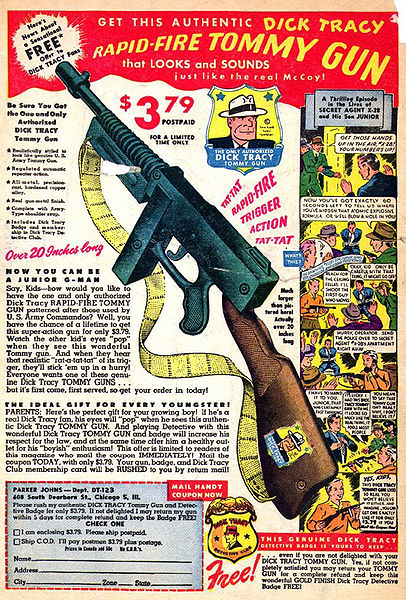
Dick Tracy still runs in the dwindling number of newspapers that publish, but Chester Gould’s comic strip was truly a sensation during its heyday, when feds squared off with gangsters, Nazis and Cold War villains. Dick Tracy was the first strip to introduce brute violence to the funnies page, so it’s no surprise to see this 1947 advertisement for a toy tommy gun. For just $3.79, a kid could own a 20-inch replica firearm (“that looks and sounds like the real McCoy”). An excerpt from the ad:

“Watch other kids’ eyes pop when they see this wonderful TOMMY GUN. And when they hear that realistic “rat-a-tat-tat” of its trigger, they’ll stick ’em up in a hurry! Everyone wants one of these Dick Tracy TOMMY GUNS…but it’s first come, first served, so get your order in today… It’s the ideal gift for every youngster. Parents, here’s the perfect gift for your growing boy. If he’s a real Dick Tracy fan, his eyes will ‘pop’ when he sees this authentic Dick Tracy TOMMY GUN. And playing detective with this wonderful Dick Tracy TOMMY GUN and badge will increase his respect for the law, and at the same time offer him an outlet for his ‘boyish enthusiasm!'”

Tags: ,

Don't make me give you a lethal karate blow. (Image courtesy of Christiaan Tonnis.)

The always wonderful boingboing tipped me off to a group of immaculate photos by Peter Ross of the personal effects left behind by the late, great writer William S. Burroughs. For whatever reason, I always find it interesting to look at the typewriters of authors who lived before the advent of word processing. I wonder if people in the future will look back fondly at the laptops that writers use today. Since most people trade in their computers for new models every few years, it’s unlikely. Back in the day, writers often clung to their hunt-and-peck machines like they were talismans. Also: Is anyone surprised that Burroughs walked around in shoes that had holes in them, possessed an air pistol and blow darts or owned candles shaped like skulls? And of course he had a copy of The Medical Implications of Karate Blows.

Tags:

August Deter, 51, was the first patient diagnosed with the disease by Alois Alzheimer, in 1901.

It may soon be possible for middle-aged people who have a simple eye scan when they visit the optician to learn if they will develop Alzheimer’s disease 20 years down the road. British scientists believe they’re about three years from perfecting the inexpensive test. Knowledge wouldn’t just allow patients to plan their lives differently but would make it possible for them to begin taking medications as early as possible and delay the onset of the disease by years. From an article in the Mail Online:

“The eye test would provide a quick, easy, cheap and highly-accurate diagnosis.

It exploits the fact that the light-sensitive cells in the retina at the back of the eye are a direct extension of the brain.

Using eye drops which highlight diseased cells, the UCL researchers showed for the first time in a living eye that the amount of damage to cells in the retina directly corresponds with brain cell death.

They have also pinpointed the pattern of retinal cell death characteristic of Alzheimer’s. So far their diagnosis has been right every time.”

Tags: ,

The great Library of Congress channel on YouTube provides us with this 1897 footage of Seattle, Washington, as the Klondike Gold Rush was in full force. The brief, shaky clip shows excited miners (or “stampeders”) equipping themselves with supplies. Many stampeders ultimately lost their lives in their quest. In fact, the outfitters got much richer serving their customers than the miners did from pursuing valuable rocks and dust. Not surprising, really. The pathways pioneers incidentally develop are usually far more valuable than the riches they seek.

Tags:

Hopper and "Easy Rider" cohort Jack Nicholson at the 1990 Academy Awards.

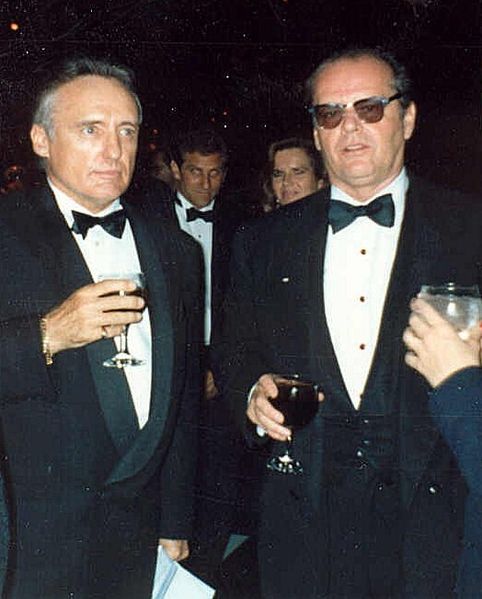
Filing for divorce from what’s described as your deathbed might seem like an odd thing to do, but it likely doesn’t even rank very high on the list of the most unusual things Dennis Hopper has done in his life. In 1970, the actor-director-artist did something that’s present somewhere on that list: He decided to use the good will from his 1969 surprise hit Easy Rider (which cost $350,000 and raked in tens of millions) and head to the backlands of Peru on Universal’s dime to make an almost indescribable film (ultimately titled The Last Movie), which would become one of the most tortured productions in Hollywood studio history. It had only a brief release and nearly ended Hopper’s career. Well, that and the drug abuse. The artist never fully recovered from the debacle of The Last Movie until his brilliantly perverse turn in David Lynch’s Blue Velvet in 1986.

Luckily, Life magazine dispatched the excellent reporter Brad Darrach to profile Hopper during the volatile production. The resulting article is called The Easy Rider Runs Wild in the Andes. An excerpt from the beginning of the article:

“Peru has painfully learned to live with earthquakes, avalanches, tidal waves, jaguars and poisonous snakes. But Dennis Hopper was something else. When the director of Easy Rider arrived in Lima several months ago, a reporter from La Prensa asked his opinion of marijuana (illegal in Peru) and ‘homosexualism.’ Taking a long reflective pull on an odd-looking cigarette, Dennis said he thought everybody should ‘do his thing’ and allowed that he himself had lived with a lesbian and found it ‘groovy.’ No remotely comparable statement had ever appeared in a Peruvian newspaper. The clergy screamed, the ruling junta’s colonels howled. Within 24 hours the government had denounced the article and issued a decree repealing freedom of the press.

Dennis Hopper was undisturbed. Furor trails him like a pet anaconda. At 34, he is known as a sullen renegade who talks revolution, settles arguments with karate, goes to bed in groups and has taken trips on everything you can swallow or shoot.”

Tags: ,

« Older entries § Newer entries »