
"tiny tim apocalypse."
A few search engine keyphrases bringing traffic to Afflictor this week:
Ideas and technology and politics and journalism and history and humor and some other stuff.
"tiny tim apocalypse."
A few search engine keyphrases bringing traffic to Afflictor this week:
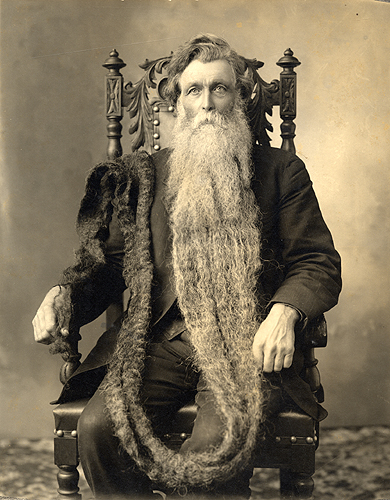
Afflictor: Subtly suggesting to this guy that maybe he should trim the beard a little since 2009.
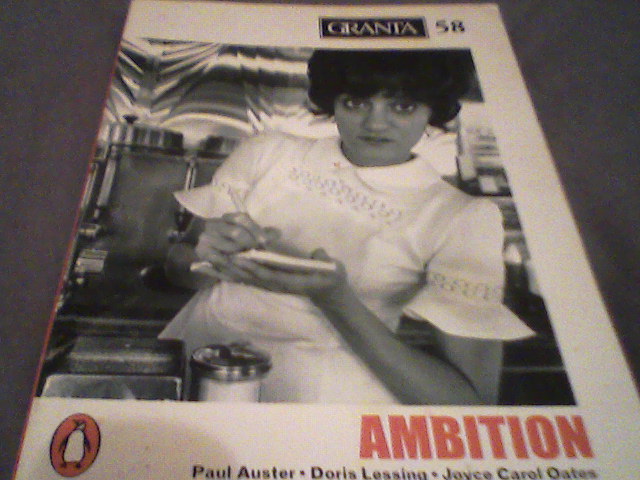
In the article, Brian MacKinnon hinted that he would get plastic surgery and try to enter medical school under a new identity.
In 1997 Granta published its “Ambition” issue. It contains a really great piece called “I Was Brandon Lee,” written by journalist Ian Parker, who is now a staff writer for the New Yorker. The story profiles a brazen impostor named Brian MacKinnon, a Scottish man who in 1995 went back and attended his old high school again when he was 32, pretending to be “Brandon Lee,” a Canadian teen who excelled academically, enjoyed extracurriculars and dreamed of being a doctor when he “grew up.”
One of the most interesting things about the case is that administrators, teachers and fellow students convinced themselves that the oldish-looking MacKinnon was 17, even though the truth stared them in the face. An excerpt:
“Gwyneth Lightbody was surprised, but hoped she did not show her surprise. ‘I said, ‘Well–in you come.” She told me that ‘He did not look like your typical teenager. I assumed he was an adult, but when you’re presented with facts…I mean, in teaching, you see all sorts of strange sights. It could be he had some illness that made him age rapidly–or something.’
On the first day she met some fellow teachers mid-morning. ‘We were all saying, ‘Have you got a pupil that looks old?’ We all thought he was an adult. But we assumed everything had been done, and he was just a bit of an oddity.’ Pupils were doing the same, trying to make Brandon fit his own story–by reminding themselves, for example, of the wide range in teenage body types. ‘I had a boyfriend who was over six feet then,’ one student said to me; another said: ‘I could think of boys with beards and hairy chests. If someone says they’re seventeen, you’re not going to turn round and say no, no you’re not.’ By lunch it seems MacKinnon had been accepted as an old-looking, odd-looking teenager–an alien from Canada–rather than an adult who looked his age.”

"Unique Valentine's Day gift." (Image by Andrew Dunn.)
Cow Skull & Antlers – UNIQUE VALENTINES DAY GIFT FOR A COLLECTOR
Genuine Cow skull with horns & teeth
Originally purchased at an American Indian Pow Wow
Also comes with REAL mounted horns & a pair of deer antlers

Depending on how you define OXO, Tennis for Two was either the first or second video game. A paddle contest displayed on an oscilloscope, the game was created by physicist and pinball fan William Higinbotham, who debuted it in 1958 at the Brookhaven National Laboratory on Long Island. Oh, and Higinbotham also helped build the first atomic bomb and later became an outspoken opponent of nukes. From his 1994 New York Times obituary:
“William A. Higinbotham, a physicist who developed electronic components for the first atomic bomb and then became a leading advocate of controlling nuclear weapons, died on Thursday at his home in Gainesville, Ga. He was 84.
The cause was emphysema, his family said.
Mr. Higinbotham was a group leader in electronics at Los Alamos, N.M., where the first atomic bomb was developed during World War II. But he soon helped establish a group of scientists, the Federation of American Scientists, that warned about the risks posed by nuclear weapons unless they were tightly controlled.
Mr. Higinbotham has also been called the grandfather of modern video games. In 1958, as a senior physicist at Brookhaven National Laboratory on Long Island, he built for the laboratory’s annual public show what was very possibly the first video game — a tennis game that was displayed on a tiny cathode ray tube.”
Tags: William Higinbotham
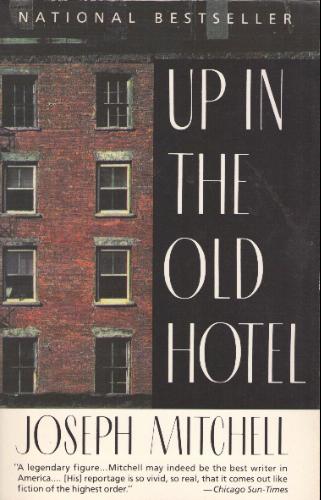
All three articles excerpted are contained Mitchell''s great collection, "Up in the Old Hotel."
Three wonderful opening sentences from articles written by the unimpeachable New Yorker legend Joseph Mitchell.
••••••••••
From “Mr. Hunter’s Grave” (1956):
“When things get too much for me, I put a wild-flower book and a couple of sandwiches in my pockets and go down to the South Shore of Staten Island and wander around awhile in one of the old cemeteries there.”
••••••••••
From “Hit on the Head with a Cow” (1938):
“When I have time to kill, I sometimes go to the basement of a brownstone tenement on Fifty-ninth Street, three-quarters of a block west of Columbus Circle, and sit on a rat-gnawed Egyptian mummy and cut up touches with Charles Eugene Cassell, an old Yankee for whose bitter and disorderly mind I have great respect.”
••••••••••
From “Goodbye, Shirley Temple” (1939):
“I’ve been going to Madame Visaggi’s Third Avenue spaghetti house off and on since speakeasy days, and I know all the old customers.”
Tags: Joseph Mitchell
From a 1977 radio interview for the Canadian Broadcast Corporation’s Quirks and Quarks program. (Thanks Treehugger.)
Tags: Isaac Asimov

New York City has earthquakes, but they’re so minor we never feel them. In most instances, the earth prefers to swallow us up one by one. But it’s different in Los Angeles.
L.A.’s tempermental turf is the subject of The Myth of Solid Ground: Earthquakes, Prediction, and the Fault Line Between Reason and Faith, a volume on the topic by David L. Ulin. I remember Ulin’s writing from back in the day when he wrote book reviews for Newsday. He’s worked at the Los Angeles Times for a number of years now.
Among other earthquake-related topics, Ulin’s book looks at the thorny issue of earthquake prediction, by scientists and psychics, the concerned and the kooky. An excerpt about Linda Curtis, Seismological Secretary of the Southern California field office of the United States Geological Survey in Pasadena:
“Curtis is, in many ways, the USGS gatekeeper, the public affairs officer who serves as a frontline liaison with the community and the press. Her office sits directly across the hall from the conference room, and if you call the Survey, chances are it will be her low-key drawl you’ll hear on the line. In her late forties, dark-haired and good-humored, Curtis has been at the USGS since 1979, and in that time, she’s staked out her own odd territory as a collector of earthquake predictions, which come across the transom at sporadic but steady intervals, like small seismic jolts themselves.
‘I’ve been collecting almost since day one,’ she tells me on a warm July afternoon in her office, adding that it’s useful for USGS to keep records, if only to mollify the predictors, many of whom view the scientific establishment with frustration, paranoia even, at least as far as their theories are concerned.
‘Basically,’ she says, ‘we are just trying to protect our reputation. We don’t want to throw these predictions in the wastebasket, and then a week later…’ She chuckles softly, a rolling R sound as thick and throaty as a purr. ‘Say somebody predicted a seven in downtown L.A., and we ignored it. Can you imagine the reaction if it actually happened? So this is sort of a little bit of insurance. If you send us a prediction, we put it in the file.'”
••••••••••
“Plus–the city of Los Angeles and its millions of people”:
Tags: David L. Ulin, Linda Curtis
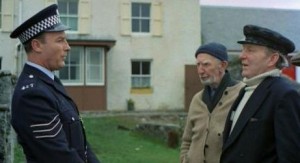 Misunderstood even by its own studio at the time of its release, director Robin Hardy’s debut film, a tale about a prim Scottish police sergeant investigating a missing-child case on a private island, uses a fiendish, economical screenplay by Anthony Shaffer to mock everything in its path, even itself.
Sergeant Howie (Edward Woodward) is stonewalled by the locals from the second a police helicopter deposits him on remote Summerisle, a Scottish burg known for its capacity to grow produce. It initially seems like this will be a straightforward case for the experienced lawman, but it’s actually something altogether kinkier, thanks to the prurient islanders.
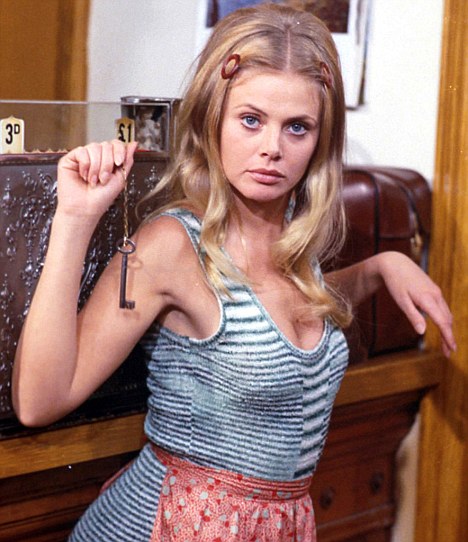 Howie, a devout Christian, is appalled by the pagan sexual rituals performed openly and wantonly by the isle’s batshit inhabitants, who like to pray, dance and sing naked. Even the chaste Howie has to look twice when the tavern owner’s bawdy daughter Willow (Britt Ekland) displays her charms. And Lord Summerisle (Christopher Lee), the village’s leader, may be the biggest wackjob of them all. Trying hard to focus on his work as the town’s licentious Mayday festival approaches, Howie interrogates one lewd, lying local after another as he zeroes in on the missing girl, who may have been murdered in some sort of sick ritual sacrifice.
What’s amazing about Wicker Man is that despite lazily being labeled a horror film, it’s really a breezy and funny whodunit until its famous conclusion, almost working as a comedy of manners, as joyous as it is sinister. It’s like an elaborate practical joke, albeit one being played by bloodthirsty pagans. The amusement emanates not only from Howie’s stunned reactions to the gleeful heathenism but from the good Christian looking down on the islanders, conveniently forgetting that his own religion is based on a brutal sacrifice. “You’ll simply never understand the nature of sacrifice,” Howie is told at one point, but what he can’t understand he may have no choice but to accept.•
Tags: Anthony Shaffer, Britt Ekland, Christopher Lee, Edward Woodward, Robin Hardy
Bold futuristic designs during the race for space.
Tags: André Courréges
"Or a portrait made with charcoal."
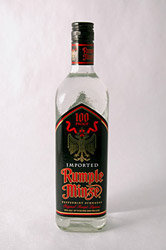
For SALE: One de-flowered bottle of Rumpleminz
In a moment of haste, much like your conception, a bottle of Rumpelminz was purchased. However, along with Chilean miners and oil spills, Rumpleminz was forgotten and sent into the heavy abyss that was 2010.
Details: This is no half empty bottle that a prohibition gangster named Fat Boy Al is trying to sell you behind his urine stained jacket – there is a good 80% left of this candycane goodness. One sip of this and it’s like a flashback of sitting on Santa’s lap at the local mall.
Will trade for half drank bottle of Whiskey, or a portrait made with charcoal.
Shovel, pick, chopper, saw, cutter, measurer, scissors, climber, anchor, shield, grappler, hammer, nail puller, bottle opener, can opener, etc. (Thanks Reddit.)
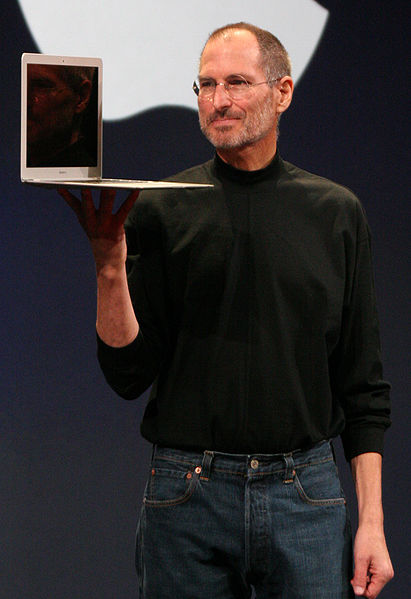
Jobs shows off the MacBook Air in 2008. (Image by Matthew Yohe.)
Steve Jobs shared his thoughts about what makes an entrepreneur successful in 1995. Even someone as brilliant as Jobs could have washed out without incredible diligence, but the creative brain he was born with is still far rarer than a great work ethic. (Thanks Newmark’s Door.) An excerpt:
“I’m convinced that about half of what separates the successful entrepreneurs from the non-successful ones is pure perseverance. It is so hard. You put so much of your life into this thing.
There are such rough moments in time that I think most people give up. I don’t blame them. Its really tough and it consumes your life. If you’ve got a family and you’re in the early days of a company, I can’t imagine how one could do it. It’s pretty much an eighteen-hour day job, seven days a week, for a while.”
Tags: Steve Jobs
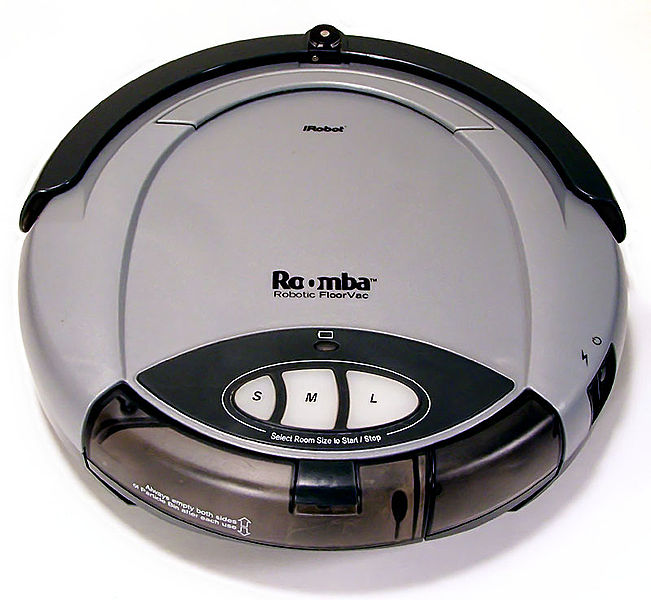
Roomba can't intellectualize vacuuming, but it gets the job done. (Image by Larry D. Moore.)
Steven Levy has an excellent piece, “The AI Revolution Is On,” in the current Wired. In it, Levy points out that artificial intelligence has turned out to be markedly different than what science in the ’50s and ’60s predicted. The reason is because yesterday’s scientists tried to make machines emulate the human brain. But since we still don’t really know how that organ operates, researchers threw away the playbook during the ’80s and have since focused on allowing computers to be “themselves.” An excerpt:
“AI researchers began to devise a raft of new techniques that were decidedly not modeled on human intelligence. By using probability-based algorithms to derive meaning from huge amounts of data, researchers discovered that they didn’t need to teach a computer how to accomplish a task; they could just show it what people did and let the machine figure out how to emulate that behavior under similar circumstances. They used genetic algorithms, which comb through randomly generated chunks of code, skim the highest-performing ones, and splice them together to spawn new code. As the process is repeated, the evolved programs become amazingly effective, often comparable to the output of the most experienced coders.
MIT’s Rodney Brooks also took a biologically inspired approach to robotics. His lab programmed six-legged buglike creatures by breaking down insect behavior into a series of simple commands—for instance, ‘If you run into an obstacle, lift your legs higher.’ When the programmers got the rules right, the gizmos could figure out for themselves how to navigate even complicated terrain. (It’s no coincidence that iRobot, the company Brooks cofounded with his MIT students, produced the Roomba autonomous vacuum cleaner, which doesn’t initially know the location of all the objects in a room or the best way to traverse it but knows how to keep itself moving.)
The fruits of the AI revolution are now all around us. Once researchers were freed from the burden of building a whole mind, they could construct a rich bestiary of digital fauna, which few would dispute possess something approaching intelligence. ‘If you told somebody in 1978, ‘You’re going to have this machine, and you’ll be able to type a few words and instantly get all of the world’s knowledge on that topic,’ they would probably consider that to be AI,’ Google cofounder Larry Page says. ‘That seems routine now, but it’s a really big deal.'”
Tags: Larry Page, Rodney Brooks, Steven Levy
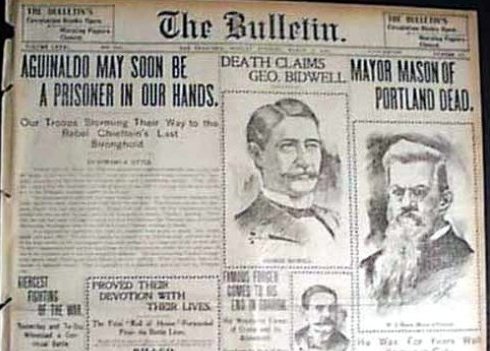
"Mr. Wellman copied eight columns of the 'Bulletin.'"
If you think today’s workers waste time merely because there are so many hand-held gadgets to play with, then have a look at this article in the November 6, 1896 Brooklyn Daily Eagle. In this piece, which originally ran in the San Francisco Bulletin, some Bay Area chucklehead wasted about six hours of company time with the aid of just a pen and a postcard. An excerpt:
“Walter D. Wellman, a bookkeeper in the employ of Anspacher Bros., the commission merchants, has performed the remarkable feat of writing in long hand 7,068 words on an ordinary postal card. About two months ago M.C.F. Grincourt, a Frenchman, succeeded in writing 5,454 words in French on a postal card. M. Grincourt’s feat made a great sensation, and his postal card was for a long time on exhibition at the Examiner office. An account given in the columns of the Examiner represented this as the finest and closest writing ever accomplished. But Mr. Wellman has far excelled the Frenchman, not only in the number of words he has succeeded in getting upon the postal card, but in the length of the words he used also.
M. Grincourt copied a portion of one of Victor Hugo’s novels, in which the words were notoriously short. Mr. Wellman copied eight columns of the Bulletin, selected from three distinct articles, so that he could not be accused of copying from one writer whose vocabulary consisted chiefly of short words. There were 110 lines on M. Grincourt’s postal card and 154 on Mr. Wellman’s. Mr. Wellman also asserts that he had plenty of room to spare and could easily have gotten in 8,500 words.
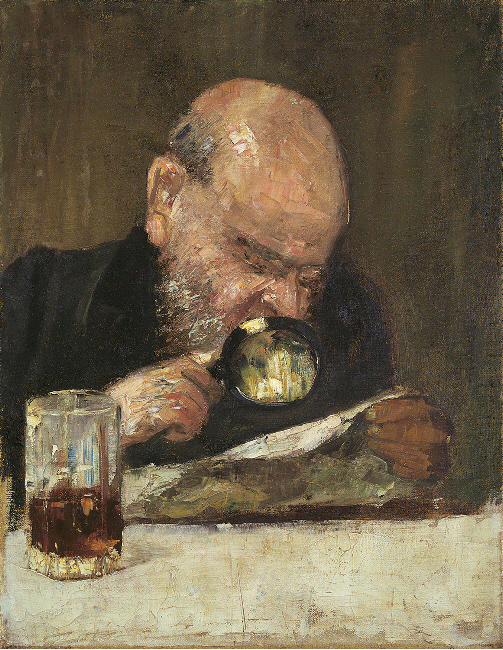
"The postal can easily be read with a glass, and a person with a good eye can read it without the help of a glass."
He worked on it for fifteen days, at odd moments, when he could escape from his business duties. He says he could have accomplished it in six hours of steady work. He wrote it at a pace of fifty words a minute, while his pace in writing the ordinary size is from thirty-five to forty a minute. The postal can easily be read with a glass, and a person with a good eye can read it without the help of a glass. A fellow clerk of Mr. Wellman easily read the postal with his naked eye, but begged off from all postals being written in this fashion. The 7,068 words are written with an ordinary steel pen in violet ink. The ink is a mere matter of chance, and has nothing to do with the fineness of the work.
Mr. Wellman has never done any work of this kind before. His only practice was in writing the Lord’s prayer. Without the slightest difficulty he accomplished the feat of writing these seventy-two words in a space no larger than a gold quarter of a dollar. The writer of this curiousity is a young American, 28 years old. He is near sighted and wears glasses, but his eyes must be very strong, as he has suffered no pain or inconvenience from this close work. In fact, his near sightedness may help him a little, as near sighted people usually see things at a close range much better than people of ordinary sight.”
“Here we are playing ping pong when we ought to be working,” says Ralph Baer, the inventor who subsequently created the Magnavox Odyssey home gaming system. The pre-Pong match takes place in Nashua, New Hampshire.
Tags: Ralph Baer

"I am going to make a incubator for reptile eggs." (Image by W. Buys.)
tell me price (not paying over 45). please nothing over 4ft tall. and 2.5feet wide.
i dont care if it doesnt cool i am going to make a incubator for reptile eggs.
please help me out!.
David Fincher is likely to receive an armful of Oscar nominations for The Social Network, but before he put himself on the map by directing Se7en, Fincher turned out the commercials for AT&T’s prescient 1990s “You Will” ad campaign. The compilation of spots below predicts teleconferencing, Skype, e-books, GPS, etc., though renewing a driver’s license at the ATM still sadly isn’t a reality. Tom Selleck provides the voiceover narration. (Thanks Reddit.)
Tags: David Fincher, Tom Selleck
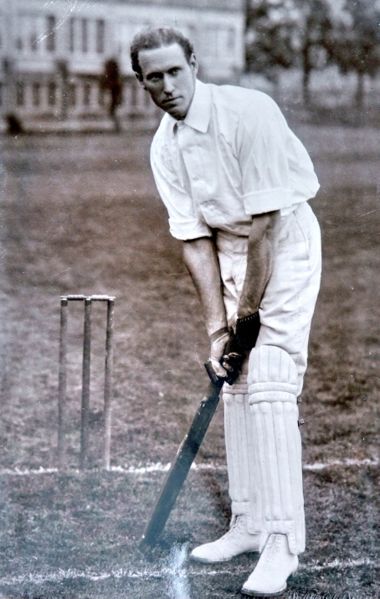
John Barton "Bart" King at bat in a Philadelphia match in 1900.
In 1900, cricket and baseball (or “base ball”) both enjoyed great popularity in America. People of that era probably couldn’t imagine a time when cricket wouldn’t be an important part of our sporting life. An excerpt from the 1901 Brooklyn Daily Eagle Almanac:
“Cricket continued to flourish in the United States during 1900. The annual contest with Canada again resulted in favor of the United States. Philadelphia is the stronghold of American Cricket, and in the Inter-City match with All New York maintained her superiority by winning the match in most hollow fashion. The Germantown Cricket Club won the Halifax Cup, the emblem of Quaker supremacy, for the sixth time in succession. In the metropolitan district, chief interest in the game is now centered in Brooklyn, where no less than six clubs have their headquarters. The championship of the Metropolitan District Cricket League was again captured by the Knickerbocker Athletic Club, while in the New York Cricket Association series the Paterson Cricket Club proved successful and retained the championship.”
Tags: John Barton "Bart" King
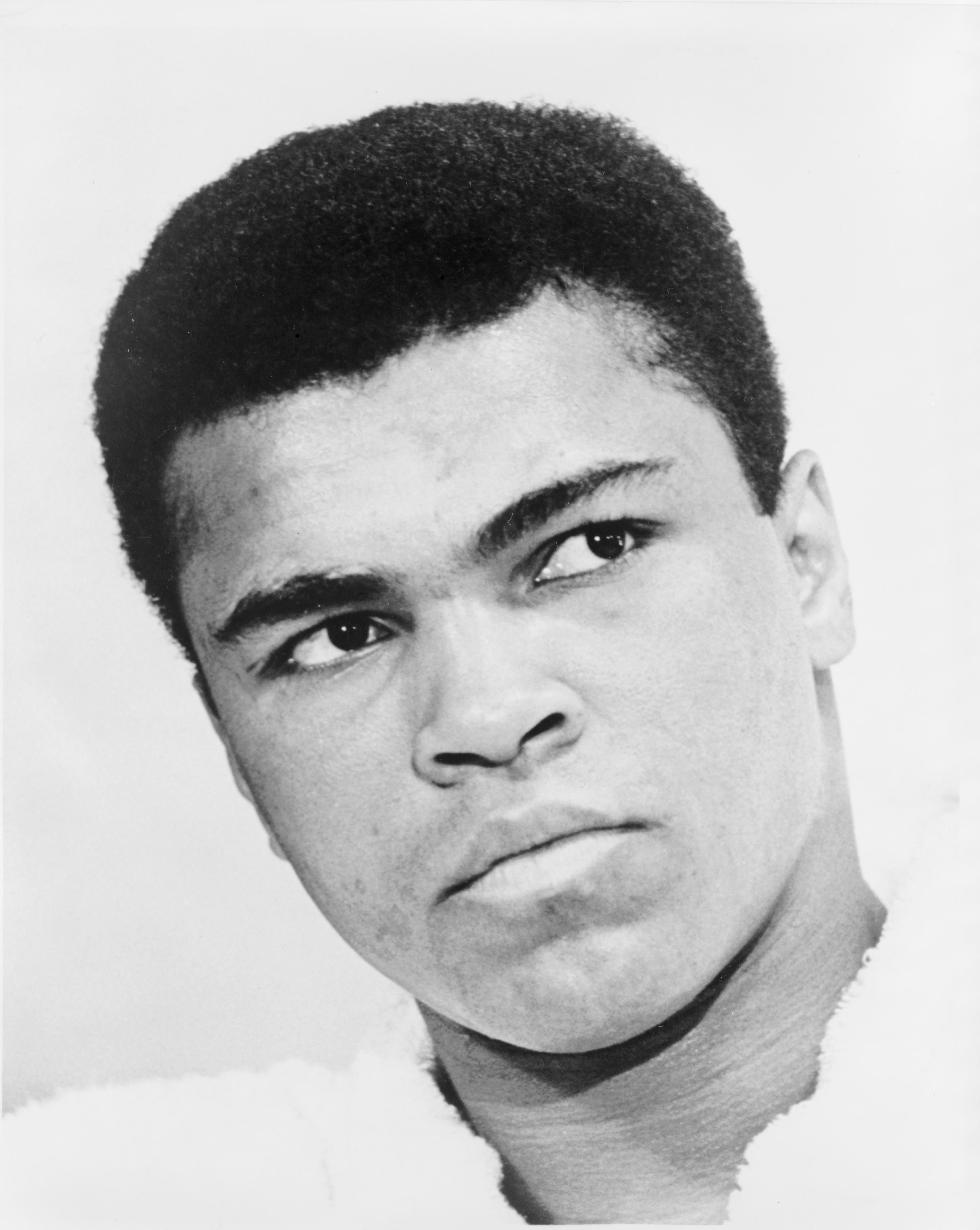
"They say I'm the fastest heavyweight in the ring today. That comes from punching underwater." (Image courtesy of Ira Rosenberg.)
I heard years ago that the young Muhammad Ali made up a bogus story about training underwater for a boxing match in order to get his face in Life magazine. The man was always very gifted when it came to hoopla. I came across the 1960 article, “A Wet Way to Train for a Fight,” on Google Books. Even a quick look at the spread will make it clear why a photo mag was a patsy for such a visual story. Ali hadn’t yet converted to Islam and was still called Cassius Clay. An excerpt from the article:
“The boxer punching up a storm with underwater lefts and rights is as cocky as he is unconventional. ‘Not to be bragging or anything like that,’ says the 19-year-old Cassius Marcellus Clay, ‘but they say I’m the fastest heavyweight in the ring today. That comes from punching underwater.’ Taking a cue from the immortal Ty Cobb, who weighted his shoes in training so that he would feel feather-footed when the season started, Clay goes into a swimming pool and, as these underwater pictures show, does a stunt of submarine shadowboxing. ‘You try to box hard,’ he explains. ‘Then when you punch the same way out of water you get speed. Clay, an Olympic champion before turning pro and winning his first eight fights, has been criticized for talking too much about everything including about how he will win the first world heavyweight title. His answer is to keep on talking–until he gets under water and just makes bubbles.”
Tags: Cassius Clay, Muhammad Ali
For some reason a chick impersonates a monkey as part of the attractions at the 1939-40 New York World’s Fair. It was a far simpler time.
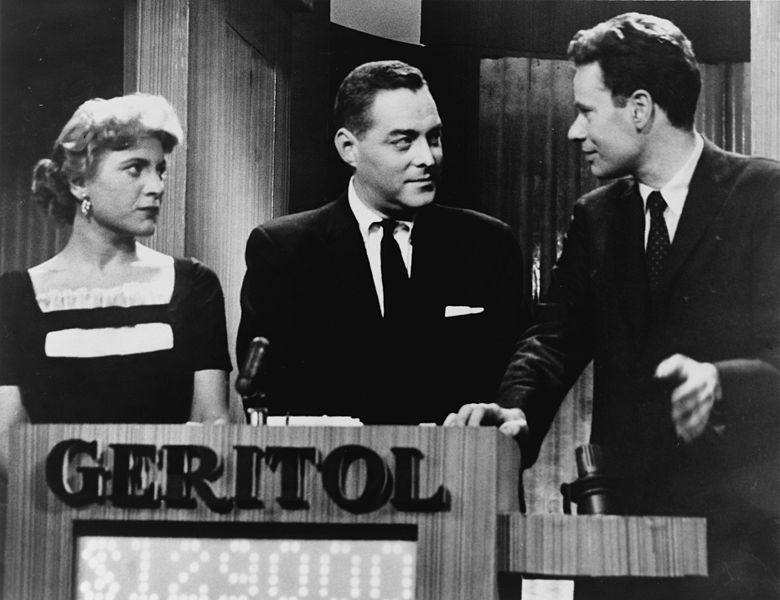
Host Jack Barry (center) and contestants Vivienne Nearing and Charles Van Doren look tense on "Twenty-One." (Image by Orlando Hernandez / "New York World Telegram.")
The New York World Telegram archives provides this classic 1957 photo of three of the principals of the infamous Quiz Show scandal on the set of the program Twenty-One: Vivienne Nearing, host Jack Barry and beloved champion Charles Van Doren. Before long, all three would be targets of an investigation of the show’s practice of rigging outcomes. What’s amazing is that such intelligent people convinced themselves to do something so stupid, that is was somehow okay because that’s how it was done. It was a stunning level of self-delusion.
It must have been brutal picking up and continuing with life after such public disgrace, especially in an age before disgrace was just another marketing tool. Barry eventually regained his footing in the industry as host of Joker’s Wild. Van Doren resigned his professorship at Columbia and lost his job as an on-air personality on the Today show; he became a writer and editor and now is an adjunct English professor at the University of Connecticut. But what of Nearing, the lawyer and feminist who “dethroned” Van Doren and was convicted of perjury along with 13 others? Her 2007 obituary from the New York Times fills in the blanks:
“Ms. Nearing made headlines in 1957 when she dethroned Charles Van Doren as champion on Twenty-One, the popular quiz show on NBC. She won $5,500 in four appearances before she was defeated.
The glory of the victory came to an end and the headlines turned sour in 1960 when 14 contestants, including Ms. Nearing, were charged with second-degree perjury after falsely telling a grand jury that they had not been fed answers. She told the truth in a second grand jury statement, but was convicted of perjury.
Ms. Nearing was a lawyer for Warner Brothers at the time. She was disbarred for six months in 1962 after pleading guilty the year before to misdemeanor perjury. She eventually moved on to work at the New York-based law firm Stroock & Stroock & Lavan, where she became a senior partner and worked until her death.
Friends and family members said Ms. Nearing did not talk much about the scandal. If people broached the subject, she would change it, Ms. Kiemback said. She refused to be involved in the making of Quiz Show, a 1994 movie about the scandal, and gave up her dream of being a judge for fear of reviving the past.”

"Looks more like a ship sitting upside down on the water." (Image by Alexander Remizov.)
If the world keeps getting warmer and the oceans rise, we’ll have issues much larger to deal with than booking a room in a luxury hotel. But Russian architect Alexander Remizov has nonetheless designed a pre-fab hotel that can be built on water as readily as on land. An excerpt from a Spiegel article about the waterborne lodging known as the “Ark”:
“The rising sea waters caused by global warming have inspired a Russian architect to design a hotel that could be built on water as well as land. The eco-friendly ‘Ark’ could be constructed in just a few months anywhere in the world, the designer says.
It’s called “The Ark”, but looks more like a ship sitting upside down on the water. A new design by Russian architect Alexander Remizov challenges the tradition of land-based hotel living and would provide a refuge in the future — should the world face a modern-day flood of Biblical proportions.
Remizov designed the hotel as part of a program on architecture and disaster relief through the International Union of Architects (UIA). He collaborated with a German design and engineering firm and the Moscow-based scientist Lev Britvin, who, according to Remizov, has developed energy-saving solutions for space stations. They are now searching for investors to make the design a reality.”
Tags: Alexander Remizov

"Cow-dung toothpaste." (Image by Pikaluk.)
Some philosophers like working in airports, so why can’t photographers live in them? Native New Yorker Taryn Simon did just that for five days in 2009 (at JFK) to compile more than a thousand photos for her book, Contraband. The volume documents a wide variety of items confiscated from passengers by Customs officials. In a piece in the Guardian by Sean O’ Hagan, there’s a partial list of some of the verboten goods:
“The seized items include various drugs (Xanax, anabolic steroids, Ritalin, khat, ketamine, hashish), counterfeit jewellery, bags, hats, sportswear, shirts, DVDs and watches as well as several kinds of plants, seeds, grass, nuts and foodstuffs. Among the more exotic confiscated substances are deer antlers, deer blood, deer penis and deer tongue, as well as cow-dung toothpaste and cow urine.”
Tags: Sean O' Hagan, Taryn Simon

"I want to learn how to wheelie." (Image Bo Nash.)
Well here’s the deal I want to learn how to wheelie if u can keep me from falling back I can pay u as long as ur reasonable I been riding for about 5 years so Im not no rookie just been hard to get that stupid wheelie thing… So if u knw what ur doing and have a bike lol oh yea I can’t use my bike it’s an 09 r1 cost to much to fix lol so if u have a bike an time hit me up I dnt care about the cold real riders dnt so email me with ur number and how much ur gonna charge…..
