Urban Studies

You are currently browsing the archive for the Urban Studies category.

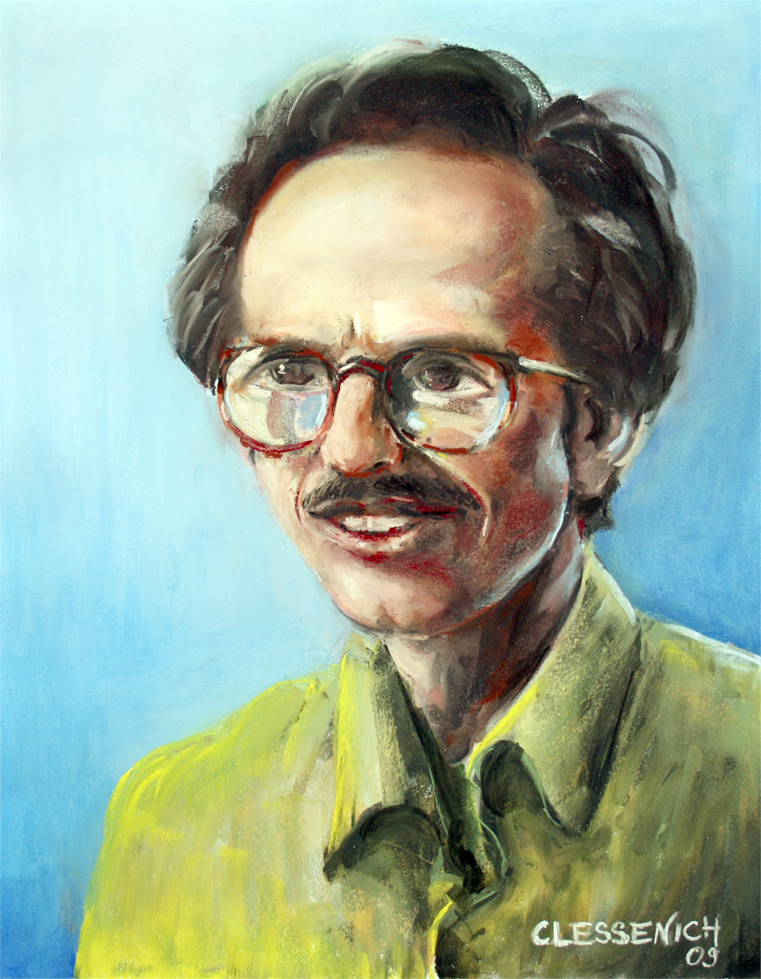
The Paris Review site has a new interview with legendary artist R. Crumb in its summer issue. During the Q&A, Crumb talks about the role psychedelic drugs and Popeye played in his development. An excerpt:

Paris Review

So how did you finally find publication?

R. Crumb

Well, the hippie revolution happened. In 1964 I first got laid, I met my first wife, Dana, and all these protohippies in Cleveland. A lot of them were Jews from Cleveland Heights, Shaker Heights. They started taking LSD and urged me to try it, so Dana got some LSD from a psychiatrist, it was still legal in ’65. We took it and that was totally a road-to-Damascus experience. It knocked you off your horse, taking LSD. I remember going to work that Monday, after taking LSD on Saturday, and it just seemed like a cardboard reality. It didn’t seem real to me anymore. Seemed completely fake, only a paper-moon kind of world. My coworkers, they were like, Crumb, what’s the matter with you, what happened to you? Because I was just staring at everything like I had never seen it before. And then it changed the whole direction of my artwork. Other people who had taken LSD understood right away what was going on, but the people who hadn’t, my coworkers, they didn’t get it.

Paris Review

How did it change your artwork?

R. Crumb

I had been working along in this modern adult cartoon trend, very influenced by the modern, expressionistic, arty quality of work by Jules Feiffer, Ronald Searle, Ralph Steadman. Then, on LSD, I got flung back into this cruder forties style, that suddenly became very powerful to me. It was a kind of grotesque interpretation of this forties thing, Popeye kind of stuff. I started drawing like that again. It was bizarre to people who had known my work before. Even Kurtzman said, What the hell are you doing? You’re regressing!”

Tags:

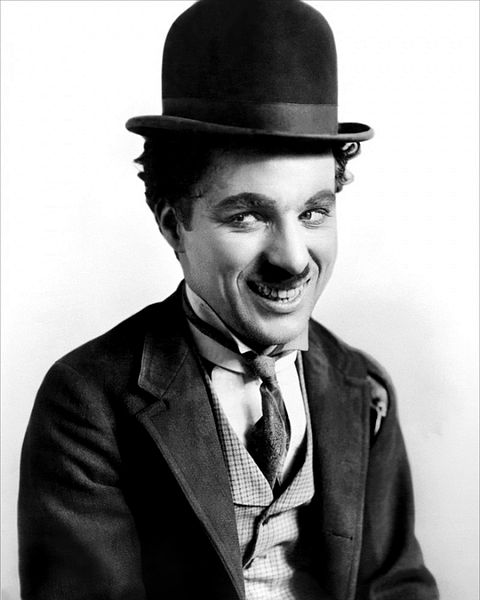
Little Tramp: I stabbed a train porter in the abdomen to acquire this necktie.

Well-dressed hobos were apparently a very serious problem in the New York region in the late nineteenth century. At least that’s the story that was being pushed in an article entitled, “Our Dude Tramps,” in the August 21, 1895 issue of the Brooklyn Daily Eagle. These ruffians, who previously were content to cover themselves in cast-off rags, had suddenly become narcissistic and were mugging decent folk for their cuff links and cummerbunds. Somebody needed to billy club these tramps into submission before they started to look too handsome. An excerpt:

“These tramps are getting too particular in the matter of their clothes. Formerly they used to go around sort of careless like, with their toes getting the benefit of the sunshine and their hats ventilated with accordion tops and flags of truce flying from the usual place, to signify that they were peaceable. But now, affected with the prevailing rage for living above their station, they insist on being clothed like dudes.

One of them terrified a farmer’s wife into convulsions by wearing a monocle when he went to the door to ask for pie and a bottle of claret. And twice within the week they have held up citizens of New Jersey and compelled them to undress, right down to the buff, in order that they may wear their clothing. The last sufferer was waylaid on the marshes near Newark, and was stripped to his undershirt, a pistol placed over his eye overcoming his natural modesty as to disrobing in this public manner, and he was left a prey to the mosquitoes which in that region surpass turkeys for size and hyenas for voracity.

Then in Bloomfield a tramp stole a swimmer’s clothes and caused him to be chased as a wild man. If the tramps keep on doing that sort of thing much longer they may get themselves disliked.”

100% Italian ice. (Image by Kim Scarborough.)

Looking 4 dentist

I m 100% italian i will exchange your work osmetic/ dentistry with italian lessons. Have your italian vacation this summer and actually understand what they are saying!

More Craigslist ads:

Duane awaits his next customer.

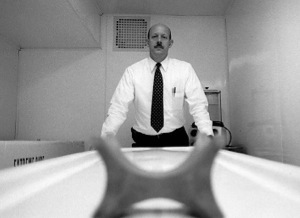
It was more than a decade ago that I saw the 11-minute b&w documentary, “The Last Guy to Let You Down,” at Sundance, and it still stands out as an impressively idiosyncratic and unique NYC portrait. Made by British-born photographer and filmmaker Rolf Gibbs, the movie is a melancholy and irreverent profile of a depressed East Village funeral director who’s had more luck dealing with the dead than loving the living. To watch the movie, visit Gibbs’ site and click on “Films” and the title.

More Featured Videos:

Tags:

Where do we keep the tiny lawn mower, Dad?

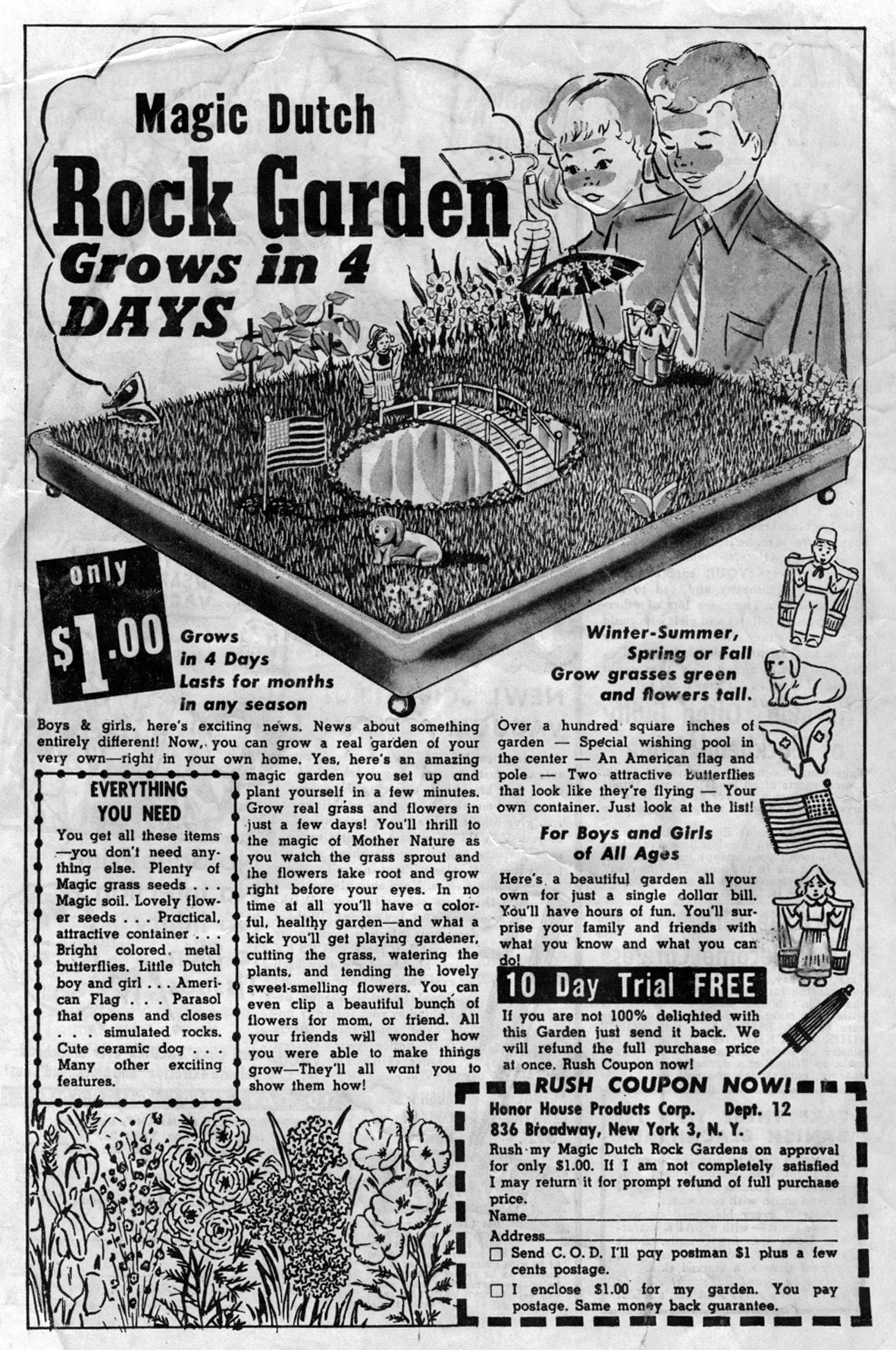
If your parents gave you a dollar in 1952 to buy this incredibly crappy toy garden, they were really sick of you and tried just about anything to keep you out of their hair for a few minutes. Even more boring than an ant farm, this faux topiary was supposed to sprout real grass and flowers in “over 100 square inches of garden.” It promised that the garden would grow is just four short days and last for months. It sounds like some sort of forerunner to the grandeur of the Chia Pet.

The garden came with Dutch boy and girl figurines, “simulated” rocks, a ceramic dog and an American flag, so that you could embarrass the whole country. (“I Wasted $1” tee shirt sold separately.) An excerpt from the copy:

“Boys & girls, here’s exciting news. News about something entirely different! Now, you can grow a real garden of your very own–right in your own home. Yes, here’s an amazing magic garden you set up and plant yourself in a few minutes. Grow real grass and flowers in a few days! You’ll thrill to the magic of Mother Nature as you watch the grass sprout and the flowers take root and grow right before your eyes. In no time at all you’ll have a colorful, healthy garden–and what a kick you’ll get playing gardener, cutting the grass, watering the plants, and tending the lovely sweet-smelling flowers. You can even clip a beautiful bunch of flowers for mom, or friend. All your friends will wonder how you were able to make things grow. They’ll all want you to show them how!”

More Old Print Ads:

Internet cafes will not make you dumber. (Image by Phallus Nocturne.)

When I was growing up in my working-class neighborhood in Queens, there wasn’t a single bookstore in the community during my entire childhood. Not one. There were candy stores where you could get a paper or a magazine and a couple of small, semi-stocked libraries, but it was difficult for a kid with a curious mind to grow up in that environment. You had to take a train to Manhattan just to get a hold of something with hard covers to read. I always felt like there was information somewhere, but I didn’t know where it was.

You know what would have leveled the playing field? The Internet. It didn’t exist then, but it does now, and it has the potential to connect any reader in the world to any book they want. You can find out about any university, look up any word and read an incredible array of great writing wherever there’s a wi-fi connection. That doesn’t mean everyone will use the medium to improve themselves, but it’s pretty hard to avoid doing so. The Internet is democratizing and despite what the hand-wringers say, it’s made our knowledge deeper and stronger.

That’s why I bristle when I hear how the Internet is destroying the literary mind and damaging our memories. If it seems like our memories are failing more often than they used to, that’s because we have so much more information at our fingertips. Ultimately, that’s a good thing.

One person who agrees with me is Steven Pinker. Pinker is a psychology professor at Harvard who’s best known for his book, The Stuff of Thought. In an article on Edge, he addresses concerns about what the Internet is doing to our brains. An excerpt:

New forms of media have always caused moral panics: the printing press, newspapers, paperbacks and television were all once denounced as threats to their consumers’ brainpower and moral fiber.

So too with electronic technologies. PowerPoint, we’re told, is reducing discourse to bullet points. Search engines lower our intelligence, encouraging us to skim on the surface of knowledge rather than dive to its depths. Twitter is shrinking our attention spans.

But such panics often fail basic reality checks. When comic books were accused of turning juveniles into delinquents in the 1950s, crime was falling to record lows, just as the denunciations of video games in the 1990s coincided with the great American crime decline. The decades of television, transistor radios and rock videos were also decades in which I.Q. scores rose continuously.

For a reality check today, take the state of science, which demands high levels of brainwork and is measured by clear benchmarks of discovery. These days scientists are never far from their e-mail, rarely touch paper and cannot lecture without PowerPoint. If electronic media were hazardous to intelligence, the quality of science would be plummeting. Yet discoveries are multiplying like fruit flies, and progress is dizzying.”

Tags:

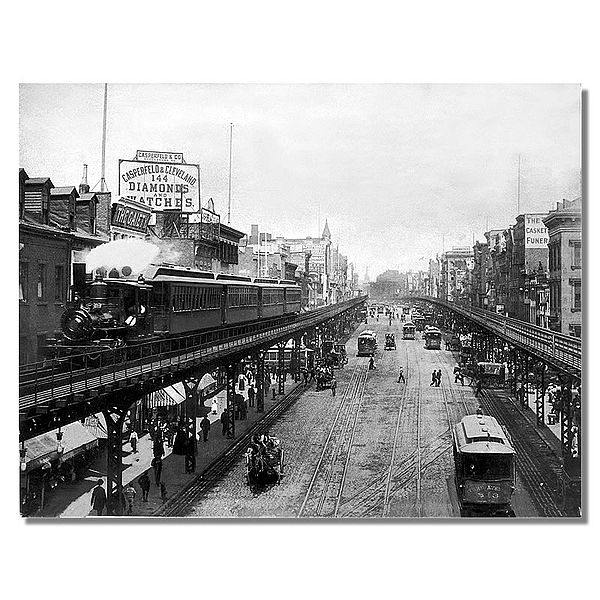
What the Bowery looked like in the late 1890s.


According to the Brooklyn Daily Eagle.

DRINK

  • Milk punch…5 ¢
  • Sherry and egg…5¢
  • Mint julep…5¢
  • Large glass of lager…3¢
  • Pint of whiskey…10¢
  • Cocktails…6¢
  • Glass of porter…3¢
  • Glass of whiskey…3¢
  • Big cup of coffee…5¢

FOOD

  • Prime roast beef…5¢
  • Corn beef and cabbage…5¢
  • Mutton chops…5¢
  • Three boiled eggs…5¢
  • Country sausages…5¢
  • Gilt edge kidney stew…5¢
  • Green turtle soup…5¢
  • Beef steak…5¢
  • Pork and beans….5¢

I don’t know when or where this occurred. But mostly, I don’t know why.

    Tags:

    “The stranger picked up a razor and invited her to have a shave.”

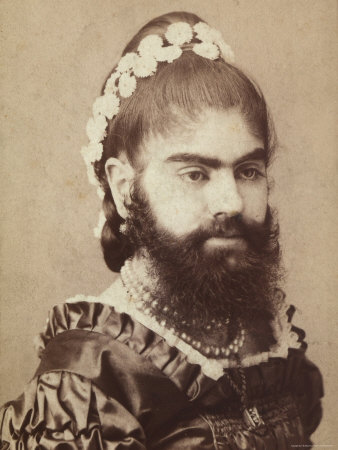
    If I’ve learned one thing from reading Old Timey newspapers, it’s that nothing good ever happened in a New York barbershop during the 1880s. No one ever went in, got a shave, and emerged the better. These shops were full of nonstop drunkenness, insults and bloody fisticuffs. You would have been safer at a cock fight in an opium den.

    In a story I came across  recently in the February 12, 1887 issue of the Brooklyn Daily Eagle, a young woman being teased about her alleged hirsuteness led to a wild melee. The story:

    “Julia McEvoy, a rather good looking young woman, who says she is 23 years old, was arrested yesterday afternoon by Officer Stevens, of the Sixth Sub Precinct, on a charge of malicious mischief preferred against her by Michael Bria, an Italian barber, whose store is at 455 Graham avenue. Miss McEvoy was very indignant over her arrest and stoutly proclaimed her innocence. When questioned she said she had been the barber’s housekeeper.

    She was in the store yesterday afternoon when a friend of her employer’s entered. He seemed to be in a jocular mood and amused himself by poking fun at Miss McEvoy. The latter did not mind this until the stranger picked up a razor and invited her to have a shave. The young woman considered that this involved an unpleasant implication and became indignant at the proposition. She informed the stranger that he was carrying this fun too far, and requested him to desist. He thought, however, that the fun was very mild, and had no intention of relinquishing it. Indeed, Miss McEvoy’s fiery eyes only served to give it keener relish.

    Then, according to the young woman’s story, he chased her about the store. It was a very lively chase. They jumped over and around chairs and tables, most of which were soon upset. Though Miss McEvoy is a nimble young woman, she was not agile enough for her tormentor, her skirts seriously impeding her movements. The stranger finally caught her and renewed his proposition to shave her. Miss McEvoy, by that time was really angry, and after she expressed her opinion of him in a manner more vigorous than the man thought the occasion demanded. He also grew angry and a war of words ensued between the two.

    The hot Southern blood of the stranger, who was an Italian, was soon aroused, and when Miss McEvoy expressed her opinion of him in a more unendurable form than she had yet used he seized her and pitched her through a large window pane of glass. She escaped without injury, and was about to re-enter the store when the officer appeared. Mr. Bria, who had been absent a part of the time, returned at this moment, and seeing the damage done to this property made the charge against her on which she was arrested.

    Miss McEvoy, when taken to the station house. expressed the belief that it was rather cruel to have her arrested after being used as an irresponsible missile instead of being an actual misdemeanant. When Mr. Bria was seen this morning he seemed to have some doubts as to who the actual culprit was. He insinuated that Miss McEvoy had been drinking a little beer. She was not really his housekeeper, but was only employed by him from day to day. The stranger’s name could not be learned. When the case was called in Justice Naecher’s Court this morning Bria did not appear, and Miss McEvoy was discharged.”

    Tags: , ,

    Maybe the couch belongs to that whiny guy with all the hair from the Counting Crows. (Image by Snowdog.)

    CELEBRITY COUCH – OWNED BY SINGER! – $1000 (Midtown West)

    A famous singer owned this freaking couch. It costs $900 brand new at IKEA. It was given to me as a gift.

    Now i am moving out of my apartment and i need to sell it. The thing is super comfortable AND friends can sleep on this thing… if you take the back pillows off and put them on the ground, you can fit probably 5 people as guests sleeping over….

    *2 guests (a couple) laying together on one leg of the “L” couch (with the back pillows on the ground, creating more room on the L leg”

    *1 guest (an individual) laying other leg of the “L” couch (*Note: you’d probably want to be foot-to-foot, not head-to-head meeting at the middle of the L, because otherwise it could be awkward)

    *with the back pillows on the floor, you can create a mattress by putting them side-by-side, putting room for 2 more.

    So actually you could fit 6 people if you put two couples on the couch… niia hahaha!!!

    the bottom line is this… the couch below is the couch we got! BUT… it is the property of a singer!!! the singer is an awesome artist that you will know. You can probably charge guests $20.00 each to sit on the couch. possibly providing a sustainable revenue stream.

    The couch is about a year old, and has a small wine stain on it. Nothing a small patch can’t fix.

    More Craigslist ads:

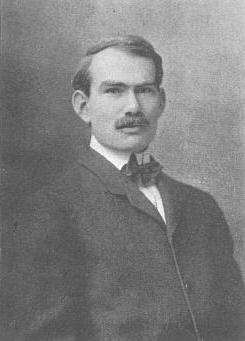
    Inventor Lee de Forest: I was a tremendous prick, but terribly important.

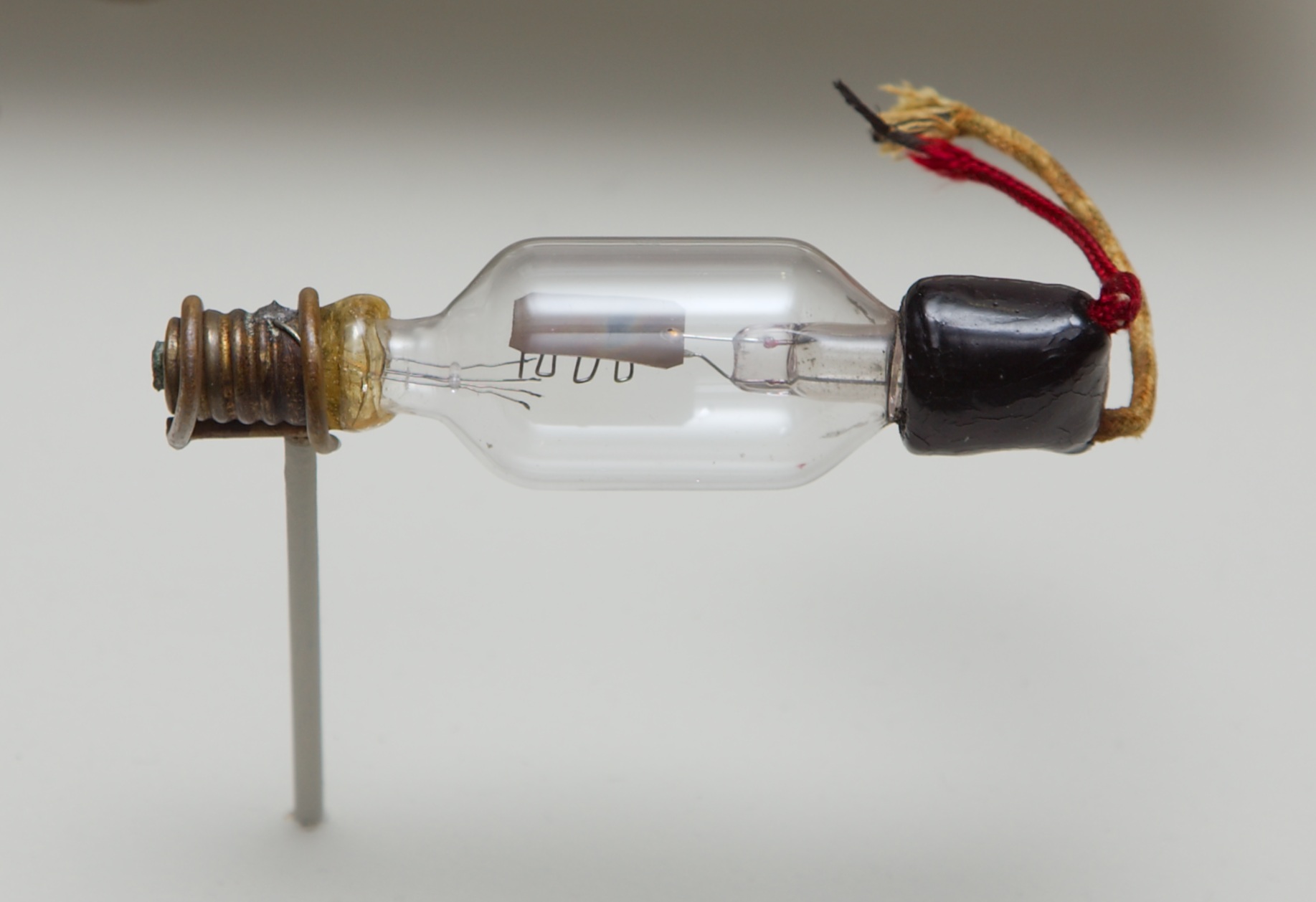
    Lee de Forest was one of the most important inventors in modern times, but don’t feel bad if you haven’t heard of him. The man is as forgotten as his invention, the Audion, is ubiquitous. The vexing inventor’s 1906 discovery made audio amplification possible, giving new life to the flagging radio industry and making possible any number of media. Gizmodo has posted an excerpt from Nicholas Carr’s new book, The Shallows, which provides insight into de Forest.  An excerpt:

    “Even when judged by the high standards set by America’s mad-genius inventors, de Forest was an oddball. Nasty, ill-favored, and generally despised–in high school he was voted ‘homeliest boy’ in his class–he was propelled by an enormous ego and an equally outsized inferiority complex. When he wasn’t marrying or divorcing a wife, alienating a colleague, or leading a business to ruin, he was usually in court defending himself against charges of fraud or patent infringement–or pressing his own suit against one of his many enemies.

    De Forest grew up in Alabama, the son of a schoolmaster. After earning a doctorate in engineering from Yale in 1896, he spent a decade fiddling with the latest radio and telegraph technology, desperately seeking the breakthrough that would make his name and fortune. In 1906, his moment arrived. Without quite knowing what he was doing, he took a standard two-pole vacuum tube, which sent an electric current from one wire (the filament) to a second (the plate), and he added a third wire to it, turning the diode into a triode. He found that when he sent a small electric charge into the third wire–the grid–it boosted the strength of the current running between the filament and the plate. The device, he explained in a patent application, could be adapted ‘for amplifying feeble electric currents.’

    De Forest’s seemingly modest invention turned out to be a world changer. Because it could be used to amplify an electrical signal, it could also be used to amplify audio transmissions sent and received as radio waves. Up to then, radios had been of limited use because their signals faded so quickly. With the Audion to boost the signals, long-distance wireless transmissions became possible, setting the stage for radio broadcasting. The Audion became, as well, a critical component of the new telephone system, enabling people on opposite sides of the country, or the world, to hear each other talk.

    De Forest couldn’t have known it at the time, but he had inaugurated the age of electronics.”

    Tags: ,

    An automobile for fans of Buckminster Fuller, the Dynasphere was a 1932 mono-wheeled electric vehicle invented by Dr. J. A. Purves. It weighed a thousand pounds and looked incredibly stupid and dangerous, though you have to admire its experiment with electricity. I don’t want to be run over and killed by any car, but I would feel even worse if one that looked like this did me in. Here’s a British newsreel of the Dynasphere’s unveiling. Enjoy.

    More Featured Videos:

    Tags:

    “You think the Kardashians lack genius?” (Image by Martin Schneider.)

    Robert Birnbaum of the Morning News has a fun, freewheeling interview with New Yorker editor David Remnick. The Q&A is pegged to Remnick’s new book about Obama, but the two cover a number of topics, both serious and silly, in an off-the-cuff manner. A few excerpts follow.

    ___________________

    Robert Birnbaum:

    What is going to happen with newspapers and such?

    David Remnick:

    I’m not a fortune teller. I know it would be interesting if I sat here and told you without a trace of uncertainty that in 10 years all magazines are going to be projected on screens on the side of the Empire State Building and the Prudential Building. Or alternately, they would be projected on the inside of your sunglasses in the summertime. I don’t know. Here’s what my job is, and I share that with other editors, too: We are in this moment of technological uncertainty and transition. The goal for me is to make sure we find a way, willy-nilly, to be healthy so that we can do the thing itself. The thing itself is what I care about most. Given a choice between the survival of the long-form narrative journalism, criticism, cartooning—all the things that we do—and print itself, there is no contest. No contest. I, at the age of 51, may still think, for me, the best technology for reading the New Yorker at this moment is the print version. But that’s just me. If your son, decides otherwise, that he wants to read it on an iPad, kenahorah [so be it].

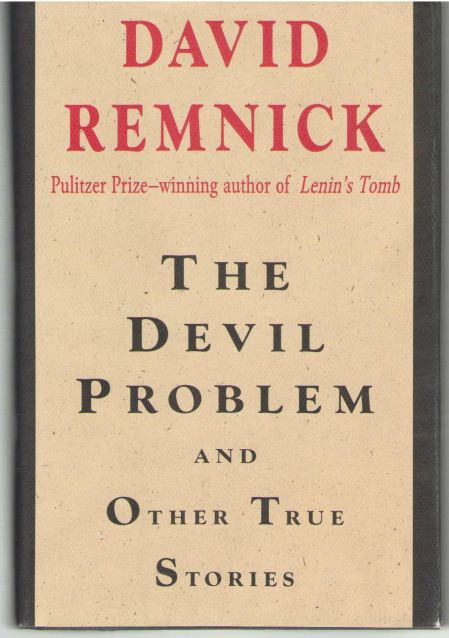
    Remnick’s “The Devil Problem and Other True Stories” is one of my favorite non-fiction collections.

    Robert Birnbaum:

    I have to say I am befuddled by what flits across my TV screen—who are these Kondrashian [sic] people?

    David Remnick

    You think they lack genius?

    Robert Birnbaum

    Uh.

    David Remnick

    (laughs)

    Robert Birnbaum

    Someone must have genius associated with them.

    David Remnick

    Something I have never found interesting at all—two unbelievably popular things on television. One is reality television—it never interested me at all. And the other is this neo-talent-show stuff, like American Idol. The reason I don’t like American Idol is that a lot of the talent seems to be a replication of the singing style of Mariah Carey and Whitney Huston. I don’t need it.

    ___________________

    David Remnick

    David Owen is a fantastic golf writer.

    Robert Birnbaum

    I find golf to be the least interesting of pastimes.

    David Remnick

    To me it looks like a nervous breakdown with a stick.

    Tags: ,

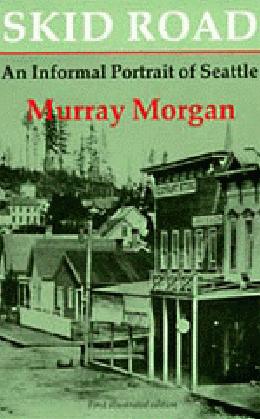
    Old Seattle shop pictured on the cover is called "Elephant Store."

    On a trip to Seattle some years back, I picked up this fun book, at the Elliott Bay Book Company, by the late area historian Murray Morgan. It tells the tale of some of the most colorful characters in the city’s history, including John Considine, who risked life and limb to bring vaudeville and other more raffish entertainments (gambling, prostitution, etc.) to Seattle during the boom time of the Klondike Gold Rush.

    And I’m not kidding when I say he risked his life. Considine had a long-running feud with Police Chief William L. Meredith. After Considine exposed some corruption on the Chief’s part and got him fired, things turned really ugly. In 1901, Meredith first slandered Considine by claiming he impregnated a 17-year-old contortionist and paid for her abortion, and then he shot Considine at point-blank range. Considine was wounded, but not fatally. Meredith wasn’t so lucky when Considine returned fire. Since the deposed lawman had started the shootout, Considine was acquitted by the jury.

    Considine eventually cleaned up his ways and brought the first superior movie theater to Seattle and later became involved in the budding motion picture business in Los Angeles. But before all of that, there were the rowdy days of the illicit People’s Theater. Due to anti-vice efforts and economic problems, Considine briefly lost control of the theater. In 1897, he schemed to get it back. An excerpt from Morgan’s book:

    The Seattle street where John Considine and William L. Meredith had their fatal gun battle.

    “One the evening of the last Thursday in December 1897, a large man wearing a brown derby, a gray raincape, and white gloves, and leading a brindle bulldog on a silver chain, strolled through the rain down Second Avenue South, gravely declining the invitation of streetwalkers and, on occasion, raising his cane in salute to a friend. He paused for a moment at the corner of Second Avenue and Washington to watch the men going down the steps into the People’s Theater. Even on a miserable midwinter night the place was drawing well; young sports out on the town, loggers in for the holidays, businessmen, and, most of all, lonesome Easterners waiting for ships bound for Alaska.

    The big man watched thoughtfully, then went to the head of the steps. He frowned at the black-and-gold sign that read, ‘People’s Theater. Moses Goldsmith, Prop.’ Nailed to the wall was a blackboard on which had been written in crayon: ‘See Lady Osmena change clothes in total darkness in a lion cage.’

    He went down the steps, paid fifty cents for a seat near the stage, ordered a glass of ‘water plain, unadorned water,’ from an amazed waitress, and turned his attention to the crowd. The place was full. The bar, which stretched along one wall, was crowded; three bartenders were kept busy. Nearly every table was occupied. Women with painted cheeks and skirts nearly up to their knees roamed the room, smiling at the patrons; from time to time the girls went to the stage and sang a loud song or danced an awkward dance. From the curtained box seats in the low balcony came the laughter and shouts and giggles and, most important, a steady ringing of bells as the box-hustlers summoned waiters with drinks.

    The place was a gold mine, John Considine decided, a real gold mine. He’d have to get it back.”

    Tags: , ,

    Sorry to barge in unexpectedly, Judge, but I really had to use the can. (Image by Liza Phoenix.)

    If the May 8, 1902 issue of the Brooklyn Daily Eagle is to be believed, the entire borough was being invaded by ominous sea monsters. That’s the impression you get from this hyperbolic article about a former New York Supreme Court Justice, whose home had strange things coming out of the bathroom faucets. Less than a year after this article was written, Justice Fredric A. Ward was found dead in his Remsen Street abode, but it was assumed he died from natural causes and not from being strangled by an octopus that crawled out of his toilet. An excerpt from the article subtitled, “No Uncommon Thing, He Has Ascertained, to Receive Visits From Sea Monsters”:

    “Former Justice of the Supreme Court Frederic A. Ward has just moved to his new house, at 52 Remsen street. Now Mr. Ward is wishing that he hadn’t. He has found things in his new house not to his liking–not a bit. They are in his bathtubs.

    In Justice Ward’s new house are two beautiful bathrooms. He was delighted with them the first day he saw them. That was before he took possession of the house. Now the former Supreme Court Justice is wondering if he was not deceived by the appearance of those bathrooms and of the exquisite bathtubs, done in mosaics, which looked so handsome and so inviting.

    It is all because of the water. The first time Mr. Ward turned on the water in the bathtubs, there came flowing out of the pipe such a motley assemblage of sea monsters, garden truck, insects and discarded vegetables that he was for a moment taken back with astonishment. After ordering the servants to clean out the tub, Mr. Ward turned the pipe on again. Still the procession came and was still coming when Mr. Ward decided to bring the parade to a halt.

    Judge Judy: A tarantula once stole my lip balm. (Image by Susan Roberts.)

    The next day the former Supreme Court Justice determined to try again. He met with the same success. The sea monsters still continued to come, grass of many shades oozed out of the pipes, huge chunks of seaweed that looked as if they had done service in the Brooklyn water system for a number of years followed and the Justice threw up his hands in despair. Mr. Ward then called the attention of the previous tenant who had preceded him to the condition of the water. To his great surprise, Mr. Ward was informed that it was no unusual thing to receive visits periodically from the sea animals described by the former Justice. The latter, however, has determined to cut them short and has written a letter to Water Commissioner Dougherty calling the latter’s attention to the polluted condition of the water being supplied to his house.

    Mr. Ward in his letter to the Water Commissioner says that not only is the water full of insects, moss and other disagreeable things, but it is of a muddy and filthy nature, making bathing an impossibility.”

    More Old Print Articles:

    Tags:

    "Body not included." (Image by Scott Sanchez.)

    Ambulance for sale (coolest ride in town) – $2200 (Beacon)

    T1979 Ford ambulance in good to excellent condition, 50K, title in hand, body just about perfect with some light surface rust on the door edges, convert to bike hauler, camper or just ride around with the lights flashing and the sirens on to piss off your neighbors, auto snow chains etc. ONE BAD RIDE.

    P.S. one gurney included
    PPS. Body not included.

    More Craigslist ads:

    Insane but impressive.

      You're not likely to get killed on the streets of El Paso. (Image by Frank Vincentz.)

      The great Newmark’s Door pointed me in the direction of an intriguing 2009 article from Reason Magazine that runs contrary to the popular thought of the day regarding immigration. Illegal immigrants (and even legal ones) have been accused of bringing chaos, crime and disorder to the cities and towns where they settle. But what if they’re actually making us safer?

      Radley Balko’s smart piece, “The El Paso Miracle,” uses the Texas border town, which has high immigration and poverty rates, to show how American cities with a large concentration of aliens tend to be some of the safest places in the country. This isn’t an argument for lax border security; it only takes a single terrorist traveling to Mexico and crossing into America to cause major destruction. But if the article’s results are accurate, it provides valuable context amidst all the anti-immigrant hyperbole and factually incorrect noise. An excerpt:

      “El Paso is among the safest big cities in America. For the better part of the last decade, only Honolulu has had a lower violent crime rate (El Paso slipped to third last year, behind New York). Men’s Health magazine recently ranked El Paso the second ‘happiest’ city in America, right after Laredo, Texas—another border town, where the Hispanic population is approaching 95 percent.

      So how has this city of poor immigrants become such an anomaly? Actually, it may not be an anomaly at all. Many criminologists say El Paso isn’t safe despite its high proportion of immigrants, it’s safe because of them.

      ‘If you want to find a safe city, first determine the size of the immigrant population,’ says Jack Levin, a criminologist at Northeastern University in Massachusetts. ‘If the immigrant community represents a large proportion of the population, you’re likely in one of the country’s safer cities. San Diego, Laredo, El Paso—these cities are teeming with immigrants, and they’re some of the safest places in the country.'”

      Tags:

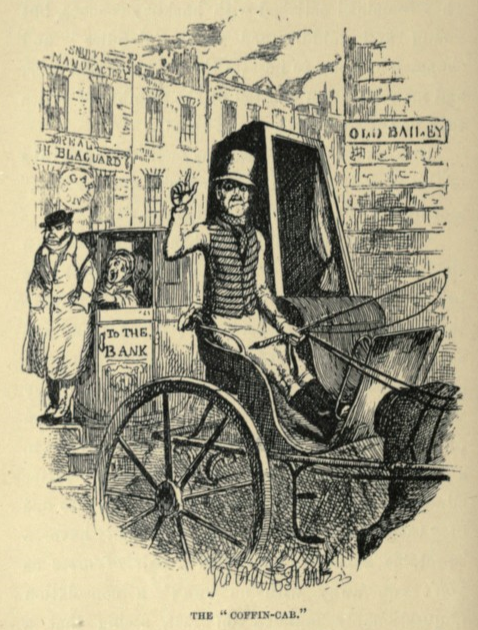
      "Coffin Cab" is a 1902 illustration by Henry Charles Moore.

      “Big Joe” Grimes was the “World’s Largest Man” at P.T. Barnum’s circus at the beginning of last century, when all you needed to be a star was enormous size. (As opposed to current times, when all you need to be a star is enormous emotional baggage.) In a 1902 Ringling tour, he shared performance space with Francisco Lentini, the Three-Legged Boy, and Enoch the Man Fish, among others. But what gave Grimes relative fame and fortune also claimed him–though not in the expected way. It wasn’t a heart attack or stroke or diabetes that ended the sideshow attraction’s life, but rather his huge body straining a cab to the breaking point and beyond.

      I came across “World’s Largest Man Dead,” a very brief notice in the September 5, 1903 issue of the New York Times, which details his death but didn’t mention his show biz career, as it were. The piece is subtitled: “‘Big Joe’ Grimes of Cincinnati Breaks Through Cab and Fatally Wounds Himself.” An excerpt:

      “‘Big Joe’ Grimes, said to have been the largest man in the world, is dead at the home of his parents in the city, as the result of a peculiar accident. While riding in a cab, his great weight broke through the bottom, one of his legs was gashed, the wound refusing to heal.

      Grimes weighed 754 pounds, and was thirty-four years of age. He was 6 feet 4 inches in height, and his body and limbs were of ponderous dimensions.”

      Tags: , , ,

      Here’s another attention-grabbing TV spot from the North Carolina-based comedy duo Rhett & Link and the fine folks at I Love Local Commercials. This odd ad touts the car-selling skills of Cuban immigrant Rudy Fuentes, who was a gynecologist in his homeland. Enjoy.

      Tags:

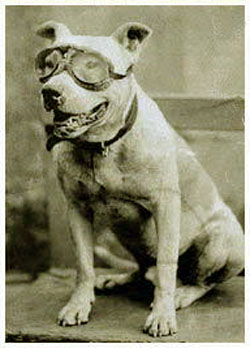
      Run like the wind, Mr. Butterscotch! Your cute goggles will not save you.

      Brooklyn was completely insane in 1896, what with old guys going dog-hunting with double-barrel shotguns in the middle of the night. That was the scenario laid out in the June 26, 1896 issue of the Brooklyn Daily Eagle. Stray dogs disturbed the peace and a geezer picked up his weapon. You know the article was from long ago because it refers to Flatbush as “the suburbs.” The piece in full:

      “Residents of the southeastern section of Flatbush are up in arms against a pack of hungry, homeless dogs, which nightly turn that peaceful neighborhood into bedlam. These starving brutes invade private lawns, prowl around chicken houses, chase cats, fight with each other over a stray bone and howl at the moon until their hair raising concert awakes the soundest sleeper.

      With that patience which is characteristic of the Flatbush resident, the unwilling auditors of these serenades for a whole week put cotton in their ears and walked the floor with the babies before they decided to stand on their rights as citizens and taxpayers.

      The initiative was taken by John J. Snyder, who is about 70 years old and lives in a handsome house on East Twenty-first street, near Avenue C. Though he is a hale and hearty man for his age, he is unable to do without sleep. In the dead of the night he was forced to rise from his bed and throw things through the window. Mr. Snyder owns an excellent shotgun and in the wee, small hours of yesterday morning, when the savage concert was at its height, he decided to use it.

      Your demise shall be my greatest triumph, Butterscotch.

      Unfortunately all his shells were loaded with fine shot, so there was small hope of doing fatal work. Armed with his trusty weapon Mr Snyder descended to the porch. The pack was in the rear of the house in full cry. Mr. Snyder stole around his house with a step as light as that of an Indian. Suddenly two shots rang out in the night. For a moment all was still and then the dogs set up a howl that made cold shivers run down the backs of Mr. Snyder’s neighbors. When morning came the yard was empty of the living and the dead.

      Among those who have suffered from the riotous dog concerts are ex-City Auditor Anton Weber, ex-County Clerk William J. Kaiser, William H. Dreyer, John Dreyer and Mr. Van Kuren. All have now laid in a stock of ammunition and when the dogs appear again there will be deadly battle.”

        Let's play quickly--the sun is melting the ice.

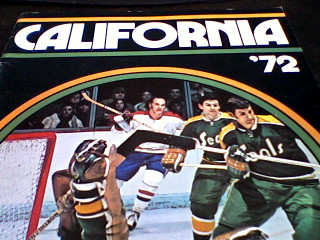
        I don’t really care for hockey, but I’ll always have a look when I come across some publication from 40 years ago for a sports franchise that no longer exists. Leagues were a lot less organized in those days and TV money hadn’t become the raison d’être. You never know what interesting factoids you might find. So I recently took advantage of an opportunity to gaze upon California ’72, a periodical that was published by Maple Leaf Gardens Sports magazines.  

        The Managing Editor, Ross Brewitt, wrote a bunch of hockey books, including one about Eddie Shack, a journeyman player who battled illiteracy. There are advertisements for Belvedere cigarettes, Corby Gin and Grissol Breads. And there’s lots of great color and b&w images of the Seals in action. 

        The California Golden Seals were an embattled NHL franchise in the Bay area from 1967-1976, part of the first wave of the league trying to spread its market beyond cold-weather environs in Canada and the Northeast and Midwest of the America. The NHL also wanted to head off progress by a competeing outfit called the Western Hockey League.  

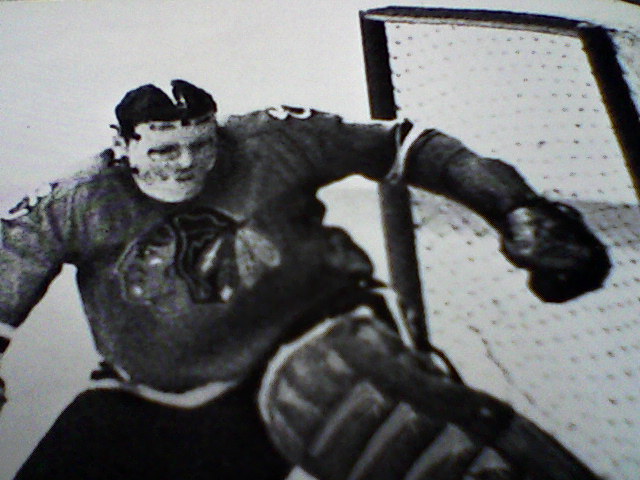
        A demonstration of superior netminding skills.

        The Seals never drew and went though a succession of owners, including Charlie Finley, who changed team colors to match those of his baseball franchise, the Oakland A’s. The Seals eventually moved to Cleveland and then merged with another franchise. An excerpt about the beleaguered franchise from the magazine:

        “From the start of expanision, unrest has been the word most commonly associated with the California Golden Seals, a team which has been afflicted with trouble in the front office for four turbulent years. General managers have been changed. Coaches have been changed. There have been changes in ownership, and the results of these changes have been completely predictable. The Seals have finished out of the playoffs for two of the four years they have been in operation and when all-time standings of the National Hockey League are considered, the Seals stand alone at the bottom of the heap.”

        More Miscellaneous Media: 

      • Ugandan currency with Idi Amin’s picture. (1973)
      • Tom Van Arsdale basketball card. (1970)
      • Okie from Muskogee” Sheet Music. (1969)
      • Beatles Film Festival Magazine (1978)
      • ABA Pictorial (1968-69)
      • Tom Seaver’s Baseball Is My Life. (1973)
      • Hockey Digest (1973)
      • World’s Fair Guide (1964)
      • World’s Fair Guide (1939)
      • Buffalo Braves Yearbook (1972-73)
      • New York Nets Yearbook (1976-77)
      • “Tom Dooley” sheet music.
      • Everyone rushing to see the new Ashton Kutcher-Katherine Heigl movie. (Image by David Shankbone.)

        There’s a really interesting article in Wired about Charles Komanoff, a New York resident who’s obsessively mapping every aspect of Manhattan traffic in online spreadsheets. The piece by Felix Salmon, “The Man Who Could Unsnarl Manhattan Traffic,” examines how the 62-year-old Tribeca activist and numbers cruncher is trying to make sense of Manhattan gridlock (environmental impact, safety concerns, reducing delays) with the aid of his Balanced Transportation Analyzer. Komanoff’s work has impressed experts on the subject not just in NYC but in Europe and Asia as well. An excerpt:

        “Komanoff’s life has been driven by two passions: cycling and data. Naturally, he has combined them in another spreadsheet, one that logs every mile he has biked since January 1, 2001. The very act of entering the data, Komanoff says, keeps him motivated to ride everywhere, even in the rain and snow. ‘I want to be able to enter the miles,’ he says. He ends up inputting about 3,000 of them every year.

        A bearded former antiwar activist, Komanoff grew up in a liberal enclave of Long Island and studied mathematics and economics at Harvard. In 1973, he analyzed a proposed hydroelectric facility in upstate New York whose business model relied on the existence of extensive nuclear power in the Northeast. He wrote a report showing that the kilowatt price of nuclear power was rising fast and that the economics of the scheme simply didn’t work. It was his professional breakthrough, and in 1981 he published a massive book on the subject, Power Plant Cost Escalation: Nuclear and Coal Capital Costs, Regulation and Economics. ‘I thought I’d never do anything that ambitious again,’ he says.

        Over the next 30 years, Komanoff built a career at this intersection of algorithms and advocacy, especially around what he calls ‘the two leading sources of environmental and social harm in industrial societies: electricity generation and motor vehicles.’”

        Tags:

        Judge Judy: Presided over the landmark case of the missing donut. (Image by Susan Roberts.)

        Jury duty service is over, so Afflictor.com no longer has any reason to suck. Don’t get me wrong: It will still suck. There’s just no excuse for it anymore.

        New things at jury duty in Brooklyn: Lounge has free wi-fi, about a dozen public computers with Internet access, a half-dozen large-screen TVs tuned to MSNBC. There’s no more sitting around for nine days if you haven’t been assigned to a trial; most people are dismissed after one day of service. Once you complete your service, you will not be called again for jury duty for eight years. The whole thing is managed very well; no more bureaucratic nightmare.

        Old things at jury duty in Brooklyn: I saw a judge wandering around the halls who must have been 200 years old. I assume he has emeritus status and was there for minor proceedings. He might have been on loan from a judge museum. When he spoke, sawdust come out of his mouth.

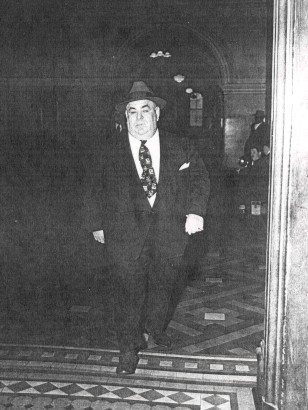
        Gambling kingpin William George Lias, aka "Butt Boy" and "Humpty Dumpty." (Image courtesy of the Wheeling Area Genealogical Society.)

        Even if he hadn’t been so overweight, West Virgina gambling kingpin William George Lias would have been a larger-than-life character. According to the Wheeling Area Genealogical Society, the man who would someday tip the scales at close to 400 pounds quit school after sixth grade to become a bootlegger. It was the start of a brilliant career in underworld booze and gambling, work that was in large part responsible for giving Wheeling its freewheeling reputation.

        In the early 1950s, the Feds thought they found a loophole that could rid them of Lias’ shady business deals: They claimed he was a foreign citizen who was brought into the country illegally by his family when he was a child. It appears the government’s case was baseless as Lias beat the rap and lived on as an American-born citizen until his death in 1970.

        During this federal effort to deport Lias, Life ran the article, “He Wants To Stay Put: The Biggest Gambler in Wheeling Fights a U.S. Try to Deport Him.” An excerpt:

        “In a federal court in West Virginia last week the government tried to put the squeeze on all 368 pounds of William George (‘I ain’t been no angel’) Lias, a big wheel in Wheeling. Starting with a bread wagon and working up through restaurants, speakeasies, gambling rooms and the numbers racket to control of Wheeling Downs, a pretty half-mile track on an Ohio River island, Lias has prospered despite a few sorrows: a couple of brief Prohibition jail sentences; the sudden death of his first wife, shot down in self-defense by the pistol-packing wife of a pal of his; titanic legal struggles over $2.8 million in unpaid taxes.

        Through it all Lias stood up for his rights. He could say that he was, after all, an American. Now the government says that he is not American. It is trying to send him back to Greece where it claims documents prove he was born. Lias, supported by witnesses who remember him as the chubbiest dumpling ever to sag the springs in a baby carriage, argues desperately that the government’s case is a mistake, that he was born and brought up in Wheeling.”

        Tags:

        « Older entries § Newer entries »