Politics

You are currently browsing the archive for the Politics category.

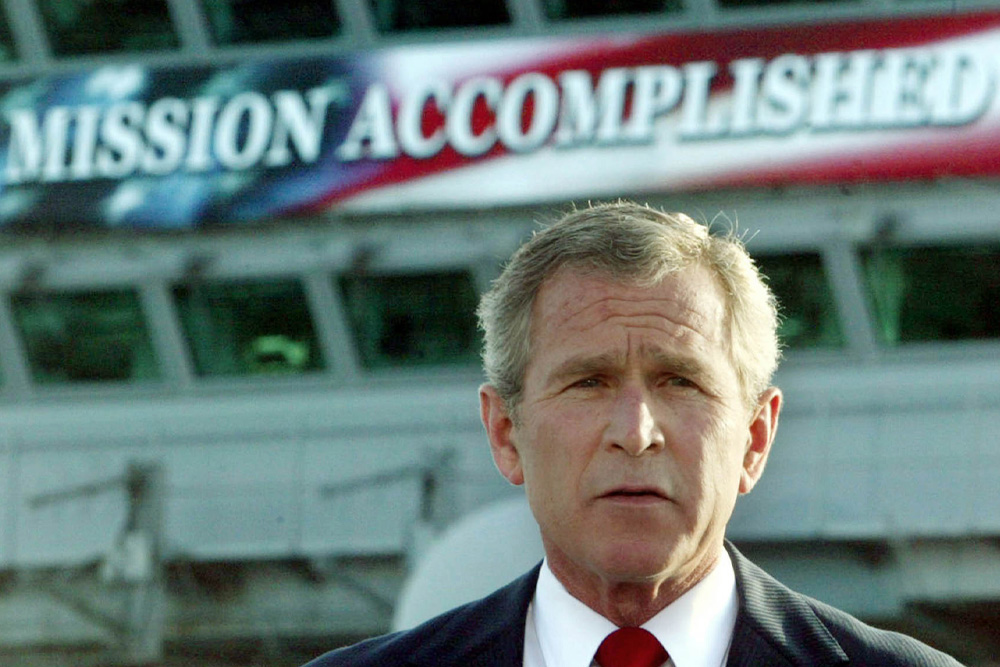
As we arrive at the 10th anniversary of the disastrous American invasion of Iraq, what I think about isn’t someone incompetent like President Bush or evil like Dick Cheney, though neither of them will ever be able to wash all that blood from their hands. What I consider most is the mania that surrounded, actually supported, that awful military operation which killed five thousand of our troops and tens of thousands of innocent Iraqis. Politicians from both parties, respected journalists and well-known public figures threw in with the senselessness, some for personal gain and others from poor judgement, ignoring what was right in front of them. And those who spoke out against the lunacy were traitors and foolish and weak and disloyal. 

It was mania and it was amnesia. So many times, when defending this illicit war, Bush supporters made the argument that the President knew what he was doing because no terrorist attack had ever occurred on his watch, completely eliding the tragedy of 9/11, which was supposedly the rationale for the war.

I recall the heartbroken parents of some of the first soldiers killed, who grew understandably enraged when it was suggested that their government had lied to them, that their children had died for no reason. They would say that they couldn’t handle it if we brought the rest of the troops home and acknowledged the war had been needless. They couldn’t withstand the truth. So we continued the lies and more parents suffered the same loss.

And it will happen again. Maybe the Iraq War won’t happen all over again–hopefully not–but some incredibly wrongheaded decision will be made and the supposed best and brightest will encourage the foot soldiers to fall in line. Rational thought will be usurped, illogic will rule. Unless we work very hard to change, we will forget the lessons, and such things will remain cyclical, tragic and inevitable. 

One of the first Marines to enter Iraq just did an Ask Me Anything on Reddit. A few exchanges follow.

____________________

Question:

After all you know now… Has your opinion of the rights and wrongs of the situation changed? 

Answer:

Definitely. I was a kid then though. When I see pics of myself then I always think what a stupid and naive asshole I used to be. I believed in what we were doing. Now I just feel used.

Question:

Thank you for such an honest answer. 

Answer:

It’s the reality of the situation. I was young and full of bravado. Now I have a daughter and I wonder how I would feel if she was going to war in the same situation.

____________________

Question:

And for what it’s worth from some average Joe, I’m sorry that we citizens didn’t stand up to the politicians who sent many of your fellow marines to their deaths, amid other injury (both physical and mental).

Our military personnel never fail at their job, no matter what we ask of them. But we the people failed you guys when we blindly approved a war that shouldn’t have happened. I was (for a short time) among those who believed in the Iraq war. For that, I apologized. We should’ve called our reps and Sens and the White House and told them that we didn’t want that war. And I didn’t do that.

I feel so bad because it wasn’t too much to ask, especially in comparison to what we all asked of guys like you.

Again, I’m sorry. But thank you and all of your fellow marines. 

Answer:

Man, we all got caught up in it. I feel like as Americans, this is a valuable learning lesson. We all let our emotions get us wrapped up and let Fox News and CNN dictate our rage. I was the same way. As a young 17 year old kid when the towers went down, living just 100 miles outside NYC, I was furious. I signed up and went off to war. As a 29 year old, looking back I realize that we made a very big mistake and a lot of people died because of it. Here’s the good news. You can make up for it. A lot of veterans are out there and they need help. They need people to volunteer for organizations that help veterans get homes, get jobs, and get help. You can donate to them! Or, if you are not financially capable of donations, which I understand, you can just give a veteran a hug or a warm smile and a thank you for all you have done. I’ve had some rough days but they were all made better just by someone’s understanding.

____________________

Question:

What contact did you have with Iraqis? How do you feel about them? 

Answer:

I interacted with Iraqi’s every day of every deployment. There was always an IP (iraqi Police) training or humanitarian mission. At the time I saw them as less human than us. Like because they lived in the dirt they were more like dogs. I saw them as a dumb culture. Now I just feel bad. You are a product of your environment and I just got lucky in being born in a rich powerful country

____________________

Question:

What about Iraqis lives that were destroyed, including myself? I’m honestly very sorry for everything that has happened to the Iraqi people. You have to understand I was not out to kill brown people or destroy a nation. I signed up for a job and did a bad thing based off bad intel.

Answer:

I’m honestly very sorry for everything that has happened to the Iraqi people. You have to understand I was not out to kill brown people or destroy a nation. I signed up for a job and did a bad thing based off bad intel.

____________________

Question:

Why the fuck hasn’t a major network interviewed vets like you?

Answer:

Eh, I guess I’m not that interesting.

It’s a scary world and everyone wants a brother–even if it’s Big Brother. So we’ve opened up our hearts and minds (and smartphones) in a way that allows government and corporations unparalleled access into our habits, our desires. No military intervention, no daunting dictators are necessary if we all willingly transform from citizens into consumers. But something tells me that a decentralized media and the people using it are too difficult to control–and will only grow more so as time goes on. From Damien Walter’s new Guardian article, “Future Tech: Big Brother, Big Data or Creator Culture?

“Today we perhaps have less to fear from the iron fist of Big Brother (although force is never far out of the picture) than from the insidious manipulation of big data. Viktor Mayer-Schonberger and Kenneth Cukier’s new book (Big Data: A Revolution) cracks open one of the most revolutionary aspects of modern technology – the huge amount of data on our behavior it gives us access to. Technology that we take for granted, from smartphones to social networks, harvest a vast array of data on the minutiae of our lives. What we buy. Where we go. Who we talk to. What we believe. Why we believe it. And the bulk of this data is delivered, unquestioningly, in to the hands of a just a few technology providers – Google and Facebook being the market leaders.

Big data has many positive applications, but the potential for oppressive uses is undeniable. Whether it’s manufacturing consent for an election campaign to deliver the right candidate, or developing consumer products so perfectly targeted to our psychological weaknesses that we can barely resist buying them, the data is now there to facilitate unparalleled levels of control over the public. And it’s for sale, an explicit and ever more profitable part of the business of modern technology companies.”

Tags:

Jonathan Chait, the excellent political writer for New York, is doing an Ask Me Anything at Reddit. A few exchanges follow.

_______________________

Question:

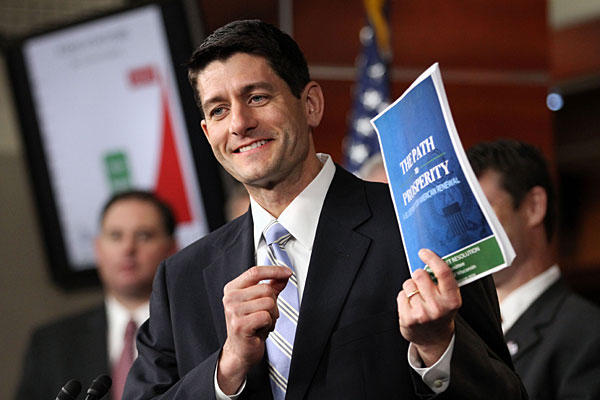
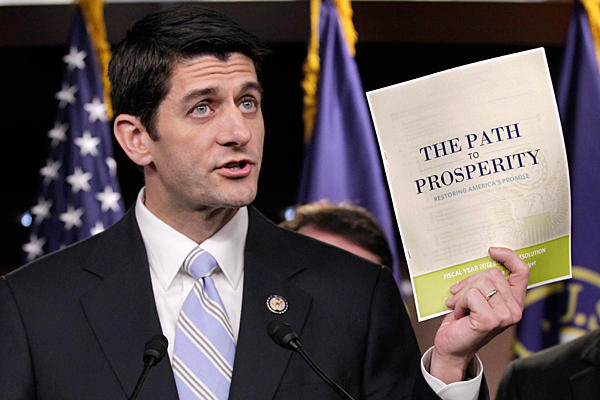
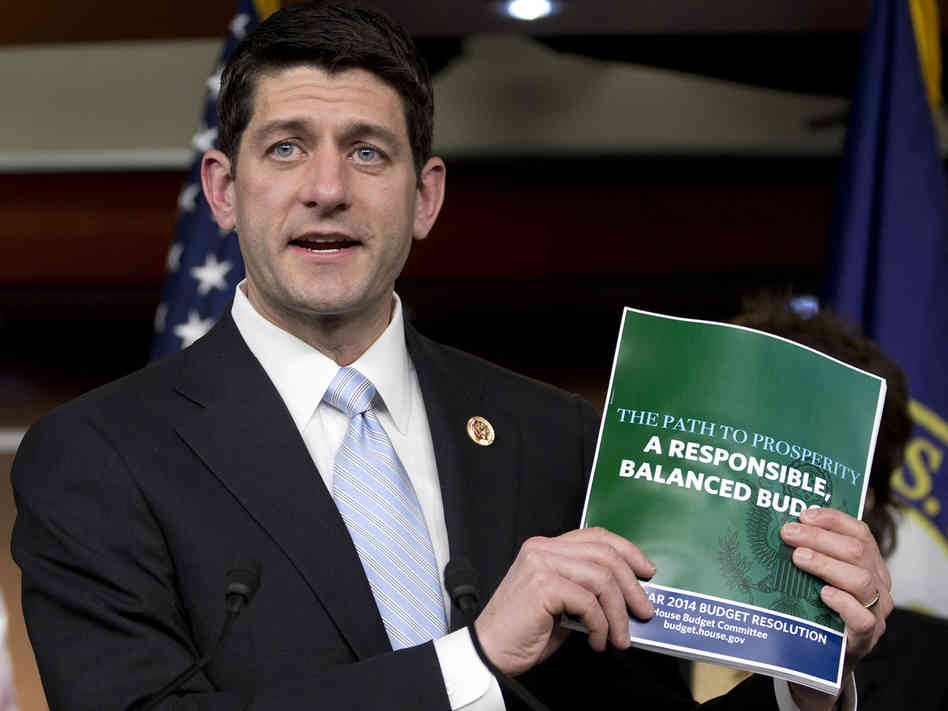
Taking down Paul Ryan’s budgets is consistently your Sistine Chapel. Having spent so much time examining the guy, do you think the waves of non partisan analysis of his proposals could ever shake his Randian foundation?

Jonathan Chait:

No, of course not. A philosophy like that is immune to empiricism.

_______________________

Question:

Do you see any way democrats could take back the House of Representatives in 2014? How big a structural handicap do they have?

Jonathan Chait: 

Enormous. I believe they’d need to win by 7% to carry the House — a nearly insurmountable obstacle while they hold the presidency and during an off year election when the electorate is disproportionately old and white.

_______________________

Question:

You specialize in hilarious and brutal takedowns, but do you think that limits you in some way? In other words, did you ever make the career choice not to be an Ezra Klein type reporter who stays “nice” in tone and gets rewarded with lots of access and chatter with the other side?

Jonathan Chait:

So many kind questions. Well, I respect Ezra a lot. He does amazing work. But, yes, I always saw myself as a blunt critic. I don’t like reporting much anyway. I think the onll real limit is that I’ve made a lot of enemies within the journalistic world.

Tags:

  • During the election, when the notion that a reelected President Obama would be greeted by a chastened opposition, I wrote that I didn’t believe it, that we would be as politically divided as ever. That’s proven to be true. 
  • Jeb Bush can insist that the problem with the GOP is one of messaging, but he’s wrong. In his CPAC address, he said: “Way too many people believe Republicans are anti-immigrant, anti-woman, anti-science, anti-gay, anti-worker.” And people believe that because they’ve been paying attention. That is now the orthodoxy of the Republicans and in a world with a decentralized media, there’s no way to cover it up. Bush himself may not be any of these horrible things, but he’s now a clear minority in his own party.
  • The battle between the establishment wing of the party (Rove, Gingrich, etc.) and the protest wing (Paul, Cruz, etc.) presents two competing sides with no chance of victory. If Rove and Gingrich think Republicans need more mainstream candidates and ideas, they’re right, but they’re the wrong ones to be leading the charge. They’ve spent decades helping to mix the party’s poisonous cocktail of race-baiting and divisiveness and now they’re choking on that drink. The extremists they’ve always found useful as foot soldiers in their cynical campaigns for power are now the generals. Meanwhile, the Tea Party is unelectable and incoherent. Bile isn’t a platform.
  • This version of the GOP will have no moment when clarity appears, no waterloo when it corrects course–it’s in a death spiral. What emerges–and when it emerges–is anyone’s guess.•

Tags: ,

P.W. Singer, author of Wired for War, gets to the essence of the future of drones in a new Foreign Policy article: size matters. When an unmanned system is the size of a bird–the size of a flea–privacy, borders and security may be all but over. An excerpt:

What really matters is not just the proliferation to an ever greater number of countries, but the proliferating makeup and uses of the technology itself. The first generation of unmanned systems was much like the manned systems they were replacing — some models actually had cockpits that were just painted over. Now, we are seeing an expanding array of sizes, shapes, and forms, some inspired by nature.

Within this trend, the size issue is important to discussions of armed drones. It is not just that drones are becoming smaller, but they are also carrying smaller and smaller munitions. So, if you want, for example, to carry out a targeted killing, do you need to send a MQ-9 Reaper carrying a JDAM or a set of Hellfire missiles? Or would a guided missile the size of a rolled up magazine, or a tiny bomb the size of a beer can that is equipped with GPS (both already tested out at China Lake) fit the bill instead, especially if it comes with less collateral damage? And if that smaller weapon is all that you need, do you need a drone the size of an F-16 to carry it?

While the discussion of the proliferation of armed drones has focused on those countries that field large systems, we will soon have to address those that have smaller systems.”

Tags:

From a Spiegel report by Marco Evers about Santander, a port city in Spain that has beaten the world largest metropolises in becoming a smart city, with sensors recording and reporting:

“Luis Muñoz, 48, is an IT professor at the University of Cantabria. He received nearly €9 million ($11.7 million) in research money, most of it from the EU, to develop a prototype smart city. Muñoz permanently installed 10,000 sensors around downtown Santander, throughout an area of 6 square kilometers (2.3 square miles). The sensors are hidden inside small gray boxes attached to street lamps, poles and building walls. Some are even buried beneath the asphalt of parking lots.

Day in and day out, these sensors measure more or less everything that can be measured: light, pressure, temperature, humidity, even the movements of cars and people.

Every couple of minutes, they transmit their data to Muñoz’s laboratory at the university, the central location that collects data streams from throughout the city. Every single bus transmits its position, mileage and speed, as well as data from its environment, such as ozone or nitric oxide pollution levels. Taxis and police cars do the same. Even the people of Santander can choose to become human sensors themselves. All it takes is to download a special app for GPS-enabled cell phones.

A central computer compiles the data into one big picture that is constantly being updated. Santander is a digital city, and everything here gets recorded. The system knows exactly where the traffic jams are and where the air is bad. Noise and ozone maps show what parts of the city are exceeding EU limits. Things can get particularly interesting when a major street is blocked because of an accident. Muñoz can observe in real time how that event affects traffic in the rest of the city.”

Tags: ,

Applying the hilarious bile of the Buffalo Beast‘s great 50 Most Loathsome Americans lists to the Forbes 2013 billionaires list, Lynn Stuart Parramore has turned out a wonderfully scathing feature for Salon. One entry:

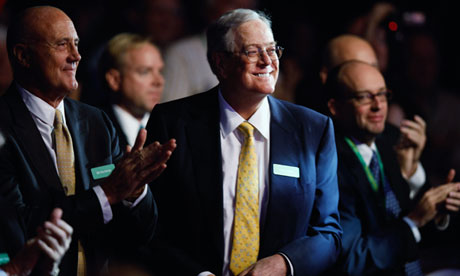
The Koch brothers: Charles Koch ($34 bn), David Koch ($34 bn), William Koch ($4 bn)

Where to begin? David and Charles, the brothers still with Koch industries, are among the world’s biggest polluters, for starters. Bill Koch, who split off from the family company, is a world-class weirdo who devotes himself to things like building a faux Western town solely for his amusement and buying a $2 million photo of Billy the Kid. Though not as active in bankrolling GOP pols as his brothers, Bill was a big supporter of fellow 1 percent jerk Mitt Romney and has found time to fight against America’s first offshore wind farm in Massachusetts. As for David and Charles, they have won a permanent spot in the Public Menace Hall of Fame, kicking their fellow human beings in the face with everything from funding climate change denial to strangling democracy. They have striven mightily to reshape America into a Tea Party nightmare, and have plenty of money to continue their mission.”

Tags: , , ,

During the first Presidential debate last year, the one where Mitt Romney was supposedly so brilliant, he asserted that half of the clean-tech companies President Obama had invested stimulus money in had gone belly up. Not even close. Tesla Motors was one of the businesses he was talking about. They’ve just announced they’re expediting their loan-repayment schedule. From Alan Ohnsman at Bloomberg:

“Tesla Motors Inc. (TSLA), which received $465 million in U.S. Energy Department loans to develop and build electric cars, will repay the funds five years ahead of schedule in a plan approved by the government.

The carmaker said in its annual report yesterday that the department approved amended terms of the loan agreements that enable it to complete repayment by December 2017. Starting in 2015, the Palo Alto, California-based company will make accelerated payments from excess free cash flow, Chief Financial Officer Deepak Ahuja said in a telephone interview.

‘Any remaining balance that’s there at the end of 2017 we’ll pay off as a balloon payment,’ Ahuja said yesterday.

The maker of battery-powered Model S sedans, led by billionaire Elon Musk, has a goal of becoming profitable this quarter, with deliveries of the vehicle forecast to rise to a record 20,000 units in 2013. Production snags in last year’s second half boosted operating expenses and triggered a wider fourth-quarter loss for Tesla than analysts anticipated.

The original terms required repayment of the loans by 2022, 10 years after the funds were drawn down. Tesla said on Sept. 25 that it was working with the Energy Department on a modified repayment schedule. Amended terms of the loan agreements were registered on Dec. 20 and March 1, the company said yesterday.”

Tags: , , ,

In my experience, female executives are no better or worse than their male counterparts, though, of course, there should be no glass ceilings. But you can’t expect a scheme to change just because there are some new schemers. Judith Shulevitz, whose excellent work I first encountered when she was editing the late, great Lingua Franca, explains in a New Republic piece why a women’s movement can accomplish things that successful boardroom executives like Sheryl Sandberg can’t, no matter how high they rise:

“Competent female executives run better companies than incompetent male executives, but they’re no more likely to make universal day care the law of the land. If Davos Woman had dominated feminist discourse when the Triangle Shirtwaist fire killed nearly 130 female sweatshop laborers in 1911, would she have pushed for the legislation that came out of that tragedy—the fire codes and occupancy limits that made workplaces safer for women, and men, for generations to come?

America’s women’s movements helped deliver a fairer world for everyone—upper-middle class, middle class, and working class—not because they produced more leaders, but because those leaders, and the rank-and-file who worked with them and even went to jail with them, changed the rules of society. They helped women get the vote, abortion access, domestic-abuse statutes, and the Family and Medical Leave Act, de minimis as that is. No corporate boss, even one as gallantly outspoken as Sandberg, can match that.”

Tags: ,

If it weren’t for Robert Reich, Rachel Maddow would be the most adorable communist in America. The MSNBC host just did an Ask Me Anything on Reddit. A few exchanges follow.

_______________________

 Question:

If you could go back in time and cover any news story in history as it unfolded, which would you pick?

Rachel Maddow:

Maybe the presidential election of 1800? A tie! Decided in Congress! Aaron Burr! All that weird campaigning they had never done before! I find electoral politics mostly enervating, but that one sounds like it would have been a blast.

_______________________

Question: 

Is there anyone at another cable news channel that you really admire as a broadcaster?

Rachel Maddow:

I really like the way Shep Smith (at Fox News Channel) balances anchorman gravitas… with a willingness to put the artifice aside and acknowledge what it really going on. Some of us can pull off seeming like human beings on TV, some of us can pull off V.O.G. authority, but Shep is really very good at both. Better than anyone else, I think. Also, I’ve met him and he’s a nice person!

_______________________

Question:

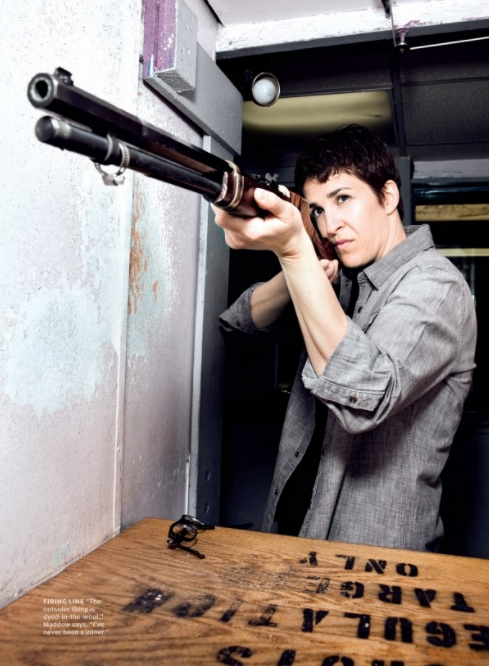
Our family hung the Rolling Stone photo of you, shooting a Henry Big Boy rifle, on the front of our refrigerator. (We love you and we love repeater rifles.) Do you think the gun legislation and conversion currently brewing in the US would be more efficient if more liberals, who occasionally like to get their cowgirl on, came out of the closet? I really don’t see why the topic ends up being so right wing vs left wing. I feel like there should be much more overlap between the camps.

Rachel Maddow:

Two things: (1) I agree! I think this issue is way more polarized in politics than it is in real life. Gun appreciation, even gun enthusiasm (which I confess to in a small way!) is absolutely not inconsistent with a belief in rational gun-safety reform. It’s weird that we think of the political battle as gun-lovers versus gun-haters — do you know a single gun-lover (who doesn’t work in the political side of the gun movement) who thinks it makes sense for someone adjudicated mentally ill to be barred from buying a gun from a guy at a store, but allowed to buy a guy under a tent or at a convention center? Also, (2) would you please do me the favor of drawing a tiny little moustache on that picture on your fridge?

_______________________

Question:

What was it like meeting Howard Stern? That was a great interview; I bought your book afterward.

Rachel Maddow:

Thanks! I love Howard Stern. I was intimidated to meet him just in a fangirl kind of way. But also because I knew he would ask me questions about sex that would make me blush like a cardinal. Once I realized that I could just tell him “no, i’m not answering that!” — then it was just pure fun. That was one of the best interviews I have ever been part of.

_______________________

When Howard met Rachel:

Tags: ,

Via Joshua Keating at Foreign Policy, an excerpt from “Some Far-out Thoughts on Computers,” CIA Analyst Orrin Clotworthy’s 1962 memo about the future of Big Data:

As a final thought, how about a machine that would send via closed-circuit television visual and oral information needed immediately at high-level conferences or briefings? Let’s say that a group of senior officers are contemplating a covert action program for Afghanistan. Things go well until someone asks, ‘Well, just how many schools are there in the country, and what is the literacy rate?’ No one in the room knows. (Remember, this is an imaginary situation.) So the junior member present dials a code number into a device at one end of the table. Thirty seconds later, on the screen overhead, a teletype printer begins to hammer out the required data. Before the meeting is over, the group has been given through the same method the names of countries that have airlines into Afghanistan, a biographical profile of the Soviet ambassador there, and the Pakistani order of battle along the Afghanistan frontier. Neat, no?”

Tags: ,

Prohibition of things people want usually just create black markets and opportunities for organized crime. But what about prohibition that grandfathers in the availability of the products for those already of age? It wouldn’t work with narcotics or alcohol, but what about cigarettes? From Richard A. Daynard in the New York Times:

“The F.D.A. would be well within its authority to require nicotine content to be below addictive levels — an idea that originated with a 1994 article in The New England Journal of Medicine urging a nonaddictive nicotine standard.

Cigarette makers would lobby hard to block such a standard. But if the F.D.A. insisted on the change, and cigarettes ceased to be addictive, ample evidence shows that most smokers would quit or switch to less toxic nicotine products. Current nonsmokers, moreover, would be far less likely to become addicted.

Another part of the act affirms the authority of states and municipal governments to prohibit the sale, distribution and possession of — and even access and exposure to — tobacco products by individuals of any age.

This provides an opportunity for states, counties and cities to adopt the Smokefree Generation, a proposal by A. J. Berrick, a mathematics professor in Singapore.

The idea is simple: no one born in or after 2000 can ever be sold cigarettes.”

Tags: ,

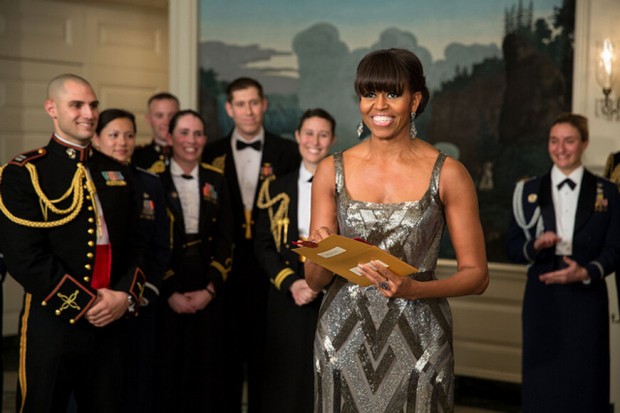
Because Peggy Noonan is a complete toolbox, she likes to make up rules of propriety based on her own political partisanship and scold those who don’t conform to her improvised decisions. So Noonan, who still believes we live in a 50-50 country–more like 53-47 and counting, Peg–was “disquieted” by something as innocuous as the First Lady appearing by video at the Academy Awards. Because the country is tired of Michelle Obama after four years, but, you know, we need more of Peggy and her weak-headed narratives after 30 years. From Noonan’s most recent Wall Street Journal column:

Mrs. Obama’s presence reached its zenith, one hopes, Sunday night at the Academy Awards when she came on, goofily star-struck military personnel arrayed in dress uniforms behind her, to announce the Best Picture award. It was startling and, as she gave her benediction—the movies ‘lift our spirits, broaden our minds, transport us to places we can never imagine’—even in a way disquieting.

This would not be an accidental assertion of jolly partisan advantage. It seemed to me an expression of this White House’s lack of hesitation to insert itself into any cultural event anywhere. And this in a 50-50 nation, a divided nation that in its entertainments seeks safety from the encroachments of politics, and the political.

I miss Michelle Obama’s early years, when she was beautiful, a little awkward, maybe a little ambivalent about her new role, as a sane person would be. Now she is glamorous, a star, and like all stars assumes our fascination.

It can be hard to imagine after four years in the White House, whichever party you’re in, that people might do all right for a few minutes if they’re free of your presence. There’s a tendency to assume you enliven with that presence, as opposed to deaden with your political overlay.”

Tags:

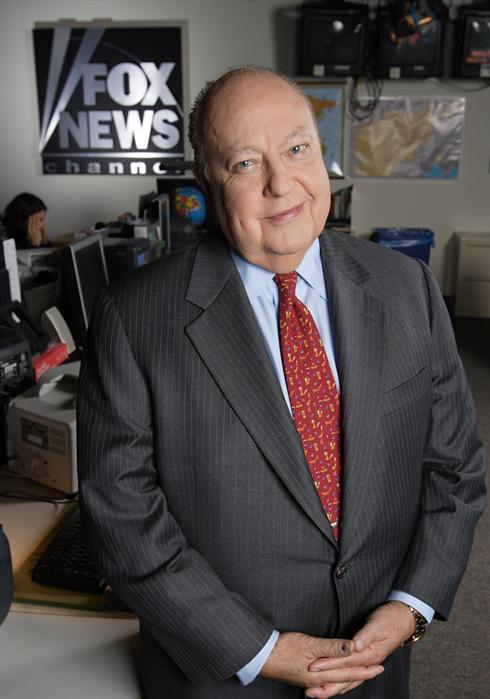
If anyone is wondering why that bastion of truthiness and GOP propaganda outlet Fox News misled its viewers so willfully during the Presidential election, it’s because the channel’s profits, not conservatism, is its chief concern. Of course. From a Vanity Fair excerpt of Zev Chafets’ new book about faux journalist Roger Ailes, a passage in which he discusses his bottom-line bromance with News Corp boss Rupert Murdoch. An excerpt:

“Ailes and Rupert Murdoch are very respectful of each other. Ailes credits Murdoch with realizing that there was a niche audience (‘half the country,’ as Charles Krauthammer, a Fox contributor, drily put it) for a cable news network with a conservative perspective. Murdoch, for his part, assured me that he doesn’t dictate editorial decisions. ‘I defer to Roger,’ he said. ‘I have ideas that Roger can accept or not. As long as things are going well … ‘

One moment of tension occurred in 2010, when Matthew Freud, the husband of Murdoch’s daughter Elisabeth and a powerful British public-relations executive, told The New York Times that ‘I am by no means alone within the family or the company in being ashamed and sickened by Roger Ailes’s horrendous and sustained disregard of the journalistic standards that News Corporation, its founder, and every other global media business aspires to.’ A spokesman for Murdoch replied that his son-in-law had been speaking for himself, and that Murdoch was ‘proud of Roger Ailes and Fox News.’ Ailes mocked Freud in an interview in the Los Angeles Times, saying he couldn’t pick the British flack out of a lineup and suggesting that he (a descendant of Sigmund Freud’s) ‘needed to see a psychiatrist.’

Murdoch often drops by Ailes’s office to joke and gossip about politics. ‘Roger and I have a close personal friendship,’ he told me. Ailes agrees—up to a point.

‘Does Rupert like me? I think so, but it doesn’t matter. When I go up to the magic room in the sky every three months, if my numbers are right, I get to live. If not, I’m killed. Our relationship isn’t about love—it’s about arithmetic. Survival means hitting your numbers.'”

Tags: ,

As robots grow more autonomous, do we need to broaden the legal system to hold them (and just their manufacturers and owners) culpable for their misdeeds? Law professor Gabriel Hallevy thinks so. From an interview with the author of When Robots Kill that was conducted by Dylan Matthews at the Washington Post:

“Any punishment that we may impose on humans, we can impose it both on corporations and on the robot, or any other non-human entity. You need some fine-tuning adjustments. We can impose imprisonment on corporations. We have no problem with it. I’m not talking about putting in prison the people who are managing the corporations. The legal technique for corporations is to ask, “What is the meaning of imprisonment?” It’s to negate its freedom. The freedom of any corporation is the legal capability to make business. Therefore, when you impose six years imprisonment on a corporation, you cannot allow the corporation during this period to do business.

Robots, it has the same technique but it may lead to different consequences. When we impose imprisonment, we should ask what is the meaning of the certain punishment on the robot. It means to negate its freedom. That freedom is the freedom to commit its useful daily tasks. So you ban him from doing the daily tasks.

I don’t think that imprisonment for robots would be effective as it is for humans. There are other punishments that may be effective on robots than on humans. For any corporation the most effective punishment isn’t imprisonment. It’s a fine. For robots, I can think of community service. For example, in the near future when I hire the services of a robot to help me with my daily task, and the robot commits a criminal offense, for the next few months it may help the community by doing daily tasks for the community. For example, to help in the community library, to help to clean the streets or such other things that contribute to the community.

This is not the only punishment, but any punishment can be adjusted to the robot. Of course, the death penalty, in the case that we still have this punishment, it would be the simple solution of a shutdown, to shut down the robot. If there is no other option, you must cease his life, and that means to shut him down.”

Tags: ,

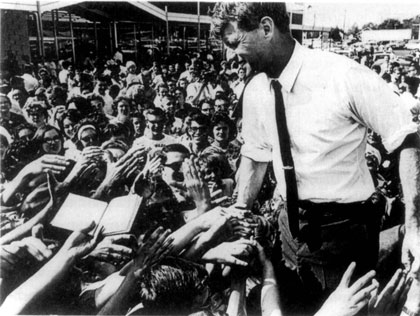
Robert F. Kennedy, then a New York Senator, meeting with some bright and playful children on Wonderama in New York at the end of 1965. I interviewed RFK Jr. a few years back, and, wow, he hated me. Asked him if he thought the Kennedy name had become something of a hindrance politically because of all the scandals. He was not receptive to that question, went a little apeshit. Oh, well.

Tags: ,

As I watch politicians like Mitch McConell and Eric Cantor play obstructionist, slowing down the economy, forcing budget sequestration which will cause people to lose their jobs for no real reason, I think about this:

Since the economic collapse, I’ve spotted an increasing number of slightly ragged adults in NYC aimlessly wheeling a single piece of luggage behind them, unsure of where they’re headed. It’s become too easy to recognize them.

They are not tourists. Life was very different for them not too long ago.

Is it like that where you live?

Tags: ,

In the name of progress, DARPA and your good friends at Boston Dynamics, have improved the BigDog rough-terrain robot so that it can now fling cinder blocks. It’s for your protection. From the promotional copy: “BigDog handles heavy objects. The goal is to use the strength of the legs and torso to help power motions of the arm. This sort of dynamic, whole-body approach is routinely used by human athletes and animals, and will enhance the performance of advanced robots.”

From Derek Thompson’s eye-opening Atlantic piece, which explains how air travel changed in America (for the better) when D.C. regulators stood down:

“If you want a two-word answer to why airfares have dropped so much since the 1970s, it’s this: Deregulation worked.

Before 1978, the airlines played by Washington’s rules. The government determined whether a new airline could fly to a certain city, charge a certain price, or even exist in the first place. With limited competition, airlines were guaranteed a profit, and they lavished flyers with expensive services paid with expensive airfares. The silver and cloth came at a predictable price: The vast majority of Americans couldn’t afford to fly, at all.

With prices skyrocketing during the energy crisis of the 1970s, an all-star team of senators and economists decided that Washington should get out of the business of coddling the airlines. Let’s hear from a young former aide to Sen. Ted Kennedy named Stephen Breyer (oh, yeah, that Stephen Breyer) reviewing the free market case for letting airlines fly solo:

In California and Texas, where fares were unregulated, they were much lower. The San Francisco-Los Angeles fare was about half that on the comparable, regulated Boston-Washington route. And an intra-Texas airline boasted that the farmers who used to drive across the state could fly for even less money — and it would carry any chicken coops for free.

Three decades later, the lesson from Texas — if you deregulate the skies, ticket prices will fall — has been applied across the country. The democratization of the air is obvious enough from the frenetic bustle of every major U.S. airport. But the stats are mind-blowing, as well. 

— In 1965, no more than 20 percent of Americans had ever flown in an airplane. By 2000, 50 percent of the country took at least one round-trip flight a year. The average was two round-trip tickets. 

— The number of air passengers tripled between the 1970s and 2011. 

— In 1974, it was illegal for an airline to charge less than $1,442 in inflation-adjusted dollars for a flight between New York City and Los Angeles. On Kayak, just now, I found one for $278.”

Tags:

Ethicist William MacAskill’s new Quartz article recommends that those who want to aid the less fortunate should trade community organizing for Wall Street banking. Of course, a lot of things you might have to do in that career may lead to destroying the economy and creating more at-risk people. His piece’s opening:

“Few people think of finance as an ethical career choice. Top undergraduates who want to ‘make a difference’ are encouraged to forgo the allure of Wall Street and work in the charity sector. And many people in finance have a mid-career ethical crisis and switch to something fulfilling.

The intentions may be good, but is it really the best way to make a difference? I used to think so, but while researching ethical career choice, I concluded that it’s in fact better to earn a lot of money and donate a good chunk of it to the most cost-effective charities—a path that I call ‘earning to give.’ Bill Gates, Warren Buffett and the others who have taken the 50% Giving Pledge are the best-known examples. But you don’t have to be a billionaire. By making as much money as we can and donating to the best causes, we can each save hundreds of lives.”

Tags:

Every time I hear American entrepreneurs warn that China will become the number one country in the world because of a lack of regulation which allows for unchecked growth, I remind myself that China is already first in one area: highest cancer rate on the planet. You certainly want nimble regulation, but you don’t want it to be entirely absent.

China has continued apace building its top-down insta-cities, throwing up towers at blinding speed, worrying about occupants later. From a recent CBC report by Adrienne Arsenault about the beautiful and barren Inner Mongolia metropolis of Ordos:

“Arriving at night in Ordos left us — here’s a shocker — in the dark. There was no problem with the electricity, but the skyline lacked the brightly lit high-rises that are the mark of a thriving city.

We drove down a snowy road from the gleaming and seemingly desolate Ordos airport in Inner Mongolia, along an empty highway past darkened building blocks and abandoned parking lots at vast malls.

We pulled into the hotel driveway at around 9 p.m. on a Saturday night. This is a city supposed to be able to house a million people. But stepping out of the car the only sound was the pinging of the crosswalk countdown timer across the road.

It actually echoed.

The hotel looked like something out of Las Vegas, and the reception when we arrived was oddly enthusiastic. The staff almost seemed surprised to see people wander through the door. It was as if they’d been all dressed up waiting for a very long time for someone to show up, and didn’t quite know what to do now that they had.

The lobby bar lights were quickly turned on and the piano started playing. By itself. There was no pianist in sight, just a computer program with a playlist that must have been set to’generic hotel lobby.’

Ghost cities, it seems, even have ghost pianists.

Daybreak shed an even stranger light on the city. Have you ever been in the computer simulation known as Second Life, where avatars fly around and through empty cities and buildings? Minus the flying part, Ordos is pretty much Second Life.

There are lovingly designed, but barren, museums and galleries. There are ambitious malls and wide boulevards, all largely deserted.

___________________

The Ordos Museum is in a shockingly beautiful area whose development was overseen by Ai Weiwei:

Tags: ,

British academics are trying to stop the development and proliferation of robotic weaponry. I don’t like their chances. From the Guardian:

“A new global campaign to persuade nations to ban ‘killer robots’ before they reach the production stage is to be launched in the UK by a group of academics, pressure groups and Nobel peace prize laureates.

Robot warfare and autonomous weapons, the next step from unmanned drones, are already being worked on by scientists and will be available within the decade, said Dr Noel Sharkey, a leading robotics and artificial intelligence expert and professor at Sheffield University. He believes that development of the weapons is taking place in an effectively unregulated environment, with little attention being paid to moral implications and international law.

The Stop the Killer Robots campaign will be launched in April at the House of Commons and includes many of the groups that successfully campaigned to have international action taken against cluster bombs and landmines. They hope to get a similar global treaty against autonomous weapons.

‘These things are not science fiction; they are well into development,’ said Sharkey.”

Tags:

Despite what some say, our forefathers did not base America on Christianity. From The Stammering Century, Gilbert Seldes’ book about our nation at its most extreme:

When the time came to frame a constitution, God was considered an alien influence and, in the deliberation of the Assembly, his name was not invoked. “Inexorably,” says Charles and Mary Beard in their story of The Rise of American Civilization, “the national government was secular from top to bottom. Religious qualifications …found no place whatever in the Federal Constitution. Its preamble did not invoke the blessings of Almighty God…and the First Amendment…declared that Congress shall make no law respecting an establishment of religion…” In dealing with Tripoli, President Washington allowed it to be squarely stated that “the government of the United States is not in any sense founded upon the Christian religion.”•

Tags: ,

I think the main problem with Mayor Bloomberg’s ban on gigantic sodas in NYC is that it won’t work. If obesity was mainly caused by this one product, perhaps you could make a case. If it led directly to saving lives like, say, mandatory seat belts, sure, that would make sense. But Bloomberg’s ban lacks such precision. 

Other people think that the main problem with Bloomberg’s plan is that he’s trying to create a nanny state, that’s he’s using state-sanctioned moral suasion. But is that always wrong: From Cass R. Sunstein’s New York Review of Books piece about Sarah Conly’s book Against Autonomy: Justifying Coercive Paternalism:

Many Americans abhor paternalism. They think that people should be able to go their own way, even if they end up in a ditch. When they run risks, even foolish ones, it isn’t anybody’s business that they do. In this respect, a significant strand in American culture appears to endorse the central argument of John Stuart Mill’s On Liberty. In his great essay, Mill insisted that as a general rule, government cannot legitimately coerce people if its only goal is to protect people from themselves. Mill contended that

the only purpose for which power can be rightfully exercised over any member of a civilized community, against his will, is to prevent harm to others. His own good, either physical or mental, is not a sufficient warrant. He cannot rightfully be compelled to do or forbear because it will be better for him to do so, because it will make him happier, because, in the opinion of others, to do so would be wise, or even right.

A lot of Americans agree. In recent decades, intense controversies have erupted over apparently sensible (and lifesaving) laws requiring people to buckle their seatbelts. When states require motorcyclists to wear helmets, numerous people object. The United States is facing a series of serious disputes about the boundaries of paternalism. The most obvious example is the ‘individual mandate’ in the Affordable Care Act, upheld by the Supreme Court by a 5–4 vote, but still opposed by many critics, who seek to portray it as a form of unacceptable paternalism. There are related controversies over anti-smoking initiatives and the ‘food police,’ allegedly responsible for recent efforts to reduce the risks associated with obesity and unhealthy eating, including nutrition guidelines for school lunches.

Mill offered a number of independent justifications for his famous harm principle, but one of his most important claims is that individuals are in the best position to know what is good for them. In Mill’s view, the problem with outsiders, including government officials, is that they lack the necessary information. Mill insists that the individual ‘is the person most interested in his own well-being,’ and the ‘ordinary man or woman has means of knowledge immeasurably surpassing those that can be possessed by any one else.’

When society seeks to overrule the individual’s judgment, Mill wrote, it does so on the basis of ‘general presumptions,’ and these ‘may be altogether wrong, and even if right, are as likely as not to be misapplied to individual cases.’ If the goal is to ensure that people’s lives go well, Mill contends that the best solution is for public officials to allow people to find their own path. Here, then, is an enduring argument, instrumental in character, on behalf of free markets and free choice in countless situations, including those in which human beings choose to run risks that may not turn out so well.

Mill’s claim has a great deal of intuitive appeal. But is it right?”

Tags: , , ,

As Argo and Zero Dark Thirty ready for their close-ups at tonight’s Academy Awards, Tom Hayden has an interesting piece at the Los Anegles Review of Books about the link between Hollywood and the CIA, the latter of which eagerly dispatches liaisons, lobbyists and collaborators to Tinseltown. An excerpt:

“Hollywood is full of very smart people, who by their nature are resistant to anyone trying to control them, whether it be CAA or CIA. They won’t yield easily on creative control of their scripts and productions. Some may embrace the CIA ideologically, but most see the Agency as an interest group to be negotiated with, to hang out with, to tour, to bring in to get the feel of the place, shoot an interior, size up the personality of an agent, hear a story or two. A collaboration results between masters of illusion on both sides. Odd, that they wouldn’t consider that the CIA is a particular kind of interest group whose main mission is deception.

But the two sides are not equivalent, and the audience needs to know the difference. Hollywood and government policymakers consider labeling the sources of their product to make the audience beware what’s being sold. We have labels for tobacco products and all kinds of across-the-counter brands. Why not require a label stating, ‘The Central Intelligence Agency provided input and resources to this film. The CIA [or Pentagon] required certain alterations in the script. The final product was controlled by the film’s producers.’

Impractical or unreasonable? If you expect disclosure of the names of screenwriters or sources of a movie script, if ‘based on a true story’ is inserted in many a film, or for that matter, we disclose where the ingredients of food were grown, why not disclosure of any CIA role in contributing to a film?”

Tags:

« Older entries § Newer entries »