Politics

You are currently browsing the archive for the Politics category.

Bill Keller, former New York Times executive editor, is spearheading the Marshall Project, a fledgling, non-profit news organization that covers criminal justice, something incredibly necessary with current U.S. drug policies, a too-large prison population and print outlets downsizing and capsizing. A quick exchange about the non-profit journalism model from an Ask Me Anything he and reporter Maurice Possley just conducted on Reddit:

“Question:

Many Future of News talking heads think that when news orgs become non-profit, they muddy the waters for everyone trying to find a new, sustainable financial model for doing the news.

Do you think the non-profit model is here to stay, or a temporary solution while journalists scramble for the next few years figuring out what works in for-profit?

Bill Keller:

Honest answer? Who the hell knows? We’re in the Mad Max stage of the media business. I expect some non-profits (meaning non-profit-on-purpose, as opposed to trying-unsuccessfully-to-be-profitable) will be around for a long time, as long as there are philanthropies and individuals who value quality journalism. After all, NPR seems to be pretty permanent, and it’s the ultimate non-profit news outlet.”


Tags: ,

Boy, that David Carr is a flawless writer. You never see the editor’s hand in his work, something that is rarer than you might think for reporters unless you’re reading closely. Emily Nussbaum, the TV critic at the New Yorker, is the same way. Pretty much perfect every time out. Journalists who write on that level can pull you into reading something you might not be initially interested in, give you something you didn’t expect.

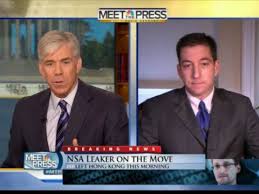
From Carr’s latest New York Times piece in which he visits Glenn Greenwald, a bothersome man who’s useful even if you’re not sure you always trust his judgement, at his Rio de Janeiro home base, a surprisingly lo-fi lair for perhaps the most wired journalist on Earth:

“For all its challenges — the monkeys and dogs have daily throw-downs and some of the spiders are large and remarkably deadly — the location suits him, the eternal guerrilla fighting from the mountains. When cable television calls, he races down the hill to a satellite facility, suit coat and tie on top, sandals and shorts on the bottom.

On Tuesday morning last week, Mr. Greenwald was pleased. He woke up early and wrote an uncharacteristically brief post about the huge number of civilian casualties in the Gaza conflict. He was proud of the pie charts he had managed to conjure to go with his post.

‘I went to Google and typed in ‘create a pie chart’ and I ended up with an online pie-chart maker probably intended for first graders,’ he said. I mentioned that he now works for a digital news site that has a $250 million endowment from Mr. Omidyar and some very talented data journalists and graphic artists.

‘Yeah, I know, but I would have had to wait and I didn’t want to wait,’ he said. ‘There are others things, like the 7,000-word story we just did on the surveillance of Muslim Americans that 15 people probably worked on — the video, graphic and editing resources make a huge difference. But I wanted this to be simple and I wanted it to be mine.’

True to his intent, Mr. Greenwald’s first-grade pie charts entered the bloodstream of the web, coursing around Twitter and various blogs. Nothing — other than yet another dog rescue — pleases Mr. Greenwald more than lobbing in something from a great distance and watching it detonate.”

Tags: , ,

When Vladimir Putin went aggressive with Ukraine, he was heralded by some in this country as appearing “strong” and President Obama as seeming “weak,” although you’d have to be pretty simple to view things that way. Putin was sticking his foot in it but good–his ass, too–becoming ensnared in a quagmire the way the U.S. did when invading Iraq, leaving himself wide open for things to career out of control (like MH-17 being shot down). Putin was a 20th-century leader adrift in the 21-st century, a visitor from the past trying to commandeer the future, and that never turns out well.

One passage from the new long-form Economist interview with Obama, which focuses on his dealings with Russia and China:

“The Economist: 

Because that is the key issue, whether China ends up inside that system or challenging it. That’s the really big issue of our times, I think.

President Obama: 

It is. And I think it’s important for the United States and Europe to continue to welcome China as a full partner in these international norms. It’s important for us to recognise that there are going to be times where there are tensions and conflicts. But I think those are manageable.

And it’s my belief that as China shifts its economy away from simply being the low-cost manufacturer of the world to wanting to move up the value chain, then suddenly issues like protecting intellectual property become more relevant to their companies, not just to US companies.

One thing I will say about China, though, is you also have to be pretty firm with them, because they will push as hard as they can until they meet resistance. They’re not sentimental, and they are not interested in abstractions. And so simple appeals to international norms are insufficient. There have to be mechanisms both to be tough with them when we think that they’re breaching international norms, but also to show them the potential benefits over the long term. And what is true for China then becomes an analogy for many of the other emerging markets.

The Economist:

What about the people who are just outright difficult? Russia being the obvious example at the moment. You tried to ‘reset’ with Russia. Angela Merkel spent the whole time telephoning Vladimir Putin. To what extent do you feel let down almost personally by what’s happened?

President Obama: 

I don’t feel let down. We had a very productive relationship with President Medvedev. We got a lot of things done that we needed to get done. Russia I think has always had a Janus-like quality, both looking east and west, and I think President Putin represents a deep strain in Russia that is probably harmful to Russia over the long term, but in the short term can be politically popular at home and very troublesome abroad.

But I do think it’s important to keep perspective. Russia doesn’t make anything. Immigrants aren’t rushing to Moscow in search of opportunity. The life expectancy of the Russian male is around 60 years old. The population is shrinking. And so we have to respond with resolve in what are effectively regional challenges that Russia presents. We have to make sure that they don’t escalate where suddenly nuclear weapons are back in the discussion of foreign policy. And as long as we do that, then I think history is on our side.”

Tags: ,

One of the best things I’ve read this year is an excellent longform conversation at the Baffler between Thomas Piketty and David Graeber, both of whom believe the modern financial system is passé, but only one of whom (Graeber) believes it’s certain to collapse. An exchange:

Moderators:

Is capitalism itself the cause of the problem, or can it be reformed?

Thomas Piketty:

One of the points that I most appreciate in David Graeber’s book is the link he shows between slavery and public debt. The most extreme form of debt, he says, is slavery: slaves belong forever to somebody else, and so, potentially, do their children. In principle, one of the great advances of civilization has been the abolition of slavery.

As Graeber explains, the intergenerational transmission of debt that slavery embodied has found a modern form in the growing public debt, which allows for the transfer of one generation’s indebtedness to the next. It is possible to picture an extreme instance of this, with an infinite quantity of public debt amounting to not just one, but ten or twenty years of GNP, and in effect creating what is, for all intents and purposes, a slave society, in which all production and all wealth creation is dedicated to the repayment of debt. In that way, the great majority would be slaves to a minority, implying a reversion to the beginnings of our history.

In actuality, we are not yet at that point. There is still plenty of capital to counteract debt. But this way of looking at things helps us understand our strange situation, in which debtors are held culpable and we are continually assailed by the claim that each of us “owns” between thirty and forty thousand euros of the nation’s public debt.

This is particularly crazy because, as I say, our resources surpass our debt. A large portion of the population owns very little capital individually, since capital is so highly concentrated. Until the nineteenth century, 90 percent of accumulated capital belonged to 10 percent of the population. Today things are a little different. In the United States, 73 percent of capital belongs to the richest 10 percent. This degree of concentration still means that half the population owns nothing but debt. For this half, the per capita public debt thus exceeds what they possess. But the other half of the population owns more capital than debt, so it is an absurdity to lay the blame on populations in order to justify austerity measures.

But for all that, is the elimination of debt the solution, as Graeber writes? I have nothing against this, but I am more favorable to a progressive tax on inherited wealth along with high tax rates for the upper brackets. Why? The question is: What about the day after? What do we do once debt has been eliminated? What is the plan? Eliminating debt implies treating the last creditor, the ultimate holder of debt, as the responsible party. But the system of financial transactions as it actually operates allows the most important players to dispose of letters of credit well before debt is forgiven. The ultimate creditor, thanks to the system of intermediaries, may not be especially rich. Thus canceling debt does not necessarily mean that the richest will lose money in the process.

David Graeber:

No one is saying that debt abolition is the only solution. In my view, it is simply an essential component in a whole set of solutions. I do not believe that eliminating debt can solve all our problems. I am thinking rather in terms of a conceptual break. To be quite honest, I really think that massive debt abolition is going to occur no matter what. For me the main issue is just how this is going to happen: openly, by virtue of a top-down decision designed to protect the interests of existing institutions, or under pressure from social movements. Most of the political and economic leaders to whom I have spoken acknowledge that some sort of debt abolition is required.”

Tags: ,

Education in and of itself is something American universities do very well, however exorbitant in price many of them are. But education is not merely the goal of the education system in the U.S. (and pretty much everywhere else). It’s about utility, about getting jobs. When a very difficult economic time rolls along like it has now, with threats of massive automation in the future, the follies of the system’s cost structure come under attack. From David Bromwich at the New York Review of Books:

“Andrew Rossi’s documentary Ivory Tower prods us to think about the crisis of higher education. But is there a crisis? Expensive gambles, unforeseen losses, and investments whose soundness has yet to be decided have raised the price of a college education so high that today on average it costs eleven times as much as it did in 1978. Underlying the anxiety about the worth of a college degree is a suspicion that old methods and the old knowledge will soon be eclipsed by technology.

Indeed, as the film accurately records, our education leaders seem to believe technology is a force that—independent of human intervention—will help or hurt the standing of universities in the next generation. Perhaps, they think, it will perform the work of natural selection by weeding out the ill-adapted species of teaching and learning. A potent fear is that all but a few colleges and universities will soon be driven out of business.

It used to be supposed that a degree from a respected state or private university brought with it a job after graduation, a job with enough earning power to start a life away from one’s parents. But parents now are paying more than ever for college; and the jobs are not reliably waiting at the other end. ‘Even with a master’s,’ says an articulate young woman in the film, a graduate of Hunter College, ‘I couldn’t get a job cleaning toilets at a local hotel.’ The colleges are blamed for the absence of jobs, though for reasons that are sometimes obscure. They teach too many things, it is said, or they impart knowledge that is insufficiently useful; they ask too much of students or they ask too little. Above all, they are not wired in to the parts of the economy in which desirable jobs are to be found.”

I don’t use illegal drugs, and I don’t think you should, either. They’re bad for you. But that doesn’t mean I support any cockamamie “War on Drugs.” That’s just bad policy crashing into stark reality. I think if someone sells drugs to a minor, they should be given a prison sentence. Otherwise, the whole thing should be decriminalized. That doesn’t mean it should be legalized. Relatively mild substances like marijuana should be legal and arrests for other harder drugs should be met with out-patient rehab and community-service sentences, for both dealers and buyers. 

Of course, the situation is further complicated because you don’t have to do anything illegal to get a dangerous high. The number of Americans attaining painkillers, Oxy and others, with prescriptions is staggering. I don’t doubt these folks have pain, though usually it’s more mental than physical. The pusher got pushed by Big Pharma, and attempting to cage that monster will only cause more problems, especially with the Internet opening up global sales far too large to be prosecuted with precision.

Mike Jay, who wrote this brilliant article for Aeon last year, returns to the same publication with a piece that doesn’t try to make sense of this unwinnable war but to show how senseless it is in the light of history and the new normal. The opening:

“When the US President Richard Nixon announced his ‘war on drugs’ in 1971, there was no need to define the enemy. He meant, as everybody knew, the type of stuff you couldn’t buy in a drugstore. Drugs were trafficked exclusively on ‘the street’, within a subculture that was immediately identifiable (and never going to vote for Nixon anyway). His declaration of war was for the benefit the majority of voters who saw these drugs, and the people who used them, as a threat to their way of life. If any further clarification was needed, the drugs Nixon had in his sights were the kind that was illegal.

Today, such certainties seem quaint and distant. This May, the UN office on drugs and crime announced that at least 348 ‘legal highs’ are being traded on the global market, a number that dwarfs the total of illegal drugs. This loosely defined cohort of substances is no longer being passed surreptitiously among an underground network of ‘drug users’ but sold to anybody on the internet, at street markets and petrol stations. It is hardly a surprise these days when someone from any stratum of society – police chiefs, corporate executives, royalty – turns out to be a drug user. The war on drugs has conspicuously failed on its own terms: it has not reduced the prevalence of drugs in society, or the harms they cause, or the criminal economy they feed. But it has also, at a deeper level, become incoherent. What is a drug these days?

Consider, for example, the category of stimulants, into which the majority of ‘legal highs’ are bundled. In Nixon’s day there was, on the popular radar at least, only ‘speed’: amphetamine, manufactured by biker gangs for hippies and junkies. This unambiguously criminal trade still thrives, mostly in the more potent form of methamphetamine: the world knows its face from the US TV series Breaking Bad, though it is at least as prevalent these days in Prague, Bangkok or Cape Town. But there are now many stimulants whose provenance is far more ambiguous.

Pharmaceuticals such as modafinil and Adderall have become the stay-awake drugs of choice for students, shiftworkers and the jet-lagged: they can be bought without prescription via the internet, host to a vast and vigorously expanding grey zone between medical and illicit supply. Traditional stimulant plants such as khat or coca leaf remain legal and socially normalised in their places of origin, though they are banned as ‘drugs’ elsewhere. La hoja de coca no es droga! (the coca leaf is not a drug) has become the slogan behind which Andean coca-growers rally, as the UN attempts to eradicate their crops in an effort to block the global supply of cocaine. Meanwhile, caffeine has become the indispensable stimulant of modern life, freely available in concentrated forms such as double espressos and energy shots, and indeed sold legally at 100 per cent purity on the internet, with deadly consequences. ‘Legal’ and ‘illegal’ are no longer adequate terms for making sense of this hyperactive global market.”

Tags: ,

In 1951, Hollywood director Edward Ludwig predicted computers would soon automatically write screenplays, and it’s difficult to see how they wouldn’t be capable of managing the flat dialogue of today’s globalized blockbusters. But machines don’t only want the starring roles–they’re also after us bit players. From Rob Enderle’s CIO report essay the so-called “robot apocalypse” and what it will mean for your job:

“It’s time for a discussion about what the future will bring. It won’t be world of lollipops and rainbows that [Marc] Andreessen and [Larry] Page will live in. The world of the rich won’t apply to the rest of us. Interestingly, Google Chairman Eric Schmidt better anticipates the ‘jobs and robots’ problem, but his solution is investing in startups, which is where we’ll all work while the robots do our existing jobs.

Sure, robots already do some jobs: Assembly lines, self-driving cars, delivery drones and cleaning robots, both the consumer Roomba and larger, industrial vacuums. There’s a bigger threat: Workers who basically look at numbers and draw conclusions. Robots are surprisingly good at this, too. Robots could do a range of jobs – including analysis, purchasing, consulting and journalism – because they can look at more real-time information in less time and with better recommendations than people.

This is one downside to big data analytics. Once you have the information, Watson, Siri, Cortana or any other artificial intelligence-like system can do a pretty decent job of identifying the best path. In the near term, at least, people will remain in the loop, but they’ll increasingly serve as little more than quality control – and, unfortunately, won’t operate fast enough to do the job properly.

Sheehy also created a spreadsheet that ranks the jobs that robots are most and least likely to take from people. The top jobs at risk: Financial analyst, financial advisor, industrial buyer, administrator, chartered legal executive (compliance officer) and financial trader. Least at risk: Clinical embryologist, bar manager, diplomatic services officer, community arts worker, international aid worker, dancer, aid/development worker and osteopath.

What’s interesting is that jobs that focus on dealing with people are relatively safe, while jobs that focus on analyzing things aren’t. Now if the people you focus on are increasingly unemployed, I have to wonder where the money’s coming from to pay the salaries of the people-focused folks. (Given that folks who write about technology need an audience to consume things to pay our salaries, we shouldn’t be sleeping that well, even though we aren’t on the list.)”

Tags: ,

I’ve yet to meet a single McKinsey consultant who didn’t seem to have a head full of gunpowder, but I’ll trust the firm’s think-tank wing, the MGI, which reports that China, for all its crush of modernization and smartphone ubiquity, has a majority of businesses surprisingly left unplugged. From the Economist:

“AT FIRST glance it would appear that China has gone online, and gone digital, with great gusto. The spectacular rise of internet stars such as Alibaba, Tencent and JD would certainly suggest so. The country now has more smartphone users and households with internet access than any other. Its e-commerce industry, which turned over $300 billion last year, is the world’s biggest. The forthcoming stockmarket flotation of Alibaba may be the largest yet seen.

So it is perhaps surprising to hear it argued that much of Chinese business has still not plugged in to the internet and to related trends such as cloud computing and ‘big data’ analysis; and therefore that these technologies’ biggest impact on the country’s economy is still to come. That is the conclusion of a report published on July 24th by the McKinsey Global Institute (MGI), a think-tank run by the eponymous consulting firm. It finds that only one-fifth of Chinese firms are using cloud-based data storage and processing power, for example, compared with three-fifths of American ones. Chinese businesses spend only 2% of their revenues on information technology, half the global average. Even the biggest, most prestigious state enterprises, such as Sinopec and PetroChina, two oil giants, are skimping on IT. Much of the benefit that the internet can bring in such areas as marketing, managing supply chains and collaborative research is passing such firms by, the people from McKinsey conclude.

Now you can put the Encyclopaedia Britannica on the head of a pin, and you can slide a war in your pocket. Or at least a drone. That’s what American soldiers may soon have to conduct remote reconnaissance. Of course, it’s just a matter of time–and not much time–until the “nano air vehicles” will be in your neighborhood. Just try to legislate that, attempt to manage that cheapness and smallness. From Douglas Ernst at the Washington Times:

“Future U.S. Army soldiers sent into combat may have a brand new tool at their disposal: the pocket drone.

The U.S. Army Natick Soldier Research, Development and Engineering Center in Massachusetts is developing a “pocket-sized aerial surveillance device” for soldiers assigned to small units in dangerous environments.

When the Army’s efforts come to fruition, the Cargo Pocket Intelligence, Surveillance and Reconnaissance program will provide dismounted troops with real-time surveillance of threats in their environment.

‘The Cargo Pocket ISR is a true example of an applied systems approach for developing new Soldier capabilities,’ said Dr. Laurel Allender, acting NSRDEC technical director, Army.mil reported July 21.”

__________________________

“Just about 10 cm x 2.5 cm”:

Tags: ,

Dick Cavett has the distinction of being the only talk-show host to land on Richard Nixon’s “Enemies List.” His “crime”? He focused segments of his great ABC program on the President’s crimes (no quotation marks required). Here’s the trailer for Dick Cavett’s Watergate, which runs next month on PBS.

Tags: ,

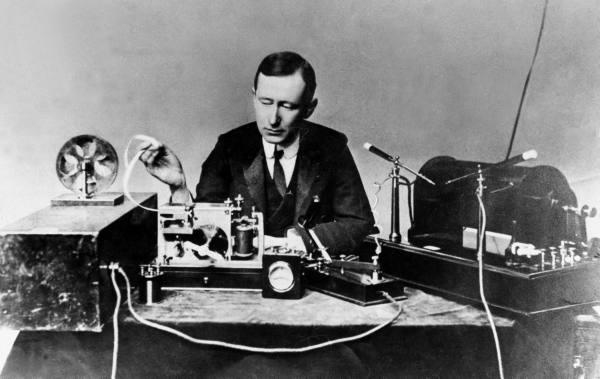
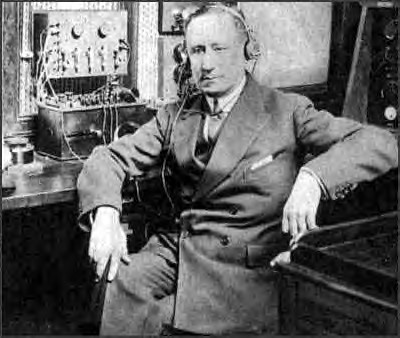
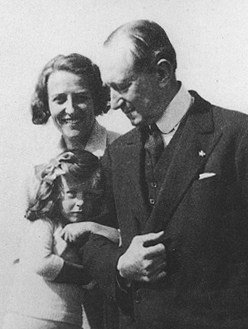
Guglielmo Marconi may or may not have been the very first to create the wireless, as he’s often credited, but he was certainly a passionate supporter of Fascist madman Benito Mussolini, and that wasn’t the inventor’s only strange idea. The text of the announcement of Marconi’s death from the July 20, 1937 Brooklyn Daily Eagle:

Rome–The Marquis Guglielmo Marconi, who invented wireless when he was only 21, died suddenly at 3:45 a.m. today (10:45 p.m. Monday, E.D.T.) at the ancient palace in downtown Rome where he lived and worked.

The 63-year-old conqueror of the ether died of heart paralysis. His widow, the Countess Cristina Bezzi-Scali, was at his bedside. She had been called back from the seaside resort of Viareggio when he began to feel ill yesterday.

Their daughter, Elettra Elena, whose godmother is Queen Elena, remained at the resort and will not return to Rome until time for the state funeral. Today is her eighth birthday.

Duce Pays Respects

Premier Mussolini, whose ardent supporter Marconi had been, was notified of the death immediately. He dispatched a telegram of condolences and later went to Marconi’s home in the Via Condotti and paid his respects beside the body.•


Tags: , , ,

An excerpt from “How to Forward a New Global Age,” economist Carlota Perez’s Financial Times piece, which argues that embarking on a green revolution would allow us to do well by doing good:

Focus on intangible growth

Green growth is not just about climate change. It is about shifting production and consumption patterns towards intangible goods, materials and energy saving, multiplying the productivity of resources and creating new markets for special materials, renewable energy, really durable products for business models based on rental rather than possession, a huge increase in personal (quality of life) services and so on.

It implies a redefinition of the aspirational ‘good life’ towards the health of the individual and the environment, imitating the educated elites (as has happened historically).

And full global development, why? Because that’s what would create growing demand for equipment, infrastructure and engineering, all redesigned in a green and sustainable direction. Accelerating the already existing shifts in those directions, would require a major set of policy innovations, including a radical reform of the tax system to change relative profitability.

For instance, instead of salaries, profits and VAT, we might need to tax materials, energy and transactions. Does that sound like a major change? Yes, it needs to be!

These are times for as much institutional imagination and bold leadership as were displayed to shape the previous revolution. Putting patches on the old policies won’t do the job! As for finance, the opportunities for profitable innovation would then be innumerable. New models would be needed to fund the green transformation, plus the knowledge intensive enterprises, the new social economy practices, the investment needs of global development and so on.”

Tags:

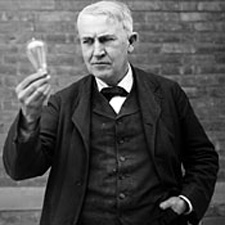
There are those with unique flair who innovate. Yes, if one person didn’t event the light bub–and one didn’t–another would. But I don’t think too many Americans decry rewarding someone who’s truly clever, even if that person had help–and they almost always have help. But the myth of the solitary genius has been so bastardized in our economy, where CEOs are paid exorbitant sums for often doing a poor job, rewarded for the throne rather than their rule, compensated lavishly while they have the floor and even more when they’re shown the door. The idea has proved hurtful. The opening of “The End of Genius?by Jonathan Low:

“For an economy so committed to collaboration, cooperation and partnership, we demonstrate a persistent fascination with the myth of the lone genius.

Particularly in fields where innovation and creativity are so often successfully translated into cash, the ‘my way or the highway’ ethos prevails despite ample evidence that it takes, if not a village, than at least a couple of buddies.

Even in tech, where Steve had Woz, Larry had Sergey and Bill had, well, he really did have a village, maybe even a city, the believers cling to the revealed truth. ‘We invest in people, not in companies’ huff the venture capitalists. Not systems, not processes, not teams, not intellectual capital, but ‘people,’ however that may be defined, the implication being that the Alpha Dog controls the biological survival imperative.

But even as the strains of Frank Sinatra singing ‘I Did It My Way,’ continue to waft from entrepreneurs’ ear buds, the reality is that the world is becoming too complex for this belief to endure.”

Tags:

Privacy as we knew it is gone and the next-generation tools will decide, far more than any legislation, how far things will go. I’m not saying I’m in favor of that, private person that I am, but that’s just how it is. We’ll never be truly alone, though that doesn’t necessarily mean we won’t be lonely. The opening of “The Internet of Things – the Next Big Challenge to Our Privacy,” by Jat Singh and Julia Powles at the Guardian:

“If there’s a depressing slogan for the early era of the commercial internet, it’s this: ‘Privacy is dead – get over it.’

For most of us, the internet is complex and opaque. Some might be vaguely aware that their personal data are getting sucked, their search histories tracked, and their digital journeys scoured.

But the current nature of online services provides few mechanisms for individuals to have oversight and control of their information, particularly across tech-vendors.

An important question is whether privacy will change as we enter the era of pervasive computing. Underpinned by the Internet of Things, pervasive computing is where technology is seamlessly embedded within the real world, intrinsically tied to the physical environment.

If the web is anything to go by, the new hyperconnected world will only make things worse for privacy. Potentially much worse.”

Tags: ,

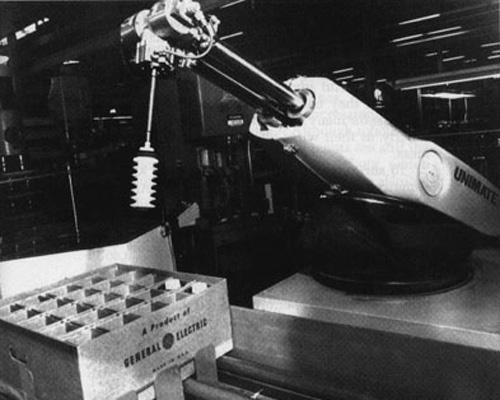
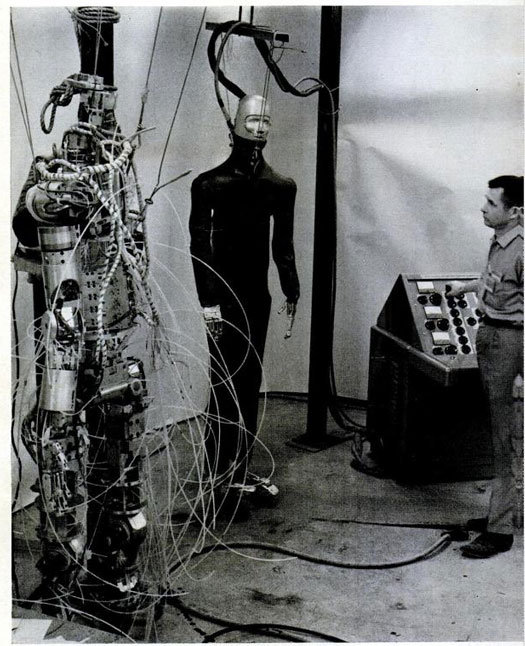
History of Unimate

In 1978, Penthouse, a magazine that wanted to pee on you or someone, anyone, took a look at the automated future of our workforce in a good article, “Robot Lib,” by Bob Schneider. Quaint that the piece predicted Big Labor would delay factory automation by seventy years. An excerpt:

In fact several roboticists believe that the day when human blue collar workers are entirely replaced by solid-state slaves is not very far off. “With the spectrum of technology available now, it would be possible to eliminate most of the blue-collar jobs today performed by humans within the next twenty or thirty years,” [Joseph F.] Engelberger maintains. “But,” he adds, “because of the social, political, and economic factors involved, a more reasonable time is likely to be a hundred years.” These three factors can be reduced to two words: Big Labor. The unions know that robots will be replacing their people on the assembly lines as well as in the foundries–and they don’t like it. They’re already fighting a holding action: as of now a robot can only replace a worker who retires or dies.

Tom Binford believes that 30 percent of the human labor force could be replaced by intelligent sensitive automata within thirty years. And Robert Malone forecasts totally roboticized factories that will need practically no human supervision: fully autonomous robots will oversee production, and robot managers and foremen will direct blue-collar robots to best meet pre-programmed quotas. A single human could probably manage several factories at the same time.•

Tags: , ,

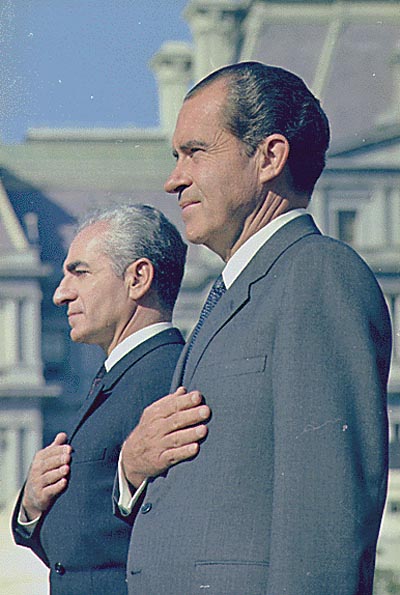
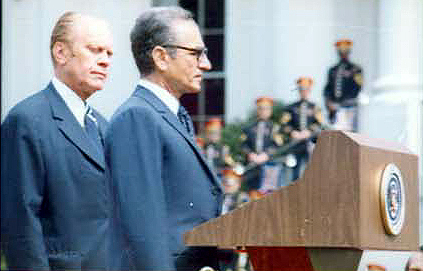
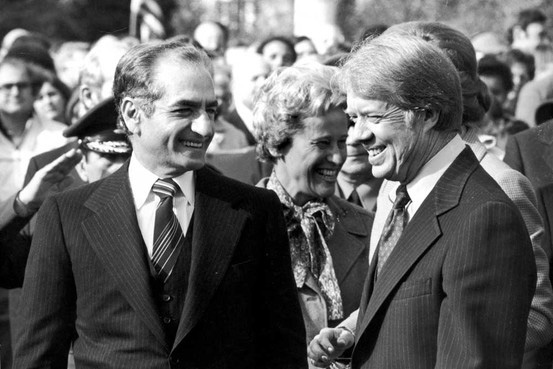
The Shah of Iran saw visions, just not the right ones. In 1973, Oriana Fallaci, at the height of her interrogatory powers, drew a sharp portrait of Mohammed Reza Pahlevi and his ghosts for the New Republic when he sat for an interview with her. The opening:

Oriana Fallaci:

You said in another interview: “If I could have my life over again, I’d be a violinist, a surgeon, an archaeologist or a polo player, anything except a king.”

Mohammed Reza Pahlevi:

I don’t remember saying that, but if I did, I was referring to the fact that a king’s job is a big headache. But that doesn’t mean I’d be ready to give it up. I believe in what I am and in what I’m doing too much for that. Where there’s no monarchy, there’s anarchy, or an oligarchy or a dictatorship. Besides, a monarchy is the only possible means to govern Iran. If I have been able to do something, a lot, in fact, for Iran, it is owing to the detail, slight as it may seem, that I’m its king. To get things done, one needs power, and to hold onto power one mustn’t ask anyone’s permission or advice. One mustn’t discuss decisions with anyone. Of course, I may have made mistakes too. I too am human. However, I believe I have a task to carry out, a mission, and I intend to perform it to the end without renouncing my throne. One can’t foretell the future, obviously, but I’m persuaded the monarchy in Iran will last longer than your regimes. Or maybe I ought to say that your regimes won’t last and mine will.

Oriana Fallaci:

Your Majesty, how many times have they attempted to kill you?

Mohammed Reza Pahlevi:

Twice officially. Otherwise, God knows how many times. I’ll stay alive till such time as I’ll have finished what I set out to accomplish. And that day has been marked by God, not by those who wish to assassinate me.

Oriana Fallaci:

Then why do you look so sad, Your Majesty?

Mohammed Reza Pahlevi:

You may be right. At heart, maybe I’m a sad man. But it’s a mystic sadness, so I believe. A sadness that stems from my mystical side. I wouldn’t know how else to explain the circumstance, since I haven’t the slightest reason to be sad. I have now attained all I ever wished for, both as man and as king. I really have everything, and my life proceeds like a splendid dream. Nobody in the world should be happier than me and yet…

Oriana Fallaci:

It must be terribly lonely to be a king instead of a man.

Mohammed Reza Pahlevi:

A king who doesn’t need to account to anyone for what he says and does is unavoidably doomed to loneliness. However, I’m not entirely alone, because a force others can’t perceive accompanies me. My mystical force. Moreover, I receive messages. I have lived with God beside me since I was five years old. Since, that is, God sent me those visions.

Oriana Fallaci:

Visions?

Mohammed Reza Pahlevi:

Visions, yes. Apparitions.

Oriana Fallaci:

Of what? Of whom?

Mohammed Reza Pahlevi:

Of prophets. I’m really surprised you should ignore this. It is common knowledge that I’ve had visions. I’ve even put it down in my biography. As a child, I had two visions: one when I was five and one when I was six. The first time, I saw our Prophet Ali, he who, according to our religion, disappeared to return the day he would save the world. I had an accident: I fell against a rock. And he saved me: He placed himself between me and the rock. I know because I saw him. And not in a dream: in reality. Material reality, if you see what I mean. I alone saw him. The person who was with me didn’t see him at all. But nobody else was supposed to see him except me because… Oh, I fear you don’t understand me.

Oriana Fallaci:

No, Your Majesty. I don’t understand you at all.

Mohammed Reza Pahlevi:

That’s because you’re not a believer. You don’t believe in God and you don’t believe me. Lots of people don’t.•

Tags: , ,

Robot Olympics, sure, they are numerous, but there have never been robots in the Olympics, and Japanese Prime Minister Shinzo Abe wants to change that at the 2020 Summer Games. If nothing else, it’s instructive to know that Japan, thought to be an unstoppable tech powerhouse just several decades ago, is now desperately trying to establish itself as a premiere player in robotics. In what areas will China not be able to sustain its momentum? From Eric Geller at the Daily Dot:

“Japan is set to host the 2020 Summer Olympics, and Prime Minister Shinzo Abe is looking for ways to turn it up a notch. His solution? Robots, of course.

According to Agence France-Presse, Abe expressed his interest in hosting an Olympic event specifically for robots as part of the international athletic competition in 2020.

‘I would like to gather all of the world’s robots and aim to hold an Olympics where they compete in technical skills,’ Abe said. ‘We want to make robots a major pillar of our economic growth strategy.’

Abe’s focus on robots for the Olympics came as part of a visit last Thursday to robot production facilities in the Japanese city of Saitama, where factories churn out robots that both assist humans and operate autonomously in a diverse array of workplaces, including daycare.”

Tags: ,

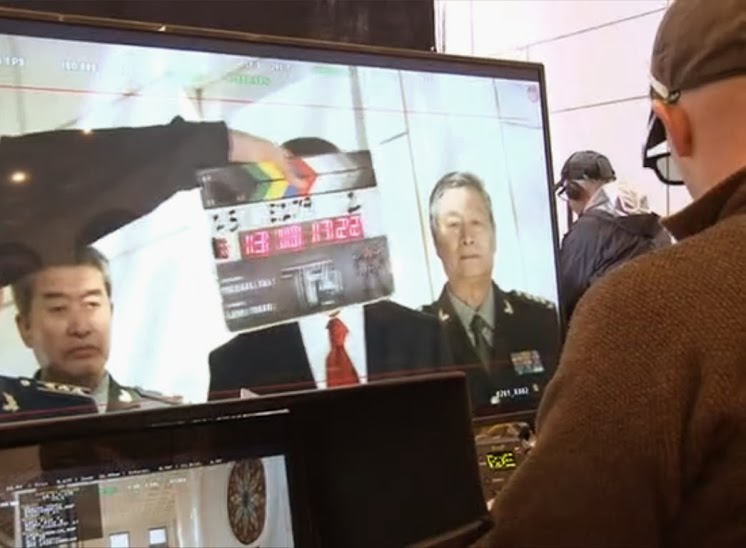
Before globalization reached critical mass, America pretty much owned the narrative ever since the conclusion of World War II. But there are other players on the stage (and screen) today, including those communists capitalists in China. If you ever scratch your head when something like Hansel & Gretel: Witch Hunters gets a sequel despite a relatively soft North American box office, just check the domestic and foreign grosses, because the international business is what turns the light green now. We’re not alone anymore. THEY are out there. From “Hollywood Transformed,” by Tom Shone in the Financial Times:

“Nobody said global takeover would be easy. On course to beating Avatar (2009) as the top-grossing film of all time at the Chinese box office, Transformers: Age of Extinction picked up a flurry of complaints from Chinese companies who had paid for their products to appear in the movie.

A Chinese takeaway chain that sells duck necks said it was ‘very dissatisfied’ with a three-second shot of its meat in a refrigerator; the Wulong Karst National Park was upset the US production team had mistaken a sign that read ‘Green Dragon Bridge’ for the park’s actual logo, and given the impression the park was near Hong Kong, when they are actually more than 700 miles apart. Clearly, the park owners had never seen Michael Bay’s movies, with their cheerful war on all manner of coherence: spatial, geographical, narratological.

‘Why do all the cars that fought in Hong Kong have their [steering] wheels on the left?’ one movie-goer asked on Weibo, the Chinese Twitter, where many gathered to puzzle over the movie’s numerous product placements. ‘Why would a middle-aged man in the middle of the desert in Texas take out a China Construction Bank card to withdraw money from the ATM?’ asked another.

A fitting image, perhaps, for the new breed of eastward-bound Hollywood blockbuster, aimed at penetrating China’s ‘Great Wall’ quota system – limiting the number of foreign films shown and the profits passed on to its makers – by gaining coveted ‘co-production’ status.

Working with their Chinese counterparts, Jiaflix Enterprises and the China Movie Channel, the producers of the fourth Transformers film shot the movie partly in China. They also cast Chinese stars Li Bingbing and Han Geng in small roles, and made multiple product-placement deals with Chinese consumer brands, although by far the strangest endorsement in the film has to be for single-party, non-democratic rule. While western democracy is represented by a Cheney-esque goon heading up the CIA and running rings around an ineffectual president, the response of the Chinese government to alien invasion is one of efficient, disciplined resolve. ‘Transformers: Age of Extinction is a very patriotic film,’ noted Variety, ‘It’s just Chinese patriotism on the screen, not American.’”

Tags:

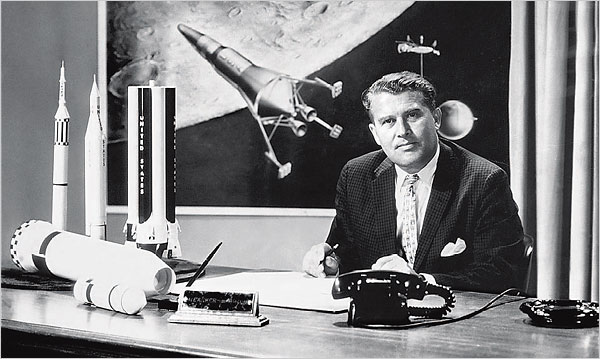
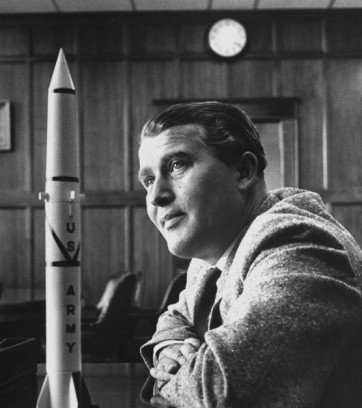
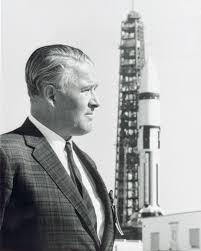
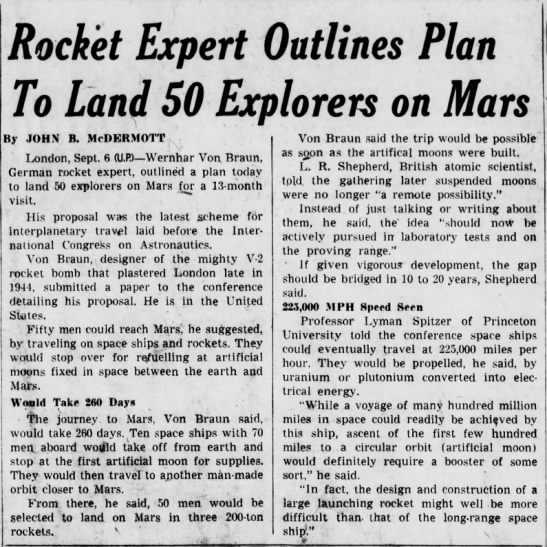
Muammar Gaddafi got exactly what he deserved, but most don’t. Case in point: Wernher von Braun, complete Nazi and celebrated American hero, who was rescued from cosmic justice at the end of WWII by an accident of geopolitics. Hitler’s rocketeer knew as much about blasting off without blowing up as anybody at just the moment when the U.S.A. and the Soviet Union both wanted to rule the air, the Space Race on the horizon. He was deemed necessary and his slate wiped clean. An article by John B. McDermott in the September 6, 1951 Brooklyn Daily Eagle laid out von Braun’s plans for a nuclear-powered mission to Mars.

wernherrocketmars

London–Wernher von Braun, German rocket expert, outlined a plan today to land 50 explorers on Mars for a 13-month visit.

His proposal was the latest scheme for interplanetary travel laid before the international Congress on Astronautics.

Von Braun, designer of the mighty V-2 rocker bomb that plastered London late in 1944, submitted a paper to the conference detailing his proposal. He is in the United States.

Fifty men could reach Mars, he suggested, by traveling on space ships and rockets. They would stop over for refuelling at artificial moons fixed in space between the earth and Mars.

Would Take 260 Days

The journey to Mars, Von Braun said, would take 260 days. Ten space ships with 70 men aboard would take off from earth and stop at the first artificial moon for supplies. They would then travel to another man-made orbit closer to Mars.

From there, he said, 50 men would be selected to land on Mars in three 300-ton rockets.

Von Braun said the trip would be possible as soon as the artificial moons were built.

L.R. Shepherd, British atomic scientist, told the gathering later suspended moons were no longer “a remote possibility.”

Instead of just talking or writing about them, he said, the idea ‘should now be actively pursued in laboratory tests and on the proving range.’

If given vigorous development, the gap should be bridged in 10 to 20 years, Shepherd said.

225,000 MPH Speed Seen

Professor Lyman Spitzer of Princeton University told the conference space ships could eventually travel at 225,000 miles per hour. They would be propelled, he said, by uranium or plutonium converted into electrical energy.

“While a voyage of many hundred million miles in space could readily be achieved by this ship, ascent of the first few hundred miles to a circular orbit (artificial moon) would definitely require a booster of some sort,” he said.

“In fact, the design and construction of a large launching rocket might well be more difficult than that of a long-range space ship.”•


Tags: , ,

You ever wonder how someone–that person–became successful and famous and known all over the world? Maybe if things had gone differently and they didn’t get a particular opening, they would have been working a much smaller stage.

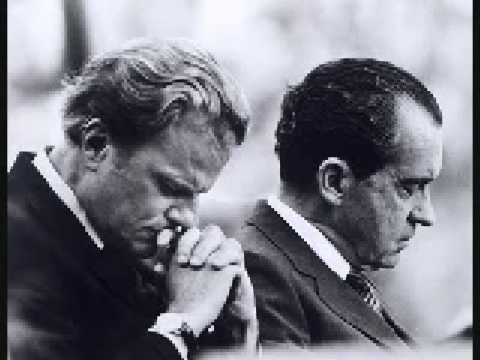
I think that way about the Rev. Billy Graham, the pulpit master who became a White House chaplain of sorts across several generations, thanks to two gatekeeper guardian angels, William Randolph Hearst and Henry Luce, anointing him America’s preacher. While Graham’s continuous access to the nation’s highest office may be unusual, at least he’s not a dunderhead like his son, Franklin, nor is he lacking in gravitas as is the grinning megachurch mogul Joel Osteen, an aspirationalist with heavenly hair.

Two excerpts follow from “Blunt Billy,” Roy Rowan’s 1975 People interview with Graham, in which the evangelist discusses becoming Hearst’s rosebud, and his disappointment in Richard Nixon over Watergate.

________________________

People:

Have you been surprised by your success? 

Rev. Billy Graham:

Extremely. There were two men who were the keys to my impact and success. One was William Randolph Hearst. I never met him, but I was told by William Randolph Hearst Jr. that one night in 1949 his father came with Marion Davies to a service out of curiosity, went back to the office and sent a two-word teletype to all of his newspapers: PUFF GRAHAM! The next night the place was crawling with reporters and photographers. I said, “What’s happened?” They said, “You’ve just been kissed by William Randolph Hearst.” 

People:

Who was the other man? 

Rev. Billy Graham:

Henry Luce. At Bernard Baruch’s suggestion, Mr. Luce got on an airplane and flew to Columbia, S.C., where I was preaching and spent three days with me. We stayed in the same house. He wanted to see if I was real. We’d sit up until 2 a.m. talking. After that I was on the cover of LIFE two times and the cover of TIME once. 

_________________________

People:

Why did you feel compelled to speak out on Watergate?

Rev. Billy Graham:

Richard Nixon was my friend. I admired him a great deal, and I respected him. I knew his father and his mother. I participated in the funeral of his mother. But just as Johnson was caught in the Vietnam war, Nixon was caught in Watergate. In defending some of his friends, Nixon just got deeper and deeper and deeper. He didn’t realize what was happening was actually breaking the law.

People:

Do you think President Nixon was personally guilty of misconduct?

Rev. Billy Graham:

I would have to say he was. I really believed in him, but I didn’t know that all that stuff was on tape. When the language came out which I had never heard, and the apparent misrepresentation to the American people, I was shocked and surprised. This was a Nixon I didn’t know.

People:

Did discovering this “Nixon you didn’t know” change your feeling about him?

Rev. Billy Graham:

I would have to use the word “disappointment.” Yet I still have great affection for Nixon, and great respect for him. As Special Watergate Prosecutor Leon Jaworski said, Nixon went through something worse than death. Nixon amazingly has lived through it. For about a year, we weren’t in contact much. Now our friendship has been reestablished. I stopped in San Clemente recently and spent an hour with him. He’s more like his old self before he became President. He’s joking, he’s kidding, he’s laughing a lot. Watergate was barely mentioned. You can see that he has overcome the psychological hump.

People:

How should Nixon make amends?

Rev. Billy Graham:

Nixon can tell the total truth in the book he’s writing. I think he will. But I could be wrong. I was wrong before.

People:

What do you think is in Nixon’s future?

Rev. Billy Graham:

Mr. Nixon is a tremendous student. After he lost the California governor’s race, he didn’t think he’d ever have a chance politically again. I said to him, “Mr. Lincoln once said, ‘I will prepare, and someday my chance will come.’ ” I said, “You get prepared, and there’ll be a place of service for you somewhere.” I was thinking he might be secretary of state. I was not thinking of him as President of the United States. Now I would seriously doubt if Nixon would ever be called back into government service.

Tags: , , , ,

Many Kentuckians who now have Obamacare love the care and hate Obama. When it comes to affordable health insurance, they need it, they want it, they wish they could live without it. Passages follow from a BBC piece about the health-care reform that dare not speak its name in the Blue Grass State and an Ezra Klein Vox post about the aftermath of the Halbig case ruling.

_________________________

From Claire Bolderson’s “Obamacare in Kentucky: The luxury of seeing a doctor“:

“Liberty Sizemore leans back in her chair and beams. The 26-year-old filling station cashier has just been told her enrolment in Obamacare is complete.

Now she can have her first routine doctor’s appointment for seven years.

‘I am so happy,’ says Sizemore as she waits at the Grace Community Health Centre in Clay County, Kentucky, ‘I’ve not had insurance since I turned 19.’

But Sizemore is also nervous. She is seriously overweight and was warned in her teens that she was likely to develop diabetes. Without health insurance she has not been able to afford tests or check-ups to see if she has indeed got the disease.

‘I’ll go to the hospital only in an emergency,’ says Sizemore, who is still paying off the $10,000 bill for removing her appendix two years ago.

‘That’s what’s on my credit card right now,’ she sighs, ‘hospital bills.’

Sizemore is one of 421,000 people in Kentucky who’ve signed up since the Patient Protection and Affordable Care Act, widely known as Obamacare, came into force last October.

Like many, she now qualifies for Medicaid, the government programme that pays for health care for the poorest Americans. Under the new law, the federal government offers states money to expand Medicaid so that many more people on very low wages, like Liberty Sizemore, are covered.

There are also federal funds for new state insurance exchanges where Americans can shop for private plans. Some plans are heavily subsidised by the government, depending on the applicant’s income level.

Kentucky is one of a minority of states – and the only one in the South – to have taken Washington’s money and embraced all the reforms.

But it has done it without embracing the man after whom they are named.

‘The president is not all that popular in the state,’ says Democratic Governor Steven Beshear, pointing to Mr Obama’s 34% approval rating in Kentucky (eight points below the latest national figure reported by Gallup). ‘So we don’t talk about Obamacare,’ he explains.”

_________________________

The opening of Klein’s “No, the Halbig case isn’t going to destroy Obamacare“:

“The Halbig case could destroy Obamacare. But it won’t. The Supreme Court simply isn’t going to rip insurance from tens of millions of people in order to teach Congress a lesson about grammar.

As Adrianna McIntyre explains, the Halbig case holds that Obamacare’s subsidies are illegal in the 36 states where the federal government runs (or partly runs) the exchange. The plaintiffs rely on an unclearly worded sentence in the law to argue that Congress never intended to provide subsidies in federally-run exchanges and so the subsidies that are currently being provided in those 36 states are illegal and need to stop immediately.

This is plainly ridiculous. The point of Obamacare is to subsidize insurance for those who can’t afford it. The point of the federal exchanges is to make sure the law works even in states that can’t or won’t set up an exchange.

For Congress to write a law that provides for federal exchanges but doesn’t permit money to flow through them would have been like Congress writing a transportation law that builds federal highways but doesn’t allow cars, bikes or buses to travel on them.

That was…not what Congress thought it was doing.”
Tags: , , , ,

Go here to listen to a really good Econtalk discussion between economists Russ Roberts and Mike Munger about the sharing economy. Uber and Airbnb certainly provide improved offerings (though not always a lower price), but they also skirt tax and regulatory rules. It’s pretty clear that consumers want a peer-to-peer economy, but there are consequences for those who’ve adhered to traditional regulations. What if you spent a million dollars on a NYC taxi medallion a few years ago only to find out the value of your purchase has cratered (which hasn’t happened yet but potentially could) because of Uber and Lyft and the like? These companies have improved the transportation market, they’ve innovated ways for consumers to connect to cabs, but they aren’t playing by the rules.

So here’s the question: What happens to all parties when the rules have changed in practice but not (yet) on paper? Munger thinks New York will ban Uber, but it’s hard to believe those market forces will be constrained for very long. Nor should they be, really. One passage from the discussion:

Russ Roberts:

We should explain. A medallion is–

Mike Munger:

A license.

Russ Roberts:

It’s a license that allows you to, in the case of a cab company, to pick up a stranger on the street who is raising his hand, saying, ‘Taxi’. There has always been an out for limos. You can always call a limo service to your house. I don’t think they need the same–they don’t have the exact same regulatory structure. But certainly, it is against the law in almost every city in America to cruise around and offer to pick up somebody who is raising his or her hand looking for a taxi and act like a taxi. And what Uber has done is be a little bit different. Sort of like that, but a little bit different. And that’s what the regulatory issue is.

Mike Munger:

Yeah. It’s much harder for the police. You don’t have to raise your hand, now. You just press a button on your phone unobtrusively. And the police don’t know. For all they know, it’s your friend picking you up at the airport.

Russ Roberts:

But, I think you exaggerate slightly. So, the medallion–now medallions have sold recently for as much as a million dollars.

Mike Munger:

In New York.

Russ Roberts:

In New York. Despite the Chicago story. So, there are people who are still investing in the right to be a taxi cab driver, either because they think that Uber is not as important as we do, or they think that Uber will be stopped and shut down and will not be a competitive force.

Mike Munger:

I predict that Uber will be stopped and shut down.

Russ Roberts:

Okay, I’m going to go against you there. I’m going to disagree with you. It is under tremendous regulatory pressure. Pittsburgh just announced–

Mike Munger:

I just meant in New York. In New York City. I just think that the people who made that, are making a good bet. It’s too easy to make a sting operation.

Russ Roberts:

Okay. We’ll see. But I do think that–the question isn’t that–I don’t think that Uber is illegal right now. It’s a gray area. Pittsburgh has just ruled that it must comply with the Pittsburgh Utility Council’s, or Pennsylvania Utility Council’s regulations. In Europe there’s tremendous pressure to shut down Uber, not allow them. But remember, there is tremendous pressure from riders. Who like it. And I think–I want to make sure we make something clear here. There are two aspects to this attractiveness of Uber. One of them–I don’t think it’s so much the price. I don’t think the price is that much different. I think it’s the convenience and power of it, on a calm, normal day; and I think it’s its ability change price on the fly, using a fairly sophisticated algorithm.

Mike Munger:

But the taxi companies can mimic all of that. They’ll do it within a month. It’s easy to do. If that were the reason, that’s easy to do. It’s basically open-source software.

Russ Roberts:

I don’t know about that. Um, you are suggesting then that the cab company doesn’t offer me a web, a phone-based opportunity to hail a cab because they don’t need to? Because they have a monopoly?

Mike Munger:

Yeah.

Russ Roberts:

I don’t know. I think the software is what gives Uber its comparative advantage.

Mike Munger:

It’s interesting that the taxi companies are so awful at this. So, if nothing else, Uber may force the taxi companies to improve the way that you connect with a taxi. But I think the cost advantage is really a problem, because it actually raises a lot of questions about the nature of due process. Suppose that we don’t take any action and the value of these medallions falls to zero. Are we obliged to offer compensation, because we in effect made a regulatory decision that is a taking? This property right, this medallion, had significant value. We made a choice, without due process, that said we are going to reduce the value of this medallion to zero. Are we obliged to compensate?

Russ Roberts:

Who is ‘we’?

Mike Munger:

The state. Just like we would if we were taking your land under eminent domain to build a road.”

Tags: ,

Kurt Vonnegut pointed out that some of us get wicker furniture and some get bubonic plague. It seems counterintuitive, but perhaps the kindest thing we can do to help the plagued is to buy more twiggy chairs. 

The idea that the best citizen is a good consumer isn’t a new one, though it’s always been complicated because of feelings of personal guilt and concerns about ecology. In his Aeon essay, “The Good Consumer,” Florian Schui, argues against the self-reproach, and while he acknowledges the environmental costs of free-market capitalism, he seems less worried about it than most. The opening:

“Westerners are constantly worrying about consuming too much and living too well. This is not a new concern. For at least the past 2,000 years we have worried about having to pay a price for prosperity. What is perhaps more surprising is that we continue to worry. During the first millennia of human existence, increases in consumption were extremely slow, but over the past 200 years or so industrialisation led to an unprecedented increase in prosperity in the West. This was topped off by a super-increase in the 1950s and ’60s. And yet, we have still not had our comeuppance. Instead, for most Westerners, the principal outcomes have been longer and more comfortable lives.

That said, the benefits of increasing prosperity are distributed highly unequally, making growing inequality perhaps the most pressing economic and social problem of our era. Consumption is one of the areas where inequality is felt most strongly, not so much due to excessive consumption at the top, interestingly enough, but because of increasing deprivation at the bottom. If we want to correct this imbalance, through redistribution, we need to recognise that this will inevitably result in a further substantial increase in overall consumption. That might be no bad thing, providing policymakers make the effort to understand the long tradition of criticising consumption that is almost as old as Western civilisation.”

Tags:

I don’t think a questionable Turing Test means we should be granting robots marriage licenses or social security cards, but there are ethical and legal questions to be addressed as society becomes increasingly automated and performance-enhancement on a grand scale becomes widespread. From Mark Goldfeder’s CNN piece “The Age of Robots Is Here“:

“Robotic legal personhood in the near future makes sense. Artificial intelligence is already part of our daily lives. Bots are selling stuff on eBay and Amazon, and semiautonomous agents are determining our eligibility for Medicare. Predator drones require less and less supervision, and robotic workers in factories have become more commonplace. Google is testing self-driving cars, and General Motors has announced that it expects semiautonomous vehicles to be on the road by 2020.

When the robot messes up, as it inevitably will, who exactly is to blame? The programmer who sold the machine? The site owner who had nothing to do with the mechanical failure? The second party, who assumed the risk of dealing with the robot? What happens when a robotic car slams into another vehicle, or even just runs a red light?

Liability is why some robots should be granted legal personhood. As a legal person, the robot could carry insurance purchased by its employer. As an autonomous actor, it could indemnify others from paying for its mistakes, giving the system a sense of fairness and ensuring commerce could proceed unchecked by the twin fears of financial ruin and of not being able to collect. We as a society have given robots power, and with that power should come the responsibility of personhood.

From the practical legal perspective, robots could and should be people.

Tags:

A city that’s too orderly is a museum and dying. You can look at it, but it can’t look back at you. A metropolis shouldn’t merely be shelter and welter, but you don’t want it to be lifeless any more than you’d want it to be lawless. It should, to some degree, be a mess. From Will Wiles’ new Aeon essay,The Concrete Tangle“:

“In 1974, when mainstream discourse held the metropolis to be a behavioural sink fit only to be turned over to the waiting Droogs, the British author Jonathan Raban’s treatise Soft City made a case for city dwelling. Writing chiefly about London and New York, Raban acknowledged that they could be unfriendly and often violent (far more so than today), but added that they offered hugely attractive social and psychological possibilities. Where Mumford finds the teeming metropolis alienating and false, Raban sees it as a splendid masquerade, a place where one is free to try on and slough off identities multiple times in a day, a stage for exploring and defining the self. The difficulty and danger become perverse sources of pride and belonging, distinguishing the seasoned urbanite from the greenhorn. The city’s anonymity and restless flux are in fact its strength: its plasticity, its softness, where it awaits ‘the imprint of an identity’.

Raban’s free and expressive city life requires fluency in certain conventions. One has to learn the city’s codes, its languages. ‘So much takes place in the head, so little is known or fixed,’ he writes. ‘Signals, styles, systems of rapid, highly conventionalised communication, are the lifeblood of the big city. It is when these systems break down – when we lose our grasp on the grammar of modern life – that the Envies [a violent gang] take over.’

These ‘systems’ constitute an invisible social infrastructure; one, indeed, in which we might see a certain resemblance to the city’s tangle of service mechanisms. Both are always multiple, improvised, threatening to break under the weight of the city’s sheer extremity:

Language codifies an order, a hierarchy, a stable view of the world, which is grossly exceeded by the reality of the modern city: and the arrival of the immigrant propels him into abstractions and the contemplation of his own internal state of mind. It is a source of transformations and distortions of scale which can only be received with dumb wonder. In American fiction and autobiography, the townscape of New York is turned into a giant perceptual conundrum, as if it has been deliberately designed as a monstrous challenge to eyes and ears accustomed to the human proportions of village and small-town architecture. … If the city is normal, then he is a dwarf; if he is normal, then the city must be some kind of concrete optical illusion, for what perspective or grammar exists in which such breathtaking heights and breadths are possible? Shifting in size, at once dwarfed and elevated by these amazing confusions of scale, the greenhorn lurches forward into his myopic destiny. … City architecture is an eloquent proclamation of the absolute strangeness of city life, a reminder that here you abandon hope of holding on to your old values, your old language.

The city is a machine for teaching people to be city-dwellers. But first it necessitates submission, which it extracts by means of its scale, but also its complexity, its confusions – its tangle.”

Tags: ,

« Older entries § Newer entries »