Politics

You are currently browsing the archive for the Politics category.

The Civil War didn’t claim so many lives merely because of the brutality of the battles but also because it was fought just before the dawn of modern medicine. One man, William Hammond, by all accounts a miserable prick to work with, saved countless thousands with his bold vision after President Lincoln appointed him Surgeon General of the Army in 1862. But there was only so much he could do. From Pat Leonard in the New York Times:

“Yet even with his state-of-the-art initiatives to improve sanitation and save lives, Hammond was fighting an uphill battle. The American Civil War was fought during what he would later describe as ‘the end of the medical Middle Ages.’ An understanding of germ theory was still a decade away, and thousands died not from their wounds but from infections or gangrene that developed later. During and following a major battle, doctors performed amputations by the hundreds, sawing off mangled limbs as quickly as men could be lifted onto makeshift operating tables, without so much as wiping their blades between procedures. The death rate following amputations ranged as high as 50 percent, especially when major limbs were involved or when soldiers had to wait more than a few hours to be treated.

And that wasn’t the worst of it. The greatest menace to Civil War soldiers was not enemy fire, nor even the infections that almost always inflamed their wounds and/or stumps. The majority of field fatalities – an estimated three out of five among Union dead, and two out of three among Confederates – were caused by preventable diseases that swept through camps and hospitals, including dysentery, typhoid fever, pneumonia, tuberculosis and even ‘childhood’ ailments like measles, chickenpox and whooping cough.

Writing home, soldiers often remarked that they didn’t fear the big battles as much as being taken to a hospital, where they would be exposed to killers they couldn’t see and didn’t understand.”

Tags: ,

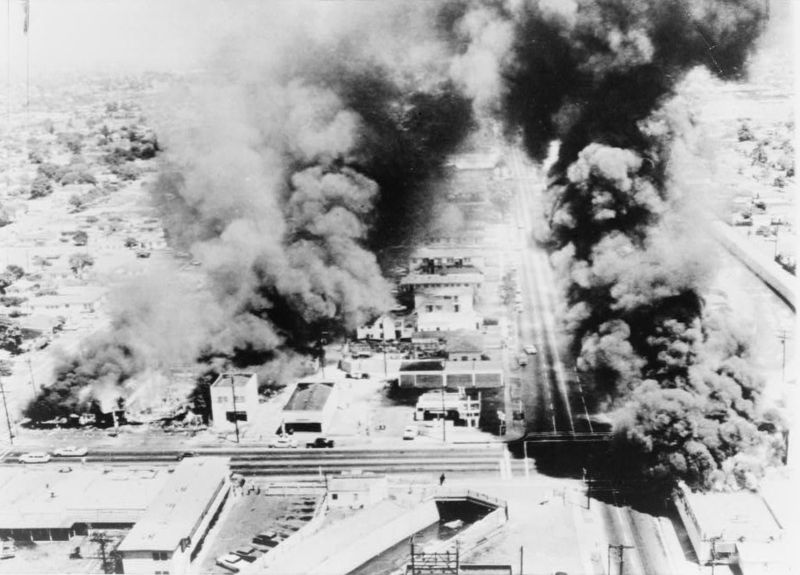
Watts, 1965.

Some of the best writing and thinking in the country right now is being done at the L.A. Review of Books. From an LARB article about lessons gone unlearned in Los Angeles, written by that prophet of doom Mike Davis:

“Indeed, L.A. labor, instead of leading the march toward prison reform and the ending of the war on drugs, now lifts its glass along with the rest to celebrate the legacy of Chief Bratton and the current liberal love affair with the LAPD.  At the same time, a new East Side civic elite (with much political but little economic power) sups from the silver chalices of the latest cohort of super-rich mega-looters (Ed Roski, Ric Caruso, Allen Casden, the Anshutz Entertainment Group, and so on).  That bankruptcy asset known as the Los Angeles Times continues its long tradition of bravely exposing graft on a miniature scale (the City of Bell scandal, for example) while giving a pass to the felonies of billionaires (almost everything having to do with downtown real estate or rail transportation).

I betray my age by noting that the current culture of comfortable corruption and jaded accommodation in City Hall — theoretical liberals doing the heavy lifting for wealthy Republicans — is smugly reminiscent of Tom Bradley’s last term.  If the analogy holds, then a skybox in the new Los Angeles Stadium will afford a wonderful view of the city burning for a third time.”

Tags:

With so much of life shifted online, it’s natural that elements of warfare will follow. From Michael Gallagher at the BBC:

“‘Sophisticated cyber attackers could do things like derail trains across the country,’ says Richard A Clarke, an adviser on counter-terrorism and cyber-security to presidents Clinton and Bush.

‘They could cause power blackouts – not just by shutting off the power but by permanently damaging generators that would take months to replace. They could do things like cause [oil or gas] pipelines to explode. They could ground aircraft.’

Clarke’s worries are fuelled by the current tendency to put more of our lives online, and indeed, they appear to be borne out by experiments carried out in the United States.”

Tags: ,

“We’re drifting toward becoming a plutocracy.” (Image by Richard Whitney.)

A sequence from former Labor Secretary Robert Reich’s excellent Ask Me Anything on Reddit:

Question (seeker135):

In your opinion, are we in the Endgame of the Republic?

Answer (robertbreich):

No.


Question (hierocles):

In the sense that the United States political system will no longer look like it used to, yes. Obviously the country is not going to fall into anarchy. But without institutional changes, all branches of government will have to be controlled by the same party if they’re going to be at all effective. We will have to enter into a pseudo one-party state.

Answer (robertbreich):

I’m not quite as pessimistic, but I do think there have to be major institutional changes. The most important, in my view, is limiting campaign contributions. That will be hard to do in the wake of the Supreme Court’s grotesque ‘Citizen’s United’ decision, but I still think public financing of general elections can work, if the extent of the potential financing is raised. Remember, both presidential candidates used public financing in 1976, and didn’t rely on any outside financing. Seems hard to believe from where we are now.


Question (kblz):

Mr. Reich, is the United States is a functioning republic? also – what would you do, now, if you were secretary of labor? would you encourage and protect small businesses? what about healthcare?

Answer (robertbreich):

We’re drifting toward becoming a plutocracy, run by a relatively small number of extremely wealthy individuals, CEOs, and Wall Street moguls. That’s why we need to get serious about campaign finance reform, why tax reform is vital, and why the entire economy needs to be reorganized to widen the circle of prosperity — so that far more of us benefit from the gains of productivity growth. If I were back in the administration, I’d strengthen labor unions, try to create a single-payer system for healthcare, use antitrust laws to break up big concentrations of power (such as the biggest banks on Wall Street), resurrect the Glass-Steagall Act (that used to separate investment from commercial banking), and enlarge the Earned Income Tax Credit (a wage subsidy for lower-income workers).”

 • • • • • • • • • •

Oh my god, look at these two tiny communists go! They are so adorable.

Tags:

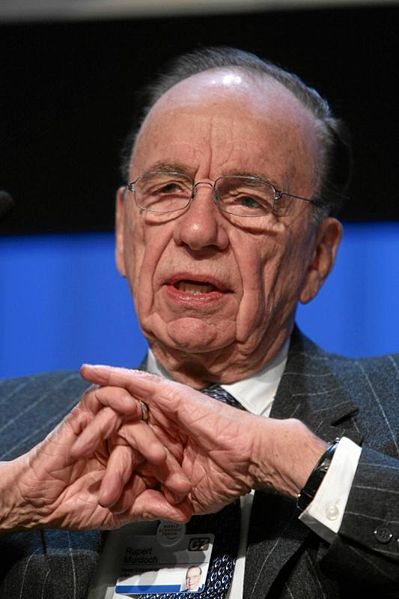
Adam Curtis has just republished a post on his BBC blog about that class act Rupert Murdoch. One segment concerns the late talk show host Russell Harty, who played a sort of jackass interviewer on TV, but certainly did not deserve to be hounded by Murdoch reporters as he lay dying in a hospital bed from an AIDS-related illness. An excerpt:

“In 1989 – on the 20th anniversary of buying the Sun – Murdoch helped write an editorial that trumpeted his vision of himself as a revolutionary:

‘The Establishment does not like the Sun. Never has

There is a growing band of people in positions of influence and privilege who want OUR newspaper to suit THEIR private convenience. They wish to conceal from readers’ eyes anything that they find annoying or embarrassing.

LIVING LIES AND HYPOCRISY ON HIGH CAN HAVE NO PLACE IN OUR SOCIETY

IT IS THE STRUGGLE OF ALL THOSE CONCERNED FOR FREEDOM IN BRITAIN.’

But the liberal elite were already fighting a counterattack. It had begun with the chat-show host Russell Harty the year before as he lay dying in a hospital bed from hepatitis.

Harty was a homosexual who had been hounded by the News of the World. With his illness this had turned into a media frenzy – with reporters from all the tabloids pursuing him in a hospital, posing as junior doctors demanding to see Harty’s medical notes, and photographers renting a flat opposite his hotel room.

At Harty’s funeral in 1988 the playwright Alan Bennett publicly accused the tabloid press of accelerating his friend’s death. ‘The gutter press finished him.’

The Sun chose to reply:

‘Stress did not kill Russell Harty. The truth is that he died from a sexually transmitted disease.

The press didn’t give it to him. He caught it from his own choice. And by paying young rent boys he broke the law.

Some – like ageing bachelor Mr Bennett – can see no harm in that. He has no family.

But what if it had been YOUR son Harty had bedded?'”

Tags: ,

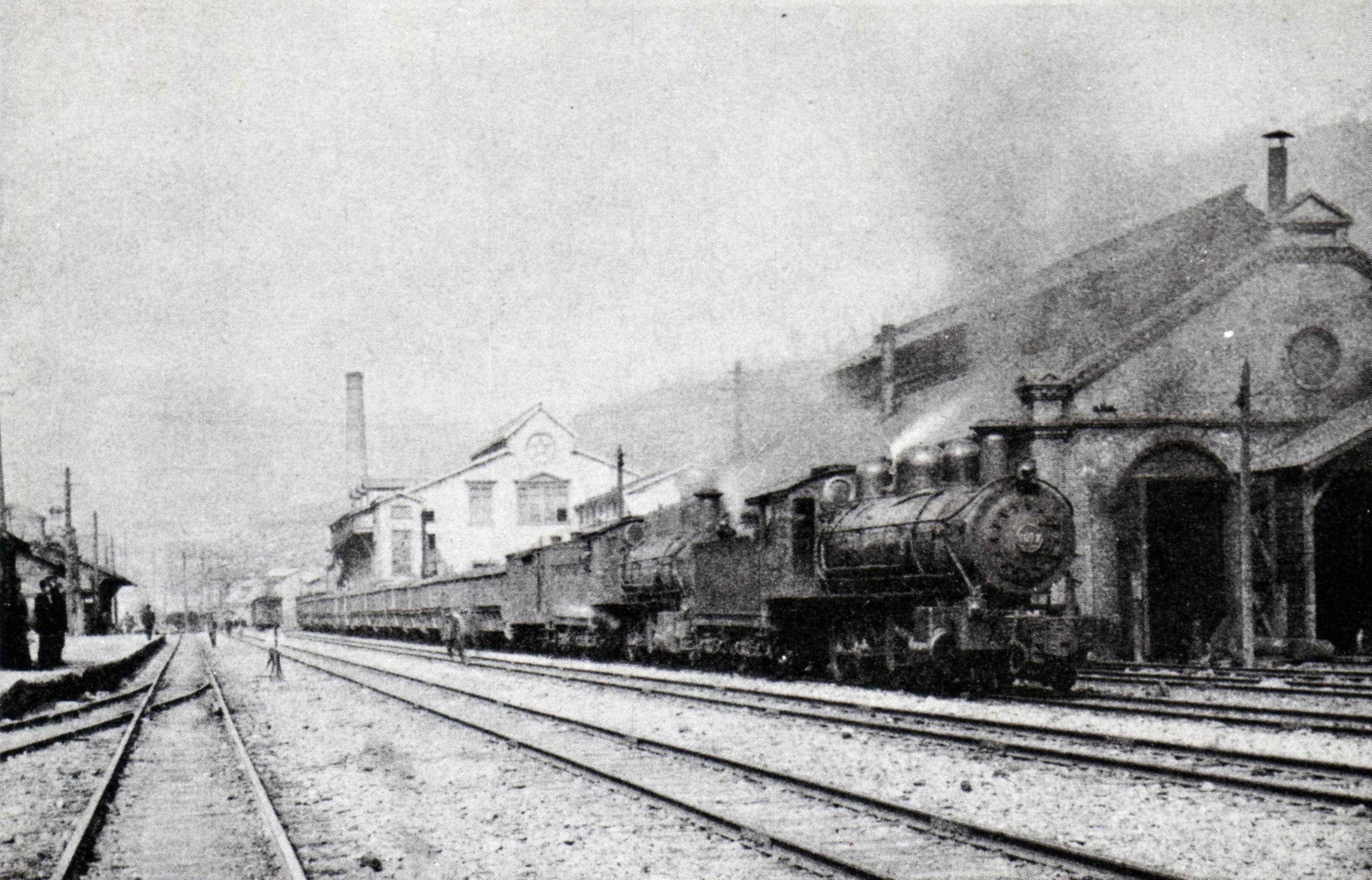
Yubari, 1918.

Japan’s population is aging and thinning, with so many younger natives moving abroad. That leaves the country in a precarious position for the future, though long-term prognostications of doom like predictions of sustained glory are often wrong. At any rate, the opening of Hiroki Tabuchi’s New York Times article on a dying town that may be a microcosm of sorts for the nation:

“YUBARI, Japan — Most young people have already fled this city of empty streets and shuttered schools, whose bankrupt local government collapsed under the twin burdens of debt and demographics that are slowly afflicting the rest of Japan.

Now, Yubari, a former coal-mining town on Japan’s northernmost main island, Hokkaido, is hoping an unlikely savior can reverse its long decline: a 31-year-old rookie mayor who has come to symbolize the struggle confronting young Japanese in the world’s most graying and indebted nation.

‘Japan  will tread the same path someday,’ said Naomichi Suzuki, who a year ago this month became the youngest mayor of the country’s most rapidly aging city. ‘If we can’t save Yubari, what will it mean for the rest of Japan?’

Indeed, the city’s plight and attempt to fight back — which has become a story line in the national media — could offer a glimpse of Japan’s future.”

Tags: ,

Justice Roberts: Like Judy Sheindlin without the charm.

There’s been no time in my life when the country has had a Supreme Court of such rancor, such arrogance and such nastiness as the Roberts Court. I’m not talking about Justice Alito showing disdain for President Obama during the State of the Union, though that is symptomatic of the problem. I’m referring more to the mocking, sarcastic, obnoxious, impatient tone of the Justices as they question American citizens who come before them. It’s not just behavior unbecoming of the highest court of the land but decorum that wouldn’t be tolerated in a playground. 

It’s always been a lie that the Constitution is this document that can interpreted with purity, that politics and personal prejudices don’t enter the picture. But the immaturity of numerous members of the current Court makes it dubious that they have the wisdom to sort as best they can through the objective and the subjective. Or that they even have that process as their goal. It may be that the Roberts Court ultimately has the distinction of being the one that makes Americans seriously question the wisdom of lifetime appointments for Justices.•

Judge Judy: I presided over the landmark case of the missing fish stick.

Tags: ,

Dubai, 1971.

From Tom Wodicka’s recent article about Douglas Coupland’s first visit to Dubai:

“I felt Dubai was a city ripe for his fiction. Had he ever thought about placing a novel here?

‘Until this trip I would never have been so presumptuous. One reason I’m glad I came is that all the things about Emirati culture that were really alien to me … clothing … architecture … art … suddenly made sense, so when I see things Arabic back home now, instead of being confused, I think, I know what that means.

‘I think everyone should come to Dubai. It would bring a lot of peace to the world. I’m always attracted to situations where new electronic patterns collide with the old. I can now very easily imagine writing a story set in that huge Dubai Mall wherein everyone talks only by texting and screen snaps.’

He then spoke about one of the strongest impressions Dubai left on him: ‘I think the key thing about the Emirati world right now is that it’s beginning to define itself as itself, as opposed to importing creativity from elsewhere. So it’s a pivotal moment for the region’s young artists: can they translate their experience and emotion into a form that makes others elsewhere understand their world more? It seems like there’s this whole massive mode of being that’s itching to be understood. And you’re getting a new museum [a modern art facility in Emaar’s Downtown Dubai development]. Young artists are going to have to fill it.'”

Tags: ,

Mike Wallace interviewing Thurgood Marshall during the Eisenhower Administration. Choppy video, but certainly worth it.

Tags: ,

No surprise that there’s been a marked spike in usage of stimulants by American soldiers with our military taxed by wars on two fronts for a decade. From “Why Are We Drugging Our Soldiers?” by Richard A. Friedman in the New York Times:

“But there is another factor that might be playing a role in the increasing rates of the disorder, one that has escaped attention: the military’s use of stimulant medications, like Ritalin and Adderall, in our troops.

There has been a significant increase in the use of stimulant medication. Documents that I obtained in late 2010 through the Freedom of Information Act, and have recently analyzed, show that annual spending on stimulants jumped to $39 million in 2010 from $7.5 million in 2001 — more than a fivefold increase. Additional data provided by Tricare Management Activity, the arm of the Department of Defense that manages health care services for the military, reveals that the number of Ritalin and Adderall prescriptions written for active-duty service members increased by nearly 1,000 percent in five years, to 32,000 from 3,000.

Stimulants are widely used in the civilian population to treat attention deficit hyperactivity disorder because they increase focus and attention. Short of an unlikely epidemic of that disorder among our soldiers, the military almost certainly uses the stimulants to help fatigued and sleep-deprived troops stay alert and awake. (A spokesman for Tricare attributed the sharp rise to ‘the increased recognition and diagnosis of A.D.H.D. by medical providers.’ However, while there is greater recognition of the disorder, the diagnoses are concentrated in children and adolescents.)

Stimulants do much more than keep troops awake. They can also strengthen learning. By causing the direct release of norepinephrine — a close chemical relative of adrenaline — in the brain, stimulants facilitate memory formation. Not surprisingly, emotionally arousing experiences — both positive and negative — also cause a surge of norepinephrine, which helps to create vivid, long-lasting memories. That’s why we tend to remember events that stir our feelings and learn best when we are a little anxious.”

Tags:

During the gas crisis of 1979, American car owners alternated days they could fill their tanks based on whether they had an odd or even number at the end of their license plates. What it looked like in Los Angeles.

Racism is not always a black-and-white thing. There are shades of gray in the minds of racists, allowing them to convince themselves that, no, they aren’t bigots. Some can accept people of other races in a lesser social position but not those in a superior one. Others can write off members of another race who’ve excelled as exceptions, while still believing “the rule.” We’re all prone to believe generalizations without holding ourseves to account. From Touré in Time:

“Racism is a mental tumor. It’s an acceptance of stereotypes, of otherness, of fear, of racial hierarchies. It requires embracing the concept of constants about certain racial groups even though there are no biological certainties about the races. Scientifically, there is only the human race. Race as we know it is a social construct and, in the sweep of human history, a relatively recent concept invented in America to justify having both “liberty for all” and slavery. Racism has long had sub-ideas protecting it like bodyguards—the idea that blacks were lesser human beings with inferior brain power and morality and criminal proclivities aided in the perpetuation of slavery, Jim Crow and the current wave of criminalization in which young black men are considered synonymous with criminals—some have captured this via the term “criminalblackman.”

Some people suggest that the multiracial embrace of Barack Obama, Oprah Winfrey, Michael Jordan, Will Smith and others portends the end of racism. But this, as the writer Arundati Roy says, is like the President pardoning one turkey before Thanksgiving and then eating another—and America eats thousands. The human mind is complex enough to integrate hypocrisy and contradictions. There have long been extraordinary blacks who succeeded far more than the vast majority and were accepted as special. The racist mind need not hate every black person it encounters, and indeed not hating all may serve as a valuable safety valve, releasing pressure and proving to the mind itself that it is not racist. Few people want to think of themselves as bad or evil.”

Tags:

There’s a full version online of Jean-Luc Godard’s 1968/72 collaboration with D.A. Pennebaker and Richard Leacock. Filmed originally as 1 A.M. (as in “One American Movie”), it was planned as Godard’s understanding of U.S. culture during the Vietnam age. (Though perhaps “misunderstanding” would be the more accurate term.) The project went uncompleted, was shelved and later reedited by Pennebaker into 1 P.M. (as in “One Parallel Movie”). A fascinating failure, the film features Rip Torn, Jefferson Airplane, Eldridge Cleaver and Tom Hayden, among others. (Thanks Dangerous Minds.)

Tags: , ,

For more than 30 years, American conservative politicians, often bearing flags and crosses, have exploited fears and prejudices and promised to return us to an earlier, grander time that never existed. But they really just wanted our money. As we’ve been led down this dark path, other global economies have progressed, leaving the middle class in the U.S. especially vulnerable. From “Economy Killers,” a Salon essay by Paul Krugman and Robin Wells about the polarized non-response to the Great Recession:

“America emerged from the Great Depression and the Second World War with a much more equal distribution of income than it had in the 1920s; our society became middle-class in a way it hadn’t been before. This new, more equal society persisted for 30 years. But then we began pulling apart, with huge income gains for those with already high incomes. As the Congressional Budget Office has documented, the 1 percent — the group implicitly singled out in the slogan ‘We are the 99 percent’ — saw its real income nearly quadruple between 1979 and 2007, dwarfing the very modest gains of ordinary Americans. Other evidence shows that within the 1 percent, the richest 0.1 percent and the richest 0.01 percent saw even larger gains.

By 2007, America was about as unequal as it had been on the eve of the Great Depression — and sure enough, just after hitting this milestone, we plunged into the worst slump since the Depression. This probably wasn’t a coincidence, although economists are still working on trying to understand the linkages between inequality and vulnerability to economic crisis.

Here, however, we want to focus on a different question: Why has the response to the crisis been so inadequate? Before financial crisis struck, we think it’s fair to say that most economists imagined that even if such a crisis were to happen, there would be a quick and effective policy response. In 2003 Robert Lucas, the Nobel laureate and then-president of the American Economic Association, urged the profession to turn its attention away from recessions to issues of longer-term growth. Why? Because, he declared, the ‘central problem of depression-prevention has been solved, for all practical purposes, and has in fact been solved for many decades.’

Yet when a real depression arrived — and what we are experiencing is indeed a depression, although not as bad as the Great Depression — policy failed to rise to the occasion.”

Tags: ,

It’s difficult to believe that the average person in China will ever know the same quality of life that Americans enjoy today, even if their economy blows past ours (which doesn’t seem to be a fait accompli). Because of China’s population size, even a super economy probably wouldn’t be able to put three SUVs in every garage. But that’s not to say that a large population foretells poverty, nor do technologies that displace workers. In the long run, a critical mass of people and technology seem to effect a greater prosperity. From “The Population Boon,” Philip E. Auerswald’s anti-Malthusian think piece in the American Interest:

“Almost exactly four years after V-J Day, on August 13, 1949, an MIT professor named Norbert Wiener wrote a letter to Walter Reuther, president of the United Auto Workers (UAW), containing a darkly prophetic message. Within a decade or two, Wiener warned, the advent of automatic automobile assembly lines would result in ‘disastrous’ unemployment. The power of computers to control machines made such an outcome all but inevitable. As a creator of this new technology, Wiener wanted to give Reuther advance notice so that the UAW could help its members prepare for and adapt to the massive displacement of labor looming on the horizon.

Now, if anyone in 1949 grasped the disruptive potential of computing machines, it was Norbert Wiener. A prodigy who earned his Ph.D. from Harvard in mathematical philosophy at age 18, he had contributed to the development of the first modern computer, created the first automated machine and laid the groundwork for a new interdisciplinary science of information and communication that he termed ‘cybernetics.’ His work anticipated and inspired Marshall McLuhan’s heralded studies of mass media, provided the initial impetus for the explorations by James Watson and Francis Crick that led to the discovery of the double helix, and spurred science-fiction writer William Gibson to coin the term ‘cyberspace’ to describe a type of virtual world that Wiener himself had envisioned two decades before the creation of the first web page.

Reuther took Wiener’s letter seriously, responding promptly by telegram: ‘Deeply interested in your letter. Would like to discuss it with you at earliest opportunity following conclusion of our current negotiations with Ford Motor Company. Will you be able to come to Detroit?’ When the two met in March 1950, they pledged to work together to create a labor-science council to anticipate and prepare for major technological changes affecting workers.

At about the same time Reuther and Weiner were meeting, a brain trust was gathering in the orbit of John D. Rockefeller III to address another problem: global overpopulation. The basic concern of this group was both old and simple: Human populations keep growing, but the planet isn’t getting bigger, so sooner or later disaster will be upon us. Funding from the Rockefeller Brothers Fund permitted the creation of the Population Council in 1952. John D. Rockefeller III appointed Frederick Osborn to be the Council’s first president.” (Thanks Browser.)

••••••••••

Frightening you and your children about overpopulation, 1970s:

Tags:

On a 1967 special, Woody Allen (and audience members) interviewed William F. Buckley. The conservative pundit asserted that tensions between Israelis and Arabs “will get tranquilized in time, I suspect.” Not quite.

Tags: ,

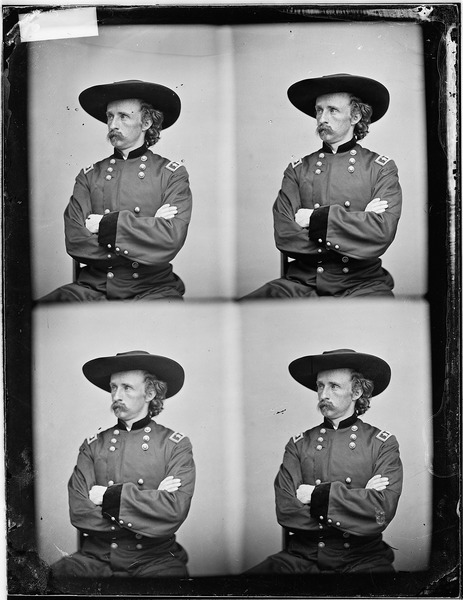
One of the things that interests me most about human beings is our tendency to self-delusion, those moments when we take a path so far afield, so confidently that it’s stunning. I don’t mean when we’re basing our decisions on faulty or incomplete information or when there’s a Taleb-ian black swan at play. I mean those times when we should certainly know better but our brains convince us otherwise. I would suggest that maybe it’s an evolutionary survival mechanism, except that such behavior can get us killed. And we all possess this ability to be block out the truth. We are wrong though we think we are right.

George Armstrong Custer, for instance, knew he was correct. From “It Was Only 75 Years Ago,” Life magazine’s 1951 retrospective of the Battle of the Little Bighorn:

He pressed forward although his men were weary and his supply train far behind.

Even when, on the morning of June 25, his force sighted a huge smoke haze on the other side of the Little Bighorn, indicating an enormous Indian camp, Custer disregarded warnings of his officers and scouts that a great mass of enemy was near. (It was, in fact, the biggest Indian mobilization in U.S. history.)

Inexplicably Custer divided his small force into three. He sent 120 men under Captain Frederick Benteen on patrol of the south. He then ordered Major Marcus Reno and 112 men to move toward what he still stubbornly believed was only 1,500 Sioux. Benteen encountered nothing. Reno ran into several thousand Sioux, made a desperate stand, then retreated with hideous losses to the other side of the river. There, joined by Benteen, he was able to re-form. Custer, to the perennial mystification of historians, never came to Reno’s support but, after trying to cross the river, proceeded north. He sent back a last message: ‘Benteen: Come on. Big Village. Be quick. Bring packs.’

Knowledge of what happened after that exists only in the misty minds of a few old Indians. Some 20 miles from where he separated his command, Custer and his 225 men were overwhelmed by almost 6,000 vengeful Sioux. From battlefield evidence they attacked from the southwest, drove the cavalrymen up a little mound and there killed them, including Mark Kellogg, a Bismarck, N. Dak. Tribune correspondent whom Custer brought along (against orders) to chronicle his new triumph and whose dispatches were later found in his pouch. Some of the dead were horribly mutilated; most were stripped. But George Custer, shot through the temple, was found with a peaceful expression on his face. He looked like a man who, hungry for glory all his life, had finally found it.”

Pile of bones remaining on the Little Bighorn battlefield, 1877.

Tags: , , ,

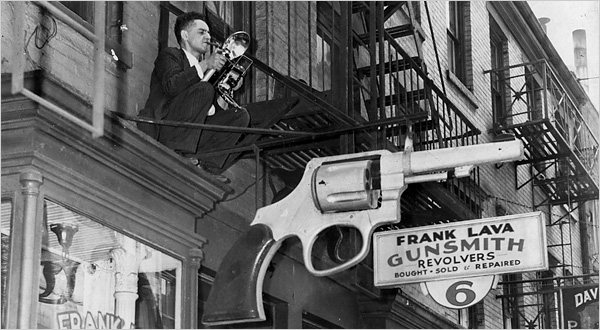
I’m in favor of regulated gun ownership in America, because it’s never a good idea to create a black market that’s far worse than the open market. But Japan getting rid of its firearms is a jaw-dropping course reversal. The fable-ish opening of Neil Postman’s 1992 Technos essay, “Deus Machina“:

“Once upon a time, in a land far away, disorder and fear plagued the people. Guns and cannons were everywhere, warring parties slaughtered each other by the thousands, and no soldier would venture into battle unless equipped with the most modern firearms. The gun makers of the land were powerful, skillful, and prosperous, for they not only made guns for their own people but sold them to foreigners as well. You could hardly travel anywhere in the cities or country without seeing a gun or hearing one, which is why the children slept fitfully, with fear in their hearts.

For almost one hundred years, this was the situation in that forlorn land. Then, gradually, the people began to wonder if they would not be better off without their guns. It is hard to know why this thought arose. But they were an intelligent people with strong and ancient traditions and a well-developed sense of civilized behavior. Perhaps that is why the soldiers announced that they did not really like guns, for there was little skill and no honor in killing a man with a gun. The politicians were forced to admit that guns were not necessary to protect the land from foreign invasion since their armies were large and loyal and had never forgotten how to use swords. Besides, no one had seriously tried to invade their land for as far back as anyone could remember. Then, too, everyone agreed that guns were ugly, hardly comparable to the elegant beauty of a well-made sword. And because the sword was so beautiful, it had a value far beyond its use as a weapon. It was a symbol of honor, piety, and courage. And everyone knew that there once was a time when swords were given as gifts to men of great character.”

Tags:

"Radicalism should abandon the mode of activism, and adopt a passive mode." (Image by Mary Ellen Mark.)

There may be a system better than regulated capitalism, but what is it? The marketplace can be a beast, but how else can we share wealth, both of information and materially? The system is corrupting and we must resist it to some extent even as we participate in it, but other alternatives are far worse. From Malcolm Harris’s writings on The State about anti-capitalist scholar Franco Berardi, who advocates the dubious strategy of resistance through lethargy:

“Of the anti-capitalist scholars and intellectuals who prescribe a political program, Franco Berardi might have the most counter-intuitive ideas. In his many articles, books, and lectures, Berardi pushes a curious line against a mind-warping market culture. During the current period of youth-led urban unrest, Berardi has consistently preached a resistance strategy that emulates the process of aging. While capital says go faster, make more, consume more, his call for ‘senilization’ says slow down, work less, consume less. Berardi wants a detox from capitalism’s psyche-damaging relations, and it’s not just a metaphor. Put down the Adderall, roll a joint. Relax.

In a new formulation he calls ‘post-futurism,’ Berardi poses the Futurist fetishization of muscular youth against ‘the force of exhaustion, of facing the inevitable with grace, discovering the sensuous slowness of those who do not expect any more from life than wisdom.’ We have enough things, he writes; what we really want is more time in which to flourish. In his heterodoxy, Berardi has broken one of the cardinal rules of Marxism: revolution as the necessary mode of social transformation. ‘Radicalism,’ he writes, ‘should abandon the mode of activism, and adopt a passive mode.’ Fewer marches, more mahjong.”

Tags: ,

Mike Wallace was as good a TV interviewer as there ever was, though some of his work was done for shock value. His passive-aggressive 1979 takedown of Ayatollah Khomeini was one for the ages, but the To Catch a Predator-level of network trash that sprang from his ambush journalism is also part of his legacy. To his credit, Wallace knew he had crossed a line with the candid camera tricks and retreated into what he did best, which was looking into the eyes of other human beings, some of whom had titanic egos, and asking that question.

A legendary non-60 Minutes interview was his exchange with Ray Bradbury the night men landed on the moon:

One of Wallace’s failures was his sanctimonius dismissal of David Frost in 1977, just before the broadcast of the latter’s damning Nixon interviews, an example of checkbook journalism that paid off handsomely:

Tags: , ,

China has swiped all sorts of intellectual property during its fierce, fascinating and frightening vault into the future, but can it copy an entire Austrian town brick for brick? That’s the plan. Stealing is terrible, right? But is China any different than you and I, downloaders and freeloaders, except that its dreams are writ large? Information may not want to be free, but people want it to be. From “Xeroxed Village” in Spiegel:

“Residents of the Austrian mountain town of Hallstatt, population 800, are scandalized. A Chinese firm has plans to replicate the village — including its famous lake — in the southern Chinese province of Guangdong, Austrian media reported this week.

Architects secretly set their sights on the picturesque town in recent months, said Mayor Alexander Scheutz on Wednesday. ‘The people are not very amused that this has happened behind their backs,’ he told German news agency DPA.

The leader of the lakeside town in the picturesque Salzkammergut region heard about the plans coincidentally in May through an Austrian economic delegation in Hong Kong where the Chinese real estate company responsible inquired about arranging a partnership between the two cities.

But a few days ago Scheutz discovered what he called an ‘indiscretion’ — the plans for the Chinese version of Hallstatt were apparently far more advanced than he’d been led to believe. ‘I’m stunned, but not outraged,’ the mayor said. He has since alerted both UNESCO and national authorities.

‘Spying’ by Chinese architects would not have been conspicuous in Hallstatt, where there are up to 800,000 visitors each year who ‘photograph everything and everyone,’ Scheutz told Austrian news agency APA.”

••••••••••

The Hallstatt Bonehouse:


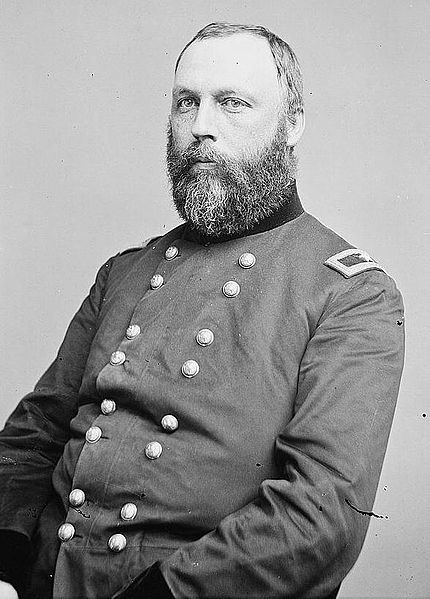
George Ripley had the best of intentions.

In 1841, the Transcendentalist social reformer and journalist founded the short-lived Massachusetts collective, Brook Farm. Established along with other progressives of his day, including Nathaniel Hawthorne, the communal space was to be a haven for workers who longed for industry, not toil. The profits would be shared fairly. But there were no profits, just debts. Brook Farm didn’t experience a moral collapse, but a financial one. The kinetic never was able to match the potential. Hawthorne got a a novel out of the experiment (The Blithedale Romance), but what did Ripley gain from this bitter failure apart from heartbreak? He said of the experience at its end in 1846: “I can now understand how a man would feel if he could attend his own funeral.”

But here’s the thing: Maybe Brook Farm wasn’t the unmitigated disaster it seemed at the time. Massachusetts today is the leader among American states in both education and health care. Ripley can’t claim responsibility for those developments, but perhaps he and other idealists help lay a foundation for the state’s magnanimity. Utopias can distort reality, yes, but they give us a goal in the distance.

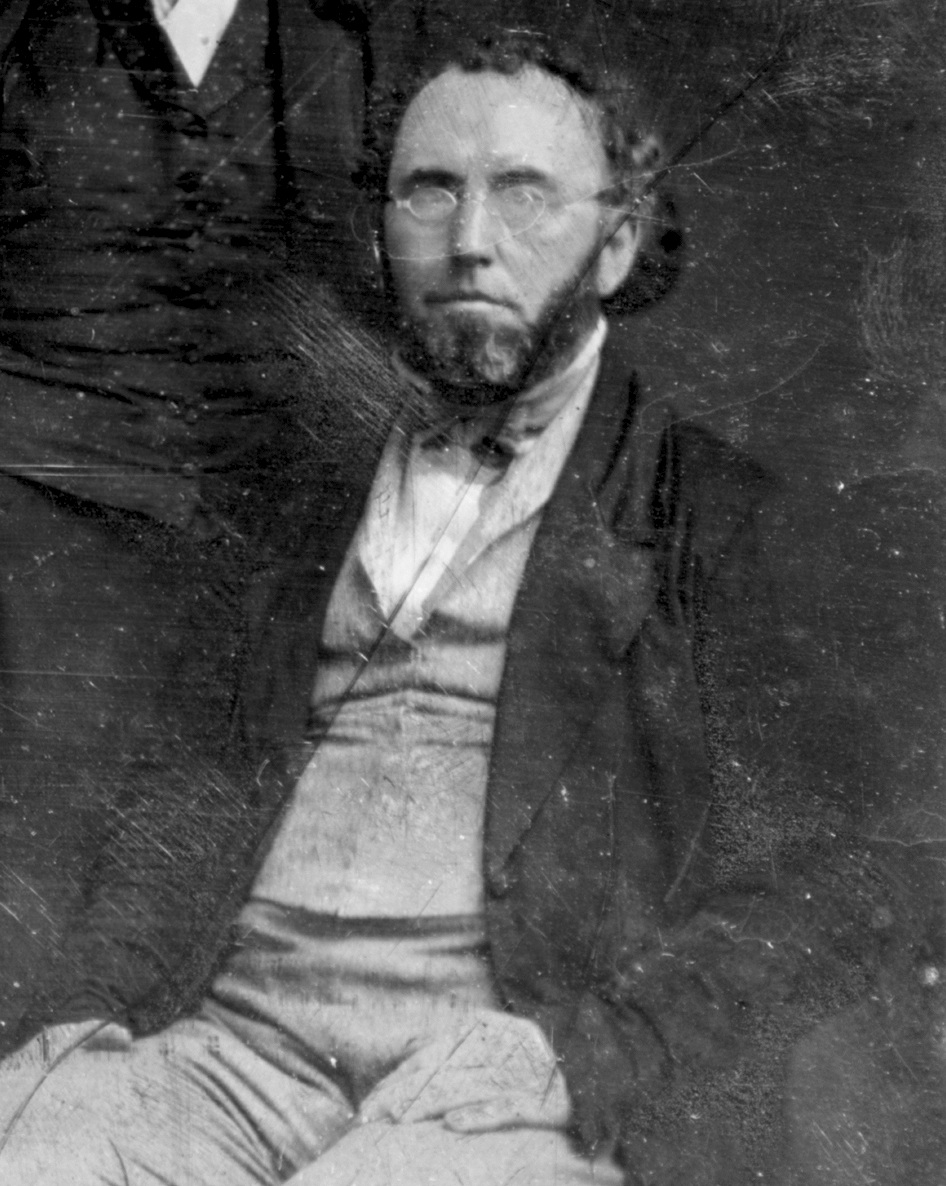
This classic photograph of Ripley, taken by Mathew Brady, is dated somewhere from 1849 to 1860. A brief article about the original promise of Brook Farm from the February 1, 1899 edition of the Brooklyn Daily Eagle:

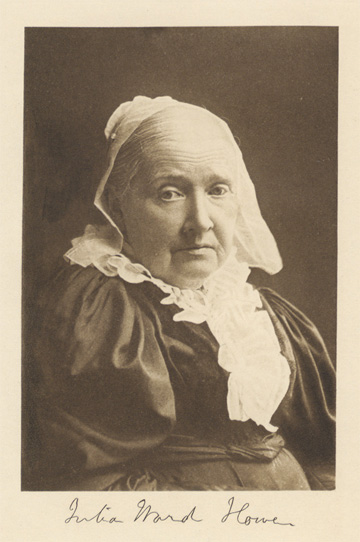
“‘The Brook Farm Experiment’ was the subject of a lecture given before the Long Island Historical Society last night. The lecturer was Mrs. Julia Ward Howe. The hall of the society, on Pierrepont and Clinton Streets, was so crowded that many stood in the aisles during the whole discourse.

“A tract of arable land was purchased, Mr. Ripley pledging his library for a part of the necessary payment.”

‘The story of what actually took place at Brook Farm,’ Mrs. Howe said, ‘is soon told. A tract of arable land was purchased, Mr. Ripley pledging his library for a part of the necessary payment. A dwelling house already on the premises was altered and enlarged, and other buildings of cheap construction were added from time to time, as the growth of the association made it necessary. Farming must have begun in 1841, as in 1842 Orestes Bronson writes of the community existing and flourishing. The work of the great family was carefully apportioned, Mr. Ripley taking upon himself some of the heaviest and least pleasant part of it, such as the daily cleaning of the stables. Justice was the ideal of the infant association. Within its domain, all labor was equally esteemed. Brain work should enjoy no preference over hand work, and the hand which guided the pen should be ready when so ordered to guide the plow. At times all the members of the community gathered to wash the dishes, and the male members did their full share. The first object in the administration was naturally the support of  life. Every effort was made to improve the land, which made but an ungrateful return for such labor. A practical farmer directed agricultural operations, much of what was produced was consumed on the premises, but milk and vegetables, excellent in their kind, were sent to the market. Mr. Ripley once mentioned to me a Boston conservative who used to say that he didn’t like Ripley’s ideas but he did like his peas.'”

Tags: , , ,

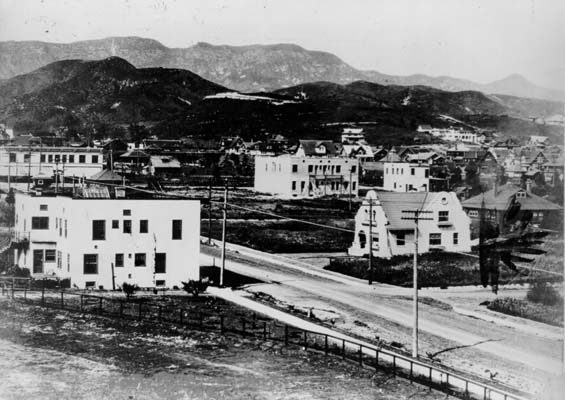
Hollywood and Highland, 1908.

Los Angeles isn’t a city–it’s a region. It has no center so it can’t be fixed or ruined. But different pieces of L.A. can become their own laboratories, experimenting, pushing forward. Hollywood, that glitzy, seamy dream factory, is being reimagined as a green, urban paradise in this age of post-peak oil, though not everyone’s happy about it. The opening of Adam Nagourney’s New York Times report:

“Hollywood, once a sketchy neighborhood in a spiral of petty crime and decay, has been well on its way over the past 10 years to becoming a bustling tourist destination and nightlife district. But now it is on the verge of another transformation: to a decidedly un-Californian urban enclave pierced by skyscrapers, clustered around public transportation and animated pedestrian street life.

A far-reaching rezoning plan that would turn parts of Hollywood into a mini-city — with residential and commercial towers rising on streets like Vine, Hollywood and Sunset — has won the support of key Los Angeles officials. And it has set off a storm of opposition from residents fearful that it would destroy the rakish small-town charm of their community with soaring anodyne buildings that block views of the Hollywood Hills (and its iconic sign) and overwhelm streets with traffic.”

••••••••••

“I’d like to dream / My troubles all away / On a bed of California stars”:

Tags:

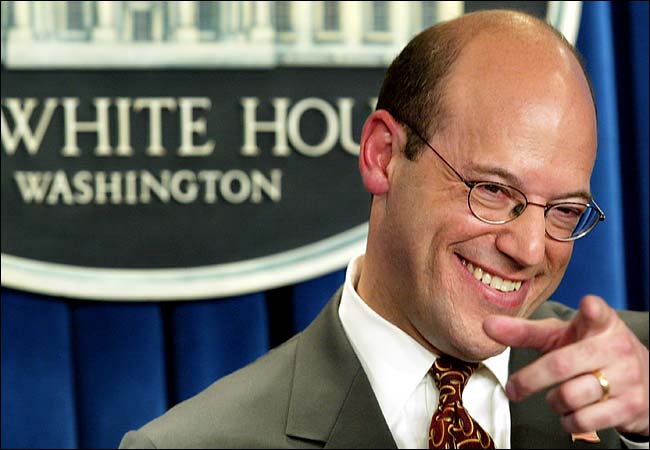
Ari Fleischer: Failing upwards.

What was most amusing about President Obama’s fiery speech labeling Paul Ryan’s budget as “radical” was the aftermath. Conservative pundits like Ari Fleischer had to sit in front of cameras with straight faces and pretend that the President had breached some sense of decorum, that the GOP was this above-the-fray body that has flawless deportment. But the lies aren’t very convincing. The Republican Party, perhaps more extremist than at any point in its history, has had members question the President’s birthplace, yell at him during the State of Union Address and label him a “socialist” and one who is complicit with our enemies.

Fleischer, who was part of one of the two or three most incompetent Administrations in U.S. history, continually contributes to the air of disrespect, though he’s too savvy to do it in such an obvious way. Listen to him whenever he refers to our 45th President and notice that he always refers to him as “Barack Obama” and never as “President Obama.” Never. It’s a Gingrich-ish method of disqualifying and demeaning his subject, smugly disallowing his status. If Fleischer is so concerned about good manners, he should can his feigned outrage, and improve his own.

Tags:

I don’t know how it is elsewhere, but in America we often choose to believe narratives rather than facts. That’s why union members vote for anti-union politicians and President Obama is referred to as a “socialist” after returning Wall Street to dizzying heights. Our delusional egos are often more important to us than even our self-interests, our fantasies dearer than our realities.

Below: The great George Carlin holds forth on advertising and other forms of deeply ingrained American bullshit.

Tags:

« Older entries § Newer entries »