Politics

You are currently browsing the archive for the Politics category.

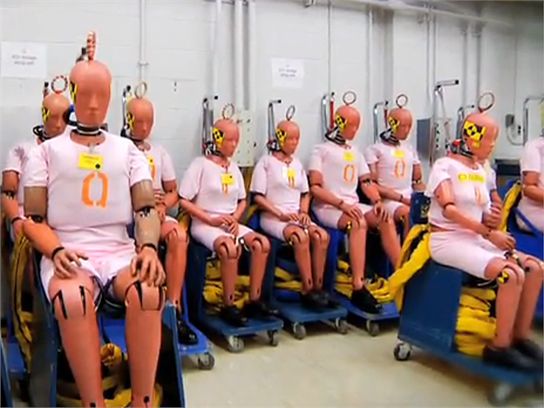
In “Taking the Driver Out of the Car” at the WSJ, Randal O’Toole champions the proliferation of robocars over the Obama Adminstration’s proposal for a new high-speed national rail system, believing driverless vehicles can reduce congestion immediately and greenhouses gases in the near future. An excerpt:

“Driverless vehicles offer huge advantages over current autos. Because computer reaction times are faster, driverless cars can safely operate more closely together, potentially tripling highway throughput. This will virtually eliminate congestion and reduce the need for new road construction.

Toyota’s recent recalls naturally lead to worries that computer glitches could cause serious accidents. Since each car will be independently controlled, a failure in one would simply lead others to avoid that car. Modern cars already have numerous built-in computers that do things, such as anti-lock braking, far more reliably than humans, even those who are not texting or inebriated. Any serious problems could be quickly corrected through wireless software upgrades.

Driverless cars and trucks will be safer. They will also be greener, first by significantly reducing congestion, and eventually because vehicles will be lighter in weight due to reduced collision risks.”

Tags:

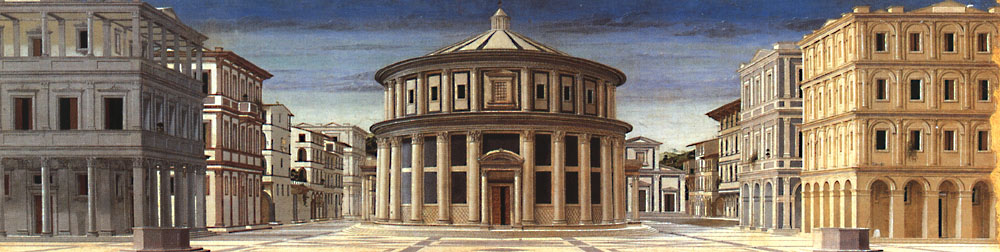
To H.G. Wells, Utopia wasn’t a perfectly pastoral or wholesome place, but one that was wise enough to separate the industrial and the green and adult entertainment from family fare. An excerpt from “A Modern Utopia,” 1905:

“But in Utopia there will be wide stretches of cheerless or unhealthy or toilsome or dangerous land with never a household; there will be regions of mining and smelting, black with the smoke of furnaces and gashed and desolated by mines, with a sort of weird inhospitable grandeur of industrial desolation, and the men will come thither and work for a spell and return to civilisation again, washing and changing their attire in the swift gliding train. And by way of compensation there will be beautiful regions of the earth specially set apart and favoured for children; in them the presence of children will remit taxation, while in other less wholesome places the presence of children will be taxed.”

Tags:

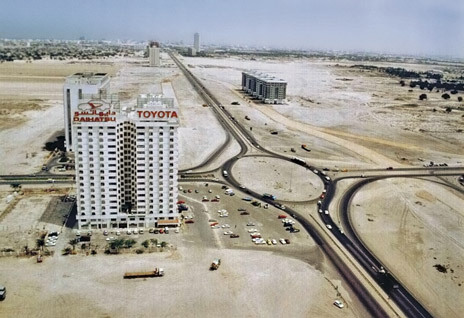
Dubai, 1993.

From “The New Mecca,” George Saunders 2005 GQ article about Dubai before the worldwide recession slowed down (somewhat) that next-level nation-state’s otherworldly development if not its outlandish dreams:

IN WHICH I FALL IN LOVE WITH A FAKE TOWN

From the air, Dubai looked something like Dallas circa 1985: a vast expanse of one- or two-story white boxes, punctuated by clusters of freakish skyscrapers. (An Indian kid shouted, “Dad, looks like a microchip!”) Driving in from the airport, you’re struck by the usual first-night-in-new-country exotica (“There’s a Harley-Davidson dealership—right in the Middle East!“), and the skyscraper clusters were, okay, odd looking (like four or five architects had staged a weird-off, with unlimited funds)—but all in all, it was, you know, a city. And I wondered what all the fuss was about.

Then I got to my hotel.

The Madinat Jumeirah is, near as I can figure, a superresort consisting of three, or possibly six, luxury sub-hotels and two, or maybe three, clusters of luxury villas, spread out over about forty acres, or for all I know it was twelve sub-hotels and nine luxury-villa clusters—I really couldn’t tell, so seamless and extravagant and confusing was all the luxury. The Madinat is themed to resemble an ancient Arabian village. But to say the Madinat is themed doesn’t begin to express the intensity and opulence and areal extent of the theming. The site is crisscrossed by 2.3 miles of fake creeks, trolled night and day by dozens of fake Arabian water taxis (abras) piloted by what I can only describe as fake Arabs because, though dressed like old-timey Arabs, they are actually young, smiling, sweet-hearted guys from Nepal or Kenya or the Philippines, who speak terrific English as they pilot the soundless electrical abras through this lush, created Arabia, looking for someone to take back to the lobby, or to the largest outdoor pool in the Middle East, or over to Trader Vic’s, which is also themed and looks something like a mysterious ancient Casbah inexplicably filled with beautiful contemporary people.

And so, though my first response to elaborate Theming is often irony (Who did this? And why? Look at that modern exit sign over that eighteenth-century bedstead. Haw!), what I found during my stay at the Madinat is that irony is actually my first response to tepid, lame Theming. In the belly of radical Theming, my first response was to want to stay forever, bring my family over, set up shop in my hut-evoking villa, and never go home again.

Because the truth is, it’s beautiful. The air is perfumed, you hear fountains, the tinkling of bells, distant chanted prayers, and when the (real) Arabian moon comes up, yellow and attenuated, over a (fake) Arabian wind tower, you feel you are a resident of some ancient city—or rather, some ancient city if you had dreamed the ancient city, and the ancient city had been purged of all disease, death, and corruption, and you were a Founder/Elder of that city, much beloved by your Citizens, the Staff.

Wandering around one night, a little lost, I came to the realization that verisimilitude and pleasure are not causally related. How is this ‘fake’? This is real flowing water, the date and palm trees are real, the smell of incense and rose water is real. The staggering effect of the immense scale of one particular crosswalk—which joins two hotels together and is, if you can imagine this, a four-story ornate crosswalk that looks like it should have 10,000 cheering Imperial Troops clustered under it and an enigmatic young Princess waving from one of its arabesquey windows—that effect is real. You feel it in your gut and your legs. It makes you feel happy and heroic and a little breathless, in love anew with the world and its possibilities. You have somehow entered the landscape of a dream, the Platonic realization of the idea of Ancient Village—but there are real smells here, and when, a little dazzled, you mutter to yourself (“This is like a freaking dream, I love it, I, wow…”), you don’t wake up, but instead a smiling Filipino kid comes up and asks if you’d like a drink.

On the flight over, I watched an interview with an employee of Jumeirah International, the company that manages the Madinat. Even though he saw it going up himself, he said, he feels it is an ancient place every time he enters and finds it hard to believe that, three years ago, it was all just sand.•
Tags:

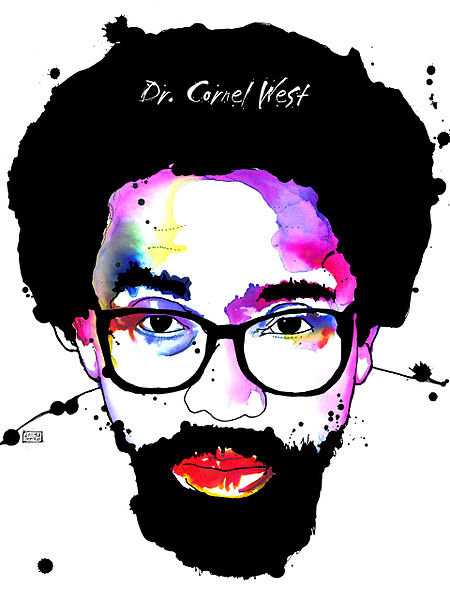
“I think at this point he’s obsessed with being on Mount Rushmore.” (Image by Lbertman.)

Cornell West is critical of President Obama in a new Financial Times interview, for a myriad of reasons. I think when all is done health-care reform, should it survive the Supreme Court, will have a monumental positive effect on wealth distribution and equity in this country. It will do more for Americans than all his critics combined have done. It’s like people dismiss the value of 30 million Americans suddenly having accessibility to health care as insignificant. An excerpt from the West piece:

“I ask him if he is hopeful that a second term for Obama will be more fruitful, once freed from the political tyranny of re-election to the White House. He is not optimistic. ‘I think at this point he’s obsessed with being on Mount Rushmore, he wants to be a great figure in the pantheon of American presidents.’ he says.

Obama, West believes, has not been willing to listen and evolve – he should have been listening to progressive economists such as Paul Krugman, Joseph Stiglitz and Sylvia Ann Hewlett – in the way that Abraham Lincoln listened and changed his views on slavery. ‘If you’re thinking about Mount Rushmore, you’re thinking about your legacy, your legacy, your legacy. Puh-lease.’

I suggest that part of the reason so many have been disappointed with Obama is that their expectations were unattainably high, and also because his supporters, especially liberals, projected their hopes on to him with little regard for his innate pragmatism. West admits this but says Obama is partly to blame. ‘When you mobilize the legacy of Martin [Luther] King and put a bust of Martin King in the Oval Office, people elevate their hopes. Martin King is not just every brother,’ he says. ‘It’s like a novelist being obsessed with Tolstoy or Proust and then he ends up writing short stories that can barely get into some middlebrow magazine. Hey, you got our hopes up man! I was expecting Proust or Tolstoy, instead it would barely get in Newsweek.‘”

Tags: ,

From “Secret Soviet Cities,” a BLDG BLOG post about covert Cold War burgs and the outré medical experiments that were conducted within their invisible walls:

“Just last week, Nature looked at Soviet-era experiments in these closed cities, where ‘nearly 250,000 animals were systematically irradiated’ as part of a larger medical effort ‘to understand how radiation damages tissues and causes diseases such as cancer.’ 

In an article that is otherwise more medical than it is urban or architectural, we nonetheless read of a mission to the formerly closed city of Ozersk in order to rescue this medical evidence from the urban ruins: ‘After a long flight, a three-hour drive and a lengthy security clearance, a small group of ageing scientists led the delegation to an abandoned house with a gaping roof and broken windows. Glass slides and laboratory notebooks lay strewn on the floors of some offices. But other, heated rooms held wooden cases stacked with slides and wax blocks in plastic bags.’ These slides and wax blocks ‘provide a resource that could not be recreated today,’ Nature suggests, ‘for both funding and ethical reasons.’ 

Perhaps it goes without saying, but the idea of medical researchers helicoptering into the ruins of a formerly secret city in order to locate medical samples of fatally irradiated mutant animals is a pretty incredible premise for a future film.”

From an interview at 3:A.M. with P.D. Smith, author of City: A Guidebook for the Urban Age, a passage about the way views of urban life have evolved:

3:AM: There is a certain, largely religious, strand of thought that connects cities with evil, and the pastoral or rural with innocence and morality. One can see it now in the idea of middle America, opposed to the coastal cities, and one can also see it in Victorian proponents of city reform. Why do you think this strand of thought exists, and how does it affect cities?

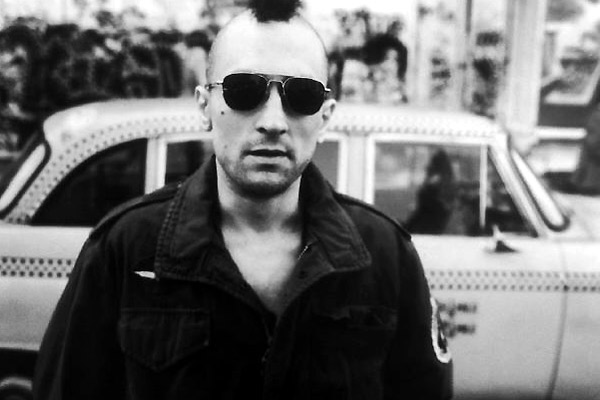
P.D. Smith: The idea of the ‘sin city’, of Sodom and Gomorrah, is certainly a strand in Judeo-Christian thought. It’s interesting to note that the first city builders in Mesopotamia did not long for some lost Garden of Eden, a bucolic Golden Age. Instead they believed their gods gave them the city. It was their home and where they were meant to be. But, yes, Augustine condemned the City of Man and directed people’s gaze towards the City of God. These ideas have been very influential. In the US, long before gangsta rap the city was associated with crime, violence and moral corruption. The city, with all its attendant social problems, was seen as a reminder of the Old World. The New World was meant to be a land of opportunity, of wilderness and far horizons, not Dickensian slums and urban crime. These ideas feed a deep distrust of cities in America. It surfaces in Martin Scorsese’s Taxi Driver, where Travis Bickle condemns New York’s crime: ‘This city here is like an open sewer, you know, it’s full of filth and scum.’ It’s a rich subject both in the US and in Britain. In fact, it’s something I would like to explore in another book.”

••••••••••

“Whores, skunk pussies, buggers, queens, fairies, dopers, junkies, sick, venal”:

Tags:

Urban planner Rahul Mehrotra, in a New York Times conversation with Neha Thirani, talking about gated communities, a dark side of the development in India that’s being fueled by global capital:

“At the micro level our biggest concern is going to be that of the immense polarization that is occurring in our built environment. The between what we call slums or the informal city and large-scale infrastructure and global architecture is going to set up enormous social tensions in our society. Global capital is landing in our cities and bullying its way physically to create a presence and a polarization which will be hard to reverse and resolve as we go on unless we address this issue very quickly.

What results from that polarization are conditions like gated communities, whether they are vertical gated communities or communities at the edge of the city. Because gated communities usually have their own water supply, sewage disposition, they are actually parasitic on the city because they don’t give to the city. They exclude the city but engage with the city on their own terms, and so it’s not a two way kind of exchange.”

Tags: ,

The opening of a 1994 New Scientist interview with well-compensated prognosticator Alvin Toffler, still best known for his incredibly popular 1970 book, Future Shock:

What led you to write Future Shock? While covering Congress, it occurred to us that big technological and social changes were occurring in the United States, but that the political system seemed totally blind to their existence. Between 1955 and 1960, the birth control pill was introduced, television became universalized [sic], commercial jet travel came into being and a whole raft of other technological events occurred. Having spent several years watching the political process, we came away feeling that 99 per cent of what politicians do is keep systems running that were laid in place by previous generations of politicians.

Our ideas came together in 1965 in an article called ‘The future as a way of life,’ which argued that change was going to accelerate and that the speed of change could induce disorientation in lots of people. We coined the phrase ‘future shock’ as an analogy to the concept of culture shock. With future shock you stay in one place but your own culture changes so rapidly that it has the same disorienting effect as going to another culture.

Were you surprised by the reaction to the book? I think that it touched a nerve. Remember we were coming out of the Sixties, countries were being torn apart, change was almost out of control for a period. It touched a nerve, it gave a language, it introduced a metaphor that people could use to describe their own experience.

Looking back to 1970 when the book came out, how would you have done it differently? The great weakness was the book wasn’t radical enough, although everybody said it was a very radical book. The reason for that is that we introduced the concept of the general crisis of industrialism. Marx had talked about the general crisis of capitalism and the argument of the left was always that capitalism would collapse upon itself and socialism would triumph. We argued that both capitalism and socialism would collapse eventually because both were the offspring of industrial civilization, and that we were on the edge of a new way of life, a new civilization. Had we understood more deeply the consequences of that idea we would not have accepted as naively as we did the forecasts of the economists. If you think that economists are arrogant now, in the Sixties they were really riding high. They claimed we would never have another recession, and the reason was that we understand how the economy works, and ‘all we have to do is fine-tune it” as one economist told us. We were young and naive and we bought that notion. We should have anticipated that the revolution we were talking about would have hit the economy in a much deeper way.”

See also:

Tags:

It was funny when Barbara Walters recently dissed the political opinions of Megan McCain: “Oh, who cares what Meghan McCain says, forgive me. I’m sorry.” The young McCain has done nothing in particular to earn her position as a pundit. But I’ll answer Barbara with a question:

Who cares what the bikini woman from Survivor thinks about politics? Forgive me, I’m sorry, but you’re responsible for that one.

Tags: ,

The Russian city of Berezniki was built atop an undergound mine during the dark days of Soviet-era madness, so it’s constantly prone to rapidly forming sinkholes capable of swallowing people or buildings whole. In order to safeguard the more than 150,000 residents, scientists constantly monitor the situation with a dizzying array of surveillance cameras. But even that may not be enough to save the burg. From Andrew E. Kramer in the New York Times:

“Mining engineers first tried to maintain the supports by pumping in saltwater, intending to raise the salinity of the floodwater to the saturation point before the structure collapsed, but that did not work.

After that, the local government adopted the policy in effect today, of careful observation and early warning: geologists, surveyors and emergency personnel use a panoply of high-technology monitors. These include the video surveillance system, seismic sensors, regular surveys and satellite monitoring of the changes in altitude of roofs, sidewalks and streets.

‘We will fight the holes with science,’ the mayor, Sergei P. Dyakov, said in an interview. The city will not need to relocate, he said, because engineers believe that no new holes will open. Much of the mine was filled before the flood, he said, and the sinkholes occurred in an anomalous area that had not been filled in.

But federal officials and company executives are debating whether to relocate the entire city to the opposite bank of the Kama River, where the bedrock is solid.”

Tags: ,

Privately owned and operated prisons are such a horrible idea for America because they incentivize the perpetuation of the cycle of crime. Why would a corporate facility ever want to have their cells empty? It’s more than harvesting organs: It’s the harvesting of whole bodies and souls. The government should run all our penitentiaries, it should be a burden on us all if they are really full, and we should work to change that dynamic. The opening of “Louisiana Is the World’s Prison Capital,” Cindy Chang’s excellent and heartbreaking New Orleans Times-Picayune piece:

Louisiana is the world’s prison capital. The state imprisons more of its people, per head, than any of its U.S. counterparts. First among Americans means first in the world. Louisiana’s incarceration rate is nearly triple Iran’s, seven times China’s and 10 times Germany’s.

The hidden engine behind the state’s well-oiled prison machine is cold, hard cash. A majority of Louisiana inmates are housed in for-profit facilities, which must be supplied with a constant influx of human beings or a $182 million industry will go bankrupt.Several homegrown private prison companies command a slice of the market. But in a uniquely Louisiana twist, most prison entrepreneurs are rural sheriffs, who hold tremendous sway in remote parishes like Madison, Avoyelles, East Carroll and Concordia. A good portion of Louisiana law enforcement is financed with dollars legally skimmed off the top of prison operations.

If the inmate count dips, sheriffs bleed money. Their constituents lose jobs. The prison lobby ensures this does not happen by thwarting nearly every reform that could result in fewer people behind bars.” (Thanks Browser.)

Tags:

Slavoj Žižek, genius and fool, using questionable geological evidence to make a case for humans embracing technology over nature.

Tags:

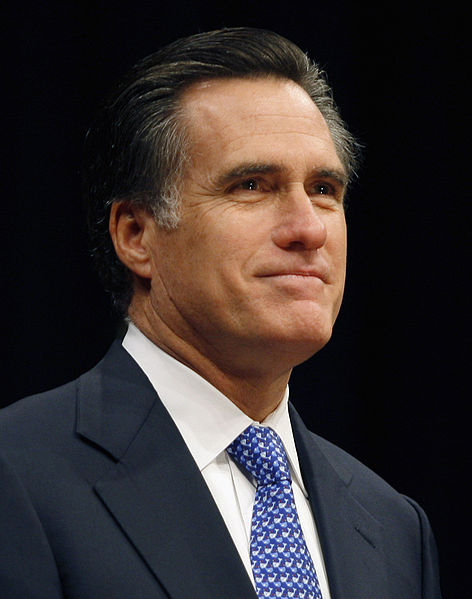
Mitt Romney: Because towel-snapping just wasn't erotic enough. (Image by Jessica Rinaldi.)

It was reported last week that when Mitt Romney was eighteen (or close to it) he arranged the gang humiliation of a fellow student. The boy had longish blond hair and appeared to perhaps be gay. So Mitt Romney got some friends together and they pinned this boy down on the ground and cut his hair against his will. A lot of media people are dismissing the act, as if this square-headed robot from the 1950s pushed someone when he was 12 or called someone a bad name. HE COMMITTED A HATE CRIME! It was a criminal assault. You know those well-intentioned but misguided “It Gets Better” ads? The ones aimed at gay kids, promising them that eventually other people will stop punching them, instead of, say, being aimed at parents who are raising vicious creeps? Mitt Romney is the unseen thug in those ads beating up the kids for being different. Mitt Romney is very lucky he didn’t attack someone in a similar fashion today in Florida. They have this Stand Your Ground law which allows those being attacked to defend themselves with firearms. People in Florida are shot for doing much less than 18-year-old Romney did. Some of them are shot for no reason at all.

I’m sure other people who’ve became President committed hate crimes in their youths. Perhaps Millard Fillmore strangled a tranny prostitute for giving him tuberculosis. But at least we didn’t know about those histories. We know for sure that Mitt Romney, who could become our President, is a huge, bullying asshole.

But why should Mitt Romney’s hate crimes be limited to his youth? Here are some other ones he can commit now:

Murder the Entire City of Detroit: Oh wait, he already did that.

Converting a Guy to a Religion Against His Will: Oh wait, he already did that.

Not Giving a Crap About Very Poor People: Oh wait, he already did that.

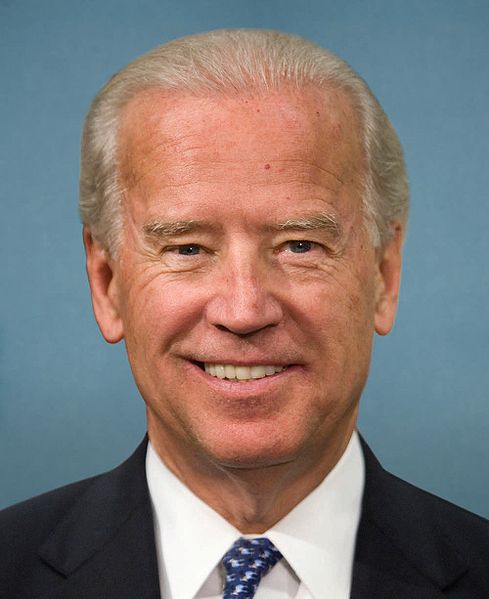
Vice President Joe Biden: Accidentally outed an entire nation.

 • • • • • • • • • •

Other posts labeled “Humor” that seemed funny at the time:

  • Lady Gaga urinates on home plate at Yankee Stadium.

Tags: ,

Noam Chomsky and Michel Foucault have a bull session on Dutch TV in 1971.

Tags: ,

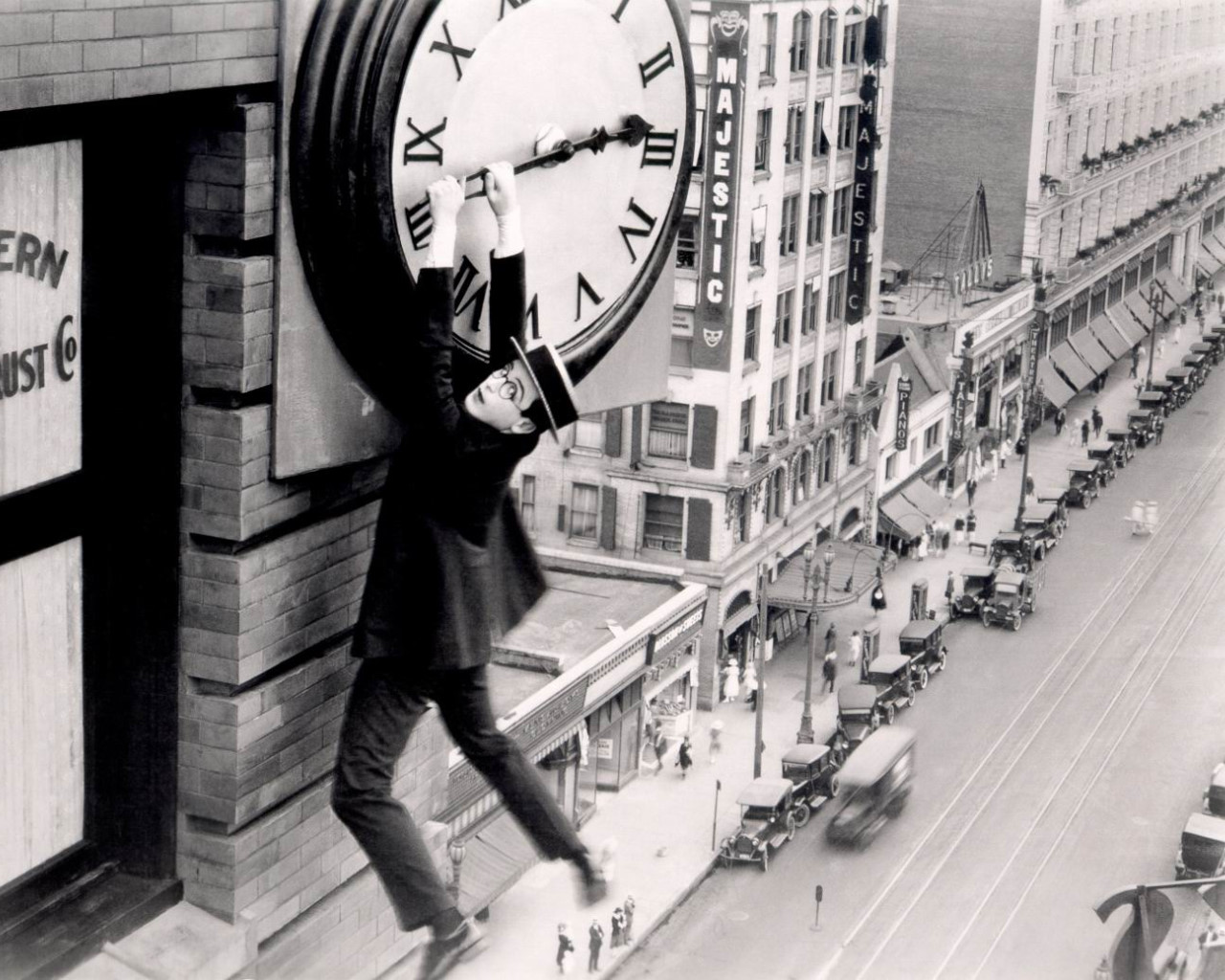
From Evgeny Morozov on the Browser, a passage about Lewis Mumford’s feelings about technology, especially the invention of clocks:

“Technology became something of a subject, I guess, in the late 1860s/70s but it only really emerged as a field for academic study in the late 1930s. The most influential early book aimed at a popular audience was Technics and Civilization by Lewis Mumford, published in 1934. It touched the worlds of history and economics and, to an extent, political philosophy. Mumford tried to look back as far as he could and study how human societies incorporated various technologies, but also how they made choices about which technologies to take on, how to regulate them, and how those decisions ended up shaping societies themselves.

The most famous example he evoked was the invention and wide acceptance of the clock. Mumford thought that the clock was one of the technologies that allowed capitalism to emerge because it provided for synchronisation and for people to cooperate. But I think this was also one of the first texts that critically engaged with the potentially negative side effects of technology. Mumford actually looked at how some technologies were authoritarian – that was his term – how some led to centralisation and establishment of control over human subjects and how some of them were driven by a completely different ethos.

Tags: ,

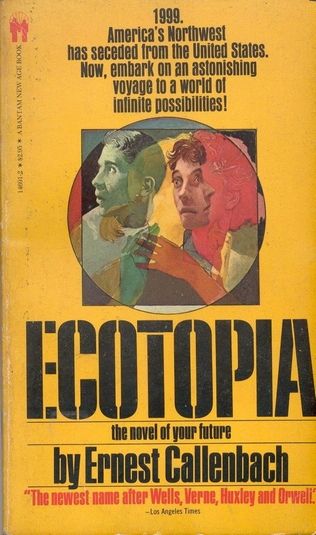
Mark Bittman at the New York Times mentions Ernest Callenbach’s 1975 futuristic novel, Ecotopia, in his most recent column. Callenbach, who also founded Film Quarterly, recently passed away. The book fantasizes that Northern California, Washington and Oregon secede to create a green paradise in which fossil fuels are banned. I’ve always meant to read it but never have. I must correct this. From a TomDispatch post about the late writer:

Callenbach once called that book ‘my bet with the future,’ and in publishing terms it would prove a pure winner. To date it has sold nearly a million copies and been translated into many languages. On second look, it proved to be a book not only ahead of its time but (sadly) of ours as well. For me, it was a unique rereading experience, in part because every page of that original edition came off in my hands as I turned it. How appropriate to finish Ecotopia with a loose-leaf pile of paper in a New York City where paper can now be recycled and so returned to the elements.

Callenbach would have appreciated that. After all, his novel, about how Washington, Oregon, and Northern California seceded from the union in 1979 in the midst of a terrible economic crisis, creating an environmentally sound, stable-state, eco-sustainable country, hasn’t stumbled at all. It’s we who have stumbled.  His vision of a land that banned the internal combustion engine and the car culture that went with it, turned in oil for solar power (and other inventive forms of alternative energy), recycled everything, grew its food locally and cleanly, and in the process created clean skies, rivers, and forests (as well as a host of new relationships, political, social, and sexual) remains amazingly lively, and somehow almost imaginable — an approximation, that is, of the country we don’t have but should or even could have.

Callenbach’s imagination was prodigious. Back in 1975, he conjured up something like C-SPAN and something like the cell phone, among many ingenious inventions on the page. Ecotopia remains a thoroughly winning book and a remarkable feat of the imagination, even if, in the present American context, the author also dreamed of certain things that do now seem painfully utopian, like a society with relative income equality.”

••••••••••

Callenbach discussing Ecotopia in 1982:

Tags: ,

It started, for the most part, during the 1980s. Americans of modest means were encouraged to relate to the wealthy and powerful, ignoring their own circumstances. Don’t vote for people who have your interests at heart because your interests will soon change. You are a hardworking person and in America, a meritocracy, people like that will join the elite. Vote for the future you think you will have, not the present your are enduring. Union members needn’t support candidates who are pro-union. Seniors can support those who would decimate social security. Do not tax the rich because you’ll soon be rich.

Of course, the math doesn’t add up. No matter how much of a meritocracy we are, not every person who works hard will become incredibly successful. A good deal of luck goes into these things as well. And voting so often for our fantasies instead of our realities has only made things more difficult for the great majority.

It was no surprise that former Lifestyles of the Rich & Famous host Robin Leach recently called President Obama a “socialist.” But Leach tripped himself up on one point while doing so. He said that he came to America in the 1960s hoping to become wildly successful and wants those opportunities for others, not mentioning how much tax policy and the corporate role in government has changed since then. As far as race and gender, the 1960s was a less fair time, but we weren’t then a country that based monetary policy on what was best for the super-rich. If anyone proposed that we return to the policies of the 1960s, Leach would call them socialists as well.•

Tags:

The free market can be corrupted, but all-out socialism would be a horrible remedy to that. Almost as bad would be not repairing our increasingly rigged form of capitalism. The opening of Robert Reich’s blog post, “The Answer Isn’t Socialism,” written in the wake of France moving leftward:

“Francois Hollande’s victory doesn’t and shouldn’t mean a movement toward socialism in Europe or elsewhere. Socialism isn’t the answer to the basic problem haunting all rich nations. 

The answer is to reform capitalism. The world’s productivity revolution is outpacing the political will of rich societies to fairly distribute its benefits. The result is widening inequality coupled with slow growth and stubbornly high unemployment.

In the United States, almost all the gains from productivity growth have been going to the top 1 percent, and the percent of the working-age population with jobs is now lower than it’s been in more than thirty years (before the vast majority of women moved into paid work).” (Thanks Browser.)

••••••••••

“Oh Karl the world isn’t fair / It isn’t and never will be / They tried out your plan / It brought misery instead / If you’d seen how they worked it / you’d be glad you were dead.” (Thanks LRR.)

Tags: , , ,

In the wake of Christopher Hitchens’ death, I put up a post about his prose broadside against Mother Teresa. Here is the 1994 film analog.

Tags: ,

I’ve noticed a few articles in the last week about DARPA planning to implant microchips in soldiers, which reminded me that I had read something about the topic in Wired a couple years ago. From that Katie Drummond piece:

“Editing DNA could have widespread implications, but Darpa seems most interested in two: microchip implants that restore senses and movement in traumatic injury patients, and the ongoing Darpa goal of boosting troop performance in the field: On the other end of the size scale, a primary goal is to apply microsystem techniques to soldier-protective biomedical systems. One example is an in-canal hearing protection device that will provide enhanced hearing capabilities in some settings, but be able to instantly muffle loud sounds of weapons fire. This one example will improve inter-personnel communications and at the same time drastically reduce the incidence of hearing loss in combat situations. For these examples and many more, the goal is to bring exceptionally potent technical approaches to bear on biological and biomedical applications where their capabilities will be significant force multipliers for the DoD.”

Tags:

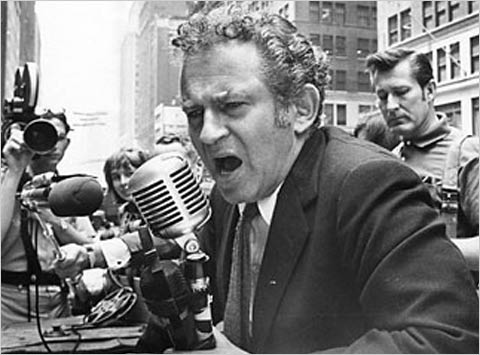
At the BBC, Adam Curtis has posted “White Negro for Mayor,” which examines the subtext of Norman Mailer’s failed 1969 mayoral campaign in New York. Included in Curtis’ post is a really good documentary about Mailer as politician. An excerpt:

“But Mailer was a complicated man – and as well as embodying many of the hipster values he was also a perceptive and vocal critic of the new sensibility. Back in 1957 he had written an essay for Dissent magazine called ‘The White Negro.’ In it he had described how fears of nuclear annihilation had begun to produce a new kind of young alienated being in America. These hyper-individualists trusted only their own feelings and desires and refused to be part of any group or organisation. And in black culture, Mailer said, they found their identity – the culture of the dangerous outsider.

This outsider culture had originally been created, Mailer wrote, by blacks in response to racial oppression and violence. But for the ‘white negroes’ that culture was then co-opted in order to give a meaning and grandeur to their psychopathic narcissism.

Tags: ,

Adam Davidson of the New York Times Magazine sat down with former Bain Capital managing director and Romney supporter Edward Conard for an open discussion about how the latter believes the 1% getting richer is better for all Americans. Conard seems to be living in a delusional bubble, but it’s a fascinating article. An excerpt:

“Nearly every economist I spoke with said that Conard has too much faith in the market’s ability to reward only those who create real value. Conard, for instance, insists that even the dodgiest financial products must have been beneficial or else nobody would have bought them in the first place. If a Wall Street trader or a corporate chief executive is filthy rich, Conard says that the merciless process of economic selection has assured that they have somehow benefited society. Even pro-market Romney supporters take issue with this. ‘Ed ought to be more concerned about crony capitalism,’ Hubbard told me.

Unintended Consequences ignores some of the most important economic work of the past few decades, about how power and politics influence economic growth. In technical language, this field is the study of ‘rent seeking,’ in which people or companies get rich because of their power, not because of their ideas. This is one of the few fields in economics in which left and right share many influences and ideas — namely that wealthy individuals and corporations are able to influence politicians and regulators to make seemingly insignificant changes to regulations that benefit themselves. In other words, to rig the game. One classic example is banking. Banks have enormous resources to constantly put explicit or subtle pressure on lawmakers and regulators so that regulation can eventually serve their interests.

Conard’s version of the financial crisis ignores much reporting and analysis — including work I’ve done with NPR’s Planet Money team — that shows that some of the nation’s largest banks actively manipulated customers and regulators and, sometimes, their own stockholders to profit from dangerous risk. And for many economists, rising inequality can create exactly the wrong outcomes for society over all. Rather than simply serving as an invitation for everybody to engage in potentially beneficial risk-taking, inequality can allow those with wealth to crush new ideas.”

Tags: ,

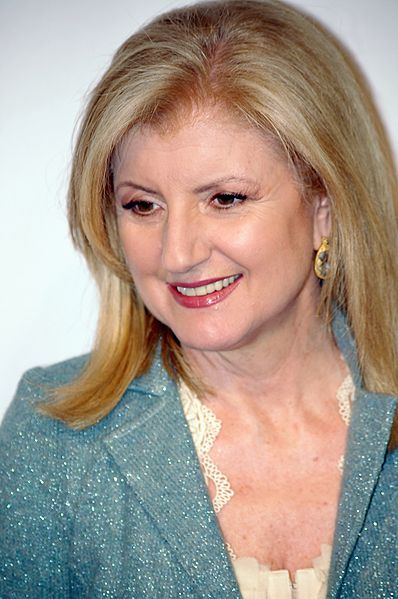
"The Huffington Post": A few good journalists, many posts about tits. (Image by David Shankbone.)

In regards to my post yesterday that criticized Arianna Huffington calling President Obama’s campaign ad about the killing of bin Laden “despicable”: You can always tell when someone has a weak argument when they create a straw man to defeat. From Huffington:

“There are many legitimate and important policy differences between Governor Romney and President Obama — but the depth of Mitt Romney’s patriotism is not one of them.”

What nonsense. The ad in no way questions Mitt Romney’s patriotism, just his judgement. And that question is valid considering the Governor’s 2007 comments on the matter. If you can’t defeat the truth, stack the deck and defeat a fiction.

Tags: , ,

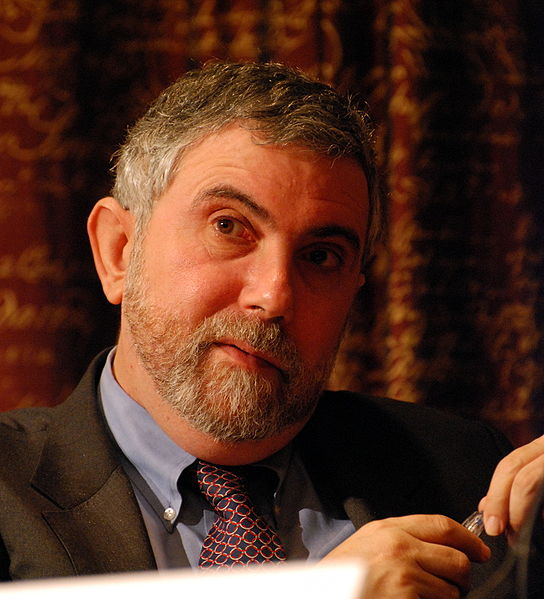
Full, but not unruly. (Image by Prolineserver.)

Two questions from the excellent Ask Me Anything that Paul Krugman just did on Reddit, one about the cause of American income disparity and one about his fabulous beard:

[–]Ashoat 382 points  ago

I want to ask about your perspective on increasing wealth and income disparities. There a couple camps on this issue, and it seems that mainstream economists haven’t yet formed a consensus on the cause for this.

Greg Mankiw and others seem to believe that the main cause of increasing income and wealth inequality is a changing labor market that rewards and values high-skilled laborers more and more. Consequently, he argues that attempts at addressing income inequality issues should be heavily based on education reform.

On the other hand, you’ve made the point that a lot of the increases in income and wealth inequality come from shifting fiscal policies and government regulation. You seem to argue that decreased taxes on the rich and more lenient policies in regards to financial industry have resulted in an economy that unduly favors certain individuals. Sorry if I’m putting words in your mouth!

I have the following two questions:

  • Do you think any of the increased disparity has resulted from the shifting labor market?
  • Do you think it makes sense to focus efforts on improving higher education and increasing access to it?

[–]nytimeskrugman[S] 573 points  ago

Well, if you look at the Congressional Budget Office report from last fall, it shows that about half the rise in income inequality is accounted for by the divergence of the 1 percent from everyone else. That part is NOT about education and returns to skills — the next 19 have about as much education as the top 1, or if you prefer, hedge fund managers and high school teachers have roughly comparable education levels. So something else is driving at least half the rise in inequality, and probably more.

That doesn’t mean that market forces play no role, but it says that it’s nowhere close to the whole story, or even most of it — a point that people like Mankiw refuse to acknowledge.

By all means let’s expand access to higher education — but I’d say that the biggest reason to do that it is not so much to reverse inequality as to stop the ongoing decline in social mobility. Horatio Alger has left the building; it’s getting ever harder for Americans born into the lower half of the income distribution to move up. And more aid for college would help make climbing the ladder easier.

[–]lifeofquill 114 points  ago

How do you maintain such a lovely beard?

[–]nytimeskrugman[S] 140 points  ago

Shave around it every day, and get your wife to clip it fairly often.”

Tags:

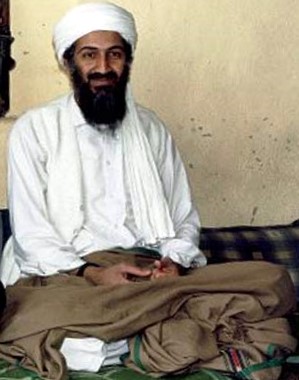
Swims with the fishes.

•In regards Obama questioning whether Mitt Romney would have made the call to enter Pakistan and kill Osama bin Laden, it’s based on factual statements that Romney made which were not taken out of context.

•We need to stop acting like the murder of bin Laden was a sacred event. It was a political and military decision to eliminate a mass murderer. Save the sacred feelings for the victims of 9/11.

•If the decision had gone badly, it would have been politicized to the hilt by the GOP, including Romney. The Democrats would have been branded weak on defense as they have been for more than 40 years.

•It’s not like the GOP didn’t do its own–and very undeserved–victory lap over bin Laden’s killing. Members of the Bush Administration (Cheney, Rumsfeld, Rice) came out of the woodwork to try to claim credit.

•You could argue that Obama is hanging his “Mission Accomplished” banner with the ad, except that the mission actually was accomplished. Maybe it seems boastful, but it is accurate.

•It’s hilarious that draft-dodging members of a party that Swiftboated an Army veteran like John Kerry are now crying foul over being called out on being less forceful on military matters.

•If Arianna Huffington wants to better understand the definition of “despicable,” she should recall how she allowed Jenny McCarthy to use the Huffington Post as a platform to repeatedly frighten parents about immunizing their children. And even after it was proven that those charges were linked to junk science, there was still no retraction or apology. Now that’s despicable.•

Tags: , , , , , , ,

« Older entries § Newer entries »