Politics

You are currently browsing the archive for the Politics category.

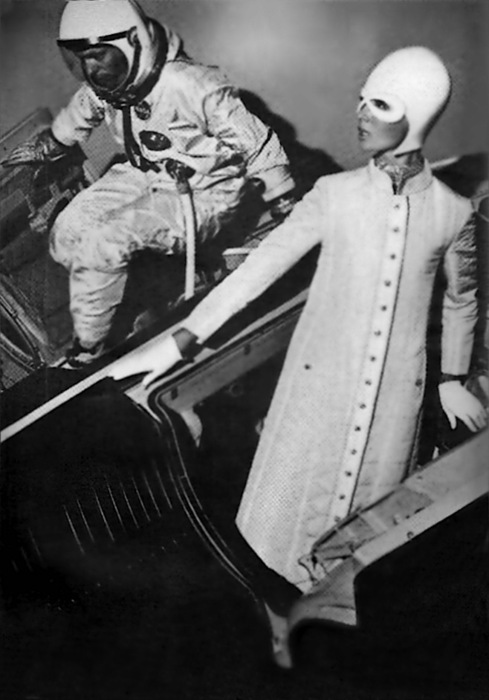
Gordon Moore didn’t publish his Law until 1965, so you can forgive U.S. space research bigwig J. Gordon Baethe for underestimating how quickly we would take ourselves from atmosphere to stratosphere, when he was interviewed in 1954 on Longines Chronoscope. As usual, that Nazi Wernher von Braun was the more accurate prognosticator.

Tags: ,

From Timothy Noah’s new Browser interview, in which the journalist speaks to America’s growing income disparity:

“If you compare consumption today to consumption 60 years ago there are differences. What you will find, broadly speaking, is that the big things are more expensive and the little things are less expensive. Cars are more expensive – they may be safer but they’re more expensive. Houses are more expensive – they’re bigger but they’re more expensive. Healthcare is more expensive – more people’s diseases are cured but it’s more expensive. College education is more expensive – and I don’t think you can make the case that college education is improved in any way compared to 50 or 60 years ago. My guess is that, if anything, it’s probably a little bit worse over the last half century. So those big things are harder to obtain.

The little things – electronics, food and clothing – are easier to obtain. The only one of those items that you have to get on a regular basis is food. And yes, clothing is less expensive. So are TVs. But you probably buy these less frequently, so they’re less meaningful. Meanwhile you have these gigantic expenses for things that are really vital. Healthcare keeps you alive. College education makes it possible for you to achieve upward mobility. An automobile in many parts of the country is a necessity to get you to your job.”

Tags:

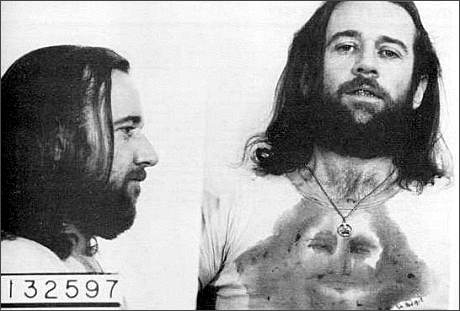
George Carlin, in one of his most famous bits, decrying the “soft language” that proliferated in America in the second half of last century, as advertising execs and marketing gurus infiltrated every aspect of life, from corporations to politics to the military.

Tags:

America should have announced in January 1970, in the wake of our successful moon voyage, that we were visiting Mars in 1986, when that planet and ours were going to be in relatively close orbit. Just imagine how much further our science would have progressed if we had stayed on course. But failure of vision isn’t the only reason why our Space Age fantasies haven’t come to fruition. The opening of David Graeber’s Baffler essay, “Of Flying Cars and the Declining Rate of Profit“:

“A secret question hovers over us, a sense of disappointment, a broken promise we were given as children about what our adult world was supposed to be like. I am referring not to the standard false promises that children are always given (about how the world is fair, or how those who work hard shall be rewarded), but to a particular generational promise—given to those who were children in the fifties, sixties, seventies, or eighties—one that was never quite articulated as a promise but rather as a set of assumptions about what our adult world would be like. And since it was never quite promised, now that it has failed to come true, we’re left confused: indignant, but at the same time, embarrassed at our own indignation, ashamed we were ever so silly to believe our elders to begin with.

Where, in short, are the flying cars? Where are the force fields, tractor beams, teleportation pods, antigravity sleds, tricorders, immortality drugs, colonies on Mars, and all the other technological wonders any child growing up in the mid-to-late twentieth century assumed would exist by now? Even those inventions that seemed ready to emerge—like cloning or cryogenics—ended up betraying their lofty promises. What happened to them?

We are well informed of the wonders of computers, as if this is some sort of unanticipated compensation, but, in fact, we haven’t moved even computing to the point of progress that people in the fifties expected we’d have reached by now.”

Tags:

I’m always disconcerted when I read Nielsen breakdowns of the viewing habits of white and black Americans, and see how little crossover there is, though, of course, I understand the reasons. It reminds that something can seem incredibly brilliant to a certain group of people but not to another because the social context and experience we bring to a work of art is often as important as the art itself. From “The Very White Poetry of Mad Men” at Capital from my excellent old pal Steven Boone:

“It would be interesting to see what Quentin Tarantino, a product of multi-ethnic working class neighborhoods in L.A., would do behind the camera on a Mad Men episode. His punk history lessonInglourious Basterds revels in ‘mistakes’ (starting with the title) and the perseverance of life’s D-students in a world of letter-perfect sociopaths-in-power. What mischief, what banana peels would Q.T. set in Don Draper’s path?

What approach would we see from filmmaker Robert Downey, Sr., who actually worked in the real-life New York ad agency milieu in the 1960s, funneling these experiences into the anarchic Putney Swope (1969)? In Swope, militant blacks take over a swank agency, a one-joke premise crawling with cobwebs by now, sure, but one which still packs a punch in the stubbornly segregated Bloomberg-era Manhattan.

Mad Men, which so far has given a few lines to a black maid, a black girlfriend and, in the latest season, a black secretary, actually does resonate in that way: In any of the ‘good jobs’ I held in Manhattan across 20 years, I was either the sole black person or one of two black people in the office. A smattering of Asians or Hispanics completed the rainbow.

But that may also be the reason I had such a hard time finding black professionals to talk to who watch Mad Men.

One black computer programmer who requested anonymity was candid about why he doesn’t: ‘Mad Men isn’t for me…. I don’t know any black people who watch the show. I know they’re out there, but I’ve never met any of them.’

The programmer was quick to add that it’s not because of the low melanin content, but because it’s too familiar.

‘It’s not necessary for me to need a black or minority character to enjoy a movie or show, but Mad Men is just so appropriately shiny and false,’ he said. ‘It reminded me a lot of dealing with the sales people I’ve dealt with over the years as a software developer. I’ve worked in offices for 25 years now, and I’ve been the only Negro in my different office departments more years than I’ll admit. It’s that way right now, in fact.

‘Programmers don’t come in our shade unless they’re from India. Until the 2000’s, I didn’t see many minorities of any stripe in high positions at places I worked. So for me, I’ve spent my entire career watching white office folks bicker, fight, backstab, love, hate, succeed and fail, all the while doing little to involve somebody like me. So why the fuck would I want to watch this on TV?'”

••••••••••

Faux ad from Putney Swope, 1969: “It started last weekend / At the Yale-Howard game.”

Read also:

Tags:

I can’t find it now, but I read a study at one point about the diminishing returns of high-payroll baseball teams that decided to spend even more money. It was a convincing case that past a certain point, you were going to get very little bang for your buck, that you wouldn’t really see any more wins for that final splurge or two. I wonder, if this is true, if it applies to politics as well. I know the DNC fears that Mitt Romney will have more money to spend than President Obama (and he most certainly will), but since they’ll both be running “high-payroll teams,” since they’ll both be funded very well, will this disparity really be the difference? It’s not like one will be outspending the other 2 to 1 let alone 10 to 1. I suppose a quarter or a half of a percent can be a big deal in a close election, but I’m curious if everyone is really just fretting about what amounts to overkill.•

Tags: ,

"Just 44 percent of Americans approve of the job the Supreme Court is doing." (Image by Stephen Masker.)

When I was a kid, the Supreme Court was held up to children as an example of high-mindedness at its best. I put up a post recently about the extreme drift we’ve seen in the way the country perceives the Court. And while the diminished view didn’t begin with the Roberts Court, the current iteration has experienced a dramatic cratering in standing. From the New York Times:

“Just 44 percent of Americans approve of the job the Supreme Court is doing and three-quarters say the justices’ decisions are sometimes influenced by their personal or political views, according to a poll conducted by The New York Times and CBS News.

Those findings are a fresh indication that the court’s standing with the public has slipped significantly in the past quarter-century, according to surveys conducted by several polling organizations. Approval was as high as 66 percent in the late 1980s, and by 2000 approached 50 percent.”

Tags:

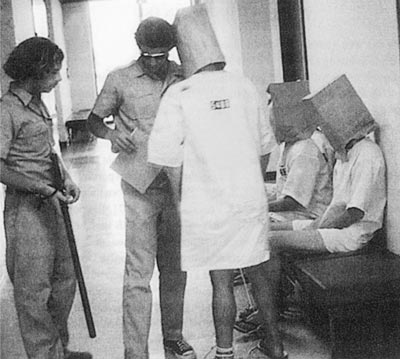
Psychologist Philip Zimbardo, mastermind of the notorious Stanford Prison Experiment, which provided a chilling look at how quickly and thoroughly jailers can become dehumanized–a dress rehearsal, if you will, for Abu Ghraib–just did an Ask Me Anything on Reddit. He discusses the SPE and his new e-book about the effect Internet porn and video games have on boys. A few exchanges about Stanford.

_____________________

Question:

For those unaware, modern-day psychological studies (or anything even remotely involving testing humans) have to go through fairly rigorous scrutiny from ethics committees to ensure that no harm lasting damage is done. Up until relatively recent times these committees weren’t necessary and researchers had much more freedom – often at the expense of their subjects.

I remember seeing a video of one of John Watson’s experiments, on operant conditioning, where he would purposely scare a baby every time it showed interest in animals. Eventually the baby was conditioned to fear the animals.

In short: You learn a lot without ethics, but you often harm the people involved.

Dr. Philip Zimbardo:

In the olden days researchers had total power to do anything to their “subjects” whether human or animal, children or prisoners– in the name of science. Some abused this privilege and Human Research committees were developed in order to create a better balance of power between researchers and their participant,and are now essential for the conduct of all research. A problem is created however, when they become excessively conservative and reject almost all research that could conceivably “stress” participants even by having them think about a stressful situation. Thus nothing like the Milgram study or my Stanford Prison study could ever be done again. Is that good? Is that bad? Open issue for debate.

_____________________

Question

I think we need to be careful when using expectations in describing how people act in these situations though. For example with Milgram I think obedience to authority was more of a factor than expectations. Thus the higher success rate(shock rate)with the teacher wearing a lab coat. There are other problems with Milgram too, he used the same teacher each time who got efficient at producing a specific result, which is interesting I think when we use him in talking about perpetrators of genocide. But it’s worth noting that the individual encouraging the shocks was also learning. With the SPE, Zimbardo got results from ‘irst timers’ which is surprising, or not depending on your view.

Dr. Philip Zimbardo:

In the Milgram study, SPE, and many other similar studies on the power of social situations to transform the behavior of good people in evil directions, the conclusion is the majority can easily be led to do so, but there is always a minority who resist, who refuse to obey or comply. In one sense, we can think of them as heroic because they challenge the power of negative influence agents (gangs, drugs dealers, sex traffickers; in the prison study it’s me, in the Milgram experiment it’s Milgram). The good news is there’s always a minority who resist, so no, not everyone has the capacity to do anything regardless of the circumstances. I recently started a non-profit, the Heroic Imagination Project in an attempt to increase the amount of resistors who will do the right thing when the vast majority are doing the wrong thing. There needs to be more research though, and we are in the process of studying heroism and the psychology of whistleblowing; curiously, there is very little so far compared to the extensive body of research on aggression, violence, and evil.

_____________________

Question: 

Based on your results, how would you suggest American imprisonment be altered, if at all?

Dr. Philip Zimbardo:

Shortly after the time we first published the results of SPE, the head graduate student of the research, Craig Haney, and I became very much involved in prison reform in California, working with the department of corrections, teaching courses on the psychology of imprisonment, organizing courses for prisoners in Soledad prison, being expert witnesses in trials about solitary confinement as cruel and unusual punishment, and also working to highlight the psychologically and physically devastating effects of “supermax” prisons.

However, in 1973, there were about 350,000 Americans in prison. This year there are more than 2 million Americans caged in the prison system at local, state, and federal levels. More than twice as much as any other country in the world. It is a national disgrace as far as I’m concerned, and with those big numbers goes reduced programs for rehabilitation, recreation, therapy, and really any concern about prisoners ever being able to live a normal life outside the prison. And this is because 3 factors: economic, political, and racial. Prisons have become a big business for many communities; many prisons are becoming privatized, which means they are for profit only. They have become political in so far as politicians all want to be seen as tough on crime, encouraging prosecutors and judges to give prisoners maximum sentences, including 25 years to life, for non-violent offenses. Racially, prisons have become dumping grounds for black and hispanic young men, so that there are now more of these young men in prisons than in college.

The whole system is designed not to help prisoners. At this point, my optimism about improving the American prison system has been severely tested and it will really take a major change in public opinion and also in basic attitudes from the top down. It’s a systemic problem; it’s not like some warden in a particular prison is a bad guy, everyone’s attitudes needs to change to become more humane. This needs to start with the President, governors, and mayors taking a strong compassionate stance. Pragmatically, citizens have to realize that it costs them through their taxes $1 million to keep one prisoner locked up for 25 years.”

_____________________

“Jesus Christ, I’m burning up inside–don’t you know?”:

Tags: ,

At the Browser, economist Tim Harford comments on Charles Perrow’s book Normal Accidents, which suggests that our technological systems growing more complex inevitably leads to greater chaos:

Tim HarfordFor him, at the time he published the first edition of this book, Three Mile Island [the nuclear core meltdown in Pennsylvania in 1979] was the definitive one. It prefigured Chernobyl. And then he revisits the subject at the end of the 1990s. The book goes through awful accidents in complex systems and explores why they happened – the human failings that go into them, the systemic consequences, the fact you could have a very small error that propagates and propagates. It’s quite a technical book, but it’s wonderful and completely compelling.

I originally read the book because I wanted to write about a particular accident. My sister is a qualified safety engineer, and she gave me a bunch of safety engineering books. But as I read Perrow’s book, I realised that it could have been written about the financial crisis. That was really shocking to me – this realisation that these banks and their interconnections were, in many ways, the same kind of system as a nuclear reactor, or at least had very important similarities.

And is there any way of avoiding this kind of disaster in future? Does the book shed any light on that?

Tim Harford: Perrow is, in many ways, a pessimist. He says that if the system is too complicated, you will have accidents. There’s nothing you can do about it. Looking back at the history of financial crises, that’s probably appropriate. But one thing that comes out of the book is the idea that we tend to make systems more complex by adding safety systems on top of them, and that the safety systems themselves create new ways for things to go wrong. That was a key problem in the financial crisis. A lot of banks were taking bets and then insuring themselves with credit default swaps (CDS). Credit default swaps were, basically, insurance contracts that banks wrote, often with [the big insurance company] AIG. Or banks were repackaging sub-prime mortgages into vehicles that were supposed to make risky loans safe. These two innovations – the packages of sub-prime loans and the credit default swaps – were both safety systems. But they were both absolutely crucial in explaining why the system blew up. I think that’s a central and really useful idea, that these safety systems are probably not helpful – and even when they are helpful, they will have unintended consequences.”

Tags: ,

Economist Richard Freeman and others opine on the future of human labor.

Just twenty-six days before his death by hunger strike in 1981, Bobby Sands is elected to Parliament.

Tags:

Guy Debord directed this 1973 adaptation of his book, Society of the Spectacle. Um, some generalizations.

Tags:

From a piece about the need for ethical robots, in the Economist:

“Robots are spreading in the civilian world, too, from the flight deck to the operating theatre. Passenger aircraft have long been able to land themselves. Driverless trains are commonplace. Volvo’s new V40 hatchback essentially drives itself in heavy traffic. It can brake when it senses an imminent collision, as can Ford’s B-Max minivan. Fully self-driving vehicles are being tested around the world. Google’s driverless cars have clocked up more than 250,000 miles in America, and Nevada has become the first state to regulate such trials on public roads. In Barcelona a few days ago, Volvo demonstrated a platoon of autonomous cars on a motorway.

As they become smarter and more widespread, autonomous machines are bound to end up making life-or-death decisions in unpredictable situations, thus assuming—or at least appearing to assume—moral agency. Weapons systems currently have human operators ‘in the loop,’ but as they grow more sophisticated, it will be possible to shift to ‘on the loop’ operation, with machines carrying out orders autonomously.

As that happens, they will be presented with ethical dilemmas. Should a drone fire on a house where a target is known to be hiding, which may also be sheltering civilians? Should a driverless car swerve to avoid pedestrians if that means hitting other vehicles or endangering its occupants? Should a robot involved in disaster recovery tell people the truth about what is happening if that risks causing a panic?”

••••••••••

Volvo’s autonomous vehicles in Barcelona:

In Evgeny Morozov’s new article at Slate, he explains why cyber warfare may not be attractive to terrorist groups. Of course, if there was a critical mass of driverless cars or robotic surgeons to tamper with, things might be different. There would definitely by a scary wow factor in that scenario. An excerpt:

“Terrorists may be more keen on anonymity, but the reality is that in the decade since 9/11, no terrorist group has had much success causing serious disruption of the civilian or military infrastructure. For a group like al-Qaida, the costs of getting it right are too high, particularly because it’s not guaranteed that such a cyber-terror campaign would be as spectacular as detonating a bomb in a busy public square.”

Tags:

From “New York Has Some Prisons To Sell You,” Thomas Kaplan’s NYT article about the Governor Cuomo’s attempts to dismantle the state’s prison-industrial complex:

“These real-estate listings come from an unpracticed seller, the State of New York. After cutting costs through traditional means like freezing wages of state workers and consolidating government offices, Gov. Andrew M. Cuomo is embarking on a less conventional effort: trying to sell New York’s old prisons.

The state has a glut of vacant correctional facilities because of lower crime rates, new programs that allow early release for nonviolent offenders and the dismantling of its strict drug laws. The situation in New York reflects changing national attitudes toward criminal justice policy: the number of state prisoners nationwide declined in 2009 and 2010 for the first times in at least three decades, according to the federal Bureau of Justice Statistics.

Mr. Cuomo’s predecessor, Gov. David A. Paterson, closed three prisons as he confronted budget problems. Mr. Cuomo declared in his first address to the State Legislature that prisons were “not an employment program,” and proceeded to shut seven of the state’s remaining 67 correctional facilities, removing 3,800 beds.

These closings reflect a sharp reversal. After New York adopted mandatory drug sentences in 1973, the state’s prison population soared from 13,437 to a peak of 71,472 in 1999, prompting a boom in prison construction, much of it during the tenure of Gov. Mario M. Cuomo, the current governor’s father. But since then, the number of inmates in state facilities has fallen nearly a quarter, to about 55,000, leaving thousands of empty beds.”

Tags: ,

"Some of them love human dignity so much that they are ready to legalize torture to defend it." (Image by Ggia.)

The opening of Slavoj Žižek’s new essay about Greece in the London Review of Books, which articulates how we often sacrifice our principles during a fight to preserve those very same principles:

“Imagine a scene from a dystopian movie that depicts our society in the near future. Uniformed guards patrol half-empty downtown streets at night, on the prowl for immigrants, criminals and vagrants. Those they find are brutalised. What seems like a fanciful Hollywood image is a reality in today’s Greece. At night, black-shirted vigilantes from the Holocaust-denying ne0-fascist Golden Dawn movement – which won 7 per cent of the vote in the last round of elections, and had the support, it’s said, of 50 per cent of the Athenian police – have been patrolling the street and beating up all the immigrants they can find: Afghans, Pakistanis, Algerians. So this is how Europe is defended in the spring of 2012.

The trouble with defending European civilisation against the immigrant threat is that the ferocity of the defence is more of a threat to ‘civilisation’ than any number of Muslims. With friendly defenders like this, Europe needs no enemies. A hundred years ago, G.K. Chesterton articulated the deadlock in which critics of religion find themselves: ‘Men who begin to fight the Church for the sake of freedom and humanity end by flinging away freedom and humanity if only they may fight the Church … The secularists have not wrecked divine things; but the secularists have wrecked secular things, if that is any comfort to them.’ Many liberal warriors are so eager to fight anti-democratic fundamentalism that they end up dispensing with freedom and democracy if only they may fight terror. If the ‘terrorists’ are ready to wreck this world for love of another, our warriors against terror are ready to wreck democracy out of hatred for the Muslim other. Some of them love human dignity so much that they are ready to legalise torture to defend it. It’s an inversion of the process by which fanatical defenders of religion start out by attacking contemporary secular culture and end up sacrificing their own religious credentials in their eagerness to eradicate the aspects of secularism they hate.” (Thanks Browser.)

Tags:

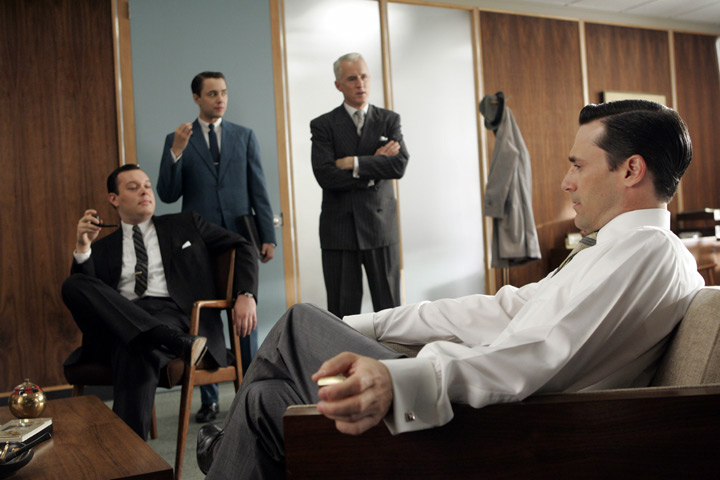
A brief analysis of the romantic appeal of Mad Men by the resolutely astute Adam Curtis at the BBC:

“The widespread fascination with the Mad Men series is far more than just simple nostalgia. It is about how we feel about ourselves and our society today.

In Mad Men we watch a group of people who live in a prosperous society that offers happiness and order like never before in history and yet are full of anxiety and unease. They feel there is something more, something beyond. And they feel stuck.

I think we are fascinated because we have a lurking feeling that we are living in a very similar time. A time that, despite all the great forces of history whirling around in the world outside, somehow feels stuck. And above all has no real vision of the future.

And as we watch the group of characters from 50 years ago, we get reassurance because we know that they are on the edge of a vast change that will transform their world and lead them out of their stifling technocratic order and back into the giant onrush of history.

The question is whether we might be at a similar point, waiting for something to happen. But we have no idea what it is going to be.”

Tags:

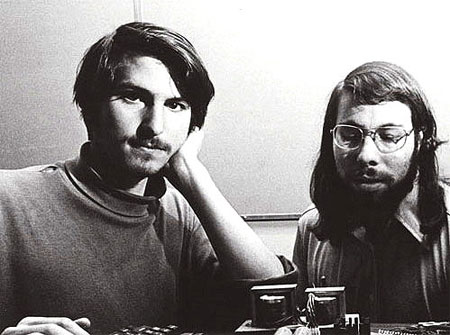
In August of last year I put up a post entitled, “Can China, With Its Present Government And Business Structure, Ever Turn Out A Company Like Apple?” I was asking whether a nation that has famously opened countless fake Apple stores could ever create an actual company like the one birthed by Jobs-Wozniak. In the New York Times, the excellent James Fallows wonders similar things in “Can China Escape The Low-Wage Trap?” An excerpt about the downside to China’s meteoric rise:

“Some of the limits and failures are well publicized: among others, the environmental despoliation that has made cancer the leading cause of death in China; the demographic shift caused by the one-child policy that threatens to make China the first society to grow old before it grows rich; and the problems of transparency and accountability in the Chinese governing system, illustrated most recently by the Bo Xilai and Chen Guangcheng cases.

Those, at least, are the problems that get the headlines. But there’s a bigger one, which the Chinese government and public are only now starting to recognize: whether the success of China’s current model is leading toward a ‘low-wage trap,’ in which its outsourcing factories get bigger but don’t necessarily move the country toward the higher tiers of the world economic structure.

PUT differently, will Chinese companies ever go from assembling iPads to fostering future Apples of their own — or, similarly, from selling knockoff copies of Western movies, music, search engines and online apps to establishing China’s own pop-culture industries with worldwide profits and soft-power appeal?

Nearly every Apple product is ‘made’ in China, but barely 10 cents on the Apple sales dollar stay with workers, suppliers or anyone else in te country. The rest goes to designers and shareholders in the United States, component makers in Japan, machine-tool makers in Germany and retailers or shippers around the world. The problem for America with this arrangement is that it disproportionately rewards the top rather than the middle of our income scale. The problem for China is figuring out how to capture more of the rewards to begin with.”

Tags:

From “The First Wired President,” Tom Wheeler’s smart New York Times Disunion post about Abraham Lincoln’s embrace of technology:

“Up until May 1862 Lincoln had sent, on average, a little over one telegram a month. But things changed when a telegraph office was opened next door to the White House, in the War Department. On May 24 the president had his online breakout, sending nine telegrams. That week he would send more than all his previous messages, combined. From May 24 — 18 years to the day since Morse had first tapped out ‘What hath God wrought’ — forward, Lincoln and the telegraph were inseparable.

The new telegraph office became the first Situation Room. Several times a day the president would walk into the telegraph office, sit down at the desk of its manager and begin going through the copies of all telegrams received, whether addressed to him or not. During great battles the president would even sleep in the telegraph office, just to be close to his oracle.

Using the telegraph to extend his voice was an obvious application of the technology. ‘You are instructed…to put twenty thousand men (20,000) in motion at once for the Shenandoah,’ the president ordered Gen. Irvin McDowell on May 24. Less obvious, however, was how Lincoln made the telegraph his eyes and ears to distant fields and the keyhole into his generals’ headquarters. As he sat in the telegraph office reading messages, he gained insights, felt the pulse of his Army in the field and reacted.”

Tags: ,

At the BBC, sci-fi writer Elizabeth Moon suggests humans get bar codes at birth:

“If I were empress of the Universe I would insist on every individual having a unique ID permanently attached – a barcode if you will; an implanted chip to provide an easy, fast inexpensive way to identify individuals.

It would be imprinted on everyone at birth. Point the scanner at someone and there it is.

Having such a unique barcode would have many advantages. In war soldiers could easily differentiate legitimate targets in a population from non combatants.”

Tags:

Just to simplify this for members of the Senate investigating whether Secret Service agents have been involved with prostitutes in the past: Yes, many, many times Secret Service agents have paid other people to perform sex acts with them. These agents possessed vital information and could have had a briefcase stolen or been blackmailed. You know who else has vital info and has had sex with prostitutes countless times over the years? Members of the Senate and Congress. Because many of them are on committees and are privy to sensitive info about the President, they also could be blackmailed. Additionally, many Presidents in the past (though not the current one by all accounts) have had all sorts of sexual affairs which could have put their lives and our state secrets in danger. Now you can save the money you’ve been spending on trying to learn that human beings have a difficult time controlling sexual impulses no matter what’s at stake.

I’m not condoning any of it, but representatives in D.C. pretending they’re shocked by important officials hooking up with prostitutes aren’t being very honest.•

There are corresponding pieces in Wired and Businessweek about authoritarian rulers in the Internet Age, trying to defend their their regimes from wired dissidents by using new media tools and aggressive PR tactics.

“But like [Ghaida al-] Tawati, these activists would suffer greatly at the hands of Gadhafi’s spy service, whose own capabilities had been heightened by 21st-century technology. By now, it’s well known that the Arab Spring showed the promise of the Internet as a crucible for democratic activism. But, in the shadows, a second narrative unfolded, one that demonstrated the Internet’s equal potential for government surveillance and repression on a scale unimaginable with the old analog techniques of phone taps and informants. Today, with Gadhafi dead and a provisional government of former rebels in charge, we can begin to uncover the secret, high tech spying machine that helped the dictator and his regime cling to power.

The regime had been following Tawati online for years, and the harassment of her was mostly orchestrated by a group that came to be called the Electronic Army. According to former members, this loose organization was founded several years ago when Mutassim Gadhafi, one of the dictator’s playboy sons, had been enraged after videos of him attending a nude beach party on New Year’s Eve were posted online. Mutassim, who chaired Libya’s National Security Council, created a group of Internet users, some paid, some volunteer, to try to take down those videos and other anti-Gadhafi material posted online. They bombarded YouTube with flags for copyright infringement and inappropriate content; they waged a constant back-and-forth battle with critics of the regime, whom they would barrage with emails and offensive comments.

After all the cruelties she had endured as a child, Tawati could deal with the insults directed at her. But it stunned her when, in August 2010, some of her private email exchanges with other dissidents somehow got leaked to Hala Misrati, a notorious TV propagandist and one of the Electronic Army’s apparent leaders. How had her accounts been compromised, she wondered?

The answer, though she would not know it until after the regime fell, lay in a secret deal Gadhafi had made with a company called Amesys—a subsidiary of the French defense firm Bull SA—for technology that would allow his spy services to access all the data flowing through Libya’s Internet system. In a proposal to the regime dated November 11, 2006, Amesys (then called i2e Technologies) laid out the specifications for its comprehensive Homeland Security Program. It included encrypted communications systems, bugged cell phones (with sample phones included), and, at the plan’s heart, a proprietary system called Eagle for monitoring the country’s Internet traffic.”

“These New Age autocrats, he says, can no longer rule by brute force. Instead, they use ‘more subtle forms of coercion’ while investing heavily in maintaining the appearance of rights, law, and elections, and keeping their borders open so that opponents can always leave. ‘Modern dictators,’ he contends, ‘understand it is better to appear to win a contested election than to openly steal it.’ He points to Chavez, who altered legislation to boost his chances of electoral victory, then, after winning, used his poll victory to eviscerate opponents—never accepting the idea, crucial to democracy, of legitimate differences between parties. Then there’s Putin, who maintains the façade of a constitution while working in what Dobson calls the ‘seams of the political system’ to centralize power, using proxies to take over leading companies and key media outlets. Putin has created government-dominated NGOs that mimic free speech but make it harder for activists to get their voices heard.

Today’s smartest dictators, such as the Chinese Communist Party, adopt many of the technocratic methods of the most successful modern businesses, justifying their rule with their economic success. The CCP operates by consensus at the highest levels, while tailoring the government, at local levels, to enhance the delivery of services without actually opening up the political system. The party also normally keeps its internal debates internal, presenting a uniform face to citizens.”


Tags: , , ,

"Anderson’s responses were still a good distillation of TED’s ideology." (Image by Steve Jurvetson.)

I enjoy a lot of TED lectures and have posted some here, but I highly recommend “Don’t Mention Income Inequality Please, We’re Entrepreneurs,” a smart Salon article by Alex Pareene about the wealthy organization’s unspoken politics. The opening:

“There was a bit of a scandal last week when it was reported that a TED Talk on income equality had been censored. That turned out to be not quite the entire story. Nick Hanauer, a venture capitalist with a book out on income inequality, was invited to speak at a TED function. He spoke for a few minutes, making the argument that rich people like himself are not in fact job creators and that they should be taxed at a higher rate.

The talk seemed reasonably well-received by the audience, but TED ‘curator’ Chris Anderson told Hanauer that it would not be featured on TED’s site, in part because the audience response was mixed but also because it was too political and this was an ‘election year.’

Hanauer had his PR people go to the press immediately and accused TED of censorship, which is obnoxious — TED didn’t have to host his talk, obviously, and his talk was not hugely revelatory for anyone familiar with recent writings on income inequity from a variety of experts — but Anderson’s responses were still a good distillation of TED’s ideology.”

Tags: ,

The opening of “Fran Lebowitz on Race,” a 1997 Vanity Fair piece that was a revelation for a country that couldn’t yet visualize its first African-American President nor the Birther backlash that landmark would evoke:

Do you think the proper way to talk about race now is to talk about multiculturalism?

I came from a town where there were two races, black and white. There were a few Chinese people, and this may sound shocking, but I had no idea they were a different race. I thought they were a different nationality, like Italian or French. Now you have people coming here from Cambodia, from Egypt, from Colombia, from places you never thought would be sending us their huddled masses. I mean, surely 20 years ago no one could have imagined a more unlikely pair of words than ‘Korean deli.’ And all these people think of themselves as being members of different races. Ethnic groups have taken on the same weight as racial groups, with the same demands, the same notion of themselves.

To me, this plays into the hands of the people in power — the white people. If you want to ensure generation after generation of Mexican gardeners in California, you insist on bilingual education in the grammar schools. You can pretend that you would just as soon have your cardiologist speak to you in Spanish, but if you don’t speak Spanish, you would just as soon not.

If you’re black, don’t you say to yourself, ‘We’ve been here for a zillion years, and here are all these people coming along, acquiring power by saying they’re powerless acquiring power by equating their lot with ours’? Blacks are the standard of oppression. People are always taking appalling historical events that one would hope are unparalleled and making absurd and immoral equations: the police raid the Stonewall Inn and instantly and forever it’s ‘Bull’ Connor turning the fire hoses on the marchers in Birmingham; antiabortion maniacs throw fetuses at abortion-performing doctors and an absolutely unembarrassed analogy is made to a lynch mob. These things are categorically unrelated, as are most things. Things are very rarely exactly like other things. If they were, people would be less baffled in general, and perhaps less given to such statements as ‘This is like the Holocaust.’ Nothing is like the Holocaust. Not that there haven’t been other tragedies, other genocides. But simply that they were peculiarly, specifically, intrinsically like themselves. Genocides are like snowflakes, each one unique, no two alike. You can’t go around making these horrendously invalid comparisons. It is disgraceful and annoying. If you were in Auschwitz, you undoubtedly feel that on top of having been in Auschwitz you shouldn’t also have to have your experience used to justify, say, gay marriage.

What is actually served by multiculturalism and all things attendant to it is the power of white people, and this, despite any and all such academic quibbling, is primarily accomplished by the continuing oppression of blacks. Because even though the conversation now includes all these other elements, the truth is that the farther you are from being black, the more likely you are to assimilate, to be more like white. The more you are like white, the less trouble you have because the more you are like white, the less trouble you are.”

••••••••••

Lebowitz comments on NYC and how Andy Warhol’s joke got out of hand:

Tags:

Before we realized that crowds might have wisdom, demographers worried mightily about overpopulation. The recent renaissance in demography has seen a shift in focus. From the Economist:

The main concern of demographers in their heyday (the 1970s and 1980s) was high fertility and the total number of the world’s people. This was the period of The Population Bomb, a bestseller by a biologist, Paul Ehrlich, which argued that the world could not feed itself. An international family-planning movement sprang up. Top-down programmes attempted to control the total size of national populations. China’s one-child policy is the best known and most extreme of these.

Now though, as John May, formerly of the World Bank and now Georgetown University, shows in World Population Policies, the focus of demographers has switched from the overall size of populations to their composition—that is, to age groups and their relation to one another. Instead of high fertility rates, demographers study ageing, dependency ratios, the ‘demographic dividend’ (a bulge of working-age adults) and distorted sex ratios, which result when millions of parents choose the sex of their children, often by aborting baby daughters.

The result, suggests Mr May, is that demography is more complex, if less dramatic, than it used to be.”

••••••••••

A 1972 UN film about threats to our environment, which features Paul Ehrlich. Also on hand: Indira Gandhi, Kurt Waldheim, Robert S. McNamara, etc.

Tags:

« Older entries § Newer entries »