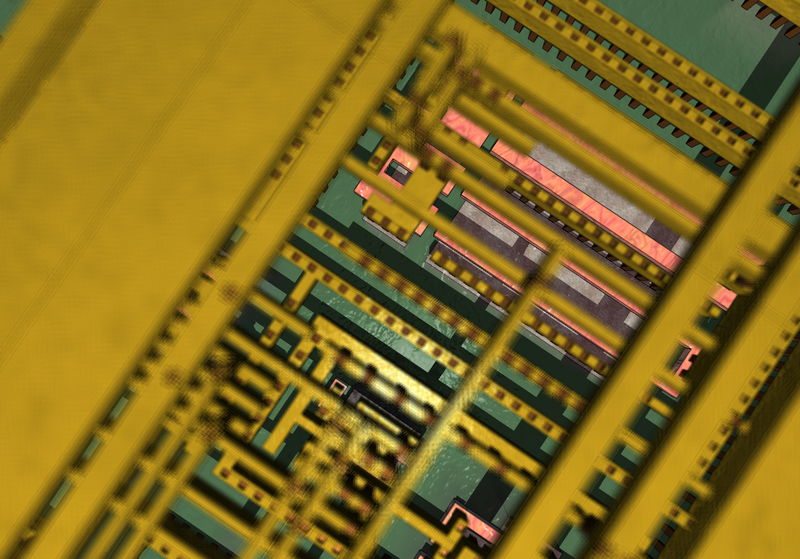
"Noyce had figured out a solution. But fabricating it was another matter." (Image by David Carron.)

The late Dr. Robert Noyce, father of the silicon microchip, would have turned 84 today. From Tom’s Wolfe’s 1983 Esquire article “The Tinkerings of Robert Noyce,” a passage about the race to create the first (and best) integrated circuit: 

“Even for a machine as simple as a radio the individual transistors had to be wired together, by hand, until you ended up with a little panel that looked like a road map of West Virginia. As for a computer, the wires inside a computer were sheer spaghetti.

Noyce had figured out a solution. But fabricating it was another matter. There was something primitive about cutting individual transistors out of sheets of silicon and then wiring them back together in various series. Why not put them all on a single piece of silicon without wires? The problem was that you would also have to carve, etch, coat, and otherwise fabricate the silicon to perform all the accompanying electrical functions as well, the functions ordinarily performed by insulators, rectifiers, resistors, and capacitors. You would have to create an entire electrical system, an entire circuit, on a little wafer or chip.

Noyce realized that he was not the only engineer thinking along these lines, but he had never even heard of Jack Kilby. Kilby was a thirty-six-year-old engineer working for Texas lnstruments in Dallas. In January, 1959 Noyce made his first detailed notes about a complete solid-state circuit. A month later Texas Instruments announced that Jack Kilby had invented one. Kilby’s integrated circuit, as the invention was called, was made of germanium. Six months later Noyce created a similar integrated circuit made of silicon and using a novel insulating process developed by Jean Hoerni. Noyce’s silicon device turned out to be more efficient and more practical to produce than Kilby’s and set the standard for the industry. So Noyce became known as the co-inventor of the integrated circuit. Nevertheless, Kilby had unquestionably been first. There was an ironic echo of Shockley here. Strictly speaking, Bardeen and Brattain, not Shockley, had invented the transistor, but Shockley wasn’t bashful about being known as the co-inventor. And, now eleven years later, Noyce wasn’t turning bashful either.

Noyce knew exactly what he possessed in this integrated circuit, or microchip, as the press would call it. Noyce knew that he had discovered the road to El Dorado.”

••••••••••

Noyce predicts the future of technology, 1981:

Tags: , ,

Selling whiskey.

Meeting the press in Japan, 1960.

Tags:

"I will not do black magic."

Wicca? Who beleives? Is there a spell on me? (Chelsea)

Someone told me a spell is on me.
What do you think!?
What the hell is going on here?!!!!!!!!
What are some ways to remove a love spell?
I will not do black magic. 

American Airlines introducing state-of-the-art on-board technology, 1960s.

"They saw the elephants lie right down, and had a laugh with every clown."

A firsthand account of the Barnum & Bailey Circus that was allegedly written by a 10-year-old schoolboy–but probably was penned by one of Phineas Taylor’s lackeys–was published in the April 28, 1897 Brooklyn Daily Eagle. An excerpt:

“A school boy who enjoyed last night’s performance of the Barnum & Bailey show sends the following description to the Eagle:

To the Editor of the Brooklyn Eagle:

Despite the gale outside the tent, some 20,000 people went with peanuts primed and eyes aglow, to see the great and only show. First baby camel met their eye and then the lady ten feet high, beside the smallest man on earth, provoked much inconsiderate mirth. The animals next, both caged and tied, were each and every one espied; the side show freaks and platforms, too, were passed before the public view, and then the bugles tooted loud, and to the ring sides rushed the crowd. They tried to watch three rings at one, and follow everything there done; but though they couldn’t quite succeed, they saw a lot of things indeed. They saw the elephants lie right down, and had a laugh with every clown; and watched the goats roll around the ring on a ball as easy as anything, and shooed the dove that rode the wheel and heard the pig’s ‘mamma’ appeal, and held their breath while in the air the slack rope walker combed his hair and trapeze artists swung and jumped, till finally into the net they plumped; and saw the ball roll up the spire, with a man inside to push it higher, and cheered the dog that kicked the ball with the tip of his nose and heard the fall of the clown who tried to stand on his head, but landed in a heap instead, and followed the man with the face so big that he scared the clown with the talking pig, and laughed at the rollicking monkey race, and the dogs that joined in the nightly chase, and watched the Jap shin up the pole and slide to the ground on his slippery sole, and hurrahed for the girl on the milk white steed who stuck to his back in spite of his speed, and marked the time for the horse quadrille and the juggler eyed with a creeping chill as he dallied with carving knives and things in one of the three entrancing rings. The same old circus? Well, hardly true–the same old show, with everything new.

Brooklyn, April 8, 1897

SCHOOL BOY.”

Tags:

Frank Abagnale, the con at the heart of Spielberg’s Catch Me If You Can, profiled in 1980.

Tags:


Some search-engine keyphrases bringing traffic to Afflictor this week:

Afflictor: Providing a brief recap...

+

...of the most recent....

=

...Kardashian marriage.

  • Kodak has been all but obliterated by the digital revolution. 

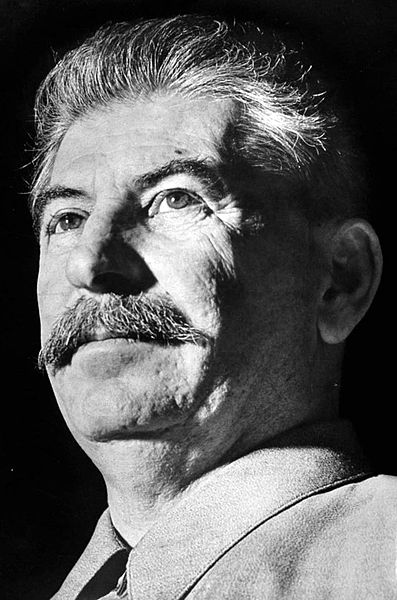
Legendary Life photojournalist Margaret Bourke-White explained how she snapped the above picture of Joseph Stalin smiling–well, smiling  by his somber standards–in quotes that ran in her 1971 New York Times obituary, I actually don’t know if she did the world a favor by locating a softer-looking Stalin, but here’s an excerpt:

“For her meeting with Stalin in the Kremlin in 1941, which was arranged by Harry Hopkins, Miss Bourke-White employed a stratagem to catch him off guard. Recalling the incident, she wrote:

‘I made up my mind that I wouldn’t leave without getting a picture of Stalin smiling. When I met him, his face looked as though it were carved out of stone, he wouldn’t show any emotion at all. I went virtually beserk trying to make that great stone face come alive.

‘I got down on my hands and knees on the floor and tried out all kinds of crazy postures searching for a good camera angle. Stalin looke down at the way I was aquirming and writhing and for the space of a lightning flash he smiled-and I got my picture. Probably, he had never seen a girl photographer before and my weird contortions amused him.’

Miss Bourke-White maintained that ‘a woman shoudn’t trade on the fact that she is a woman.’ Nonetheless, several of her male colleagues were certain that her fetching looks–she was tall, slim, dark-haired and possessed of a beautiful face–were often employed to her advantage.

‘Generals rushed to tote her cameras,’ Mr. [Alfred] Eisenstadt recalled, ‘and even Stalin insisted on carrying her bags.'”

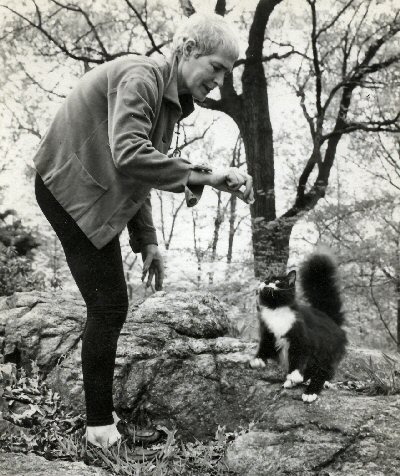
Margaret Bourke-White, 1964.

Tags: ,

Walter Cronkite on January 20, 1981, the day Ronald Reagan was inaugurated and the American hostages in Iran returned home.

Tags: ,

Whenever there is a succession of 3-D films, you know Hollywood is in trouble. When the studio system was in its dotage during the 1950s, before the industry knew enough to rejuvenate itself by handing over the keys to the motorcycle to Easy Riders and other wild-eyed independents, it relied on 3-D to fill the coffers. Right now, the Dream Factory in California is located more in Silicon Valley than Hollywood. Science fiction no longer predicts science as the technology sector has the better ideas. And the movie industry responds with an over-reliance on gimmicks.

While the hunger for 3-D has abated somewhat in America, the world market has yet been satisfied, so even the mad genius auteur Werner Herzog has been given the opportunity to work with the effect in Cave of Forgotten Dreams. The film is an exploration of the Chauvet Cave in Southern France, which was discovered in 1994 by Eliette Brunel-Deschamps, Christian Hillaire, and Jean-Marie Chauvet. It bears the most historical artwork known to humankind on its walls, elaborate drawings of megafauna, human beings and creatures that combine the two, which were made at least 32,000 years ago. But Cave of Forgotten Dreams isn’t a mere art-history documentary, but rather a tacit struggle between Herzog and the 3-D illusion itself, which has a knack for directing directors, for wrestling the story from their hands.

It’s not completely a fair fight, either. Herzog not only has to deal with technical necessities of 3-D but is also hampered by the fragility of the cave, which demands that Herzog work from bended knee (sometimes in a metaphorical sense, sometimes not), not use too many cameras or lights, not get too close, not get his hands dirty. Whether he has been running headlong into the maw of a bubbling volcano (“La Soufriere”) or dragging a riverboat over a mountain into the jungle (Fitzcarraldo), Herzog is no stranger to obstructions forming his art. He is, however, alien to not being allowed to challenge the elements and having to genuflect in awe rather than form an adversarial relationship. 

Making this movie for History Films (a subsidiary of the History Channel) has its restrictions, too. In addition to being a great artist, Herzog is a canny journalist, asking questions others wouldn’t pose, tugging at loose threads that most would never notice. His films are amazing as much for his powers of observation as for his daring. In one scene the director interviews an archaeologist who used to be a circus man. A scene that would have been a long and fascinating digression in a usual Herzog film is instead glossed over in favor of more standard storytelling, a concession that seemingly was made for the producers.

That’s the overall tone of the film: handsome and reverential with the requisite 3D-motion shots, but not Herzogian, lacking his insane brilliance. Until the five-minute “Postscript” section, that is. Herzog discovers a nuclear power plant less than 20 miles from the priceless cave. A second startling discovery is a nearby greenhouse that uses the warm water runoff from the power plant to grow hothouse flowers and allow albino crocodiles to thrive. The past, the present and the future unite against odd scenes of ferocious reptiles in an almost operatic way. The Herzog magic emerges in these moments, and we see the wry storytelling and resourcefulness that always restores Hollywood once its gimmicks run aground. In these scenes, Herzog’s been able to traverse one of the biggest obstacles of his career, one that is more ominous than a volcano or jungle–technology itself.•

Tags: , , ,

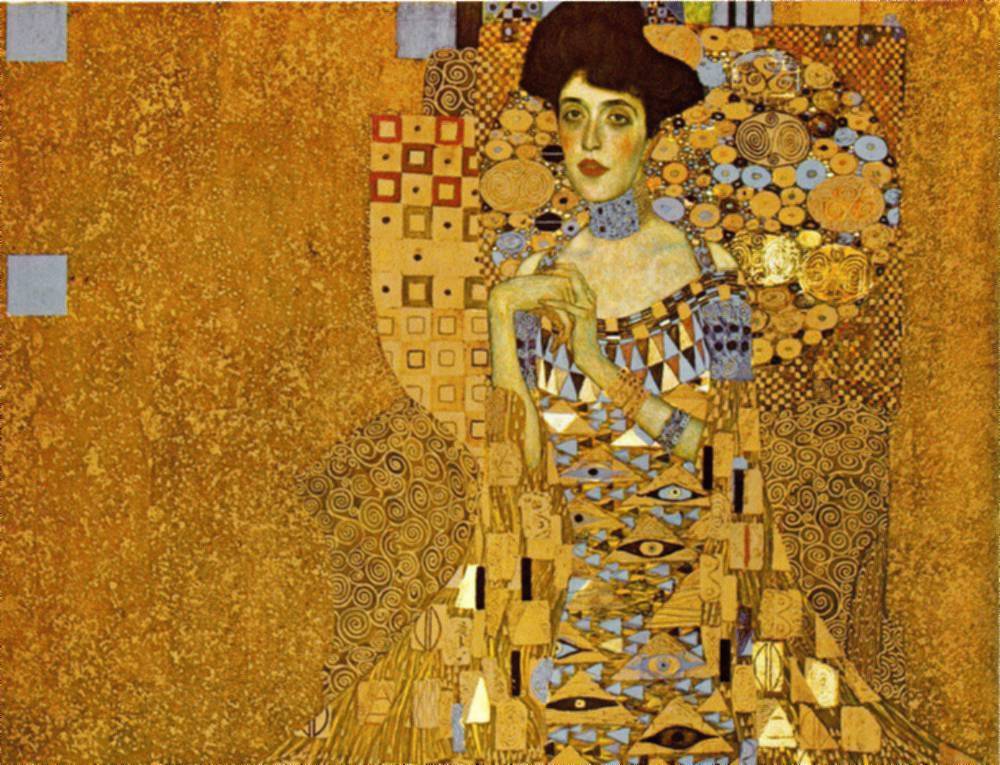
"Crowds lining up to see a portrait by Gustav Klimt in the private Neue Galerie in New York weren’t there out of any fondness for the artist."

Eye-popping prices for artworks are a puzzlement for people outside of that world–and for many people on the inside. In Newsweek, Blake Gopnik attempts to explain why this market is impervious even to worldwide financial collapse. An excerpt:

“‘If I can’t sell something, I just double the price.’ That’s what Ernst Beyeler, the great Swiss dealer who helped found Art Basel, reportedly said. Some people actually prefer to pay more than makes sense. Zelizer explains that, in all walks of life, we treat the biggest sums -differently, with special respect or even awe, than more-everyday money. ‘I think very often the price paid for a work is the trophy itself,’ says Glimcher, the dealer.

In 2006, the crowds lining up to see a portrait by Gustav Klimt in the private Neue Galerie in New York weren’t there out of any fondness for the artist. They were there because they’d heard that the museum’s founder, cosmetics heir Ronald Lauder, had paid a record $135 million for it.

The sociologist Mitch Abolafia, who has made a study of Wall Street financiers, says that sometimes money speaks for itself. ‘A trader said to me one day, with glee in his eyes, ‘You can’t see it, but money is everywhere in this room. Money is flying around—millions and millions of dollars.’ It was a generalized excitement about money. Even I felt it.’ That’s the excitement we all get from expensive art. One collector, who believes deeply that art should be bought for art’s sake, acknowledges basking in the ‘robust glow of prosperity’ that his purchases give off once their value has soared.

The people who are spending record amounts on art buy more than just that glow. (And much more than the pleasure of contemplating pictures, which they could get for $20 at any museum.) They’ve purchased boasting rights. ‘It’s, ‘You bought the $100 million Picasso?!,’’ says Glimcher. Abolafia explains that his financiers were ‘shameless’ in declaring the price of their toys, because in their world, what you buy is less about the object than the cash you threw at it. The uselessness of art makes any spending on it especially potent: buying a yacht is a tiny bit like buying a rowboat, and so retains a taint of practicality, but buying a great Picasso is like no other spending. Olav Velthuis, a Dutch sociologist who wrote Talking Prices, the best study of what art spending means, compares the top of the art market to the potlatches performed by the American Indians of the Pacific Northwest, where the goal was to ostentatiously give away, even destroy, as much of your wealth as possible—to show that you could. In the art-market equivalent, he says, prices keep mounting as collectors compete for this ‘super-status effect.'”

•••••••••

Carson Daly visits Mr. Brainwash’s Warholian vomitorium:

Robot personal trainer. (Thanks IEEE Spectrum.)

I recently posted the 1971 Village Voice obituary of photographer Diane Arbus. Here’s a good doc about her from the following year, which features her daughter Doon.

From a 2003 New York Times piece by Arthur Lubow: “‘Giving a camera to Diane Arbus is like giving a hand grenade to a baby,’ Norman Mailer said after seeing how she had captured him, leaning back in a velvet armchair with his legs splayed cockily. The quip was funny, but a little off base. A camera for Arbus was like a latchkey. With one around her neck, she could open almost any door. Fearless, tenacious, vulnerable — the combination conquered resistance.”

Tags: , ,

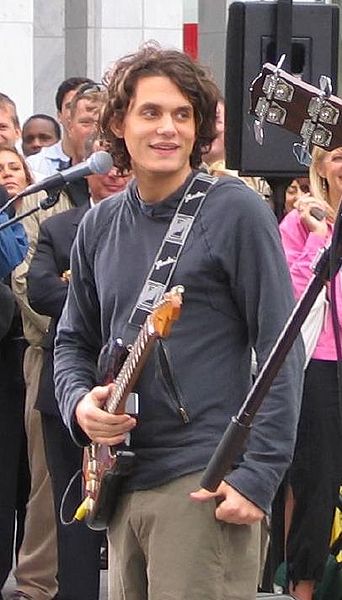
"Creepy." (Image by bretthpatrick.)

Guys With Guitars (Greenwich Village)

The next dude who pulls out a guitar and starts serenading me gets the Belushi Treatment! Creepy.

President-Elect Ronald Reagan reacts to John Lennon’s murder 31 years ago. The two had met at a Monday Night Football game six years earlier, when the pol tried unsuccessfully to explain the rules of the NFL to the former Beatle.

It’s Diego Rivera’s 125th birthday today. In  his 1960 autobiography, My Art, My Life, the famed Mexican muralist claimed to have spent part of his youth dining on human flesh. It sounds like complete bullshit. The brief chapter called, “An Experiment in Cannibalism”:

“In 1904, wishing to extend my knowledge of human anatomy, a basic requisite for my painting, I took a course in that subject in the Medical School in Mexico City. At that time, I read of an experiment which greatly interested me.

A French fur dealer in a Paris suburb tried to improve the pelts of animals by the use of a peculiar diet. He fed his animals, which happened to be cats, the meat of cats. On that diet, the cats grew bigger, and their fur became firmer and glossier. Soon he was able to outsell his competitors, and he profited additionally from the fact that he was using the flesh of the animals he skinned.

His competitors, however, had their revenge. They took advantage of the circumstance that his premises were adjacent to a lunatic asylum. One night, several of them unlocked his cages and let loose his oversize cats, now numbering thousands. When the cats swarmed out, a panic ensued in the asylum. Not only the inmates but their keepers and doctors ‘saw cats’ wherever they turned. The police had a hard time restoring order, and to prevent a recurrence of such an incident, an ordinance was passed outlawing ‘caticulture.’

At first the story of the enterprising furrier merely amused me, but I couldn’t get it out of my mind. I discussed the experiment with my fellow students in the anatomy class, and we decided to repeat it and see if we got the same results. We did — and this encouraged us to extend the experiment and see if it involved a general principle for other animals, specifically human beings, by ourselves living on a diet of human meat.

Those of us who undertook the experiment pooled our money to purchase cadavers from the city morgue, choosing the bodies of persons who had died of violence — who had been freshly killed and were not diseased or senile. We lived on this cannibal diet for two months, and everyone’s health improved.

During the time of our experiment, I discovered that I liked to eat the legs and breasts of women, for as in other animals, these parts are delicacies. I also savored young women’s breaded ribs. Best of all, however, I relished women’s brains in vinaigrette.

I have never returned to the eating of human flesh, not out of a squeamishness, but because of the hostility with which society looks upon the practice. Yet is this hostility entirely rational? We know it is not.

Cannibalism does not necessarily involve murder. And human flesh is probably the most assimilable food available to man. Psychologically, its consumption might do much to liberate him from deep-rooted complexes — complexes which can explode with the first accidental spark.

I believe that when man evolves a civilization higher than the mechanized but still primitive one he has now, the eating of human flesh will be sanctioned. For then man will have thrown off all of his superstitions and irrational taboos.”


Tags:

Anne Sexton, ever-cheerful, in 1966.

Tags:

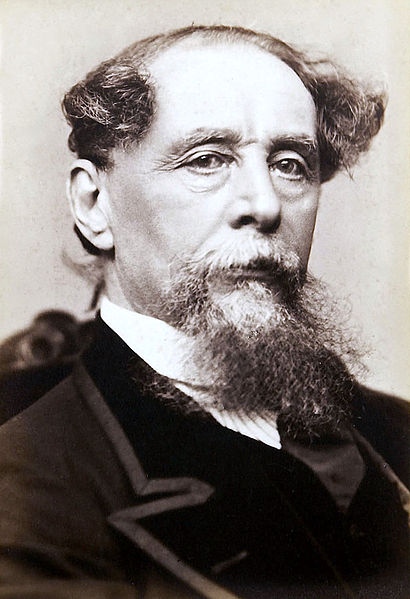
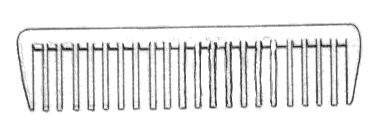
"The first thing he did on coming into the office was to comb his hair."

The Louisville Commercial scored an interview with someone who did dictatorial duties for Charles Dickens. The resulting article was republished in the August 16, 1882 Brooklyn Daily Eagle. An excerpt:

“‘You were an amanuensis of Charles Dickens, were you not?’

‘Yes, I did shorthand work for Mr. Dickens for eighteen months. I did not take dictation for any of his novels, only his fugitive pieces. He dictated to me most of his articles in All the Year Round. He was a very clever gentleman to those under him. He always treated me very well, indeed. Most people seem to think Dickens was a ready writer. This is by no means the case. He used to come into his office in St. Catherine Street about eight o’clock in the morning and begin dictating. He would walk up and down the floor several times after dictating a sentence or a paragraph and ask me to read it. I would do so, and he would, in nine cases out of ten, order me to strike out certain words and insert others. He was generally tired out by eleven o’clock, and went down to his club on the Strand. A singular thing was that he never dictated the closing paragraphs of his story. He always finished it himself. I used to look in the paper for it, and find that he had changed it very greatly from what he had dictated to me.

Dickens had a very odd habit of combing his hair. He would comb it a hundred times in a day. He seemed never to tire of it. The first thing he did on coming into the office was to comb his hair. I have seen him dictate a sentence or two, and then begin combing. When he got through he dictated another sentence. He was very careful about his writings. He wanted every sentence to be as perfect as possible before letting it go to press. Dickens was an odd fellow regarding the company he sought. I have known him, while I was employed by him, to go down to the Seven Dials, about the worst place in London, and sleep and eat there. He roasted his herring where the rest did, and slept with the poorest. He loved low society. He never seemed so happy as when seated in a poor coffee house, with a crowd of the lower classes talking around him. He never missed a word that was said, and was the closest observer I ever met. Nothing escaped him. Those most minute mannerisms were noted and stored away. When I was working for him he was at the zenith of his fame, just before his death; and even then he loved those careless, rollicking rounds among the poor better than a high toned dinner.

‘Was he a great drinker as he has the reputation of being?’

‘I never saw him drink myself. I have seen him several times, exhilarated, however. He only drank the best of wine, but he drank that very freely. Sherry was his special favorite, and he never refused a glass of fine old sherry. He was an insatiable cigarette smoker, and when dictating to me always had a cigarette in his mouth. He was a very spruce man, too. He brushed his coat frequently and changed his collars several times a day. He was every bit as humorous in his speech as in his writings. When he was in a very particularly fine humor he could keep you laughing by the hour with his witty talk. He was not one of those men who are above those they employ; he chatted as freely with me as any member of his club on the Strand. Dickens was undoubtedly the best after dinner speaker in England. I heard him at Whitehall once. There was an enormous crowd, hardly standing room, and he kept them in a continual roar. He was a fine actor, and this, added to his wit, made him irresistibly funny. He was a great eater; not an epicure, but a gourmand. He ate and ate and ate, and cared little for the quality so there was enough before him.”


Tags:

The machine that heavily influenced Steve Jobs, with its mouse and GUI. In Japanese, but understandable to all.

Tags:

An uncommonly prophetic 1969 Australian concept car is born again, as the Holden Hurricane is restored. From the Daily Mail:

‘Concept cars’ are unveiled by car makers to show off new technologies. Sometimes they evolve into production vehicles, sometimes they don’t – but very occasionally, they offer a vision of the future.

Holden’s Hurricane – unveiled 42 years ago in Melbourne – was packed with decades-worth of technologies that have become standard in cars. The Hurricane not only had digital displays, it also had a primitive magnetic GPS system, a rear-view CCTV camera, and a hydraulic entry system that would have made the Dukes of Hazzard jealous – the entire roof lifted off on hydraulic plates.

Now the concept car has been brought back to life at a motor show in Melbourne.”

•••••••••

“It shows amazing foresight into future automotive technologies’;

Anthony Burgess, Jerzy Kosinski, and Barbara Howar turn the tables on Dick Cavett, 1974. Nice socks, Tony.

Tags: , , ,

From Michael Hiltzik’s L.A. Times piece on former blue chipper Kodak, laid low by the digital revolution and creative destruction:

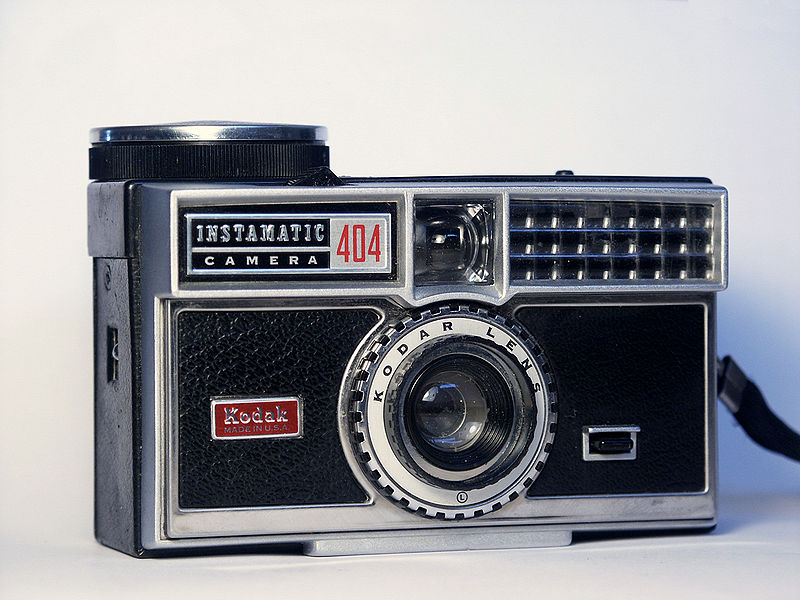
“Kodak Brownie and Instamatic cameras were once staples of family vacations and holidays — remember the ‘open me first’ Christmas ad campaigns? But it may not be long before a generation of Americans grows up without ever having laid hands on a Kodak product. That’s a huge comedown for a brand that was once as globally familiar as Coca-Cola.

It’s hard to think of a company whose onetime dominance of a market has been so thoroughly obliterated by new technology. Family snapshots? They’re almost exclusively digital now, and only a tiny fraction ever get printed on paper.

Eastman Kodak engineers invented the digital camera in 1975; but now that you can point and click with a cheap cellphone, even the stand-alone digital camera is becoming an endangered species on the consumer electronics veld. The last spool of yellow-boxed Kodachrome rolled out the door of a Mexican factory in 2009. Paul Simon composed his hymn to Kodachrome in 1973, but his camera of choice, according to the lyrics, was a Nikon.

It’s not uncommon for great companies to be humbled by what the Austrian economist Joseph Schumpeter called the forces of ‘creative destruction.’ Technology, especially digital technology, has been the most potent whirlwind sweeping away old markets and old strategies for many decades.” (Thanks Browser.)

•••••••••••

“These poor mortals are getting rather clever”:

Tags:

By Samsung. (Thanks Physorg.)

From “The Heron and the Astronaut,” Anne Morrow Lindbergh’s lyrical 1969 Life account of the Apollo 8 mission:

“At midnight, we decide to go out to the Cape to see the rocket lit up with searchlights for its final servicing. Already the roads approaching the Cape are full, the sides lined with cars, tents and trailers full of people spending the night on the beach to be in place for the early morning spectacle.

Even before we reach the Cape we see Apollo 8 miles away across the water, blazing like a star on the horizon. We journey toward it until we are only a mile or two distant. As we approach, it gets larger and brighter until it dominates the dark landscape, an incandescent tube, a giant torch with searchlights, focused on it and and beaming beyond over the heavens. The whole sky is arched with rainbows of light.

We climb out of the car and stand in the night wind, facing the source of light. Even at this distance we can see the rocket clearly, poised on its pad and gleaming white. The service structure, one half of its protective sheath, has been pulled away. Only the mobile launcher (the umbilical tower), that dark, bulky cranelike structure, stands beside it, dimmed by brilliance.

For the first time the rocket is alone, whole and free. It is no longer in sections, dwarfed by the mammoth assembly building or obscured by scaffolding. The thousands of details we witnessed this morning have been unified into a single shape. We cannot see, except as a dazzling whiteness, the glaze of frost that coats it due to the extreme cold of the liquid fuels it holds. There is just a wisp of vapor curling from one side like a white plume of breath in the darkness. All is simplified by distance and night into the sheer pure shape of flight, into beauty.”

••••••••••

The Apollo 8 mission:

Tags:

« Older entries § Newer entries »