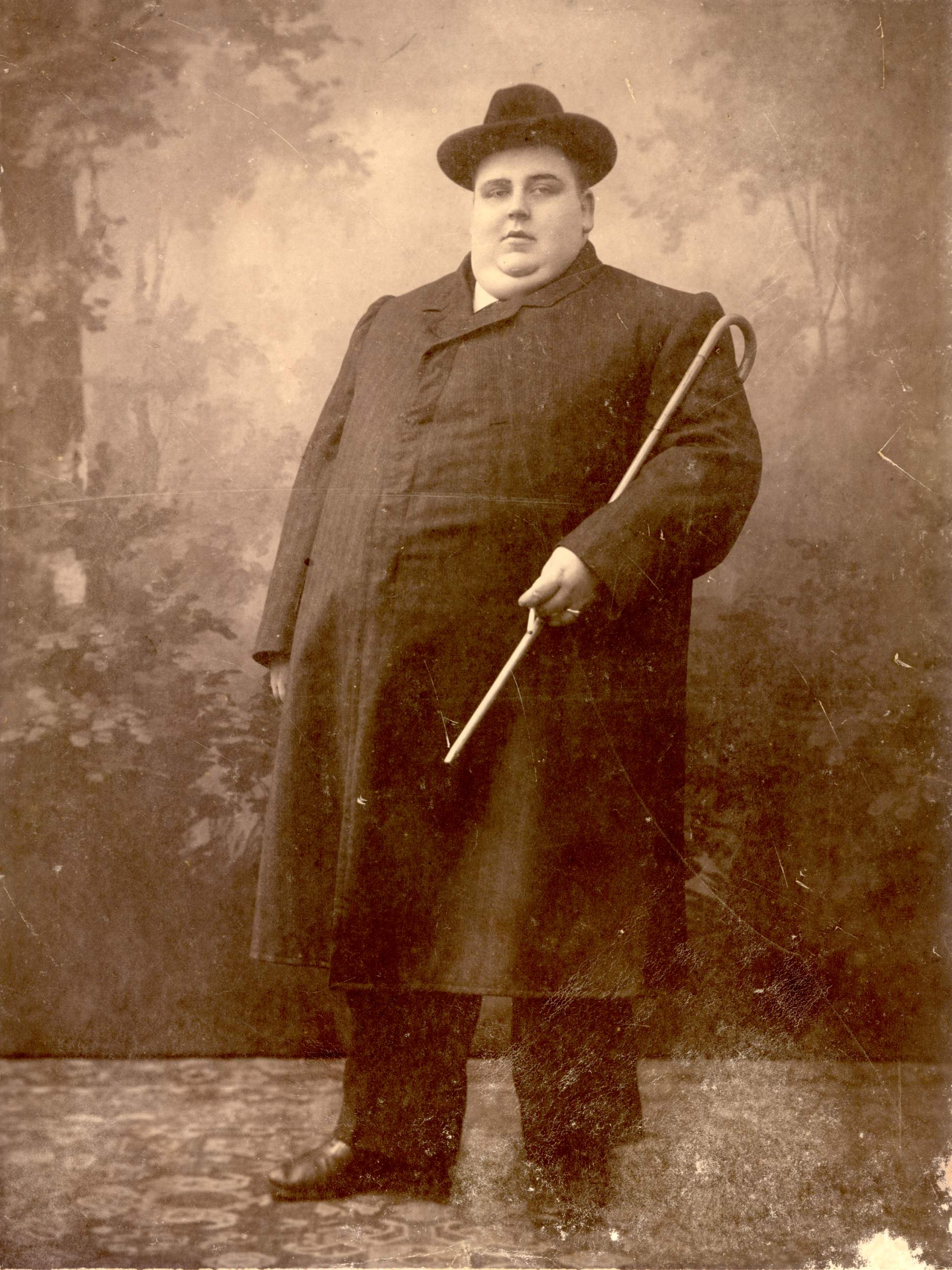
"I'll bet she's a daisy and I guess I'll get her, but I'll dream it over first."

Everyone in 19th-century Huntington, Long Island, was a complete ninny, so courtship wasn’t easy, as evidenced by an article in the September 3, 1893 Brooklyn Daily Eagle. An excerpt:

“Huntington has lots of pretty girls, and Joseph Schumaker is susceptible. Togged out to the limit of his salary as a compositor in a local printing office–kid gloves and cane not wanting–he fairly cut a swath on Saturday nights as he meandered through town. He gained access to the better society and was presented by friends to several young women who, according to his notions, would be pleased to become Mrs. Schumaker in the near future. His ardor outstripped his judgement, however, and in short order he was dismissed as being altogether too precipitate. Huntington girls favor long courtships, unless the catch is particularly handsome and flighty.

Joseph’s assiduity attracted the attention of his male associates, who had likewise noted the poor success with which his advances were meeting. Upon the advice of one of them he decided to try his luck out of town. He accordingly corresponded with a matrimonial agency in New York, giving his name as Joe Prescott and his address, Box 255, Huntington. His note to the agency met with prompt attention and the return mail brought him a letter assuring him of every success. A number of photographs of young women were also inclosed, with the guarantee that each was charming and anxious to marry. One photograph, named Evelyn No. 285, appealed more particularly to Joseph, who remarked: ‘I’ll bet she’s a daisy and I guess I’ll get her, but I’ll dream it over first.’

All this was last week. Schumaker’s dreams were propitious and he wrote Evelyn a letter in care of the agency. The agency reminded him that he had failed to make the remittance necessary to justify the disclosure of the young woman’s address, and that while she had read his letter, and was just dying to see him, she could not have his address or be allowed to see him unless the fees were sent at once.

"Togged out to the limit of his salary...kid gloves and cane not wanting...he fairly cut a swath on Saturday nights."

In the meantime several of Schumaker’s intimates fixed up an endearing letter, which purported to have been written by Evelyn, and sent it to him. The letter gave as her address a number on Third Avenue, New York, and urged him to call at once. The young man hastened to New York only to find himself the victim of a joke.

On his return he was informed that a man describing himself as the representative of Wellman’s matrimonial agency was in town searching for Joseph Prescott. Schumaker kept out of sight. The man applied to Postmaster Pearsall for the name of the owner of Box 255, and was told that no one by the name of Prescott lived in Huntington. Mr. Pearsall refused to divulge the name of the boxholder. The man has left town. Before he went he promised trouble for Prescott and also for the postmaster. He declared that the young woman listed as Evelyn was greatly smitten with Prescott’s style of writing and already loved him. Of the many hundreds of letters she had received, none had so impressed her as had Schumaker’s epistle. The agent also hinted that other Huntington people were in correspondence with marriageable women through the medium of their agency.”

Tags: , , ,

The Space Shuttle actually completed 135 missions. 1970s Air Force footage:

Nanobots are now a near-term reality. From ExtremeTech’s “Top 10 Tech Breakthroughs of 2011“:

Nanorobotics 

One of the most marked breakthroughs in 2011 was our control of nanorobotics, or nanobots. We now have the ability to control nanobots inside a living, breathing body, and using them to deliver highly-targeted medications — like cancer drugs — is now just a year or two away.

When you factor in autonomous ‘Constructicon’ robots and this year’s discovery of one-molecule electric motors and ‘nanocars,’ it’s also humbling to think how close we are to a reality with swarms of nanobots that fly or float around building and maintaining our towns and cities.”

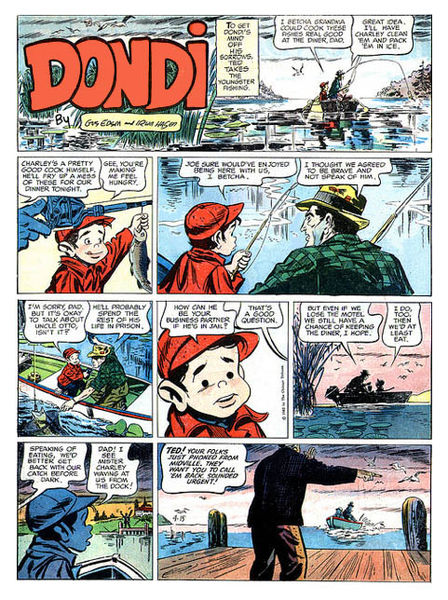
Irwin Hasen, longtime illustrator of Dondi, the once-popular comic strip about a war orphan, now draws fresh panels of the strip only on the walls of a Manhattan eatery. From Corey Kilgannon’s New York Times piece:

“From 1955 to 1986, Mr. Hasen spent nearly every day drawing the character, a lovable war orphan, for the syndicated daily strip that at its peak was carried by more than 100 newspapers.

Now, fresh Dondi cartoons are published only on the walls of the Nectar Café at Madison Avenue and 79th Street, where nearly every morning for the past 30 years Mr. Hasen has arrived at 8:30 on the dot to sit at the same stool at the counter.

Dondi’s endorsements of the diner, and cartoon versions of its employees, are posted above the grill and on the menu rack.

‘I call it Café Hasen — I’m the staff artist,’ said Mr. Hasen, who lives a block away. He has a corresponding evening constitutional: his 5:30 jaunt to the bar at Bistro Le Steak, on Third Avenue and 75th Street, for a martini.”

Tags: ,

David Frost welcomes the jaw-dropping trio of Duke Ellington, Billy Taylor and Willie “the Lion” Smith, 1969.

Laurel & Hardy deliver a piano, 1932 (colorized, sadly):

Tags: , , , , ,

"I have been turned down by a prostitute."

Why does the world hate fat men? (New York)

Today marks the 10 year anniversary of my last date. I have answered hundreds of ads and have not even had one woman on the face of this earth that has wanted to even have a first date. I am fat. I am 450 pounds. I have an emotional problem obviously. I have been turned down by a prostitute. I was told by a dating service that I should save my money because they didn’t think they could do anything for me. Loneliness and depression are all I have day in and day out. My friends tell me that I am a nice guy. They tell me that there is someone out there for everyone. It seems that fat people are the last universally acceptable group to tease or ignore. Every other group has at least themselves that they can fall back on, to socialize within and find someone. Unfortunately, it seems even fat women want nothing to do with fat men. 

Walt Disney on What’s My Line?, 1956. Jerry Lewis is a panelist.

Tags: ,

From a recent Drake Bennett Businessweek article about David Graeber, the anarchist anthropologist who is one of the more intriguing anti-leaders of the OWS movement:

Graeber is a 50-year-old anthropologist—among the brightest, some argue, of his generation—who made his name with innovative theories on exchange and value, exploring phenomena such as Iroquois wampum and the Kwakiutl potlatch. An American, he teaches at Goldsmiths, University of London. He’s also an anarchist and radical organizer, a veteran of many of the major left-wing demonstrations of the past decade: Quebec City and Genoa, the Republican National Convention protests in Philadelphia and New York, the World Economic Forum in New York in 2002, the London tuition protests earlier this year. This summer, Graeber was a key member of a small band of activists who quietly planned, then noisily carried out, the occupation of Lower Manhattan’s Zuccotti Park, providing the focal point for what has grown into an amorphous global movement known as Occupy Wall Street.

It would be wrong to call Graeber a leader of the protesters, since their insistently nonhierarchical philosophy makes such a concept heretical. Nor is he a spokesman, since they have refused thus far to outline specific demands. Even in Zuccotti Park, his name isn’t widely known. But he has been one of the group’s most articulate voices, able to frame the movement’s welter of hopes and grievances within a deeper critique of the historical moment. ‘We are watching the beginnings of the defiant self-assertion of a new generation of Americans, a generation who are looking forward to finishing their education with no jobs, no future, but still saddled with enormous and unforgivable debt,’ Graeber wrote in a Sept. 25 editorial published online by the Guardian. ‘Is it really surprising they would like to have a word with the financial magnates who stole their future?'”

••••••••••

Graeber in conversation with that avuncular capitalist, Charlie Rose;

Tags: ,

From Daniel Terdiman’s CNET article about IBM’s predictions for the next five years of technology:

“This time, the predictions are perhaps a bit more fanciful:

  • Mind reading is no longer science fiction.
  • You will be able to power your home with the energy you create yourself.
  • You will never need a password again.
  • The digital divide will cease to exist.
  • Junk mail will become priority mail.

It would seem the most interesting idea posited by IBM is the one about reading minds. But lest you think that what its scientists are saying is that you’ll be able to glare at a friend–or perhaps more importantly, an enemy–and know what he or she is thinking, that may be more than five years off. Rather, this is about how our brains might someday be synced with computing devices:

If you just need to think about calling someone, it happens. Or you can control the cursor on a computer screen just by thinking about where you want to move it.

Scientists in the field of bioinformatics have designed headsets with advanced sensors to read electrical brain activity that can recognize facial expressions, excitement and concentration levels, and thoughts of a person without them physically taking any actions.

Within five years, we will begin to see early applications of this technology in the gaming and entertainment industry. Furthermore, doctors could use the technology to test brain patterns, possibly even assist in rehabilitation from strokes and to help in understanding brain disorders, such as autism.”

Tags:

Kim Jong-Il, a diminutive despot who refused to go away, much like Mike Bloomberg, just died–too young, too young–but he sadly lived a full life. When he wasn’t busy dictating, Kim always kept his iron hand in the country’s movie industry. From an insane Mental Floss story by Jessica Royer Ocken about how the Dear Leader “recruited” a star director:

“Long before his father’s death in 1994, Kim Jong Il played supervisor to the North Korean movie industry. As such, he made sure each production served double duty as both art form and propaganda-dispersion vehicle. Per his instructions, the nation’s cinematic output consisted of films illuminating themes such as North Korea’s fantastic military strength and what horrible people the Japanese are. It was the perfect job for a cinephile like Kim, whose personal movie collection reportedly features thousands of titles, including favorites Friday the 13thRambo, and anything starring Elizabeth Taylor or Sean Connery.

Despite Kim’s creative influence on the industry during the 1970s (when he served with the country’s Art and Culture Ministries) and the fact that he literally wrote the book on communist filmmaking (1973’s On the Art of the Cinema), North Korean movies continued to stink. Frustrated, Kim sought help by forcing 11 Japanese ‘cultural consultants’ into servitude during the late 1970s and early 1980s, only to have several die inconveniently on the job (some by their own hands). But coerced consulting can only get a film industry so far, and North Korea was still in search of its Orson Welles. Then, in 1978, respected South Korean director Shin Sang Ok suddenly found himself out of work after he angered his own country’s military dictator in a spat over censorship, and Kim Jong Il saw his chance to harness Shin’s artistry.

Kim promptly lured Shin’s ex-wife and close friend, actress Choi Eun Hee, to Hong Kong to ‘discuss a potential role.’ Instead, she was kidnapped.

A distraught Shin searched for Choi, but found himself similarly ambushed by Kim’s minions. After some ‘convincing’—by way of some chloroform and a rag—he was whisked away to North Korea. Choi lived in one of Kim’s palaces, and Shin—having been captured after an attempted escape only months after arriving—lived for four years in a prison for political dissidents, where he subsisted on grass, rice, and communist propaganda.”

Tags: ,

The first paragraph of Brian Kim Stefans’ L.A. Review of Books article about Baroness Elsa von Freytag-Loringhoven, one of Dada’s leading ladies:

“The typical thumbnail portrait of the Baroness Elsa von Freytag-Loringhoven usually goes like this. She was the Queen of New York Dada from 1913 to 1923, the first to wear clothes made of discarded clothes and rubbish (including a brassiere made of tin cans). She constructed assemblage-style art in the manner of Marcel Duchamp, and her scatological proclivities may have inspired his seminal Fountain. She was prone to spontaneous ‘performance,’ often in the nude, and was sexually aggressive in a decidedly ‘masculine’ way. She courted Duchamp actively and mocked him in poems (dubbing him ‘M’ars’ — my arse), and chased right to his front lawn in Rutherford, New Jersey the relatively prudish doctor-poet William Carlos Williams, who, legend has it, learned how to box in order to deck her in self-defense.”

Tags: ,

May you live in interesting times, goes the sly, old Chinese curse. Some eras are more interesting than others, but they’re all fascinating in one scary way or another, not just these desperate times we’re facing now. FromThe Evil in the Room,” Norman Mailer’s 1972 Republican National Convention coverage from Miami, which he filed for Life:

“There were ghosts on the convention. And the sense of having grown old enough to be passing through life a second time. Flying to San Francisco in 1964 to write up the convention which nominated Barry Goklwater, he had met an Australian journalist who asked why Americans made the interior of their planes look like nurseries, and he had answered, in effect that the dread was loose in American life. Was it still loose, that sense of oncoming catastrophe going to fall on the nation like the first bolt from God? Such dread had taken many a turn–from fear of Communism to fear of walking the streets at night, which was a greater fear if one thought about it (since the streets were nearer). It was a fear when all was said which suggested that the nation, in whatever collection of its consciousness, was like a person who wakes up often in the middle of the night with the intolerable conviction that something is loose in the system, and the body is on a long slide from which there will be no remission unless a solution is found; the body does not even know where the disease is at. Nor will the doctors, is what the body knows in the dark.”

••••••••••

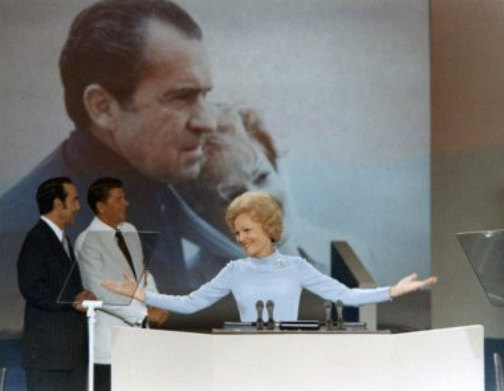
Occupying the GOP Convention, 1972: “Don’t hurt the car, don’t hurt the car!”

“It’s a very plastic, packaged thing”:

Tags:

A brief note from the wacky world of upholstery, from the October 21, 1886 Brooklyn Daily Eagle:

“A Chicago upholsterer, in repairing an old sofa that had been brought to his shop, found the following articles, which had slipped down between the back and cushion: Forty-seven hairpins, 8 mustache combs,19 suspender buttons, 13 needles, 8 cigarettes, 4 photographs, 217 pins, some grains of coffee, a few cloves, 27 cuff buttons, 6 pocket knives, 15 poker chips, a vial of homeopathic medicine, 34 lumps of chewing gum, 19 toothpicks, 28 matches and 14 buttonhooks. The sofa belonged to a man who had seven unmarried daughters.”

Tom Snyder marvels over a tiny Casio keyboard and some toy robots while interviewing Ric Ocasek and Greg Hawkes of the Cars, 1981.

Tags: , ,

"As we're more and more connected to each other, there's more and more to copy." (Image by Warren H. Chaney.)

I would guess there are as many if not more innovators than ever, though our interconnected world and the proliferation of information has made copying remarkably easy. Evolutionary biologist Mark Pagel meditates on this dynamic at Edge. An excerpt:

“The interesting thing with Facebook is that, with 500 to 800 million of us connected around the world, it sort of devalues information and devalues knowledge. And this isn’t the comment of some reactionary who doesn’t like Facebook, but it’s rather the comment of someone who realizes that knowledge and new ideas are extraordinarily hard to come by. And as we’re more and more connected to each other, there’s more and more to copy. We realize the value in copying, and so that’s what we do.

And we seek out that information in cheaper and cheaper ways. We go up on Google, we go up on Facebook, see who’s doing what to whom. We go up on Google and find out the answers to things. And what that’s telling us is that knowledge and new ideas are cheap. And it’s playing into a set of predispositions that we have been selected to have anyway, to be copiers and to be followers. But at no time in history has it been easier to do that than now. And Facebook is encouraging that.”

Tags:

Living beetle controlled remotely by DARPA technology.

"I feel like something is crawling all over me even as I send this to you." (Image by ThisParticularGreg.)

Larvae Found In Imported African Bras (showing up in NY)

It is horrible. Guys tell your wife, sisters, girlfriends, and girl cousins to wash bra before wearing.

All please wash all bras, underwear when you buy before wearing them. We do not know what parasite is in our clothes when we buy them. Forward to everybody you know. Let me fore warn you. Thiis is so  squimish. I feel like something is crawling all over me even as I send this to you. Be aware. It is so grotesque. Please wash your underwear before wearing. Preferably in boiling hot water. 

Despite what team owners pretending empty pockets say, new sports arenas benefit only them, not local economies, as study after study has shown. Yet taxpayers keep getting hustled and giving welfare to the wealthy. An excerpt from Patrick Hruby’s seething, spot-on Yahoo! Sports piece about the use of public funds to build a new stadium for the Miami Marlins and their wealthy art-dealer owner Jeffrey Loria:

“Following the financial meltdown of 2008, President Bush diagnosed the deus ex machina of the Great Recession like this: ‘Wall Street got drunk.’ He was wrong. Wall Street did not get drunk. Wall Street got over. Wall Street made billions underwriting crappy mortgagees, repackaging them as Triple-A investments and peddling them to naïve investors (read: your 401(k), state pension plans); made billions more placing side bets on and against the preceding criminal, but not technically criminal practice; made billions on top of that when the whole unsustainable shell game went belly up, thanks to a massive, unprecedented influx of taxpayer cash — again: your money — via TARP and the Federal Reserve’s money-for-nothing “discount window,” which in turn allowed financial houses to keep handing out the kind of outsized salaries and bonuses that had the encamped residents of Zuccotti Park so peeved.

Over in the sports world, the Marlins are running the same basic con.

‘They’re finally spending money? That’s a misnomer,’ says Ken Reed, Sports Policy Director for the League of Fans, a Washington, D.C.-based fan advocacy group affiliated with consumer advocate Ralph Nader. ‘To me, it’s more like taxpayers have funded the entry fee into this high-priced fantasy league, and the Marlins are going off and buying players with our money. I think this will go down as the ultimate case of corporate sports welfare gone bad.’

Sick of corporate bailouts? Occupy the Marlins.”

••••••••••

“Are you in?”:

Tags: ,

A brief passage about the history of the shopping cart, from a New York Times Magazine piece by Hilary Greenbaum and Dana Rubinstein:

“One night in 1936, [Sylvan] Goldman had an epiphany. ‘As he worked late in his office, his attention was drawn to two ordinary folding chairs,’ wrote Terry P. Wilson in The Cart That Changed the World, the seminal Goldman biography, published in 1978. What if, he wondered, one chair was placed on top of another? What if a basket was placed on top of each seat? What if it had wheels? The modern shopping cart was born.

Widely considered the inventor of the shopping cart, Goldman was no slouch as a promoter either. He ran ads in local newspapers that read, in part, ‘Can you imagine wending your way through a spacious food market without having to carry a cumbersome shopping basket on your arm?’ He stationed what he described as ‘an attractive girl’ near his store entrance to hype the new device. When it became clear that only the elderly were interested, he employed actors to push carts through his aisles.”

••••••••••

In addition to customers, actors sometimes portray fictional, folksy CEOs. If things had broken differently, these people could have been cast as horse trainers or secret agents or bank robbers. It’s just a costume.

Colonel Harlan Sanders:

Bartles & Jaymes :

Betty Crocker:

Tags: ,

One of John and Yoko’s odder gambits for world peace, Bagism, 1969.

Recalling the origins of Bagism with Dick Cavett, 1971 (at 2:28):

Tags: , ,


Some search-engine keyphrases bringing traffic to Afflictor this week:

Afflictor: Thinking even Rick Perry's staunchest supporters may be sending subliminal messages about his campaign. (Image by Lenore Edman.)

  • Ian Fleming explained James Bond’s propensity for violence, in 1964.
  • Technology has helped and hurt the United States Postal Service.
  • Drones help capture American cow poachers.

Allen Funt meets Muhammad Ali on Candid Camera.

Tags: ,

Warfare changed dramatically over the past decade with the development and deployment of Predator drones. With the wars abroad drawing down, drones will soon transform domestic policing in the U.S., whether we like it or not, even for cow poachers. From the Los Angeles Times:

“Armed with a search warrant, Nelson County Sheriff Kelly Janke went looking for six missing cows on the Brossart family farm in the early evening of June 23. Three men brandishing rifles chased him off, he said.

Janke knew the gunmen could be anywhere on the 3,000-acre spread in eastern North Dakota. Fearful of an armed standoff, he called in reinforcements from the state Highway Patrol, a regional SWAT team, a bomb squad, ambulances and deputy sheriffs from three other counties.

He also called in a Predator B drone.

As the unmanned aircraft circled 2 miles overhead the next morning, sophisticated sensors under the nose helped pinpoint the three suspects and showed they were unarmed. Police rushed in and made the first known arrests of U.S. citizens with help from a Predator, the spy drone that has helped revolutionize modern warfare.”

••••••••••

Cow, perturbed by surveillance:

Douglas Englebart recalls creating the computer mouse during the 1960s.

Mother of all demos, 1968:

Tags:

« Older entries § Newer entries »