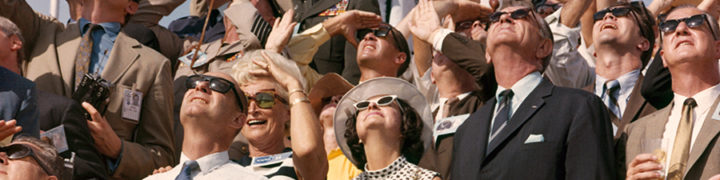
Gene Kelly performing some steps with boxer “Sugar” Ray Robinson on Omnibus, 1958.
Tags: "Sugar" Ray Robinson, Gene Kelly
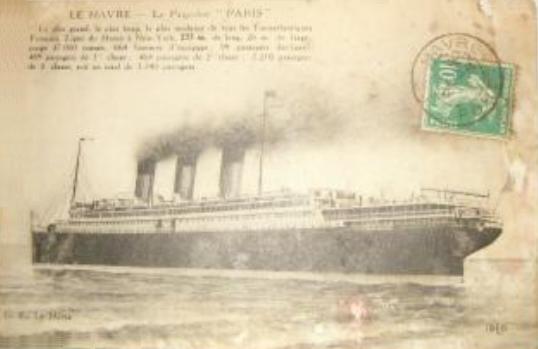
From “We’re All in the Same Boat–Aren’t We?” an excellent Adam Curtis BBC piece outlining the hidden history of the cruise-ship industry:
“I want to tell the story of the rise of the modern cruise ship industry from its beginning in the 1960s – how it promised to make a world of aristocratic luxury available to everyone in the west, but also the hidden story of how that promise was achieved.
In many cruise ships there are hundreds of workers from some of the poorest countries on earth who are paid minute amounts of actual wages – sometimes less than two dollars a day – to attend to the passengers’ needs.
Many of the ships’ workers can only get a living wage on the whim of the thousands of passengers above them – on the tips they choose to give them. And in the strange fun-world of the superliners the waiters, the cabin staff, the cooks and everyone else who serves, live in a state of continual vulnerability – unprotected by most of the employment laws that apply on land. Meanwhile many of the companies that own the vast ships pay practically no tax at all.
But it wasn’t always supposed to be like that.
The biggest company in the cruising world is the Carnival Corporation, based in Miami (the Costa Concordia is owned by one of their subsidiaries). Carnival has its roots in a small company set up in the 1960s which had a utopian vision that cruise liners could transform the world. One of its founders believed that the giant ships were machines that could help bring about a new era of world peace.
The liners would, he was convinced, unite the rich westerners and the poor from the ‘third world’ by bringing tourists to new and remote destinations. This would foster a new enlightened understanding of each other that would bring about equality and justice throughout the world.
But it didn’t turn out like that. And this is the story of what happened – and how the very opposite resulted.” (Thanks Browser.)
Read also:
Tags: Adam Curtis
“Design” is a fun 1969 pitch film that the legendary designer Saul Bass made for Bell Telephone when he was reimagining the company’s logo.
The great Kurtis Blow, 1980, Soul Train: “And Ma Bell sends you a whopping bill / With eighteen phone calls to Brazil.”
Tags: Kurtis Blow, Saul Bass
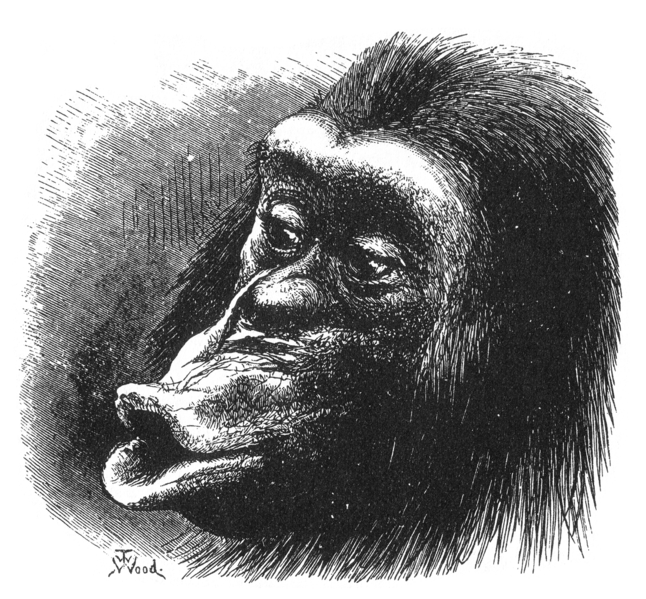
"He claimed also to be perfectly familiar with the languages of cats and dogs and to speak the languages of apes."
A real-life Doctor Dolittle, Frenchman Jules Richard talked to animals–and despised priests. An article about him from the July 21, 1893 Brooklyn Daily Eagle, which was originally published in Popular Science Monthly:
“In 1857 Jules Richard had occasion to visit a sick friend in a hospital, where he made the acquaintance of an old official of the institution from the south of France, who was exceedingly fond of animals, his love of them being equaled only by his hatred of priests; he claimed also to be perfectly familiar with the languages of cats and dogs and to speak the languages of apes even better than the apes themselves. Jules Richard received the statement with an incredulous smile, whereupon the old man, whose pride was evidently touched by such skepticism, invited him to come the next morning to the zoological garden.

"He was exceedingly fond of animals, his love of them being equaled only by his hatred of priests."
‘I met him at the appointed time and place,’ says Mr. Richard, ‘and we went together to the monkeys’ cage, where he leaned on the outer railing and began to utter a succession of guttural sounds, which alphabetical signs are scarcely adequate to represent–kirruu, kirrikie, kuruki, kirikiu–repeated with slight variations and differences of accentuation. In a few minutes the whole company of monkeys, a dozen in number, assembled and sat in rows before him with their hands crossed in their laps or resting on their knees, laughing gesticulating and answering.’
The conversation continued for a full quarter of an hour to the intense delight of the monkeys, who took a lively part in it. As their interlocutor was about to go away they all became intensely excited, climbing up on the balustrade and uttering cries of lamentation. When he finally departed and disappeared more and more from their view they ran up to the top of the cage and, clinging to the frieze, made motions as if they were bidding him goodbye. It seemed, adds Mr. Richard, as though they wished to say. ‘We are sorry to part and hope to meet again, and if you can;t come do drop us a line!'”
Tags: Jules Richard
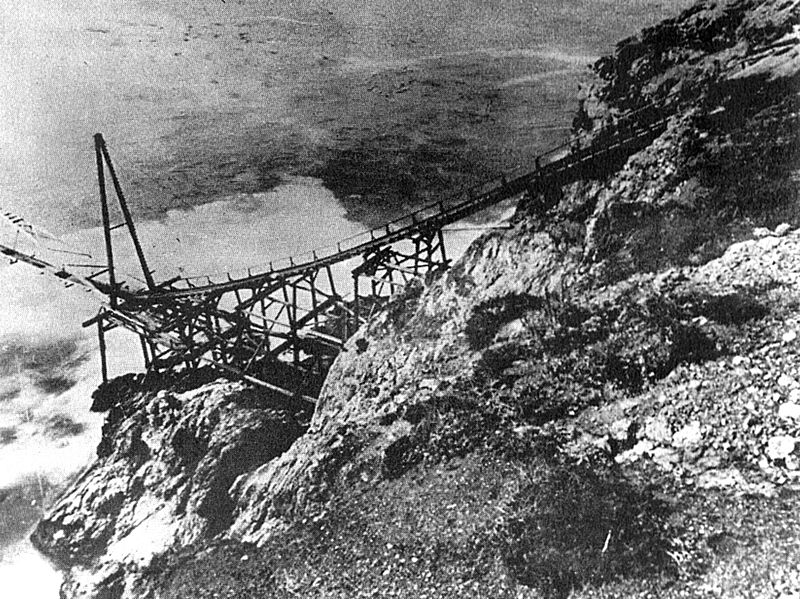
In 1969, Hunter S. Thompson published “It Ain’t Hardly That Way No More,” an account of gentrification washing over the bohemian California enclave of Big Sur, where he had lived at the beginning of his journalism career. The article’s opening:
“Will Liz Taylor change Big Sur?”
That was the question the San Francisco Examiner‘s society columnist asked the world recently, after she had scrambled, along with other minions of the West Coast press, to report the doings of Elizabeth Taylor and Richard Burton in California’s most famous “Bohemia,” a mountainous and sparsely populated stretch of coastline some 150 miles below San Francisco.
The occasion was the filming of a few scenes for a movie called The Sandpiper, starring Liz as a lady painter with a yen for rocky beaches and Dick as an offbeat beachcomber with a yen for lady painters. The scenes were shot here because Big Sur has some of the most spectacular scenery in America: booming surf, rocky beaches, and pine-topped mountains slanting straight to the sea.
In the years after World War II this rugged South Coast, as the oldtimers call it, got a valid reputation as a hideaway for artists, writers, and other creative types. Local history abounds with famous names. Henry Miller, author of Tropic of Cancer and Tropic of Capricorn, lived here for 19 years. The late Robinson Jeffers was Big Sur’s original poet laureate, and folk singer Joan Baez is still considered a local, although she recently moved to Carmel Highlands, a few miles north. Other famous residents have been Dennis Murphy, author of a best seller called The Sergeant, prize-winning poet Eric Barker, sculptor Benjamin Bufano, and photographer Wynn Bullock. Unfortunately, that era is just about ended. Big Sur is no longer a peaceful haven for serious talent, but a neurotic and dollar-conscious resort area.•
Tags: Elizabeth Taylor, Hunter S. Thompson, Joan Baez, Richard Burton
I’m always posting clips from What’s My Line?, the 1950-67 quiz show in which a panel attempts to guess the identity of mystery guests. It’s incredibly addicting Youtube viewing because the program had an amazing roster of guests, from Eleanor Roosevelt to Brian Epstein to the last living witness of the Lincoln assassination. But the show on November 7, 1965 was particularly poignant, even though the celebrity guest was merely Joey Heatherton, who was best known for being breathy and blond.
That episode marks the final appearance of longtime panelist Dorothy Kilgallen, a New York newspaper columnist. A few hours after the live broadcast, Kilgallen overdosed on alcohol and barbiturates, dying alone in her apartment. The following morning her hairdresser discovered her lifeless body.
That would have been the end of the story, a drug-related death, an accident or, perhaps, suicide, except that Kilgallen had been an outspoken critic of the Warren Commission and had become a confidante of Jack Ruby. She promised publicly that she had information which would explode the commission’s findings about the JFK assassination and complained privately to friends that she believed she was under surveillance. In the wake of a shadowy murder of an American President, many wondered–some still do–if Kilgallen was silenced by foul play. My assumption is that her death was simple and sad, but the conspiracy theory speaks to the distrust people had for the government at the time.
The final guest, after Heatherton, is pioneering female sportswriter, Elinor Kaine.
Tags: Dorothy Kilgallen, Elinor Kaine

I disagree with many of Nick Carr’s concerns about the Internet, though I always find him a really smart and lively thinker. I don’t believe new media will necessarily make us a lot smarter–at least not in the short term–but I don’t think it’s turned us from a contemplative nation of readers of thick Russian novels into pinheads. I mean, when did that earlier nation even exist? When was it ever going to exist? An excerpt from “We Turn Ourselves Into Media Creations,” a new inteview by Lars Mensel in The European in which Carr makes some points about social networking:
“Carr: There are social pressures and brain chemicals that encourage us to stay connected: It becomes very difficult to cut ourselves off from the flow of information. As technology becomes ever more deeply woven into our social processes and expectations, it becomes something more than just a matter of personal discipline. In their jobs, many people face the expectation to always monitor messages and emails coming from colleagues or clients. That pressure goes on even when they leave work and go home; they are still constantly checking information. Thanks to Facebook, social networking and other communication tools, there is now a situation where similar pressures are arising in our social lives: People you know are using online tools to plot their social lives and exchange information – it makes you feel compelled to also always be monitoring information. Obviously that doesn’t mean we don’t have free will or the choice to disconnect, we shouldn’t miss the fact that it is – like earlier technology such as the automobile – being woven so deeply into society that it is not just a matter of personal discipline to decide how to use it.
The European: A study has shown that using Facebook causes people to romanticize other peoples’ lives whilst seeing their own in a negative light: It is because people share predominately good news of flattering photos…
Carr: I saw a study that examined how people regard their Facebook friends and when somebody admired the exciting life of a friend, this friend often said exactly the same about them. It shows you how we turn ourselves and each other into media creations through social networks. As with celebrities and other media personalities, the reality can be very different from how we present ourselves online.” (Thanks Browser.)
Tags: Lars Mense, Nicholas Carr

From Tiffany Kaiser’s DailyTech piece about Berkeley researchers making a breakthrough in the translation of brainwaves into words, which could create communication possibilities for those unable to speak–and all sorts of ethical quandaries:
“At some point in the near future, mind-reading could be a power possessed not only by fictional characters like Professor Charles Xavier (Professor X), but also real-life researchers who are searching for ways to help individuals who have lost their ability to speak.
Robert Knight, of the Helen Wills Neuroscience Institute at the University of California – Berkeley, and Brian Pasley, a scientist in Knight’s lab at UC Berkeley, have successfully translated brain activity into words.
The team was able to do this by recruiting the cooperation of 15 patients, who were already in the hospital for intractable epilepsy treatment. This particular operation requires removal of the top of the patient’s skull, where a net of electrodes are then placed along the surface of the brain. Theelectrodes identify the origin areas of the patient’s fit, and that particular tissue is eliminated.”
Tags: Brian Pasley, Robert Knight, Tiffany Kaiser
Alistair Cook brought his Omnibus TV show into the New York Times newsroom in 1954 to see how men–and only men–published news in that era. Listen to those clunky typewriter keys tapping. Notice the lack of a healthy blue glow on the faces of the editors.
A piece of this Cook clip was included in the excellent doc about the latter-day Gray Lady, Page One:
Tags: Alistair Cook

"My guys would love to eat some fresh roadkill."
Roadkill for my dogs (Phillipsburg)
I’m looking for deer to feed to my dogs if you see any dead deer. My guys would love to eat some fresh roadkill…& I need to save some money on dog food so I can pay my vets for services. Thanks Peter 3dogs.

This classic photograph from the early 1900s captures a group breathing activity at the Battle Creek Sanitarium in Michigan, which became one of the most famous health resorts in the world under the stewardship of Dr. John Harvey Kellogg, a brilliant if eccentric doctor, a holistic enthusiast and an enterprising Adventist. Originally established in 1866 as the Western Health Reform Institute, Kellogg’s spa offered restorative hydrotherapy, diet, exercise, enemas and vibratory chairs. The good doctor also was co-inventor of the cornflake with his brother, Will Keith Kellogg. The sanitarium remained open until the 1940s when it was purchased by the U.S. government and converted into an Army hospital. An excerpt from the 1943 New York Times obituary for Kellogg, who lived until 91:
“A determined practitioner of the rules for simple eating and living he preached for all humanity, Dr. Kellogg was perhaps the best example of the truth of his own dogmas.
When he became a physician Dr. Kellogg determined to devote himself to the problems of health, and after taking over the sanitarium he put into effect his own ideas. Soon he had developed the sanitarium to an unprecedented degree, and he launched the business of manufacturing health foods. He gained recognition as the originator of health foods and coffee and tea substitutes, ideas which led to the establishment of huge cereal companies besides his own, in which his brother, W. K. Kellogg, produced the cornflakes he invented. His name became a household word.
Dr. Kellogg’s youth was one of hard work. Born in Tyrone, N. Y., on Feb. 26, 1852, he moved to Battle Creek with his parents, John Preston and Ann Jeanette Kellogg, at an early age. He worked in his father’s broom factory and also served as a ‘printer’s devil’ in Battle Creek publishing houses.”
••••••••••
Anthony Hopkins as Kellogg in the 1994 film adaptation of T.C. Boyle’s novel, The Road to Wellville:
Conversational bot with a brain that’s a mesh of wires. Just like you and I.
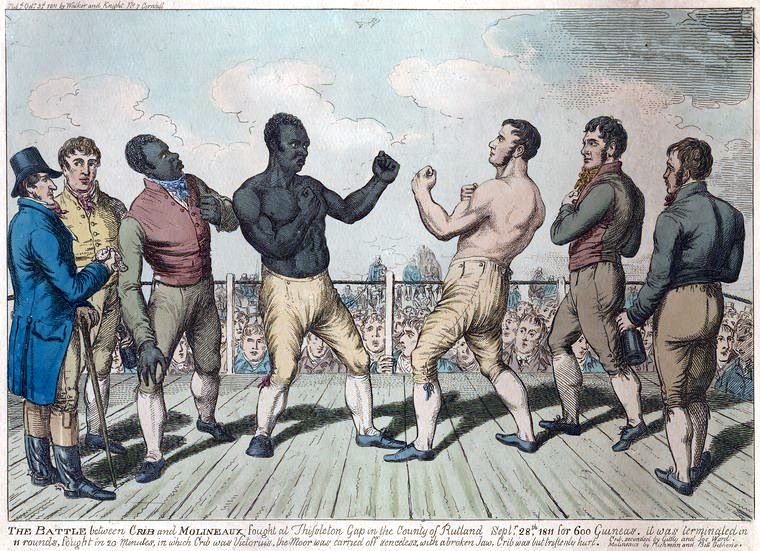
The opening of “A Fighter Abroad,” Brian Phillips’ smart Grantland article about an 1810 boxing match, noted for its brutality, hoopla and racial politics, which helped birth modern sports:
“On December 10, 1810, in a muddy field around 25 miles from London, a fight took place that was so dramatic, controversial, and ferocious that it continues to haunt the imagination of boxing more than 200 years later. One of the fighters was the greatest champion of his age, a bareknuckle boxer so tough he reportedly trained by punching the bark off trees. The other was a freed slave, an illiterate African-American who had made the voyage across the Atlantic to seek glory in the ring. Rumors about the match had circulated for weeks, transfixing England. Thousands of fans braved a pounding rain to watch the bout. Some of the first professional sportswriters were on hand to record it.
It was the greatest fight of its era. But its significance went beyond that. Even at the time, it seemed to be about more than boxing, more than sport itself. More than anything, the contest between a white English champion and a black American upstart seemed to be about an urgent question of identity: whether character could be determined in the boxing ring, whether sport could confirm a set of virtues by which a nation defined itself.
The fight cemented a set of stock characters — the fast-talking, ultra-talented, self-destructive black athlete; the Great White Hope; the canny coach who’s half devoted to his pupil and half exploiting him — that have echoed down the centuries. In fact, so much about the fight feels familiar today, from the role of race to the role of the media, that if you had to name a date, you could make a good case that December 10, 1810, was the moment sport as we know it began.”
Tags: Brian Phillips, Tom Molineaux

A paperback is still my favorite medium for reading. Don’t care for cloth books because I’m a reader, not a collector. Don’t like trade paper because those were made oversized just to jack up the price, and they can’t slide into a pocket. But while I do not own an e-reader yet, I can’t say I have any major problem with them. Jonathan Franzen, however, does. From Anita Singh’s Telegraph piece about Franzen’s criticism of e-books:
“The author of Freedom and The Corrections, regarded as one of America’s greatest living novelists, said consumers had been conned into thinking that they need the latest technology.
‘The technology I like is the American paperback edition of Freedom. I can spill water on it and it would still work! So it’s pretty good technology. And what’s more, it will work great 10 years from now. So no wonder the capitalists hate it. It’s a bad business model,’ said Franzen, who famously cuts off all connection to the internet when he is writing.
‘I think, for serious readers, a sense of permanence has always been part of the experience. Everything else in your life is fluid, but here is this text that doesn’t change.'”
Tags: Anita Singh, Jonathan Franzen
Jacques Cousteau, surfacing briefly in 1956 to appear on What’s My Line? Just-retired Yankee Phil Rizzuto on the panel.
Tags: Jacques Cousteau, Phil Rizzuto
 Higher Ground
Vera Farmiga’s sharp directorial debut, an adaptation of Carolyn S. Briggs’ memoir about her uneasy attempt to find a state of grace in a 1970s spiritual community, is wise enough to realize that life doesn’t always offer closure, but instead sometimes continues tormenting like an open wound. Corinne (played as an adult by Farmiga) comes from a broken home, gets pregnant young, and tries to live within a traditional Christian community that expects subservience from women. Over time, her relationship with her husband and neighbors falter, but it’s Corinne’s skittish relationship with God that founders the most after her best friend becomes desperately ill. A large cast provides uniformly excellent performances, but it’s Farmiga herself who ultimately devastates with an impassioned, confused speech to the flock near film’s end. Watch trailer.
••••••••••
 The Black Power Mixtape 1967-1975
An invaluable document from the militant stage of the American Civil Rights movement, Göran Olsson’s documentary collects footage shot by a group of Swedish journalists who visited America trying to figure out what the hell was going on. And they weren’t the only confused ones. As footage unfolds in chronological order, we see incredibly intelligent and desperate young Americans of color trying to make a place for themselves by (almost) any means necessary. Especially poignant is a passage in which a flummoxed Angela Davis, in prison awaiting trial, explains the obvious: that most violence in America wasn’t perpetrated by people with black skin. No matter how familiar you are with the era, much of the footage startles, often revealing what wasn’t apparent to American eyes at the time, perhaps not even to Swedish eyes–just how innocent, fragile, and, yes, even frightened, these supposedly scary people looked. Watch trailer.
••••••••••
 Senna
Senna
From go-karts to Formula One, Brazilian race car driver Ayrton Senna lived for speed, willing to risk his life for the glory of the checkered flag. Senna wasn’t using auto racing to flee a favela, wasn’t leaving behind an illicit past, like Junior Johnson outpacing the bootlegger’s life. He was the son of privilege, a good Christian, who for some reason simply needed to drive faster than anyone in the world. Asif Kapadia, the documentary’s director, wisely doesn’t try to explain why–some things are innate and unknowable–but instead follows the arc of Senna’s dramatic story as his subject becomes a three-time world champion during the ’80s and ’90s and a huge idol in his struggling homeland, as industry politics, countless crashes and technological changes hound him at every turn. If you listen closely as he navigates those unforgiving angles, you soon begin to notice that screeching tires sound a lot like ambulance sirens. Watch trailer.
See also:
More recent films I liked: Certified Copy, Another Earth, The Arbor.
Tags: Asif Kapadia, Göran Olsson, Vera Farmiga
It’s amazing how little effect a disgraced Richard Nixon’s resignation had on the future of the GOP. It cost the Republicans the White House in 1976, but his party has held the Oval Office more often than not since. And Nixon’s brand of conservatism, which at least had some room for environmentalism and Affirmative Action, has all but vanished from the Right. In 1967, before he was President, Nixon discussed the GOP’s future with William F. Buckley, Jr.
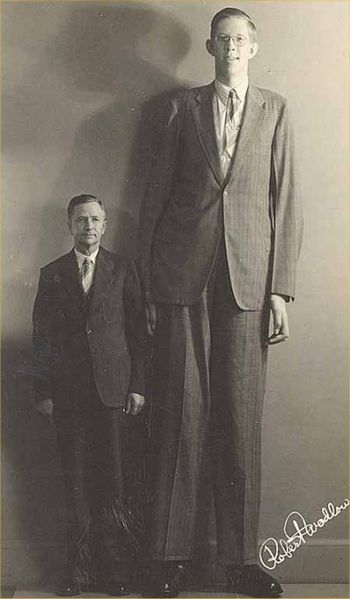
"There is absolutely no relation between intelligence and stature."
While it’s true that taller people aren’t necessarily smarter than shorter people, that would seem to be the only correct scientific fact presented by Dr. Charles E. Woodruff in this January 6, 1901 article from the Brooklyn Daily Eagle. An excerpt:
“From investigations among soldiers and from the literature on the subject, there is no doubt in my own mind that if a man’s development is so unstable that he has physical stigmata, he is invariably of bad physical development also. As far as I know, there are few, if any, cases of abnormal minds in average bodies devoid of stigmata. It is a fair inference, then, that if a man’s body is nearly an average in all respects–height, weight, proportions, etc.–there must also be an average brain, and, therefore, a normal mind–excluding. of course, normal men who have acquired insanity. Beyond this we dare not go, for there is absolutely no relation between intelligence and stature. Men of genius may be big, like Bismarck, or little, like Napoleon or Da Costa, and the same may be said of the feeble-minded as well as those of average intelligence. George Washington’s physical measurements are said to have been identical with those of Jeffries, the giant pugilist. Other illustrations might be given indefinitely.
It is true that the human brain weight depends upon the body weight, for the muscles require many brain cells. In like manner the sparrow needs but a few grains of brain, while the whale and the elephant must have more than man. Yet the indescribable and immeasurable variable called intelligence depends upon other things in addition to weight of brain, and the increased stature consists of tissue which may not and probably does not, have any bearing on intelligence.
A big physique, with immense reserve power and endurance, is a decided element in forcing men to the front in the struggle of life. This is in accordance with recent investigations among Chicago school children, which are said to show that the best scholars in any class are apparently bigger than the rest. Hence, other things being equal, the big men, having an advantage, should have a larger percentage of their number successful than the little men. Yet, statistics show the very opposite, for Lambroso mentions (“Man of Genius,” page 6) but twenty-six great men of tall stature, while he names fifty-nine who are short, some of them being even dwarfish or less than five feet in height. As the anomalies of height are equally distributed to each side of the mean, there must be some tremendously active cause to make the little men more than twice as brilliant as the big. The two classes, being equally removed from the average, should be equally abnormal mentally.”

From David Sheff’s 1989 Rolling Stone interview with the late artist Keith Haring, who used spare subway station panels as his canvas:
“How did you begin drawing in the subways?
One day, riding the subway, I saw this empty black panel where an advertisement was supposed to go. I immediately realized that this was the perfect place to draw. I went back above ground to a card shop and bought a box of white chalk, went back down and did a drawing on it. It was perfect – soft black paper; chalk drew on it really easily.
I kept seeing more and more of these black spaces, and I drew on them whenever I saw one. Because they were so fragile, people left them alone and respected them; they didn’t rub them out or try to mess them up. It gave them this other power. It was this chalk-white fragile thing in the middle of all this power and tension and violence that the subway was. People were completely enthralled.
Except the police.
Well, I was arrested, but since it was chalk and could easily be erased, it was like a borderline case. The cops never knew how to deal with it. The other part that was great about it was the whole thing was a performance.
When I did it, there were inevitably people watching – all kinds of people. After the first month or two I started making buttons because I was so interested in what was happening with the people I would meet. I wanted to have something to make some other bonding between them and the work. People were walking around with little badges with the crawling baby with glowing rays around it. The buttons started to become a thing now, too; people with them would talk to each other, there was a connection between people in the subway.
The subway pictures became a media thing, and the images started going out into the rest of the world via magazines and television. I became associated with New York and the hip-hop scene, which was all about graffiti and rap music and break dancing. It had existed for five years or more, but it hadn’t really started to cross over into the general population. It was incredibly interesting to me that it was reaching all kinds of people in different levels from different backgrounds. Then, in 1982, I had my first one-man show in New York at a big gallery, Tony Shafrazi, in SoHo.” (Thanks Longform.)
••••••••••
“You are known as the Michelangelo of the New York subway”:
Tags: David Sheff, Keith Haring
Don’t believe your psychic family member or friend? (NYC)
Anyone out there have a family member or friend who claims to be psychic but you believe they’re lying or potentially delusional?
Elsa Lanchester, most famously Frankenstein’s bride in 1935, chatting up Dick Cavett in 1970. Her longtime husband, Charles Laughton, was famously childish in his recreational tastes, often dragging people, including Ray Bradbury, to Disneyland, one of his favorite places.
Woman notices streak of gray in hair, settles for brain-dead douchebag with bolts in neck:

Piers Morgan: Different guests, same questions. (Image by Pete Riches.)
Great Britain remained Afflictor Nation champion in January by sending more unique visitors to this site than any other foreign nation. Here are the Top 5 finishers:
- Great Britian
- Canada
- Germany
- Netherlands
- Sweden
As Kevin Kelly is wont to say, no tool or technology we’ve ever created has become completely extinct. The following reports concern the “last” typewriter repairman. After they’re all gone, there will still somehow be a few typewriters and a few people who can fix them. Likely, someone will continue manufacturing typewriters for a niche market. They will exist in the margins, but they will never end.
••••••••••
Jacksonville:
Chicago:
Houston:
Read also:
Tags: Kevin Kelly

Provided it’s done in a safe and healthy way, I’m in favor of all sorts of performance enhancement. The idea of human “purity” is a lie that we tell ourselves while behaving counter to it. In his post, “The Ethics of Brain Boosting,” Jonathan Wood examines the ramifications of transcranial direct current stimulation or TDCS, which seems to enhance brain function. An excerpt:
“Dr Roi Cohen Kadosh, who has carried out brain stimulation studies at the Department of Experimental Psychology, very definitely has a vision for how TDCS could be used in the future: ‘I can see a time when people plug a simple device into an iPad so that their brain is stimulated when they are doing their homework, learning French or taking up the piano,’ he says.
The growing number of positive results in early-stage studies, led the neuroscientists Dr Cohen Kadosh and Dr Jacinta O’Shea to talk to Professor Neil Levy, Dr Nick Shea and Professor Julian Savulescu in the Oxford Centre for Neuroethics about what ethical issues there may be in future widespread use of TDCS to boost abilities in healthy people.
The researchers outline the issues in a short paper in the journal Current Biology, and indicate the research that is now necessary to address some of the potential concerns.
‘We ask: should we use brain stimulation to enhance cognition, and what are the risks?’ explains Roi. ‘Our aim was to look at whether it gives rise to new ethical issues, issues that will increasingly need to be thought about in our field but also by policymakers and the public.’” (Thanks Browser.)
Tags: Jonathan Wood, Roi Cohen Kadosh