Former heavyweight champ Jack Dempsey, the “Manassa Mauler,” the most famous athlete on earth during the 1920s, on What’s My Line?, 1965. During the interview segment, Dempsey suggests that the Ali-Liston fight was bogus.

In 1927, at the end of his run of dominance thanks to age and Gene Tunney, while he was training for a return to greatness which would never arrive, Dempsey suffered a personal tragedy when his brother, John, murdered his wife and committed suicide. An excerpt from a July 3, 1927 New York Times article:

“Schenectady–Apparently in a spell of temporary insanity due to a recurring attack of an illness to which he had been subject for several years, John Dempsey, brother of the former heavyweight champion, fatally shot his 21-year-old wife, Edna, in a rooming house here today. He turned the gun on himself, dying instantly.

The Dempseys had been estranged for about a year. They are survived by a two year-old son, Bruce.

Jack Dempsey was deeply affected when notified at his training camp at White Sulphur Springs, Saratoga Lake. He came at once to Schenectady and positively identified the bodies.

The boxer ordered his brother’s body to be sent tonight for burial to Salt Lake City, his former home, and Mrs. Dempsey’s body to be taken to Green Island.

It was announced that Jack Dempsey would cease his training activities for a few days because of the tragedy, but would not cancel his match with Sharkey, set for July 21 in New York City.”

See also:

Tags:

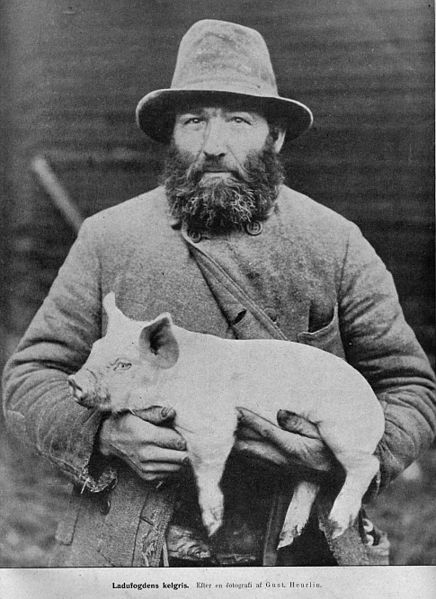
"One of the greatest department stores in the West was the creation of a man who used to exhibit an educated pig in a travelling circus."

From a 1901 edition of Ainslee’s Magazine:

“The department store is an evolution of the dry goods store, which exists no longer as an ambitious retail business. One of the greatest department stores in the West was the creation of a man who used to exhibit an educated pig in a travelling circus. When his estate was probated it was appraised at $15,000,000. This man opened a small dry goods store in Chicago and annexed one business after another in his neighborhood until he owned what some declare was the first department store in America. However that may be, the idea is older in England and France.”

Industry has poisoned the environment in the past, so it’s possible mysterious illnesses can arise from chemical dumping or such behaviors. But more often we simply want to believe that the cause of our trouble is outside of ourselves, that there is a culprit somewhere else. And clusters can form. We saw it just recently with the nonsense about immunizations supposedly causing autism. The brain is mysterious and we’re often at the mercy of it, to its demands and delusions.

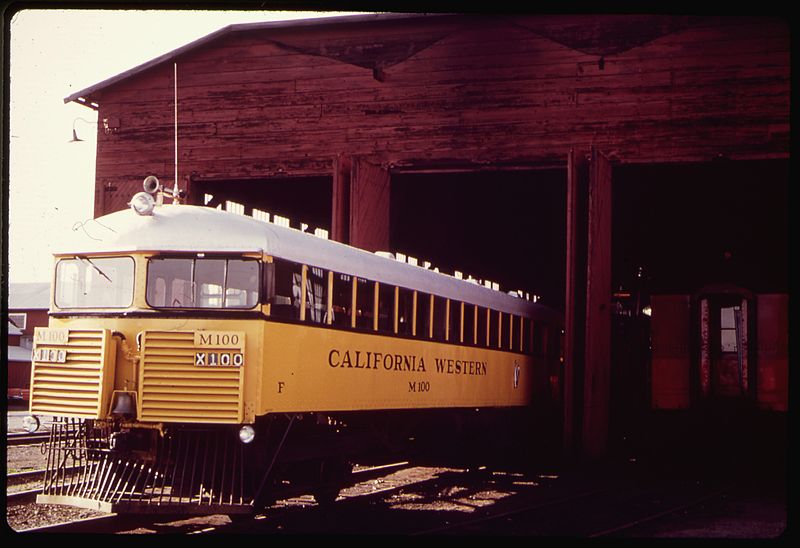
From Stanford history professor Richard White’s answer to the question, “Does California need a high-speed rail line, ultimately connecting San Francisco to Los Angeles?” in the New York Times:

“We shouldn’t build it. At best it will not solve any problems for decades to come, and at worst it will become an expensive problem itself. It will become a Vietnam of transportation: easy to begin and difficult and expensive to stop.

In a state dismantling its education system and watching its existing infrastructure collapse, it is criminally profligate to build a system that will drain revenue from more-needed projects. This is like building a state-of-the-art driveway while your house collapses.

Highway 5 between Los Angeles and San Francisco is miserable, but it is not the key transportation problem in California. For high-speed rail to work, it needs to get people out of cars, but the project doesn’t touch the huge mass of traffic, which swirls daily in the Los Angeles and San Francisco metropolitan areas. High-speed rail between Boston and Washington, D.C., connects trains with functioning public transportation systems. This is not true in Los Angeles nor in large parts of the Bay area.”

Tags:

“Here in my car / You know I’ve started to think / About leaving tonight / Although nothing seems right.” Created by OgilvyWest for Cisco Systems.

"GO GIANTS."

TWO GIRLS DESPERATE FOR SUPER BOWL TICKETS – $1000 (NEW YORK, NY)

WE ARE TWO VERY LOVELY GIRLS IN OUR MID 20’S WHO NEED TICKETS TO THE SUPER BOWL

WE SADLY CANNOT PAY $2000 A TICKET BUT CANT A KIND SOUL HELP US GET IN SOMEHOW?

WE HAVE A CAR AND WE CAN DRIVE THERE FROM NYC.

PLEASE HELP US!!!!!!!!!!!!!!!!!!!!!!!! WE NEED TO GET TO INDY!!!!!!!!!!!!!!!!!!!!!!!!!!

GO GIANTS

Carrie Brownstein, now a comedy star for Portlandia and already an indie rock icon for Sleater-Kinney, had a wordless role in Miranda July’s odd, haunting 2001 short, “Getting Stronger Every Day.”

Tags: ,


Some search-engine keyphrases bringing traffic to Afflictor this week:

Afflictor: Thinking it's nice that some of Newt Gingrich's wives agreed to the open marriage.

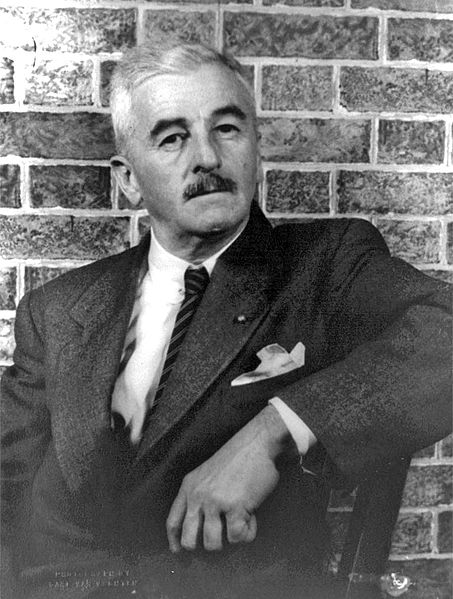
  • William Styron wrote a Life article about William Faulkner’s death in 1962.

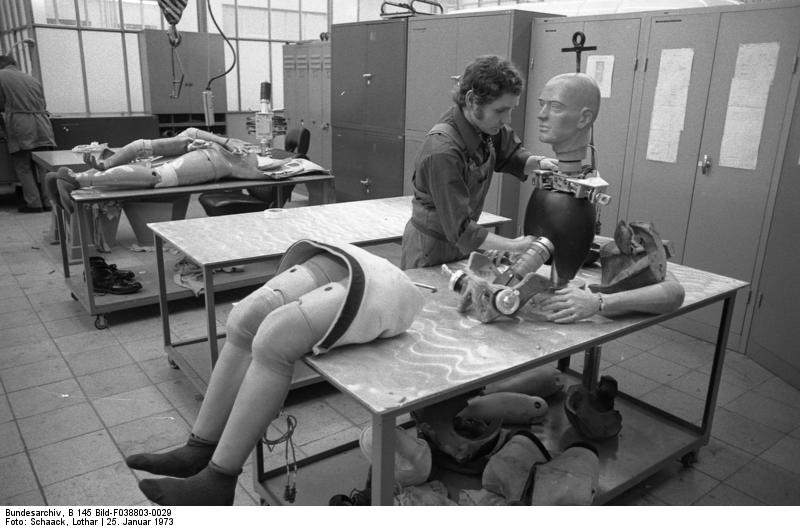
At the Institute of Robotics and Mechatronics of the German Aerospace Center.

William Styron attended his idol William Faulkner’s 1962 funeral and filed a report for Life. The opening of the questionably titled, “As He Lay Dead, a Bitter Grief“:

“He detested more than anything the invasion of his privacy. Though I am made to feel welcome in the house by Mrs. Faulkner and by his daughter, Jill, and though I know that the welcome is sincere, I feel an intruder nonetheless. Grief, like few things else, is a private affair. Moreover, Faulkner hated those (and there were many) who would poke about in his private life–literary snoops and gossips yearning for the brief glimpse of propinquity with greatness and a mite of reflected fame. He had said himself more than once, quite rightly, that the only thing that should matter to other people about a wirter is his books. Now that he is dead and helpless in a gray wooden coffin. I feel even more an interloper, prying around in a place I should not be.

But the first fact of the day, aside from that final fact of a death which has so diminished us, is the heat, and it is a heat which is like a small mean death itself, as if one were being smothered to extinction in a damp woolen overcoat. Even the newspapers in Memphis, 60 miles to the north, have commented on the ferocious weather. Oxford lies drowned in heat, and the feeling around the courthouse square on this Saturday forenoon is a hot, sweaty languor bordering on desperation. Parked slantwise against the curb, Fords and Chevrolets and pickup trucks bake in merciless sunlight. People in Mississippi have learned to move gradually, almost timidly, in this climate. They walk with both caution and deliberation. Beneath the portico of the First National Bank and around the scantily shaded walks around the courthouse itself, the traffic of shirtsleeved farmers and dewy-browed housewives and marketing Negroes is listless and slow moving. Painted high up against the side of a building to the west of the courthouse and surmounted by a painted Confederate flag is a huge sign at least 20 feet long reading ‘Rebel Cosmetology College.’ Sign, flag and wall, dominating one hot angle of the square, are caught in blazing light and seem to verge perilously close to combustion. It is a monumental heat, heat so desolating to the body and spirit as to have the quality of a half-remembered bad dream, until one realizes that it has, indeed, been encountered before, in all these novels and stories of Faulkner through which this unholy weather–and other weather more benign–moves with almost touchable reality.”

••••••••••

Read also:

Tags: ,

James Gleick, author of The Information; A History, a Theory, a Flood, explaining how the shift from oral communications to the written word impacted humanity.

Tags:

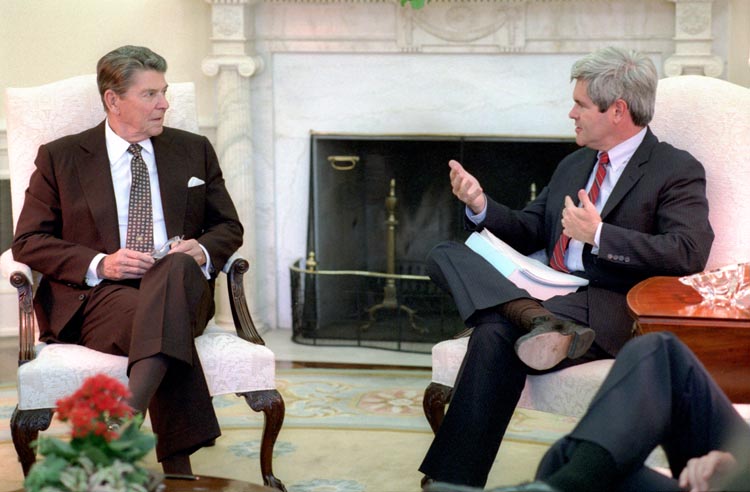
I would assume after last night’s embarrassing debate performance, Newt Gingrich is consigned to runner-up status, a sad, pompous buffoon who was only seriously considered because of the dearth of GOP options. But perhaps conservatives view things differently than I do? At any rate, the New York Times’ Timothy Egan righteously undresses the overstuffed hypocrite in “Deconstructing a Demogogue.” An excerpt:

Back in 1994, while plotting his takeover of the House, Gingrich circulated a memo on how to use words as a weapon. It was called ‘Language: A Key Mechanism of Control.’ Republicans were advised to use certain words in describing opponents — sick, pathetic, lie, decay, failure, destroy. That was the year, of course, when Gingrich showed there was no floor to his descent into a dignity-free zone, equating Democratic Party values with the drowning of two young children by their mother, Susan Smith, in South Carolina.

Today, if you listen carefully to any Gingrich takedown, you’ll usually hear words from the control memo.

He even used them, as former Assistant Secretary of State Elliott Abrams wrote in National Review Online this week, in going after President Reagan, calling him ‘pathetically incompetent,’ as Abrams reported. And he compared Reagan’s meeting with the Soviet leader Mikhail Gorbachev to ‘the most dangerous summit for the West since Adolf Hitler met with Neville Chamberlain in 1938 in Munich.”

•••••••••••

The full Gingrich memo about the use of language:

Language: A Key Mechanism of Control

   As you know, one of the key points in the GOPAC tapes is that “language matters.” In the video “We are a Majority,” Language is listed as a key mechanism of control used by a majority party, along with Agenda, Rules, Attitude and Learning. As the tapes have been used in training sessions across the country and mailed to candidates we have heard a plaintive plea: “I wish I could speak like Newt.”

   That takes years of practice. But, we believe that you could have a significant impact on your campaign and the way you communicate if we help a little. That is why we have created this list of words and phrases.

   This list is prepared so that you might have a directory of words to use in writing literature and mail, in preparing speeches, and in producing electronic media. The words and phrases are powerful. Read them. Memorize as many as possible. And remember that like any tool, these words will not help if they are not used.

   While the list could be the size of the latest “College Edition” dictionary, we have attempted to keep it small enough to be readily useful yet large enough to be broadly functional. The list is divided into two sections: Optimistic Positive Governing words and phrases to help describe your vision for the future of your community (your message) and Contrasting words to help you clearly define the policies and record of your opponent and the Democratic party.

   Please let us know if you have any other suggestions or additions. We would also like to know how you use the list. Call us at GOPAC or write with your suggestions and comments. We may include them in the next tape mailing so that others can benefit from your knowledge and experience.

Optimistic Positive Governing Words

   Use the list below to help define your campaign and your vision of public service. These words can help give extra power to your message. In addition, these words help develop the positive side of the contrast you should create with your opponent, giving your community something to vote for!

  • active(ly)
  • activist
  • building
  • candid(ly)
  • care(ing)
  • challenge
  • change
  • children
  • choice/choose
  • citizen
  • commitment
  • common sense
  • compete
  • confident
  • conflict
  • control
  • courage
  • crusade
  • debate
  • dream
  • duty
  • eliminate good-time in prison
  • empower(ment)
  • fair
  • family
  • freedom
  • hard work
  • help
  • humane
  • incentive
  • initiative
  • lead
  • learn
  • legacy
  • liberty
  • light
  • listen
  • mobilize
  • moral
  • movement
  • opportunity
  • passionate
  • peace
  • pioneer
  • precious
  • premise
  • preserve
  • principle(d)
  • pristine
  • pro- (issue): flag, children, environment, reform
  • prosperity
  • protect
  • proud/pride
  • provide
  • reform
  • rights
  • share
  • strength
  • success
  • tough
  • truth
  • unique
  • vision
  • we/us/our

Contrasting Words

   Often we search hard for words to define our opponents. Sometimes we are hesitant to use contrast. Remember that creating a difference helps you. These are powerful words that can create a clear and easily understood contrast. Apply these to the opponent, their record, proposals and their party.

  • abuse of power
  • anti- (issue): flag, family, child, jobs
  • betray
  • bizarre
  • bosses
  • bureaucracy
  • cheat
  • coercion
  • “compassion” is not enough
  • collapse(ing)
  • consequences
  • corrupt
  • corruption
  • criminal rights
  • crisis
  • cynicism
  • decay
  • deeper
  • destroy
  • destructive
  • devour
  • disgrace
  • endanger
  • excuses
  • failure (fail)
  • greed
  • hypocrisy
  • ideological
  • impose
  • incompetent
  • insecure
  • insensitive
  • intolerant
  • liberal
  • lie
  • limit(s)
  • machine
  • mandate(s)
  • obsolete
  • pathetic
  • patronage
  • permissive attitude
  • pessimistic
  • punish (poor …)
  • radical
  • red tape
  • self-serving
  • selfish
  • sensationalists
  • shallow
  • shame
  • sick
  • spend(ing)
  • stagnation
  • status quo
  • steal
  • taxes
  • they/them
  • threaten
  • traitors
  • unionized
  • urgent (cy)
  • waste
  • welfare

Tags: ,

Chris Elliott as a robot designed to be slenderer than Shelley Winters, 1986.

Tags:

FromLet the Robot Drive: The Autonomous Car of the Future Is Here,Tom Vanderbilt’s new Wired piece about humans on the verge of relinquishing control of the wheel:

“[Chris] Urmson, with the soft-spoken, intense mien of a roboticist who has debugged a Martian rover in the deserts of Chile, occupies the nominal ‘driver’s seat’—just one of the entities open to ontological inquiry this morning.

The last time I was in a self-driving car—Stanford University’s ‘Junior,’ at the 2008 World Congress on Intelligent Transportation Systems—the VW Passat went 25 miles per hour down two closed-off blocks. Its signal achievement seemed to be stopping for a stop sign at an otherwise unoccupied intersection. Now, just a few years later, we are driving close to 70 mph with no human involvement on a busy public highway—a stunning demonstration of just how quickly, and dramatically, the horizon of possibility is expanding. ‘This car can do 75 mph,’ Urmson says. ‘It can track pedestrians and cyclists. It understands traffic lights. It can merge at highway speeds.’ In short, after almost a hundred years in which driving has remained essentially unchanged, it has been completely transformed in just the past half decade.”

•••••••••••

Kraftwerk, “Autobahn,” 1975:

Tags: ,

Human Kidney (Very Healthy) – $500

I am very healthy and just a little short on cash. Buyer will arrange for pickup by a professional, 
or at least someone who’s done it before. No BS offers, Price is very reasonable!

I will consider a trade for a PS3 with some good games 

Joan Crawford on What’s My Line?, in 1957. She uses the appearance to promote the International Adoption Agency, though, to put it mildly, she wasn’t exactly mother of the year. Peter Ustinov is on the panel.

A decided preference for wooden hangers:

Tags:

From “The Machine-Tooled Happyland,” Ray Bradbury’s 1965 Holiday analysis of the robot-centric Disneyland:

“We live in an age of one billion robot devices that surround, bully, change and sometimes destroy us. The metal-and-plastic machines are all amoral. But by their design and function they lure us to be better or worse than we might otherwise be.

In such an age it would be foolhardy to ignore the one man who is building human qualities into robots—robots whose influence will be ricocheting off social and political institutions ten thousand afternoons from today.

Snobbery now could cripple our intellectual development. After I had heard too many people sneer at Disney and his audio-animatronic Abraham Lincoln in the Illinois exhibit at the New York World’s Fair, I went to the Disney robot factory in Glendale. I watched the finishing touches being put on a second computerized, electric- and air-pressure-driven humanoid that will “live” at Disneyland from this summer on. I saw this new effigy of Mr. Lincoln sit, stand, shift his arms, turn his wrists, twitch his fingers, put his hands behind his back, turn his head, look at me, blink and prepare to speak. In those few moments I was filled with an awe I have rarely felt in my life.

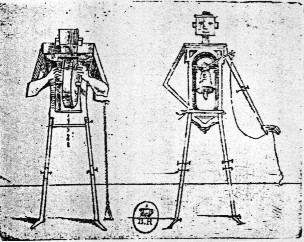
Giovanni Battista Bracelli's robot drawings, 1624.

Only a few hundred years ago all this would have been considered blasphemous, I thought. To create man is not man’s business, but God’s, it would have been said. Disney and every technician with him would have been bundled and burned at the stake in 1600.

And again, I thought, all of this was dreamed before. From the fantastic geometric robot drawings of Bracelli in 1624 to the mechanical people in Capek’s R.U.R. in 1925, others have conceived and drawn metallic extensions of man and his senses, or played at it in theater.

But the fact remains that Disney is the first to make a robot that is convincingly real, that looks, speaks and acts like a man. Disney has set the history of humanized robots on its way toward wider, more fantastic excur­sions into the needs of civilization.” (Thanks Longform.)

••••••••••

“We also accompanied him on a trip to Disneyland,” 1968:

Tags: ,

It’s difficult to fathom that just about 20 years ago, the spellcheck function wasn’t ubiquitous–even intrusive–and there was actually a market for a product like this one.

"Make her a pretty frock at once."

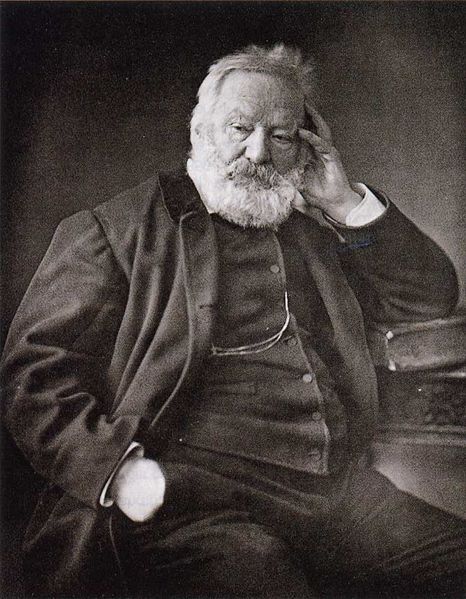
Generals in Napoleon’s army apparently didn’t want their sons crying, as little Victor Hugo learned, much to his chagrin. From an article in the August 1, 1897 Brooklyn Daily Eagle:

“The great French writer, Victor Hugo, tells this story about his own childhood–his father it is remembered, was one of Napoleon’s generals.

‘When I was five or six years old, I was crying. My father, who heard me, did not reprove me, but this is the way he punished me:

‘Why, the poor, dear little girl,’ he said, in a cool, ironical manner. ‘What’s the matter with her? What’s making her cry? She shan’t be found fault with. It’s right for little girls to cry. But how’s this? What have you been dressing her in boys’ clothes for? Make her a pretty frock at once, and to-morrow she shall go and take a walk in the garden of Tulleries.

‘Sure enough, the nurse put the girl’s dress on me the next day, according to order, and took me to walk at the Tulleries. I was well mortified, as you may perhaps imagine. But I never again cried from that day until I had become a man grown.'”

Tags:

President Richard Nixon in New York City, 1972, at the beginning of the war on drugs, encouraging the absurd Rockefeller Drug Laws, pledging public funds to be wasted on a futile cause. But while Nixon was there at the beginning, the prohibition of drugs has been a bipartisan folly ever since, one that allows campaigning politicians to tell citizens a lie they want to hear. The truth is professional poison. And that comes from someone who has no interest in drugs and doesn’t think anyone should use them.

Tags: ,

George Soros, opportunist turned alarmist, frets in a Newsweek article that the whole damn world might go bust. An excerpt:

“Sitting in his 33rd-floor corner office high above Seventh Avenue in New York, preparing for his trip to Davos, he is more concerned with surviving than staying rich. ‘At times like these, survival is the most important thing,’ he says, peering through his owlish glasses and brushing wisps of gray hair off his forehead. He doesn’t just mean it’s time to protect your assets. He means it’s time to stave off disaster. As he sees it, the world faces one of the most dangerous periods of modern history—a period of ‘evil.’ Europe is confronting a descent into chaos and conflict. In America he predicts riots on the streets that will lead to a brutal clampdown that will dramatically curtail civil liberties. The global economic system could even collapse altogether.

‘I am not here to cheer you up. The situation is about as serious and difficult as I’ve experienced in my career,’ Soros tells Newsweek. ‘We are facing an extremely difficult time, comparable in many ways to the 1930s, the Great Depression. We are facing now a general retrenchment in the developed world, which threatens to put us in a decade of more stagnation, or worse. The best-case scenario is a deflationary environment. The worst-case scenario is a collapse of the financial system.'”

Tags:

Jan Hammer, Miami Vice house composer, explaining how he could create such gritty urban music while living in a rustic environment. Intro provided by a pimped-out Philip Michael Thomas. It’s like the 1980s vomited blood.

Tags: ,

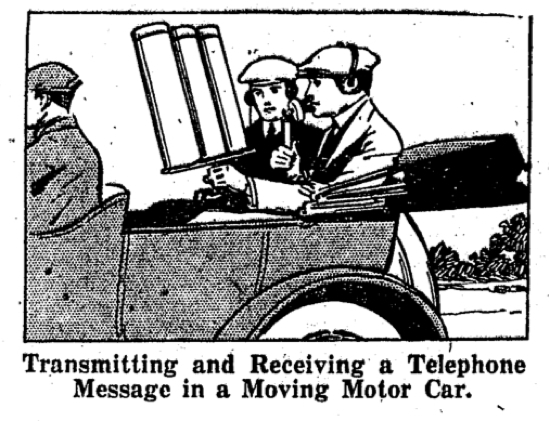
"Sandusky Register," March 1920.

From Smithsonian‘s Paleofuture blog, which presents a brief history of the first car phone, or “the portable stovepipe wireless telephone”:

“An article in the March 21, 1920 Sandusky Register in Sandusky, Ohio retold the story of a man in Philadelphia named W. W. Macfarlane who was experimenting with his own ‘wireless telephone.’ With a chauffeur driving him as he sat in the back seat of his moving car he amazed a reporter from The Electrical Experimenter magazine by talking to Mrs. Macfarlane, who sat in their garage 500 yards down the road.

A man with a box slung over his shoulder and holding in one hand three pieces of stove pipe placed side by side on a board climbed into an automobile on East Country Road, Elkins Park, Pa.

As he settled in the machine he picked up a telephone transmitter, set on a short handle, and said:

‘We are going to run down the road. Can you hear me?’

Other passengers in the automobile, all wearing telephone receivers, heard a woman’s voice answering: ‘Yes, perfectly. Where are you?’

By this time the machine was several hundred yards down the road and the voice in the garage was distinctly heard.

This was one of the incidents in the first demonstration of the portable wireless telephone outfit invented by W. W. Macfarlane, of Philadelphia, as described by the Electrical Experimenter.”

Tags:

Before the advent of advanced animation, video-game cops read subtitles of long, boring lectures given by their commanding officers. Atari, 1982.

« Older entries § Newer entries »