
Urban Studies

You are currently browsing the archive for the Urban Studies category.

Barefoot Isadora performs during her 1915-1918 American tour in this Arnold Genthe photograph.

In his U.S.A. Trilogy, modernist master John Dos Passos incorporated all manner of experimentation and ephemera, including idiosyncratic biography. One of the towering figures of early twentieth-century America he wrote about was the great dancer Isadora Duncan. An excerpt from his writing about Duncan’s hand-to-mouth upbringing with her mother and siblings (all punctuation and spellings are Dos Passos’):

“she bore a daughter whom she named after herself Isadora

The break with Mr. Duncan and the discovery of his duplicity turned Mrs. Duncan into a bigoted feminist and an atheist, a passionate follower of Bob Ingersol’s lectures and writing, for God read Nature; for duty beauty, and only man is vile.

Mrs. Duncan had a hard struggle to raise her children in the love of beauty and hatred of corsets and conventions and manmade laws. She gave pianolessons, she did embroidery and knitted scarves and mittens.
The Duncans were always in debt.

The rent was always due.

Isadora’s earliest memories were of wheedling grocers and butchers and landlords and selling little things her mother had made from door-to-door.

helping handvalises out of back windows when they had to jump their bills at one shabbygenteel boardinghouse after another in the outskirts of Oakland and San Francisco.

The little Duncans and their mother were a clan; it was the Duncans against a rude and sordid world. The Duncans weren’t Catholics anymore or Presbyterians or Quakers or Baptists; they were Atheists.”

Tags: , , ,

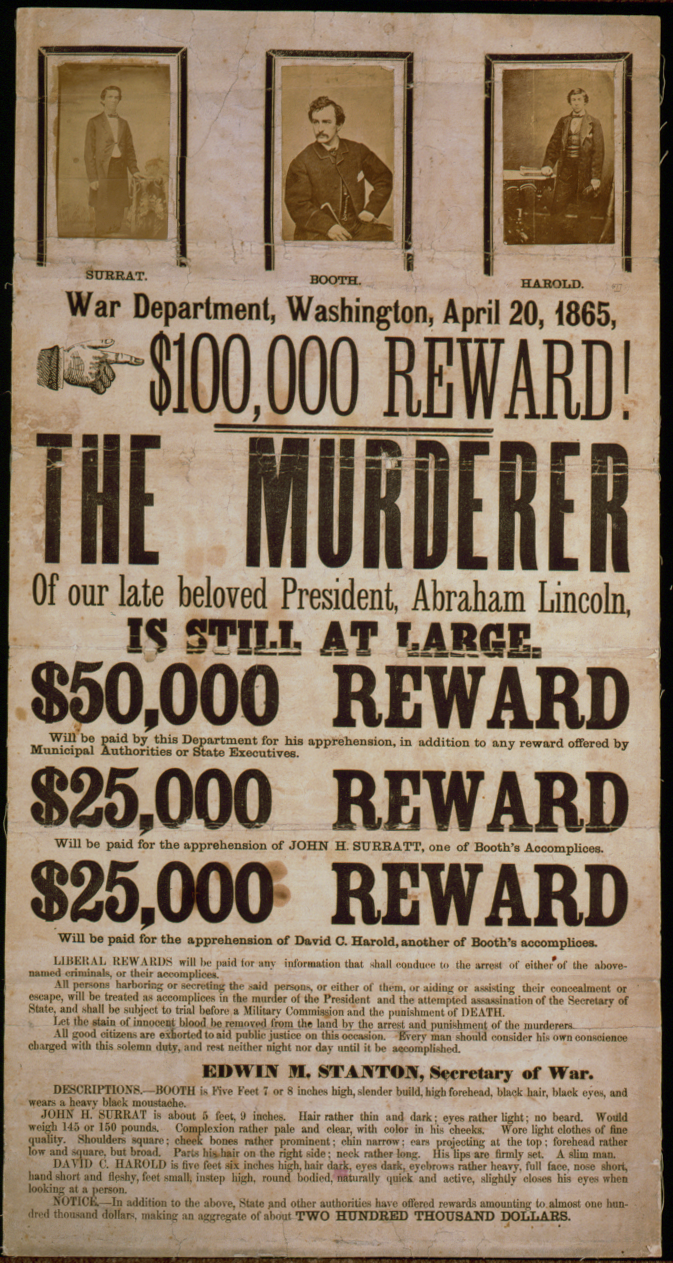
America has suffered numerous shocks to the system in its history, but the assassination of President Abraham Lincoln on April 12, 1865 is still probably as calamitous as any. I came across the “Wanted” poster for Lincoln’s assassin John Wilkes Booth, which was circulated in wake of the shocking crime at Ford’s Theatre, when Booth and his accomplices were still at large. “Wanted For The Murder of our late beloved President, Abraham Lincoln,” the poster declares, offering large sums of money for information leading to capture. An excerpt from the more poetic potions of the poster

“Let the stain of innocent blood be removed from the land by the arrest and punishment of the murderers. All good citizens are exhorted to aid public justice on this occasion. Every man should consider his own conscience charged with this solemn duty, and rest neither night nor day until it is accomplished.”

Booth was fatally wounded two weeks later by U.S. soldiers on a Virginia farm.


Tags: , ,

"Keep that 16mm camera on Diego Rivera's handsome face," says Diego Rivera.

There are tons of great videos on the Internet Archive, including the travelogues of Watson Kintner (1890-1978), a chemical engineer at RCA by trade who sojourned extensively and had a knack with a 16mm camera. The kind folks at the University of Pennsylvania Museum of Archaeology and Anthropology have preserved the movies and shared them online. The particular film I’m linking to in this post is of a vibrant-looking Mexico in either 1933 or 1934. Although most of the people Kintner recorded on his trip were unknown locals, look for the scene of Diego Rivera standing alone in a room. The video embed is causing me havoc, so I have to redirect you to the official site to watch the 7-minute film.

Tags: ,

Lester J. Gillis (aka Babyface Nelson) in a 1931 mug shot. I would pinch his cute face if he would just stop trying to murder me for a minute.

In a post I put up yesterday, I introduced you to my favorite reference book, the 1971 edition of Webster’s New World Thesaurus. Indulge me once again as I post the top 15 synonyms for the word “criminal” from this book filled with colorful language.

  • Big brains
  • Bird dog
  • Black marketeer
  • Buccaneer
  • Check artist
  • Clip artist
  • Fixer
  • Gorilla
  • Greaser
  • Nightrider
  • Ringer
  • Rustler
  • Second-story man
  • Stooge
  • Torpedo plugger

Tags:

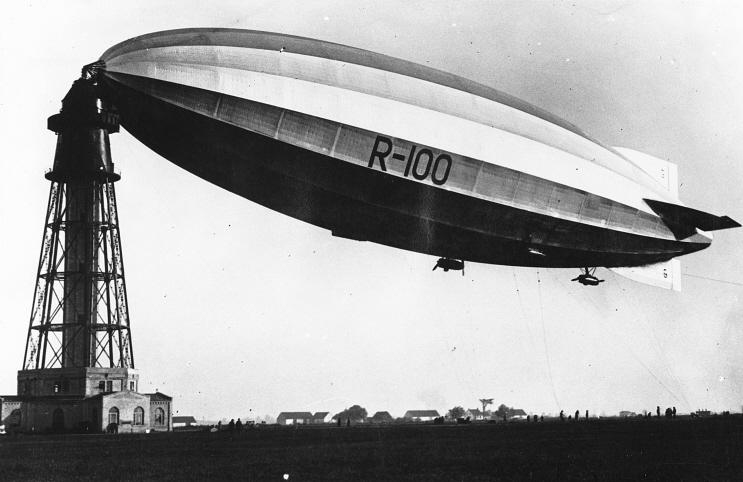
The British airship R-100 docked in Quebec, Canada, in 1930.

Nine  years prior to the 1937 Hindenburg disaster, Popular Science ran a breathless article about the advent of commercial dirigibles, as England and Germany raced to be the first to launch a successful transatlantic flight with passengers. In 1928, the balloons were planned to hold roughly 100 ticket buyers and the price from New York to London was going to be $400. That transatlantic trip was scheduled to take 38 hours to complete. Pictured is the English airship R-100, which the article thought was the favorite in the transatlantic race. It had beds, baths with showers, saloons, an area on deck for dancing and refreshment tables. The only note of caution about this potentially dangerous new mode of transportation–quickly dismissed–comes late in the article. An excerpt:

“To be sure, this history must consider the disaster of the American-built and operated Navy dirigible Shenandoah, broken in two by a storm over Ohio in 1925 and destroyed with the loss of fourteen men. And the fate before that of the German-built, French-operated military dirigible Diamude, lost in the storm over the Mediterranean. And that of the Italian-built, American-operated Roma, military dirigible, which, forced down by rudder trouble, struck a high tension cord and burned when the hydrogen in its gas bags exploded. There have been costly errors in construction and operation of the first great ships. But the builders have profited by all these mistakes. Each disaster has taught a new lesson.”

The German airship, the L7-127, which is given less attention in this piece, won the race with its first commercial passenger transatlantic flight on October 11, 1928. In November 1931, after the disaster of fellow British airship R-101, the R-100 was discontinued. It was flattened and sold for scrap.

Tags:

Bumped head while jumping turnstile. (Image courtesy of David Shankbone.)

Arts & Letters Daily pointed me in the direction of this excellent Financial Times article by Susanne Sternthal about the 35,000 stray dogs that live in Moscow, several hundred of which reside in the subway. Metro dogs are such a common occurrence that there is a website dedicated to cellphone photographs of such canines. What’s more fascinating is that some of these dogs have learned how to use the subway to get from point A to point B the way human riders do. An excerpt from the article:

“‘The metro dog appeared for the simple reason that it was permitted to enter,’ says Andrei Neuronov, an author and specialist in animal behaviour and psychology. ‘This began in the late 1980s during perestroika,’ he says. ‘When more food appeared, people began to live better and feed strays.’ The dogs started by riding on overground trams and buses, where supervisors were becoming increasingly thin on the ground.

Neuronov says there are some 500 strays that live in the metro stations, especially during the colder months, but only about 20 have learned how to ride the trains. This happened gradually, first as a way to broaden their territory. Later, it became a way of life. ‘Why should they go by foot if they can move around by public transport?’ he asks.

‘They orient themselves in a number of ways,’ Neuronov adds. ‘They figure out where they are by smell, by recognizing the name of the station from the recorded announcer’s voice and by time intervals. If, for example, you come every Monday and feed a dog, that dog will know when it’s Monday and the hour to expect you, based on their sense of time intervals from their biological clocks.’”

Tags: , ,

On June 22, 1897, the Edison Film Company recorded this horse race at the Sheepshead Bay Racing Track in Brooklyn, New York. The track was built by prominent businessmen in 1880 and was popular until Governor Charles Evans Hughes banned all racetrack gambling in the state in 1910. The track was eventually sold and an auto racing track was subsequently built. It eventually ran into financial troubles as well and the land was purchased by real estate concerns.

From what I can gather, there were nine horses competing in this 1897 race. A horse named Clifford, who was then approximately seven years old, was the heavy favorite and easily dispatched of his competitors.

Tags: , ,

Altair BASIC was an early programming language and the first product of Microsoft (then called Micro-Soft). Bill Gates (who was still at Harvard at the time) and Paul Allen apparently read about the Altair personal computer system in a science magazine and thought that making software for it could be a good business. You got that one right, boys.

This 1975 advertisement offers the Altair 8800 computer loaded with the MS guys’ basic language for the relatively inexpensive price of $995. In order to save records, you would hook up this computer to a cassette recorder and store the info on cassette tapes. The MITS (Micro Instruments and Telemetry Systems) company of Albuquerque, NM, distributed the computer and software. MITS was founded in 1971 as a calculator manufacturer and added computers to their inventory in 1975, so this was one of their first attempts at selling PCs. The Altair 8800 was the first commercially successful home computer and the Information Age was off and running. MITS co-founder Ed Roberts, who had earlier served in the Air Force for ten years, sold the company to Pertec Computer Corporation in 1976. He subsequently went to medical school and today practices medicine in a small town in Georgia.

Tags: , , ,

Somebody destroyed my pneumatic tube with a tomahawk.

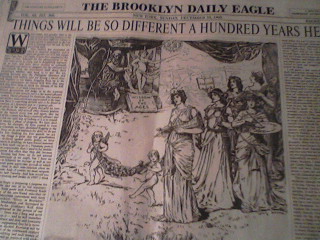
I got my grubby, ink-stained hands on a special supplement from the December 30, 1900 issue of the Brooklyn Daily Eagle, which bore the headline: Things Will Be So Different A Hundred Years Hence.”The papers’ editors used that section to predict life on Earth in the year 2000. Some of the prognostications worked out better than others, but the whole fascinating thing reads like an Onion parody. Here are the 12 most interesting headlines:

  • Liquid Air Will Open Up A New World of Wonders
  • New York To Be The World’s Metropolis
  • Interest In Music Will Increase Constantly
  • Mail By Pneumatic Tubes A Possibility For All Houses In Future
  • Women To Have The Ballot
  • Women To Be Homemakers
  • Base Ball, The National Game, Is Steadily Declining
  • Automobiles And Airships The Twentieth Century Vehicles
  • Man To Live Longer And Be Happier Owing To Use Of Plant Foods Only
  • Science May Find Means To Bring Dead To Life
  • International Court To Prevent War
  • Wars To Be Waged As Of Old: We Will Revert To Using Tomahawks And Shotguns

Read other Listeria lists.

Tags:

The Glidden Barn of Illinois, which was added to the National Register of Historic Sites in 2002, is in no danger.

There may have been as many as ten million barns in the United States during the 1920s. But the decline of the family farm, a population shift to urban life and numerous other factors have reduced that number by about eighty percent. The National Barn Alliance is trying to preserve and restore the barns that still exist before we lose all of our “prairie cathedrals.” Like a lot of people who live in urban environs, barns seem to me an almost mythical part of the American landscape. An excerpt from a 2007 USA Today article on the topic:

“The barns–particularly in grain-farming states like Illinois and Indiana–serve little practical purpose. Barns were built primarily for livestock, but commercial livestock farming is a small business in much of the Midwest. Grain farming is more profitable than all but the biggest cattle or hog farms, but old barns aren’t big enough to store modern combines, planters and other farm machinery.

‘Someday, we wake up and the barns are all gone, it’s gonna’ be tough to educate our future generations,’ said Wallace Yoder, president of the Bloomington, Ill.-based BarnKeepers.

Most interest in saving barns, Rod Scott of the National Barn Alliance said, comes from urban dwellers and others like himself with no direct connection to farming. Modern agriculture emphasizes progress, while historic preservation is an expensive luxury that most farms can’t afford.

‘We’re literally at the end, in a generation, maybe two, of this great family farming era, which was pretty much from the 1600s to now,’ Scott said.”

Tags: ,

The great Library of Congress channel on YouTube provides us with this 1897 footage of Seattle, Washington, as the Klondike Gold Rush was in full force. The brief, shaky clip shows excited miners (or “stampeders”) equipping themselves with supplies. Many stampeders ultimately lost their lives in their quest. In fact, the outfitters got much richer serving their customers than the miners did from pursuing valuable rocks and dust. Not surprising, really. The pathways pioneers incidentally develop are usually far more valuable than the riches they seek.

Tags:

The Library of Congress has a fun YouTube account that has samples of some of the rare videos they possess. I found a 1902 clip by Thomas Edison that shows bathers frolicking at the Sutro Baths in San Francisco. Adolph Sutro built the public bathhouse in 1896; it burned to the ground during its demolition in 1966. Based on this video, it had a 50-foot-high water slide which was all kinds of fun. In a letter published in a 1998 San Francisco Chronicle, an elderly man named Bill Roddy recalls the Sutro Baths when he was a child in the 1930s, when it had started getting a little run down. An excerpt:

“I went outside and walked a few feet to Sutro Baths, a massive Victorian structure that was beginning to show its age. I think I paid 25 cents admission. I was given a swim suit (we could not bring our own) and a meager towel. The suits were not trunks. They covered all of my puny body with straps that went over my shoulders, and they were made of wool with ‘Sutro Baths” across the front in white letters. As if anybody would have wanted to steal one!

I changed into my woolen suit and raced down the stairs to the baths. There were eight or nine pools with temperatures ranging from hot to ice cold. The biggest pool had a waterwheel.”

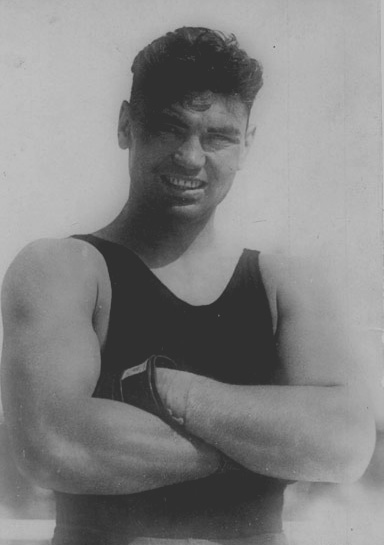
Jack Dempsey: Enjoy the fisticuffs and remember to visit the confection stands.

Temporary stadiums are still built and torn down for some Olympic events, but the practice was pretty common for larger sports gatherings in the early-20th century when few permanent structures of tremendous size existed. No mere hole-in-the-wall could have contained a crowd for a boxing match featuring Jack Dempsey during the 1920s, when as Urban Oyster points out, he was an even bigger star than Babe Ruth.

Boxing promoter Tex Rickard outdid himself in 1921 for the Dempsey-Georges Carpentier fight, spending $250,000 to build an octagonal, wooden 91,000-seat stadium (see photo) called Boyle’s Thirty Acres in Jersey City, the largest such structure in the world to that point. A June 26, 1921 article in the New York Times fills in the details. It covered 300,00 square feet and took two months to complete. Reserved seats cost from $5.50 to $50.

Dempsey dispatched of the Frenchman quickly, knocking him out in the fourth round. According to New Jersey City University, the stands were full, though only 81,000 were paying customers (2,000 were women). The gate was close to $1.8 million. The stadium played host to several other prizefights before being torn down in 1927. A housing project was built on the land in 1950 and remains there today.

Tags:

Investing in the stock system.

There isn’t an abundance of jobs in the country right now, but the Federal Bureau of Prisons is hiring. The department’s website lists numerous positions available in a system that incarcerates millions and employs tens of thousands. Included on the site are informational videos that explain what it takes to work in chaplaincy or food services.

At some point and soon, we need to rethink our entire penal system. What are the systemic problems leading to our being the nation with the highest per-capita level of incarceration? Should we be putting anyone in prison for drug use? What type of incarceration will lead to lower rates of recidivism? We have plenty of talented minds in socioeconomics and they need to be marshaled by Washington to troubleshoot a situation that is bad for us economically and just bad for us, period. It’s a bipartisan problem and their should be a bipartisan solution.

Just a pawn in the game of life.

Watching the ball drop in Times Square, as many of us recently did, always makes me think of one of my favorite films, Stanley Kubrick’s The Killing. The brilliant 1956 crime story doesn’t have any key scenes that take place on New Year’s Eve, but it has one that’s set right near the New Amsterdam Theatre where the ball drops, in a dingy chess club of yore called the Flea House. For much of its existence (which began during the Great Depression), you could rent a chess board at the dive for 10 cents an hour. Elder chess master Bill Hook recalls the Flea House in Hooked on Chess: A Memoir. Jeremy Silman, an expert on the game, writes about Hook’s book on his site:

“Much of Hook’s twenties and early thirties were spent in abject poverty in New York City. His health precluded steady work and his painting hadn’t taken off but Hook had one good thing that kept him going. Known by different names at different times — The New York Chess and Checker Club, Fischer’s, Fursa’s and finally the Flea House, the game playing establishment on 42nd street near Times Square was  a home away from home for many lost souls. Hooked on Chess has many stories of the characters that passed through this 24-hour New York City institution that ran from the Depression until the early 1970s. Some of the strongest players in the United States like George Treysman and Abe Kupchik were regulars when Hook first started going, but there were also plenty of weak players and odds games for various stakes were always being contested. According to Hooked on Chess, it was the clientele who created the special atmosphere. Certainly it was not the mismatched furniture or smoked stained walls that did. The tables that chess, bridge and various games were played on were frequently covered in a pile of ashes and it was not uncommon to see people sleeping at night in the club. Hook gives a lengthy and moving testimonial to the many people he met daily at the club.”

Tags: , , , , ,

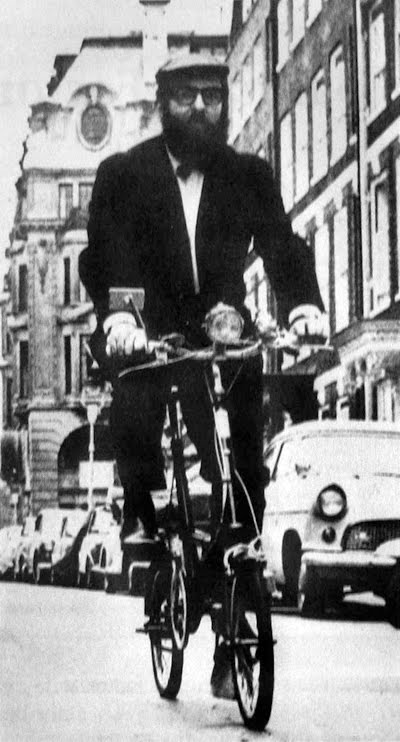
Reyner Banham was an interesting figure in urban studies in the ’60s, ’70s and ’80s. Born in England, he fell in love with Los Angeles as a child, while devouring Hollywood-set silent movies. As an adult, he became a foremost architecture critic in an age when that profession barely existed, focusing a great deal of his writing on L.A. He died in 1988, just as he was about to move to New York to teach at NYU. At the time of his death, architect Philip Johnson asserted that Banham was “really one of the founders of architecture criticism, which has now become a worldwide profession.”

In 1972, the down-to-earth academic was the subject of a fun 51-minute BBC documentary, Reyner Banham Loves Los Angeles, that had him act as tour guide through the city he loved best. Watch for the amusing scene that has his friend, the artist Ed Ruscha, explain to Banham why the architecture of L.A. gas stations is so great.

Tags: , ,

Because "Hijacke" lacked subtlety.

Odd product names always exist, but they usually only seem odd in retrospect. The classic example is the Ayds diet plan, which existed long before the scourge of AIDS began ravaging people. The product line was, of course, discontinued. But ransom existed before J. Dawson Ransome named his commuter airline business in 1966.

Ransome Airlines, a fleet of commuter planes headquartered in Philadelphia, operated for 20 years before being sold to Pan Am and renamed. Ransome, a WWII Air Force vet who passed away in 2002, was apparently a beloved person, as his employees continue to hold reunions and speak highly of him. Still, he probably should have gone with “Dawson” Airlines.

Tags: ,

I got my designer jeans on, ladies. Let's go boogie at Studio 54.

During a grungier era in New York, Rolling Stone published an issue dedicated to the city. The October 6, 1977 edition bore a cover with a Warhol silkscreen treatment of pioneering female politician Bella Abzug. (It was Abzug who first said “You have to be a little crazy to live in New York.”) Writers fixated on Abzug’s hats the way they do with Hilary’s pantsuits. With female politicians, it always seems to be about the clothes.

There’s an interesting article titled “Elliot Murphy’s New York,” in which the singer-songwriter, novelist and journalist lists some of his favorite places of the moment. Murphy was raised in the city by the family that owned Aquashow. a water ballet arena that was located on the former World’s Fair grounds. During Murphy’s childhood, big-band concerts by Duke Ellington, Count Basie and others took place there.

One of Murphy’s favorite places of the moment was Fiorucci, a designer clothes outlet right near Bloomingdale’s that sold skintight jeans suitable for Studio 54 to Madonna, Cher, Marc Jacobs, etc. (It closed in 1984.) Murphy writes: “I have seen 50-year-old women walk into Fiorucci and ask one of the dancing salesmen (disco music is omnipresent) what is the latest thing. I have seen these same women walk out in gold láme hot pants. When you buy jeans at Fiorucci they fit them as tight as they can. I think this is a form of Italian birth control. Fiorucci clothing is usually very well-made though with the way fashion changes these days, by the time it makes it through the third wash it’s out of style anyway.”

Tags: , , , , , , ,

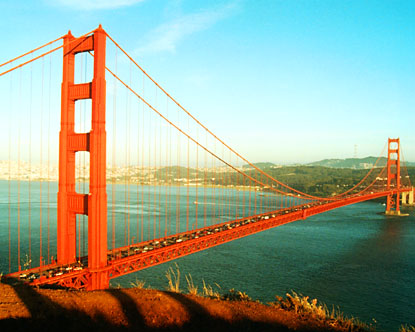
Inept government has never caused the closure of the Golden Gate Bridge, but high winds have shut it down three times.

The resolutely excellent Newmark’s Door pointed me to this devastating article about the utter mismanagement of San Francisco by its corrupt, incompetent government. An excerpt from the San Francisco Weekly article:

“The city’s ineptitude is no secret. “I have never heard anyone, even among liberals, say, ‘If only [our city] could be run like San Francisco,'” says urbanologist Joel Kotkin. “Even other liberal places wouldn’t put up with the degree of dysfunction they have in San Francisco. In Houston, the exact opposite of San Francisco, I assume you’d get shot.”

Who is to blame for this city’s wretched state of affairs? Yomi Agunbiade, that’s who. Metaphorically, that is.

An engineer by trade, Agunbiade was appointed by Mayor Gavin Newsom to head the San Francisco Recreation and Park Department in 2004. Even before Agunbiade’s tenure, Rec and Park was the department other city departments pointed and laughed at — but under Agunbiade, it became Amy Poehler funny.

During his reign, an audit revealed, rec centers frequently didn’t open, because staff simply didn’t show up — and the department had no process to do anything about it. Good news: New rec centers were slated to open. Bad news: Agunbiade’s department had no plan for how to staff them. But that wasn’t enough to cost Agunbiade his job.”

Tags: , ,

Balloon Popcorn

A delicious photo shoot.

I fear the Balloon Boy saga has forever given hoaxes a bad name. Well, not forever, but for the time being. The backlash wasn’t the result of a family pretending a child was in peril. You can convince the whole nation its imperiled and emerge a genius. The problem with the Balloon Boy prank was its utter crassness; it signified nothing more than a sloppy attempt at reality-show riches. It taught people nothing and delivered no sense of wonder or fun. In short, you need to have style and understand context to be a respected hoaxer. Someone who fits that bill is Alan Abel, the proudest practitioner of the art.

Since the late 1950s, Abel has been pranking his way into media professionals’ hearts and craws, showing Americans that they are “a nation of sheep” who too readily believe what they are told. And his opinion of the gullible media is no kinder.

There was his campaign for S.I.N.A. (Society for Indecency to Naked Animals.), in which he convinced TV and newspapers that he was a prudish crusader who wanted animals to have to wear pants in public. And who can forget the time he planted audience members at a live taping of Donahue and had them faint on cue. Hoaxes are an important tool that help us maintain a healthy skepticism. Long may they (and Abel) live.

ALSO:

Alan Abel’s official site.
Watch Abel Raises Cain, a documentary about Abel on Hulu.
Esquire interviews Alan Abel.
Jiffy Pop popcorn.
Mmm….

Tags: ,

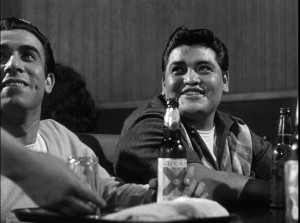
Tommy Reynolds (left) and Homer Nish.

Tommy Reynolds (left) and Homer Nish.

British expat director Kent MacKenzie’s 1961 neorealist drama, The Exiles, played at the Venice and San Francisco film festivals, but it never received a proper threatrical release until 2008. Even now, this story about young Indians (as they were called then) trading in life on an Arizona reservation for a marginal existence in Los Angeles, feels strange enough to deny classification. It’s part ethnography, part urban history. part early-rock-era free-for-all. MacKenzie and his brilliant cinematographer Erik Daarstad follow the characters (all played by Indian non-actors) as they drink, gamble, carouse and brawl their way through a 12-hour night. (Cassavetes was shooting Shadows in Manhattan at roughly the same time, and both films share a freewheeling, improvisational look at hell-raising machismo.) The director refused to idealize his subjects, believing he had made an existential film rather than an Indian one.

MacKenzie died at age 50 and made just one other feature, but this film is an impressive legacy and Milestone has done an excellent job on the DVD. Also included in the extras is MacKenzie’s “Bunker Hill: 1956,” a 17-minute documentary about elderly pensioners gingerly making their way through life in a neighborhood marked for demolition and renovation. It’s an absolute treasure for the urban anthropologist. Just as much as the main feature, it confirms what documentarian Thom Andersen said of Exiles, “It proves that there was once a real city here before they tore it down and built a simulacrum.”

ALSO:

  • The Exiles official site.
  • Milestone’s official site.
  • On Bunker Hill: A Lost Neighborhood Found site.
  • Manohla Dargis’ 2008 review of Exiles, The.
  • Moreabout Thom Andersen.

Tags: , ,

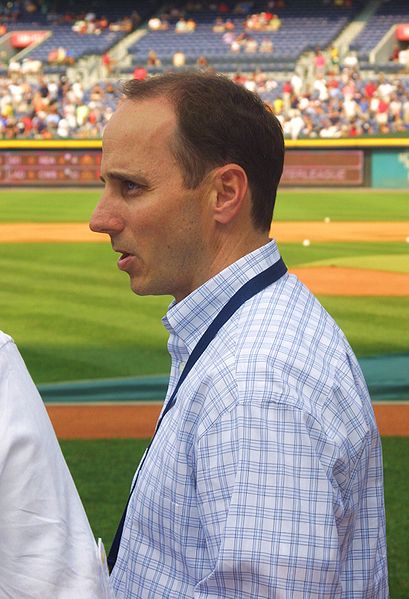
In “Brian Cashman: Bad Lieutenant,” his scathing Men’s Journal article from April 2009, Matt Taibbi was none too kind to the New York Yankees General Manager:

“The GM of the New York Yankees may be the worst ever at the best job in the world. Which is why he’ll inevitably fail this year in his shameless attempt to buy a World Series.”

Yes, watching the Yankees spend more than gazillions and win the World Series was as soulless an experience as seeing Mike Bloomberg putting a third term as NYC Mayor on his American Express Black Card. But they did win and Taibbi is wrong. He should have eaten some post-Series crow.

Tags: , ,

Newer entries »