Urban Studies

You are currently browsing the archive for the Urban Studies category.

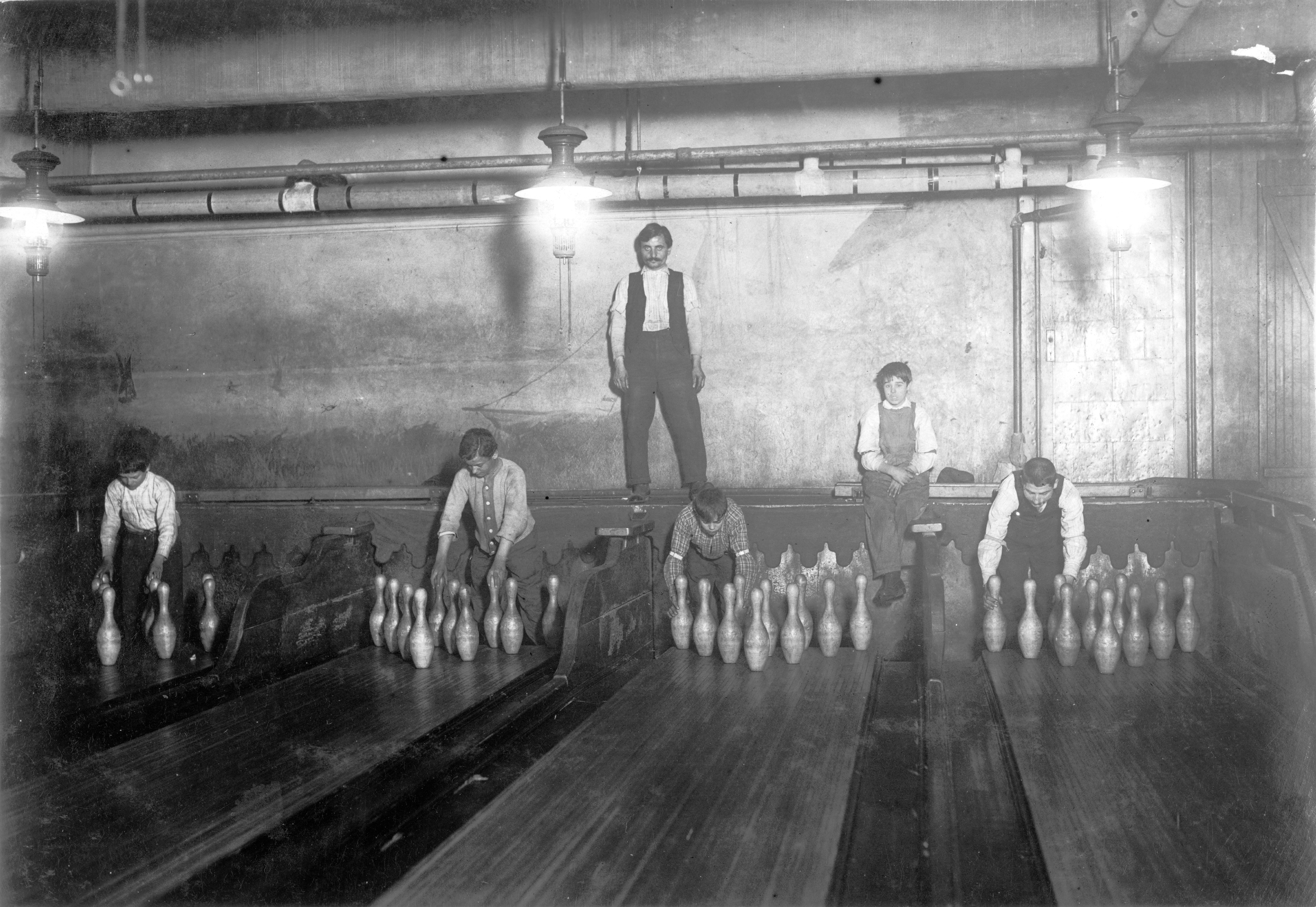
Brooklyn pin boys (circa 1912) do work that would be automated four decades later.

I came across a 1954 article in Sports Illustrated about the then-booming game of bowling, which was becoming increasingly popular thanks to new machinery that automatically placed pins and returned balls. These machines were referred to in the article as “gadgets Rube Goldberg never dreamed of.” The opening of the piece explains the origins of the beer-soaked sport. An excerpt:

“The futuristic fantasy of steel and wire shown above is the pin-spotting machine developed by the American Machine & Foundry Co., a gadget which has revolutionized the bowling industry and started the pin boy on his way out after an unbroken tenure of some 17 centuries. It is a far cry indeed from the game originated around 250 A.D. by a Bavarian priest who first set up a wooden pin in the cloister of his church. He labeled the pin Heide (heathen) and called upon each parishioner to knock it down with a rounded stone. If the Kegeler (thrower) scored a hit, he was judged to be living a devout, pure life. If he missed, his soul was presumed to require cleansing at church.”

Tags:

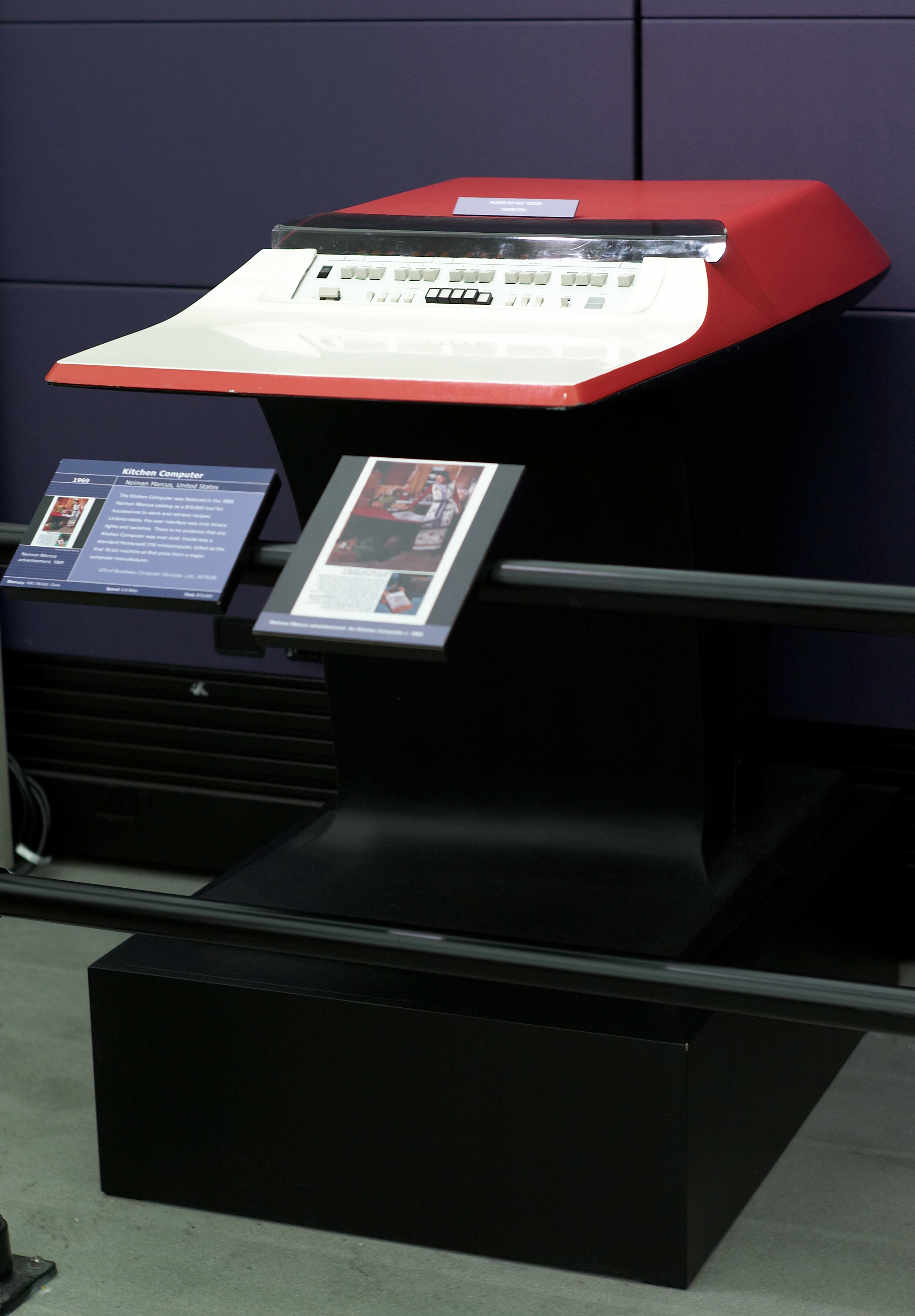
"If she can only cook as well as Honeywell can compute."

In a Wall Street Journal article about an exhibit at the Computer History Museum, Deborah Gage recalls a pricey appliance, the Honeywell 316:

“…a short-lived experiment designed to help women store recipes, organize menus, and balance the family checkbook. As high and wide as a table, it weighed over 100 pounds, took two weeks to learn to program and was sold by Niemen Marcus for about $10,000 in 1969.”

(Image by Joi Ito.)

Tags:

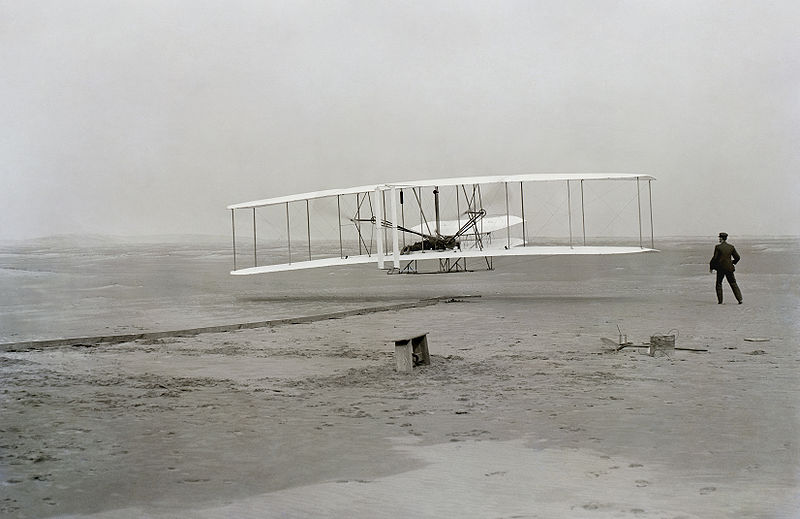
The first sustained flight.

Letters of Note reprints the telegram the Wright Brothers sent to their father, who was a Bishop of the Church of the United Brethren in Christ, in 1903, after getting their Flyer to successfully make four sustained trips. The transcript:

“176 C KA C8 33 Paid. Via Norfolk Va

Kitty Hawk N C Dec 17

Bishop M Wright

7 Hawthorne St

Success four flights thursday morning all against twenty one mile wind started from Level with engine power alone average speed through air thirty one miles longest 57 seconds inform Press home Christmas.

Orevelle Wright 525P”

Tags: ,

He sort of sucks. (Thanks Reddit.)

"We accept Pay Pal." (Image by Lipedia.)

Real Mummy Kitty (yes really) – $450 (Virginia)

I am posting this for sale in New York because we just saw the show “Oddities” featuring the store “Obscurities” and there was a mummified cat on the show. New York will probably be more open to odd things for sale than where we live. This is a real cat preserved underneath an old barn we just tore down. We accept Pay Pal.

Robot actors on stage and in guerrilla performances. The big advantage is that they use slightly less cocaine than human actors. (Thanks Reddit.)

“It might be possible to make the television set so slim that it could be hung on the wall.” Two futuristic reports mixed in with other stuff.

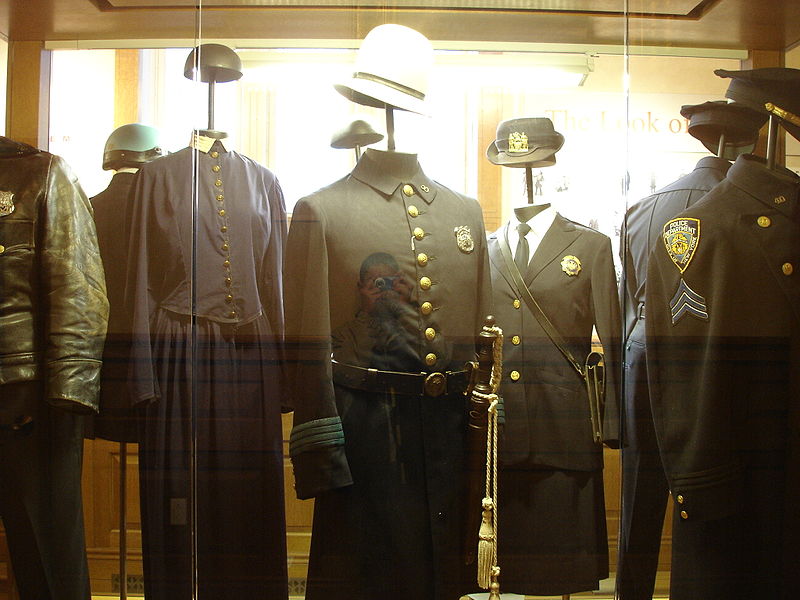
Vintage uniforms at the New York City Police Museum. (Image by official-ly cool.)

Wanted: Family Police Heirlooms

Do you have a collection of police memorabilia from your own career, or a family member…….and have no one interested in preserving this heritage? Are you concerned about the collection falling into the wrong hands (criminals, unscrupulous dealers)? If so, feel free to contact me. I am a retired police officer, with 28 years on the job. I am a nationally recognized collector of police memorabilia such as badges, cabinet cards, Gamewell police call boxes, vintage uniforms, restraint devices (handcuffs, leg irons), shoulder patches, and other items. I would love to add new items into my collection, and will travel to your location to inspect your collection and provide an estimate. Of special interest are entire collections, or pre-1900 one of a kind items. Please contact me and I’ll provide you with specifics as to my background and collecting endeavors to satisfy you that you would be in good hands.

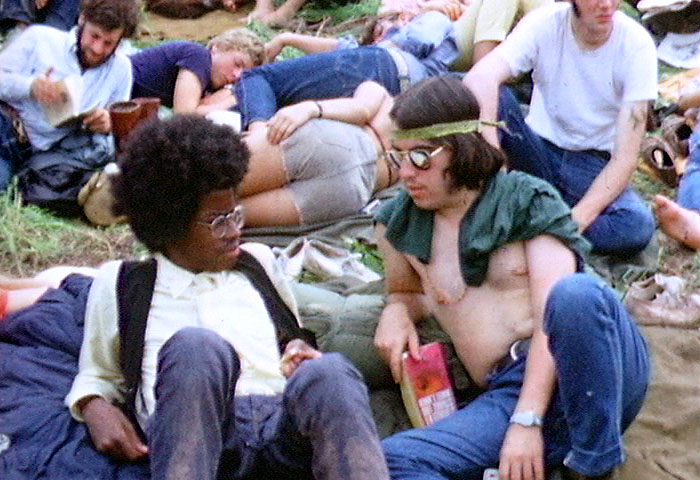
"They're a dirty, immoral bunch." (Image by Derek Redmond and Paul Campbell.)

Ebony magazine was on the scene in San Francisco in 1967 to turn out a good Summer of Love article, “The Hippies of Hashberry: A New Generation Flees Fabled American Dream.” There was, naturally, an African-American angle to part of Charles E. Brown’s piece, which explained that the hippies were more taken with Native American culture than the Beats, who were influenced by black culture. But most of the report looked at hippiedom in a broader context. An excerpt:

“A residential neighborhood just south of San Francisco’s Golden Gate Park is probably where it all began. The steepled rooftops of Haight-Ashbury’s Victorian homes were once the mark of middle-class respectability. Three years ago the hippies converged and christened the place Hashberry. Now, as the ‘squares’ depart to resume ‘more orderly’ lives, the hippies come in larger numbers, mostly in the summer…They come to Haight-Ashbury to be ‘where it’s at.’

‘But they carry lice and venereal disease wherever they go,’ a Haight Street realtor complains. ‘They’re a dirty, immoral bunch.’ His views are seconded by most people in authority–certainly the police in nearly every city in America.

There are those, like Episcopalian minister Malcolm Boyd, who see them in a different light: as young men and women in search of an honest morality, a morality that is foreign to middle-class Americans. ‘This is a time of great social ferment,’ says the Rev. Mr. Boyd, ‘and very little is being swept under the rug…the people who appear to be copping out–the hippies–are making serious contributions…while some who pose as liberals are not.'”

Tags: ,

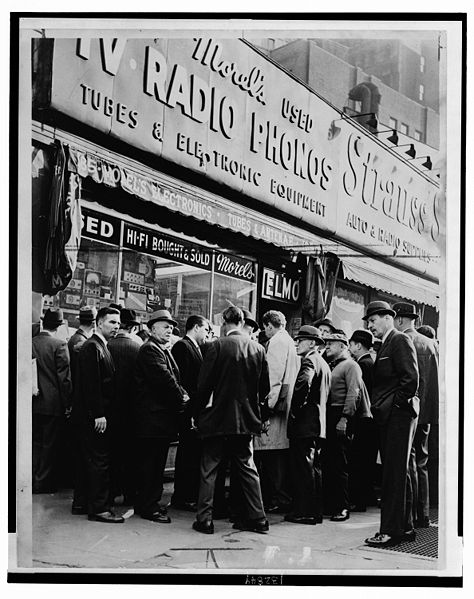
Orlando Fernandez took this photo for the "New York World Telegram."

People across the country gathered information instantly from the Internet yesterday about the shooting of Arizona Representative Gabrielle Giffords. But in the pre-wired age, on November 22, 1963, concerned citizens of another tragedy, the assassination of President Kennedy, learned details by flocking to Morel’s Electronics shop in New York City, on Greenwich and Dey Streets. An even earlier generation had learned about the sinking of the Titanic by listening to a wireless transmission at Wanamaker’s department store.

Tags: , ,

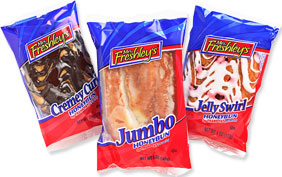
A 2008 Wall Street Journal article revealed that inmates in American prisons used cans of mackerel as currency, mostly because they were worth about a dollar and packs of cigarettes, an erstwhile coinage, had been banned. An Orlando Sentinel piece by Drew Harwell declares that honey buns are also a coin of the realm in penitentiaries as well as being a popular last meal for the condemned on death row. The sticky, sugary blobs are now more coveted behind prison walls than tobacco or envelopes or Coke. An excerpt:

In September, the day after the New Orleans Saints beat the San Francisco 49ers in a Monday Night Football game, a fight broke out in the Alpha Pod of the Hernando County Jail.

Inmate Ricardo Sellers, 21, had punched Brandon Markey, 23, in the face, sending Markey to a Brooksville hospital, according to Hernando deputies. Sellers was angry that Markey hadn’t paid up after losing a bet over football.

His debt? Four honey buns.

For all their sweetness, honey buns have a history of involvement in prison violence. In 2006, at the Kent County Jail in Michigan, inmate Benny Rochelle dragged his cell mate off the top bunk, killing the man, when he could not find his honey bun. And last year, at the Lake Correctional Institution west of Orlando, two men were sentenced to life in prison for stabbing with crude shivs the man they thought had stolen shaving cream, cigarettes and a honey bun from their footlockers.

Yes, murder over honey buns. Was it their decadence, or their status as jailhouse currency?

In Texas and Pennsylvania, inmates bartered honey buns for tablets of Seroquel, an addictive antipsychotic abused on the street as a sleeping pill.

In Sarasota, a millionaire businessman charged with child abuse earned the nickname ‘Commissary King’ after fashioning honey buns into birthday cakes for inmates he felt he could sway to his defense.

In Naples, a bail bondsman was accused of giving an inmate hundreds of dollars’ worth of honey buns over 13 years as rewards for referring him business.”

Tags: , , ,

Quebec researcher Jean-Christophe Laurence recently showed tech gadgets that have fallen into disuse (floppy disks, ColecoVision game cartridges, Fisher-Price turntables, etc.) to schoolchildren and asked them to figure out what they were once used for. “Oh, I though it was a bomb,” one child says when examining an 8-track player. Great stuff. (Thanks Reddit and Geekosystem.)

Tags:

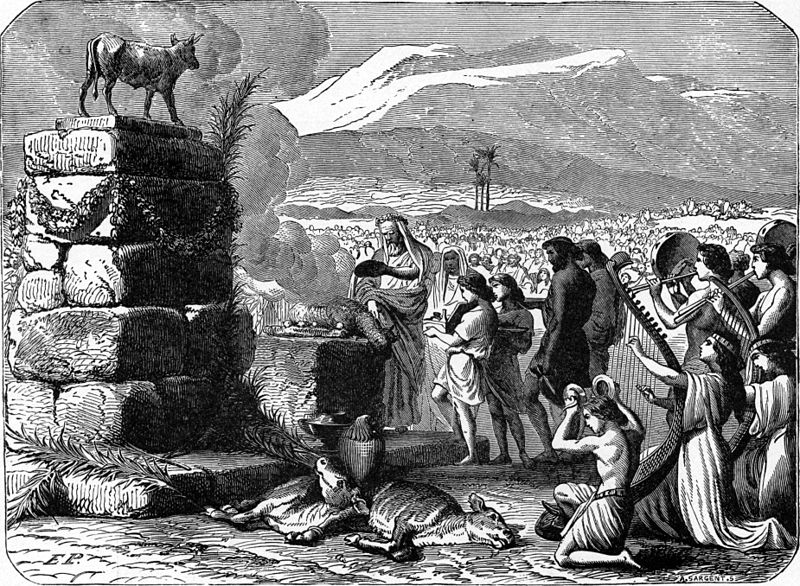
Pagans pray to a golden idol. (Image by A. Sargent.)

  • Roman Catholics…212,000,000
  • Protestants…115,000,000
  • Greek and Oriental Churches…91,000,000
  • Atheists, Deists and Infidels…100,000,000
  • Jews…8,000,000
  • Buddhists, Confucians…400,000,000
  • Brahmanism…107,000,000
  • Mohammedans…154,000,000
  • Pagan…62,000,000
  • All other Creeds (1,100)…106,000,000

Taken from the 1893 Brooklyn Daily Eagle Almanac.

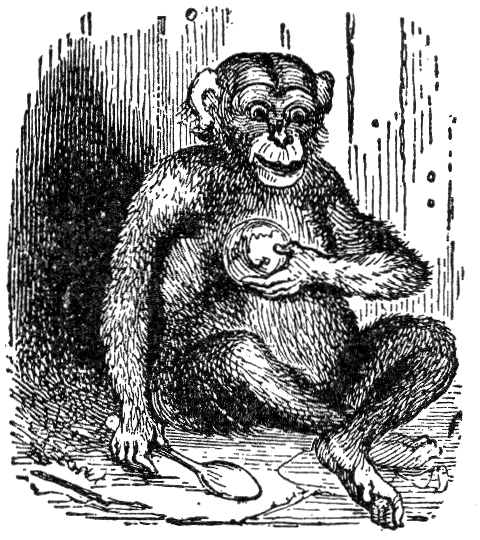
"Sometimes the monkey goes out for a stroll on the beach."

This story from the August 12, 1894 Brooklyn Daily Eagle explains why so few barber shops these days have pet monkeys. An excerpt:

“A chief attraction of the barber shop attached to Schillinger’s hotel on Rockaway Beach is a monkey, which the barber plays with in the absence of faces to scrape or hair to cut. Sometimes the monkey goes out for a stroll on the beach. Yesterday afternoon he was peregrinating when little Ellen Mason of Allen street and Railroad avenue, who was also out for a stroll, happened to meet him. The child became frightened, and ran with the monkey in hot pursuit. In a playful way the monkey perched on one of Ellen’s arms and bit a good piece out of it. The child screamed, which had the effect of attracting the barber’s attention, who grabbed the miscreant by the tail as he was meditating another assault. The child was carried home and her wound bandaged.

Ellen’s father last night made application to Justice Smith for a warrant to shoot the monkey. It was granted.”

Tags: ,

A driver education class for first graders in Phoenix, Arizona, in 1954. Not such a bad idea, really. Jimmy Stewart narrates.

Tags:

In the article, Brian MacKinnon hinted that he would get plastic surgery and try to enter medical school under a new identity.

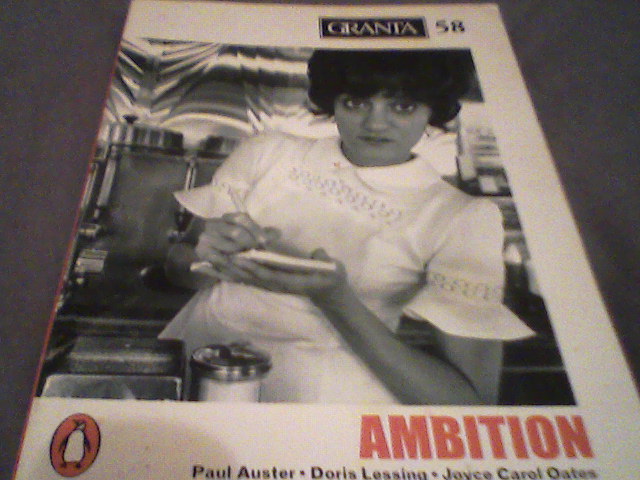
In 1997 Granta published its Ambition” issue. It contains a really great piece called “I Was Brandon Lee,” written by journalist Ian Parker, who is now a staff writer for the New Yorker. The story profiles a brazen impostor named Brian MacKinnon, a Scottish man who in 1995 went back and attended his old high school again when he was 32, pretending to be “Brandon Lee,” a Canadian teen who excelled academically, enjoyed extracurriculars and dreamed of being a doctor when he “grew up.”

One of the most interesting things about the case is that administrators, teachers and fellow students convinced themselves that the oldish-looking MacKinnon was 17, even though the truth stared them in the face. An excerpt:

“Gwyneth Lightbody was surprised, but hoped she did not show her surprise. ‘I said, ‘Well–in you come.” She told me that ‘He did not look like your typical teenager. I assumed he was an adult, but when you’re presented with facts…I mean, in teaching, you see all sorts of strange sights. It could be he had some illness that made him age rapidly–or something.’

On the first day she met some fellow teachers mid-morning. ‘We were all saying, ‘Have you got a pupil that looks old?’ We all thought he was an adult. But we assumed everything had been done, and he was just a bit of an oddity.’ Pupils were doing the same, trying to make Brandon fit his own story–by reminding themselves, for example, of the wide range in teenage body types. ‘I had a boyfriend who was over six feet then,’ one student said to me; another said: ‘I could think of boys with beards and hairy chests. If someone says they’re seventeen, you’re not going to turn round and say no, no you’re not.’ By lunch it seems MacKinnon had been accepted as an old-looking, odd-looking teenager–an alien from Canada–rather than an adult who looked his age.”

Tags: , ,

"Unique Valentine's Day gift." (Image by Andrew Dunn.)

Cow Skull & Antlers – $75 (Suffolk County)

Cow Skull & Antlers – UNIQUE VALENTINES DAY GIFT FOR A COLLECTOR

Genuine Cow skull with horns & teeth

Originally purchased at an American Indian Pow Wow

Also comes with REAL mounted horns & a pair of deer antlers

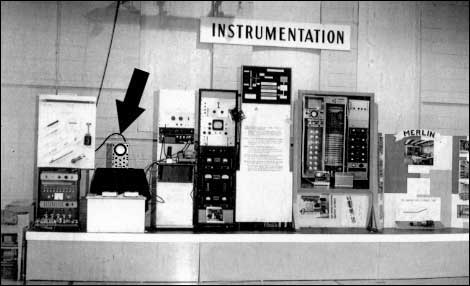
Depending on how you define OXO, Tennis for Two was either the first or second video game. A paddle contest displayed on an oscilloscope, the game was created by physicist and pinball fan William Higinbotham, who debuted it in 1958 at the Brookhaven National Laboratory on Long Island. Oh, and Higinbotham also helped build the first atomic bomb and later became an outspoken opponent of nukes. From his 1994 New York Times obituary:

“William A. Higinbotham, a physicist who developed electronic components for the first atomic bomb and then became a leading advocate of controlling nuclear weapons, died on Thursday at his home in Gainesville, Ga. He was 84.

The cause was emphysema, his family said.

Mr. Higinbotham was a group leader in electronics at Los Alamos, N.M., where the first atomic bomb was developed during World War II. But he soon helped establish a group of scientists, the Federation of American Scientists, that warned about the risks posed by nuclear weapons unless they were tightly controlled.

Mr. Higinbotham has also been called the grandfather of modern video games. In 1958, as a senior physicist at Brookhaven National Laboratory on Long Island, he built for the laboratory’s annual public show what was very possibly the first video game — a tennis game that was displayed on a tiny cathode ray tube.”

Tags:

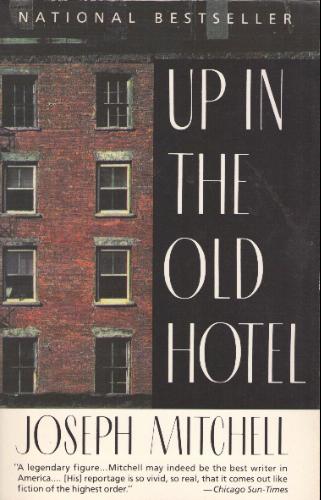
All three articles excerpted are contained Mitchell''s great collection, "Up in the Old Hotel."

Three wonderful opening sentences from articles written by the unimpeachable New Yorker legend Joseph Mitchell.

••••••••••

From “Mr. Hunter’s Grave” (1956):

“When things get too much for me, I put a wild-flower book and a couple of sandwiches in my pockets and go down to the South Shore of Staten Island and wander around awhile in one of the old cemeteries there.”

••••••••••

From “Hit on the Head with a Cow” (1938):

“When I have time to kill, I sometimes go to the basement of a brownstone tenement on Fifty-ninth Street, three-quarters of a block west of Columbus Circle, and sit on a rat-gnawed Egyptian mummy and cut up touches with Charles Eugene Cassell, an old Yankee for whose bitter and disorderly mind I have great respect.”

••••••••••

From “Goodbye, Shirley Temple” (1939):

“I’ve been going to Madame Visaggi’s Third Avenue spaghetti house off and on since speakeasy days, and I know all the old customers.”

Tags:

New York City has earthquakes, but they’re so minor we never feel them. In most instances, the earth prefers to swallow us up one by one. But it’s different in Los Angeles.

L.A.’s tempermental turf is the subject of The Myth of Solid Ground: Earthquakes, Prediction, and the Fault Line Between Reason and Faith, a volume on the topic by David L. Ulin. I remember Ulin’s writing from back in the day when he wrote book reviews for Newsday. He’s worked at the Los Angeles Times for a number of years now.

Among other earthquake-related topics, Ulin’s book looks at the thorny issue of earthquake prediction, by scientists and psychics, the concerned and the kooky. An excerpt about Linda Curtis, Seismological Secretary of the Southern California field office of the United States Geological Survey in Pasadena:

“Curtis is, in many ways, the USGS gatekeeper, the public affairs officer who serves as a frontline liaison with the community and the press. Her office sits directly across the hall from the conference room, and if you call the Survey, chances are it will be her low-key drawl you’ll hear on the line. In her late forties, dark-haired and good-humored, Curtis has been at the USGS since 1979, and in that time, she’s staked out her own odd territory as a collector of earthquake predictions, which come across the transom at sporadic but steady intervals, like small seismic jolts themselves.

‘I’ve been collecting almost since day one,’ she tells me on a warm July afternoon in her office, adding that it’s useful for USGS to keep records, if only to mollify the predictors, many of whom view the scientific establishment with frustration, paranoia even, at least as far as their theories are concerned.

‘Basically,’ she says, ‘we are just trying  to protect our reputation. We don’t want to throw these predictions in the wastebasket, and then a week later…’ She chuckles softly, a rolling R sound as thick and throaty as a purr. ‘Say somebody predicted a seven in downtown L.A., and we ignored it. Can you imagine the reaction if it actually happened? So this is sort of a little bit of insurance. If you send us a prediction, we put it in the file.'”

••••••••••

“Plus–the city of Los Angeles and its millions of people”:

Tags: ,

Bold futuristic designs during the race for space.

Tags:

"Or a portrait made with charcoal."

Trade: Bottle of Rumpleminz (Bushwick)

For SALE: One de-flowered bottle of Rumpleminz

In a moment of haste, much like your conception, a bottle of Rumpelminz was purchased. However, along with Chilean miners and oil spills, Rumpleminz was forgotten and sent into the heavy abyss that was 2010.

Details: This is no half empty bottle that a prohibition gangster named Fat Boy Al is trying to sell you behind his urine stained jacket – there is a good 80% left of this candycane goodness. One sip of this and it’s like a flashback of sitting on Santa’s lap at the local mall.

Will trade for half drank bottle of Whiskey, or a portrait made with charcoal.

Shovel, pick, chopper, saw, cutter, measurer, scissors, climber, anchor, shield, grappler, hammer, nail puller, bottle opener, can opener, etc. (Thanks Reddit.)

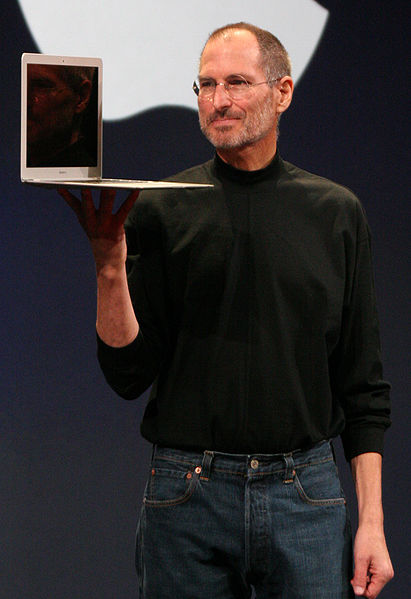
Jobs shows off the MacBook Air in 2008. (Image by Matthew Yohe.)

Steve Jobs shared his thoughts about what makes an entrepreneur successful in 1995. Even someone as brilliant as Jobs could have washed out without incredible diligence, but the creative brain he was born with is still far rarer than a great work ethic. (Thanks Newmark’s Door.) An excerpt:

“I’m convinced that about half of what separates the successful entrepreneurs from the non-successful ones is pure perseverance. It is so hard. You put so much of your life into this thing.

There are such rough moments in time that I think most people give up. I don’t blame them. Its really tough and it consumes your life. If you’ve got a family and you’re in the early days of a company, I can’t imagine how one could do it. It’s pretty much an eighteen-hour day job, seven days a week, for a while.”

Tags:

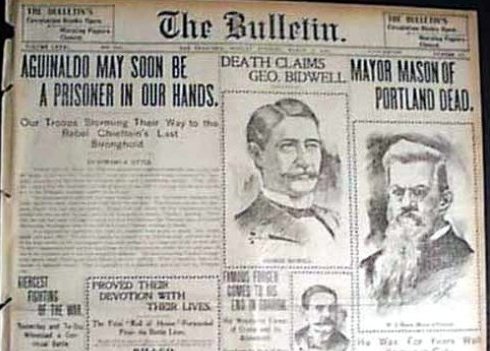
"Mr. Wellman copied eight columns of the 'Bulletin.'"

If you think today’s workers waste time merely because there are so many hand-held gadgets to play with, then have a look at this article in the November 6, 1896 Brooklyn Daily Eagle. In this piece, which originally ran in the San Francisco Bulletin, some Bay Area chucklehead wasted about six hours of company time with the aid of just a pen and a postcard. An excerpt:

“Walter D. Wellman, a bookkeeper in the employ of Anspacher Bros., the commission merchants, has performed the remarkable feat of writing in long hand 7,068 words on an ordinary postal card. About two months ago M.C.F. Grincourt, a Frenchman, succeeded in writing 5,454 words in French on a postal card. M. Grincourt’s feat made a great sensation, and his postal card was for a long time on exhibition at the Examiner office. An account given in the columns of the Examiner represented this as the finest and closest writing ever accomplished. But Mr. Wellman has far excelled the Frenchman, not only in the number of words he has succeeded in getting upon the postal card, but in the length of the words he used also.

M. Grincourt copied a portion of one of Victor Hugo’s novels, in which the words were notoriously short. Mr. Wellman copied eight columns of the Bulletin, selected from three distinct articles, so that he could not be accused of copying from one writer whose vocabulary consisted chiefly of short words. There were 110 lines on M. Grincourt’s postal card and 154 on Mr. Wellman’s. Mr. Wellman also asserts that he had plenty of room to spare and could easily have gotten in 8,500 words.

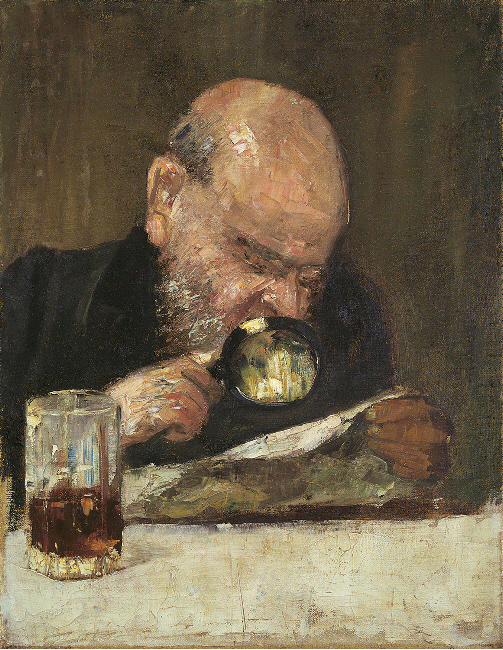
"The postal can easily be read with a glass, and a person with a good eye can read it without the help of a glass."

He worked on it for fifteen days, at odd moments, when he could escape from his business duties. He says he could have accomplished it in six hours of steady work. He wrote it at a pace of fifty words a minute, while his pace in writing the ordinary size is from thirty-five to forty a minute. The postal can easily be read with a glass, and a person with a good eye can read it without the help of a glass. A fellow clerk of Mr. Wellman easily read the postal with his naked eye, but begged off from all postals being written in this fashion. The 7,068 words are written with an ordinary steel pen in violet ink. The ink is a mere matter of chance, and has nothing to do with the fineness of the work.

Mr. Wellman has never done any work of this kind before. His only practice was in writing the Lord’s prayer. Without the slightest difficulty he accomplished the feat of writing these seventy-two words in a space no larger than a gold quarter of a dollar. The writer of this curiousity is a young American, 28 years old. He is near sighted and wears glasses, but his eyes must be very strong, as he has suffered no pain or inconvenience from this close work. In fact, his near sightedness may help him a little, as near sighted people usually see things at a close range much better than people of ordinary sight.”

Tags: ,

« Older entries § Newer entries »