Urban Studies

You are currently browsing the archive for the Urban Studies category.

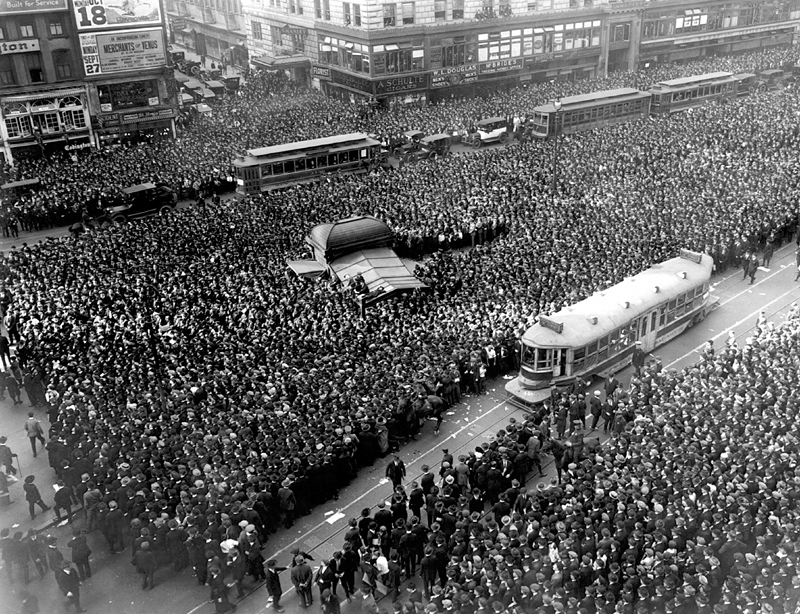
Crowd gathers in Times Square on October 12, 1920 to hear play-by-play of the World Series between the Brooklyn Dodgers and the Cleveland Indians.

I would have thought that the Black Sox scandal, in which several members of the Chicago White Sox accepted bribes to throw the 1919 World Series, would have dampened enthusiasm for the 1920 World Series. After all, it was in September of 1920 that some of the Sox admitted to a grand jury that they had participated in the fix. But based on this photo taken in Times Square during the ’20 World Series between the Brooklyn Dodgers and the Cleveland Indians, fans were still very into the National Pastime. People came together in the pre-radio age to hear play-by-play coverage of the Fall Classic outside of the New York Times building.

The Dodgers, who were often referred to as the Robins in those days and had previously been known as the Bridegrooms, were defeated by the Indians five games to two in the best-of-nine series. The team’s rabid fan base remained loyal until after the 1957 season, when the Dodgers, rather than moving to Queens as Robert Moses wished, instead decamped to Los Angeles.
Tags:

Bunny rabbits…they hop among us!

"She has spent some 15 years since that day studying this emerging breed of 'sociable robots.'" (Image by jeanbaptisteparis.)

Sherry Turkle fell in love with a robot once. It didn’t work out.

Turkle is the MIT professor whose 1995 book, Life on the Screen, was sanguine about the growing interaction between people and technology. But she had doubts after feeling her emotions stir for a robot named Cog she was working with at the university. The personal connection with the bot gave Turkle pause, making her wary that humans are growing reliant on gadgets not just for utility but also for the type of nourishment provided in the past by people.

While her love for Cog may say more about the academic herself than anyone else, Turkle doesn’t think so. She shared some of her fears of how artificial intelligence may soon replace human emotion with Jeffrey R. Young of the Chronicle. (Thanks A&L Daily.) An excerpt:

“She has spent some 15 years since that day studying this emerging breed of ‘sociable robots’—including toys like Furbies and new robotic pets for the elderly—and what she considers their seductive and potentially dangerous powers. She argues that robotics’ growing trend toward creating machines that act as if they were alive could lead people to place machines in roles she thinks only humans should occupy.

Her prediction: Companies will soon sell robots designed to baby-sit children, replace workers in nursing homes, and serve as companions for people with disabilities. All of which to Turkle is demeaning, ‘transgressive,’ and damaging to our collective sense of humanity. It’s not that she’s against robots as helpers—building cars, vacuuming floors, and helping to bathe the sick are one thing. She’s concerned about robots that want to be buddies, ‘implicitly promising an emotional connection they can never deliver.”

Tags: ,

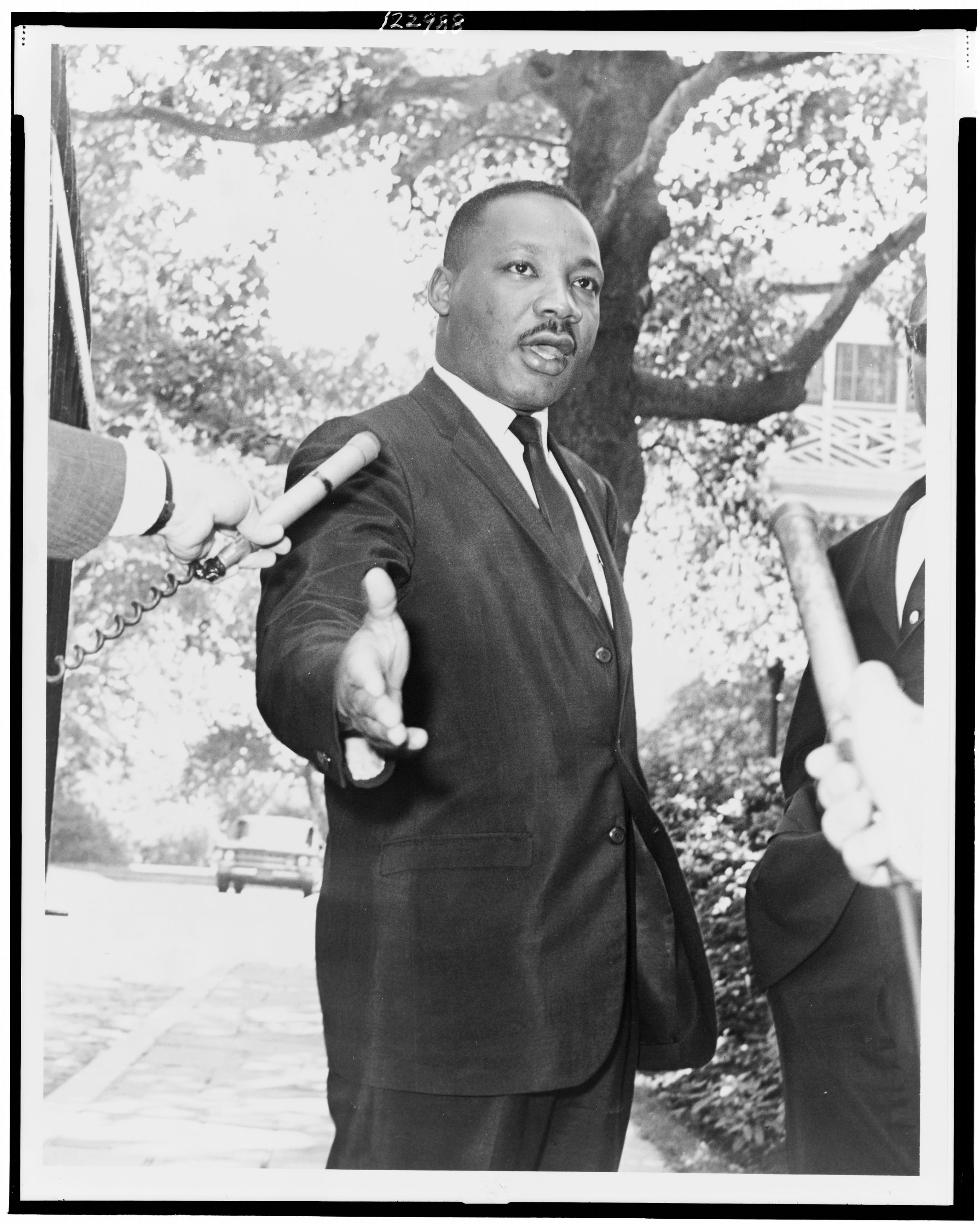
Martin Luther King, Jr. at New York's Grace Mansion on July 30, 1964. (Image by Dick DeMarsico.)

From Martin Luther King, Jr.’s 1965 Playboy interview:

PLAYBOY: You categorically reject violence as a tactical technique for social change. Can it not be argued, however, that violence, historically, has effected massive and sometimes constructive social change in some countries?

MARTIN LUTHER KING: I’d be the first to say that some historical victories have been won by violence; the U.S. Revolution is certainly one of the foremost. But the Negro revolution is seeking integration, not independence. Those fighting for independence have the purpose to drive out the oppressors. But here in America, we’ve got to live together. We’ve got to find a way to reconcile ourselves to living in community, one group with the other. The struggle of the Negro in America, to be successful, must be waged with resolute efforts, but efforts that are kept strictly within the framework of our democratic society. This means reaching, educating and moving large enough groups of people of both races to stir the conscience of the nation.”

Tags:

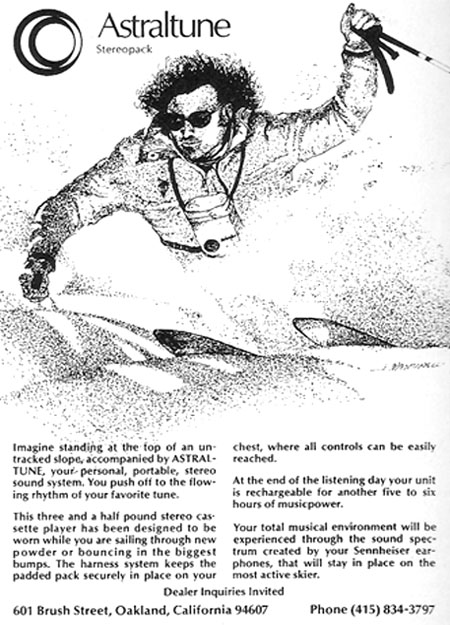
"The harness system keeps the padded pack securely in place on your chest."

Before the Sony Walkman and long before the iPod, the Astraltune was a personal music system, which was marketed to skiers who wanted some tunes on the slopes. It was the very first portable stereo cassette player, but the company somehow never patented the invention. The Finest Daily includes the Astraltune in a new list of firsts from the annals of gadgetry. (Thanks to justabuzz.) An excerpt:

“Most people think Sony’s Walkman paved the way to hearing loss for a generation of teenagers, but the original portable music player actually pre-dated the Walkman by almost five years. The Astraltune Stereopack debuted in Reno, Nevada in 1975 and it was aimed at freestyle skiers who wanted to groove out to their favorite tunes while hitting the slopes. It was a bulky 3-pound unit worn in a sack mounted on the chest, but it was the first time you had a power source, a cassette player and a headphone output in the same unit. The story doesn’t have a happy end though – the inventor(s) never patented their invention and today very few people remember it; Sony went on to dominate the personal stereo market for well over 15 years.”

"I'm not sure what to offer in return except a loving home for your dummy." (Image by Roy Erickson.)

Wanted: Free Ventriloquist Dummy

Hey everyone,

I’m on the look out for anyone offering to give away their ventriloquist dummy, condition isn’t that important as long as his mouth and eye functions still work, in fact, he can be a she. I’m also interested in free puppets but only if they are quality and not just some child’s stuffed animal. I’m not sure what to offer in return except a loving home for your dummy. Dummies from homes with pets are ok and so are dummies from smokers. If you happen to have a ventriloquist dummy that needs a good home please let me know, I’d be more than happy to come pick him up.

Thanks in advance!

Aftermath of the devastating San Francisco earthquake of 1906. (Image by H.D. Chadwick.)


From the February 2, 1867
Brooklyn Daily Eagle:

“California is troubled occasionally with slight shocks of earthquakes, but, as yet, has sustained no serious damage therefrom.

That of October, 1865, the most severe ever known, even by the oldest inhabitant, was in San Francisco, the cause of great alarm and some slight destruction of property. However, such a shock as that of 1865, may not occur again for a thousand years.”


Dr. Sidney Cohen is the one dispensing LSD to a patient in this 1950s video that was made at the Los Angeles Veterans Administration Hospital. *Thanks Reddit.) A decade later, in “Psychotherapy with LSD: Pro and Con,” Cohen was still largely singing the praises of acid. An excerpt:

“At a 1965 LSD conference Dr. Sidney Cohen, an American authority on LSD, summed up the claims made for LSD and LSD-like drugs by psychiatrists:

1. They reduce the patient’s defensiveness and allow repressed memories and conflictual material to come forth. The recall of these events is improved and the reaction is intense.

2. The emerging material is better understood because the patient sees the conflict as a visual image or in vivid visual symbols. It is accepted without being overwhelming because the detached state of awareness makes the emerging guilt feelings less devastating.

3. The patient feels closer to the therapist and it is easier for him to express his irrational feelings.

4. Alertness is not impaired and insights are retained after the drug has worn off.

Under skilled treatment procedures, the hallucinogens do seem to produce these effects and one more which is not often mentioned. That is a marked heightening of the patient’s suggestibility. Put in another way, the judgmental attitude of the patient toward the experience itself is diminished. This can be helpful, for insights are accepted without reservations and seem much more valid than under nondrug conditions.”

Tags:

"The trouble started when the cowboy endeavored to help himself to a quantity of peanuts which he refused to pay for."

In 1902, if you mixed cowboys, Indians, Cossacks and Italian peanut vendors, you were asking for trouble, as is proven in this trenchant piece of reporting from the May 6, 1902 Brooklyn Daily Eagle. An excerpt:

“Cowboys, Indians, Cossacks and Italian peanut vendors were mixed up this morning in a row which occurred near the entrance of the Wild West show on Halsey street. In the scrimmage one of the cowboys was cut in the face with a knife in the hands of one of the Italians. The trouble started when the cowboy endeavored to help himself to a quantity of peanuts which he refused to pay for. The vendor struck the cowboy with a stick, and when the latter rushed at him drew a knife and stabbed him. In the confusion that ensued a number of stands were overturned and their contents strewn over the street. The row ended when the injured cowboy was taken into the doctor’s tent and his wound dressed. No arrests were made.”

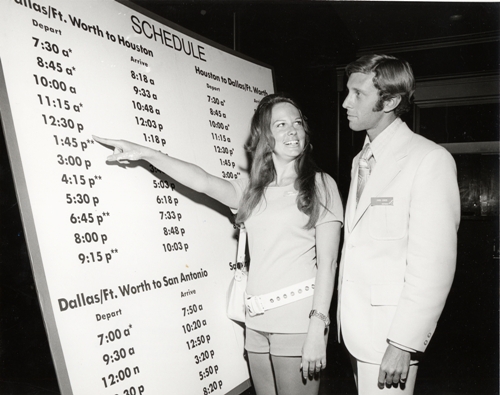
This Southwest Airlines TV commercial was part of the company’s “Remember” campaign from 1972. A note about the early days of the so-called “love airline” and its co-founder Herb Kelleher from CBS News:

“Kelleher is legendary in the airline industry for doing things differently than the competition. Before he found himself Southwest’s pitchman, Kelleher was a lawyer retained by the airline to get it off the ground – a fight that took him all the way to the U.S. Supreme Court. It seemed the last thing Southwest’s competitors wanted to see was a low-cost upstart doing nothing but flying around Texas in and out of Dallas Love Field.

In 1971, ‘the love airline’ took off. At first, Southwest was known for sexy flight attendants in hot pants, which got it the attention it needed.

‘You can have a low-cost carrier and people still don’t fly it because they don’t know about it,’ Kelleher said. ‘And so, the schtick kind of fit in with getting known.'”


Tags:

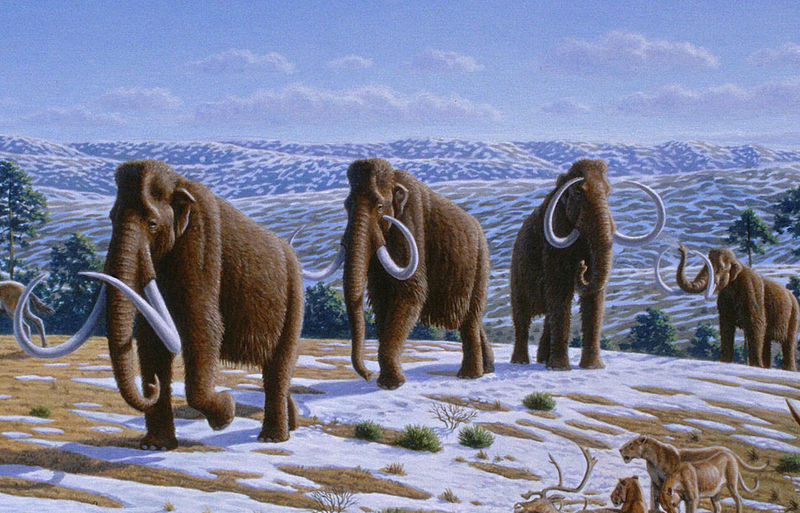
"All we need is a good sample of soft tissue from a frozen mammoth." (Image by Mauricio Antón.)

After 5,000 years of extinction, the Woolly Mammoth may be getting a new lease on life, as Japanese scientists believe they’ll be able to clone the humongous beasts within a few years. It sounds like such a terrible idea. (Thanks Newser.) An excerpt from a Telegraph article about the experiment:

“Previous efforts in the 1990s to recover nuclei in cells from the skin and muscle tissue from mammoths found in the Siberian permafrost failed because they had been too badly damaged by the extreme cold.

But a technique pioneered in 2008 by Dr. Teruhiko Wakayama, of the Riken Centre for Developmental Biology, was successful in cloning a mouse from the cells of another mouse that had been frozen for 16 years.

Now that hurdle has been overcome, Akira Iritani, a professor at Kyoto University, is reactivating his campaign to resurrect the species that died out 5,000 years ago.

‘Now the technical problems have been overcome, all we need is a good sample of soft tissue from a frozen mammoth,’ he told The Daily Telegraph.

He intends to use Dr Wakayama’s technique to identify the nuclei of viable mammoth cells before extracting the healthy ones.

‘The success rate in the cloning of cattle was poor until recently but now stands at about 30 per cent,’ he said. ‘I think we have a reasonable chance of success and a healthy mammoth could be born in four or five years.'”

Tags: ,

"It's really AOL with a different layout." (Image by Raphaël Labbé.)

I suppose I should be losing sleep over Facebook’s questionable practices regarding privacy, but I’m not. What really bothers me about Mark Zuckerberg’s toy is how utterly prosaic a product it is. Zuckerberg hasn’t come up with anything great or original; his chief accomplishments are recognizing a niche in the market and having the brass to not sell the company to a big media conglomerate that would have bungled the whole thing. Facebook isn’t a perfect design like the iPod but a creeping mediocrity with some utility. It’s a global high school yearbook, and its success largely stems from how uninventive it is. John C. Dvorak explains further in his new PCmag.com article, “Why I Don’t Use Facebook.” (Thanks Reddit.) An excerpt:

“Which begs the question as to why anyone would use Facebook when it is essentially AOL done right? The fastest growing group on Facebook are people in their 70’s. Oldsters are flocking to Facebook the way they once did with AOL. Facebook is a simple system for the masses that do not really care about technology and do not want to learn anything new except something easy like Facebook.

Whenever someone tells me to check out something on Facebook, I recall the heyday of AOL with its keywords. ‘Go to the Internet at www.blah.com or AOL keyword: blah. This was a common comment on the nightly news or in magazines. The AOL keyword is replaced by the Facebook page name.

There is no reason for anyone with any chops online to be remotely involved with Facebook, except to peruse it for lost relatives. So, next time you log on, remember it’s really AOL with a different layout.

Welcome to the past.”

Tags: ,

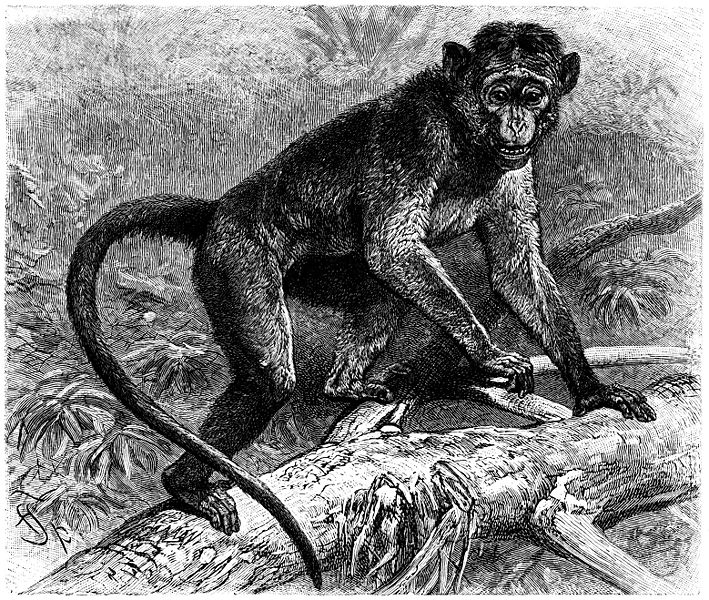
"Butch comes to work with me every day."

Macaque monkey for sale to good home – $575 (Berry St. & 10th St)

I’m getting shipped out and have to let loose of this beautiful 8 year old male Rhesus Macaque monkey named Butch. We’ve had him for 7 years and it breaks my heart to let him go. We have all the paperwork making him a legal to own in the U.S. and he is tame and used to being around people and dogs. Trust me, you’ll be the center of attention every where you go!

Check around, this price is amazing, I need to find him a good home ASAP – by next week. Must go to a good home and I will need to see his living arrangements before the deal is final. Butch comes to work with me every day, so feel free to stop in and check him out

Tags:

Bartenders...$6 to 20 per week.

Range of salaries for various trades in 1889, taken from the 1890 Brooklyn Daily Eagle Almanac. All wages weekly except where otherwise noted.

  • Bakers…$18-25
  • Barbers…$9-13
  • Bartenders…$6-20
  • Brewery Employees…$15-18
  • Bricklayers…$15-30
  • Butchers’ Employees…$9-13.50
  • Carpenters…$15-19.50
  • Cart Drivers…$10-12
  • Cellar Diggers…$12-15
  • Cemetery Laborers…15¢ per hour
  • Chewing Gum Makers…$4-21
  • Cigar Makers…$9-20
  • Clock Makers…$15-18
  • Coffee Handlers…$10.50-12
  • Firemen…$2-2.50 (per diem)
  • Fur Workers…$6-8 (girls), $10-12 (men)
  • Glass Workers…$16-20
  • Grave Diggers…16¢ per hour
  • Hatters…$15-20
  • Horseshoers…$18-21
  • Iron Workers…$18-21
  • Leather Workers…$18.50-21
  • Longshoremen…30-45¢ per hour
  • Locksmiths…$18-19.50
  • Lumber Handlers…$10.50-12
  • Marble Cutters…$21
  • Musicians…$17-30
  • Painters…$16.50-18
  • Steamboat Pilots…$125
  • Plasterers…$24
  • Plumbers…$16.50-21
  • Printers…$18
  • Railroad Employees…$10.50-14
  • Roofers…$12-21
  • Shoemakers…$6-18
  • Soap Makers…$12-25
  • Stair Builders…$19.50
  • Stone Masons…$23
  • Straw Workers…$3-12
  • Tin Can Makers…$18-20
  • Truck Drivers…$12-13
  • Varnishers…$12-15
  • Waiters…$10-13

A five-minute clip from a documentary about “visual futurist” artist Syd Mead, who, in addition to creating his own tech-friendly, optimistic work, has been a key force in the art department of many huge sci-fi films, including Blade Runner. In a 2009 interview, Mead addressed the future of our planet:

Q: What do you think our future will look like? Can we expect something positive or negative?

Syd Mead: The future is what we try to make of it. Obviously we’re going through a earth warming period, which could be caused by our local star, the sun, or other reasons like the accumulation of carbon dioxide. But you have to remember that nature has treated this planet rather harshly several times before, take the asteroid for example that wiped out the dinosaurs.

You have to realize that over 80% of the scientists and engineers that have ever lived are alive right now. So if anything is going to be figured out we’re in a good position to do so now. I like to image a bright future, because that’s healthy. If you really believe that the world is coming to an end then it probably is – you’re helping.”

Tags:

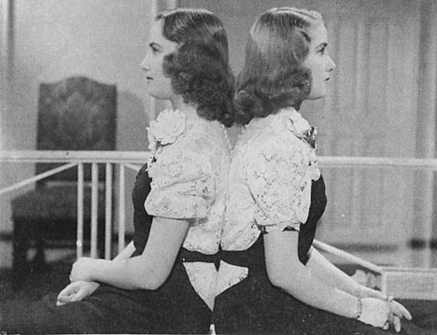
A 1940s photo of the Argentine actors known as the Legrand sisters. No public domain photos available of the sisters featured in the "Times" story.

Bob Pool of the Los Angeles Times reports on Inez Harries and Venice Shaw, twin sisters in California who are celebrating their 100th birthdays this Sunday–together, of course. These women remained close and share similar lives and tastes, but even twins who are separated at birth seem to have much in common despite the different stimuli they experience. Nature is a fierce thing, even in the face of nurture. An excerpt:

“Born Jan. 15, 1911, in Pasadena to citrus ranch manager William Hesser and his wife, Anna, the twins were reared in San Fernando and later in what is now Granada Hills. The family also lived in Whittier for a time.

Harries is now a Sylmar resident and Shaw lives in Newbury Park.

Inseparable as young children, the twins dressed alike, double-dated as teenagers and worked at the same Sunkist packing house as young adults. Later, after both were married, the two couples vacationed together on camping trips to such places as Yosemite and Kings Canyon national parks.

Family photos show them dressed in identical baby clothes and in matching dresses, sewn by their mother, in elementary school and high school — their San Fernando High School senior portrait from 1929 shows them wearing identical pink polka-dot outfits.

In grade school, the pair had the same friends — at the same time. They would pick one girl and Inez would be on one side of her and Venice on the other, they recall.

‘Other kids called us ‘Twinny’ rather than make a mistake calling us the wrong name,’  Harries said.”

Tags: , , ,

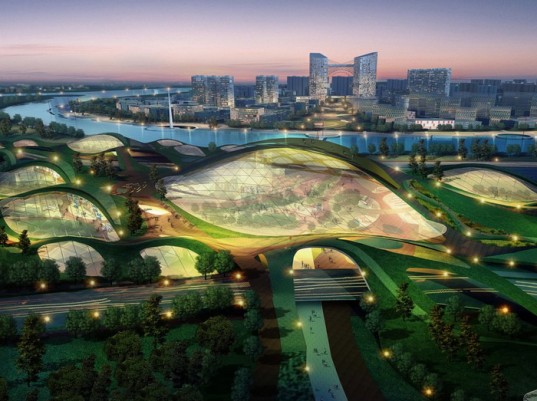
"Utilizing the concept of a compact, multilayered city, the Urbanscape is a dense, compact city core where facilities are located within close proximity of each other."

The target date is 2020 for the 30-square-kilometer planned Chinese community to be known as Tianjin Eco-City. A working laboratory of the newest green technologies and eye-popping gizmos, the community will be home to 350,000 residents. An excerpt from the development’s website:

“Eco-City will make use of the latest sustainable technologies such as solar power, wind power, rainwater recycling, and wastewater treatment/desalination of sea water. In order to reduce the city’s carbon emissions, residents will be encouraged to use an advanced light rail system, and China has also pledged that 90 percent of traffic within the city will be public transport. The development also features some beautiful public green spaces.

The city will be divided into seven distinct sectors – a Lifescape, an Eco-Valley, a Solarscape, an Urbanscape, a Windscape, an Earthscape and Eco-Corridors. Surrounded by greenery, the Lifescape will consist of a series of soil-topped mounds that will counteract the towering apartment buildings of the other communities. To the north of the Lifescape, the Solarscape will act as the administrative and civic center of the Eco-City. Demonstrating the concept of a compact, multilayered city, the Urbanscape will be the core of the Eco-City, featuring stacked programs interconnected by sky-bridges at multiple levels to make efficient use of vertical space. In contrast to the Urbanscape, the Earthscape will act as a sort of suburb of the city, with stepped architecture that will maximize public green space. Last but not least, the Windscape will transform Qingtuozi, a century-old village surrounded by a small lake, into a venue for citizens to relax and recreate.”

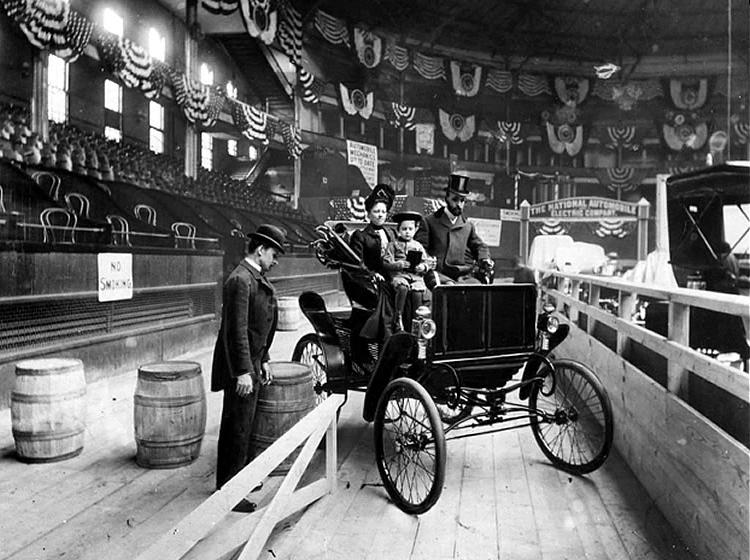
A ticket to the initial New York Auto Show in 1900 cost fifty cents, which would be more than $12 by today's standards.

The initial New York Auto Show took place in 1900 at Madison Square Garden. There had previously been joint bicycle and auto shows in the Garden (with bicycles in the starring role), but this was the first large-scale, modern car show of its kind in America. And it wasn’t all about internal combustion engines and fossil fuels. An excerpt about the event from the October 13, 1900 Brooklyn Daily Eagle:

“During the Automobile Show at Madison Square Garden, November 3 to 10, there will be contests of many kinds. The usefulness of the automobile in all kinds of going and under all conditions will be fully tested, and everybody will have an opportunity to see how the experienced chauffeur gets out of trouble. All the contests but these on Friday will be for vehicles on the show, and the programme, under the directions of the technical committee and the contests and exhibition committee of the Automobile Club of America, C.J. Field, chairman, will be as follows–

  • November 3: Brake contest and obstacle contest for steam vehicles.
  • November 5: Brake contest and obstacle contest for electric vehicles.
  • November 6: Brake contest and obstacle contest for gasoline vehicles.
  • November 9: Obstacle contest between electric cabs for hire, competition of electric delivery wagons.
  • November 10: Championship competition and obstacle contest between winners in steam, electric and gasoline, championship between winners of stopping competition in steam, electric and gasoline.”

"Trying to redecorate it inexpensively." (Image by SUPER AKWARIUM.)

Willing to barter for drift wood (westchester NY)

I can trade you some items for driftwood for my fish tank. I am trying to redecorate it inexpensively.

Thanks.

The First Post has an interesting piece about a proposed “straddling bus” in China that will ride above traffic on stilts and be able to transport 1,000 passengers at a time. An excerpt:

“The bizarre-sounding idea is the brainchild of Shenzhen Huashi Future Parking Equipment company, which has developed a ‘3D Express Coach’ that stands four metres high and resembles a moving bridge.

The bus, which is actually a light-rail train, can travel at speeds of up to 60kmph and will be able to carry more than 1,000 passengers. Not only does it reduce congestion, it also cuts down on pollution as it is powered by electricity and solar energy.

And the idea is not as far fetched as it might appear. Work on special tracks for the buses is expected to begin in the Mentougou district in Beijing later this year. But the buses don’t come cheap, each vehicle will cost $75m.”

Lots of gizmos and gadgets.

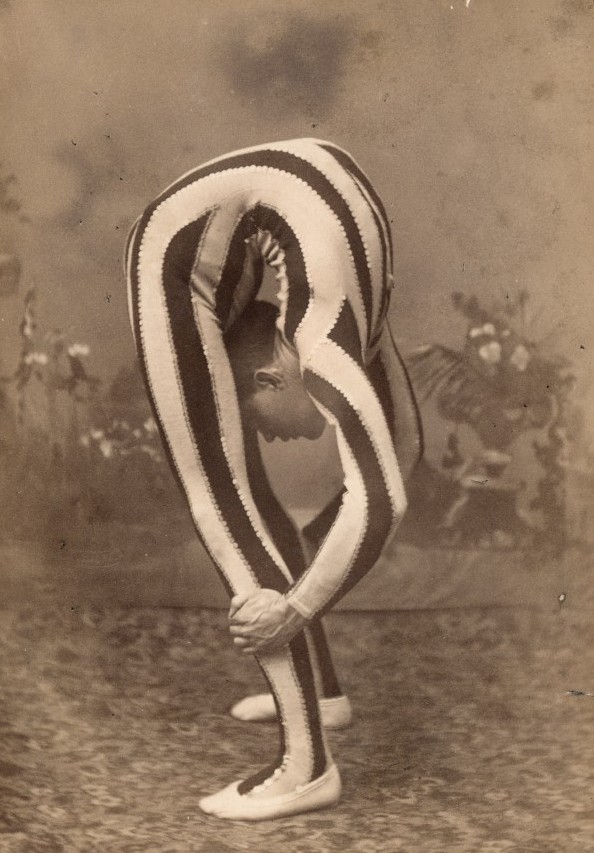
"Raymond Wood, a contortionist, is lying in a precarious condition."

A vital report from Indiana reached the offices of the Brooklyn Daily Eagle on September 1, 1894. It concerned a contortionist who had apparently been poisoned by the dye in his green tights. An excerpt:

Anderson, Ind.—Raymond Wood, a contortionist, is lying in a precarious condition, caused by wearing green tights. He did his act at a home minstrel performance in this city last Friday and in perspiring the tights faded. The was especially the case on his right leg below the knee. He thought nothing of it and was surprised to find the member highly inflamed the next morning. It had become discolored and swollen to twice the usual size and it is now feared that amputation will be necessary, if not more serious results are caused by blood poisoning, extending over the entire system.”

Tags:

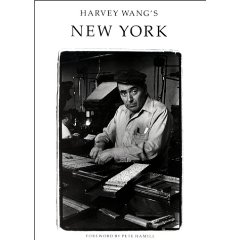
One of Wang's subjects, bowling alley mechanic Bill Newman, is someone I recall from my childhood in Queens.

Of all my favorite books about NYC, I think the one I love above all others is Harvey Wang’s New York. The 1990 book contains an introduction by Pete Hamill and just a few dozen black-and-white photos with a paragraph of text accompanying each one. And that’s all it needs.

Wang, a photographer and filmmaker, who maintains a website of his work, uses his trusty Leicas and Nikons to capture a phase of the city that had entered into obsolescence and is all but gone now: a New York that wasn’t drunk on self-awareness and star power, a place that was perhaps harder but less self-conscious.

In the book, Wang profiles New Yorkers at work in trades such as blacksmith, mannequin maker and scrap-metal collector, among others. He also interviews a seltzer bottler named George Williams. An excerpt:

“‘I go to sleep dreaming of seltzer bottles,’ says George Williams, who estimates he fills 3,000 empty glass canisters with a mixture of filtered water and carbon dioxide gas every day. He works at G & K Beer Distributors in Canarsie, Brooklyn. Kenny Gomberg, grandson of G & K founder Moe Gomberg says at the beginning seltzer was the biggest part of the business. Now it’s a novelty. George started in the business about thirty-five years ago at Cohen Seltzer Works in Boro Park, one of the dozens of bottlers in business back then. There are just a few left that fill the antique Czech-made bottles with a Barnett and Foster Syphon (sic) Filler machine that dates back to 1910. Says George, ‘The younger generation mostly goes for flavored sodas.'”

ALSO: Harvey Wang is having an exhibit of the many photographs he took of Adam Purple’s amazing Lower East Side earthwork, “The Garden of Eden,” fifteen thousand square feet of natural beauty that the artist somehow grew out of urban blight. It was sadly razed by developers in 1986. Wang’s photographs of the erstwhile oasis and its eccentric creator will be on display at the FusionArts Museum Gallery from February 2-20.

Tags: , , , , ,

"I need deer meat." (Image by Disney.)

Deer/Roadkill?? (20 miles/Phillipsburg)

If you see any dead deer on th side of the road,,,please call me ,,I need deer meat to help feed rescued dog.

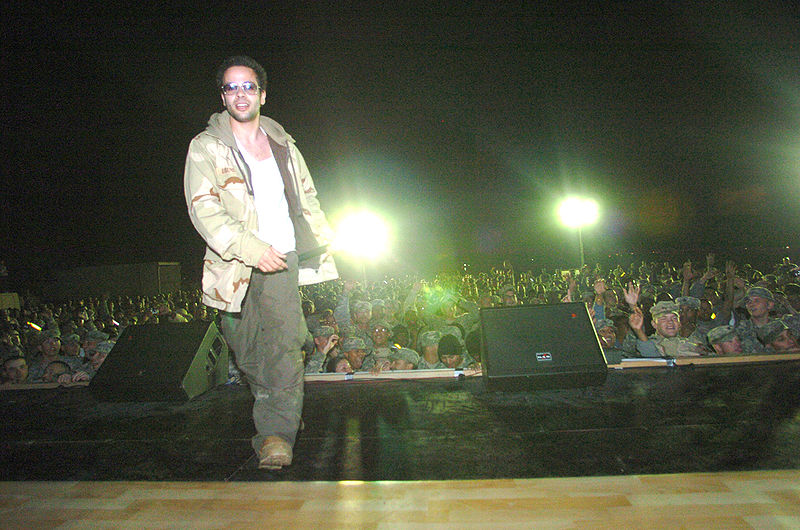
Rapper Stu Stone entertains the troops during 2010, but Baghdad nightlife is scarce outside of U.S. military bases. (Image by Spc. Cal Turner.)

Baghdad discos and nightclubs, once legendary, are now strobe-less thanks to the U.S. war in Iraq and the religious conservatism that has arisen in the city in its aftermath. According to a Washington Post piece by Yahya Barzanji, the party has relocated north into liberal Kurdish territories. An excerpt:

“Dozens of dance halls and clubs have opened across the Kurdish region during the past months, capitalizing on a crackdown against alcohol in Baghdad, where officials in November began closing clubs serving booze and banned alcohol sales at stores.

That prompted the capital’s nightlife – its musicians, dancers and impresarios, and the patrons who flock to them – to migrate north.

‘Baghdad has become a dead city where there is no more amusement, no drinks and no music. They have dressed the capital in religious clothes,’ said Hameed Saleh, a Baghdad Academy of Music graduate who plays the drums and oud, the Arabic forerunner to the lute, at Kurdonia Club. ‘Now I play music in Sulaimaniyah and my life is secure.’

Baghdad in the 1970s and 1980s was renowned for being the capital of Middle East nightlife with the most raucous nightclubs and an endless flow of whiskey. U.N. sanctions and Saddam Hussein’s newfound piety dimmed its star a bit in the 1990s, but it was the U.S.-led invasion in 2003, the violence that ensued and the rise of conservative Islamic militias that all but snuffed it out.

Nightlife in Baghdad tried to rise from the dead after violence declined in 2008, but the final blow came when religious conservatives began enforcing a Saddam-era ban on alcohol in clubs and added a ban in stores.”

Tags: ,

« Older entries § Newer entries »