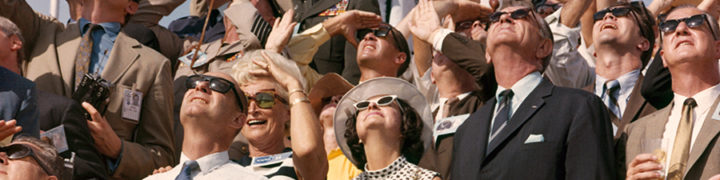
From Singularity Hub: “Ever since True Lies I’ve been waiting for an affordable pair of spy glasses that can transmit video in real time. My wait looks like it may be over very soon. Seattle startup ZionEyez is building momentum to launch their Eyez video recording glasses this year. The Roy Orbison looking Eyez will feature a 720p HD recording camera, microphone, Bluetooth and WiFi connectivity, 8 GB flash memory, and three hours of battery life. Using an iPhone or Android app you can transmit what your Eyez record directly to the web.”
You are currently browsing the archive for the Urban Studies category.
This is your life now. Work is scarce so you do what you must when you’re told to. You work the graveyard shift (if you’re lucky enough to be offered it). But what if you can’t stay energetic in the middle of the night? What if you work during the daylight hours but spend half the night digesting your computer screen, trying to keep up with the flow of information, keeping track of the other you? How can you summon the strength? For an age like ours, there’s Nuvigil, a stimulant for “shift work disorder” from the good people at Cephalon. Side effects include (no joke): life threatening allergic reaction, skin rashes, chest pain, dark urine, depression, anxiety, hallucinations, psychosis, mania, thoughts of suicide, aggression, and other mental problems, headache, nausea, dizziness, and trouble sleeping. It costs $300 a month. You will pay.
Adam Curtis’ silicon-phobic BBC documentary series, which takes its title from Richard Brautigan’s great poem.
Tags: Adam Curtis, Richard Brautigan

"Prom is tomorrow."
Odd Job gig (Greater Danbury region)
I need some money for my tuxedo by today because prom is tommorow. I can mow your lawn, babysit or be a driver from 3:30 today until 7:00 pm tonight. Please help me out
Thanks
We want to be first, we want something other people don’t have, we want a great deal. Tell us that we’re special, make up for all that we lack.
•••••••••
Affianced women make a mad dash for discount wedding gowns at the “Running of the Brides” promotion at Filene’s Basement:
Far more depressingly, people stampede into a Florida courtroom hoping to grab a coveted seat at the Casey Anthony murder trial:
Tags: Casey Anthony
Paleontologist Jack Horner, who wants to use genetic advances to create a living dinosaur so that we can all know the thrill of death by dinosaur, presented this new TED Talk about his Chickensauraus.
Tags: Jack Horner
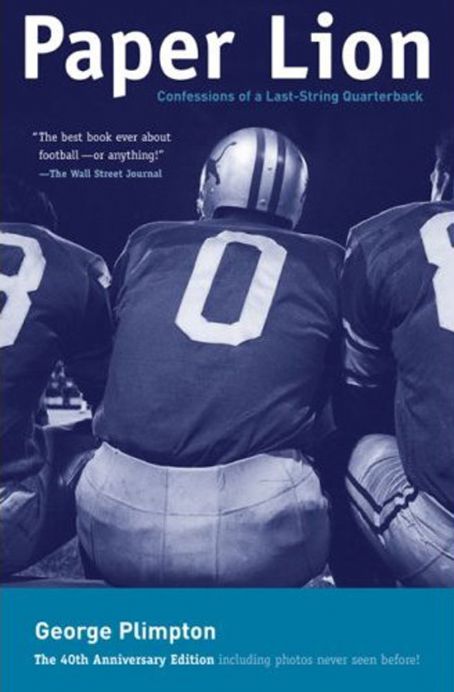
I interviewed George Plimpton shortly before his death, though I accept no blame for his demise. In 1966, the journalist, editor, party maven and prankster scored one of his greatest successes with Paper Lion, a sports book about trying out for third-string quarterback for the Detroit Lions. The other players weren’t in on the lark, though they soon came to realize the 36-year-old rookie was better at throwing back martinis than throwing tight spirals. The book grew out of “Zero of the Lions,” the author’s famous 1964 Sports Illustrated article. An excerpt from that piece:
“I looked for my helmet, relieved to see it lying in the grass a few yards away. My impulse was to put it on. From the beginning I’d had trouble getting into the helmet. The procedure was to stick the thumbs in the helmet’s ear holes and stretch the helmet out as it came down over the head—a matter of lateral pull, and easy enough if you practiced isometrics, but I never had the strength to get my ears quite clear, so they were bent double inside the helmet once it was on. I would work a finger up inside to get the cars upright again, a painful procedure, and noisy, the sounds sharp in the confines of the hard shell of the helmet as I twisted and murmured until it was done, the ears ringing softly. Then quiet would settle in the helmet, and I would look out beyond the bars of the nose guard—the ‘cage,’ the players call it—to see what was going on outside, my eyes still watering slightly. It was even more difficult to get the helmet off. The first helmet Friday Macklem had given me was too small—a helmet is supposed to fit snugly to afford the best protection—and when I tried it on in front of my locker I yelled as it came down over my ears. Wayne Walker, the big linebacker, happened to be chatting with me at the time.
‘How’d she feel?’
‘Feels fine. Snug,’ I said. ‘Once you get the thing on.’
I tried to take it off. I got my thumbs in the ear holes and tried to budge the helmet loose.
‘I’m stuck in here,’ I said, simply.
Walker began to grin. He looked down the locker room aisle for other players who would have enjoyed the dilemma. Mercifully, none were on hand.
‘Damn!’ I said. ‘I can’t budge this thing.'”
••••••••••
Plimpton parlayed his Paper Lion success into Oldsmobile Vista Cruiser ads:
Tags: George Plimpton

An excerpt (via Wired) from The Red Market, Scott Carney’s horrifying account of contemporary flesh peddlers of all sorts, including an Indian farmer who holds people captive and “milks” them for blood which is sold for profit:
“For the last three years the man had been held captive in a brick-and-tin shed just a few minutes’ walk from where the farmers were drinking tea. The marks on his arms weren’t the tell-tale signs of heroin addiction; they came from where his captor, a ruthless modern-day vampire and also a local dairy farmer and respected landowner named Papu Yadhav, punctured his skin with a hollow syringe. He had kept the man captive so he could drain his blood and sell it to blood banks. The man had managed to slip out when Yadhav had forgotten to lock the door behind him.
The emaciated man brought the officers to his prison of the last three years: a hastily constructed shack sandwiched between Papu Yadhav’s concrete home and a cowshed. A brass padlock hung from the iron door’s solid latch. The officers could hear the muffled sounds of humanity through the quarter inch of metal.
They sprung the lock and revealed a medical ward fit for a horror movie. IV drips hung from makeshift poles and patients moaned as if they were recovering from a delirium. Five emaciated men lying on small woven cots could barely lift their heads to acknowledge the visitors. The sticky air inside was far from sterile. The sun beating down on the tin roof above their heads magnified the heat like a tandoor oven. One man stared at the ceiling with glassy eyes as his blood snaked through a tube and slowly drained into a plastic blood bag on the floor. He was too weak to protest.”
Tags: Papu Yadhav, Scott Carney
Some smart person on Reddit posted this image of nineteenth-century circus “Fat Man” Frank Williams, who was considered so grotesquely overweight during his life that he amazed crowds at sideshows. Today he would be far too slender to earn a place on network TV weight-loss spectacles.
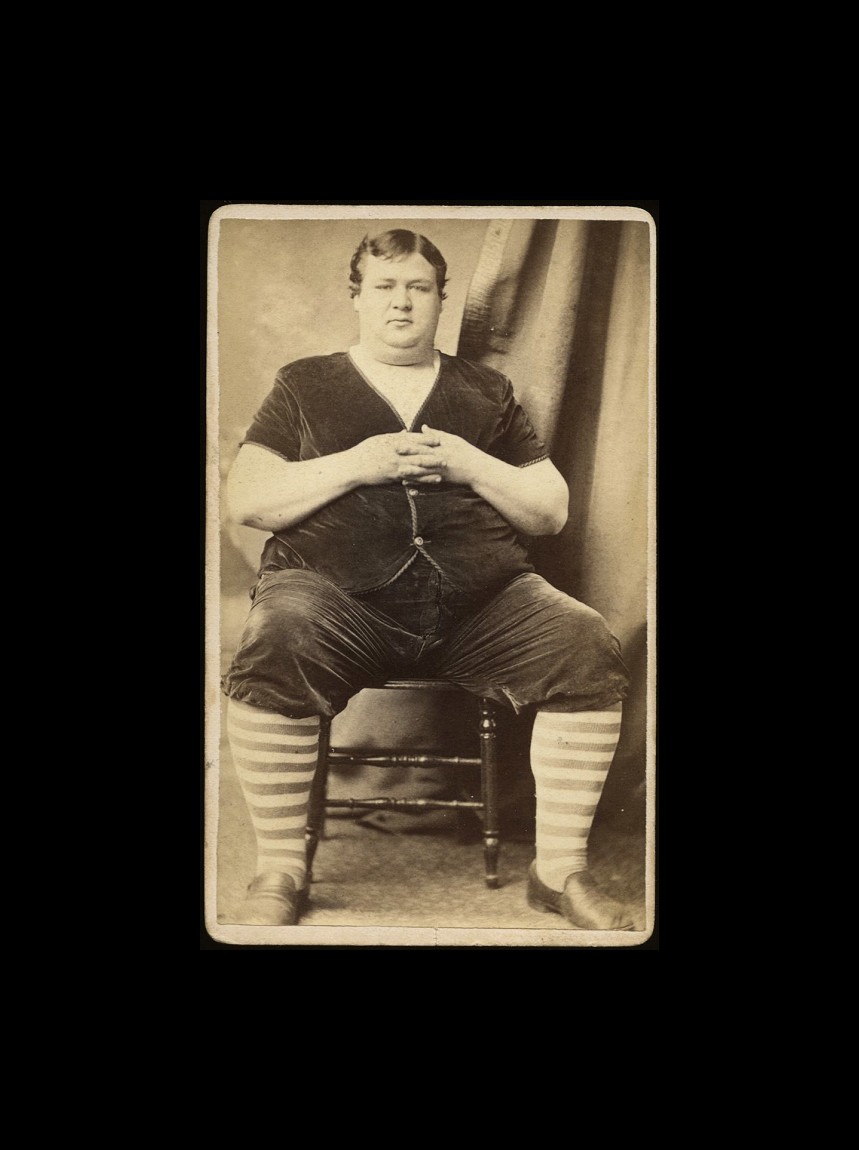
Frank Williams was billed at 525 pounds when he worked at sideshows. Not even close.
Tags: Frank Williams

From “My Dealing, Stealing, Squealing Neighbors,” a recent New York magazine piece by the excellent Luc Sante about his years living in Manhattan tenements:
“The task of holding the house together fell on the super, a man named Zygmunt, whom everyone called George. He lived in the first apartment on the right as you came in, was usually available—except on Sunday mornings, when his hangover took precedence—and was a dab hand with a pipe wrench. He did commendable work under the circumstances, although he never was able to fix the bathtub of Rose and Simon, my neighbors across the hall, with the result that they came over to use mine a few times a week for the entire term of my residence.
By and large, I loved my neighbors, although I worried constantly, owing to the presence of so many loose cannons in a single fragile container. One afternoon I took myself out to the movies. Film Forum was showing the last picture directed by Erich von Stroheim, which he called Walking Down Broadway although it ended up as Hello, Sister! It contained a subplot about a construction worker who, after getting plowed at the saloon across the street from his work site every night, would sneak back in and steal a few sticks of dynamite, which he’d throw under his bed when he got home. In the third act, naturally, nature took its course. I walked home thinking about how such a character would not be out of place in my building. Then when I opened the door I beheld my neighbors, all of them, out in the halls, rushing around with buckets of water. We had very narrowly escaped a conflagration.
It seemed that the art critic on the fourth floor had become immersed in crack to the extent that he had neglected to pay his Con Ed bill. His service cut off, he had been lighting his way with candles, although he was perhaps not as attentive as the situation might warrant. Furthermore, his apartment contained several years’ worth of newspapers, as well as a small fortune in contemporary oil paintings. Nature had taken its course.”
••••••••••
Luc Sante collects postcards:
More Luc Sante posts:
Marshall McLuhan, a devout Catholic, on a 1970s religious program.
More McLuhan posts:
The shit-kicking (and shit-eating!) Divine visited that bombastic chucklehead Tom Snyder in 1979. Also on hand: Warhol superstar Holly Woodlawn.
From Divine’s 1988 obituary in the Times of London: “Divine, the 21-stone drag artist who has died in Los Angeles at the age of 42, won a cult following through his appearances in American underground films.
Once voted ‘the filthiest person alive,’ Divine built his reputation on the ability to shock. But it was, he claimed, part of a calculated assault on what he saw as American materalism and hypocrisy.
He always disliked being labelled a transvestite and insisted that cha-cha heels and thigh-splitting spandex dresses were purely ‘work clothes’ designed to make people laugh.
He was born Harris Glen Milstead and started his career as a hairdresser in Baltimore, Maryland. The film director John Waters, who had been at school with him, devised his professional name.
Made during the 1970s, the Waters/Divine films were deliberately raucous, crudely made and sexually explicit but achieved a critical respectability as a searing portrait of a sick society. They included Desperate Living, a tale of rape, murder and cannibalism, and Female Trouble, in which Divine played a delinquent schoolgirl who is violated by a struck driver and ends up in the electric chair.”
Tags: Divine, Harris Glen Milstead, Holly Woodlawn, John Waters, Tom Snyder
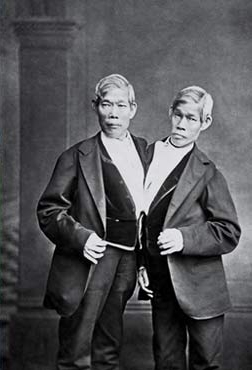
"The features of Chang were partially discolored, those of Eng being quite natural."
The famous 19th-century Siamese twins Chang and Eng, conjoined brothers who were actually born in Siam, passed away in North Carolina at the age of 63 in 1874. The siblings were sideshow and medical curiosities during their lives, so it’s no surprise that they attracted much interest at the time of their death. An article in the February 6, 1874 Brooklyn Daily Eagle reported on the post-mortem. An excerpt:
“On Sunday the Scientific Medical Commission, consisting of Dr. William H. Pancosat, of Jefferson Medical College, Dr. Harrison Allen, of the University of Pennsylvania, and Dr. T.H. Andrews, also of Jefferson Medical College, arrived at the residence of Mrs. Eng, one of the widows of the Siamese twins. A consultation took place between the medical gentlemen and both the widows, the former setting forth the object of their visit and urged the importance to science of an examination of the bodies.
After a brief discussion, during which both the ladies evinced considerable feeling, they consented to the propositions of the commission, on the condition and with the distinct understanding that the bodies should not be injuriously mutilated. This the commission agreed to in a few moments. Afterward they descended to the cellar where the bodies were interred. This was found to be a dark but somewhat spacious apartment, the floor of which was naked earth, the soil of the substrata of rock being of a porous and mouldy nature. Accompanying the commission was a tinner, to open the case in which the bodies had been placed. The scene was now quite a weird and solemn one. The temporary sepulchre was reached by a northwestern door from another basement apartment, and when the commission descended the crowd of neighbors thronged in and stood silently around the improvised tomb of the twins. The darkness being intense, pine wood knots were then lighted in one corner, the flickering glare of which cast ghostly shadows of the spectators athwart the wooden ceiling and along the roughly built granite walls of the room.
The tomb was then opened. There was a cadaveric odor from the coffin. A white gauze muslin covering being drawn off, the faces of the dead twins were exposed. The features of Chang were partially discolored, those of Eng being quite natural.
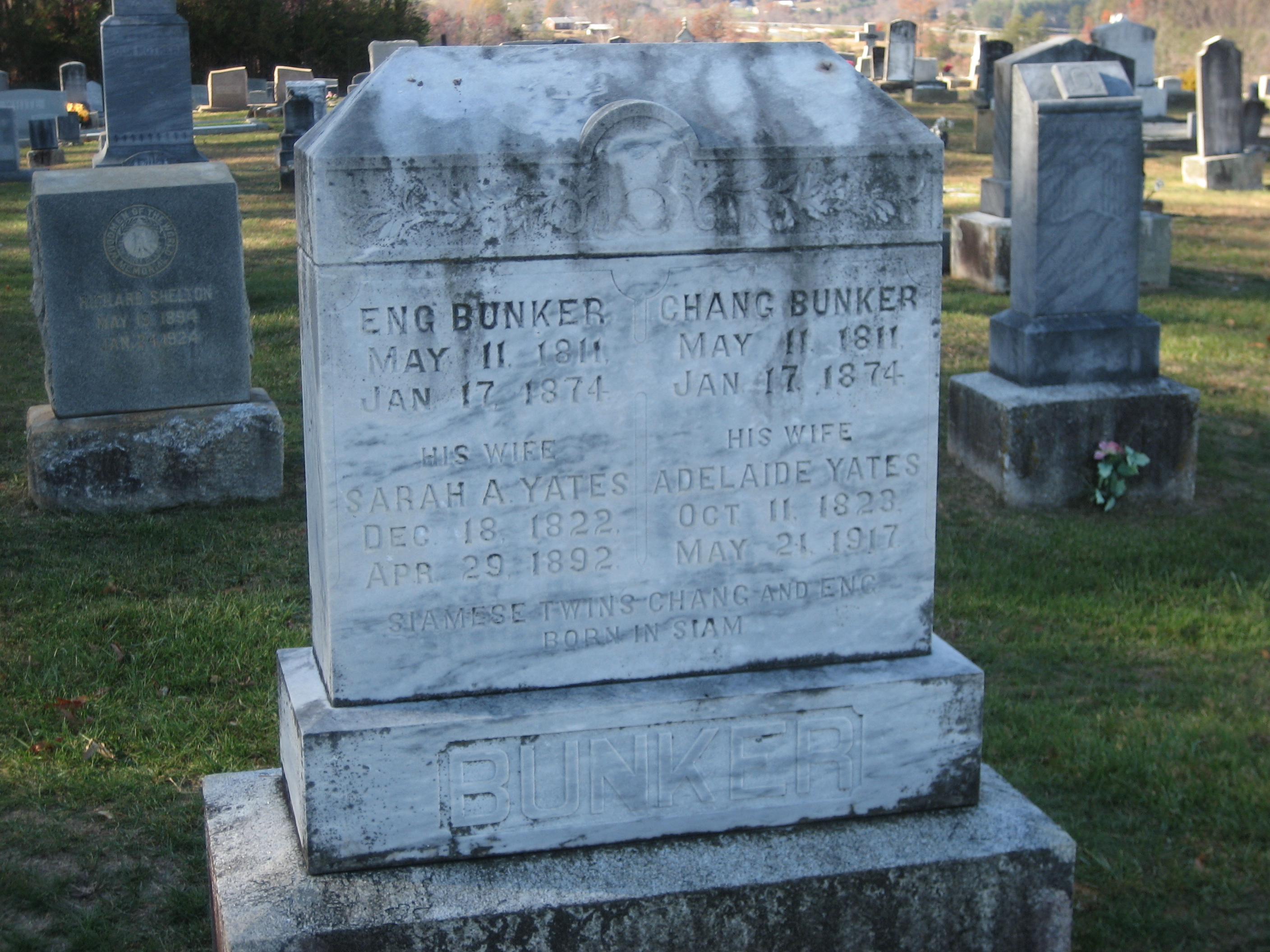 The members of the commission, assisted by those present, then disrobed the bodies, and a partial examination was made, no operation being performed, and the result of this was followed by a medical consultation. From what could be learned it was found the bodies, though well preserved so far, would in a few days be in a state of decomposition, and that the surgical operation, if performed now, might endanger the ultimate preservation of the now defunct natural curiosity, a consequence which both the commission and the families were anxious to avoid. It was further decided that the facilities for an autopsy were so meagre and insufficient that it would not be wise to attempt it on the present occasion, and that beside the present examination and efforts to obtain good photographic views of the ligament and the bodies, the operations of the commission would be limited to a partial embalmment to insure the preservation of the bodies. A number fo efforts to obtain photographic views were then made, resulting successfully in one instance only. After which the partial embalmment was performed, and the bodies were once more covered in the coffin. The widows then consented to have the bodies removed to the College of Physicians at Philadelphia.
The commission returned to Mount Airy late Sunday evening. On Monday they left for Salem, in Forsyth County, in a carriage, the wagon containing the coffin following, and behind two buggies with the photographers, making for quite a funeral procession, which attracted the attention of the people all along the route. On Tuesday afternoon the cortege reached Salem, where the bodies were shipped to Greensboro, the commission accompanying them. They arrived at that point this morning and left for Philadelphia this afternoon, where they will arrive to-morrow at half past one o’clock.”
Tags: Chang and Eng, Chang Bunker, Eng Bunker

Single-file lines that snake around–like at airports or banks–haven’t always been the way people queued up. According to “Mr. Next,” Ian Parker’s fun 2003 “Talk” piece in the New Yorker, the practice only began in America in the 1980s. It seems so simple and obvious, but someone had to come up with it. An except:
“The history of American queuing has a simple outline. First there were hordes with sticks, then there were lines, and then, in the early nineteen-eighties, thanks in part to visionary thinking at the Columbus, Ohio, headquarters of Wendy’s (and initiatives at American Airlines and Chemical Bank, among others), customers began to be asked to form lines that the trade usually describes as ‘serpentine’: they snaked back on themselves, and the person at the head of the snake stepped up to the next available cashier or teller. This system was plainly fairer: no one who arrived after you would be served before you. It removed most fear and doubt from the queue calculus, leaving only impatience and anger; and in almost every place where it could be adopted it was.”
Another Ian Parker post:
Tags: Ian Parker
Entertaining putz Tom Snyder hectors Ayn Rand in 1979.
Tags: Ayn Rand, Tom Snyder
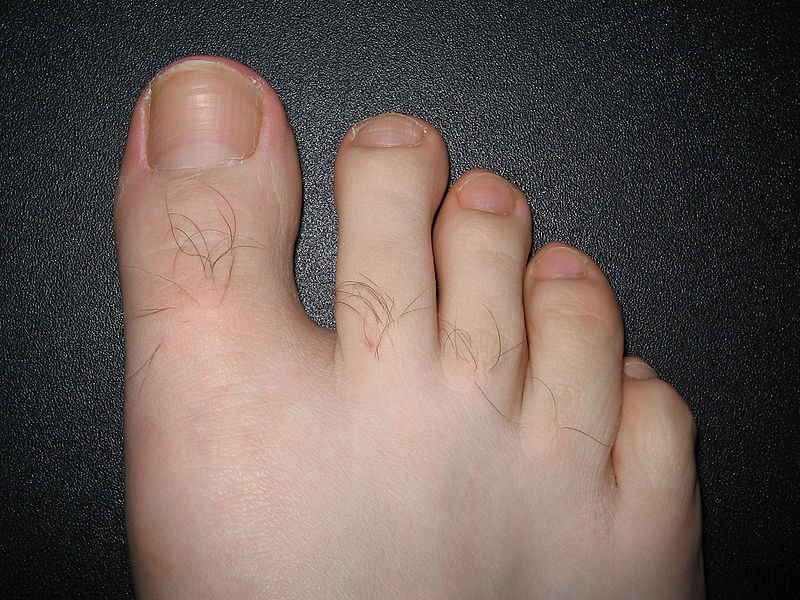
"I'm willing to do PayPal." (Image by Kommissar.)
Toenail Collection – for sale – $9 (Newark)
This is a very rare in-valuable item. I mean, how do I know how to price this, what it’s worth? You won’t find somethin’ like this on e-bay, bet your ass! I’ve decided to sell my entire toenail collection that I have been collecting for many many years now. I was going to put this ad under the Antiques category, but I threw a few new ones in there a few days ago. Been keeping ’em since I was about 6, I’m 81 now. I’m willing to do PayPal and mail this out to you. Or, we can meet in Newark somewhere. Not near the airport….wouldn’t want a big wind from a plane to come by just as I’m opening the jar.
The jar is included, with the screw-on top….if I’m gonna mail this out to you, you wouldn’t want these to get loose and all mixed around in the mail, so I’ll keep ’em in the jar. Might be worse than Anthrax! But, better yet, if we meet in person, I can update the jar with my latest nails. Bring scissors. And exact change.
Thirsty pipes.
Tags: Malcom McLaren
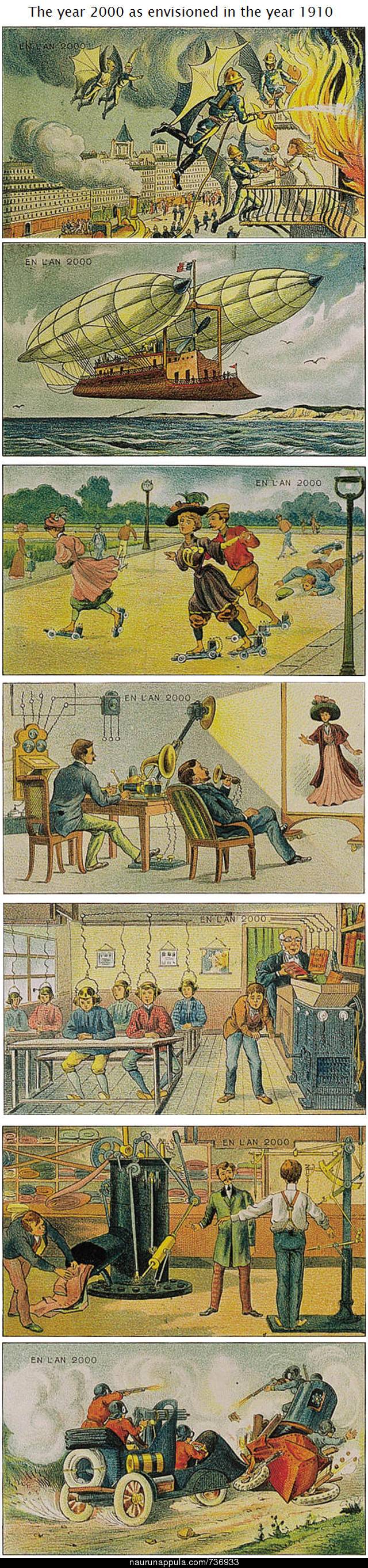
I was noodling around on Reddit when I found this odd series of 1910 drawings which tried to predict what life would be like in 2000. Apparently, firefighters and boats would be able to fly, roller skates would be electric, books would be fed directly to the brain and washing machines would be awesome. Fun stuff.
In 1977, Hunter S. Thompson thought President Carter was a badass. That persona was subsumed in scenes of blindfolded American hostages being paraded around in Iran, a national embarrassment which played out nightly, endlessly on flickering screens.
Tags: Hunter S. Thompson, Jimmy Carter
Betty Friedan in 1964.
Tags: Betty Friedan
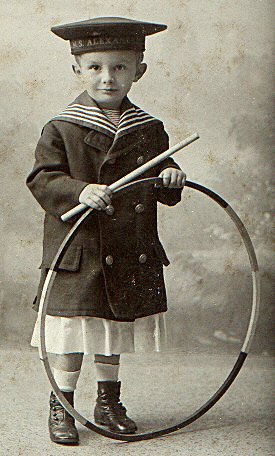
"He is now confined to his home under medical treatment."
We’re plenty dumb right now, but people in the nineteenth century were even dumber, as the following story from the October 17, 1890 Brooklyn Daily Eagle about a boy with a wooden hoop and a neighbor with a bad temper proves. An excerpt:
“Justice Goetting this morning held Stephen Rose, of 76 Roebling Street, on $1,000 bail to answer on Thursday the charge of striking 13 year old John Murray, of 230 North Eighth Street on the head with a brick, and injuring him so badly that he is now confined to his home under medical treatment. His physician, Dr. A.A. Weber, is doubtful of his recovery. The complaint is brought by Miss Mary Murray, the boy’s sister. The defendant is about 61 years old. The residences of the two parties, it appears, adjoin, and it is alleged that Rose, annoyed by the boy breaking up a wooden hoop against the wooden fence of the yard, climbed on a ladder and dropped a brick on his head.”
Tags: Dr. A.A. Weber, Justice Goetting, Miss Mary Murray, Stephen Rose
He meows for us all. (Thanks Reddit.)
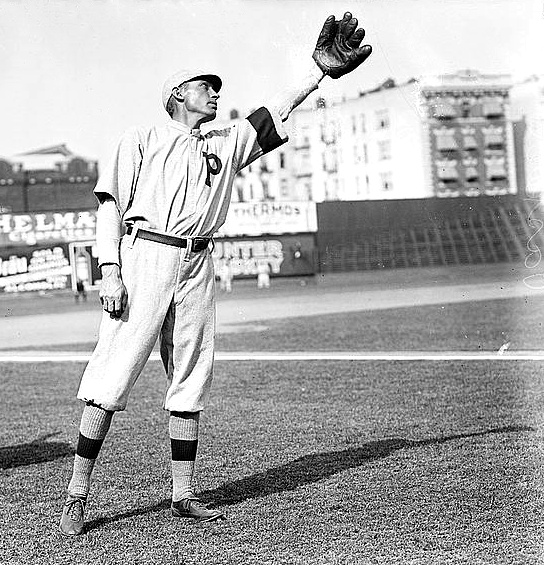 Some people can sense earlier than others that something is being done incorrectly, that methods are amiss, that the whole thing is a sham. Brooklyn baseball fan Walter Lappe was just such a person. I knew about Bill James and Eric Walker and the Moneyball era of advanced baseball statistics that their number-crunching ushered in, but I had never heard of Lappe, who was on the same path years earlier, trying to instill science and objective reasoning into baseball. He teamed with renegade ex-pitcher Jim Bouton to publish something called The Baseball Brain, which was the first attempt by “barbarians” to crash the gate. Lappe and his stats don’t seem to have arrived at a lot of correct answers, but he was asking the right questions before others were. An excerpt from a July 1, 1974 New York magazine article that Bouton penned about their attempt to reinvent baseball:
“If I told you that some nutty baseball fan from Brooklyn held the secret for getting the Mets and Yankees into the World Series, you wouldn’t believe me. It sounds like something from Damn Yankees or like that old movie It Happens Every Spring, where Fred MacMurray or Ray Milland or somebody invents a magic substance which repels wood and when you rub it on baseballs they become unhittable. Our fan from Brooklyn doesn’t have anything that sneaky, but what he does have could be just as revolutionary. I’ve seen his stuff, and I believe. Now, if only Yogi Berra and Bill Virdon (Mets and Yankees managers as of this writing) will read this, we’ll all be rolling in champagne and ticker tape this fall.
The fan from Brooklyn who could cause baseball’s first intra-stadium World Series is Walter Lappe (pronounced ‘Lap’), who believes that big-league managers rarely use the best strategy and players don’t seem to know what they’re doing out there. For the last 20 of his 49 years, Walter as a hobby, has been keeping his own statistics on the New York ball teams. He listens to games on the radio and writes down where each batter hits the ball, who’s pitching, balls and strikes, runners on base, weather conditions, phases of the moon, etc. Now that’s pretty nutty, but so is flying a kite in a rainstorm.
I don’t know if Benjamin Franklin has a brother, but Walter has one named Henry who is always saying, ‘Walter, why don’t you stop wasting your time listening to baseball games and go get a job, Walter?’ But how can someone get a job when you’re unlocking the secrets of the universe?”
_________________________
A 1970s ESPN Sportscenter report on Bouton’s controversial book, Ball Four. What mutton chops, what suits!
Tags: Jim Bouton, Walter Lappe

Carl Van Vechten took this classic 1936 photograph of Argentine surrealist painter Leonor Fini, she of the experimental hats and ever-present cats. From Fini’s 1996 obituary in the Independent: “In the 17th century Leonor Fini would have been burnt as a witch. Surrounded by cats, and with feline eyes herself, she exuded what her one-time lover Max Ernst described as ‘Italian fury, scandalous elegance, caprice and passion.’ In photographs you would take her for beautiful in the manner of Bianca Jagger but, according to the American art dealer Julian Levy, she was not a beauty as such, in that ‘Her parts did not fit well together: head of a lioness, mind of a man, bust of a woman, torso of a child, grace of an angel, discourse of the Devil . . .’
Levy confirms my belief that if she had been born in the age of the extra teat and the familiar, this lady was for burning. “Her allure,” he says, “was an ability to dominate her misfitted parts so that they merged into whatever shape her fantasy wished to present from one moment to the next.” You can almost hear the faggots crackle.
Leonor Fini was of mixed Spanish, Italian, Argentinian, and Slavic blood, a formidable genetic cocktail. She was born in Buenos Aires in 1908 but grew up in Trieste. Her formal education was, as might be imagined given her independent and imperious temperament, fragmentary, but she had the run of her uncle’s large library in Milan and also travelled widely in Italy and Europe visiting all the museums and taking in such then unfashionable painters as the Mannerists, a school later reflected in her own work. In reproduction she was to add Beardsley, the German Romantics and the British Pre-Raphaelites – all evidence of a Surrealist eye.
Her facility was precocious. By the time she was 17 she was already painting commissioned portraits. It was however in 1936 when she moved to Paris and became friendly with Ernst, the Eluards, Brauner and others, that she began to paint Surrealist images and to draw close to the movement. Close but not of. Like her greater contemporary Frida Kahlo, Fini refused to bend her knee before Andre Breton, and declined to accept the iconic role of child-woman or to accept his belief in l’amour fou, the monogamist obsession with one person as opposed to bisexual narcissism. She did however exhibit with the group as a kind of fellow traveller.”
Tags: Carl Van Vechten, Leonor Fini
Ray Bradbury in the late ’60s discussing his cultural role during the adaptation of his short-story collection, The Illustrated Man, which rested (uneasily) at the nexus of technology and psychology.
Tags: Ray Bradbury