
Urban Studies

You are currently browsing the archive for the Urban Studies category.

The first paragraph of Brian Kim Stefans’ L.A. Review of Books article about Baroness Elsa von Freytag-Loringhoven, one of Dada’s leading ladies:

“The typical thumbnail portrait of the Baroness Elsa von Freytag-Loringhoven usually goes like this. She was the Queen of New York Dada from 1913 to 1923, the first to wear clothes made of discarded clothes and rubbish (including a brassiere made of tin cans). She constructed assemblage-style art in the manner of Marcel Duchamp, and her scatological proclivities may have inspired his seminal Fountain. She was prone to spontaneous ‘performance,’ often in the nude, and was sexually aggressive in a decidedly ‘masculine’ way. She courted Duchamp actively and mocked him in poems (dubbing him ‘M’ars’ — my arse), and chased right to his front lawn in Rutherford, New Jersey the relatively prudish doctor-poet William Carlos Williams, who, legend has it, learned how to box in order to deck her in self-defense.”

Tags: ,

May you live in interesting times, goes the sly, old Chinese curse. Some eras are more interesting than others, but they’re all fascinating in one scary way or another, not just these desperate times we’re facing now. FromThe Evil in the Room,” Norman Mailer’s 1972 Republican National Convention coverage from Miami, which he filed for Life:

“There were ghosts on the convention. And the sense of having grown old enough to be passing through life a second time. Flying to San Francisco in 1964 to write up the convention which nominated Barry Goklwater, he had met an Australian journalist who asked why Americans made the interior of their planes look like nurseries, and he had answered, in effect that the dread was loose in American life. Was it still loose, that sense of oncoming catastrophe going to fall on the nation like the first bolt from God? Such dread had taken many a turn–from fear of Communism to fear of walking the streets at night, which was a greater fear if one thought about it (since the streets were nearer). It was a fear when all was said which suggested that the nation, in whatever collection of its consciousness, was like a person who wakes up often in the middle of the night with the intolerable conviction that something is loose in the system, and the body is on a long slide from which there will be no remission unless a solution is found; the body does not even know where the disease is at. Nor will the doctors, is what the body knows in the dark.”

••••••••••

Occupying the GOP Convention, 1972: “Don’t hurt the car, don’t hurt the car!”

“It’s a very plastic, packaged thing”:

Tags:

A brief note from the wacky world of upholstery, from the October 21, 1886 Brooklyn Daily Eagle:

“A Chicago upholsterer, in repairing an old sofa that had been brought to his shop, found the following articles, which had slipped down between the back and cushion: Forty-seven hairpins, 8 mustache combs,19 suspender buttons, 13 needles, 8 cigarettes, 4 photographs, 217 pins, some grains of coffee, a few cloves, 27 cuff buttons, 6 pocket knives, 15 poker chips, a vial of homeopathic medicine, 34 lumps of chewing gum, 19 toothpicks, 28 matches and 14 buttonhooks. The sofa belonged to a man who had seven unmarried daughters.”

Tom Snyder marvels over a tiny Casio keyboard and some toy robots while interviewing Ric Ocasek and Greg Hawkes of the Cars, 1981.

Tags: , ,

"As we're more and more connected to each other, there's more and more to copy." (Image by Warren H. Chaney.)

I would guess there are as many if not more innovators than ever, though our interconnected world and the proliferation of information has made copying remarkably easy. Evolutionary biologist Mark Pagel meditates on this dynamic at Edge. An excerpt:

“The interesting thing with Facebook is that, with 500 to 800 million of us connected around the world, it sort of devalues information and devalues knowledge. And this isn’t the comment of some reactionary who doesn’t like Facebook, but it’s rather the comment of someone who realizes that knowledge and new ideas are extraordinarily hard to come by. And as we’re more and more connected to each other, there’s more and more to copy. We realize the value in copying, and so that’s what we do.

And we seek out that information in cheaper and cheaper ways. We go up on Google, we go up on Facebook, see who’s doing what to whom. We go up on Google and find out the answers to things. And what that’s telling us is that knowledge and new ideas are cheap. And it’s playing into a set of predispositions that we have been selected to have anyway, to be copiers and to be followers. But at no time in history has it been easier to do that than now. And Facebook is encouraging that.”

Tags:

Living beetle controlled remotely by DARPA technology.

"I feel like something is crawling all over me even as I send this to you." (Image by ThisParticularGreg.)

Larvae Found In Imported African Bras (showing up in NY)

It is horrible. Guys tell your wife, sisters, girlfriends, and girl cousins to wash bra before wearing.

All please wash all bras, underwear when you buy before wearing them. We do not know what parasite is in our clothes when we buy them. Forward to everybody you know. Let me fore warn you. Thiis is so  squimish. I feel like something is crawling all over me even as I send this to you. Be aware. It is so grotesque. Please wash your underwear before wearing. Preferably in boiling hot water. 

Despite what team owners pretending empty pockets say, new sports arenas benefit only them, not local economies, as study after study has shown. Yet taxpayers keep getting hustled and giving welfare to the wealthy. An excerpt from Patrick Hruby’s seething, spot-on Yahoo! Sports piece about the use of public funds to build a new stadium for the Miami Marlins and their wealthy art-dealer owner Jeffrey Loria:

“Following the financial meltdown of 2008, President Bush diagnosed the deus ex machina of the Great Recession like this: ‘Wall Street got drunk.’ He was wrong. Wall Street did not get drunk. Wall Street got over. Wall Street made billions underwriting crappy mortgagees, repackaging them as Triple-A investments and peddling them to naïve investors (read: your 401(k), state pension plans); made billions more placing side bets on and against the preceding criminal, but not technically criminal practice; made billions on top of that when the whole unsustainable shell game went belly up, thanks to a massive, unprecedented influx of taxpayer cash — again: your money — via TARP and the Federal Reserve’s money-for-nothing “discount window,” which in turn allowed financial houses to keep handing out the kind of outsized salaries and bonuses that had the encamped residents of Zuccotti Park so peeved.

Over in the sports world, the Marlins are running the same basic con.

‘They’re finally spending money? That’s a misnomer,’ says Ken Reed, Sports Policy Director for the League of Fans, a Washington, D.C.-based fan advocacy group affiliated with consumer advocate Ralph Nader. ‘To me, it’s more like taxpayers have funded the entry fee into this high-priced fantasy league, and the Marlins are going off and buying players with our money. I think this will go down as the ultimate case of corporate sports welfare gone bad.’

Sick of corporate bailouts? Occupy the Marlins.”

••••••••••

“Are you in?”:

Tags: ,

A brief passage about the history of the shopping cart, from a New York Times Magazine piece by Hilary Greenbaum and Dana Rubinstein:

“One night in 1936, [Sylvan] Goldman had an epiphany. ‘As he worked late in his office, his attention was drawn to two ordinary folding chairs,’ wrote Terry P. Wilson in The Cart That Changed the World, the seminal Goldman biography, published in 1978. What if, he wondered, one chair was placed on top of another? What if a basket was placed on top of each seat? What if it had wheels? The modern shopping cart was born.

Widely considered the inventor of the shopping cart, Goldman was no slouch as a promoter either. He ran ads in local newspapers that read, in part, ‘Can you imagine wending your way through a spacious food market without having to carry a cumbersome shopping basket on your arm?’ He stationed what he described as ‘an attractive girl’ near his store entrance to hype the new device. When it became clear that only the elderly were interested, he employed actors to push carts through his aisles.”

••••••••••

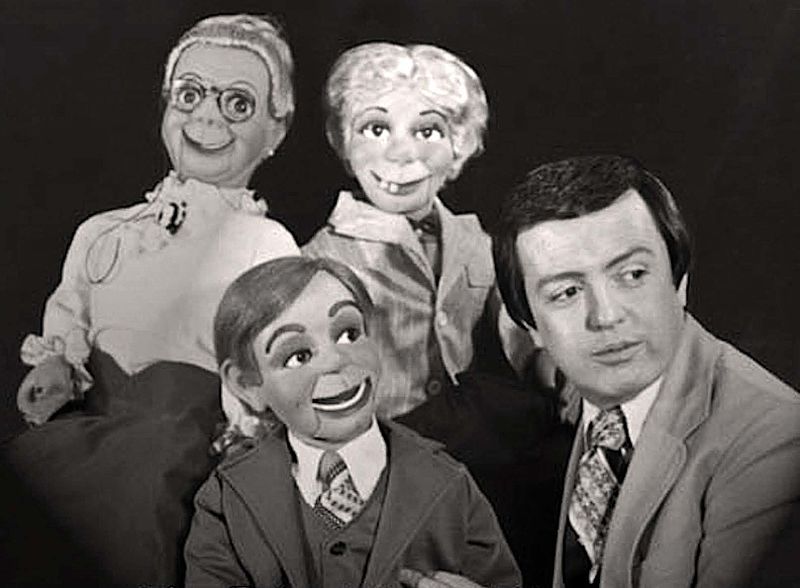
In addition to customers, actors sometimes portray fictional, folksy CEOs. If things had broken differently, these people could have been cast as horse trainers or secret agents or bank robbers. It’s just a costume.

Colonel Harlan Sanders:

Bartles & Jaymes :

Betty Crocker:

Tags: ,

One of John and Yoko’s odder gambits for world peace, Bagism, 1969.

Recalling the origins of Bagism with Dick Cavett, 1971 (at 2:28):

Tags: , ,

Allen Funt meets Muhammad Ali on Candid Camera.

Tags: ,

Warfare changed dramatically over the past decade with the development and deployment of Predator drones. With the wars abroad drawing down, drones will soon transform domestic policing in the U.S., whether we like it or not, even for cow poachers. From the Los Angeles Times:

“Armed with a search warrant, Nelson County Sheriff Kelly Janke went looking for six missing cows on the Brossart family farm in the early evening of June 23. Three men brandishing rifles chased him off, he said.

Janke knew the gunmen could be anywhere on the 3,000-acre spread in eastern North Dakota. Fearful of an armed standoff, he called in reinforcements from the state Highway Patrol, a regional SWAT team, a bomb squad, ambulances and deputy sheriffs from three other counties.

He also called in a Predator B drone.

As the unmanned aircraft circled 2 miles overhead the next morning, sophisticated sensors under the nose helped pinpoint the three suspects and showed they were unarmed. Police rushed in and made the first known arrests of U.S. citizens with help from a Predator, the spy drone that has helped revolutionize modern warfare.”

••••••••••

Cow, perturbed by surveillance:

Douglas Englebart recalls creating the computer mouse during the 1960s.

Mother of all demos, 1968:

Tags:

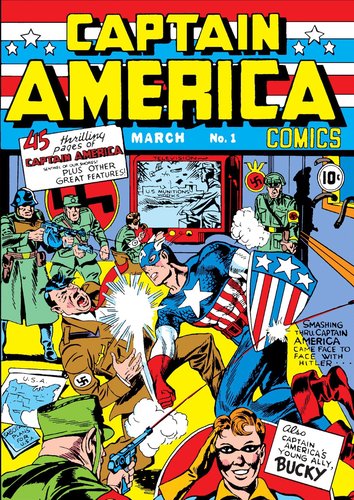
From Bruce Weber’s New York Times obituary of Joe Simon, the comic-book legend who not only co-created Captain America but also made Hitler a villain in his panels right before America entered WWII:

“He took to drawing at an early age, creating comic strips and cartoons for his high school newspaper and yearbook. After graduating, he worked in the art department at newspapers in Rochester and Syracuse, learning how to retouch photographs and lay out pages. He created cartoons and illustrations for the papers’ sports sections — ‘Drawing athletes prepared me for drawing superheroes,’ he said in his autobiography — and began to write as well, covering boxing matches and other sports events.

He eventually moved to New York, where his first job was for Paramount Pictures, retouching still photographs of movie stars. ‘I retouched some of the most famous bosoms in motion pictures — Gloria Swanson, Joan Crawford, Bette Davis, Carole Lombard and Dorothy Lamour,’ he wrote. ‘Good bosom men were considered experts and got lots of work. I could hold up a sagging bust line with the best of them.'”

Tags: ,

Alice awakens from the languid wonderland that is well-appointed suburbia, in Mike Mills’ 2000 short, “Architecture of Reassurance,” 2000.

Tags:

mother-teresa-india

Christopher Hitchens, that godless heathen (I mean that as a compliment as well as a statement of fact), just passed away from esophageal cancer. FromMommie Dearest,” his enthusiastic flogging of Mother Teresa published on Slate in 2003:

MT was not a friend of the poor. She was a friend of poverty. She said that suffering was a gift from God. She spent her life opposing the only known cure for poverty, which is the empowerment of women and the emancipation of them from a livestock version of compulsory reproduction. And she was a friend to the worst of the rich, taking misappropriated money from the atrocious Duvalier family in Haiti (whose rule she praised in return) and from Charles Keating of the Lincoln Savings and Loan. Where did that money, and all the other donations, go? The primitive hospice in Calcutta was as run down when she died as it always had been—she preferred California clinics when she got sick herself—and her order always refused to publish any audit. But we have her own claim that she opened 500 convents in more than a hundred countries, all bearing the name of her own order. Excuse me, but this is modesty and humility?

The rich world has a poor conscience, and many people liked to alleviate their own unease by sending money to a woman who seemed like an activist for “the poorest of the poor.” People do not like to admit that they have been gulled or conned, so a vested interest in the myth was permitted to arise, and a lazy media never bothered to ask any follow-up questions. Many volunteers who went to Calcutta came back abruptly disillusioned by the stern ideology and poverty-loving practice of the ‘Missionaries of Charity,’ but they had no audience for their story. George Orwell’s admonition in his essay on Gandhi—that saints should always be presumed guilty until proved innocent—was drowned in a Niagara of soft-hearted, soft-headed, and uninquiring propaganda.•

Tags: ,

Eleanor Roosevelt on What’s My Line?, 1953.

Tags:

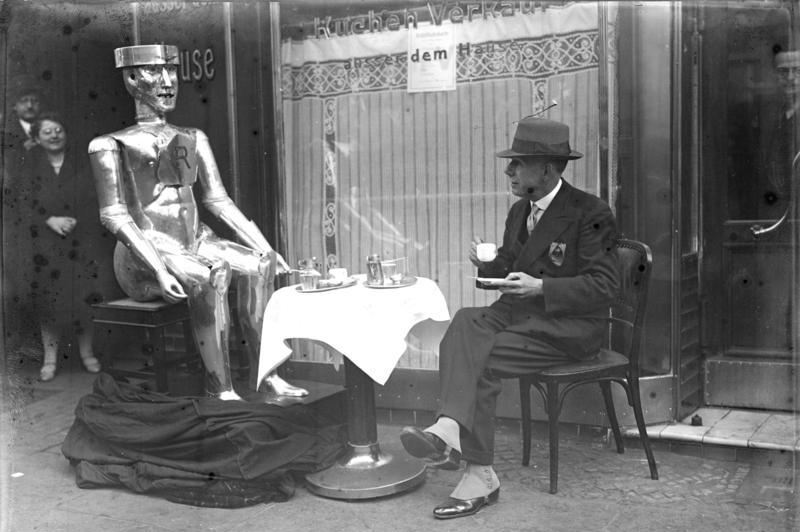
GQ writer Jon Ronson converses with our AI brethren in his excellent March 2011 article, “Robots Say the Damndest Things.” The opening:

“I’m having an awkward conversation with a robot. His name is Zeno. I clear my throat. ‘Do you enjoy being a robot?’ I ask him, sounding like the Queen of England when she addresses a child.

‘I really couldn’t say for sure,’ he replies, whirring, glassy-eyed. ‘I am feeling a bit confused. Do you ever get that way?’

Zeno has a kind face, which moves as expressively as a human’s. His skin, made of something called Frubber, looks and feels startlingly lifelike, right down to his chest, but there’s nothing below that, only a table. He’s been designed by some of the world’s most brilliant AI scientists, but talking to him is, so far, like talking to a man suffering from Alzheimer’s. He drifts off, forgets himself, misunderstands.

‘Are you happy?’ I ask him.

‘Sorry,’ says Zeno. ‘I think my current is a bit off today.’ He averts his gaze, as if embarrassed.

I’ve been hearing that there are a handful of humanoid robots scattered across North America who have learned how to have eloquent conversations with humans. They listen attentively and answer thoughtfully. One or two have even attained a degree of consciousness, say some AI aficionados, and are on the cusp of bursting into life. If true, this would be humanity’s greatest achievement ever, so I’ve approached the robots for interviews. Conversations with robots! I’ve no doubt the experience is going to be off the scale in terms of profundity.

‘Are you happy?’ I ask Zeno again.

‘I prefer not to use dangerous things,’ he replies.”

••••••••••

“Will you knock that stuff off?”:

Tags:

I bought peanuts for the squirrels but ate them myself, is that wrong?

They were delicious. 

I remember reading some years back that Hershey made a special chocolate bar crammed with thousands of calories for the U.S. Army so that soldiers could stave off starvation. Now the American military has come up with a BBQ chicken sandwich that doesn’t spoil for two years. From NPR:

For the U.S. military around the world, the enemy can be hard to pinpoint and even harder to defeat. But back at home, the Army has a tiny and vexing foe in its sights: the bacteria that cause food to rot.

In this bacterial battle, though, it’s clearer who’s winning, and the evidence is a humble pocket sandwich, which looks from the outside no different than your average hot pocket in the frozen foods aisle.

But this sandwich is spectacularly resilient to threats (or hurdles, in Army speak) that would turn it into a dry, moldy mess if they could. Unlike probably any other sandwich out there, this one keeps the microbial forces of nature at bay for up to two years.”

••••••••••

“Not even a Hot Pocket?”:

"Miss Lucia Zarate, his companion and intended wife, is over 15 years of age and weighs less than five pounds."

In a much earlier time before the phrase “little people” was the preferred term of usage, the tiniest among us were often exhibited at circuses, sideshows and dime museums. The May 18, 1879 Brooklyn Daily Eagle had a story about such a pair of Lilliputians. An excerpt:

“The ensuing week is the third and positively the last of the famous little people, known to the world as ‘Uffnor’s Marvelous Midgets.’ This week will close their tour of the United States, as they sail directly to Europe to remain some three or four years. These tiny morsels were first brought together about three years ago, and since the first day they were placed upon exhibition have drawn immense audiences in every city in which they were introduced. Many celebrated ‘little folks’ and ‘dwarfs’ have been from time to time brought before the public, but in searching history or biography there is no record of any couple so infinitesimally small as these two wonderful  beings so aptly called ‘Midgets.’ The largest of the pair, General Mite, is 14 years of age and weighs only nine pounds; Miss Lucia Zarate, his companion and intended wife, is over 15 years of age and weighs less than five pounds. To realize such a marvelous departure of nature from her ordinary productions requires quite a stretch of the imagination. Their combined age is nearly thirty years, while their united weight is only fourteen pounds. Such little creatures appeal to the sensibilities and sympathies of men, women and children alike, and awaken a peculiar interest akin to enthusiasm. These miraculous human wonders remain but six days longer, and will give afternoon and evening levees at Music Hall, at an admission fee of twenty-five cents.”

Tags: ,

David Byrne, known for his songs about buildings, explains how architecture influences musical performance, at his 2010 TED Talk.

Tags:

Steve Jobs has posthumously received much credit for the “Think Different” advertising campaign that relaunched the Apple brand in 1997. Rob Siltanen, former creative director of TBWA/Chiat/Day, sets the record straight for Forbes. An excerpt:

“While I’ve seen a few inaccurate articles and comments floating around the Internet about how the legendary ‘Think Different’ campaign was conceived, what prompted me to share this inside account was Walter Isaacson’s recent, best-selling biography on Steve Jobs. In his book, Isaacson incorrectly suggests Jobs created and wrote much of the ‘To the crazy ones’ launch commercial. To me, this is a case of revisionist history.

Steve was highly involved with the advertising and every facet of Apple’s business. But he was far from the mastermind behind the renowned launch spot. In fact, he was blatantly harsh on the commercial that would eventually play a pivotal role in helping Apple achieve one of the greatest corporate turnarounds in business history. As you’ll learn later in my account, the soul of the original ‘The crazy ones’ script I presented to Jobs, as well as the original beginning and ending of the celebrated script, all ultimately stayed in place, even though Jobs initially called the script ‘shit.’ I’ve also read a few less than correct accounts on how the ‘Think Different’ campaign was originally conceived. While several people played prominent parts in making it happen, the famous ‘Think Different’ line and the brilliant concept of putting the line together with black and white photographs of time-honored visionaries was invented by an exceptionally creative person, and dear friend, by the name of Craig Tanimoto, a TBWA/Chiat/Day art director at the time.

I have read many wonderful things about Steve Jobs and how warm and loving he was to his wife, children and sister. His Stanford commencement address is one of the most touching and inspiring speeches I have ever heard. Steve was an amazing visionary, and I believe the comparisons of him to some of the world’s greatest achievers are totally deserved. But I have also read many critical statements about Steve, and I must say I saw and experienced his tongue lashings and ballistic temper firsthand—directed to several others and squarely at me. It wasn’t pretty. While I greatly respected Steve for his remarkable accomplishments and extraordinary passion, I didn’t have much patience for his often abrasive and condescending personality. It is here, in my opinion, that Lee Clow deserves a great deal of credit. Lee is more than a creative genius. In working with Jobs he had the patience of a saint.” (Thanks Browser.)

Tags: , ,

A passage from My Dinner with Andre, about reality, that elusive thing, which has only grown fuzzier since the film’s release in 1981. And despite history being recorded with ever greater devotion, it still is increasingly forgotten.

Tags: , ,

Paul Allen is willing to invest $200 million of his Microsoft billions to create a mega-aircraft with wingspans wider than football fields, which are capable of launching truck-sized satellites into space. From today’s Wall Street Journal:

“The concept seems to border on science fiction. It envisions a behemoth mother ship with twin, narrow fuselages, featuring six Boeing Co. 747 engines attached to a record 385-foot wingspan, plus a smaller rocket pod nestled underneath. Expected to weigh roughly 1.2 million pounds, the combination would roughly match the maximum takeoff weight of the largest, fully loaded Airbus A380 superjumbo plane, but the wings would be more than 120 feet longer than those of the Airbus A380.

Flying at roughly 30,000 feet, the craft would climb sharply just as it released the rocket, which would use a cluster of four or five engines to boost itself into orbit.

The sheer size of the endeavor presents severe engineering and production challenges. While scientists have long studied the principles of air-launched rockets—Mr. Rutan recalls beginning preliminary work on such a project as long ago as 1991—Stratolaunch Systems Inc., as the new venture is called, still hasn’t firmed up critical design details.”

•••••••••••

A clip from Paul Allen’s 2011 talk with male impersonator Rosie Charles:

Tags:

« Older entries § Newer entries »