Urban Studies

You are currently browsing the archive for the Urban Studies category.

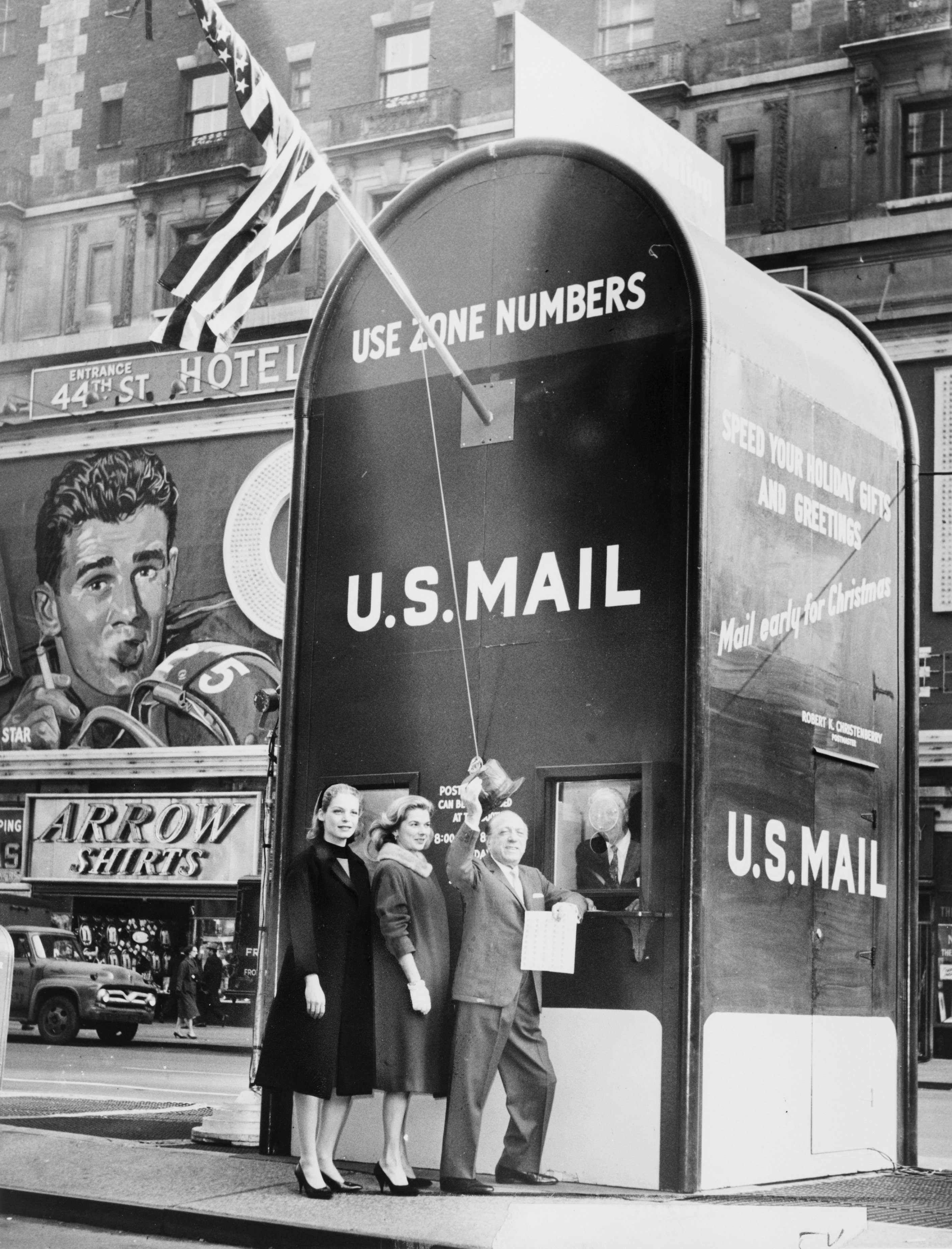
Mail delivered by the United States Postal Service increased every year for 200 years until 2007, when the digital revolution jumpstarted the USPS’s   obsolescence. Technology has doomed the former linchpin of American communications, but technology actually rescued it in the 1960s. An excerpt from an Alexis Madrigal piece in the Atlantic:

“Despite these successes, there have been some hard times for the Postal Service. The biggest crisis USPS faced probably came in the mid-1960s. During that time, which was before Richard Nixon signed a bill that made the service ‘self-funding,’ the Post Office could not get enough funds from Congress to buy the machines they needed to keep up with the post-War explosion in the mail. In October of 1966 the situation came to a head, when, as the museum exhibit put it, ‘a flood of holiday advertisements and election mailings choked the system.’ The Chicago Post Office, the largest in the country, ‘stopped delivering mail for three weeks.’

Automation was the only way out. Zip codes, which were only introduced in 1963, became the lynchpin in the automated postal system. Imagine life without them: a single person can’t sort more than a letter a second, which is at best, 3,600 letters an hour. With the help of machines, postal workers could gain almost an order of magnitude of speed, sorting 30,000 letters an hour.”

••••••••••

“An army of men in wool pants running through the neighborhood handing out pottery catalogs door to door”:

See also:

Tags:

Alfred Hitchcock appears on What’s My Line?, 1954, promoting Rear Window.

See also:

Tags: ,

"I told her to go away. She threatened me."

woman who threatened me and wouldnt go away- (Upper West Side)

This woman sits around in the park all day, as though she has nothing else to do.

Her and I had an issue and I walked away. She kept comeing over to me and getting in front of my face. I told her to go away. She threatened me. What should I do?

She is always gossiping and telling people what to do who come into the park! It is unpleasant for me to come back and I enjoy the park so much!
Help! 


Info learned during first run is utilized during second run.

First run:

Much faster second run:

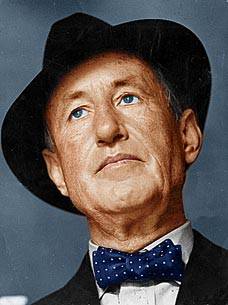
A brief excerpt of Ian Fleming discussing 007’s propensity for violence, in a 1964 Playboy Interview:

Playboy: You’ve been criticized for being ‘obsessed’ with violence in your books. Do you feel the charge is justified?

Fleming: The simple fact is that, like all fictional heroes who find a tremendous popular acceptance, Bond must reflect his own time. We live in a violent era, perhaps the most violent man has known. In our last War, 30 million people were killed. Of these, some six million were simply slaughtered, and most brutally. I hear it said that I invent fiendish cruelties and tortures to which Bond is subjected. But no one who knows, as I know, the things that were done to captured secret agents in the last War says this. No one says it who knows what went on in Algeria.”

••••••••••

“I wanted a really flat, quiet name”:

Tags:

Designer Yves Saint Laurent on What’s My Line?, 1965. Featuring a blindfolded Buddy Hackett.

Tags:

The opening of Ben Paynter’sThe Meteor Farmer,” a 2007 Wired article about a Midwestern man hunting for the remains of rock that had fallen to Kansas from heavens:

“For two weeks, Steve Arnold trudged through the dusty farmland of Kiowa County, Kansas, a 6-foot rope trailing over his shoulder. Tied to the end of the rope was a metal detector cobbled together from PVC pipe and duct tape. Back and forth Arnold paced, pulling the jury-rigged device across the dirt, hunting for meteorites. He had already found a few, but nothing bigger than 100 pounds or so. Mostly, he found horseshoes. And beer cans. Soon the farmers would want him off their land; planting season was coming. To speed things up, Arnold attached his contraption to a tractor. He was sure there was a bigger rock out there, just a few feet beneath the turf.

On a Thursday afternoon, his rig yelped, a shrill beep sounding through his headphones. He drove forward, tires pulling in the fine soil, and the detector crescendoed to an electric wail. Arnold saved the coordinates on his GPS receiver, marked the spot with a pile of dirt, and pulled out his cell phone.

Three days later, Arnold and his partner and investor – an oil and gas attorney from San Antonio named Philip Mani – were attacking the site with a backhoe. After digging down about 5 feet, Arnold scrabbled into the hole with a shovel and started clearing. Finally, the blade clanged against something metallic. The more dirt he moved, the more meteorite he exposed. They lowered the backhoe scoop and strapped the rock to it. Grinding and whining, the machine pulled free the biggest meteorite Arnold had ever seen.

Its shell was mottled, stippled like ground beef. That’s a pattern typical of pallasites, the rarest type of meteorite on Earth. One side was rounded and streamlined by passage through the atmosphere. ‘It’s oriented, Steve!’ Mani shouted. ‘It’s oriented!’

About the size of a beer keg, the rock weighed 1,430 pounds, the largest pallasite ever found in the US. By Arnold’s reckoning, it was worth more than $1 million.” (Thanks Longform.)

•••••••••••

“A modern-day treasure hunter was searching for something out of this world–literally”:

Tags: ,

Rod Serling hosting a game show, The Liar’s Club, in 1969. Betty White guests.

Tags: ,

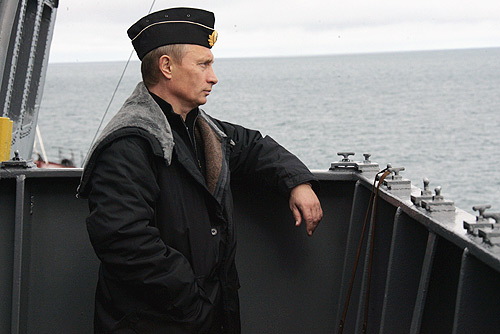
David Remnick can write about any topic brilliantly, but it’s always special when he focuses on American politics, boxing or Russia. He has a new New Yorker article on the latter topic, focusing on Vladimir Putin at a time when the once and perhaps future president of the Russian Federation is facing vociferous dissent from his people for the first time. The opening:

“On the night of November 20th, two weeks before elections for the State Duma, Vladimir Putin set aside the cares of the Kremlin and went to the Olympic SportComplex for an ultimate-fighting match—a ‘no rules’ heavyweight bout between a Cyclopean Russian named Feodor (the Last Emperor) Yemelianenko and a self-described anarchist from Olympia, Washington, named Jeff (the Snowman) Monson. The bout was broadcast nationally on Rossiya-2, one of the main state television channels. Putin, wearing a blue suit and no tie, was at ringside. He has always been eager to project the macho posture of a muzhik, a real man. He has had himself photographed riding horses bare-chested, tracking tigers, shooting a whale with a crossbow, piloting a firefighting jet, swimming a Siberian river, steering a Formula One race car, befriending Jean-Claude Van Damme, and riding with a motorcycle gang. Once, on national television, he tried to bend a frying pan with his bare hands. He did not quite succeed, but the effort was appreciated. And now ultimate fighting: the beery crowd of twenty thousand—some prosperous, some less so—were his own, Putin’s people.

Yemelianenko and Monson were of a rough equivalence: heads shaved, two enormous sacks of rocks, though the Russian was distinguished by his unstained skin; Monson had tattoos from ankle to neck, including two in crowd-friendly Cyrillic—svoboda and solidarnost’. The gesture got him nowhere. Almost from the start, the Russian dominated the fight. Yemelianenko, with a deft and powerful kick, snapped a bone in Monson’s leg, causing the American to limp pitifully. But, even as Yemelianenko took command, steadily reducing Monson to a swollen, bloody pulp—a source of pleasure to the crowd—it was hard to tell if Putin was enjoying himself. The camera flashed to him now and then. He barely betrayed a smile. His face, now smoothed with Botox and filler (it is said), is more enigmatic than ever. What was more, he had larger concerns. He knew that, no matter how hard his operatives tried to get out the vote in the provinces and massage the results, the Kremlin party, United Russia, was going to lose ground.

At the end of the bout—a unanimous decision for Yemelianenko—the Prime Minister climbed through the ropes to pay tribute to the loser and to congratulate his countryman. By this time, the American handlers were tenderly helping their warrior to the dressing room. Monson could no longer walk. His lips were as fat as bicycle tires.

Putin had a kind word for Monson (‘a real man’) and paid Yemelianenko the ultimate compliment of Russian masculinity, calling him a ‘nastoyashii Russki bogatyr‘—a genuine Russian hero. As Putin spoke, and as the national audience watched, many in the crowd started to jeer and whistle. This had never happened to Putin before, not once in two four-year terms as President, not in three-plus years as Prime Minister. And yet now, having announced his intention to reassume the Presidency in March, possibly for another twelve years, he was experiencing an unmistakable tide of derision.”

•••••••••

Bending frying pans:

Emelianenko crushes Monson:

Tags: ,

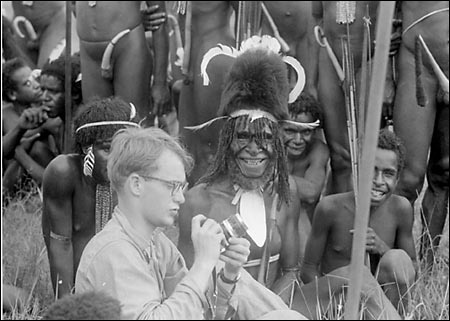
“They had moved extra patrol boats in, chartered air search planes from as far away as Australia and sent policeman sloshing through coastal swamps to look for Mike.” (Image by Harvard.)

Michael Rockefeller may not have been devoured by crocodiles or cannibals but he was most definitely swallowed whole by the rugged expanses of New Guinea in 1961. The wealthy young scion of Governor Nelson Rockefeller was in that country studying the culture and art of the Asmat people when he and his associate found themselves stranded in a canoe. Rockefeller decided to try to swim 12 miles to shore. He was never seen again, his body never recovered, and sensational theories about his disappearance began to emerge. From a 1961 Life article by Richard B. Stolley about the fruitless rescue mission:

“The full horror of this primitive country where his son was lost struck Governor Nelson Rockefeller only after he had seen it himself. En route from New York with his daughter, Mary Strawbridge, he was cheered by news that his son’s companion, Dutch Anthropologist Rene Wassing, had been saved. When the governor’s chartered jetliner landed at Biak, on the north side of the island, colonial authorities described for him the enormous search already under way. They had moved extra patrol boats in, chartered air search planes from as far away as Australia and sent policeman sloshing through coastal swamps to look for Mike and to urge the friendly Asmat natives to do the same.

A Dutch admiral told Rockefeller that the Navy had put a seaman into Flamingo Bay, where Mike disappeared, with two metal gasoline cans like those Mike had used. By holding the cans in front of him, the sailor could swim quite rapidly, and the experiment proved that young Rockefeller might easily have reached shore. Everywhere in New Guinea, compassionate Dutch officials treated Rockefeller not so much with deference due a man who is one of the most powerful leaders in the U.S. but with the sympathy deserved by a father who has lost a son.”

••••••••••

The subject of an In Search Of… episode:

Tags: , , , ,

Humanoid robotics, as manufactured by Aldebaran.

"Noyce had figured out a solution. But fabricating it was another matter." (Image by David Carron.)

The late Dr. Robert Noyce, father of the silicon microchip, would have turned 84 today. From Tom’s Wolfe’s 1983 Esquire article “The Tinkerings of Robert Noyce,” a passage about the race to create the first (and best) integrated circuit: 

“Even for a machine as simple as a radio the individual transistors had to be wired together, by hand, until you ended up with a little panel that looked like a road map of West Virginia. As for a computer, the wires inside a computer were sheer spaghetti.

Noyce had figured out a solution. But fabricating it was another matter. There was something primitive about cutting individual transistors out of sheets of silicon and then wiring them back together in various series. Why not put them all on a single piece of silicon without wires? The problem was that you would also have to carve, etch, coat, and otherwise fabricate the silicon to perform all the accompanying electrical functions as well, the functions ordinarily performed by insulators, rectifiers, resistors, and capacitors. You would have to create an entire electrical system, an entire circuit, on a little wafer or chip.

Noyce realized that he was not the only engineer thinking along these lines, but he had never even heard of Jack Kilby. Kilby was a thirty-six-year-old engineer working for Texas lnstruments in Dallas. In January, 1959 Noyce made his first detailed notes about a complete solid-state circuit. A month later Texas Instruments announced that Jack Kilby had invented one. Kilby’s integrated circuit, as the invention was called, was made of germanium. Six months later Noyce created a similar integrated circuit made of silicon and using a novel insulating process developed by Jean Hoerni. Noyce’s silicon device turned out to be more efficient and more practical to produce than Kilby’s and set the standard for the industry. So Noyce became known as the co-inventor of the integrated circuit. Nevertheless, Kilby had unquestionably been first. There was an ironic echo of Shockley here. Strictly speaking, Bardeen and Brattain, not Shockley, had invented the transistor, but Shockley wasn’t bashful about being known as the co-inventor. And, now eleven years later, Noyce wasn’t turning bashful either.

Noyce knew exactly what he possessed in this integrated circuit, or microchip, as the press would call it. Noyce knew that he had discovered the road to El Dorado.”

••••••••••

Noyce predicts the future of technology, 1981:

Tags: , ,

Selling whiskey.

Meeting the press in Japan, 1960.

Tags:

"I will not do black magic."

Wicca? Who beleives? Is there a spell on me? (Chelsea)

Someone told me a spell is on me.
What do you think!?
What the hell is going on here?!!!!!!!!
What are some ways to remove a love spell?
I will not do black magic. 

American Airlines introducing state-of-the-art on-board technology, 1960s.

"They saw the elephants lie right down, and had a laugh with every clown."

A firsthand account of the Barnum & Bailey Circus that was allegedly written by a 10-year-old schoolboy–but probably was penned by one of Phineas Taylor’s lackeys–was published in the April 28, 1897 Brooklyn Daily Eagle. An excerpt:

“A school boy who enjoyed last night’s performance of the Barnum & Bailey show sends the following description to the Eagle:

To the Editor of the Brooklyn Eagle:

Despite the gale outside the tent, some 20,000 people went with peanuts primed and eyes aglow, to see the great and only show. First baby camel met their eye and then the lady ten feet high, beside the smallest man on earth, provoked much inconsiderate mirth. The animals next, both caged and tied, were each and every one espied; the side show freaks and platforms, too, were passed before the public view, and then the bugles tooted loud, and to the ring sides rushed the crowd. They tried to watch three rings at one, and follow everything there done; but though they couldn’t quite succeed, they saw a lot of things indeed. They saw the elephants lie right down, and had a laugh with every clown; and watched the goats roll around the ring on a ball as easy as anything, and shooed the dove that rode the wheel and heard the pig’s ‘mamma’ appeal, and held their breath while in the air the slack rope walker combed his hair and trapeze artists swung and jumped, till finally into the net they plumped; and saw the ball roll up the spire, with a man inside to push it higher, and cheered the dog that kicked the ball with the tip of his nose and heard the fall of the clown who tried to stand on his head, but landed in a heap instead, and followed the man with the face so big that he scared the clown with the talking pig, and laughed at the rollicking monkey race, and the dogs that joined in the nightly chase, and watched the Jap shin up the pole and slide to the ground on his slippery sole, and hurrahed for the girl on the milk white steed who stuck to his back in spite of his speed, and marked the time for the horse quadrille and the juggler eyed with a creeping chill as he dallied with carving knives and things in one of the three entrancing rings. The same old circus? Well, hardly true–the same old show, with everything new.

Brooklyn, April 8, 1897

SCHOOL BOY.”

Tags:

Frank Abagnale, the con at the heart of Spielberg’s Catch Me If You Can, profiled in 1980.

Tags:

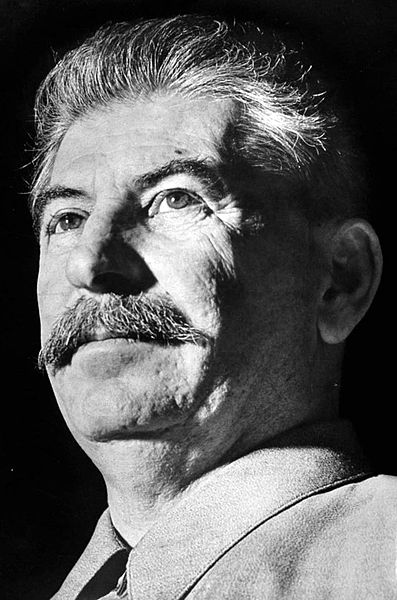
Legendary Life photojournalist Margaret Bourke-White explained how she snapped the above picture of Joseph Stalin smiling–well, smiling  by his somber standards–in quotes that ran in her 1971 New York Times obituary, I actually don’t know if she did the world a favor by locating a softer-looking Stalin, but here’s an excerpt:

“For her meeting with Stalin in the Kremlin in 1941, which was arranged by Harry Hopkins, Miss Bourke-White employed a stratagem to catch him off guard. Recalling the incident, she wrote:

‘I made up my mind that I wouldn’t leave without getting a picture of Stalin smiling. When I met him, his face looked as though it were carved out of stone, he wouldn’t show any emotion at all. I went virtually beserk trying to make that great stone face come alive.

‘I got down on my hands and knees on the floor and tried out all kinds of crazy postures searching for a good camera angle. Stalin looke down at the way I was aquirming and writhing and for the space of a lightning flash he smiled-and I got my picture. Probably, he had never seen a girl photographer before and my weird contortions amused him.’

Miss Bourke-White maintained that ‘a woman shoudn’t trade on the fact that she is a woman.’ Nonetheless, several of her male colleagues were certain that her fetching looks–she was tall, slim, dark-haired and possessed of a beautiful face–were often employed to her advantage.

‘Generals rushed to tote her cameras,’ Mr. [Alfred] Eisenstadt recalled, ‘and even Stalin insisted on carrying her bags.'”

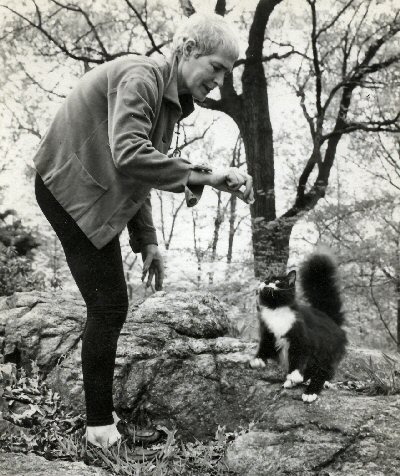
Margaret Bourke-White, 1964.

Tags: ,

Walter Cronkite on January 20, 1981, the day Ronald Reagan was inaugurated and the American hostages in Iran returned home.

Tags: ,

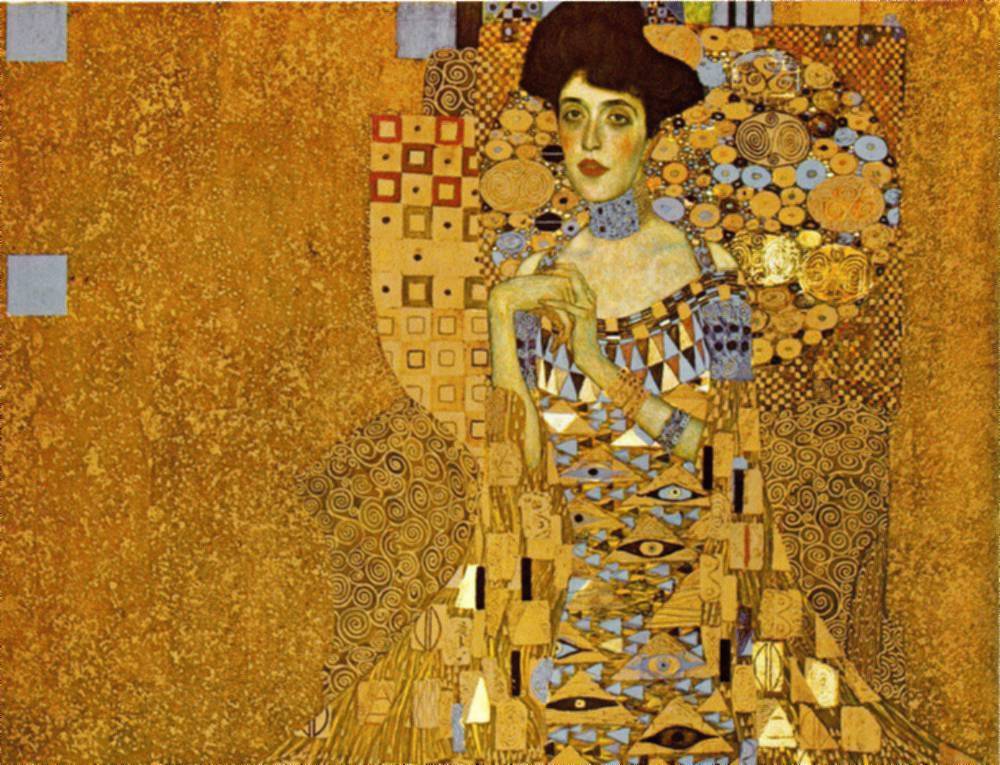
"Crowds lining up to see a portrait by Gustav Klimt in the private Neue Galerie in New York weren’t there out of any fondness for the artist."

Eye-popping prices for artworks are a puzzlement for people outside of that world–and for many people on the inside. In Newsweek, Blake Gopnik attempts to explain why this market is impervious even to worldwide financial collapse. An excerpt:

“‘If I can’t sell something, I just double the price.’ That’s what Ernst Beyeler, the great Swiss dealer who helped found Art Basel, reportedly said. Some people actually prefer to pay more than makes sense. Zelizer explains that, in all walks of life, we treat the biggest sums -differently, with special respect or even awe, than more-everyday money. ‘I think very often the price paid for a work is the trophy itself,’ says Glimcher, the dealer.

In 2006, the crowds lining up to see a portrait by Gustav Klimt in the private Neue Galerie in New York weren’t there out of any fondness for the artist. They were there because they’d heard that the museum’s founder, cosmetics heir Ronald Lauder, had paid a record $135 million for it.

The sociologist Mitch Abolafia, who has made a study of Wall Street financiers, says that sometimes money speaks for itself. ‘A trader said to me one day, with glee in his eyes, ‘You can’t see it, but money is everywhere in this room. Money is flying around—millions and millions of dollars.’ It was a generalized excitement about money. Even I felt it.’ That’s the excitement we all get from expensive art. One collector, who believes deeply that art should be bought for art’s sake, acknowledges basking in the ‘robust glow of prosperity’ that his purchases give off once their value has soared.

The people who are spending record amounts on art buy more than just that glow. (And much more than the pleasure of contemplating pictures, which they could get for $20 at any museum.) They’ve purchased boasting rights. ‘It’s, ‘You bought the $100 million Picasso?!,’’ says Glimcher. Abolafia explains that his financiers were ‘shameless’ in declaring the price of their toys, because in their world, what you buy is less about the object than the cash you threw at it. The uselessness of art makes any spending on it especially potent: buying a yacht is a tiny bit like buying a rowboat, and so retains a taint of practicality, but buying a great Picasso is like no other spending. Olav Velthuis, a Dutch sociologist who wrote Talking Prices, the best study of what art spending means, compares the top of the art market to the potlatches performed by the American Indians of the Pacific Northwest, where the goal was to ostentatiously give away, even destroy, as much of your wealth as possible—to show that you could. In the art-market equivalent, he says, prices keep mounting as collectors compete for this ‘super-status effect.'”

•••••••••

Carson Daly visits Mr. Brainwash’s Warholian vomitorium:

Robot personal trainer. (Thanks IEEE Spectrum.)

I recently posted the 1971 Village Voice obituary of photographer Diane Arbus. Here’s a good doc about her from the following year, which features her daughter Doon.

From a 2003 New York Times piece by Arthur Lubow: “‘Giving a camera to Diane Arbus is like giving a hand grenade to a baby,’ Norman Mailer said after seeing how she had captured him, leaning back in a velvet armchair with his legs splayed cockily. The quip was funny, but a little off base. A camera for Arbus was like a latchkey. With one around her neck, she could open almost any door. Fearless, tenacious, vulnerable — the combination conquered resistance.”

Tags: , ,

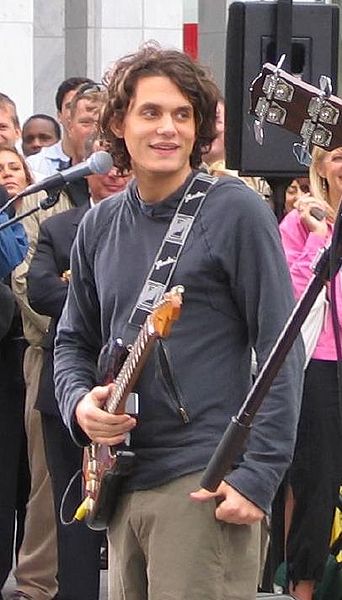
"Creepy." (Image by bretthpatrick.)

Guys With Guitars (Greenwich Village)

The next dude who pulls out a guitar and starts serenading me gets the Belushi Treatment! Creepy.

President-Elect Ronald Reagan reacts to John Lennon’s murder 31 years ago. The two had met at a Monday Night Football game six years earlier, when the pol tried unsuccessfully to explain the rules of the NFL to the former Beatle.

It’s Diego Rivera’s 125th birthday today. In  his 1960 autobiography, My Art, My Life, the famed Mexican muralist claimed to have spent part of his youth dining on human flesh. It sounds like complete bullshit. The brief chapter called, “An Experiment in Cannibalism”:

“In 1904, wishing to extend my knowledge of human anatomy, a basic requisite for my painting, I took a course in that subject in the Medical School in Mexico City. At that time, I read of an experiment which greatly interested me.

A French fur dealer in a Paris suburb tried to improve the pelts of animals by the use of a peculiar diet. He fed his animals, which happened to be cats, the meat of cats. On that diet, the cats grew bigger, and their fur became firmer and glossier. Soon he was able to outsell his competitors, and he profited additionally from the fact that he was using the flesh of the animals he skinned.

His competitors, however, had their revenge. They took advantage of the circumstance that his premises were adjacent to a lunatic asylum. One night, several of them unlocked his cages and let loose his oversize cats, now numbering thousands. When the cats swarmed out, a panic ensued in the asylum. Not only the inmates but their keepers and doctors ‘saw cats’ wherever they turned. The police had a hard time restoring order, and to prevent a recurrence of such an incident, an ordinance was passed outlawing ‘caticulture.’

At first the story of the enterprising furrier merely amused me, but I couldn’t get it out of my mind. I discussed the experiment with my fellow students in the anatomy class, and we decided to repeat it and see if we got the same results. We did — and this encouraged us to extend the experiment and see if it involved a general principle for other animals, specifically human beings, by ourselves living on a diet of human meat.

Those of us who undertook the experiment pooled our money to purchase cadavers from the city morgue, choosing the bodies of persons who had died of violence — who had been freshly killed and were not diseased or senile. We lived on this cannibal diet for two months, and everyone’s health improved.

During the time of our experiment, I discovered that I liked to eat the legs and breasts of women, for as in other animals, these parts are delicacies. I also savored young women’s breaded ribs. Best of all, however, I relished women’s brains in vinaigrette.

I have never returned to the eating of human flesh, not out of a squeamishness, but because of the hostility with which society looks upon the practice. Yet is this hostility entirely rational? We know it is not.

Cannibalism does not necessarily involve murder. And human flesh is probably the most assimilable food available to man. Psychologically, its consumption might do much to liberate him from deep-rooted complexes — complexes which can explode with the first accidental spark.

I believe that when man evolves a civilization higher than the mechanized but still primitive one he has now, the eating of human flesh will be sanctioned. For then man will have thrown off all of his superstitions and irrational taboos.”
 

Tags:

« Older entries § Newer entries »