
Urban Studies

You are currently browsing the archive for the Urban Studies category.

"The evolving role of digital storage in facilitating truly pervasive surveillance is less widely recognized." (Image by Bob Blaylock.)

The opening of John Villasenor’s new cautionary article, “Recording Everything: Digital Storage as an Enabler of Authoritarian Governments“:

“Within the next few years an important threshold will be crossed: For the first time ever, it will become technologically and financially feasible for authoritarian governments to record nearly everything that is said or done within their borders – every phone conversation, electronic message, social media interaction, the movements of nearly every person and vehicle, and video from every street corner. Governments with a history of using all of the tools at their disposal to track and monitor their citizens will undoubtedly make full use of this capability once it becomes available.

The Arab Spring of 2011, which saw regimes toppled by protesters organized via Twitter and Facebook, was heralded in much of the world as signifying a new era in which information technology alters the balance of power in favor of the repressed. However, within the world’s many remaining authoritarian regimes it was undoubtedly viewed very differently. For those governments, the Arab Spring likely underscored the perils of failing to exercise sufficient control of digital communications and highlighted the need to redouble their efforts to increase the monitoring of their citizenry.

Technology trends are making such monitoring easier to perform. While the domestic surveillance programs of countries including Syria, Iran, China, Burma, and Libya under Gadhafi have been extensively reported, the evolving role of digital storage in facilitating truly pervasive surveillance is less widely recognized. Plummeting digital storage costs will soon make it possible for authoritarian regimes to not only monitor known dissidents, but to also store the complete set of digital data associated with everyone within their borders. These enormous databases of captured information will create what amounts to a surveillance time machine, enabling state security services to retroactively eavesdrop on people in the months and years before they were designated as surveillance targets. This will fundamentally change the dynamics of dissent, insurgency and revolution.”

••••••••••

“Soon the ultimate tool will become the ultimate weapon”:
Tags:

Two short films Ray and Charles Eames made for IBM during the 1950s:

“A Communications Primer,” 1953.

“The Information Machine,” 1956.

See also:

Tags: ,

Scanning the Browser‘s list of the best 2011 articles reminded me of two more of my favorite pieces from this year: Economist Joseph Stiglitz’s Vanity Fair essay from May, which I blogged about at the time, was ahead of the curve in its crystallization of wealth inequality; and Peter Hessler’s excellent September New Yorker profile looked at the workaday life of a small-town Colorado chemist and the amazing way the past revisits him.

••••••••••

From “Of the 1%, by the 1%, for the 1%“:

“It’s no use pretending that what has obviously happened has not in fact happened. The upper 1 percent of Americans are now taking in nearly a quarter of the nation’s income every year. In terms of wealth rather than income, the top 1 percent control 40 percent. Their lot in life has improved considerably. Twenty-five years ago, the corresponding figures were 12 percent and 33 percent. One response might be to celebrate the ingenuity and drive that brought good fortune to these people, and to contend that a rising tide lifts all boats. That response would be misguided. While the top 1 percent have seen their incomes rise 18 percent over the past decade, those in the middle have actually seen their incomes fall. For men with only high-school degrees, the decline has been precipitous—12 percent in the last quarter-century alone. All the growth in recent decades—and more—has gone to those at the top. In terms of income equality, America lags behind any country in the old, ossified Europe that President George W. Bush used to deride. Among our closest counterparts are Russia with its oligarchs and Iran. While many of the old centers of inequality in Latin America, such as Brazil, have been striving in recent years, rather successfully, to improve the plight of the poor and reduce gaps in income, America has allowed inequality to grow.

••••••••••

FromDr. Don“:

“When outsiders come to town—loners, drifters—they often find their way to Don. A number of years ago, a man in his seventies named Tim Brick moved to Naturita and rented a mobile home. He placed special orders at the Apothecary Shoppe: echinacea, goldenseal, chamomile teas. He distrusted doctors, and often had Don check his blood pressure. It was high, and eventually Don persuaded him to get on regular medication. Soon, he was visiting every four or five days, mostly to talk.

Don referred to him as Mr. Brick. He had no other local friends, and he was cagey about his past, although certain details emerged over time. His birth name had been Penrose Brick—he was a descendant of the Penrose family, which came from Philadelphia and had made a fortune from mining claims around Cripple Creek. But for some reason Mr. Brick had been estranged from all his relatives for decades. He had changed his first name, and he had spent most of his working life as an auto mechanic.

One day, his mobile home was broken into, and thieves made off with some stock certificates. Mr. Brick had never used a broker—to him, they were just as untrustworthy as doctors—so he went to the Apothecary Shoppe for help. Before long, Don was making dozens of trips across Disappointment Valley, driving two hours each way, in order to get documents certified at the bank in Cortez, Colorado. Eventually, he sorted out Mr. Brick’s finances, but then the older man’s health began to decline. Don managed his care, helping him move out of various residences; on a couple of occasions, Mr. Brick lived at Don’s house for an extended stretch. At the age of ninety-one, Mr. Brick became seriously ill and went to see a doctor in Montrose. The doctor said that prostate cancer had spread to his stomach; with surgery, he might live another six months. Mr. Brick said he had never had surgery and he wasn’t going to start now.

Don spent the next night at the old man’s bedside. At one point in the evening, Mr. Brick was lucid enough to have a conversation. ‘I think you’re dying,’ Don said.

‘I’m not dying,’ Mr. Brick said. ‘I’m just going to pray now.’

‘Well, you better pray pretty hard,’ Don said. ‘But I think you’re dying.'”

Tags: ,

Were you hypnotized in school?

Do you remember the hypnotist show coming in to the school auditorium? Did you volunteer?

Early global television broadcast, 1967, which features media seer Marshall McLuhan as a guest. “It’s a real humming, buzzing confusion,” he says, referring to the crowded control room, but also predicting the nature of the more connected, interactive media to come.

Tags:

Just as the cash register is being placed in our pockets more and more, we are also increasingly products ourselves, handing over what’s in our hearts and minds in exchange for “free” products. From a Daily Beast piece by Dan Lyons, the erstwhile Fake Steve Jobs, about the true cost of doing business today:

“The truth is, we have no interest in protecting your privacy, and if you still believe that we do, then you are stupider than we thought, and believe me, we already thought you were pretty stupid. Think about it. The only way our business works is if we can track what you do and sell that information to advertisers. Did you honestly not realize that?

You are not our customer. You are the product that we sell. For us to say we’re going to protect you is like the poultry industry promising to create more humane living conditions for chickens. Sure, they say that. But you know they don’t mean it.”

••••••••••

Maggie gets scanned, quantified:

Tags: ,

The Star Wars Holiday Special, from 1978. Simply the biggest piece of crap I have ever seen.

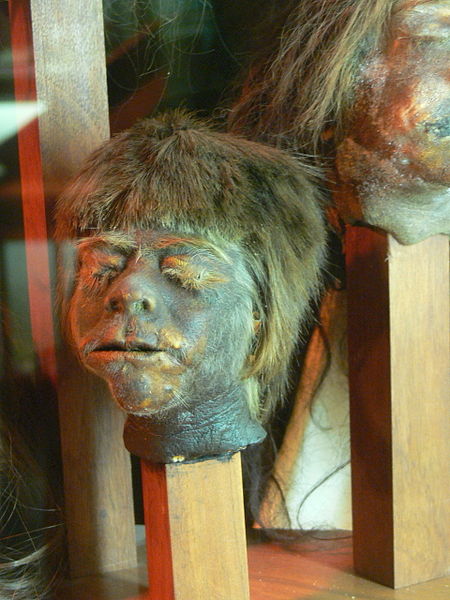
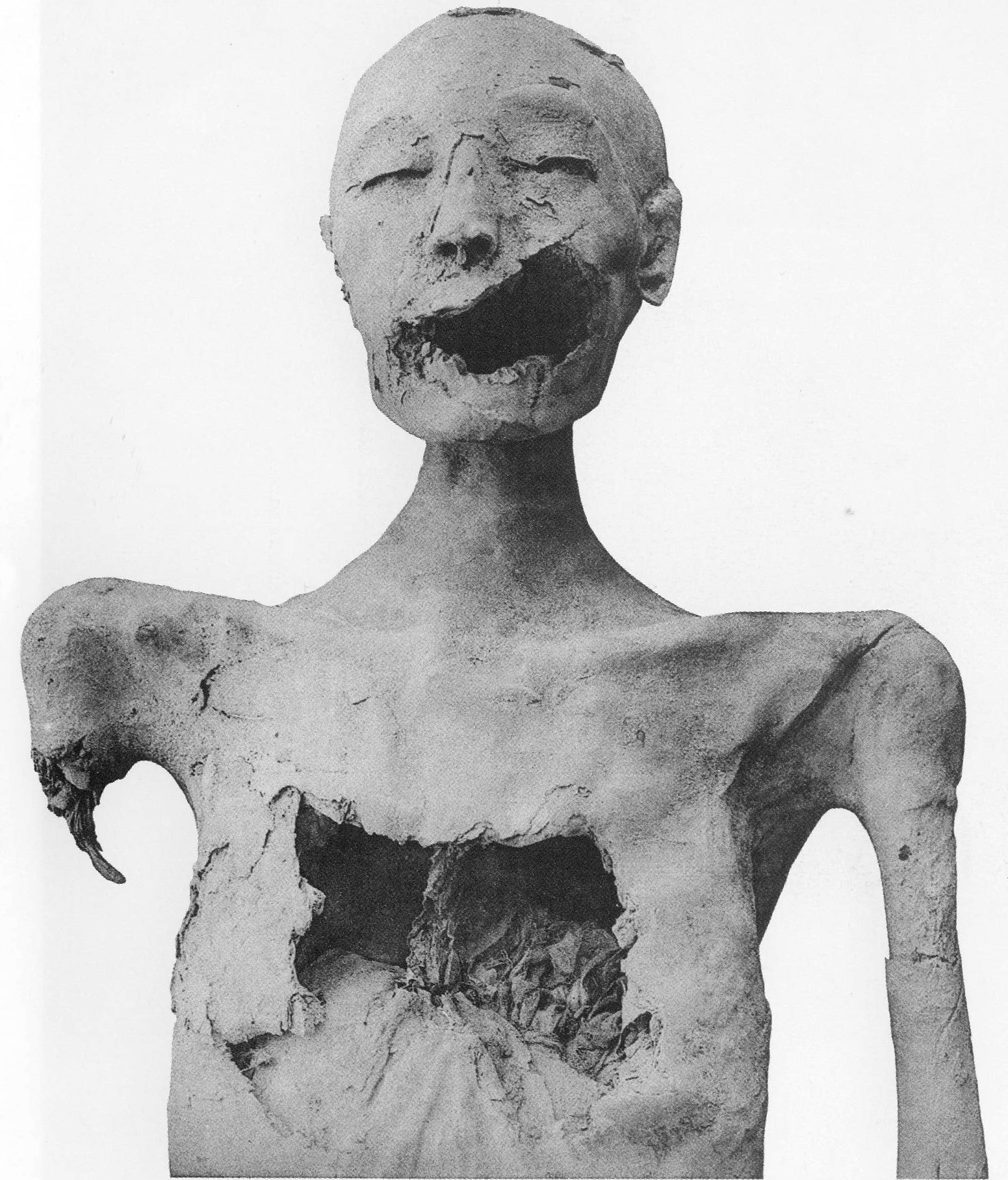
Mary Roach has never met a dead man she didn’t like, so it’s no surprise Outside sent her to investigate a true-life tale of head shrinking. An excerpt:

“Thirteen inches from heel to crown, the specimen is mounted on a mahogany stand that could serve as a paper-towel holder. The first thing you notice is the skin color. The Shuar believed that killing a man created an avenging soul that would leave the corpse via the mouth and come after the perpetrator. Lips were sewn shut to prevent this, and true ceremonial tsantsas have blackened skin, the result of the killer having rubbed it with charcoal to prevent the victim’s spirit from ‘seeing’ out. This child’s skin is the buff color and rough texture of a dried kala­mata fig. Based on its proportions—the plump bowed legs, the nubbin of a penis, the fat cheeks—it looks more like a mummified infant than a shrunken boy. In fact, the inventory lists it as ‘stillborn.’

‘Gustav told us it had been given to him by the Shuar and that he carried it out when he escaped,’ Brown says. ‘He never told us that he himself shrunk humans.’

Brown has his laptop open and has been clicking through images from his family’s photo albums. He shows me a 1955 shot of Gus and Gert—as American friends sometimes called them—seated at a restaurant table for a family dinner in Los Angeles. Bowls and spoons are set before them. Struve looks at the camera with the mild peevishness of an old guy who wants to have his soup. He wears dress suspenders over a short-sleeved button-down shirt and sports the pencil-thin mustache he wore most of his adult life. I remark to Brown that it’s hard to picture this natty gentleman flaying bodies and boiling skins.

‘Check the pattern on the shirt,’ he says. I lean in closer. The shirt is decorated with a row of tsantsas, life-size and garish, with lips sewn shut and flowing Wonder Woman hair.

‘So he was a bit of an odd one,’ I say.

‘Well, bear in mind,’ Brown says quickly, ‘America was in the midst of a ­shrunken-head craze.’ He calls up a 1960s TV ad for a toy Witch Dr. Head Shrinkers Kit (‘Shrunken heads for all occasions!’) featuring a pith-helmeted actor hacking his way through what looks like a Kansas wheat field.”

••••••••••

Witch Dr. Head Shrinkers Kit ad:

Tags:

From “Computational Periodics,” a 1975 essay by the Pasadena-born computer-animation pioneer John Whitney:

“Also from the point of view that this Century is but an episode in the life of human culture, it is clear that more paraphernalia of this epoch may be castoff than will survive into the next. Yet surely the computer will not. A solid state image storage system will replace the silver chemical ribbon and cinema will eventually be interred in the archival museum. But computer and computer graphics bring to mind the kind of tools that may characterize an age succeeding this century’s age of the machine.”

••••••••••

“Catalog” (1961):

“Per•mu•ta•tion” (1966):

“Arabesque” (1975):

Tags:

Sheila Nirenberg gives a TED Talk about the cutting edge of ocular prosthetics.

Tags:

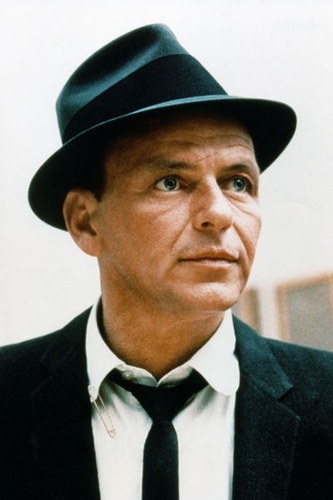
From the Harlan Ellison segment of the most famous magazine article of the last 50 years, Gay Talese’s 1965 Esquire piece,Frank Sinatra Has a Cold“:

“The younger men in the room, accustomed to seeing Sinatra at this club, treated him without deference, although they said nothing offensive. They were a cool young group, very California-cool and casual, and one of the coolest seemed to be a little guy, very quick of movement, who had a sharp profile, pale blue eyes, blondish hair, and squared eyeglasses. He wore a pair of brown corduroy slacks, a green shaggy-dog Shetland sweater, a tan suede jacket, and Game Warden boots, for which he had recently paid $60.

Frank Sinatra, leaning against the stool, sniffling a bit from his cold, could not take his eyes off the Game Warden boots. Once, after gazing at them for a few moments, he turned away; but now he was focused on them again. The owner of the boots, who was just standing in them watching the pool game, was named Harlan Ellison, a writer who had just completed work on a screenplay, The Oscar.

Finally Sinatra could not contain himself.

‘Hey,’ he yelled in his slightly harsh voice that still had a soft, sharp edge. ‘Those Italian boots?’

“No,” Ellison said.

‘Spanish?’

‘No.’

‘Are they English boots?’

‘Look, I donno, man,’ Ellison shot back, frowning at Sinatra, then turning away again.

Now the poolroom was suddenly silent. Leo Durocher who had been poised behind his cue stick and was bent low just froze in that position for a second. Nobody moved. Then Sinatra moved away from the stool and walked with that slow, arrogant swagger of his toward Ellison, the hard tap of Sinatra’s shoes the only sound in the room. Then, looking down at Ellison with a slightly raised eyebrow and a tricky little smile, Sinatra asked: ‘You expecting a storm?’

Harlan Ellison moved a step to the side. ‘Look, is there any reason why you’re talking to me?’

‘I don’t like the way you’re dressed,’ Sinatra said.

‘Hate to shake you up,’ Ellison said, ‘but I dress to suit myself.’

Now there was some rumbling in the room, and somebody said, ‘Com’on, Harlan, let’s get out of here,’ and Leo Durocher made his pool shot and said, ‘Yeah, com’on.’

But Ellison stood his ground.

Sinatra said, ‘What do you do?’

‘I’m a plumber,’ Ellison said.

‘No, no, he’s not,” another young man quickly yelled from across the table. ‘He wrote The Oscar.’

‘Oh, yeah,’ Sinatra said, ‘well I’ve seen it, and it’s a piece of crap.’

‘That’s strange,’ Ellison said, ‘because they haven’t even released it yet.’

‘Well, I’ve seen it,’ Sinatra repeated, ‘and it’s a piece of crap.’

Now Brad Dexter, very anxious, very big opposite the small figure of Ellison, said, ‘Com’on, kid, I don’t want you in this room.’

‘Hey,” Sinatra interrupted Dexter, “can’t you see I’m talking to this guy?’

Dexter was confused. Then his whole attitude changed, and his voice went soft and he said to Ellison, almost with a plea, ‘Why do you persist in tormenting me?’

The whole scene was becoming ridiculous, and it seemed that Sinatra was only half-serious, perhaps just reacting out of sheer boredom or inner despair; at any rate, after a few more exchanges Harlan Ellison left the room. By this time the word had gotten out to those on the dance floor about the Sinatra-Ellison exchange, and somebody went to look for the manager of the club. But somebody else said that the manager had already heard about it — and had quickly gone out the door, hopped in his car and drove home. So the assistant manager went into the poolroom.

‘I don’t want anybody in here without coats and ties,’ Sinatra snapped.

The assistant manager nodded, and walked back to his office.”

_____________________________

The young, cool Ellison who irked Sinatra so much:

See also:

Tags: ,

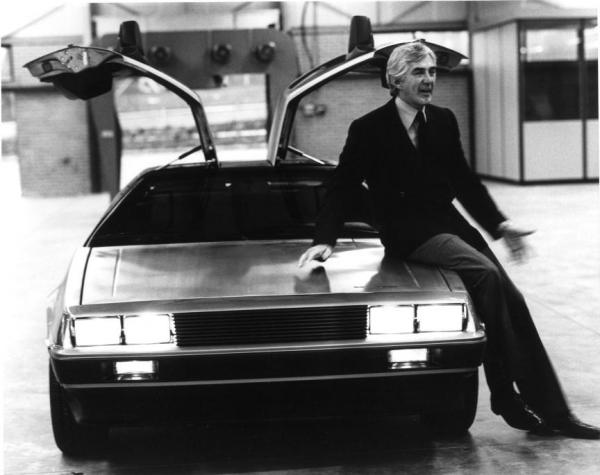
Before he was crushed beneath the wheel of his dreams. John Z. DeLorean had as much ambition as anyone in the history of American commerce. From a 1980 People article by Martha Smilgis about the automaker, when all roads still seemed wide open and endless:

“Six years ago John Z. (for Zachary) DeLorean was earning $650,000 a year as a General Motors vice-president—with a passably clear track to the presidency—when he stunned Detroit by abruptly quitting. Two months ago he rocked Motor City again, this time because of a book that attacks his old company for waste, corruption, neglect of consumers and corporate amorality. Among some cringing auto company men, the book has made him a hero—’He’s the only man who ever fired General Motors,’ as one admirer puts it. Now DeLorean, who will be 55 this week, is about to go that one better. Next fall he will market a new sports car of his own design and production, and he has convinced some GM dealers to distribute it. ‘Don’t people believe you can start a business these days?’ DeLorean asks skeptics. ‘I’d like to show that a bunch of little guys can make it.’

The humility is attractive but a bit disingenuous. DeLorean Motor Company is a $200 million operation backed by a consortium of investors in the U.S. and Europe (Johnny Carson among them). DeLorean himself is hardly the average internal-combustion tinkerer. A twice-divorced bon vivant whose romantic life has been as prodigious as his business career, DeLorean fled Detroit in part, he says, because he was bored with it. 

The disenchantment is plain in his book, On a Clear Day You Can See General Motors. Written by the former Detroit bureau chief of Business Week, J. Patrick Wright, and billed as DeLorean’s ‘own story,’ the book charges GM with official nonchalance toward the Corvair (a car that inspired Ralph Nader’s Unsafe at Any Speed). It ridicules numbing, time-wasting rituals of paper-shuffling in the executive suites and waxes outraged at the perks demanded by top GM brass. (To provide a traveling sales executive with his customary midnight snack, the book charges, GM took out a window in his hotel suite and lowered in a fully stocked refrigerator by crane.) After giving Wright all his ammunition, DeLorean pulled out of their publishing agreement—thereby saving his skin with GM—but Wright published the book anyway. ‘It came out a lot tougher than was my intention,’ DeLorean says. ‘I wanted it to be constructive.’ Then he smiles and adds, ‘GM hasn’t retaliated. In fact they’ve offered me an opportunity to merge with their Iranian subsidiary.’ A Ford factory worker’s son who paid his own way through college and earned master’s degrees in automotive engineering and business at night, DeLorean insists he has goodwill toward his old company: ‘GM was very good to me. I was an unsophisticated transmission engineer who was given many opportunities.’

What GM never appreciated, he says, was his life-style. Six-foot-four with movie star good looks, DeLorean is a physical fitness zealot who works out three times a week and is as proud of his 30-inch waist as of his latest marketing coup. Between his three marriages, he squired the likes of Ursula Andress, Joey Heatherton, Candice Bergen and Nancy Sinatra. Such glamorous escorts, along with his modishly long hair and turtleneck sweaters, scandalized automotive society. In 1973 he married fashion model Cristina Ferrare—she had lived with him for three months before saying, ‘Either we marry or I am leaving.’ The clatter of tongues grew louder. He was 48, she was 23. ‘I consider myself young for my age, so that wasn’t a problem for us,” he says. ‘But Cristina wasn’t accepted into Detroit society, and I didn’t want to subject her to that kind of vindictiveness. When I told her I wanted to leave, she supported me 100 percent.'”

••••••••••

A year before the People article was published, Gary Numan showed appreciation for automobiles:

More DeLorean posts:

Tags: , , ,

"Some 420 wouldn't hurt either." (Image by T-bone.)

I need BOOZE pls help (Brooklyn)

Hey as the title says I need some booze I’m really stressed and broke I havnt drank in about a year not that I’m recovering alcoholic I just havnt had the need but now I’m stressed and broke and before I do something stupid thought I would get drunk and jus take a break from all the craziness in my life so if you have any booze you don’t want hit me up if your not to far I’ll come by and pick it up.

Some 420 wouldn’t hurt either.

Thanks for reading and thanks on advance.

A 1972 film about Arpanet, the Internet precursor. An amazing document.

Barbra Streisand chats up Golda Meir in 1978 as part of The Stars Salute Israel at 30. Fun, despite the atrocious canned laughter.

See also:

Tags: ,

"I'll bet she's a daisy and I guess I'll get her, but I'll dream it over first."

Everyone in 19th-century Huntington, Long Island, was a complete ninny, so courtship wasn’t easy, as evidenced by an article in the September 3, 1893 Brooklyn Daily Eagle. An excerpt:

“Huntington has lots of pretty girls, and Joseph Schumaker is susceptible. Togged out to the limit of his salary as a compositor in a local printing office–kid gloves and cane not wanting–he fairly cut a swath on Saturday nights as he meandered through town. He gained access to the better society and was presented by friends to several young women who, according to his notions, would be pleased to become Mrs. Schumaker in the near future. His ardor outstripped his judgement, however, and in short order he was dismissed as being altogether too precipitate. Huntington girls favor long courtships, unless the catch is particularly handsome and flighty.

Joseph’s assiduity attracted the attention of his male associates, who had likewise noted the poor success with which his advances were meeting. Upon the advice of one of them he decided to try his luck out of town. He accordingly corresponded with a matrimonial agency in New York, giving his name as Joe Prescott and his address, Box 255, Huntington. His note to the agency met with prompt attention and the return mail brought him a letter assuring him of every success. A number of photographs of young women were also inclosed, with the guarantee that each was charming and anxious to marry. One photograph, named Evelyn No. 285, appealed more particularly to Joseph, who remarked: ‘I’ll bet she’s a daisy and I guess I’ll get her, but I’ll dream it over first.’

All this was last week. Schumaker’s dreams were propitious and he wrote Evelyn a letter in care of the agency. The agency reminded him that he had failed to make the remittance necessary to justify the disclosure of the young woman’s address, and that while she had read his letter, and was just dying to see him, she could not have his address or be allowed to see him unless the fees were sent at once.

"Togged out to the limit of his salary...kid gloves and cane not wanting...he fairly cut a swath on Saturday nights."

In the meantime several of Schumaker’s intimates fixed up an endearing letter, which purported to have been written by Evelyn, and sent it to him. The letter gave as her address a number on Third Avenue, New York, and urged him to call at once. The young man hastened to New York only to find himself the victim of a joke.

On his return he was informed that a man describing himself as the representative of Wellman’s matrimonial agency was in town searching for Joseph Prescott. Schumaker kept out of sight. The man applied to Postmaster Pearsall for the name of the owner of Box 255, and was told that no one by the name of Prescott lived in Huntington. Mr. Pearsall refused to divulge the name of the boxholder. The man has left town. Before he went he promised trouble for Prescott and also for the postmaster. He declared that the young woman listed as Evelyn was greatly smitten with Prescott’s style of writing and already loved him. Of the many hundreds of letters she had received, none had so impressed her as had Schumaker’s epistle. The agent also hinted that other Huntington people were in correspondence with marriageable women through the medium of their agency.”

Tags: , , ,

The Space Shuttle actually completed 135 missions. 1970s Air Force footage:

Nanobots are now a near-term reality. From ExtremeTech’s “Top 10 Tech Breakthroughs of 2011“:

Nanorobotics 

One of the most marked breakthroughs in 2011 was our control of nanorobotics, or nanobots. We now have the ability to control nanobots inside a living, breathing body, and using them to deliver highly-targeted medications — like cancer drugs — is now just a year or two away.

When you factor in autonomous ‘Constructicon’ robots and this year’s discovery of one-molecule electric motors and ‘nanocars,’ it’s also humbling to think how close we are to a reality with swarms of nanobots that fly or float around building and maintaining our towns and cities.”

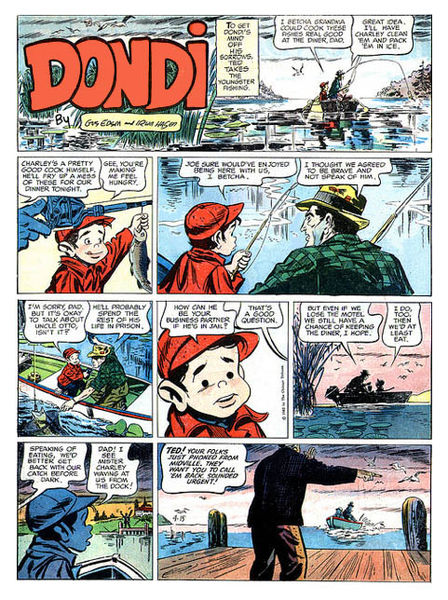
Irwin Hasen, longtime illustrator of Dondi, the once-popular comic strip about a war orphan, now draws fresh panels of the strip only on the walls of a Manhattan eatery. From Corey Kilgannon’s New York Times piece:

“From 1955 to 1986, Mr. Hasen spent nearly every day drawing the character, a lovable war orphan, for the syndicated daily strip that at its peak was carried by more than 100 newspapers.

Now, fresh Dondi cartoons are published only on the walls of the Nectar Café at Madison Avenue and 79th Street, where nearly every morning for the past 30 years Mr. Hasen has arrived at 8:30 on the dot to sit at the same stool at the counter.

Dondi’s endorsements of the diner, and cartoon versions of its employees, are posted above the grill and on the menu rack.

‘I call it Café Hasen — I’m the staff artist,’ said Mr. Hasen, who lives a block away. He has a corresponding evening constitutional: his 5:30 jaunt to the bar at Bistro Le Steak, on Third Avenue and 75th Street, for a martini.”

Tags: ,

David Frost welcomes the jaw-dropping trio of Duke Ellington, Billy Taylor and Willie “the Lion” Smith, 1969.

Laurel & Hardy deliver a piano, 1932 (colorized, sadly):

Tags: , , , , ,

"I have been turned down by a prostitute."

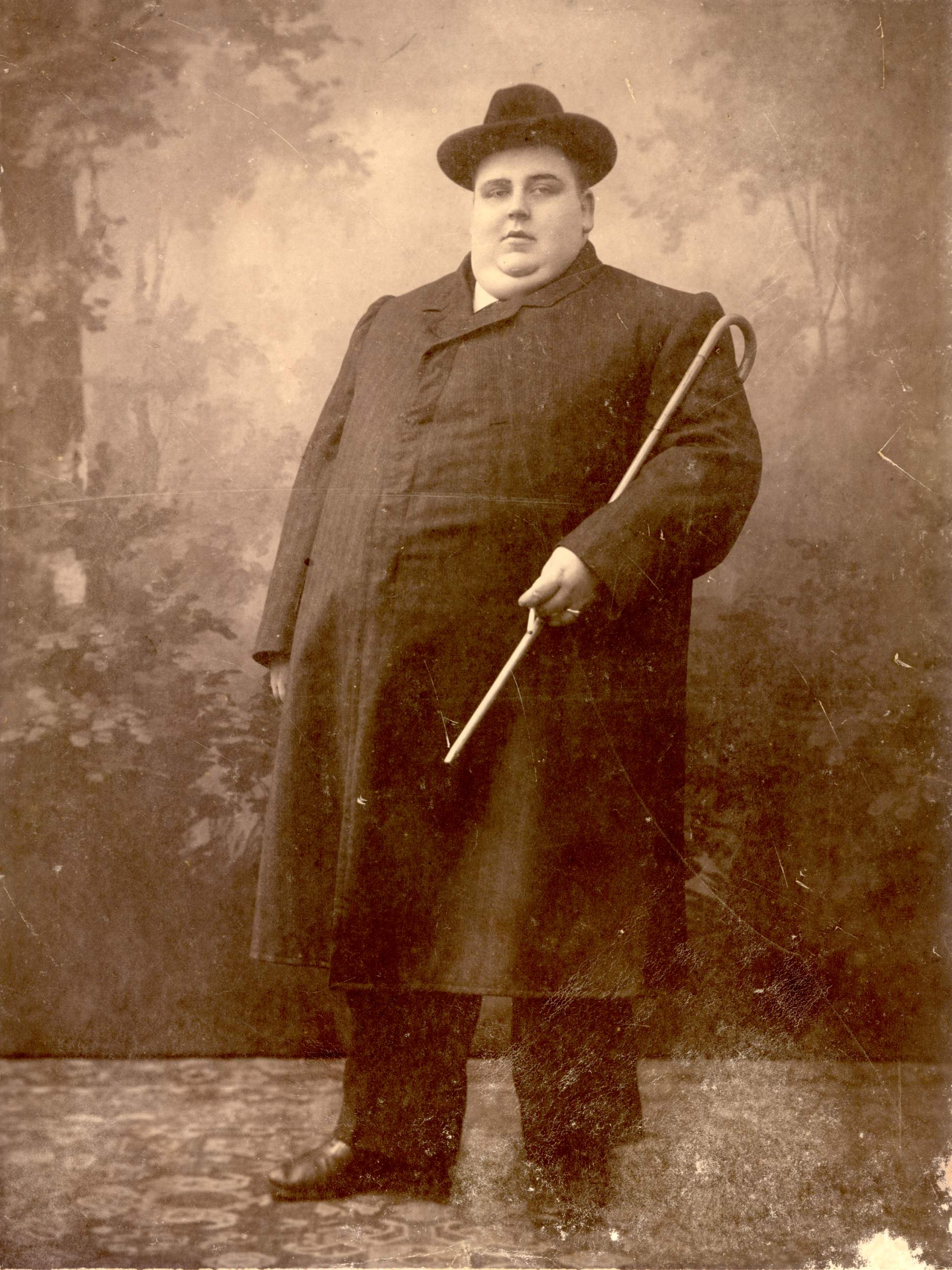
Why does the world hate fat men? (New York)

Today marks the 10 year anniversary of my last date. I have answered hundreds of ads and have not even had one woman on the face of this earth that has wanted to even have a first date. I am fat. I am 450 pounds. I have an emotional problem obviously. I have been turned down by a prostitute. I was told by a dating service that I should save my money because they didn’t think they could do anything for me. Loneliness and depression are all I have day in and day out. My friends tell me that I am a nice guy. They tell me that there is someone out there for everyone. It seems that fat people are the last universally acceptable group to tease or ignore. Every other group has at least themselves that they can fall back on, to socialize within and find someone. Unfortunately, it seems even fat women want nothing to do with fat men. 

Walt Disney on What’s My Line?, 1956. Jerry Lewis is a panelist.

Tags: ,

From a recent Drake Bennett Businessweek article about David Graeber, the anarchist anthropologist who is one of the more intriguing anti-leaders of the OWS movement:

Graeber is a 50-year-old anthropologist—among the brightest, some argue, of his generation—who made his name with innovative theories on exchange and value, exploring phenomena such as Iroquois wampum and the Kwakiutl potlatch. An American, he teaches at Goldsmiths, University of London. He’s also an anarchist and radical organizer, a veteran of many of the major left-wing demonstrations of the past decade: Quebec City and Genoa, the Republican National Convention protests in Philadelphia and New York, the World Economic Forum in New York in 2002, the London tuition protests earlier this year. This summer, Graeber was a key member of a small band of activists who quietly planned, then noisily carried out, the occupation of Lower Manhattan’s Zuccotti Park, providing the focal point for what has grown into an amorphous global movement known as Occupy Wall Street.

It would be wrong to call Graeber a leader of the protesters, since their insistently nonhierarchical philosophy makes such a concept heretical. Nor is he a spokesman, since they have refused thus far to outline specific demands. Even in Zuccotti Park, his name isn’t widely known. But he has been one of the group’s most articulate voices, able to frame the movement’s welter of hopes and grievances within a deeper critique of the historical moment. ‘We are watching the beginnings of the defiant self-assertion of a new generation of Americans, a generation who are looking forward to finishing their education with no jobs, no future, but still saddled with enormous and unforgivable debt,’ Graeber wrote in a Sept. 25 editorial published online by the Guardian. ‘Is it really surprising they would like to have a word with the financial magnates who stole their future?'”

••••••••••

Graeber in conversation with that avuncular capitalist, Charlie Rose;

Tags: ,

From Daniel Terdiman’s CNET article about IBM’s predictions for the next five years of technology:

“This time, the predictions are perhaps a bit more fanciful:

  • Mind reading is no longer science fiction.
  • You will be able to power your home with the energy you create yourself.
  • You will never need a password again.
  • The digital divide will cease to exist.
  • Junk mail will become priority mail.

It would seem the most interesting idea posited by IBM is the one about reading minds. But lest you think that what its scientists are saying is that you’ll be able to glare at a friend–or perhaps more importantly, an enemy–and know what he or she is thinking, that may be more than five years off. Rather, this is about how our brains might someday be synced with computing devices:

If you just need to think about calling someone, it happens. Or you can control the cursor on a computer screen just by thinking about where you want to move it.

Scientists in the field of bioinformatics have designed headsets with advanced sensors to read electrical brain activity that can recognize facial expressions, excitement and concentration levels, and thoughts of a person without them physically taking any actions.

Within five years, we will begin to see early applications of this technology in the gaming and entertainment industry. Furthermore, doctors could use the technology to test brain patterns, possibly even assist in rehabilitation from strokes and to help in understanding brain disorders, such as autism.”

Tags:

Kim Jong-Il, a diminutive despot who refused to go away, much like Mike Bloomberg, just died–too young, too young–but he sadly lived a full life. When he wasn’t busy dictating, Kim always kept his iron hand in the country’s movie industry. From an insane Mental Floss story by Jessica Royer Ocken about how the Dear Leader “recruited” a star director:

“Long before his father’s death in 1994, Kim Jong Il played supervisor to the North Korean movie industry. As such, he made sure each production served double duty as both art form and propaganda-dispersion vehicle. Per his instructions, the nation’s cinematic output consisted of films illuminating themes such as North Korea’s fantastic military strength and what horrible people the Japanese are. It was the perfect job for a cinephile like Kim, whose personal movie collection reportedly features thousands of titles, including favorites Friday the 13thRambo, and anything starring Elizabeth Taylor or Sean Connery.

Despite Kim’s creative influence on the industry during the 1970s (when he served with the country’s Art and Culture Ministries) and the fact that he literally wrote the book on communist filmmaking (1973’s On the Art of the Cinema), North Korean movies continued to stink. Frustrated, Kim sought help by forcing 11 Japanese ‘cultural consultants’ into servitude during the late 1970s and early 1980s, only to have several die inconveniently on the job (some by their own hands). But coerced consulting can only get a film industry so far, and North Korea was still in search of its Orson Welles. Then, in 1978, respected South Korean director Shin Sang Ok suddenly found himself out of work after he angered his own country’s military dictator in a spat over censorship, and Kim Jong Il saw his chance to harness Shin’s artistry.

Kim promptly lured Shin’s ex-wife and close friend, actress Choi Eun Hee, to Hong Kong to ‘discuss a potential role.’ Instead, she was kidnapped.

A distraught Shin searched for Choi, but found himself similarly ambushed by Kim’s minions. After some ‘convincing’—by way of some chloroform and a rag—he was whisked away to North Korea. Choi lived in one of Kim’s palaces, and Shin—having been captured after an attempted escape only months after arriving—lived for four years in a prison for political dissidents, where he subsisted on grass, rice, and communist propaganda.”

Tags: ,

« Older entries § Newer entries »