Urban Studies

You are currently browsing the archive for the Urban Studies category.

FromThe Accidental Universe: Science’s Crisis of Faith,” a Harper’s piece by physicist and novelist Alan Lightman:

“Dramatic developments in cosmological findings and thought have led some of the world’s premier physicists to propose that our universe is only one of an enormous number of universes with wildly varying properties, and that some of the most basic features of our particular universe are indeed mere accidents—a random throw of the cosmic dice. In which case, there is no hope of ever explaining our universe’s features in terms of fundamental causes and principles.

It is perhaps impossible to say how far apart the different universes may be, or whether they exist simultaneously in time. Some may have stars and galaxies like ours. Some may not. Some may be finite in size. Some may be infinite. Physicists call the totality of universes the ‘multiverse.’ Alan Guth, a pioneer in cosmological thought, says that ‘the multiple-universe idea severely limits our hopes to understand the world from fundamental principles.’ And the philosophical ethos of science is torn from its roots. As put to me recently by Nobel Prize–winning physicist Steven Weinberg, a man as careful in his words as in his mathematical calculations, ‘We now find ourselves at a historic fork in the road we travel to understand the laws of nature. If the multiverse idea is correct, the style of fundamental physics will be radically changed.'”

••••••••••

Brian fails to complete his novel in several universes:


Tags: , ,

George Carlin, our best stand-up ever, with a brilliant bit about the ever-increasing deceit of language. Just audio.

Tags:

"Head for the hills." (Image by Andrew Butko.)

The Robots are Coming!! (Your Mind)

The robots are coming to mindf*ck you. You cant tell them apart from humans and they are smarter than you.

Head for the hills while you still can.

Max Headroom was a computer-generated talking head who existed only on television, and I suspect the same is true of Charlie Rose. From 1986:

Tags: , ,

There was a brouhaha last Friday when Mitt Romney’s son, Matt, used some Birther vernacular while campaigning on behalf of his father in New Hampshire, but it really shouldn’t be a surprise to anyone who’s followed the former Massachusetts Governor’s strategy. Playing to the idea that Obama is “Other” has been a tacit but clear part of the Romney strategy. The younger Romney’s only real deviation was being explicit instead of implicit.

When Romney says that “Obama doesn’t have a clue about the economy,” that’s obviously fair game. But when he states that Obama “doesn’t get America,” he’s labeling the President as less than adequately American or not a real American. When Romney says Obama is trying to turn “America into Europe,” he may as well be using “Kenya” in the comparison.

Trying to pander to people who want to see Obama as alien is sad, especially for someone who’s likely been treated to same way because of his own religion. That kind of faux patriotism is often the last refuge of a lout, but it in Romney’s case, it’s been present from the first.

••••••••••

Tags: ,

From “Between the Lines,” a really interesting piece in L.A. Magazine by Dave Gardetta about the science of parking spaces, a segment about UCLA traffic guru Donald Shoup:

“In the United States hundreds of engineers make careers out of studying traffic. Entire freeway systems like L.A.’s have been hardwired with sensors connecting to computer banks that aggregate vehicle flow, monitor bottlenecks, explain congestion in complicated algorithms. Yet cars spend just 5 percent of their lives in motion, and until recently there was only one individual in the country devoting his academic career to studying parking lots and street meters: Donald Shoup.

Shoup is 73 years old. He drives a 1994 Infiniti but for the last three decades has steered a 1975 Raleigh bike two miles uphill daily in fair weather, from his home near the Mormon temple to the wooded highlands of UCLA’s north campus. He was born near one shore (Long Beach), grew up on a far shore (Hawaii), and resembles a 19th-century figure sketched by Melville. He has a mildly hectic complexion, a halo of silver hair that breaks over his small ears into a white froth of a beard, and brimstone eyes. This year Shoup’s 765-page book, The High Cost of Free Parking, was rereleased to zero acclaim outside of the transportation monthlies, parking blogs, and corridor beyond his office door in UCLA’s School of Public Affairs building. He wasn’t surprised—’There’s not even a name for what I do,’ he says. Shoup, however, does not lack for acolytes. His followers call themselves Shoupistas, like Sandinistas, and on a Facebook page they leave posts suggesting parking meters for prostitutes and equations that quantify the contradiction between time spent cruising for free parking versus the ‘assumed time-value’ cited to justify expanding roadways. (The hooker stuff is more interesting.)

After 36 years, Shoup’s writings—usually found in obscure journals—can be reduced to a single question: What if the free and abundant parking drivers crave is about the worst thing for the life of cities? That sounds like a prescription for having the door slammed in your face; Shoup knows this too well. Parking makes people nuts. ‘I truly believe that when men and women think about parking, their mental capacity reverts to the reptilian cortex of the brain,’ he says. ‘How to get food, ritual display, territorial dominance—all these things are part of parking, and we’ve assigned it to the most primitive part of the brain that makes snap fight-or-flight decisions. Our mental capacities just bottom out when we talk about parking.'” (Thanks Longform.)

•••••••••

Godard‘s darkly comic 1967 traffic nightmare:

Goofy on a superhighway, 1965:

Tags: ,

Built in the 1990s in Arizona, Biosphere 2 was a sealed and self-contained ecological world that was to house a team of researchers during two closures. But even controlled environments can’t really be controlled. Disputes over financial management led to the early termination of Biosphere 2 in 1994, and ownership of its remants have changed hands several times, as if it were a failed department store. From a 1996 New York Times article by William J. Broad about Columbia University taking over Biosphere for a spell, at a time when it lay dormant, a domicile only to exotic ants:

The exotic species of ant known as Paratrechina longicornus, or the crazy ant, named for its speedy and erratic behavior when excited, somehow managed to kill off all the other ants over the years, as well as the crickets and grasshoppers.

Swarms of them crawled over everything in sight: thick foliage, damp pathways littered with dead leaves and even a bearded ecologist in the humid rain forest of Biosphere 2, an eight-story, glass-and-steel world in the wilds of the Sonora Desert that cost $200 million to build.

“These little guys pretty much run the food web,” Dr. Tony Burgess, the ecologist, said as he tapped a dark frond, sending dozens of the ants into a frenzy. ”Until we understand the ecology, we’re reluctant to eliminate them.”

Columbia University, an icon of the Ivy League, is struggling to turn a utopian failure into a scientific triumph.

The university took over management of Biosphere 2 in January and is starting to reveal just how badly things went awry when four men, four women and 4,000 species of plants and animals were sealed inside this giant terrarium for a two-year experiment that ended in 1993.

The would-be Eden became a nightmare, its atmosphere gone sour, its sea acidic, its crops failing, and many of its species dying off. Among the survivors are crazy ants, millions of them.•

_____________________________________

Biosphere 2, before its fall:

Jane Poynter recalls living in Biosphere 2, at TED:

Tags:

As the Flash Mob concept closes in on a decade of existence, its originator, Wired editor Bill Wasik, has penned an article about the intersection of group behavior, technology and violence. Wasik on the origins of the idea:

“I even called my events ‘mobs,’ as a wink to the scary connotations of a large group gathered for no good reason. But I didn’t come up with the name flash mob—that honor belongs to Sean Savage, a UC Berkeley grad student who was blogging about my events and the copycats as they happened. He added the word ‘flash’ as an analogy to a flash flood, evoking the way that these crowds (which in the original version arrived all at once and were gone in 10 minutes or less) rushed in and out like water from a sudden storm. Savage and I never met while the original mobs were still going on, but today we work just a block away from each other in San Francisco—me at Wired, him at Frog Design, where he’s an interaction designer—so we now can get together and commiserate about what’s become of our mutual creation. It had been bad enough to see the term get appropriated by Oprah to describe a ridiculous public dance party featuring the Black Eyed Peas. Now the media was stretching the term to include just about any sort of group crime. ‘It means everything and nothing now,’ Savage says morosely.

One reason the term ‘flash mob’ stuck back in 2003 was its resonance, among some sci-fi fans who read Savage’s blog, with a 1973 short story by Larry Niven called ‘Flash Crowd.’ Niven’s tale revolved around the effects of cheap teleportation technology, depicting a future California where “displacement booths” line the street like telephone booths. The story is set in motion when its protagonist, a TV journalist, inadvertently touches off a riot with one of his news reports. Thanks to teleportation, the rioting burns out of control for days, as thrill-seekers use the booths to beam in from all around to watch and loot. Reading ‘Flash Crowd’ back in 2003, I hadn’t seen much connection to my own mobs, which I intended as a joke about the slavishness of fads. I laughed off anyone who worried about these mobs getting violent. In 2011, though, it does feel like Niven got something chillingly correct. He seems especially prescient in the way he describes the interplay of curiosity, large numbers, and low-level criminality that causes his fictional riots to grow. ‘How many people would be dumb enough to come watch a riot?’ the narrator asks. ‘But that little percentage, they all came at once, from all over the United States and some other places, too. And the more there were, the bigger the crowd got, the louder it got—the better it looked to the looters … And the looters came from everywhere, too.’

That last line passed for science fiction in 1973. The not-infrequent riots that wracked American cities in the 1960s tended to be strikingly localized, with rioters taking out their aggression on the immediate neighborhood in which they lived. By contrast, Nick de Bois says that of the 165 or so people arrested so far for the looting in Enfield Town, only around 60 percent hailed from the local borough, which includes not just greater Enfield but a few surrounding towns. The other 40 percent commuted in from elsewhere, including locales as far afield as Essex and Twickenham, each a good hour’s drive away. Instead of teleportation booths replacing telephone booths—how quaint!—it turned out that those phones merely had to shrink down enough to fit into our pockets.”

••••••••

Austin Flash Mob, 2003, the year it started:

Tags: ,

Robots designed to work alongside people, from the fine folks at Kawada Industries.

"I will be at your door tomorrow with various carpet samples."

I hate my noisy neighbor (Inwood / Wash Hts)

You! Upstairs neighbor- I will be speaking with you tomorrow- but why are you walking around upstairs like you are 500 pounds! you drag your feet and walk around constantly and then every it sounds like you are dropping a small child on the floor- It is 1 in the morning!!!! And who is this kid who keeps coming around 11 at night- he keeps ringing the buzzer so what’s his deal

In my mind you are all engaged in some illeagal operation up there, but some days I have a heart and i think- the boy is taking care of an old uncle- what ever it is I am done guessing! Co-op says 80 percent of the floor should be covered in carpeting- I will be at your door tomorrow with various carpet samples.

I hate you people so much- SO MUCH 

And is it just me or does everyone have this experience 

"He has shown his power of mind reading in a manner that would do credit to a Bishop or other person of like fame."

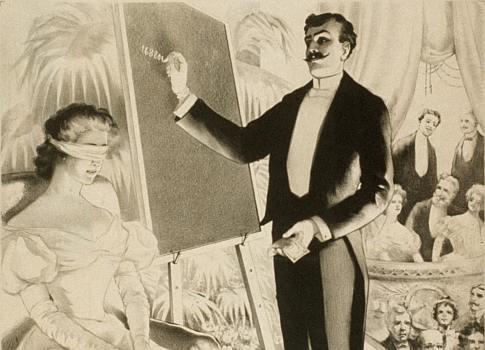
I have no idea what became of Flavius Taylor, but for a period of time in the late 19th century the lad from Kentucky received wide notice for his supposed mind-reading powers. An article from an August 1891 edition of the New York Times, which originally ran in the Louisville Courier-Journal:

“The wonderful feats of Flavius Taylor, the boy mind reader of Glasgow, Ky., continues to astonish all those who see him. Though only nineteen years of age, he has shown his power of mind reading in a manner that would do credit to a Bishop or other person of like fame.

The young man is very modest about his power. It is not often that he will consent to give a performance, even in private. When he does he has never been known to fail, even in the most severe tests. It makes him very nervous, and sometimes after a performance his muscles are in tremor the whole of the next day. Recently he attended a reception near Glasgow, and a Courier-Journal reporter who was present had an opportunity of witnessing some of his wonderful feats.
"As he always does, he took hold of the intermediary's hand." (Image by Keith Schengili-Roberts.)

Mr. Taylor was in another room when it was decided to ask him to give an exhibition of his power. Three coins–a dollar, a quarter, and a nickel–were first secreted by as many young ladies. The room was crowded, and a fourth person, who was a disbeliever in mind reading, went to the room where Mr. Taylor was engaged in conversation. He consented to the test, and then, as he always does, he took hold of the intermediary’s hand. The mind reader led the way in a rapid walk, and without hesitation went directly to the first young lady and asked her to please hand him the nickel from under the edge of her waist. Though the room was crowded, he had not the least trouble in finding the second girl and taking the quarter from her handkerchief, which lay under the fold of her dress. The third young woman was sitting in an opposite corner busily engaged in conversation, but he walked straight to her and took the dollar from her hand.

Perhaps the most remarkable part of this particular test then followed. When the money was his it was also the desire of the one making the trial that young Taylor should give the dollar to a certain person in the room, the quarter to a certain other, and the nickel to a particular third person. He did this without the slightest blunder, and the young mind reader had one more convert.

A physician who was present doubted even in the face of this test, and for his self-satisfaction he decided to give Taylor something that would be hard to do. Fifty yards from the front gate of the house, in a thick clump of trees, were hitched more than a dozen horses and vehicles in which the guests had come. One belonged to the doctor, and he thought of the whip which was in his buggy. Upon taking the physician’s hand, Mr. Taylor said that he knew what he was thinking of, but, to more fully convince him, he led the man to his buggy in the darkness, though he did not know one of the vehicles from the other, and took out the whip.

Small pieces of money were hidden in nooks and corners of the house, but he walked as straight to them as if he had secreted them himself. Some one thought of a certain book in the library. Without knowing what he was to hunt for, he went to the room, opened the door and took out the book. He also turned to a certain page and passage, of which the young man was thinking. He would grasp the hand of any one present and tell exactly what his thoughts were.

"In addition to his ability to possess himself of the secrets of the mind, the young man is a ventriloquist."

Mr. Taylor is a handsome young man, and until six months ago, when he first became aware of his power, the ladies and girls were not loth to shake his hand. He danced at all the parties, and his hand was grasped without fear or tremor. But things have changed, Mr. Taylor says, and not to his advantage. For six months he has been unable to find a girl who will allow him to touch her hand. He often steals a march on those unacquainted with his power, but he fears that his dancing days are over. In addition to his ability to possess himself of the secrets of the mind, the young man is a ventriloquist. He is overflowing with wit and good humor, and on every occasion he takes advantage of his power as a ventriloquist to provoke laughter. He has possessed this particular control of his voice for several years, and is an adept at its practice.

Mr. Taylor is about 5 feet 8 inches in height, weighs about 135 pounds, has light hair, regular features, with a very high, prominent forehead, and is altogether striking in appearance. He has a brother and sister near his own age, but in none other of the family have any of his remarkable powers been exhibited.

Scientific men over the country are beginning to be attracted by his feats, and he has had offers from several managers to go to some of the larger cities to exhibit himself, all of which he has declined, as his father fears that it would seriously impair his health to practice it continually. On account of his youth and the short time he has been aware that he is a mind reader his case is looked upon as one of the most remarkable ever known, especially as he has so far mastered the hardest tests that could be devised.”

Tags:

Damnjan Mitic has developed the the Citroën Eggo–an electric concept car like no other. Egg-shaped with all glass doors, a motor in each wheel and  solar panels on the roof, it’s a car from the future that has arrived today. (Thanks Kanikasweet.)

Mitic also designs futuristic concept luggage for Samsonite:

Tags:

A 1964 Jacques Cousteau doc about Continental Shelf Station Two, the first manned underwater colony:

Steve Zissou tells you about his boat:

Tags:

The above picture, taken by American West photographer Edward Sheriff Curtis, depicts a young woman from the Tewa tribe, wearing her hair in the style of an unmarried maiden. It was composed two years prior to the passage of the Indian Citizenship Act, legislation that gave Indigenous Peoples rights of full U.S. citizenship at a time when the popular idea among white culture was that Native Americans were a “vanishing race” and would soon completely disappear. Thankfully, that hasn’t occurred, though Curtis’ photographs are an amazing history lesson nonetheless. From a 1911 New York Times article, “Lives 22 Years With Indians To Get Their Secrets,” in which Curtis discusses becoming an Indian priest:

“‘Do you mean that you are a Pueblo priest in good order?’ asked the reporter.

‘Yes,’ said Mr. Curtis,’ and I am a priest in other nations. If I went back there to-day I could officiate as a priest in the snake-dance, that is, in the order to which I belonged.’

‘Then you were adopted into the tribe?’

‘No,’ he said. ‘That isn’t necessary. Being adopted into a tribe is nothing–nothing. The thing is to become a member of a secret order. That is the only way to learn their secrets, and to do that it is not necessary to be adopted into the tribe.

‘Every ceremonial group you get into makes it easy to get into others. Belonging to the Snake Order in that village wouldn’t necessarily let me into an order in another village, but it would give me a good ground to make an argument.

‘My belonging to the Snake Order in Arizona helped me greatly when I tried to get into a ceremonial order in Alaska.’

‘You were a priest in Alaska, too?’

‘Oh, yes,’ he said, in a matter of fact way.

‘But what could the Alaska Indians know about what was done so far off as Arizona?’

‘Oh, when they saw my photographs of the snake dance and heard the phonograph records–‘

‘Do you mean to say that you photographed and phonographed these ceremonies while you were officiating as a priest?’

‘Yes.’

‘How did you make them agree to such a thing?’

‘It was not easy,’ said Mr. Curtis, ‘but I finally convinced them of the advantages of getting in the record.'”

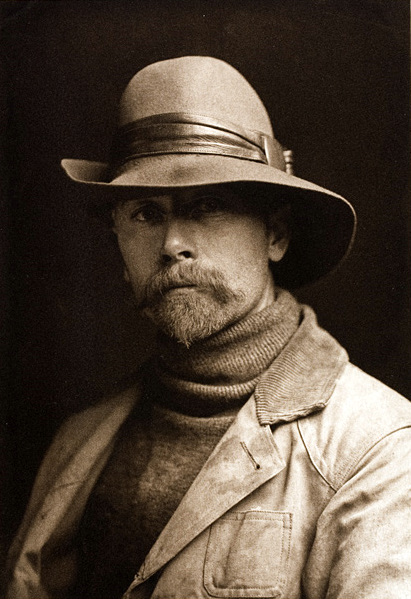
Edward Sheriff Curtis, self-portrait, 1889.


Tags:

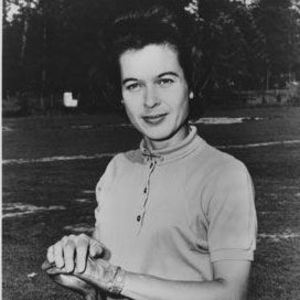
A founding member of the Ladies Professional Golf Association which formed in 1950, Bettye Danoff didn’t enjoy the fame or financial rewards of contemporary players, but it sounds like she had fun while paving the way for them. An excerpt from her New York Times obituary by Maraglit Fox:

“Bettye Danoff, one of 13 founding members of the Ladies Professional Golf Association, which began as a hardy, poorly paid band of women who traveled the country for the chance to play the game, died on Thursday in McKinney, Tex. She was 88.

Her daughter Debbie Danoff Bell confirmed the death.

Officially founded in 1950, the L.P.G.A. was begun by 13 women, including Danoff, Babe Didrikson Zaharias, Patty Berg and Alice Bauer.

If Danoff was somewhat less well known than they, that owed partly to the fact that she curtailed her touring in the early 1960s, after her husband’s death left her with children to care for at home.

But before that, she joined her comrades in driving from tournament to tournament, convoy style, in their own cars. In each car, the driver kept a set of color-coded paddles — red, green and yellow — that she could wave out the window to signal a stop for gas, food or the bathroom.

Arriving at a course, they might encounter a sea of mud, or greens more brown than green. Before they teed off, they sometimes had to pull weeds. At night they shared motel rooms and sang popular songs together, sweetly off-key. It was A League of Their Own with woods and irons.”

•••••••••••

Some of Danoff’s fellow female golf pioneers, 1950s:

Tags:

Genesys, 1970:

Key Frame Animation, 1971:

If you want to argue that athletes shouldn’t be using PEDs because they may suffer terrible health consequences, feel free. It’s risky business. But arguing that enhancement should not occur at all is futile. We’re all going to be enhanced in the future. It’s not a matter of if it will be done but how. In “The Case for Enhancing People” in the New Atlantis, Ronald Bailey examines pretty much every angle of the topic, including the potential inequality of our brave new world. An excerpt:

“Those who favor restricting human enhancements often argue that human equality will fall victim to differential access to enhancement technologies, resulting in conflicts between the enhanced and the unenhanced. For example, at a 2006 meeting called by the American Association for the Advancement of Science, Richard Hayes, the executive director of the left-leaning Center for Genetics and Society, testified that ‘enhancement technologies would quickly be adopted by the most privileged, with the clear intent of widening the divisions that separate them and their progeny from the rest of the human species.’ Deploying such enhancement technologies would ‘deepen genetic and biological inequality among individuals,’ exacerbating ‘tendencies towards xenophobia, racism and warfare.’ Hayes concluded that allowing people to use genetic engineering for enhancement ‘could be a mistake of world-historical proportions.’

Meanwhile, some right-leaning intellectuals, such as Nigel Cameron, president of the Center for Policy on Emerging Technologies, worry that ‘one of the greatest ethical concerns about the potential uses of germline interventions to enhance normal human functions is that their availability will widen the existing inequalities between the rich and the poor.’ In sum, egalitarian opponents of enhancement want the rich and the poor to remain equally diseased, disabled, and dead.

Even proponents of genetic enhancement, such as Princeton University biologist Lee M. Silver, have argued that genetic engineering will lead to a class of people that he calls the ‘GenRich,’ who will occupy the heights of the economy while unenhanced ‘Naturals’ provide whatever grunt labor the future economy needs. In Remaking Eden (1997), Silver suggests that eventually ‘the GenRich class and the Natural class will become … entirely separate species with no ability to cross-breed, and with as much romantic interest in each other as a current human would have for a chimpanzee.’

In the same vein, George J. Annas, Lori B. Andrews, and Rosario M. Isasi have laid out a rather apocalyptic scenario in the American Journal of Law and Medicine:

The new species, or ‘posthuman,’ will likely view the old ‘normal’ humans as inferior, even savages, and fit for slavery or slaughter. The normals, on the other hand, may see the posthumans as a threat and if they can, may engage in a preemptive strike by killing the posthumans before they themselves are killed or enslaved by them. It is ultimately this predictable potential for genocide that makes species-altering experiments potential weapons of mass destruction, and makes the unaccountable genetic engineer a potential bioterrorist.

Let’s take their over-the-top scenario down a notch or two. The enhancements that are likely to be available in the relatively near term to people now living will be pharmacological — pills and shots to increase strength, lighten moods, and improve memory. Consequently, such interventions could be distributed to nearly everyone who wanted them. Later in this century, when safe genetic engineering becomes possible, it will likely be deployed gradually and will enable parents to give their children beneficial genes for improved health and intelligence that other children already get naturally. Thus, safe genetic engineering in the long run is more likely to ameliorate than to exacerbate human inequality.” (Thanks Browser.)

Tags:

Yoko Ono performance art, “Cut Piece,” from 1965. Audience members were invited to come on stage and scissor pieces from her clothes. The phrase recited at the beginning is an inscription on the Georgia Guidestones.

Tags:

"It is in a big jar."

MUMMIFIED MONKEY – $8000 (hardyston)

I have an authentic mummified money that is 75 years old available for sale. It looks just as it did when it passed. It is in a big jar but the glass is a bit cloudy. Rare piece.

The opening of “The Xinjiang Procedure,” Ethan Gutmann’s alarming Weekly Standard article about the organ market that surrounds executions of China’s political prisoners:

“To figure out what is taking place today in a closed society such as northwest China, sometimes you have to go back a decade, sometimes more.

One clue might be found on a hilltop near southern Guangzhou, on a partly cloudy autumn day in 1991. A small medical team and a young doctor starting a practice in internal medicine had driven up from Sun Yat-sen Medical University in a van modified for surgery. Pulling in on bulldozed earth, they found a small fleet of similar vehicles—clean, white, with smoked glass windows and prominent red crosses on the side. The police had ordered the medical team to stay inside for their safety. Indeed, the view from the side window of lines of ditches—some filled in, others freshly dug—suggested that the hilltop had served as a killing ground for years.

Thirty-six scheduled executions would translate into 72 kidneys and corneas divided among the regional hospitals. Every van contained surgeons who could work fast: 15-30 minutes to extract. Drive back to the hospital. Transplant within six hours. Nothing fancy or experimental; execution would probably ruin the heart.” (Thanks Longform.)

••••••••••

“Patients are suspended by wires through long bones”:

Tags:

Peter Lorre on What’s My Line?, 1960, promoting a film which was made in Scent-o-Vision, during the dying days of the Studio System.

Tags:

The opening of “The Real Cape Kennedy Is Inside Your Head,” a Dylan Trigg meditation in 3:AM Magazine about J.G. Ballard’s “Cape Canaveral” stories:

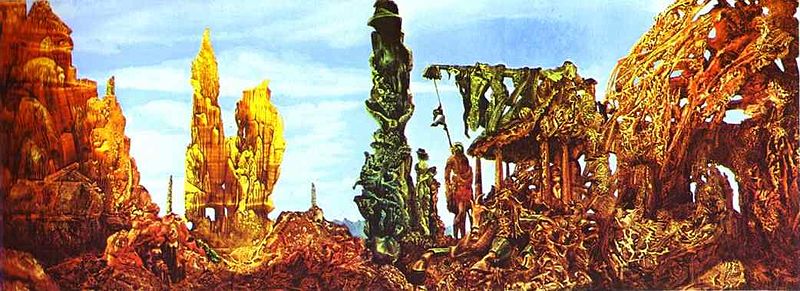
Against a saturated blue sky, a landscape is in a state of decomposition. Semi-gelatinous material entwines with desiccated chunks of a destroyed world. Towering shafts of ruined debris shoot haphazardly into the sky, forming a monolithic domelike structure in the process. A cow—or its head—appears trapped in the rubble, its body colonised by the ruins. Into this zone of mutilation, two figures, a man and a woman, stand adrift. They enter the field of our horizon and then remain motionless in the ruins. The woman is dressed elegantly, her back turned to the viewer, her body in motion. Turning toward her, a man with the skull of a bird looks on passively. Whether or not they were caught in the destruction or have returned to survey the remains, the viewer cannot be sure. In each case, they are no longer recognisable as “human” and instead have begun assuming the physiognomic characteristics of the landscape. Like the cow, their bodies are in a state of atrophy, their tones now mirroring the colouring of the landscape. Everywhere, borders collapse. What looks like the remains of a civilization may also be the inception of a new world. Similarly, if there are humans in the ruins, then they might just as easily be a new species of life, composed from both the organic and synthetic waste left behind. In the rot and the ruin, there is also life and vitality, a bewildering fusion of different orders of space and time colliding in the same sphere.

We are in the world of Max Ernst’s celebrated painting, Europe After the Rain II. Painted between 1940-1942, the work has become canonised as a masterpiece in the surrealist tradition. For J.G. Ballard, the landscapes of Max Ernst assumed a particular importance in his own thinking and writing. Above all else, what Ballard was able to discover in Ernst’s visions was a symbiosis of the natural and the supernatural, the banal and the uncanny, all of which begin not in the objective features of the landscape, but in the pathology of inner space. In his words, Ernst’s world took the form of “self-devouring phantasmagoric jungles [which] screamed silently to itself, like the sump of some insane unconscious.” Like the German romantics who influenced him, Ernst’s eerie forests and organic cities are emblems of the inner working of the deep unconscious manifest—as though by accident—on the canvas of the work. In Ballard, the same process of alchemically distilling disjoined images from the prima materia of everyday life finds its strange expression in his repetition of motifs. Abandoned parking lots, empty swimming pools, and neon nightclubs glowing in the thick forests of night all assume a level of spectral significance made possible thanks to the conjunction of inner and outer space.

Nowhere is this strange union between inner and outer space clearer than in Ballard’s “Cape Canaveral” stories, which are scattered through his writing from the early 1960s to the 1990s. In these stories, Ballard plays with themes of spatio-temporal distortion resulting from the flight into cosmic space. At once a warning against cosmic misadventures, the stories can also be read as an affirmation of humanity’s transformation the misadventures entail, as he states:

By leaving his planet and setting off into outer space man had committed an evolutionary crime, a breach of the rules governing his tenancy of the universe, and of the laws of time and space. Perhaps the right to travel through space belonged to another order of beings, but his crime was being punished just as surely as would be any attempt to ignore the laws of gravity.•

Tags: ,

By far, the worst moment of the 2011 MLB season was when Texas Rangers’ fan Shannon Stone reached for a thrown baseball from the stands in Arlington, hoping to nab a souvenir for his six-year-old son, but instead plunged to his death. In the Sunday Times Magazine, Lisa Pollak of This American Life tells Stone’s story, with the help of the late man’s parents. SuZann and Al Stone. An excerpt:

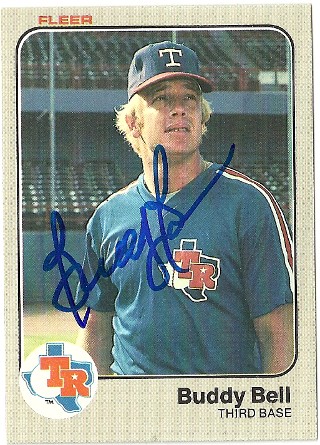
SuZann: Well, at that time the Rangers had a third-base player named Buddy Bell. And that was Shannon’s very favorite player, just as Josh Hamilton is Cooper’s player. We were pretty close behind home plate, if I’m not mistaken. Where we were sitting, Buddy Bell hit a foul ball, and it came back over —

Al: There was an upper deck just above us. I remember seeing this foul ball. The wind carried it. The ball went out of sight as it went up above that other deck, and then the wind caught it and blew it back.

SuZann: And it just almost fell right into Al’s lap. Shannon was so excited that he got that ball.

Al: Getting a ball is kind of like the holy grail of baseball. It’s one of the reasons you go, is hoping to get a souvenir of the game, a ball. To be able to catch one from Buddy Bell just made it so much more important.

SuZann: Shannon always kept it on a shelf. He loved baseball. And then it just seemed like when Cooper came along, he just kind of passed that on to Cooper.

Al: They were inseparable.

SuZann: They always sat in the same place, because Josh Hamilton played left field. So they always sat so they could be out where Josh Hamilton was. That’s why they sat there, hoping they could catch a ball. And Shannon was always one of these people that thought he was 10 feet tall and bulletproof. There wasn’t anything he couldn’t do. I’m sure he thought, I can reach out there, I can get it, I can just stretch a little bit farther.”

Tags: , ,

"In two hours the invalid was pronounced dead by the ladies in the boarding house." (Image by Antônio Rafael Pinto Bandeira.)

The following article from the June 16, 1889 edition of the Brooklyn Daily Eagle, originally published in the San Francisco Chronicle, concerns an unusual Bay Area couple, and has echoes of Nathaniel Hawthorne at his most fantastic. The piece in full:

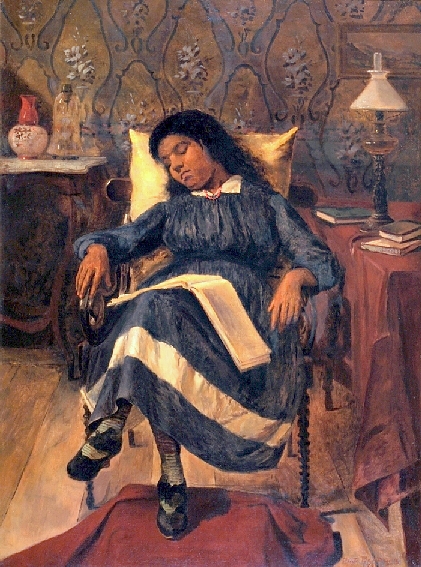
“The question of being buried alive and the recent case of Washington Irving Bishop were matters discussed by a party of gentlemen at the Bohemian Club the other night. A journalist who was present told the following story of local interest: Living in San Francisco to-day are two persons whose strange experiments have long been a mystery to me. Two years ago a Boston gentlemen came out to the coast. He brought with him his companion, a young woman in the last stages of consumption. She was pretty and talented and ten years younger than her escort. I am of the opinion that a sort of Platonic love existed between them. Three times in my own knowledge the young woman has apparently passed out of this life into the other world and twice preparations have been made for her burial. On one occasion her companion was out of the city when she was taken suddenly with a sinking spell and the landlady became greatly alarmed. In two hours the invalid was pronounced dead by the ladies in the boarding house who were in attendance upon her. As the day advanced the landlady, seeing no signs of the gentleman’s return, visited an undertaker near by and preparations were made for laying out the corpse. The body was cold and stiff when the undertaker arrived. He viewed the corpse and went back to his shop for his assistant.

During his absence the missing companion of the dead young woman arrived upon the scene. It was now about 4 o’clock in the afternoon. Upon being informed of her death some five hours before, the gentleman uttered an exclamation of surprise. Then, rushing up to the room where the body lay, he closed the door behind him and turned the key. When the undertaker returned he was refused admission. Two hours later the gentleman emerged from the room and ordered two suppers sent to the apartment. Later the young lady was seen sitting upright in bed, eating heartily. Her companion had brought her back to life by a method of rubbing and physical manipulation known only to himself. Twice after this he repeated the performance. Three times, to my knowledge, has the man brought the young woman back from the dead. She lives here today, still and invalid, and is liable to die again at almost any moment.”

Georgia Governor Jimmy Carter, completely unknown on the national stage in 1974, appears on What’s My Line? a mere two years before becoming President of the free world’s most powerful country.

Tags:

« Older entries § Newer entries »