Urban Studies

You are currently browsing the archive for the Urban Studies category.

"No I do not want to give you a blow job."

I’ll be your friend and you be my friend (Downtown)

It sucks out here. And it sucks worse when you have no friends for no good reason. Me: (Im)mature old fart; highly intelligent (or difficult to get along with); can be funny, depending; financially and physically pitiful; prone to depression; broke (very); sophisticated (look it up); ugly; fat; shrewish; parent. I smoke cigarettes. I drink beer. Interests include: Your car; poker; scrabble (3 minutes–I have ADD); ‘treasure hunting’; fishing (bring a wheel chair); metal detecting (bring a wheel chair); arts; antiques; collectibles; avid reader; coonhound owner; musical tastes very very eclectic and loved; writer; cook; (food when available); apolitical because it’s pointless but yeah I’d wear a hoodie and eat skittles for sure; yada yada.

You could be 18. You could be 79. Male. Female. Homo. Trans. Cripple. You could be a poor person. You could be a “Master of the Universe.” I love everybody and can talk to anybody. In turn you are also non-judgemental.

Just looking for friends–you know like someone to talk to and shit. 

Please include phone number. 

No I do not want to give you a blow job. 
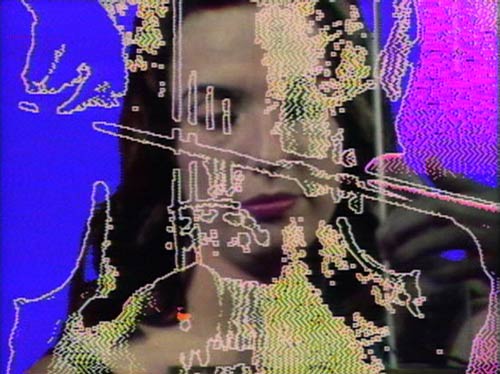
Nam June Paik’s satellite installation, Good Morning, Mr. Orwell, broadcast live in 1984, appropriately. It was an early, artsy step in the direction of people the world over sharing images as well as a riposte to George Orwell.

Tags:

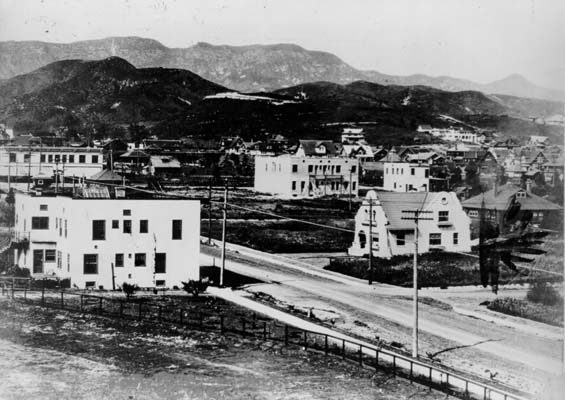
Hollywood and Highland, 1908.

Los Angeles isn’t a city–it’s a region. It has no center so it can’t be fixed or ruined. But different pieces of L.A. can become their own laboratories, experimenting, pushing forward. Hollywood, that glitzy, seamy dream factory, is being reimagined as a green, urban paradise in this age of post-peak oil, though not everyone’s happy about it. The opening of Adam Nagourney’s New York Times report:

“Hollywood, once a sketchy neighborhood in a spiral of petty crime and decay, has been well on its way over the past 10 years to becoming a bustling tourist destination and nightlife district. But now it is on the verge of another transformation: to a decidedly un-Californian urban enclave pierced by skyscrapers, clustered around public transportation and animated pedestrian street life.

A far-reaching rezoning plan that would turn parts of Hollywood into a mini-city — with residential and commercial towers rising on streets like Vine, Hollywood and Sunset — has won the support of key Los Angeles officials. And it has set off a storm of opposition from residents fearful that it would destroy the rakish small-town charm of their community with soaring anodyne buildings that block views of the Hollywood Hills (and its iconic sign) and overwhelm streets with traffic.”

••••••••••

“I’d like to dream / My troubles all away / On a bed of California stars”:

Tags:

Joni Mitchell performing “California,” 1970.

Tags:

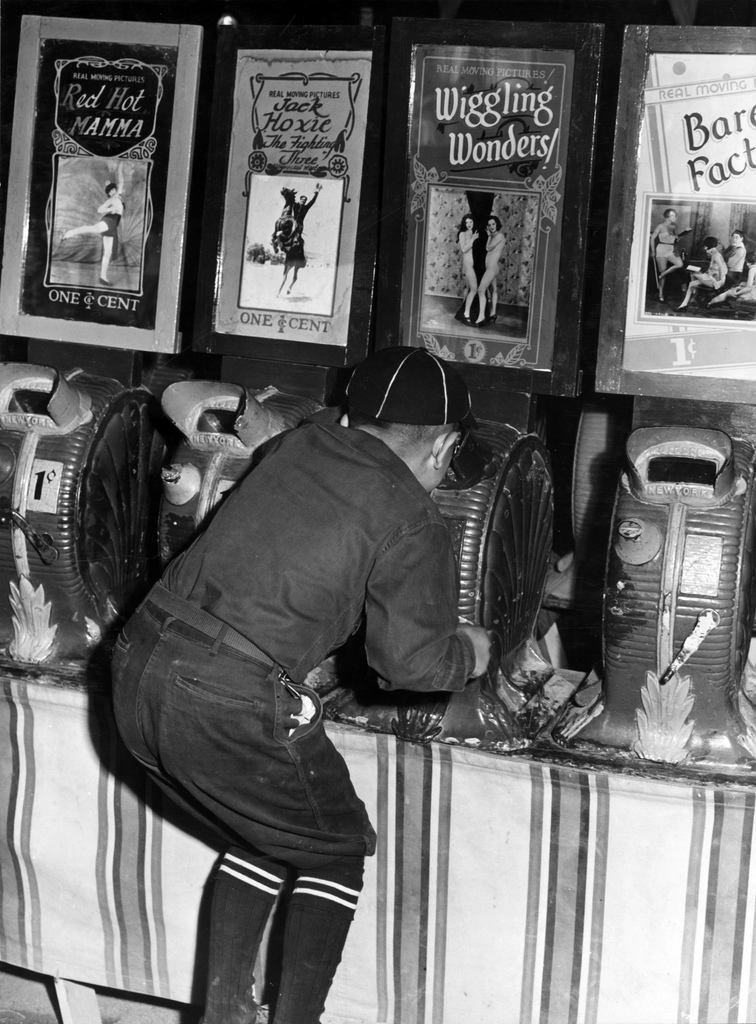
From the July 30, 1897 Brooklyn Daily Eagle:

“The Rev. Frederick Bruce Russell made a raid on the Mutoscope machines at Coney Island this morning and closed several of them. These are a species of moving picture contrivances and show various scenes. They are operated by the dropping of a nickel in a slot. Those closed by Mr. Russell to-day were at Feltman’s Pavilion, Koster’s Concert Hall, the Sea Beach Palace and the Old Iron Pier. The particular pictures which fell under the reformer’s eye were entitled ‘What the Girls Did With Willie’s Hat’ and ‘Fun in a Boarding School.'”

Tags: ,

From “Darwin’s Devices,” John Long’s piece at Slate about evolutionary robotics, the use of futuristic tools to teach us about the past:

“My fellow researchers and I are using them to harness evolution, putting it to work as an automatic, hands-off process to go where no robot has gone before: the ancient past of animals and the unknown future of human technology.

Making robots that can evolve solves a serious problem that has long vexed biologists: Dead fossils tell no tales. While fossils inform us about evolutionary patterns, they don’t tell us about life’s processes, like the dynamics of physiology, behavior, and the ‘struggle for existence’ that Darwin recognized as the basis of the evolutionary game of life. We can reconstruct and re-enact those missing processes using biorobots, a special class of physically embodied and fully autonomous machines designed to mimic living and behaving animals.

At first blush, this field, called evolutionary biorobotics, seems to present a Zen koan: How does one use evolution to study evolution?”

Tags:

Making noise, 1966.

Playing amplified cacti, 1984:

Tags:

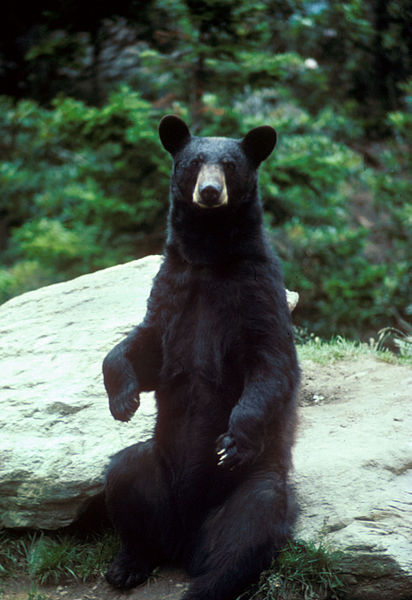
"This bear was waxed by my Great Aunt."

Huge Black Bear Rug (real) – $2000 (Fairfield, CT)

Real Canadian Black Bear Rug. Was 440 lbs. Full thick coat, museum quality mounting by Jonas Brothers. Over 6 foot, this is a full size rug, lightly padded underneath with black felt trim edging. This bear’s BIG! Can be seen on display at Forest & Field Shooting Range / Gun Shop in Norwalk, CT.

AND, for you few whiny douchebags who insist on writing to tell me what a scumbag I must be….

This was NOT a nice bear…This was NOT Yogi da Bear…This bear was waxed by my Great Aunt, 25(?) years ago…(she was 85 at the time) after raiding her farm several times. It destroyed chicken coops, killed hens, it killed a goat that was tethered, it maimed and blinded the Labrador that tried to chase it off….Her cat ran over and stood on top of the dog after he was down to protect it, and the bear swatted the cat too….So Fuck off. He got his, and now he’s a rug….A big, soft, fat, thick, plush rug. GET OVER IT.

I never realized the timeline of the reemergence of dinosaur studies in academia until reading this passage from paleontologist Paul Barrett at the Browser:

“It’s really only from the 70s onwards that we start to get this change in view and only from the 80s that we had a crystallisation of this view that dinosaurs were very exciting animals. For most of the 20th century dinosaurs were viewed as a dead end – an evolutionary dead end that was kind of interesting because they were big and odd-looking, but that never really went anywhere. It was the recognition in the 70s that dinosaurs and birds were closely related, and that dinosaurs were more like birds than like other reptiles, that suddenly led to a new burst of interest in them and new research programmes. If you spoke to a student in the 1940s or 50s they would just view dinosaurs as curiosities, but these days they’re viewed as an integral part of a greater knowledge of how animals are related to each other and how animal behaviour has changed through time, not just as a side-show oddity.”

Tags:

Michael Parkinson interviews Orson Welles in the wake of Watergate, 1974.

Tags: ,

"A nearly bankrupt Finnish company called Rovio hit upon a similarly perfect fusion of game and device: Angry Birds."

The New York Times Magazine is deservedly getting a lot of play for the Asteroids-like video game it’s embedded in the online version of its featureJust One More Game…but Sam Anderson’s article is excellent, gimmicks or not. It looks from every angle at our obsession with seemingly dumbed-down, repetitive, low-fi digital time-killers in the age of the iPhone. From Anderson’s article, an excerpt about the back-story of two relentless compulsions, Tetris and Angry Birds:

“Tetris was invented exactly when and where you would expect — in a Soviet computer lab in 1984 — and its game play reflects this origin. The enemy in Tetris is not some identifiable villain (Donkey Kong, Mike Tyson, Carmen Sandiego) but a faceless, ceaseless, reasonless force that threatens constantly to overwhelm you, a churning production of blocks against which your only defense is a repetitive, meaningless sorting. It is bureaucracy in pure form, busywork with no aim or end, impossible to avoid or escape. And the game’s final insult is that it annihilates free will. Despite its obvious futility, somehow we can’t make ourselves stop rotating blocks. Tetris, like all the stupid games it spawned, forces us to choose to punish ourselves.

In 2009, 25 years after the invention of Tetris, a nearly bankrupt Finnish company called Rovio hit upon a similarly perfect fusion of game and device: Angry Birds. The game involves launching peevish birds at green pigs hiding inside flimsy structures. Its basic mechanism — using your index finger to pull back a slingshot, over and over and over and over and over and over and over — was the perfect use of the new technology of the touch screen: simple enough to lure a suddenly immense new market of casual gamers, satisfying enough to hook them.

Within months, Angry Birds became the most popular game on the iPhone, then spread across every other available platform. Today it has been downloaded, in its various forms, more than 700 million times.”

••••••••••

Tetris, the music:

Tags:

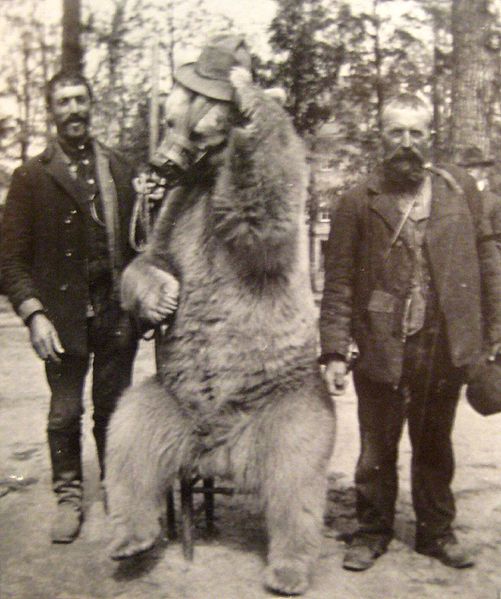
"He rushed into the room valiantly and found himself face to face with a huge brown bear. "

Somehow no one was mauled to death during a deeply dangerous and deeply funny practical joke that was reported on in the August 23, 1894 edition of the Brooklyn Daily Eagle. The story in full:

“A wild, unearthly yell broke the tower of the old iron pier at about 1 o’clock this morning. It proceeded from the handsome apartments occupied by Mr. A.S. Judge, the superintendent of the old iron pier, and the brother-in-law of Mr. Pierre Lorillard. So piercing was the shriek, that it even had the potence to arouse Sarcarichi, Mr. Judge’s Japanese servant, from his slumbers. Hurriedly throwing on a loose Japanese gown Sarcarichi flew to his master’s room, fully convinced that murder was being done. He rushed into the room valiantly and found himself face to face with a huge brown bear. Sarcarichi is no coward, but he glanced around very cautiously before he bolted again for the door. In this brief glimpse he saw his employer curled up in bed with clothes pulled up over his head. This was enough for Sarcarichi. With a yell which would not have been discreditable to a Comanche Indian he fled, his coattails flying backward. Bruin looked at the flying figure, and, thinking it was another chance for some fun, pursued the Japanese from the room. No sooner was it cleared than Judge leaped  to his feet, locked and double locked his door.

The bear’s keeper caught the animal at the bottom of the stairs. The entire trouble occurred because Mr. Judge boasted that even if the London Zoo broke loose it wouldn’t frighten him. Harry Sturdevent, to whom the remark was made, gave a dollar to the keeper of the bear. Whether or not there is any connection between these facts is matter for speculation.”


Tags: , , ,

Ben Ehrenreich, a brilliant guy who is consumed by death, looked at the end of print in an electric age in his great 2011 essay, “The Death of the Book,” at the Los Angeles Review of Books. An excerpt:

“In 1962, Marshall McLuhan had published an almost spookily prescient book titled The Gutenberg Galaxy. It was, among other things, an extended critique of the culture of print. Technology shapes our consciousness, McLuhan argued, and the development of the printed book in the mid-fifteenth century had inaugurated a reorientation of human experience towards the visual, the regimented, the uniform and instrumental. Language, which had once been a wild, uncontainable affair between the oral and aural (think whisper, shout, and song, the playful market-square dynamism of dialect and argot) was silenced, flattened, squeezed into lines evenly arrayed across the rectilinear space between the margins. Spellings were standardized, vernaculars frozen into national languages policed by strict academies. Print, for McLuhan, was the driver behind all that we now recognize as modern. Through it nationalisms arose, and other horrors: capitalism, individualism, alienation. Time itself was emptied out—reduced, like the words on each page, to a linear sequence of homogeneous moments. Print had stolen something. Books had shrunk us. They had ‘denuded’ conscious life. ‘All experience is segmented and must be processed sequentially,’ McLuhan mourned. ‘Rich experience eludes the wretched mesh or sieve of our attention.’

An end was in sight. We had already entered a ‘new electric age’ characterized by interdependence rather than segmentation. ‘The world has become a computer,’ McLuhan wrote, ‘an electronic brain, exactly as in an infantile piece of science fiction.’ The Internet was still a Cold-War fantasy, but for McLuhan print’s corpse was already growing cold. (He dated the collapse of the Gutenberg Galaxy to 1905 and Einstein’s early work on relativity.) This was not necessarily cause for optimism. McLuhan coined the phrase ‘global village’ to describe the hyper-networked world that was already taking shape. He had no illusions, though, about the nobility of village life. Our newly TV-, telephone-, and radio-enwebbed multiverse could just as easily be ruled by ‘panic terrors … befitting a world of tribal drums’ as by any bright pastoral harmony. And so it was and is.”

In 1967, when Jacques Derrida took up the theme of ‘the end of the book’ in Of Grammatology, McLuhan’s ideas were still sufficiently in the air that the philosopher could refer to ‘this death of the civilization of the book of which so much is said’ without need for further explanation. But the ‘civilization of the book,’ for Derrida, meant more than the era of moveable type. It preceded Gutenberg, and even the medieval rationalists who wrote of ‘the book of nature’ and via that metaphor understood the material world as revelation analogous to scripture. The book for Derrida stood in for an entire metaphysics that reached back through all of Western thought: a conception of existence as a text that could be deciphered, a text with a stable meaning lodged somewhere outside of language. ‘The idea of the book is the idea of a totality,’ he wrote. ‘It is the encyclopedic protection of theology and of logocentrism against the disruption of writing, against its aphoristic energy and … against difference in general.’ Those, in case you couldn’t tell, are fighting words.”

••••••••••

Dylan goes electric, Newport, 1965:

Tags: ,

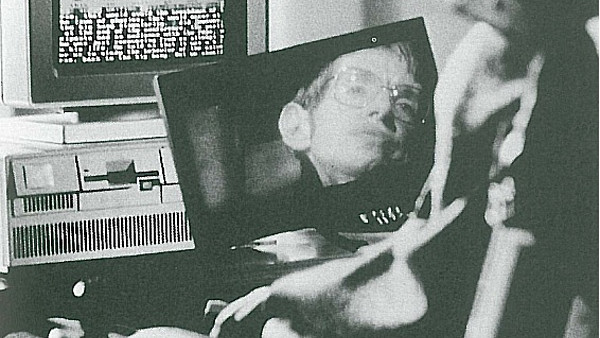
From “A Little Device Trying to Read Your Thoughts,” David Ewing Duncan’s New York Times article about Stephen Hawking adopting the iBrain:

“Already surrounded by machines that allow him, painstakingly, to communicate, the physicist Stephen Hawking last summer donned what looked like a rakish black headband that held a feather-light device the size of a small matchbox.

Called the iBrain, this simple-looking contraption is part of an experiment that aims to allow Dr. Hawking — long paralyzed by amyotrophic lateral sclerosis, or Lou Gehrig’s disease — to communicate by merely thinking.

The iBrain is part of a new generation of portable neural devices and algorithms intended to monitor and diagnose conditions like sleep apnea, depression and autism. Invented by a team led by Philip Low, a 32-year-old neuroscientist who is chief executive of NeuroVigil, a company based in San Diego, the iBrain is gaining attention as a possible alternative to expensive sleep labs that use rubber and plastic caps riddled with dozens of electrodes and usually require a patient to stay overnight.

‘The iBrain can collect data in real time in a person’s own bed, or when they’re watching TV, or doing just about anything,’ Dr. Low said.”

••••••••••

Main title music by Philip Glass for Errol Morris’ 1991 Hawking film:

Tags: , , , ,

Heart surgery from NYU Medical Center was broadcast on live TV in 1958. 

In the post about Olivetti, I mentioned the Austrian-born design genius Ettore Sottsass, who passed away in 2007. Here’s a piece from his best-known essay, “When I Was a Very Small Boy“:

“Now that I’m old they let me design electronic machines and other machines in iron, with flashing phosphorescent lights and sounds and no one knows whether they are cynical or ironical: now they only let me design furniture that ought to be sold, furniture they say, that is useful to society, they say, and other things that are sold ‘at low prices’ they say, and in this way they can sell more of them, for society they say, and now I design things of this kind. Now they pay me to design them. Not much, but they pay me. Now they look for me and wait for models from me, as they say, ideas and solutions which end up heaven knows where.

Now everything seems to have changed. The things I do (by myself or with my companions) seem to have changed and the way they are done also seems to have changed because, goodbye bright blue Planet, goodbye melodious seasons, goodbye stones, dust, leaves, ponds, and dragon flies, goodbye boiling-hot days, dead dogs by the roadside, shadows in the wood like prehistoric dragons, goodbye Planet, by now I feel as if I do the things I do sitting in a bunker of damp artificial light and conditioned air, sitting at this white laminate table, sitting in this silver plastic chair, captain of a spaceship traveling at thousands of miles an hour, squashed against this seat — immobile in the sky.

By now I have to think of things from an artificial space, with neither place nor time; a space only of words, phone-calls, meetings, timetables, politics, waiting, failures. By now I’m a professional acrobat, actor and tightrope walker, for an audience that I invent, that I describe to myself, a remote audience with whom I have no contact, stifled echoes of whose talking, clapping and disapproval reach me, whose wars, catastrophes, famines, suicides, escapes, poverty or anxious restings along crowded beaches or inside smoky stadiums I read about in papers; how can I know who are the ones expecting something from me?

I would like to break this strange mechanism I’ve been driven into.”

Tags:

"I don't want to kill him." (Image by George Chernilevsky.)

One stupid feeder goldfish – $1 (Flushing)

I bought him from a feeder tank at Petco. He’s been a headache for almost 2 months now. Three days after I got him, he got sick. The meds I bought cost a lot but I managed to nurse him back to health.

Now all he does is eat and poop and swim like he’s had ten mugs of coffee. Anyway, I don’t want him anymore. The Petco won’t take him back. And I don’t want to kill him cause I spent so much time and money saving him. The little idiot doesn’t know how lucky he is. Feeders are destined to die. He should’ve been eaten by a snake by now. Hell, if I had a snake, I’d have fed him to one by now.

As for why I got him to begin with, I’ve got other goldfish, and he was really beautiful at first. But he lost all his colors cause I had him quarantined in a hospital tank in a dark room. I say he’s a dollar, but you can have him for free. Don’t even need to tell me what you plan on doing with him. But it’d be nice if a kid would take him. I know folks believe goldfish are boring, but HE’S REALLY CRAZY ENERGETIC. Just give him plenty of room to swim and gravel to poke at. Or a fish treadmill. 

Short doc about the Olivetti company, which gave us the first desktop personal computer in 1964, the Programma 101, and brought a liberating modern design sense to all sorts of information systems. How could we be terrified of something that looked so cool?

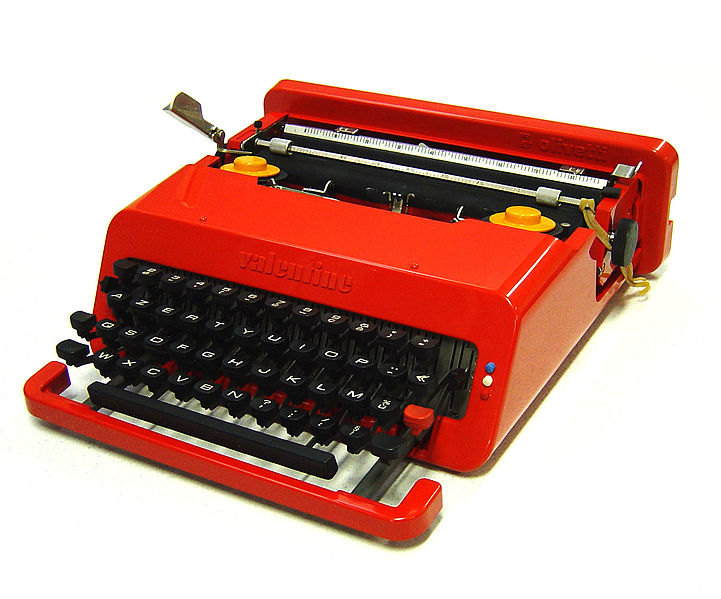
The Valentine typewriter, designed in 1969 for Olivetti by Ettore Sottsass, is one of the best commercial designs ever. It was marketed as a typewriter you would use outside of the office. Information tools could be personal, portable and non-institutional.

Tags: , ,

Old Time wrestling legend Chief Jay Strongbow reportedly passed away today. The good Chief was always very proud of his Native American heritage, which was impressive since he was Italian. Here he is fighting a galoot, for some strange reason, inside of a shark cage. Who booked this shit?

Tags:

Video about the press conference to promote the 1992 rematch between Bobby Fischer and Boris Spassky, which was played for money, not glory. Fischer was far gone at this point, a sad spectacle overflowing with demons.

Tags: ,

"Monkeys could choose whether they got a tiny square of blue Jell-O or a big chunk of red Jell-O." (Image by Donar Reiskoffer.)

From Amy Dockser Marcus’ WSJ article about Yale psychologist Laurie Santos’ experiments with monkey-based economics, an excerpt about the differences between human and simian fiscal sense:

The experiments that have been done so far show that many of our economic behaviors are deeply rooted. Still, there appears to be a place where the two species part ways.

Researchers wondered whether monkeys, like humans, desire an expensive item more. For the same number of tokens, the monkeys could choose whether they got a tiny square of blue Jell-O or a big chunk of red Jell-O. Later, the monkeys were allowed to choose which kind they wanted. If the monkeys were like humans, they would have gone for the blue Jell-O, the more ‘expensive’ choice. But the monkeys gorged happily on both.

The researchers are still gathering and analyzing the data. One possibility: Human taste preferences are based on many factors, whereas the monkeys’ are not. Some might argue that human economic behavior is more advanced since it includes ‘culture and meta-awareness’ in decision-making, said Dr. Santos. There’s another, less flattering possibility too. ‘The monkeys,’ she said, ‘are more rational.'”

••••••••••

Santos lectures on monkey economics at TED:

Tags: ,

Speaking of B.F. Skinner, his daughter, Deborah, has always vehemently denied charges that she was raised as a Behaviorist lab rat. From a 2004 Guardian article:

“My early childhood, it’s true, was certainly unusual – but I was far from unloved. I was a much cuddled baby. Call it what you will, the ‘aircrib,’ ‘baby box,’ ‘heir conditioner’ (not my father’s term) was a wonderful alternative to the cage-like cot. My father’s intentions were simple, and based on removing what he and my mother saw as the worst aspects of a baby’s typical sleeping arrangements: clothes, sheets and blankets. These not only have to be washed, but they restrict arm and leg movement and are a highly imperfect method of keeping a baby comfortable. My mother was happy. She had to give me fewer baths and of course had fewer clothes and blankets to wash, so allowing her more time to enjoy her baby.

I was very happy, too, though I must report at this stage that I remember nothing of those first two and a half years. I am told that I never once objected to being put back inside. I had a clear view through the glass front and, instead of being semi-swaddled and covered with blankets, I luxuriated semi-naked in warm, humidified air. The air was filtered but not germ-free, and when the glass front was lowered into place, the noise from me and from my parents and sister was dampened, not silenced.

I loved my father dearly. He was fantastically devoted and affectionate. But perhaps the stories about me would never have started if he had done a better job with his public image. He believed that, although our genes determine who we are, it is mostly our environment that shapes our personality. A Time magazine cover story ran the headline ‘BF Skinner says we can’t afford freedom.’ All he had said was that controls are an everyday reality – traffic lights and a police force, for instance – and that we need to organise our social structures in ways that create more positive controls and fewer aversive ones. As is clear from his utopian novel, Walden Two, the furthest thing from his mind was a totalitarian or fascist state.”

Tags: ,

Finally got around to reading the Economist article, “What Happened to the Flying Car?” An excerpt about a couple of such vehicles close to the market:

“The Transition is being aimed at pilots who want to be able to drive to the airport and take off without changing vehicles, or land at a distant airport and not be stranded. As its name implies, it is intended to be a transitional product, a step on the way to true sky cars capable of taking off and landing almost anywhere. Such aircraft will require the development of more efficient motors and better control systems, says Rob Bulaga, president of Trek Aerospace in Folsom, California, another company developing a flying car.

Trek is adapting a ‘personal aerial vehicle’ concept originally developed for DARPA, the research-funding agency of America’s Department of Defence, to create a civilian vehicle. This two-seater, the Tyrannos, has ducted propellers powered by petrol engines, with a battery backup. Although it has been possible to make such vehicles for decades, they are notoriously difficult to fly. ‘It’s just basic physics,’ says Mr Bulaga. ‘Any vehicle that takes off and lands vertically is unstable.’ To make it practical, computers are needed to make the constant tweaks required to achieve stable flight. Without them, even just hovering is like trying to stand on a beachball, he says.”

••••••••••

A personal flying vehicle from Trek Aerospace:

Tags:

William F. Buckley and B.F. Skinner, in 1973, discussing moral development.

See also:

Tags: ,

"High quality." (Image by Manfred Morgner.)

Free high-quality sand (Midtown West)

We have two tons of sand that was used for a photoshoot, and now have no use for. You can take as much as you can haul. We have dollys and shovels to help move it.


« Older entries § Newer entries »