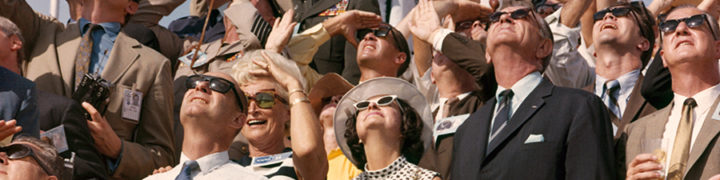
Befuddled dowager Margaret Dumont’s final appearance–hello, she must be going–was fittingly made with longtime tormentor Groucho Marx in 1965. She died three days after this ancient piece from Animal Crackers was taped. And speaking of ancient pieces, ladies and gentlemen, Margaret Dumont.
You are currently browsing the archive for the Urban Studies category.
Tags: Groucho Marx, Margaret Dumont
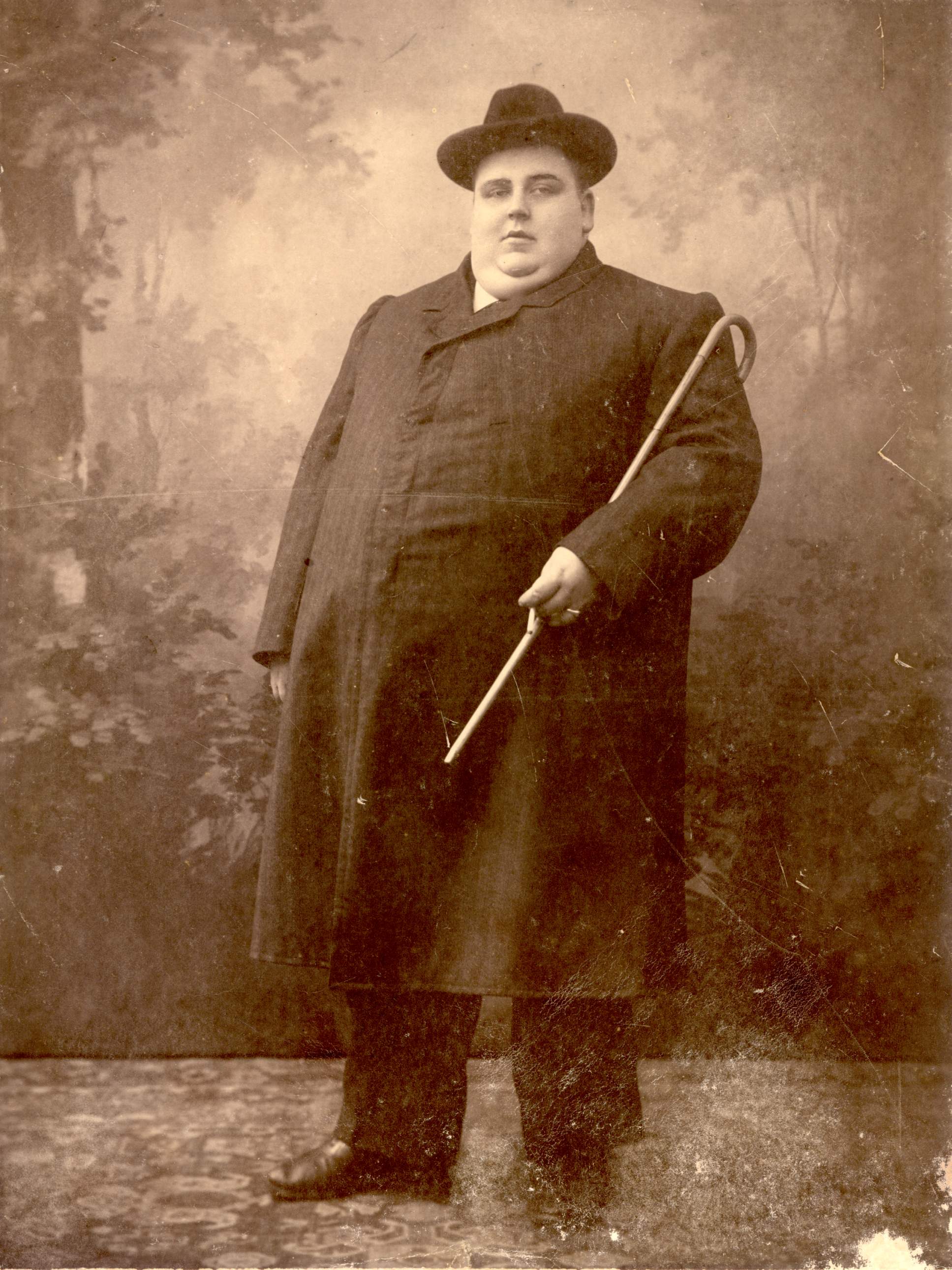
"For a wager he would eat a whole sheep or whole pig."
A story about dietary anomalies, which appeared in the January 30, 1887 edition of the Brooklyn Daily Eagle and was originally published in Good Housekeeping. An excerpt:
“Elizabeth Charlotte, the Duchess of Orleans, writing under the date of December 5, 1718, says: ‘The late king, monsieur the Dauphin, and the Duc de Berri were enormous eaters. I have often seen the King eat four plates of different kinds of soup, a whole pheasant, a partridge, a dish of salad, two thick slices of ham, mutton flavored with garlic, a plateful of pastry and finish his repast with fruit and hard boiled eggs.’ There was a good old German from Wittemberg, where my Lord Hamlet attended the university, who had a fine faculty for storing away provender. His case is well attested. For a wager he would eat a whole sheep or whole pig or put out of sight a bushel of cherries, stones and all. He lived until he was 80 years of age, a great portion of the time supporting himself by exhibiting the peculiarity of his appetite, which, to say the least, must have been a very eccentric one. Thus, he would chew glass, earthenware and flint into small fragments. He had an especial preference for caterpillars, mice and birds, and when these were not procurable he would content himself with mineral substances. Once he put down his maw and gull a pen, the ink and the sand pounce and he would have gobbled the inkstand, too, had he not been restrained.
Dr. Copland, in speaking of two children who had wonderful appetites, the youngest 7 seven years old being the worst, said: ‘The quantity of food devoured by her was astonishing. Everything that could be laid hold of, even in its raw state, was seized upon most greedily. Among other articles, an uncooked rabbit, half a pound of candies and some butter, were taken at one time. The mother stated that this little girl, who was apparently in good health otherwise, took more food if she could possibly obtain it, than the rest of her family, consisting of six besides herself.’
Instances of depraved appetite are numerous, and men have been known to swallow fire, swords, spiders, flies, toads, serpents, cotton, hair, paper, wood, cinders, sand, earth, clay, chalk, flint, musket balls and gold watches. One man could swallow billiard balls.”
The late, great Hiram Bullock joins David Sanborn, Marcus Miller, Omar Hakim and Philippe Saisse on Night Music in 1989 to jam on electric toy instruments.
Tags: David Sanborn, Hiram Bullock, Marcus Miller, Omar Hakim, Philippe Saisse
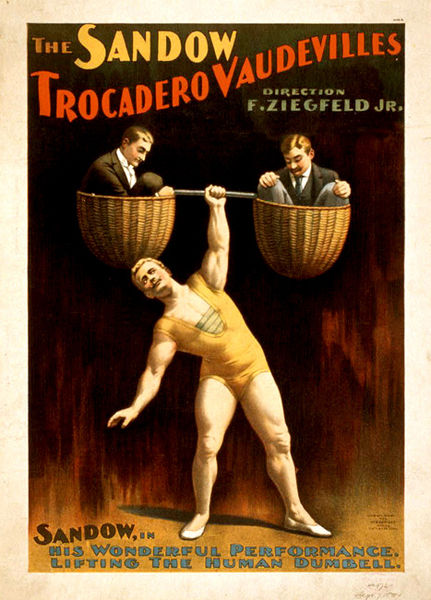
From a typically eccentric Adam Curtis essay, “Bodybuilding and Nation-Building,” a look at how developing muscles was begun as a riposte to industrialization:
“At the end of the nineteenth century a fanatical craze for physical fitness swept through Britain. Millions of men and women took up gymnastics, body building and other physical exercises.
Such a thing had never happened before – and it was given a name – Physical Culture.
The craze had an almost religious intensity because those who promoted it said that it was the only way to prevent the British nation – and its Empire – from collapsing. Behind this was a powerful belief that the modern world of the 1890s – the teeming cities with their slums and giant factories – was leading to a ‘physical degeneracy’ in millions of people.
It was a fear that had started with the elite who ran Britain’s public schools. Matthew Arnold warned of ‘the strange disease of modern life’ with its ‘sick hurry’ and ‘divided aims.’ Out of that came a movement called ‘Muscular Christianity’ which wanted to recreate the kind of heroic human being that existed before industry and the modern world came along and corroded everything.
It was a vision of a restored physical and moral perfection in the young men who were going to run the empire. And it involved doing lots of exercises in new things called Gymnasiums. Then liberal reformers got worried about the working classes – convinced that the slums were leading to a ‘physical degeneracy.’ So they persuaded lots more people to do exercises.
Then a figure rose up who united all of this dramatically into a mass movement. He was called Eugen Sandow.
Sandow came from Prussia, he started as a circus and music-hall performer. But then in the late 1890s he invented something he called ‘body-building.’ It caused a sensation throughout Europe and America – and he became a massive celebrity because he was seen as the leader of a crusade of Physical Culture that was going to stop the degeneracy that was plaguing Britain.” (The Browser.)
Tags: Adam Curtis, Eugen Sandow
Smart Sand shares information, joins together to form objects. From CNET: “Researchers at MIT have developed a robotic system for duplicating shapes, a potential alternative approach to three-dimensional printing. The Distributed Robotics Lab at MIT today detailed research aimed at replicating objects by essentially carving them from an unformed pile of ‘smart sand’ or ‘robot pebbles.’ The vision is to have these miniature robots automatically create replicas of different sizes with only an original shape to work with.”
Only a computer demo at this point:

"Talk more about that."
I’m always skeptical about the AMAs (Ask Me Anything posts) on Reddit, but this one by a kid claiming he’s being raised in a carnival has great sociological import. An excerpt:
“IamA person who was raised in the carnival. AMA (self.IAmA)
submitted ago by Harb1ng3r
I watched this excellent John Zorn documentary about a decade ago, but where? There was no Youtube. Was it all a dream? No, it was real.
Tags: John Zorn
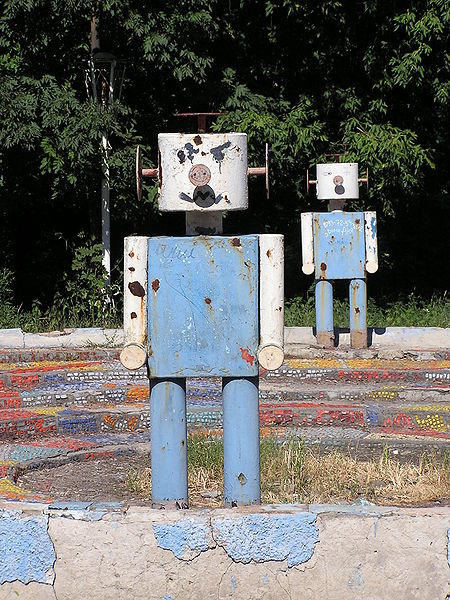
I’ve probably posted something about swarmbots being programmed to create their own language, but Marcus du Sautoy sums up the experimentation really well in a new article about the Turing Test in the Guardian. An excerpt:
“For me one of the most striking experiments in AI is the brainchild of the director of the Sony lab in Paris, Luc Steels. He has created machines that can evolve their own language. A population of 20 robots are first placed one by one in front of a mirror and they begin to explore the shapes they can make using their bodies in the mirror. Each time they make a shape they create a new word to denote the shape. For example the robot might choose to name the action of putting the left arm in a horizontal position. Each robot creates its own unique language for its own actions.
The really exciting part is when these robots begin to interact with each other. One robot chooses a word from its lexicon and asks another robot to perform the action corresponding to that word. Of course the likelihood is that the second robot hasn’t a clue. So it chooses one of its positions as a guess. If they’ve guessed correctly the first robot confirms this and if not shows the second robot the intended position.
The second robot might have given the action its own name, so it won’t yet abandon its choice, but it will update its dictionary to include the first robot’s word. As the interactions progress the robots weight their words according to how successful their communication has been, downgrading those words where the interaction failed. The extraordinary thing is that after a week of the robot group interacting with each other a common language tends to emerge. By continually updating and learning, the robots have evolved their own language. It is a language that turns out to be sophisticated enough to include words that represent the concept of ‘left’ and ‘right.’ These words evolve on top of the direct correspondence between word and body position. The fact that there is any convergence at all is exciting but the really striking fact for me is that these robots have a new language that they understand yet the researchers at the end of the week do not comprehend until they too have interacted and decoded the meaning of these new words.”
••••••••••
Luc Steels talks robot culture at TED:
Tags: Luc Steels, Marcus du Sautoy
The cameras follow us now, but we don’t mind. We even invite them. Nothing seems real, but everything is a reality show. It’s attention we think we need. But when everyone is a star, no one is. What happens when this new arrangement is not enough?
We don’t even know what it means yet, but we guess it’s cool. But what if it isn’t? What if those pictures of us on screens of all sizes aren’t flattering?
Not you, Ashlee. You’re good people. But what of the rest of us?•

"Can cook delicious meals." (Image by Jiří Humpolíček.)
Need Dermatological Help!
Hi! I have horrible scabs & scars all over my body from bedbug bites and have no idea who to turn to. I’m living a nightmare for the past 5 months with skin I don’t recognise: bumpy, continuously itchy, with some of the scabs not healing well/getting infected. I feel disgusting and ugly. I have no money or health insurance, but can cook delicious meals in exchange for help.
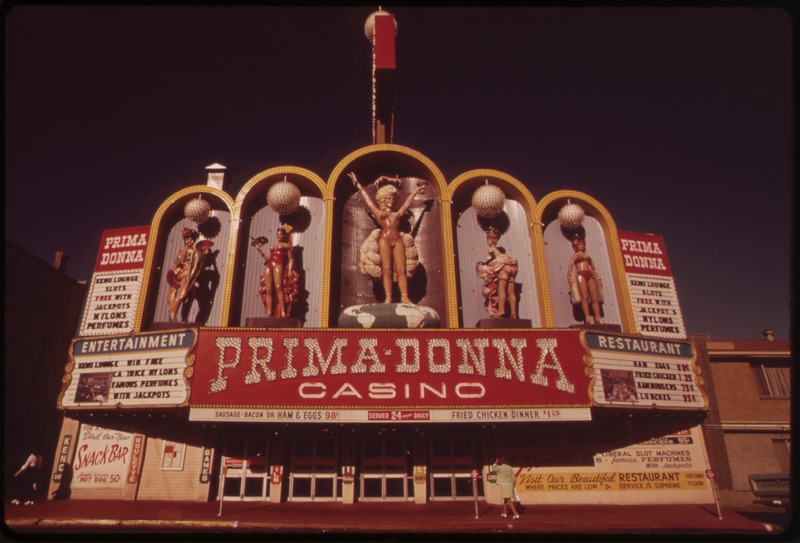
I don’t believe in the prohibition of gambling or pretty much anything consenting adults want to do, but that doesn’t mean I don’t recognize casinos for what they are: predatory pits where the deck is stacked, an attraction that draws people in and spits them out, places without clocks that steal your time. From Edward Luce’s excellent Financial Times essay about the serious economic and political challenges currently facing America, a segment about the false hope of glitzy gambling parlors in former manufacturing centers:
“From Florida to California, and numerous Native American reservations in between, the impact of gambling varies, according to a welter of studies. Some show that the effect on the people around the casinos is a net negative. It can also be bad for tax revenues. One study estimated that for every dollar a gaming house invests in an area, three are subtracted by the costs of dealing with its social effects. Casinos may be a way of replacing some of the manufacturing jobs lost to China, Brazil and elsewhere. But they are also a magnet for racketeers, pimps, drugs and those living on the margins.
In a world where the economic centre of gravity is shifting from west to east, the continued faith in casinos, and other forms of gaming, epitomises a certain bankruptcy of thinking among America’s policy makers. On the charts they show up as service jobs, which economists instinctively treat as superior to jobs that involve making things. Much like the shift from farming to manufacturing a century ago, America is now climbing up the value-added chain to the more cerebral world of service industries. Brain power is America’s future.
It doesn’t always appear too cerebral in practice. Too large a share of the new service jobs are dead-end and enforced part-time positions that enable the employer to wriggle out of providing healthcare insurance. In the past decade, the number of Americans insured by their employers has fallen from two-thirds to barely half. Only the senior managerial slots offer any real security and they are mostly taken by outsiders. Much the same could be said of the armies of food preparers, domestic carers and data-entry workers who account for so many of the new service jobs America is creating.
‘We are on track to becoming a country where the top tier remains wealthy beyond imagination, and the remainder, in one way or another, are working in jobs that help make the lives of the elites more comfortable,’ says Harvard’s Lawrence Katz, one of America’s foremost labour economists. ‘They will be taking care of them in old age, fixing their home WiFi, or their air-conditioning, teaching or helping with their kids and serving them their food. It is not a very elegant prospect.'” (Thanks Browser.)
Tags: Edward Luce, Lawrence Katz

From the August 15, 1899 Brooklyn Daily Eagle:
“‘Superstitions About Babies’–In Spain the infant’s face is swept with a pine tree bough to bring good luck. In Ireland a belt made of women’s hair is placed about the child to keep harm away. Garlic, salt, bread and steak are put into the cradle of a new-born babe in Holland. Romanian mothers tie red ribbons around the ankles of their children to preserve them from harm.”

From Felix Gillette’s smart new Businessweek article about the Internet buzz saw that is Buzzfeed, a passage on company co-founder Jonah Peretti, who sees the site as a psycho-sociological experiment, and one of his influences, Stanley Milgram:
“Peretti, 38, has a knack for coining clever Web neologisms. Among the keys to achieving success on the Internet, he says, is deploying ‘Big Seed Marketing,’ optimizing ‘Viral Lift,’ using a ‘Mullet Strategy,’ and catering to the ‘Bored at Work Network.’ ” He sees himself not only as a businessman but as something of an applied scientist, testing the theories of 20th century academic sociologists vs. the contemporary data of the social Web.
To understand some of the principles underlying BuzzFeed’s strategy, he recommends reading The Individual in a Social World, a 1977 book by Stanley Milgram, who is known, among other things, for his experiments leading to the six degrees of separation theory. ‘When some cute kitten video goes viral,’ says Peretti, ‘you know a Stanley Milgram experiment is happening thousands of times a day.’
Peretti grew up in Oakland, Calif., graduated Phi Beta Kappa from the University of California at Santa Cruz in 1996 with a degree in environmental studies, and spent a couple of years teaching computers and Web publishing to high school students in New Orleans. After co-writing a number of papers for academic conferences (‘Historical Role-Playing in Virtual Worlds: VRML in the History Curriculum and Beyond’), he matriculated at the Massachusetts Institute of Technology, where he earned a master’s degree from the Media Lab.
In 2001, inspired by reports of substandard working conditions at Nike (NKE) factories, Peretti ordered a pair of custom Nike sneakers decorated with the word ‘Sweatshop.’ The company refused to fill the order, and Peretti got into a theatrical back-and-forth with a customer rep on e-mail. Afterward, Peretti e-mailed the document to 10 acquaintances, who passed it along to their friends. The whole thing snowballed. Overnight, Peretti became an Internet sensation. NBC flew him to New York to appear on Today.
Peretti walked away from the Nike affair a presumed expert on the explosive Internet phenomena now known as viral media. Writing about his experience for the Nation in April 2001, he theorized, ‘In the long run this episode will have a larger impact on how people think about media than how they think about Nike and sweatshop labor.’ He speculated that by understanding the dynamics of ‘decentralized distribution systems and peer-to-peer networks,’ new forms of social protest would emerge and challenge the ‘constellations of power traditionally supported by the mass media.'”
••••••••••
Stanley Milgram’s 1962 experiment, “Obedience”:

Excellent article at Capital by my old pal Steven Boone, in which he does the Wi-Fi shuffle, scamming free connectivity wherever he can and summing up our somnambulant, searching age. An excerpt:
“Back home I had run into many such late-night nerd-drifters at the Apple store on 58th Street. An angry young black British writer had tipped me to the glories of 24-hour Apple joints one night, when we both found ourselves kicked out of the Grand Central Terminal wifi hotspot at closing time.
58th Street was a revelation. So this was where all the weirdoes who used to fill the early-2000’s Internet cafe on Times Square had migrated.
Under the supervision of highly tolerant Apple store Geniuses, folks could play with the latest MacBooks, iPods, Shuffles, Airs, iPhones, and iMacs (iPads were still a few months off) for as long as they could stand or lean at the waist-level display tables. Others who brought their own devices siphoned wifi while sitting on the stone bench encircling the store’s Logan’s Run-looking glass elevator.
My favorite stand-up regular was a wild Hispanic man who scoured YouTube for reggaeton booty-shaking videos. None of my business, except that he would watch the clips full-screen on the store’s biggest iMac display, the speaker bass thumping while he ground his hips in the approximate space the dancing women’s butts would have occupied if the videos were holograms. Here was the only argument for 3-D that I could respect. On a similar theme, I once overheard a young, broke playboy arranging a booty call on one of the iPhones. Speaking above the store’s iTunes-diverse muzak, he told the girl he was just leaving the studio.
Others conducted important business on the phones, shouting or sobbing or plaintively whispering. Been there, too: The day my MacBook and phone got stolen, I ran to the Geniuses before I thought to run to the cops.
This was the future a lot of dystopian sci-fi authors warned us about, where a private, profit-hungry corporation could make itself feel like Mom’s house.“
Tags: Steven Boone

"A decentralized network that routed messages from place to place using addresses that had nothing to do with physical locations." (Image by Remi Jouan.)
From “World War 3.0,” Michael Joseph Gross’ new Vanity Fair examination of the current challenges to the Internet, a passage about the origin of the boundary-busting nature of the medium:
“Vint Cerf knew from the start that there was a problem—he just couldn’t fix it. The year was 1975, and Cerf was on a team of computer scientists at Stanford University under contract to finish a new communications network for the U.S. military. The goal was full cryptographic capability—a system that allowed all messages to be authenticated from both sides—on a network that could be used anywhere in the world. Two things prevented the scientists from making this network as secure as they would have liked. One obstacle was institutional: ‘The only technology that would have allowed for such security was still classified at the time,’ Cerf recalls. The other obstacle was simple momentum. Before the developers could implement truly secure encryption, Cerf explains, ‘the system kind of got loose,’ meaning that problems would have to be fixed on the fly.
Cerf is frequently referred to as ‘the father of the Internet.’ His most celebrated achievement, for which he shares credit with the engineer and computer scientist Robert Kahn, was creating the TCP/IP protocol, the system that allows computers and networks all over the world to talk to one another. He was an early chairman of the Internet Corporation for Assigned Names and Numbers, or icann, which maintains the Domain Name System, the virtual address book that shows your computer where to go when you type the name of a Web site into your browser. He now works as Internet Evangelist—that’s his actual title—for Google.
Most of the Internet’s problems, Cerf believes, stem from the issue of state sovereignty. The Internet was designed to ignore national boundaries. It was designed this way, Cerf says, because ‘it was intended to deal with a military problem’: how could soldiers exchange messages without letting their enemies know where they were? Cerf and others solved that problem by building a decentralized network that routed messages from place to place using addresses that had nothing to do with physical locations.
This was something new.”
Tags: Michael Joseph Gross, Robert Kahn, Vint Cerf
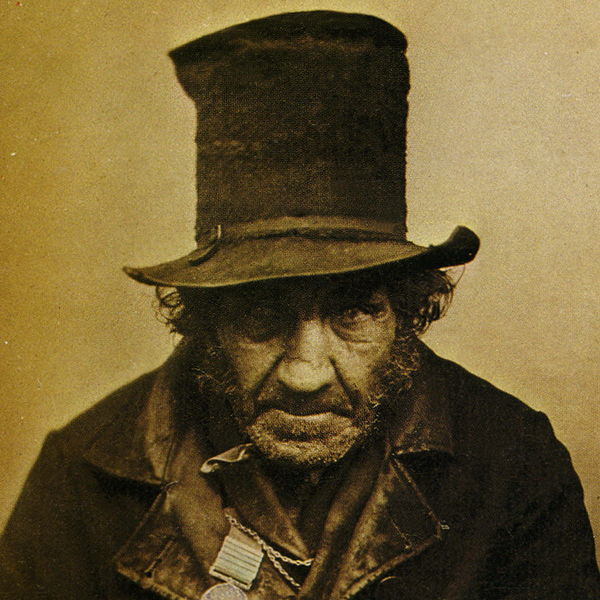
"No kooks please."
Biggest Bra in Brooklyn (metro nyc)
Seeing if there is an audience of unattached quality ladies intrested in winning the largest bra size in Brooklyn.
Will advise by email details and if responce is viable. No kooks please ( I have to say that ladies.) Kindly indicate your size.
Thanks, Steve.
Before the trickle-down voodoo, the GOP cared about the working class.
Tags: Gerald Ford
Russell Harty visits Quentin Crisp’s filth-covered East Village dump in 1985.
At one point, Crisp comments that what makes New York City different is that it’s the only place where everyone talks to everyone. That may still be true for certain strips of Brooklyn, but it’s mostly a thing of the past otherwise. And it’s not just New Yorkers who have become so alienated from others–people who visit here from the rest of the country (and the rest of the world) seem even worse. We’ve always been tribal, but the tribe used to be more bound to geography and genuineness. No more. Now the virtual network of “friends” we accrue online is our tribe. The other self we create on social networks, which has only a glancing connection to the truth, is who we think we are. But it’s not real and we’re disconnected from ourselves and disenchanted with reality when it has the gall to encroach on our bubble. Things have gotten murky.
Tags: Quentin Crisp, Russell Harty

"The funds will be used to 'design, program, harden, and field-test the apps with bonobo testers and to connect them to robots.'" (Image by Ltshears.)
Giving a bonobo its own robot to control remotely isn’t, on the face if it, as dangerous as letting a kangaroo have an A-bomb, but I still have my concerns. Nonetheless, unless this is an early April fools joke, a new Kickstarter campaign wants to match primates and bots. From IEEE Spectrum:
“What Dr. Ken Schweller (a professor of computer science and psychology and chair of the Great Ape Trust) wants to do is develop a set of Internet-connected keyboards that the bonobos can carry around with them and use to communicate directly with humans. Humans, for their part, will be able to use an app that translates their speech directly to the symbols used by the bonobos, potentially opening up real-time two-way intelligent communication between you and another species.
RoboBonobo and Bonobo Chat are trying to raise $20,000 on Kickstarter; the funds will be used to ‘design, program, harden, and field-test the apps with bonobo testers and to connect them to robots and other external devices.’ That’s a little bit unspecific for such a large sum of money (although we do know that the robot in the picture above will be getting a total redesign), but at least the $500 level reward is pretty awesome: you get to have a live Skype chat session with a bonobo, completely safe from rampaging RoboBonobos with water cannons.”
Tags: Ken Schweller
Steve Mahan, a blind man, behind the wheel of a Google self-driving car. (Thanks Verge.)
Tags: Steve Mahan
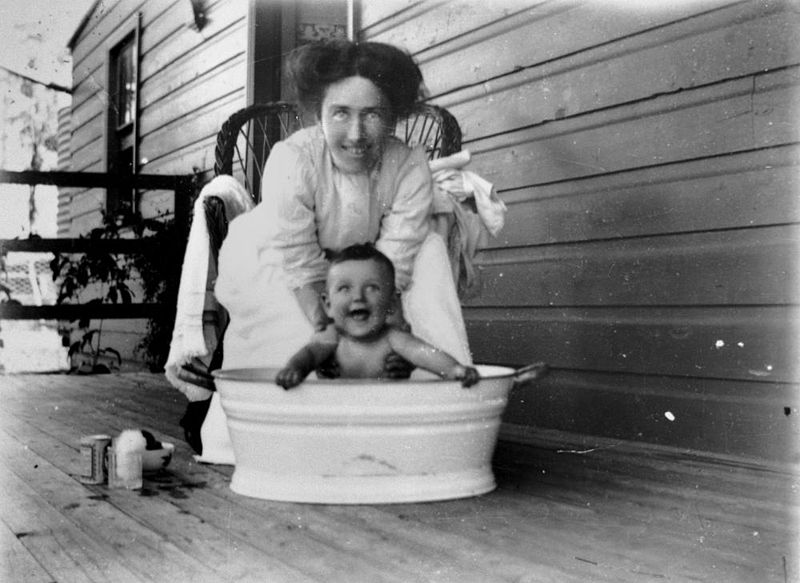
"The dog baby barks when it wants food."
A misbegotten Manhattan baby show was held, appropriately, at Midget Hall, in 1877. An amazing eyewitness account of the horror was published in the November 26 edition of the Brooklyn Daily Eagle. An excerpt:
“At ten o’clock this morning the great National Baby Show at Midget Hall, corner of Fourteenth Street and Fifth Avenue, New York, was opened. There are four hundred babies entered, and about half that number were in their places this morning. The show occupies two floors of the building, and around the sides of the rooms, on raised platforms, are the babies, with their mothers or nurses. At least one hundred and eighty of the two hundred babies spent the greater portion of the morning crying. The women vainly endeavored to pacify their youngsters, but it seemed as if there was a tacit understanding between the infants that they were not allowed themselves to be bulldozed. Nearly every child had a bottle of milk, and after they exhausted their power of suction and filled their infantile stomachs, they yelled. Dolls and other toys were thrown away on the babies, and many ladies endeavored to stop up the children’s throats by stuffing them with gum drops.
There will be distributed $1000 in prizes ranging from $10 to $150, the highest prize being given to the handsomest mother and child. The mothers, with the exception of two, are not handsome. There are many babies, children of rich New Yorkers, who are entered by their nurses. The majority of the mothers are German, and among the Germans there are a fair sprinkling of Hebrews. There are also Russian babies, Icelandic babies, Polish babies, Norwegian babies, English babies, Irish babies and one Chinese infant named Wee Boo. Many of the infants are positively hideous looking, yet their fond mothers think their offsprings the handsomest in the show. There is one baby that resembles a monkey and another with long ears and jaw, that is called the dog baby. The dog baby barks when it wants food.
Among the novelties are a set of quartets which are promised, but have not yet arrived, and a baby who attempted suicide. The suicidal youngster tried to drown himself in a bath tub. There is another baby that claims attention because it is said that baby was born ten minutes after its mother died. A two year old baby that swallowed a fork, laughed and crowed while it endeavored to bite off the end of its mother’s nose. An elfish looking baby, seventeen months old, is said to weigh less than six pounds, and its mother was proud of it. It was advertised that a baby thirteen months old, without hair or nails, would be exhibited, but the hairless youngster did not make its appearance today.”
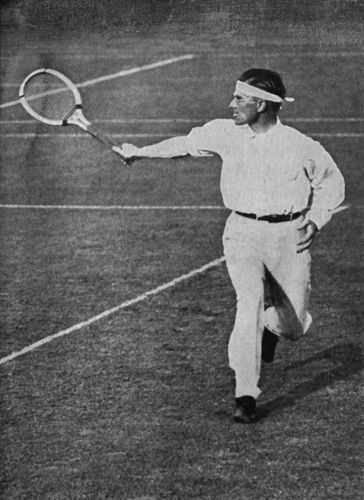
Two Titanic survivors, tennis pros Richard Williams and Karl Behr, met for a match in Boston several months after the disaster. In “Unsinkable,” L. Jon Wertheim’s excellent new Sports Illustrated story, the writer recalls their dramatic stories. An excerpt that imagines the shipwreck occurring in our media-drenched era:
“Imagine the Titanic sinking not in 1912 but in 2012. Passengers’ Twitter feeds and Facebook posts would describe the disaster in real time as they were rescued. Cable networks would provide round-the-clock coverage, complete with theme music, a catchphrase—Catastrophe at Sea!—and digital animation of the sinking. Morning shows would book survivors, literary and film agents would hustle story rights, class-action lawyers would troll for clients. Just see the media frenzy that followed the sinking of the Italian luxury cruise linerCosta Concordia earlier this year.
Now consider a scenario in which two of the survivors were dashing, world-class athletes in the same sport, destined to face off against each other many times. The hype surrounding those matches would be immeasurable. After their playing careers, the two men would be bracketed together—the Ralph Branca and Bobby Thomson of the sea—perhaps cowriting a book, then hitting the speaking circuit.
A century ago the culture was different. Look-at-me sensibilities were considered gauche. Many passengers lucky enough to have ended up on the Carpathia struggled with what today would be diagnosed as post–traumatic stress disorder. This was especially true for the men, whose survival was seen by some as evidence of cowardice. Ismay, the White Star director, was pilloried in the British newspapers. Ostracized by London society, he moved to Ireland and spent the remaining 25 years of his life out of the public eye.
Behr, according to family members, suffered profound survivor’s guilt. His granddaughter Helen Behr Sanford, known as Lynn, spent 10 years meticulously researching his story and recently published Starboard at Midnight, a fictionalized account of Behr’s experience on the Titanic. ‘He wished he had saved someone from the water so that at least an act of heroism could have resulted from his survival,’ she writes. ‘He was crushed by [an] inarticulate sadness beyond anyone’s understanding.'” (Thanks Browser.)
Tags: Karl Behr, L. Jon Wertheim, Richard Williams
Nicholas de Monchaux, who’s written a history of NASA spacesuits, proposes taking underutilized city-owned parcels, maximizing them and linking them.
Tags: Nicholas de Monchaux

"I don't find real doll owners to be weird or perverted." (Image by Wandadollgirl.)
Want to rent sex doll, real doll for photoshoot – $300
I’m a indie filmmaker and photographer hoping to rent a sex doll preferable a Real Doll for a day for a photoshoot. I assume most real doll owners would be hesitant to rent out something so expensive. The doll will be insured and the owner or whomever are more than welcome to be on set. Transportation will be provided. I can offer 300 dollars for the day, which is negotiable. Also there is nothing pornographic that will be taking place though there will be models interacting with the doll. Also I can find a way for something to be left in your possession as collateral. I understand that these dolls are extremely valuable and personal, which is the main reason this project is so interesting to me. I would like to add that I don’t find real doll owners to be weird or perverted.

I love Ray Kurzweil, but let’s say that he is a glass-half-full kind of futurist. Naturally, he’s drawn to the promise of Evacuated Tube Transport Technolgy (ET3), car-sized passenger capsules that travel via tubes. Space travel here on Earth! Someday, perhaps. From Kurzweil:
“The Evacuated Tube Transport (ETT) system (U.S. Patent 5950543, assigned to ET3.com, Inc.) would take passengers from New York to Beijing in just two hours. Advocates of Evacuated Tube Transport (ETT) claim it is silent, cheaper than planes, trains, or cars and faster than jets.
How it would work: put a superconducting maglev train in evacuated tubes, then accelerate using linear electric motors until the design velocity is attained. Passive superconductors allow the capsules to float in the tube, while eddy currents induced in conducting materials drive the capsules. Efficiency of such a system would be high, as the electric energy required to accelerate a capsule could largely be recaptured as it slows.”

••••••••••
ET3 promotional video:
Tags: Ray Kurzweil