Leaps 30 feet without sustaining damage. From Boston Dynamics.
You are currently browsing the archive for the Urban Studies category.

At the Browser, John Gray decries the idea of Utopia, which was considered extremist in the days of George Ripley’s failed Brook Farm experiment, but has become more centrist in our age, resulting in tortured nation-building experiments in the Middle East. An excerpt:
“Q: If utopias are unreachable – you could say that in Thomas More’s 1516 book Utopia, which coined the term, that’s the whole point – why does that make the striving for them pernicious?
John Gray: There are those who say that utopian projects, while they can never be achieved, are valuable because they spur human advance. That’s not my view. My view is that the attempt to achieve the impossible very often – if not always – has huge costs. Even if a project has good intent, its colossal cost always outweighs its reasonability, as we saw inIraq. What is distinctive about utopianism at the end of the 20th century and start of the 21st is that it has become centrist. In other words, for the first half of the 20th century utopianism was extremist, but now we have the utopian idea of building democracy inLibya or Afghanistan. So the utopian impulse – the impulse to achieve what rational thought tells us is impossible – has migrated to the centre of politics. That is connected with humanism and the idea of progress.”
Tags: John Gray
Russell Harty, who played a huge wanker on TV, interviewing Gary Numan on a plane.
Tags: Gary Numan, Russell Harty

Considering the Los Angeles Dodgers just sold to Magic Johnson’s ownership group for approximately $2.15 billion, I reiterate my question about Forbes’ sports franchise valuations (and most likely all their company valuations). I understand Magic and co. overpaid, but the numbers aren’t even close.
Tags: Magic Johnson

"He pleaded that the authorities refrain from shearing his locks."
A Rasputin-like figure from the 19th century, Francis Schlatter, a cobbler who turned to faith healing, was rumored to have retired and/or died in 1896 or so. But the Brooklyn Daily Eagle subsequently ran an assortment of stories about him–or others purporting to be him. At some point, it seems he became more idea than flesh, “appearing” in cities all over America. The following are a few pieces about those strange years.
••••••••••
“Schlatter on a Wheel” (July 15, 1896): “Guthrie, Okla.–A man claiming to be Schlatter, the healer, from Denver, rode into town yesterday on a bicycle and is creating a sensation. He was dressed in a trailing gown of black and wore a curling beard and long, flowing hair. As soon as his identity became known a great crowd gathered about the man and since then hundreds of people have constantly dogged his footsteps. Last night he addressed an immense throng, laying on hands to heal people and blessing hundreds of handkerchiefs.”
••••••••••
“Schlatter the Healer” (August 19, 1897): “Pittsburgh, Pa.–Late last night it was positively announced that Mrs. Margaret Ferris, widow of the builder of the Chicago wheel, had been married in Pittsburgh to Francis Schlatter, healer, of Canton. The ceremony was performed by Rev. Mr. Ward, pastor of St. Peter’s Episcopal Church. Mr. and Mrs. Schlatter are now at a downtown hotel.”
••••••••••
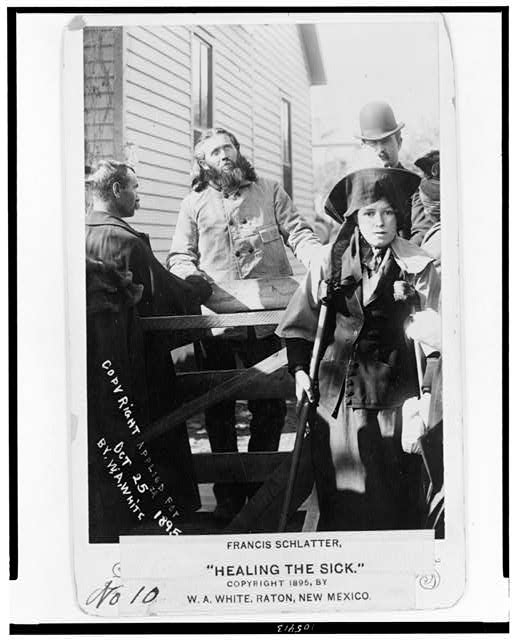
"He would recite an inarticulate prayer."
“Schlatter the Healer” (January 10, 1899): “Lynbrook, L.I.–A tramp, who resembles Schlatter, the healer, and who is evidently deranged, applied for lodging at the Rudd Farm, East Rockaway, and was permitted to sleep in the coachman’s room. He spent a week in fasting and prayer and was only seen to leave his room once in all that time. He refuses all food and it is supposed that he is preparing by fasting and prayer for forty days to resume the work of preaching and healing. He seems younger than Schlatter and his features strikingly resemble those of Christ as depicted by modern artists. Although evidently a cultured and scholarly man he refuses to talk and is apparently anxious to conceal his identity.”
••••••••••
“Small Audience Attracted” (January 30, 1899): “Brooklyn–Before an audience of about two hundred spectators, the Rev. Charles McLean, M.D., who claims to be the original Schlatter, the divine healer in a resurrected form, gave an exhibition of his healing powers. The meeting was held at the Antheneum, Atlantic Avenue and Clinton Street. Among the two hundred were those afflicted with every ill flesh is heir to. Some hobbled up as early as 7 o’clock. although it was after 8 o’clock before the alleged healer began to talk. Others were led, and about the whole crowd was an air of tragic expectation. About thirty came up on the front seats to be treated when the call was made for subjects. The healer rejected all but ten, after a hurried questioning as to the nature of their ills. He explained that he did work where he felt called and those subjects not treated must report at future meetings. One by one as rapidly as he could apply his method these ten were led up to the stage and were seated in a chair with back to the audience. For a minute the hands of the healer would be pressed over their foreheads. At the same time he would recite an inarticulate prayer. Then he would interview his subject as to the result of the treatment and announce the decision.”
••••••••••
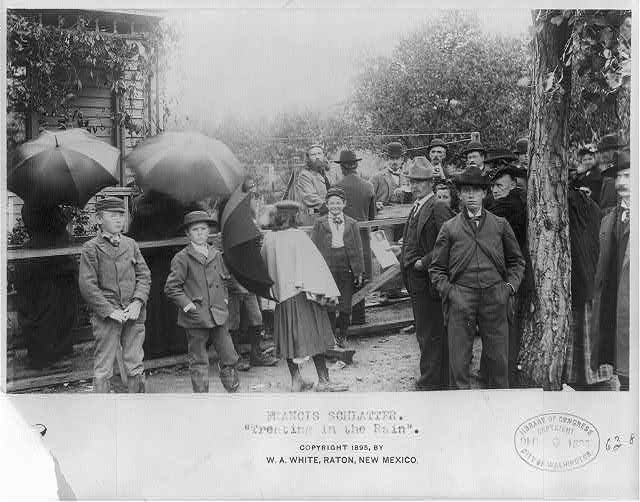
"About the whole crowd was an air of tragic expectation."
“Divine Healer” (July 21, 1901): “Washington–Francis Schlatter, the so-called ‘divine healer,’ was tried in the police court to-day as a vagrant and fined $10 or thirty days in the workhouse.
As he returned to the cells he pleaded that the workhouse authorities refrain from shearing his locks. Schlatter stated to the court that he had come here to get his wife, who had deserted him to approve the sale of some English property. Becoming discouraged, he had commenced to drink. A policeman testified that he found Schlatter surrounded by a boisterous crowd and that he admitted having been on a ‘drunk’ since July 3.”
••••••••••
“Schlatter Sent to the Island” (August 25, 1901): “Manhattan–Francis Schlatter, who calls himself ‘the divine healer,’ was sentenced to three months in the workhouse on the Island yesterday by Magistrate Zeller, in the Harlem police court. Mrs. Elizabeth Muller, the janitress of the house at 44 Bradhurst Avenue, where Schlatter’s wife had been living since she quarreled with and left him, was the complaintant against the prisoner. The healer’s wife left the house a few days ago, and Mrs. Muller charged that he constantly annoyed all the tenants in the house, persisting in visiting the rooms to see his wife. On each of these visits, the complaintant said, Schlatter was in an intoxicated condition, bordering on delerium tremens.
When the sentence of three months was pronounced Schlatter said that he did not care, as he had powerful friends who would have him set free. Among these he named President McKinley.”•
Tags: Francis Schlatter, Magistrate Zeller, Mrs. Elizabeth Muller, Mrs. Margaret Ferris, President McKinley, Rev. Charles McLean, Rev. Mr. Ward
Susan Sontag and Philip Johnson talk about the Seagram Building from the inside. Johnson designed the structure with Mies van der Rohe.
See also:
Tags: Agnes Varda, Mies van der Rohe, Philip Johnson, Susan Sontag

In the technologically simpler era of a hoaxer like Clifford Irving (here and here), perhaps there was some slim chance a public fraud could get away his scheme, or at least he could live well for a good, long time before his deceit undid him. But in our age of extreme connectivity and data trails, there’s no way someone can misrepresent themselves for too long. So why do people continue to perpetrate doomed hoaxes? Pathological behavior, I would assume. But more troublingly: Why do some others continue to cling to a faker’s veracity after the truth has become apparent, as if surrendering on one issue will topple their entire belief system?
From Gene Maddeus’ LA Weekly story about a drug dealer who feigned being a billionaire intent on purchasing the Los Angeles Dodgers:
“At this point, Dodger fans are desperate to be told two things: That the McCourt era is over, and that the team will win again. Unfortunately, nobody can say those things.
McCourt seems to have every intention of hanging on to the Dodger Stadium parking lots. That would force the new owner into an awkward partnership with the most hated man in Los Angeles.
As for winning, no one can make any promises about that, either — at least not while the bankruptcy sale is pending. The auction is a secret process, and the bidders making a play for the team have signed nondisclosure agreements. Though there have been plenty of leaks, no one is permitted to speak directly to the fans.
No one, except Josh Macciello.
Because, as it turns out, Macciello was never a real contender for the team. He is, instead, a fraud. Despite what he’s told reporter after reporter, and despite what those journalists have dutifully repeated, he does not have billions of dollars. He does not have rights to any gold mines. He is, instead, a convicted drug dealer and a huckster who has used his talents to persuade many people — not just journalists — to place their confidence in him. In his wake he has left a string of abandoned projects and broken promises.
The Dodger play is his boldest stunt so far. And, judged strictly as a bid for attention, it was a fantastic success. Reporters and fans ate up the tale of the regular guy who wanted to buy the team. Never mind the gaping holes in that narrative: At the end of the day, it was a great story.
Macciello is such a charismatic force that people continue to believe in him, even when confronted with evidence of his deceit. Provided with some of that information, his publicist, Cindy Rakowitz, continues to stand up for him. ‘I really do believe he has the money somewhere, somehow, some way,’ she says. ‘I want to believe.'”
•••••••••••
“All his life he was a million-to-one shot”:
Tags: Cindy Rakowitz, Gene Maddeus, Josh Macciello

"I am very fertile." (Image by Schmitt.)
selling my eggs – $3000 (bronx, ny)
yes u saw right im selling my eggs. i am very fertile ive had 3 pregnancys all twins. i only kept one pregnancy and they were 2 boys one has blone hair green eyes and the other one has blue eyes light brown hair. i am a very strong willed person, outgoing and smart. i will carry if wanted but that would be 30,000 because i would not be able to work because i become sick during pregnancy. if interested or know someone who is having trouble having children contact me and only serious people please i dont want no jokes sent to my email i am trying to help someone become a mom a enjoy her future child.
Fast food, in miniature. From Japan, of course.

Factories already use robots that can repair themselves, and we aren’t too far from self-healing materials. From Popsci:
“Self-healing materials will eventually fix anything from cell phone screens to car fenders, enabling surfaces to heal on their own in the presence of different types of light. But none of the earlier prototypes we’ve seen work quite like this new plastic: It bleeds red at the site of injury. Then it heals itself, inspired by the properties of tree trunks and human skin.
Marek W. Urban from the University of Southern Mississippi presented a paper on his new co-polymer at the American Chemical Society’s national meeting in San Diego Monday. When it scratches or tears, a red splotch forms around the ‘wound,’ marking the site.”
Tags: Marek W. Urban

A book that was seemingly written specifically for me (and anyone else who spends way too much time thinking about airports), Aerotropolis: The Way We’ll Live Next, by John Kasarda and Greg Lindsay, predicts that airport-centric insta-cities will be the next wave. Probably not going to happen outside of a few autocratic states, but it’s still a fun thought project. From the introduction of an interview with Lindsay at BLDG:
“If Atlanta’s Hartsfield-Jackson International Airport were to become its own country, its annual workforce and user base would make it ‘the twelfth most populous nation on Earth,’ as John Kasarda and Greg Lindsay explain in Aerotropolis; even today, it is the largest employer in the state of Georgia.
As J.G. Ballard once wrote, and as is quoted on the frontispiece of Aerotropolis:
I suspect that the airport will be the true city of the 21st century. The great airports are already the suburbs of an invisible world capital, a virtual metropolis whose fauborgs are named Heathrow, Kennedy, Charles de Gaulle, Nagoya, a centripetal city whose population forever circles its notional center, and will never need to gain access to its dark heart.
The remarkable claims of John Kasarda’s and Greg Lindsay’s new book are made evident by its subtitle: the aerotropolis, or airport-city, is nothing less than ‘the way we’ll live next.’ It is a new kind of human settlement, they suggest, one that ‘represents the logic of globalization made flesh in the form of cities.’ Through a kind of spatial transubstantiation, the aerotropolis turns abstract economic flows—disembodied currents of raw capital—into the shining city form of tomorrow.
The world of the aerotropolis is a world of instant cities—urbanization-on-demand—where nations like China and Saudi Arabia can simply ‘roll out cities’ one after the other. ‘Each will be built faster, better, and more cheaply than the ones that came before,’ Aerotropolis suggests: whole cities created by the warehousing demands of international shipping firms. In fact, they are “cities that shipping and handling built,’ Lindsay and Kasarda quip—urbanism in the age of Amazon Prime.”
_________________
Tags: Greg Lindsay, J.G. Ballard, John Kasarda
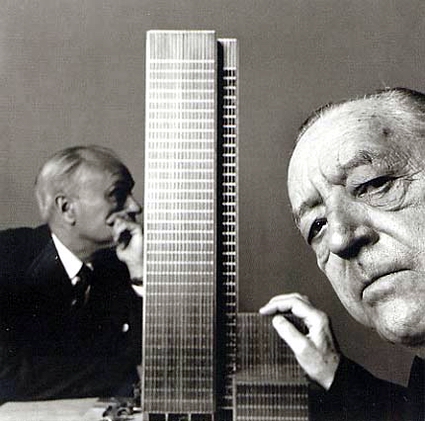
Mies van der Rohe, who was born 125 years ago today, put God in the details of his spare, glassy, flat-roofed buildings and striking furniture. From his 1969 New York Times obituary:
“Ludwig Mies van der Rohe, a man without any academic architectural training, was one of the great artist-architect-philosophers of his age, acclaimed as a genius for his uncompromisingly spare design, his fastidiousness and his innovations.
Along with Frank Lloyd Wright and Le Corbusier, the German-born master builder who was universally know as Mies (pronounced mees) fashioned scores of imposing structures expressing the spirit of the industrial 20th century.
‘Architecture is the will of an epoch translated into space,’ he remarked in a talkative moment. Pressed to explain his own role as a model for others–a matter on which he was shy, as he was on most others–he said:
‘I have tried to make an architecture for a technological society. I have wanted to keep everything reasonable and clear–to have an architecture that anybody can do.'”
••••••••••
Lego version of the Farnsworth House:
Tags: Mies van der Rohe
Orson Welles, sometimes drunk and shaky and sometimes sober and brilliant, in his 1978 documentary, Filming Othello.
Tags: Orson Welles

From the March 31, 1890 edition of the Brooklyn Daily Eagle:
“Last Monday, Lewis Johnson, living on Butler Street, east of Buffalo Avenue, was digging near an old graveyard, when he unearthed a skeleton. He took it home for several days and kept it to show to friends. This morning, tiring of his possession, Lewis gave it to the police. Coroner Rooney will make an investigation.”
Tags: Coroner Rooney, Lewis Johnson

Much like Dick Cheney, the comedian Gallagher is an asshole with a bad heart. (Correction: Cheney was an asshole with a bad heart. He just had a heart transplant. Congratulations, you asshole!) No one should waste a moment of life writing a great article about a bigoted prop comic with a vicious streak, but that’s what Alex Pappademas did for Grantland. An excerpt from Gallagher Retires, Sort Of:
“He got bitterer as time went on. As with [George] Carlin, there was always some trigger-hippie rage boiling in Gallagher’s eyes; unlike Carlin, Gallagher never got a Mark Twain Prize, wrote bestsellers, or saved the universe using a time-traveling phone booth. Former standup comedians who went on to become huge stars despite not being good at standup comedy, according to a 2005 interview with Gallagher: David Letterman, Robin Williams, Tom Hanks, Chevy Chase, Michael Keaton (‘a terrible comedian’), Jim Carrey (’embarrassing.’)
‘It amazes me,’ he fumed, ‘that these comedians have serious acting careers.’
In his later years, when he wasn’t smashing fruit onstage, he was spraying bile—railing against gays, transsexuals, Mexicans, opponents of torture, people with tattoos, and the French, and spewing Arab jokes your most right-wing relative might have thought twice about mass-emailing even on the morning of 9/12/01. Most written accounts suggest that your average 21st-century Gallagher show played not unlike the way Wikipedia describes his 1992 laserdisc-based live-action shooting game, Gallagher’s Gallery: ‘Generally, the items that Gallagher deems broken or unnecessary, or those he simply dislikes, must be targeted.’ Reviewing a 2010 Gallagher performance in Bremerton, Washington for the Stranger, Lindy West described him spitting out the word Obama ‘like a mouthful of burning hair’ before impugning both Obama’s blackness and his loyalty to this country.”
••••••••••
Gallagher’s Gallery video game:
Tags: Alex Pappademas, Gallagher
Google, if this were the 1980s.

In the 1960s, NASA spacesuits were iconic for their fashion-forward look, but their main goal was to be a life-sustaining garment. From an excellent interview at BLDG with Nicholas de Monchaux about his book, Spacesuit: Fashioning Apollo:
“De Monchaux: One of the things I find most fascinating about the idea of the spacesuit is that space is actually a very complex and subtle idea. On the one hand, there is space as an environment outside of the earthly realm, which is inherently hostile to human occupation—and it was actually John Milton who first coined the term space in that context.
On the other hand, you have the space of the architect—and the space of outer space is actually the opposite of the space of the architect, because it is a space that humans cannot actually encounter without dying, and so must enter exclusively through a dependence on technological mediation.
Whether it’s the early French balloonists bringing capsules of breathable air with them or it’s the Mongolfier brothers trying to burn sheep dung to keep their vital airs alive in the early days of ballooning, up to the present day, space is actually defined as an environment to which we cannot be suited—that is to say, fit. Just like a business suit suits you to have a business meeting with a banker, a spacesuit suits you to enter this environment that is otherwise inhospitable to human occupation.
From that—the idea of suiting—you also get to the idea of fashion. Of course, this notion of the suited astronaut is an iconic and heroic figure, but there is actually some irony in that.
For instance, the word cyborg originated in the Apollo program, in a proposal by a psycho-pharmacologist and a cybernetic mathematician who conceived of this notion that the body itself could be, in their words, reengineered for space. They regarded the prospect of taking an earthly atmosphere with you into space, inside a capsule or a spacesuit, as very cumbersome and not befitting what they called the evolutionary progress of our triumphal entry into the inhospitable realm of outer space. The idea of the cyborg, then, is the apotheosis of certain utopian and dystopian ideas about the body and its transformation by technology, and it has its origins very much in the Apollo program.
But then the actual spacesuit—this 21-layered messy assemblage made by a bra company, using hand-stitched couture techniques—is kind of an anti-hero. It’s much more embarrassing, of course—it’s made by people who make women’s underwear—but, then, it’s also much more urbane. It’s a complex, multilayered assemblage that actually recapitulates the messy logic of our own bodies, rather than present us with the singular ideal of a cyborg or the hard, one-piece, military-industrial suits against which the Playtex suit was always competing.
The spacesuit, in the end, is an object that crystallizes a lot of ideas about who we are and what the nature of the human body may be—but, then, crucially, it’s also an object in which many centuries of ideas about the relationship of our bodies to technology are reflected.”
•••••••••••
The EX-1A offered great mobility, 1960s:
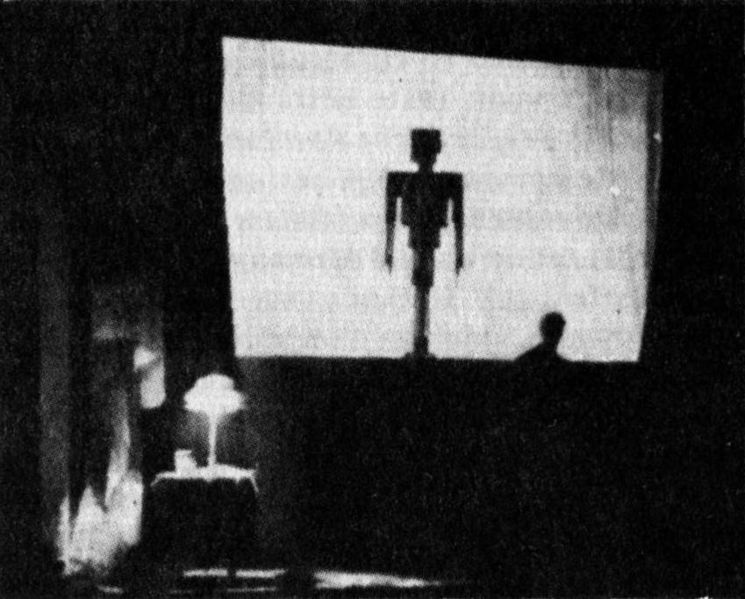
George Dyson at Edge discussing our digital revolution, still very much in its infancy, going who knows where:
“We’re still here at the big bang of this thing, and we’re not studying it enough. Who’s the cosmologist really looking at this in terms of what it might become in 10,000 years? What’s it going to be in 100 years? Here we are at the very beginning and we just may simply not be asking the right questions about what’s going on. Try looking at it from the other side, not from our side as human beings. Scientists are the people who can do that kind of thing. You can look at viruses from the point of view of a virus, not from the point of view of someone getting sick.
Very few people are looking at this digital universe in an objective way. Danny Hillis is one of the few people who is. His comment, made exactly 30 years ago in 1982, was that “memory locations are just wires turned sideways in time”. That’s just so profound. That should be engraved on the wall. Because we don’t realize that there is this very different universe that does not have the same physics as our universe. It’s completely different physics. Yet, from the perspective of that universe, there is physics, and we have almost no physicists looking at it, as to what it’s like. And if we want to understand the sort of organisms that would evolve in that totally different universe, you have to understand the physics of the world in which they are in. It’s like looking for life on another planet. Danny has that perspective. Most people say just, ‘well, a wire is a wire. It’s not a memory location turned sideways in time.’ You have to have that sort of relativistic view of things.
We are still so close to the beginning of this explosion that we are still immersed in the initial fireball. Yet, in that short period of time, for instance, it was not long ago that to transfer money electronically you had to fill out paper forms on both ends and then wait a day for your money to be transferred. And, in a very few years, it’s a dozen years or so, most of the money in the world is moving electronically all the time.”
• • • • • • • • • •
George’s dad, Freeman, planning interplanetary travel via A-bomb, 1958:
Tags: Freeman Dyson, George Dyson

Some people are fascinated by post-apocalyptic culture, but they don’t really want the world to end. Not most of them anyhow, thankfully. The thought of people being harmed or killed of the engines of society actually falling to pieces are horrifying. So, what then is the fantasy of barren landscapes and streets that have no name? What is alluring about people-less avenues and ruined earth?
I think it stems less from survivalist urges than from creative frustration, from people imagining a blank slate and what they could do with it. Knocking down a sand castle to creat a new and better one, if you will. Now some people can’t separate fantasy and reality. The composer Karl Stockhausen infamously called 9/11 the “greatest work of art.” Let’s hope that was the result of senility. Disaster movies were criticized at the time because they were supposedly providing a blueprint for terrorists. While the images we create can certainly influence others, I think it’s good we’ve continued to create art about our fantasies, even our dark ones. Nothing is as dangerous as a repressed society.
In a New York Times Opinion piece Bill Clegg links his own urges to witness disaster–the real kind, unfortunately–to his gradual descent into one of his own making. The opening:
“MY college roommates and I chased firetrucks.
We’d hear the sirens wail, hop in the car and tear off in the direction of the sound with the windows open, no matter how cold. We lived in a small town on the Eastern Shore of Maryland and there were many rickety old wooden buildings prime for fire, so there was always something going up in flames. Most of the time we’d chase the receding sound, sniff for smoke as we passed a joint between us, scan the side streets for signs of catastrophe and after a while call it quits and go home.
Once, just once that I can remember, we saw the kind of fire we’d been after. An old many-shuttered thing with flames licking from every inch. We pulled up seconds after the firetrucks. We got out of the car and from across the street felt great waves of heat coming off the place. It popped and cracked and roared out of control and we stood, mesmerized.
A ballet of sparks in the air made magic above the chaos. People were everywhere, standing around watching the roof collapse and the tops of nearby trees catch fire. No one spoke. We stayed for hours. Each time we moved away some part of the house threatened to collapse; we knew we were stuck, that we had somehow contracted to see it through to the very end, until the last charred beam had fallen and all that was left was a smoldering, ashy ruin.”
Tags: Bill Clegg
Russell Harty, who in British parlance was a “world-class prat,” interviews David Bowie via TV remote in 1975. Harty was in Britain while Bowie was in Los Angeles, having just shot The Man Who Fell To Earth. Nobody was more meant to be a disembodied head on a television screen than Bowie. He was the original Max Headroom.
Tags: David Bowie, Russell Harty

"Two tabs."
on acid anyone wanna chat (Upper West Side)
so i just took two tabs of acid and was bored so if anyone wants to chat im here
The Hillary Clinton portion of the famous campaign appearance that Bubba made with Arsenio Hall in 1992, when the future President played sax.
I think if you look at their first terms side by side, President Obama has been a far more sure-handed leader than Bill Clinton with far fewer miscues–and during a much more challenging time. Hillary herself, as Secretary of State, has been more commanding than her husband was in foreign affairs. But during this appearance, she was in a supporting role.
I often think of how different relations between the sexes would be in America if at this point in our nation’s history roughly half the Presidents had been men and half women. Men are from Mars and women are from Venus, I know, but I don’t think the disconnect is merely because of some celestial difference. I think when you live in an unequal society, things become weird for all involved.
Tags: Arsenio Hall, Bill Clinton, Hillary Clinton

Shaun Randol of the L.A. Review of Books writing about the numbing intersection of warfare and software:
“As Paul Virilio has noted, with the filming of the 1990-91 Gulf War, most notably by CNN, the American public was encouraged to see war as a technological process and a media event. The ubiquitous green and grainy images of anti-aircraft fire over Baghdad, or black-and-white videos of missiles slamming into boxy structures from projectile-mounted cameras were so bereft of the realities of warfare — blood, guts, screams, and mangled bodies — that they were shown in prime-time news broadcasts. Much of the public enthusiastically embraced this antiseptic projection of war. Now, many soldiers and their civilian leaders see war through the same technological lens.
American military training and planning increasingly uses video games and virtual reality (for pre-deployment and decompressing) and autonomous robots (for actual fighting). Peter Finn surmises that ‘the successful exercise in autonomous robotics could presage the future of the American way of war: a day when drones hunt, identify and kill the enemy based on calculations made by software, not decisions made by humans.’ Peter W. Singer of the Brookings Institution has written extensively on how the increase in military research into robots, be it nanotechnology or outsized pilotless aircraft that can — theoretically — stay adrift indefinitely, indicates the direction of the U.S.’s fighting strategy.”
Tags: Paul Virilio, Peter W. Singer, Shaun Randol

From the November 15, 1877 Brooklyn Daily Eagle:
“Coroner Carroll, of Newtown, was called to the hotel of Christian F. Siebs, at Middle Village, on Monday, to hold and inquest on the body of an unknown man. Mr. Siebs testified that at ten o’clock on Sunday night he heard a noise outside of his house, and calling two men, they procured a lamp and went out. They found the man on the road in a comatose state, and unable to stand. His clothes were very wet. They carried him into the house, replaced the wet clothes with dry ones and they carried him to the barn, laid him on some hay and covered him with some blankets and robes. Next morning he was dead. He was apparently an Italian, about thirty-five years old. The jury found that he had died ‘from congestion of the brain caused by excessive use of alcoholic liquors.””

Didn’t realize until spying The Electric Typewriter that “The Taste Makers,” Raffi Khatchadourian’s excellent 2009 New Yorker article about the clandestine food flavor industry, is online for free. A brief excerpt:
“Flavor is a cognitive figment. The brain fuses into a single experience the results of different stimuli registered by the tongue, nose, eyes, and ears, in addition to memories of previously consumed meals. For reasons that are not fully understood, we perceive flavor as occurring in our mouths, and that illusion is nearly unshakable, as is made clear by our difficulty identifying, with any reasonable specificity, the way each of our various senses contributes to the experience. In 2006, Jelly Belly, the candy manufacturer, produced a jellybean that mimicked the flavor of an ice-cream sandwich. When the company manufactured a prototype with a brown exterior and a white interior, people identified the flavor accurately during a trial, and said that it was a good representation of an ice-cream sandwich. Jelly Belly then made an all-white prototype; many trial respondents found it confusing, misidentifying its flavor as vanilla or marshmallow. As Hagen told me, ‘Color can play tricks on your mind, for sure.'”
••••••••••
Inside the Jelly Belly factory:
Tags: Raffi Khatchadourian