Urban Studies

You are currently browsing the archive for the Urban Studies category.

"Around the pupils of the eyes are the twenty-six letters of the alphabet."

Total bullshit delivered with conviction in the May 24, 1892 Brooklyn Daily Eagle:

Fort Worth, Tex.–A freak of nature has come to light in the county jail. His name is Jesse Lee, aged 18 years. Turn the boy’s face so that a string of light may shine into his eyes and a phenomenon is seen. Around the pupils of the eyes, in the iris, are the twenty-six letters of the alphabet, arranged symmetrically. There are letters in each eye, those up to M being in the left eye and the remaining ones in the right. Lee says his father and four brothers are similarly affected.”

Tags:

Calculator and computer legend Jack Tramiel just passed away. His name isn’t as well known as Jobs or Gates, but it should be recalled that his Commodore 64, which came to the market in 1982, was the Model T of home computing, introducing zeros and ones into home addresses. In this 1977 video, a host presents the Commodore PET, a gorgeous machine that was ahead of its time.

Commodore’s Mini-Slide Rule, 1973:

Tags:

I need ducks (Yorktown)

I have six ducks, four of them are males (drakes) and I need to get some more females. If you have any that you need to get rid of, please let me know? Thank you for your help. 

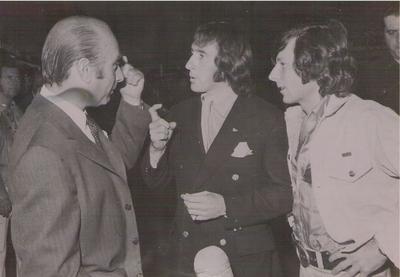
“The machine cannot lie,” said Leland Stanford, but racer Jackie Stewart knew that humans certainly could–especially to themselves–as he discusses his elaborate preparations for Monaco in 1972 with his good friend, yes, Roman Polanski.

Tags: , ,

From a 1993 Technos article by that late Luddite Neil Postman, who worried over technology but knew its dominion would only increase:

“Let me begin, then, to make my case by telling you about a conversation I had with an automobile salesman who was trying to get me to buy a new Honda Accord. He pointed out that the car was equipped with cruise control, for which there was an additional charge. As is my custom in thinking about the value of technology, I asked him, ‘What is the problem to which cruise control is the answer?’ The question startled him, but he recovered enough to say, ‘It is the problem of keeping your foot on the gas.’ I told him I had been driving for 35 years and had never found that to be a problem. He then told me about the electric windows. ‘What is the problem,’ I asked, ‘to which electric windows are the answer?’ He was ready for me this time. With a confident smile, he said, ‘You don’t have to wind the windows up and down with your arm.’ I told him that this, too, had never been a problem, and that, in fact, I rather valued the exercise it gave me.

I bought the car anyway, because, as it turns out, you cannot get a Honda Accord without cruise control and electric windows—which brings up the first point I should like to mention. It is that, contrary to conventional wisdom, new technologies do not, by and large, increase people’s options but do just the opposite.”

Tags:

Charlotte Moorman models Nam June Paik’s “TV-Bra for Living Sculpture,” 1969.

Tags: ,

Life takes so much from us, sometimes a great deal all at once but usually through a series of small, excruciating thefts. Eventually, everything’s gone. Some people–they would be heroes if they were making decisions rather than acting compulsively–resist. An excerpt from an Ask Me Anything thread on Reddit, in which someone who assists hoarders accepts questions:

IaMa home assistant for compulsive hoarders AMA (self.IAmA)

submitted  ago by imwhiteontheinside

I cant tell you names or anything to specify the people I work/worked with, but other than that, ask away, 

[–]yawnoc 2 points  ago

What does it take to make you squirm? What was the worst house you’ve ever seen? 

[–]imwhiteontheinside[S] 1 point  ago

It takes a lot to make me squirm and surprisingly most of the homes I have go e into haven’t been “dirty” they have a TREMENDOUS amount of things in them but most things like food and perishables are thrown away.

One house I helped with actually didn’t throw away anything and that was definitely the worst. She had used feminine napkins in bags. I never got to ask her why she kept those she was already incredibly embarrassed about everything else.

Of course with all these homes most people know they have a problem and just feel overwhelmed to do anyhing about it but this woman definitely had something else going on. 

[–]sunnyfunny 2 points  ago

what is your feeling when doing your job?

[–]imwhiteontheinside[S] 1 point  ago

Most of the time I actually feel very frustrated. And so do the people I work with. Mainly because it takes hrs, weeks, years, to actually make a visual difference. We don’t just through stuff out I have to help them make the decision of gettin rid of their stuff and help them work through the loss of their stuff.

[–]crumb_buckets 3 points  ago

What’s the most interesting collection you have come across? 

[–]imwhiteontheinside[S] 2 points  ago

One woman was very very involved in arts and crafts so she would save everything she possibly could that he believed she could make a piece out of. So her house contained a lot of nick nacks she found and the art she built out of that

I really loved working with her because she knew where she found absolutely everything! She must have had millions of little things but knew about all of it.

[–]dizzystuff-folks 2 points  ago

Are there specific causes behind someone beginning to hoard?

[–]imwhiteontheinside[S] 2 points  ago

I have not done scientific research or anything but some people think its a form of OCD.

Regarding the people I have met, Every single one has lost a significant person in their life and that caused them to get worse and eventually need help.

Most already have hoarding tendencies but then have a loss and start to try and fill the void with stuff.”

Your computer and phone can be hacked, but what about your heart? If coders can get inside our equipment and more equipment is inside our bodies and brains, why can’t we be invaded on a more personal level? We can. And what about when self-driving cars and the Internet of Things reach critical mass? Could terrorists–or bored teenagers–program us all to turn left when there is no left turn to be made? Can they make our tools become weapons? Of course. From Medical Daily:

“An increasing number of patients are being fitted with medical implants like pacemakers and insulin pumps that are vulnerable to cyber-attacks, according to security researchers.

Expert Barnaby Jack, a researcher at security firm McAfee, discovered that the wireless links used in heart-regulating pacemakers, insulin-delivering pumps and cardiac rhythm-monitoring defibrillators that are used for interrogating and updating these devices left them opening exposed to hackers looking to gain remote control.

Jack told BBC that in just two weeks he found a way to scan for and compromise insulin pumps that communicate wirelessly.  After overriding the pump’s safeguard, a hacker can threaten the lives of patients on the device by either turning off the device or by commanding wireless implants to deliver a hazardous dose of medicine to the patient.

‘We can influence any pump within a 300ft range,’ Jack told the BBC. ‘We can make that pump dispense its entire 300 unit reservoir of insulin and we can do that without requiring its ID number.'”

Tags:

"An able-bodied boa constrictor does not smell like peaches."

Cornering the snake market isn’t as easy as it looks. But one bold visionary sought to do just that, according to an article in the May 28, 1900 edition of the Brooklyn Daily Eagle, which was reprinted from the Philadelphia Bulletin. An excerpt:

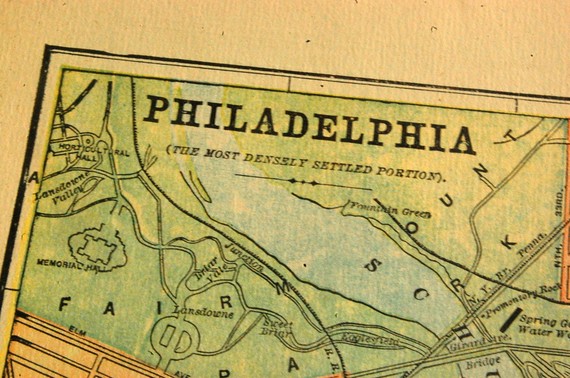
“Jacobus Hope of 29 North Ninth Street is the president, vice president, secretary and treasurer of the snake trust. Mr. Hope has cornered the market. Snakes labeled ‘Jacobus Hope, Philadelphia, Pa.,’ are coming this way from all quarters of the globe by rail, by steamer, on horseback and on foot. Like Joe Leiter of Chicago, who cornered the wheat market. Mr. Hope means to have the snakes actually in his possession. The snake hunters of India have been snaking day and night to fill the orders of Jacobus Hope, Philadelphia.

‘Send every python you can lay your hand on,’ were the cabled instructions of Mr. Hope, and as a result India’s supply of pythons and anacondas is well nigh exhausted.

India, it is reported, had a cold spell, which gave the snake crop a setback from which it will take a year to recover. Several hundred yards of snakes are expected from India any day now. All snakes sell by the yard. The regular price of a python up to ten feet is $2.50. Beyond that length the price grows abruptly steeper. A twenty-foot python is worth about $300.
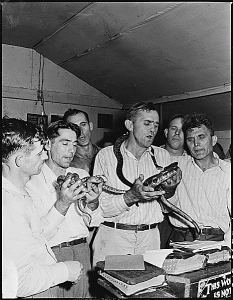
"All snakes sell by the yard."

Boa constrictors from South America are headed this way. They come in boxes that look like giants’ coffins. The baggage man will be in doubt as to the nature of his baggage, as an able-bodied boa constrictor does not smell like peaches.

Thousands of dollars’ worth of the boa constrictors will soon be in the city. Texas is rushing east hog snakes, whip snakes and thunder snakes. A few barrels of blue racers, chicken snakes, bull snakes and milk snakes are coming from New Mexico, while Arizona will be able to spare several crates of ribbon snakes, black snakes and adders, not to mention a Gila monster or so.

In answer to Mr. Hope’s cry for snakes and scorpions, Philadelphia promises to be the greatest snake center of the world, herself having a supply of snakes, big and little, that has never been equaled. As soon as the weather moderates, the busy little Jerseyite, with his stout canvas bag, will go snaking. Pine snakes are the Jerseyite’s specialities. These snakes sell at retail at so much a foot. They grow to a length of five feet.

"Philadelphia promises to be the greatest snake center of the world."

‘Never,’ said Mr. Hope, ‘has there been such a demand for snakes. I have orders from Maine to California, and never, it seems to me, have they been so scarce. The zoological gardens and museums are wanting new snakes. The small tent shows, of which there are more than 250 in the United States, are getting ready to start out. Each of these shows carries from ten to twenty snakes, and the proprietors all want their orders filled immediately. I am rushing the snakes on as fast as possible, but,’ concluded Mr. Hope pathetically, ‘I can’t make snakes.’

Any man who has snakes can now dispose of them at famine prices.”
 

Tags:

"Very stained." (Image by andaluztapatio.)

free stained couch (flatbush)

3 seater pullout couch, free, very stained with dogs period blood, gross i know but its free and with a little DIY spirit it can surely be revived yet again.

6th floor elevator.

peace.

Stunt cyclist Evel Knievel, destined for amazing fame but just an opening act at this point, makes his debut on Wide World of Sports in 1967.

Tags:

"Radicalism should abandon the mode of activism, and adopt a passive mode." (Image by Mary Ellen Mark.)

There may be a system better than regulated capitalism, but what is it? The marketplace can be a beast, but how else can we share wealth, both of information and materially? The system is corrupting and we must resist it to some extent even as we participate in it, but other alternatives are far worse. From Malcolm Harris’s writings on The State about anti-capitalist scholar Franco Berardi, who advocates the dubious strategy of resistance through lethargy:

“Of the anti-capitalist scholars and intellectuals who prescribe a political program, Franco Berardi might have the most counter-intuitive ideas. In his many articles, books, and lectures, Berardi pushes a curious line against a mind-warping market culture. During the current period of youth-led urban unrest, Berardi has consistently preached a resistance strategy that emulates the process of aging. While capital says go faster, make more, consume more, his call for ‘senilization’ says slow down, work less, consume less. Berardi wants a detox from capitalism’s psyche-damaging relations, and it’s not just a metaphor. Put down the Adderall, roll a joint. Relax.

In a new formulation he calls ‘post-futurism,’ Berardi poses the Futurist fetishization of muscular youth against ‘the force of exhaustion, of facing the inevitable with grace, discovering the sensuous slowness of those who do not expect any more from life than wisdom.’ We have enough things, he writes; what we really want is more time in which to flourish. In his heterodoxy, Berardi has broken one of the cardinal rules of Marxism: revolution as the necessary mode of social transformation. ‘Radicalism,’ he writes, ‘should abandon the mode of activism, and adopt a passive mode.’ Fewer marches, more mahjong.”

Tags: ,

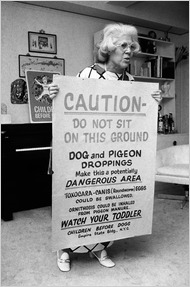
Difficult to believe that it’s only since 1978 that NYC dog owners have been legally required to clean up after their pets. Before then, canines were free to crap all over the sidewalk and street. Poop everywhere. We were seriously that unsophisticated and unhygenic that recently. What disgusting things are we brainlessly doing now that should really stop?

In 1972, so-called Pooper-Scooper Law lady Fran Lee took to the airwaves to point out that we were huge slobs. She was a little batty, but she was right. Good on her. Gil Noble, the pioneering African-American TV journalist who recently passed away, held on for dear life while conducting the interview.

Fran Lee died in 2010 at age 99. From her New York Times obituary: Though Ms. Lee was best known for her work on dog effluence (in 1972, The New York Times called her ‘New York’s foremost fighter against dog dirt’), she had been a crackling presence on city and national airwaves long before then.

On a string of programs and under a series of names – Mrs. Fix-It, Mrs. Consumer, Granny Franny – Ms. Lee advised radio and television audiences on household and consumer issues from the late 1940s until well into the ’90s. Her purview ranged from cyclamates to asbestos to how to make a candle from a sausage. (Add a wick and light; the pervasive fat does the rest.)

In the late 1960s and early ’70s Ms. Lee was seen regularly on two New York stations, Channel 5 (then WNEW) and Channel 11 (WPIX). She was also a frequent guest on many national programs, including The Tonight Show, The Mike Douglas Show and The Steve Allen Show, where she once taught Mr. Allen to transform a worn-out sweater into a bikini.”

Tags: ,

It is no longer Chinatown, Jake, so you needn’t forget it. But still you often do.

There was a time in America of Manchurian Candidates, Warren Commissions and Parallax Views, when the facts were tantalizingly, frustratingly beyond our reach. What schemes were being hatched beneath the surface, what cabal was making secret plans? These people had more information than we did, access we could only dream of. They always seemed one step ahead. Even if we learned what deal was, that knowledge would soon retreat into a welter of confusion. The innocence would end and then begin again. The status quo would be restored.

But technology changed all that. Or was supposed to. Now there’s a diffuse media and data trails. Things have never been clearer.

And, yet. What if everything is transparent, what if it is all laid out for us to see and little changes? It doesn’t matter if we have access to the facts if we refuse the facts, if we choose to live inside a narrative. It doesn’t matter if we have unlimited channels if we only accept the ones that congratulate our prejudices. What if knowing isn’t enough? What if the problem all along hasn’t been a lack of information but a lack of some other kind?•

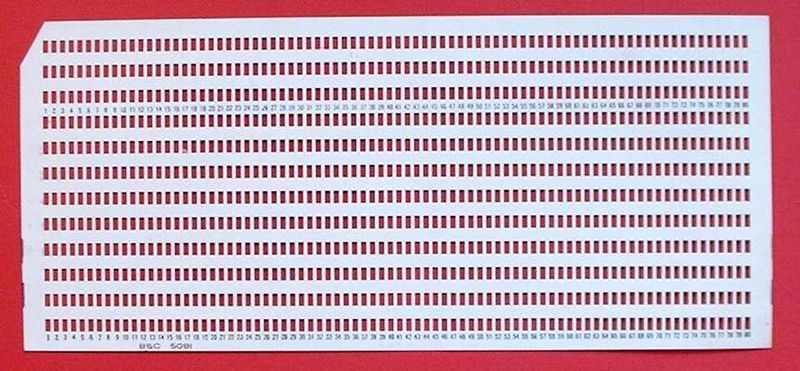
Our every effort today is, in fact, recorded, collated and analyzed. Optimized, in some ways. But the process started long ago, with those attentive algorithms. Our cards were being punched but so were our tickets.

The Remington-Rand Univac at your service, 1952:

The good news: You can get a lot of bang for your buck these days, really wonderful amenities you could never have afforded in the past. The bad news: It would be really helpful if you were dead. In Raymond Carver terms: Can you please be dead, please? From Greg Beato’s new Reason article, “Better Off Dead: The Cheap, Exciting Afterlife Of Modern Mortal Remains“:

“But if the intervening 50 years have taught us anything, it’s that 1963’s corpses were woefully underserved. Sure, the ‘1 percent’ of that era could afford stunning crypts and mausoleums that were far more lavish and better appointed than the homes most of us spend our lives in. For everyone else, however, death was a homogenizing force more ruthless than any communist regime. Everyone who died got an overpriced casket, an awful post-mortem makeover, and a bland grave marker immortalizing them in the same conventionally abstract fashion as everyone else who had died that century.

Now, we’ve got caskets that look like beer cans, headstones shaped like teddy bears, companies that will provision your loved ones with white doves to release graveside. Major League Baseball teams, many colleges, and the rock band KISS, among others, license their logos for use on caskets.

As the number of afterlife options expands, prices are dropping. For years only licensed funeral directors could sell caskets, a practice that kept prices artificially high. According to a 1988 FTC study, the average price of a casket in 1981 was $1,010, or $2,513 in 2011 dollars. In 1984, however, Congress passed the Funeral Rule, which in part requires that funeral homes accept a casket purchased from a third-party provider without charging any additional fees.” (Thanks Browser.)

Tags:

Mike Wallace was as good a TV interviewer as there ever was, though some of his work was done for shock value. His passive-aggressive 1979 takedown of Ayatollah Khomeini was one for the ages, but the To Catch a Predator-level of network trash that sprang from his ambush journalism is also part of his legacy. To his credit, Wallace knew he had crossed a line with the candid camera tricks and retreated into what he did best, which was looking into the eyes of other human beings, some of whom had titanic egos, and asking that question.

A legendary non-60 Minutes interview was his exchange with Ray Bradbury the night men landed on the moon:

One of Wallace’s failures was his sanctimonius dismissal of David Frost in 1977, just before the broadcast of the latter’s damning Nixon interviews, an example of checkbook journalism that paid off handsomely:

Tags: , ,

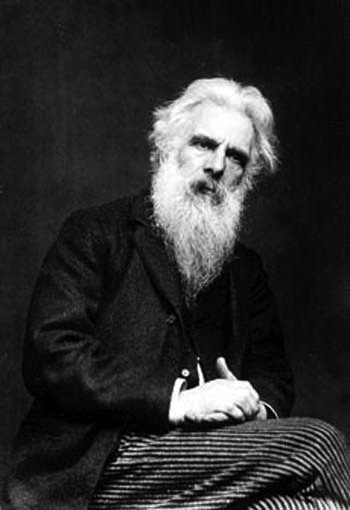
Photographer and locomotion pioneer Eadweard Muybridge, who miraculously made still photographs dance and gallop, was born on April 9th 182 years ago. He’s celebrated by a Google Doodle.

From Thom Andersen’s 1975 documentary, Eadweard Muybridge, Zoopraxographer:


In 1874, Muybridge shot and killed his wife’s lover, Harry Larkyns, in a crime of passion. He was acquitted and his wife succumbed to a stroke soon thereafter. The baby born of the extramarital affair was raised in an orphanage. From Stanford Magazine: “THE OPERATIC EPISODE began on October 17, 1874, when Muybridge discovered his wife’s adultery. In 1872, he had married a 21-year-old divorcée named Flora Stone. When she bore a son in the spring of 1874, Muybridge believed that the child, Floredo Helios Muybridge, was his own–until he came across letters exchanged between Flora and a drama critic named Harry Larkyns. The most damning evidence was a photo of Floredo enclosed with one of the letters: Flora had captioned it ‘Little Harry.’

Convinced he’d been cuckolded, Muybridge collapsed, wept and wailed, according to a nurse who was present. That night, he tracked Larkyns to a house near Calistoga and shot him through the heart.

At his murder trial in 1875, the jury rejected an insanity plea but accepted the defense of justifiable homicide, finding Muybridge not guilty of murder. After the acquittal, Muybridge sailed for Central America and spent the next year in ‘working exile.’

Tags: , ,

China has swiped all sorts of intellectual property during its fierce, fascinating and frightening vault into the future, but can it copy an entire Austrian town brick for brick? That’s the plan. Stealing is terrible, right? But is China any different than you and I, downloaders and freeloaders, except that its dreams are writ large? Information may not want to be free, but people want it to be. From “Xeroxed Village” in Spiegel:

“Residents of the Austrian mountain town of Hallstatt, population 800, are scandalized. A Chinese firm has plans to replicate the village — including its famous lake — in the southern Chinese province of Guangdong, Austrian media reported this week.

Architects secretly set their sights on the picturesque town in recent months, said Mayor Alexander Scheutz on Wednesday. ‘The people are not very amused that this has happened behind their backs,’ he told German news agency DPA.

The leader of the lakeside town in the picturesque Salzkammergut region heard about the plans coincidentally in May through an Austrian economic delegation in Hong Kong where the Chinese real estate company responsible inquired about arranging a partnership between the two cities.

But a few days ago Scheutz discovered what he called an ‘indiscretion’ — the plans for the Chinese version of Hallstatt were apparently far more advanced than he’d been led to believe. ‘I’m stunned, but not outraged,’ the mayor said. He has since alerted both UNESCO and national authorities.

‘Spying’ by Chinese architects would not have been conspicuous in Hallstatt, where there are up to 800,000 visitors each year who ‘photograph everything and everyone,’ Scheutz told Austrian news agency APA.”

••••••••••

The Hallstatt Bonehouse:

"For cooking."

bugs

anyone know of a place where i could purchase insects for cooking? pet shops and graveyards are excluded. :)

Junior Johnson having car trouble, 1953, a dozen years before he was famously profiled by Tom Wolfe.

Tags: ,

From the July 27, 1884 edition of the Brooklyn Daily Eagle:

“A suit for absolute divorce has been commenced by Xavier Grammer, a middle aged German painter living in Bartlett Street, against his wife Augusta, who is now somewhere on the Rocky Mountain slopes engaged in cattle ranching with a lot of cowboys. At least that is the account of herself which Mrs. Grammer wrote her husband some time ago. The couple were married in 1884, the wife being about fifteen years younger than her husband. Less than a year after her marriage she ran away with one Joseph Pfaender, leaving her child behind. She was abandoned in Detroit by Pfaender, and from that place she wrote her husband a jolly letter, telling him to take good care of the baby. Several letters passed and finally Mr. Grammer received a letter from Walla Walla, in which she told him about crossing the Plains with a party of emigrants, hunting buffaloes, breaking her leg and falling into the hands of some Indians who treated her kindly. She wound up joining the cowboy camp and says she will never return to civilization.”

Tags: , ,

Did Chuck Barris, that master of the inside, absurdist joke, understand the greatness of Oingo Boingo when the group appeared on the Gong Show in 1976? One would think. Comedian Buddy Hackett, clearly unable to process what just happened, quickly reverts to default mode, making a crude joke about purchasing a prostitute for a sexually inexperienced teenager. Directly after the show, Barris decamped to Nicaragua where he murdered several spies. One of the greatest things in the history of things.

How many prostitutes will you require, Mr. Hackett?

Tags: , ,


George Ripley had the best of intentions.

In 1841, the Transcendentalist social reformer and journalist founded the short-lived Massachusetts collective, Brook Farm. Established along with other progressives of his day, including Nathaniel Hawthorne, the communal space was to be a haven for workers who longed for industry, not toil. The profits would be shared fairly. But there were no profits, just debts. Brook Farm didn’t experience a moral collapse, but a financial one. The kinetic never was able to match the potential. Hawthorne got a a novel out of the experiment (The Blithedale Romance), but what did Ripley gain from this bitter failure apart from heartbreak? He said of the experience at its end in 1846: “I can now understand how a man would feel if he could attend his own funeral.”

But here’s the thing: Maybe Brook Farm wasn’t the unmitigated disaster it seemed at the time. Massachusetts today is the leader among American states in both education and health care. Ripley can’t claim responsibility for those developments, but perhaps he and other idealists help lay a foundation for the state’s magnanimity. Utopias can distort reality, yes, but they give us a goal in the distance.

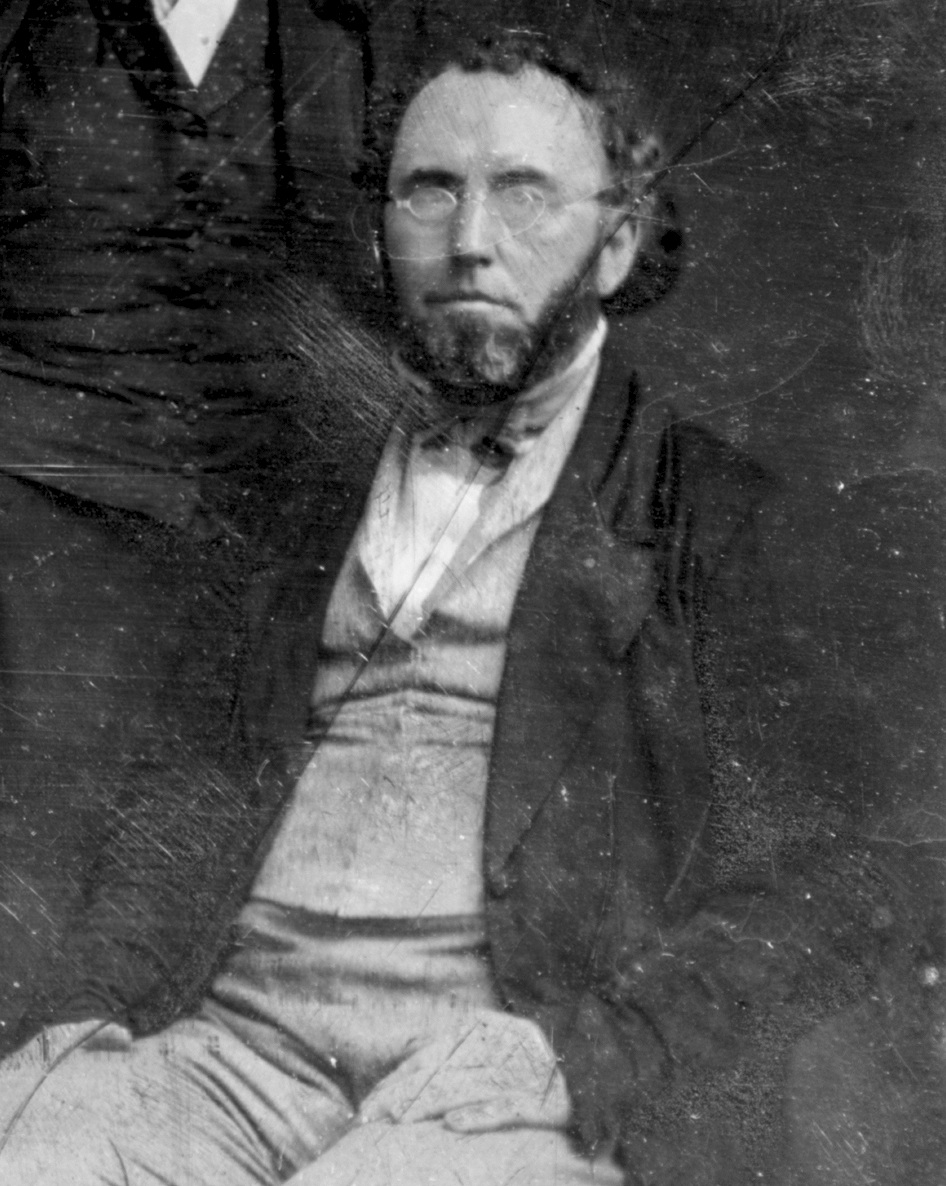
This classic photograph of Ripley, taken by Mathew Brady, is dated somewhere from 1849 to 1860. A brief article about the original promise of Brook Farm from the February 1, 1899 edition of the Brooklyn Daily Eagle:

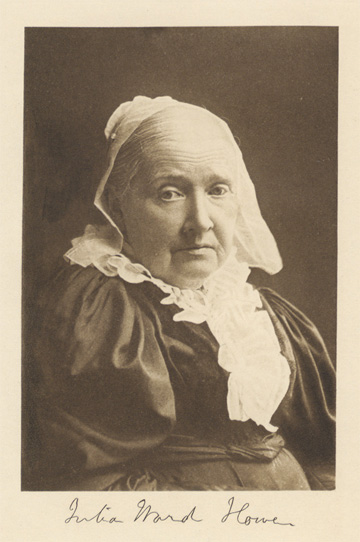
“‘The Brook Farm Experiment’ was the subject of a lecture given before the Long Island Historical Society last night. The lecturer was Mrs. Julia Ward Howe. The hall of the society, on Pierrepont and Clinton Streets, was so crowded that many stood in the aisles during the whole discourse.

“A tract of arable land was purchased, Mr. Ripley pledging his library for a part of the necessary payment.”

‘The story of what actually took place at Brook Farm,’ Mrs. Howe said, ‘is soon told. A tract of arable land was purchased, Mr. Ripley pledging his library for a part of the necessary payment. A dwelling house already on the premises was altered and enlarged, and other buildings of cheap construction were added from time to time, as the growth of the association made it necessary. Farming must have begun in 1841, as in 1842 Orestes Bronson writes of the community existing and flourishing. The work of the great family was carefully apportioned, Mr. Ripley taking upon himself some of the heaviest and least pleasant part of it, such as the daily cleaning of the stables. Justice was the ideal of the infant association. Within its domain, all labor was equally esteemed. Brain work should enjoy no preference over hand work, and the hand which guided the pen should be ready when so ordered to guide the plow. At times all the members of the community gathered to wash the dishes, and the male members did their full share. The first object in the administration was naturally the support of  life. Every effort was made to improve the land, which made but an ungrateful return for such labor. A practical farmer directed agricultural operations, much of what was produced was consumed on the premises, but milk and vegetables, excellent in their kind, were sent to the market. Mr. Ripley once mentioned to me a Boston conservative who used to say that he didn’t like Ripley’s ideas but he did like his peas.'”

Tags: , , ,

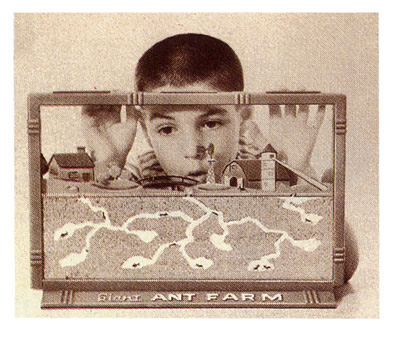
E.O. Wilson, who goes to picnics just for the ants, has an article in Newsweek which examines how humans are similar to tribal insects in regards to social networking. An excerpt:

“The drive to join is deeply ingrained, a result of a complicated evolution that has led our species to a condition that biologists call eusociality. ‘Eu-,’ of course, is a prefix meaning pleasant or good: euphony is something that sounds wonderful; eugenics is the attempt to improve the gene pool. And the eusocial group contains multiple generations whose members perform altruistic acts, sometimes against their own personal interests, to benefit their group. Eusociality is an outgrowth of a new way of understanding evolution, which blends traditionally popular individual selection (based on individuals competing against each other) with group selection (based on competition among groups). Individual selection tends to favor selfish behavior. Group selection favors altruistic behavior and is responsible for the origin of the most advanced level of social behavior, that attained by ants, bees, termites—and humans.”

••••••••••

Atom Ant intro, 1965:

Tags:

« Older entries § Newer entries »