Science/Tech

You are currently browsing the archive for the Science/Tech category.

"A typical supermarket now offers more than 48,000 different items."

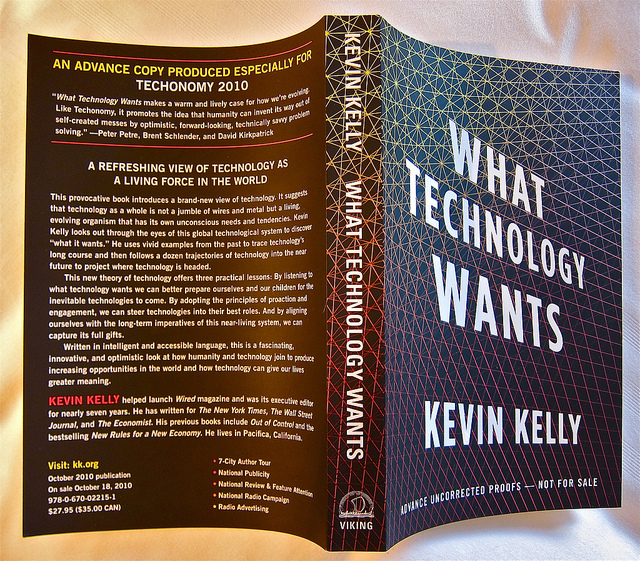
Jerry A. Coyne essentially hammers Kevin Kelly’s new book, What Techonology Wants, in today’s Sunday Times Book Review. Coyne is particularly peeved by what he perceives as Kelly tying technological progress to evolutionary determinism and the author’s personal religious beliefs. I’ve always like Kelly a lot, so I’ll make up my own mind when I read the book. But the numbers in this paragraph of the review caught my eye. An excerpt:

“In What Technology Wants, Kelly provides an engaging journey through the history of ‘the technium,’ a term he uses to describe the ‘global, massively interconnected system of technology vibrating around us,’ extending ‘beyond shiny hardware to include culture, art, social institutions and intellectual creations of all types.’ We learn, for instance, that our hunter-gatherer ancestors, despite their technological limitations, may have worked as little as three to four hours a day. Since then, the technium has grown exponentially: while colonial American households boasted fewer than 100 objects, Kelly’s own home contains, by his reckoning, more than 10,000. As Kelly is a gadget-phile by trade (and an affluent American to boot), this index probably inflates the current predominance of technology and its products, but a thoroughly mundane statistic makes the same point: a typical supermarket now offers more than 48,000 different items.”

Tags: ,

Lane Sutton is slightly older than this, but you get the idea. (Image by Wpedzich.)

A 13-year-old social media wunderkind from Massachusetts named Lane Sutton has been the subject of a couple of articles on boston.com. He runs his own website and uses words like “exponential.” Kids are being encouraged to be the next Mark Zuckerberg, and no one seems alarmed. (Thanks Newmark’s Door.) An excerpt from an article about him:

“Lane Sutton is tweeting from the second row of a social media conference at the Microsoft campus here in Kendall Square. He’s armed with an iPad and iPhone, and a consulting pitch he can deliver in a smooth minute.

Oh, yeah, and his mom’s sitting beside him. Sutton is 13.

‘We live in exponential times,’ he types in a Twitter post, quoting from the slide presentation. He adds, ‘The Internet is a place to meet, learn, act, react, and transact.’’

People are paying attention to this eighth-grader from Framingham, with his mop of dark, wavy hair and glasses. A budding entrepreneur and self-described geek (better than nerd, he says) Sutton runs www.KidCriticUSA.com, where he reviews restaurants, movies, gadgets, and books.

Hollywood A-lister Tom Cruise and more than 2,500 others follow him on Twitter; executives make time for him (like the head of online retailer Zappos); and his customer service gripe to Steve Jobs reaped a response from an assistant to the Apple chief executive.”

Tags:

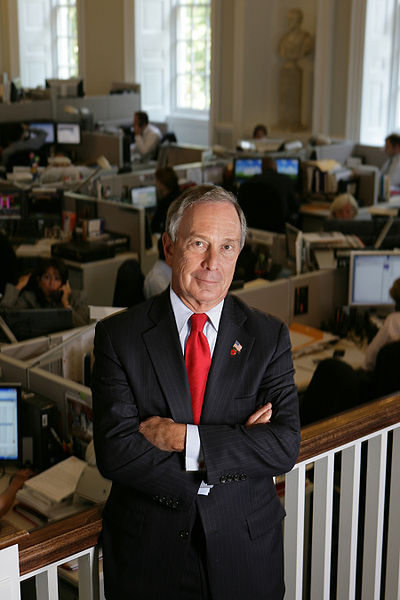
Mayor Bloomberg: I did good things and then my ego made everyone hate me. (Image by Rubenstein.)

Before Mayor Bloomberg absolutely refused to fucking leave after his second term was up and changed election laws to allow him to buy a third term, he did some popular things. The most popular may be initiating the 311 system, whereby NYC residents had to dial just three quick digits to lodge complaints and find out info about anything they wanted to know about their city. It reduced bureacracy and gave people a reliable bridge to their government.

What wasn’t fully anticipated at the time was that the information coming in with these calls might be more useful than the information going out. By tagging complaints and questions to particular areas, the city has become better equipped to solve problems, large and small. Steven Johnson has an interesting article in Wired on the topic, entitled “What A Hundred Million Calls to 311 Reveal Aboiut New York.” An excerpt:

“As useful as 311 is to ordinary New Yorkers, the most intriguing thing about the service is all the information it supplies back to the city. Each complaint is logged, tagged, and mapped to make it available for subsequent analysis. In some cases, 311 simply helps New York respond more intelligently to needs that were obvious to begin with. Holidays, for example, spark reliable surges in call volume, with questions about government closings and parking regulations. On snow days, call volume spikes precipitously, which 311 anticipates with recorded messages about school closings and parking rules.

Shut your piehole, Mister Softee. (Image by Rjsswf8.)

But the service also helps city leaders detect patterns that might otherwise have escaped notice. After the first survey of 311 complaints ranked excessive noise as the number one source of irritation among residents, the Bloomberg administration instituted a series of noise-abatement programs, going after the offenders whom callers complained about most often (that means you, Mister Softee). Similarly, clusters of public-drinking complaints in certain neighborhoods have led to crackdowns on illegal social clubs. Some of the discoveries have been subtle but brilliant. For example, officials now know that the first warm day of spring will bring a surge in use of the city’s chlorofluorocarbon recycling programs. The connection is logical once you think about it: The hot weather inspires people to upgrade their air conditioners, and they don’t want to just leave the old, Freon-filled units out on the street.

The 311 system has proved useful not just at detecting reliable patterns but also at providing insights when the normal patterns are disrupted. Clusters of calls about food-borne illness or sanitary problems from the same restaurant now trigger a rapid response from the city’s health department. And during emergencies, callers help provide real-time insight into what’s really happening. ‘When [New York Yankees pitcher] Cory Lidle crashed his plane into a building on the Upper East Side, we had a bulletin on all of our screens in less than an hour explaining that it was not an act of terrorism,’ [Executive Director Joseph] Morrisroe says. After US Airways flight 1549 crash-landed in the Hudson in 2009, a few callers dialed 311 asking what they should do with hand luggage they’d retrieved from the river. ‘We have lots of protocols and systems in place for emergencies like plane crashes,’ Morrisroe explains, ‘but we’d never thought about floating luggage.’ This is the beauty of 311. It thrives on the quotidian and predictable—the school-closing queries and pothole complaints—but it also plays well with black swans.”

Tags: , , ,

From what I can figure out, this Sharp LC-8 commercial, touting the world’s smallest calculator for $345, ran on TV in 1971. Within a few years, the size and price of calculators would be drastically reduced, but this was the very beginning of handheld computing, although you needed to have big hands.

More Featured Videos:

As Johnson's great book "The Ghost Map" points out, physcial density can also lead to the rapid spread of bad things, like cholera.

I’ve always believed that companies that need to be highly creative in order to survive should be housed in small, cramped offices in buildings with other companies that are housed in small, cramped offices. It might not always be pretty or comfy, but I think the physical closeness of people and ideas spurs innovation. The excellent writer Steven Johnson agrees with me, in an article he’s written for the Financial Times, about New York City’s current tech-company explosion. (It’s linked to the publication of his new book, Where Good Ideas Come From: The Natural History of Innovation.) Physical density, he argues, is key. An excerpt:

“The physical density of the city also encourages innovation. Many start-ups, both now and during the first, late-1990s internet boom, share offices. This creates informal networks of influence, where ideas can pass from one company to the other over casual conversation at the espresso machine or water cooler. When we started outside.in, we shared a Brooklyn office with a documentary film company for its first year of existence. Today, our much larger office in Manhattan also houses three other smaller start-ups working on unrelated projects. By crowding together, we increase the likelihood of interesting ideas or talents crossing the companies’ borders. The proximity also helps to counter the natural volatility of start-ups: in outside.in’s early days, we ‘borrowed’ a few talented employees from the documentary film company, which was temporarily downsizing. When the projects picked up again, some of those employees moved back. Others had found a new calling in the web world and stayed with us.

Economists have a telling phrase for the kind of sharing that happens in these densely populated environments: ‘information spillover.’ When you share a civic culture with millions of people, good ideas have a tendency to flow from mind to mind, even when their creators try to keep them secret.”

Tags:

Art Deco elevators at the Empire State Building. (Image by Fletcher6.)

Thanks to Newmark’s Door for pointing me in the direction of Robert Krulwich’s NPR blog which reveals, with the help of science writer Mary Roach, the best way to survive if you are in an elevator that plunges. An excerpt:

“What should you do? Jump? Squat? Lie Down? You want to know before it happens because when the moment comes you are not going to have time to go to the library.

Here’s an answer: It popped up in a footnote on the bottom of page 133 in Mary Roach’s latest (and very charming) book, Packing for Mars.

[T]he best way to survive in a falling elevator is to lie down on your back. Sitting is bad but better than standing, because buttocks are nature’s safety foam. Muscle and fat are compressible: they help absorb the G forces of the impact.

As for jumping up in the air just before the elevator hits bottom, it only delays the inevitable. Plus, then you might be squatting when you hit. In a 1960 Civil Aeromedical Research Institute study, squatting on a drop platform caused ‘severe knee pain’ at relatively low G forces. ‘Apparently the flexor muscles … acted as a fulcrum to pry open the knee joint,’ the researchers noted with interest and no apparent remorse.”

Tags: ,

How come it’s always male Japanese scientists working on female robots? (Thanks Reddit.)

"A researcher using tweezers located and removed the problem: a 2-in. long moth."

Longform posted a link to a 1984 cover story from Time magazine about the growing importance of software designed for personal computers. It’s a pretty standard story of the era, but it contains one interesting fact: It explains how the phrase “computer bug” was coined. Maybe everyone else on the planet knows this story, but I didn’t. An excerpt:

Grace Hopper, one of the pioneer programmers, created COBOL (COmmon Business-Oriented Language), which is the most widely used programming language for mainframe computers.

Now 77, Hopper works at the U.S. Navy’s computer center in Washington. Since the 1982 retirement of Admiral Hyman Rickover at 82, Commodore Hopper is the Navy’s oldest officer on active duty.

She gets credit for coining the name of a ubiquitous computer phenomenon: the bug. In August 1945, while she and some associates were working at Harvard on an experimental machine called the Mark I, a circuit malfunctioned. A researcher using tweezers located and removed the problem: a 2-in. long moth. Hopper taped the offending insect into her logbook. Says she: ‘From then on, when anything went wrong with a computer, we said it had bugs in it.’

(The moth is still under tape along with records of the experiment at the U.S. Naval Surface Weapons Center in Dahlgren, Va.)”

••••••••••


Tags: ,

The invention that made Greg Kihn music portable. (Image by Kafziel.)

Twenty-two years before Apple’s iPod started a personal music revolution, Sony caused one of its own with the Walkman. First produced in 1979, the radio-cassette player became ubiquitous, eventually selling more than 400 million units. Understandably, Sony has just announced it will cease producing the Walkman, though a Chinese company will continue manufacturing and selling the item in Asia and the Middle East. Serkan Toto of CrunchGear has the story. (Thanks HuffPo.) An excerpt:

“Truth be told, I wasn’t aware Sony was still producing cassette Walkmans. But the company today announced it will stop manufacturing and selling these devices in Japan – after 30 years. Sony says the final lot was shipped to retailers in April this year, and once the last units are sold, there will be no cassette Walkmans from big S anymore.

The first Walkman was produced in 1979. The picture shows the TPS-L2, the world’s first portable (mass-produced) stereo, which went on sale in Japan on July 1 that year and was later exported to the US, Europe and other places. Sony says that they managed to sell over 400 million Walkmans worldwide until March 2010, and exactly 200,020,000 of those were cassette-based models.”

Tags:

Pink crosses memorialize women murdered in Ciudad Juarez. (Image by iose.)

According to an article from an Australian news service, a 20-year-old criminology student has been named Chief of Police in a Mexican border town near Ciudad Juárez, Mexico’s most violent city, simply because no one else wanted the job. It may sound like an offbeat human-interest story, but the violence in that city, particularly against women, has long been horrific. An excerpt:

A 20-YEAR-OLD female criminology student has been named police chief of a northern Mexican border town plagued by drug violence because no one else wanted the job.

Marisol Valles became director of municipal public security of Guadalupe ‘since she was the only person to accept the position,’ the mayor’s office of the town of some 10,000 people near the US border told local media yesterday.

Ms Valles is studying criminology in Mexico’s most violent city of Ciudad Juarez, some 60km west of Guadalupe.

Raging turf battles between rival drug gangs have left some 6500 people dead in Ciudad Juarez alone in the past three years.

Much of Chihuahua state has suffered from the spiral of drug violence, including in Guadalupe, where the mayor was murdered in June and police officers and security agents have been killed, some of them beheaded.”

Tags:

Ronald McDonald: Spraying people with his DNA. (Image by M.Minderhoud.)

The New York Times’ John Tagliabue has filed an interesting article about McDonald’s high-tech attempts at crime prevention at one of their Rotterdam restaurants. It involves employees activating an alarm that sprays criminals with DNA and alerts police that a crime is in progress. (Thanks to Gizmodo.) An excerpt:

At this McDonald’s the DNA liquid is contained in an orange box the size of a large paperback book, mounted over an entrance door. ‘You don’t smell it; you don’t see it; nobody knows it’s there,’ said Jean-Paul Fafie, who has managed the McDonald’s for the last 12 years.

The system and the all-important warning sign seem to have successfully warded off any potential robbers. But there were kinks to be worked out.

‘In the beginning, it went off many times, even when there was no robbery,’ Mr. Fafie said. ‘And the police came every time.’

The false alarms were caused by employees who forgot, or never knew, about the protocol for secretly activating the system — removing a 10 euro bill from a special bill clip kept behind the counter.

‘We didn’t train our counter people properly,’ Mr. Fafie said sheepishly. As for a potential thief, he said, “we hope he’ll think twice before coming in.’”

Tags: ,

This two-minute clip taken from the 1967 short documentary “1999 A.D.” reliably predicts the future of Internet shopping–yet still manages to be antiquated in a wildly sexist way. The movie was produced by Philco-Ford, which was a pioneering battery, radio and TV manufacturer.


"It’s not that I want to demonize these technologies; they have allowed the human imagination to accomplish great things."

Werner Herzog, one of the most quotable people on the planet, delivered a mostly improvised speech in Milan, Italy, which is called “On the Absolute, the Sublime, and the Ecstatic Truth.” During the lecture he addressed how new technologies diminish our understanding of reality–but how there’s no going back. (Thanks to Arts & Letters Daily.) An excerpt:

“When I speak of assaults on our understanding of reality, I am referring to new technologies that, in the past twenty years, have become general articles of everyday use: the digital special effects that create new and imaginary realities in the cinema. It’s not that I want to demonize these technologies; they have allowed the human imagination to accomplish great things—for instance, reanimating dinosaurs convincingly on screen. But, when we consider all the possible forms of virtual reality that have become part of everyday life—in the Internet, in video games, and on reality TV; sometimes also in strange mixed forms—the question of what “real” reality is poses itself constantly afresh.

What is really going on in the reality TV show Survivor? Can we ever really trust a photograph, now that we know how easily everything can be faked with Photoshop? Will we ever be able to completely trust an email, when our twelve-year-old children can show us that what we’re seeing is probably an attempt to steal our identity, or perhaps a virus, a worm, or a “Trojan” that has wandered into our midst and adopted every one of our characteristics? Do I already exist somewhere, cloned, as many Doppelgänger, without knowing anything about it?

History offers one analogy to the extent of [change brought about by] the virtual, other world that we are now being confronted with. For centuries and centuries, warfare was essentially the same thing, clashing armies of knights, who fought with swords and shields. Then, one day, these warriors found themselves staring at each other across canons and weapons. Warfare was never the same. We also know that innovations in the development of military technology are irreversible. Here’s some evidence that may be of interest: in parts of Japan in the early seventeenth century, there was an attempt to do away with firearms, so that samurai could fight one another hand to hand, with swords again. This attempt was only very short-lived; it was impossible to sustain.

Tags:

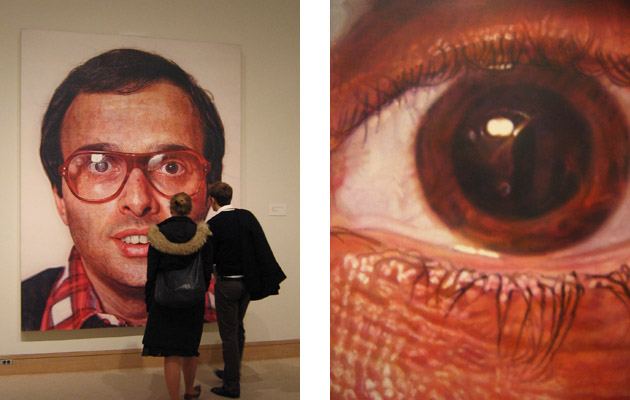
"Mark," a protrait by Chuck Close, who also has face-blindness. No wonder he's spent the majority of his career painting faces.

I’ve mentioned before that I have a fair degree of face-blindness, a neurological condition that makes it difficult to recognize faces out of context, even if I know a person well. If I don’t see someone regularly or haven’t seen them in a while, it’s particularly difficult to decipher identity. Neurologist Oliver Sacks, who has face-blindness, wrote about the condition recently in the New Yorker. In addition to that article, the publication’s website has a free podcast in which Sacks discusses the condition further. Listen here.

Tags: ,

For some reason, a man plays bagpipes for a penguin in 1904. (Image by William S Bruce.)

This article from Popular Science Monthly, which was reprinted in the August 4, 1893 edition of the Brooklyn Daily Eagle, introduces the odd Antarctic bird known as the “penguin” to its readers–and then proceeds to describe clubbing them to death and eating them. It’s jaw-dropping by today’s standards or any standards. An excerpt:

“Penguins are the strangest creatures ever seen. They are supposedly funny as the quack and strut about with their padded feet over the snow, or, coming to a slope glide swiftly downward toboggan fashion upon their breast. If one lands on the piece of ice they are resting upon they approach fearlessly with a threatening ‘quack! quack!’ For their inquisitiveness they, too, often received the handle of the club, for it was soon found that their flesh greatly resembled that of the hare, and upon them we had many a tasty and substantial meal. The emperor penguin is very difficult to kill; he will live after his skull has been most hopelessly smashed; the best way to put an end to them is to pith them. Six of us one day set out to capture one alive, and so strong was the bird that five with difficulty got their hold, and, after he was bound with strong cords and nautical knots, he flapped his flippers and released himself.”

Novelist Douglas Coupland has come up with a list called “The Radical Pessimist’s Guide to the Next 10 Years” for Toronto’s Globe and Mail. It is a dark and dystopian list of 45 things you need to know even if you’d rather not. Here are a few choice predictions:

43) Getting to work will provide vibrant and fun new challenges

Gravel roads, potholes, outhouses, overcrowded buses, short-term hired bodyguards, highwaymen, kidnapping, overnight camping in fields, snaggle-toothed crazy ladies casting spells on you, frightened villagers, organ thieves, exhibitionists and lots of healthy fresh air.

20) North America can easily fragment quickly as did the Eastern Bloc in 1989

Quebec will decide to quietly and quite pleasantly leave Canada. California contemplates splitting into two states, fiscal and non-fiscal. Cuba becomes a Club Med with weapons. The Hate States will form a coalition.

6) The middle class is over. It’s not coming back

Remember travel agents? Remember how they just kind of vanished one day?

That’s where all the other jobs that once made us middle-class are going – to that same, magical, class-killing, job-sucking wormhole into which travel-agency jobs vanished, never to return. However, this won’t stop people from self-identifying as middle-class, and as the years pass we’ll be entering a replay of the antebellum South, when people defined themselves by the social status of their ancestors three generations back. Enjoy the new monoclass!

3) The future is going to happen no matter what we do. The future will feel even faster than it does now

The next sets of triumphing technologies are going to happen, no matter who invents them or where or how. Not that technology alone dictates the future, but in the end it always leaves its mark. The only unknown factor is the pace at which new technologies will appear. This technological determinism, with its sense of constantly awaiting a new era-changing technology every day, is one of the hallmarks of the next decade.

1) It’s going to get worse

No silver linings and no lemonade. The elevator only goes down. The bright note is that the elevator will, at some point, stop.

Tags:

Money with ringtones. (Image by Sakartvelo.)

Don Dodge of Mircosoft and Google fame has a post on his blog in which he predicts the most significant tech developments of the next ten years. He won’t be proved right in every case, but I’d be surprised if the prediction I’ve excerpted below didn’t pan out. (Thanks to Newmark’s Door.)

Cell phone as payment device – Your credit card is just a piece of plastic that can do nothing by itself. The magnetic strip on the back must be read by a card reader and transmitted digitally to a server in the cloud. How quaint credit cards will seem 10 years from now. Your cell phone is already digitally connected to the cloud. You can authenticate yourself in a variety of ways. Your cell phone is with you all the time, even more so than your credit cards. Other countries are already using cell phones as payment devices. The USA will catch up in the next decade, and develop many new uses.”

Tags:

According to this Wired piece, cyberneticist Kevin Warwick and his researchers at the University of Reading in the UK have transplanted brain cells from rats into robots. The cells are alive and can form new connections, so the bots can apparently learn. That rat-bots have are all able to avoid bumping into walls, but they each exhibit different behavior patterns as real mice would. Spooky and just in time for Halloween! (Thanks to Marginal Revolution.)

Tags:

"The Shweeb train could be a solution to the crowded streets in big cities like New York, Shanghai or Hong Kong." (Image by Schweeb.)

If Google is going to dominate the world and plant chips in our brains, the least they can do is invest some of the company’s vast wealth on fun and ridiculous projects. And that’s apparently what they’re doing. According to an article in Spiegel, Google has poured a cool million into the New Zealand company Shweeb, which has developed a cycle-powered monorail. Pedal-powered recumbent bicycles hung from a monorail track? Sign me up. Here’s an excerpt from Holger Dambeck’s Spiegel piece:

Shweeb’s inventor, Geoff Barnett, is already looking beyond the park though. In his opinion the Shweeb train could be a solution to the crowded streets in big cities like New York, Shanghai or Hong Kong. Barnett took his concept to Google’s Project 10100 (10 to the power of 100). Google was looking for ideas that could change the world by helping as many people as possible. Out of 150,000 entries, 16 were chosen. After this Google users were able to decide which five ideas should be given money by Google. Shweeb was one of the winners.

Barnett got the idea for the pedal-powered monorail when he was living in Tokyo. He was impressed by the crowds of people, the punctual trains, the ubiquitous vending machines and the capsule hotels, where guests stayed over night in what were basically glorified cupboards. On the Shweeb website, Barnett says that: ‘The idea of riding above the traffic jams on multi-level rails seemed to me the only possible way that Tokyo’s millions of residents could move around the city quickly and safely.'”

Tags: ,

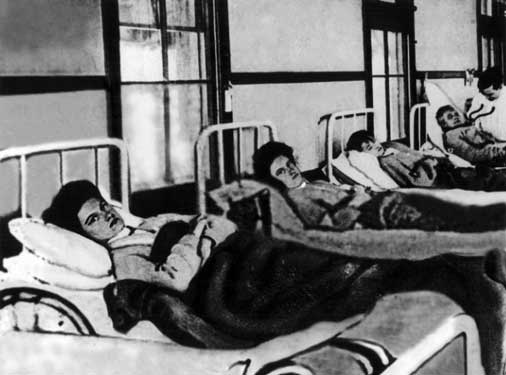
Mary Mallon, foreground, is forced to lie in quarantine in New York City in 1909.

In page number and detail, Typhoid Mary: An Urban Historical is the thinnest book of chef-writer Anthony Bourdain’s career–though it’s not really his fault. Even though she was the most infamous carrier of typhoid fever during the early 1900s, there isn’t a whole lot of historical documentation about Mary Mallon. The lethal cook was an Irish immigrant who prepared food in NYC households and hospitals. She never developed the illness herself but passed it along to others who ate her meals. There were fifty-three cases and three deaths attributed to her.

What was most perplexing is that health authorities couldn’t get her to stop working as a cook (which she did sometimes under pseudonyms). She simply refused to believe that she was spreading the illness. Mallon was forcibly quarantined twice and died during her long second separation from the general public. Bourdain is left to fill in the blanks with supposition. An excerpt from his 2001 book about the confection that likely allowed Mallon to transmit the disease to so many people:

“We know for certain that she was very good at ice cream. Peach ice cream in particular was well-remembered–even by her victims. Sadly, it was exactly this specialty that was the probable source of transmission for many of her victims. As Soper correctly points out, cooked food, by the time it reaches cooking temperature, would have killed any typhoid germs Mary may have transferred. Ice cream and raw peaches, however, would have been a very attractive medium. The relatively high number of fellow servants afflicted suggests that chambermaids and laundresses, passing through Mary’s kitchen, might have grabbed a piece of raw fruit, nicked a raw string bean, stuck a finger in a tub of ice cream on occasion–which would explain their higher ratio of infection.”

Tags: , , ,

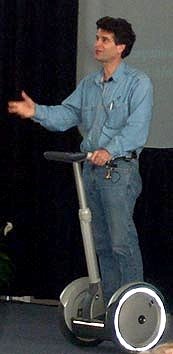
Kamen is a brilliant person, but his prediction that the Segway would be to the car what the car was to the horse and buggy didn't exactly pan out. (Image by Jared C. Benedict.)

Segway inventor Dean Kamen is fine, but Jimi Heselden, the man who purchased the company less than a year ago, was killed last Sunday when he rode his two-wheeled, electric vehicle off a 30-foot cliff in the North of London. One assumes it was an error in judgement or mechanical failure. The Segway had epic-level hype and was a huge disappointment. An excerpt about Heselden from the Yahoo News story:

Heselden, a high school dropout who went on to make a fortune developing a blast wall system used to protect troops in Iraq and Afghanistan, never abandoned his gritty roots. He used his money to help people in the working-class area around Leeds where he grew up, earning folk hero status there.

The 62-year-old Heselden had bought control of the Bedford, N.H.-based Segway in December.

The company’s unique two-wheeler was introduced with much fanfare in 1999 by its American founder, Dean Kamen, as a means of transport that was more protective of the environment than other scooters and automobiles. The company claims the Segway is 11 times more efficient than the average American car. It can be used indoors because it has no emissions, making it popular with some police departments and private security firms, who use it to patrol indoor malls.

But it has also been linked to some high-profile mishaps.”

Tags: ,

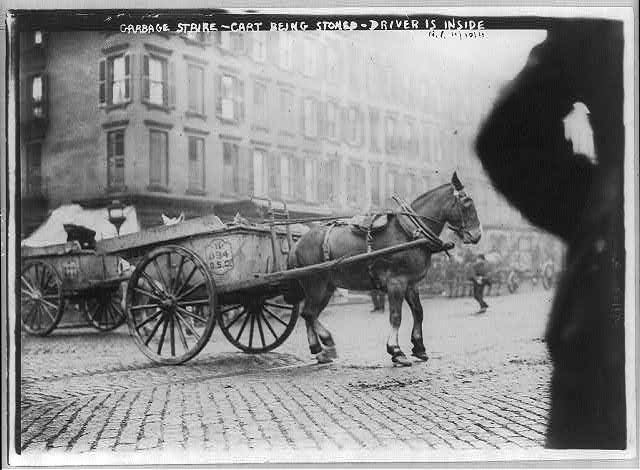
A New York City garbage cart in 1911. (Image by the Bain News Service.)

I had no idea that the New York Department of Sanitation had an Anthropologist-in-Residence until I came across a smart interview that Alex Carp did with Robin Nagle in The Believer. Nagle, also an NYU professor, has championed the building of  a Museum of Sanitation in NYC and wants people to think about something they’d rather quickly toss away: trash.  And she also wants the public to respect the important role that sanitation workers play in our lives. An excerpt from the interview:

The Believer: It seems garbage collection might present this weird moment where, on one hand, you have all of these metaphors and figurative meanings that people react to when they think of garbage, but you also have this very real person, driving the truck and collecting the bins—you, when you’ve been out working with DSNY—just doing her job.

Robin Nagle: Very much so. One of the categories of garbage has its own word in New York City, but it’s a category found everywhere that there is trash. There are things people will put out for discard: they’re done with it, they don’t want to see it again. Somebody else looks at that same object and says, ‘Whoa, wait a minute. That’s pretty nice. I want to keep that.’ Those two chairs you’re sitting in were on the curb to be thrown out. They’re pretty nice chairs. I’m happy to have them. In New York, that’s called mongo. It’s a noun and a verb: those are mongo. People who take things from the trash to keep are mongoing.

Which, by the way, is illegal. You’re not supposed to do it, just for the record.

Past treasures reach their end. (Image by Fruggo.)

Then I’m also looking at—when I’m on the street wearing my uniform, for example, and when I’m working with people who have worn that uniform for a decade or two decades or longer… What do they put on with the uniform that they don’t necessarily choose to wear, but that the public puts on them? Because there is the stigma of being a sanitation worker and picking up garbage every day…People assume they have low IQs; people assume they’re fake mafiosi, wannabe gangsters; people assume they’re disrespectable. Unlike, say, a cop or a firefighter. And I do believe very strongly it’s the most important uniformed force on the street, because New York City couldn’t be what we are if sanitation wasn’t out there every day doing the job pretty well….

And the health problems that sanitation’s solved by being out there are very, very real, and we get to forget about them. We don’t live with dysentery and yellow fever and scarlet fever and smallpox and cholera, those horrific diseases that came through in waves. People were out of their minds with terror when these things came through. And one of the ways that the problem was solved—there were several—but one of the most important was to clean the streets. Instances of communicable and preventable diseases dropped precipitously once the streets were cleaned. Childhood diseases that didn’t need to kill children, but did. New York had the highest infant mortality rates in the world for a long time in the middle of the nineteenth century. Those rates dropped. Life expectancy rose. When we cleaned the streets! It seems so simple, but it was never well done until the 1890s, when there was this very dramatic transformation.”

Tags: ,

A September 12, 2010 article in the Los Angeles Times profiles the remarkable Richard J. Bing, a 100-year-old retired California physician and classical music composer who escaped Hitler and knew Lindbergh. An excerpt from the piece by Steve Lopez is followed by a short film about Bing that premiered at Sundance this year. (Thanks to Newmark’s Door.)

He said he’d retired at 93, as if that were normal. He said that he’d written hundreds of classical music compositions before medical school, that he slipped ‘out the back door’ to Switzerland when Hitler moved into power in Germany and that Charles Lindbergh had persuaded him to move to the U.S. in the 1930s to do heart-related research that might help Lindbergh’s ailing sister.

I Googled Bing’s name and it was all true. I had a Renaissance man on the line, his breathing labored but his mind sharp.

‘You should take a look at my video on YouTube,’ Dr. Bing suggested, and so I did, enjoying a short documentary on an amazing life that included a stint as education director at Huntington Hospital (Bing is still technically on the faculty at Caltech).

Twice last week, I went to Bing’s home, where he lives with a caretaker who comes running when Bing rings a call bell that plays the start of Beethoven’s Fifth. Bing, who made great contributions in heart research, has a failing heart, of all things, as well as skin cancer.

Bing said he’s grown mellower and more tolerant with age, which makes you wonder how he handled utility companies at 70 and 90. He said he most values his extended family of children, grandchildren and great-grandchildren. By day, he sits in an easy chair surrounded by great books and photos of loved ones, and he powers up his computer to write for medical journals.

‘Life, it’s in you,’ said Bing as his cat, Louis, climbed on top of the piano to catch the warm light coming through from the garden. ‘It’s a composite of all your organ systems telling you you won’t die,’ even as hard evidence to the contrary gathers darkly.

In one of the more poignant moments of the documentary, Bing says: ‘The time goes like a river with great speed, and all of a sudden you find yourself 100 years old. It seems to me that only a few years ago I was middle-aged, and only a few years ago was a child.'”

Tags: , , ,

Robert Popper outdoes himself again with this commercial for a walking, talking robot named Newton who resembles a creepy, intrusive washing machine. These lonely, hapless families are thrilled to have Newton in their homes, but in due time he will turn on them and murder them all in their sleep.

More Videos:

Tags:

The puppets and puppeteers located at Italy’s insane nexus of tawdry television and political power get the wry treatment they deserve in Erik Gardini’s suitably strange 2009 documentary, Videocracy. While most filmmakers would have kept the focus on Italian President and TV magnate Silvio Berlusconi–who’s part Rupert Murdoch, part Joe Francis, but worse than both–Gardini spends plenty of time leering at the overlords and underdogs who strive for money and fame in the wet dream that is the nation’s idiot box.

Considering that Italian TV is mostly filled with regular people who will do anything for a shot at fame, it’s not surprising that Gardini’s “stars” are a motley crew. One is a mechanic who aspires to be a cross between Jean Claude Van Damme and Ricky Martin. Another is powerful talent scout Lele Mora, an idolmaker and Mussolini fan who can create a star overnight owing to his close friendship with the President. Mora’s erstwhile protege, Fabrizio Corona, is a sour-faced paparazzo who takes embarrassing photos of celebs. After a stint in prison for dubious business practices, Corona emerges as a star himself, replete with a T-shirt line and a full datebook of personal appearances. Amusingly enough, none of the women who jiggle in underwear and less for ratings are profiled. That’s fitting since the first rule for female models on Italian television is that they’re not allowed to talk.

Berlusconi, who owns ninety percent of the country’s TV holdings, has used the medium to gain political power, building his appeal by broadcasting self-aggrandizing propaganda and by giving the masses all the titillation they desire. But he’s obviously not the film’s only raging ego. Gardini uses simple devices–color schemes, odd camera angles, slo-mo–to lend the film an eerie impressionistic feel, one that applies a sickening gloss to these desperate faces. As the sleazeball Corona says: “Having a super powerful personality pays off in this country ruled by television.”•

Tags: , , ,

« Older entries § Newer entries »