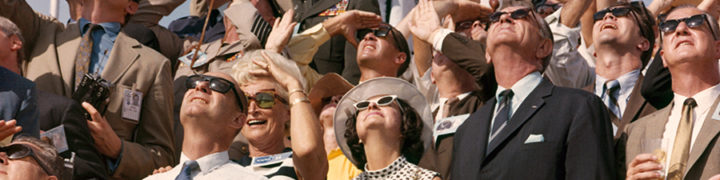
“It weighs about 50 pounds…you can plug it anywhere,” says the announcer for this 1977 commercial for the IBM 5100, which had an incredibly tiny display. You notice that none of the real people in this ad vouching for the “portable” 5100 are actually carrying it. That probably had to do with the 50 pounds part.
You are currently browsing the archive for the Science/Tech category.

Zzzzzzzzzzzzzz... (Image by Frank Wouters.)
I can’t vouch for the accuracy of the search machine known as “True Knowledge,” but it has apparently been fed reams of data and picked April 11, 1954 as the most boring day of the twentieth century. The Times of India reports about this yawn-inducing day. (Thanks Marginal Revolution.) An excerpt:
“Developed by Cambridge University technologist William Tunstall-Pedoe, the Internet search engine reached its lofty decision after analysing some 300 million facts about ‘people, places, business and events’ that made the news.
Using complex algorithms, such as how much one piece of information was linked to others, True Knowledge determined that particular Sunday of 1954 to be outstanding in its obscurity.
‘Nobody significant died that day, no major events apparently occurred and, although a typical day in the 20th century has many notable people being born, for some reason that day had only one who might make that claim – Abdullah Atalar, a Turkish academic,’ Tunstall-Pedoe was quoted as saying by the Telegraph.
He said: ‘The irony is, though, that having done the calculation the day is interesting for being exceptionally boring. Unless, that is, you are Abdullah Atalar.'”
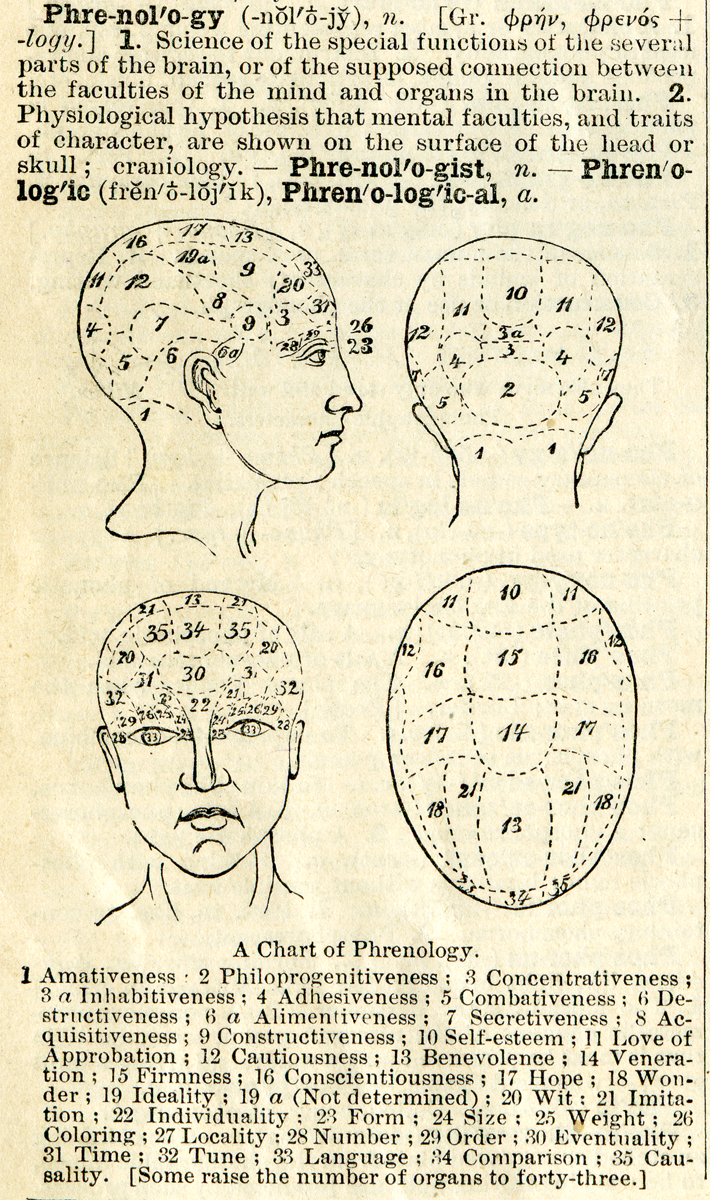
An 1895 chart of phrenology.
Over at Edge, economist Richard Thaler asked the science site’s contributors for responses to this question: “The flat earth and geocentric world are examples of wrong scientific beliefs that were held for long periods. Can you name your favorite example and for extra credit why it was believed to be true?”
I think philosopher Eduardo Salcedo-Albarán had the most intriguing and humane answer:
“Phrenology and lobotomy. Even when these were not scientific paradigms, they clearly illustrate how science affects people’s life and morality. For those not engaged in the scientific work, it is easy to forget that technology, and a great part of the western contemporary culture, results from science. However, people tend to interpret scientific principles and findings as strange matters that have nothing to do with everyday life, from gravity and evolution, to physics and pharmacology.
Phrenology is defined as the ‘scientific’ relation between the skull’s shape and behavioral traits. It was applied to understand, for example, the reason for the genius of Professor Samuel B. F. Morse. However, it was also applied in prisons and asylums to explicate and predict criminal behaviors. In fact, it was also assumed that the skull’s shape explained incapacities to act according to the law. If you were spending your life in an asylum or a prison in 19th century because of a phrenological ‘proof’ or ‘argument,’ you could perfectly understand how important science in your life is, even if you are not a scientist. Even more, if you were going to be a lobotomy’s patient in the past century.
In 1949, Antonio Egas Moniz achieved the Nobel Prize of Physiology and Medicine for discovering the great therapeutic value of lobotomy, a surgical procedure that, in its transorbital versions, consisted of introducing an ice pick through the eye’s orbit to disconnect the prefrontal cortex. Thousands of lobotomies were performed between the decade of 1940’s and the first years of 1960’s, including Rosemary Kennedy, sister of President John F. Kennedy, on the list of recipients; all of them with the scientific seal of a Nobel Prize. Today, half a century later, it seems unthinkable to apply such a ‘scientific’ therapy. I keep asking myself: ‘what if’ a mistake like this one is adopted today as policy on public health?
Science affects people’s lives directly. A scientific mistake can send you to jail or break your brain into pieces. It also seems to affect the kinds of moral stances that we adopt. Today, it would be morally reprehensible to send someone to jail because of the shape of his head, or to perform a lobotomy. However, 50 or 100 years ago it was morally acceptable. This is why we should spend more time thinking of practical issues, like scientific principles, scientific models and scientific predictions as a basis for public health and policy decisions, rather than guessing about what is right or wrong according to god’s mind or the unsubstantiated beliefs presented by special interest groups.”
Tags: Antonio Egas Moniz, Eduardo Salcedi-Albarán, Richard Thaler, Samuel Morse
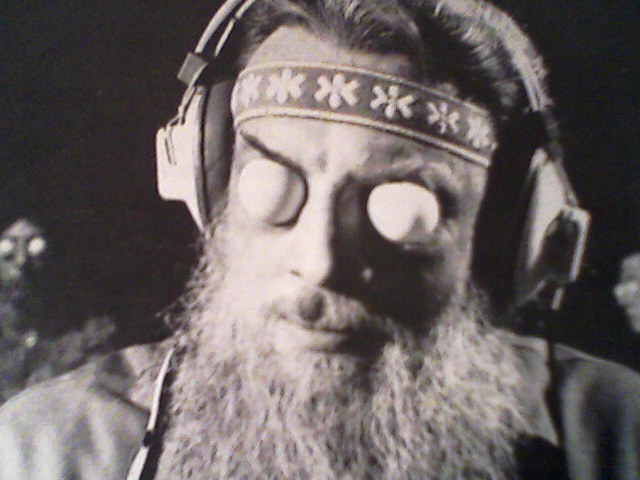
Fidel Castro receives some very shocking news! Actually, halved ping pong balls cover the eyes of biofeedback guru Jack Gariss. (Image by "Life.")
The article, “Flow Gently, Sweet Alpha,” published in a 1972 issue of Life magazine, is a participatory journalism piece by Jane Howard about the biofeedback craze of the time. Howard travels to several locales–New York, Los Angeles and Laredo, Texas–having electrodes glued to her head, learning to “program her dreams,” taking imaginary excursions through cubes of metal and enrolling in a “Mind Control” course in search of enlightenment. Being hooked up to a biofeedback machine for 45 minutes cost $145. Jack Gariss, one of the L.A. spiritual gurus featured in the article, had an earlier career as a screenwriter, earning a credit for The Ten Commandments. An excerpt from the piece:
“Mind Control does not use hardware. ‘Those machines are hopelessly obsolete already,’ one instructor told the 50 or so of us in my class. ‘We’re light years ahead of them. In these four days we’ll open up a channel that will make you feel like you can walk on water. You’d better start with puddles, though, until you’re used to being at your alpha level.’
The Silva Mind Control Institute of Laredo, Texas, was founded a year ago by a visionary electronics technician. ‘None of what you’ll learn here is new,’ our instructor told us in the New York City branch. ‘But José Silva is the first man in history to arrange these ideas in their proper sequence. It took him 26 years’ research.’
Mind Control has 50,000 graduates in 50 states and three foreign countries. In four days we would be graduates, too. We would learn all sorts of things. But first we had to stand up, one by one, and say what our zodiacal signs were, what we did for a living, and why we had come.
‘I’m a Gemini and a barber, and I heard this course was really far out.’
‘I’m a Serpico and a stockbroker, and I figured all this alpha stuff might give me insights about the market.’
‘I’m a waitress, Pisces with Capricorn rising, and I’ll try anything once.'”
Tags: Jack Gariss, Jane Howard, José Silva

Boxes. (No public-domain images available of software designers Bob and Carolyn Box.)
Before I put Hackers, Steven Levy’s 1984 book about the rise of renegade computer wizards, back on the shelf, I want to provide one more excerpt. This one is about married couple Bob and Carolyn Box, who decided to make software their livelihood after working as gold prospectors, among other things. They quickly taught themselves to be star hackers at Ken Williams’ gaming company, Sierra On-Line. Even by the eccentric standards of the time, these two had colorful backgrounds. An excerpt:
“Of all Ken’s new programmers, none exemplified his zeal for reforming lives by computer power as much as did Bob and Carolyn Box. Bob Box was in his fifties: they had lived in the area for well over a decade and worked at their ranch-style home five miles from Oakhurst, in the almost undetectable hamlet of Ahwahnee. Bob, who had dark hair, soulful eyes, and a nose of basset-hound proportions, was approximately four feet in height. He was a former New Yorker, a former engineer, a former race car driver, a former jockey, and a former Guinness Book of World Records champion in gold panning. Carolyn Box was slightly over five feet tall, had long brown hair and a world-weary attractiveness, and was the current Guinness Book of World Records champion in gold panning. They’d married twenty-six years ago, when Carolyn was fifteen. For the past few years, they’d been running a gold-prospecting supply business and searching for gold in the Fresno River, which ran in their backyard. The Oakhurst-Coarsegold area was on the southern rim of the California mother lode, and the gold the Boxes dredged up from the river one morning they came up with two thousand dollars’ worth in a half hour financed their programming courses at a Fresno trade school.

Man panning for gold in Alaska, 1916.
They had realized that the gold of the 1980s would be software, and their goal was to work at On-Line. Though Carolyn Box had been apprehensive about dealing with a computer, she instantly understood the required concept, as if computers were a language she’d always been talking. It was almost supernatural. She was the first one in the history of the school to get a 4.0 average in her courses. Bob did well, too: programming was like gold panning, he realized you proceeded in logical steps, and concentrated while you did it.
But when they presented themselves to Ken, he was skeptical. He told them that programmers usually peaked at nineteen and were over the hill at twenty; even Ken, at twenty-eight, was just about washed up. (Not that he believed it.) Ken wanted to give the Boxes a chance, though, because they fit right in with the dream he had about On-Line and the great computer future. So he told them to put up something on the screen using assembly language, in thirty days. The Boxes’ school had taught them programming in high-level languages on mainframe computers; they knew nothing about Apple assembly language. But working day and night, they came up with an 82-line program only five days later. It moved a dot around the screen. Ken asked them to try something else, and, again working almost every waking hour, the Boxes created a 282-line program with a little airplane moving around the high-resolution screen. Ken hired them, and set them to work programming a pet project of his, an educational game.
Soon the Boxes were hard at work getting a little dog, whom they named Dusty after their own dog, to walk across the screen. They would proudly explain to visitors that their hack used a sophisticated technique called exclusive-or-ing, which allowed for zero-flicker animation. They felt they’d given life to Dusty Dog. ‘This dog is like our pet,’ Carolyn Box would say. When Ken first saw Dusty Dog move across the screen, the little basset legs moving with steady, non-flickering fluidity, he almost burst. ‘It’s days like this that make you proud to be in this business,’ he told them. Even these middle-aged gold prospectors could be software superstars … and Ken was the Moses who led them to the promised Computer Land.”
Tags: Bob Box, Carolyn Box, Dusty Dog, Ken Williams

Tuataras often live to be one hundred years old.
Natalie Angier of the New York Times has an interesting article today about the tuatara, one of Earth’s most unusual vertebrates. Found in New Zealand, the tuatara are lizard-looking reptiles with a third eye atop their skulls and are referred to as “living fossils.” An excerpt:
“The tuatara — whose name comes from the Maori language and means ‘peaks on the back’ — is not an iguana, is not a lizard, is not like any other reptile alive today.
In fact, as a series of recent studies suggest, it is not like any other vertebrate alive today. The tuatara, scientists have learned, is in some ways a so-called living fossil, its basic skeletal layout and skull shape almost identical to that of tuatara fossils dating back hundreds of millions of years, to before the rise of the dinosaurs. Certain tuatara organs and traits also display the hallmarks of being, if not quite primitive, at least closer to evolutionary baseline than comparable structures in other animals.
For example, the tuatara has a third eye at the top of its skull, the legendary if poorly understood pineal eye, which is found in only a sprinkling of reptile species and which vision researchers suspect harks back to nature’s original eye — pretty much a few light-sensitive cells on a stalk. A tuatara’s teeth likewise follow the no-nonsense design seen in dinosaur dentition, erupting directly from the jawbone and without the niceties of tooth sockets and periodontal ligaments that characterize the teeth of all mammals and many reptiles. Some researchers are looking at tuataras for clues to how dental implants, which are inserted directly into the jaw, might be improved.”
Tags: Natalie Angier
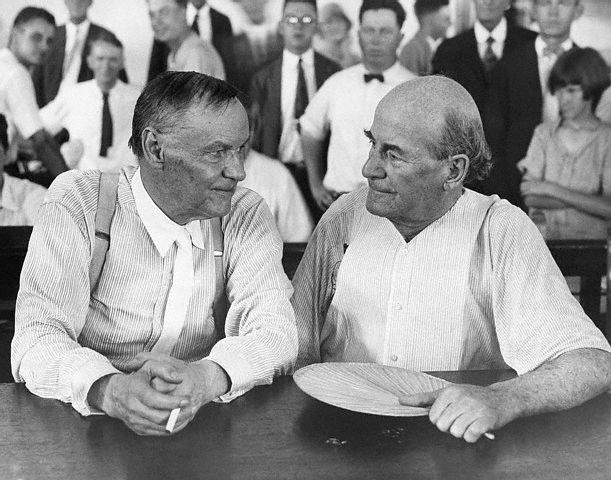
“It’s All About the Fabulous Monkey Trials That Rocked America!” screamed the tag line for Inherit the Wind, the 1960 Stanley Kramer drama about the Scopes Monkey Trial of 1926. Like most people, I always assumed that Scopes was a simple battle between evolutionists and creationists. Clarence Darrow liked logic and William Jennings Bryan hated monkeys.
But according to Stephen Jay Gould’s essay, “William Jennings Bryan’s Last Campaign,” included in the late Queens-born paleontologist’s finest collection, Bully for Brontosaurus, it wasn’t quite that simple. While anyone who has even a shred of logic in their head accepts evolution, the textbook at the center of that trial was truly odious. Tennessee high-school teacher John Scopes taught from A Civic Biology by George William Hunter, which wasn’t exactly the enlightened tome. An excerpt from Gould’s essay, in which he quotes verbatim from Hunter’s disturbing writing about the poorer classes in the United States:
Hundreds of families, such as these described above exist today, spreading disease, immorality and crime to all parts of this country. The cost to society of such families is very severe. Just as certain animals or plants become parasitic on other plants and animals, these families become parasitic on society. They not only do harm to others by corrupting, stealing or spreading disease, but they are actually protected and cared for by the state out of public money. Largely for them the poorhouse and asylum exist. They take from society, but they give nothing in return. They are truly parasites.
If such people were lower animals, we would probably kill them off to prevent them from spreading. Humanity will not allow this, but we do have the remedy of separating the sexes in asylums or other places and in various ways preventing intermarriage and the possibilities of perpetuating such a low and degenerate race.•
Tags: Clarence Darrow, George William Hunter, Stanley Kramer, Stephen Jay Gould, William Jennings Bryan
Sadly, the title gives it away.
Tags: Oliver
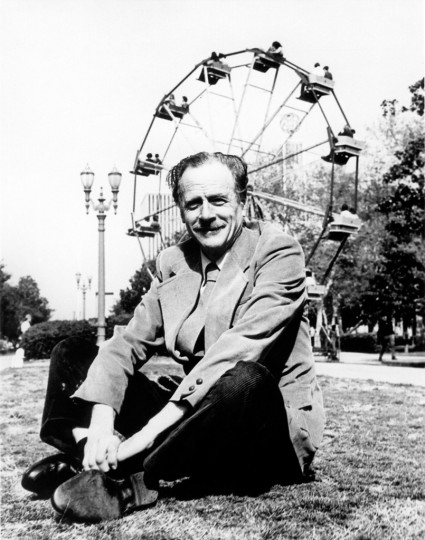
Marshall McLuhan was usually a genuinely incisive thinker and not the mountebank that some make him out to be. His writings still have a lot to teach us about the great paradigm shift we’re currently experiencing. But he was prone to sometimes wildly misread the future like anyone who constantly traffics in tea leaves. One glaring example was his prediction at the end of the 1960s that there might soon be genocide in America. In a 1969 Playboy interview, he opined that the shift from mechanical to technological culture might cause just that to occur. An excerpt:
Playboy:
What, specifically, do you think will happen to [the black man]?
Marshall McLuhan:
At best, he will have to make a painful adjustment to two conflicting cultures and technologies, the visual-mechanical and the electric world; at worst, he will be exterminated.
Playboy:Exterminated?
Marshall McLuhan:
I seriously fear the possibility, though God knows I hope I’m proved wrong. As I’ve tried to point out, the one inexorable consequence of any identity quest generated by environmental upheaval is tremendous violence. This violence has traditionally been directed at the tribal man who challenged visual-mechanical culture, as with the genocide against the Indian and the institutionalized dehumanization of the Negro. Today, the process is reversed and the violence is being meted out, during this transitional period, to those who are nonassimilable into the new tribe. Not because of his skin color but because he is in a limbo between mechanical and electric cultures, the Negro is a threat, a rival tribe that cannot be digested by the new order. The fate of such tribes is often extermination.•
Tags: Marshall McLuhan
An android police officer, Ernest Borgnine and the dad from Good Times fight crime in what appears to have been one of the dumbest TV shows ever created. Great period dialogue such as: “Man, that’s the fastest white boy I ever seen.” That line was definitely not made in reference to Borgnine.
Tags: Ernest Borgnine, John Amos, Michael Shannon
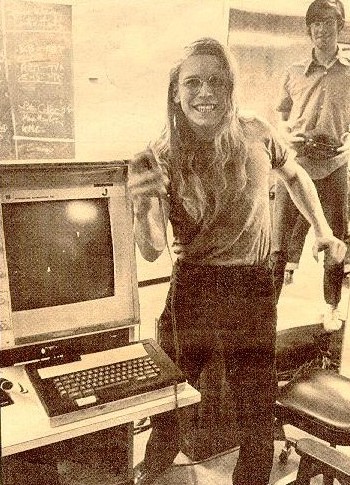
From Stewart Brand’s prophetic December 7, 1972 “Spacewar” article in Rolling Stone, about the potential ramifications of the Internet:
One popular new feature on the Net is AI’s Associated Press service. From anywhere on the Net you can log in and get the news that’s coming live over the wire or ask for all the items on a particular subject that have come in during the last 24 hours. Project that to household terminals, and so much for newspapers (in present form). Since huge quantities of information can be computer-digitalized and transmitted, music researchers could, for example, swap records over the Net with ‘essentially perfect fidelity.’ So much for record stores (in present form).•
Tags: Stewart Brand
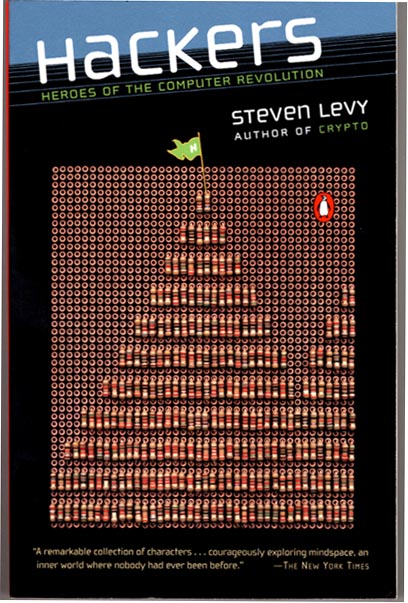
Steven Levy's next book, about Google, is to be published in 2011.
A few months ago, I excerpted a Wired article in which Steven Levy revisited some subjects profiled in his great 1984 book, Hackers: Heroes of the Computer Revolution. That book looked at the pioneers from the ’50s, ’60s, and ’70s who built the foundation of today’s interconnected technology. I’m rereading Hackers now, so I thought I’d provide a passage. This sequence is about the moment when computers passed over from institutions into the hands of Berkeley hackers. Eventually, some of the folks who cut their teeth on this XDS-940 Bay Area behemoth would help personal computing take quantum leaps forward, but initially the work was as unglamorous as it was idealistic and exciting. An excerpt:
“The first public terminal of the Community Memory project was an ugly machine in a cluttered foyer on the second floor of a beat-up building in the spaciest town in the United States of America: Berkeley, California. It was inevitable that computers would come to ‘the people’ in Berkeley. Everything else did, from gourmet food to local government. And if, in August 1973, computers were generally regarded as inhuman, unyielding, warmongering and nonorganic, the imposition of a terminal connected to one of those Orwellian monsters in a normally good-vibes zone like the foyer outside of Leopold’s Records on Durant Avenue was not necessarily a threat to anyone else’s well-being. It was yet another kind of flow to go with.
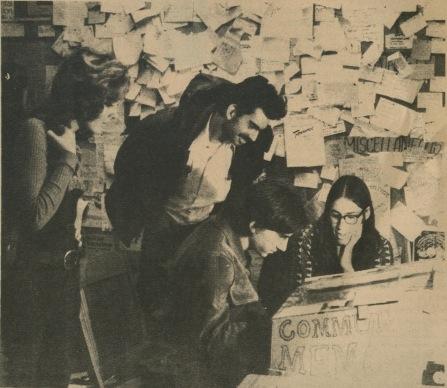
A faded photo of the Community Memory project in action in Berkeley during the 1970s.
Outrageous, in a sense. Sort of a squashed piano, the height of a Fender Rhodes, with a typewriter keyboard instead of a musical one. The computer was protected by a cardboard box casing, with a plate of glass set in its front. To touch the keys, you had to stick your hands through little holes, as if you were offering yourself for imprisonment in an electronic stockade. But the people standing by the terminal were familiar Berkeley types, with long stringy hair, jeans, and a demented gleam in their eyes that you would mistake for a drug reaction if you did not know them well. Those who did know them well realized that the group was high on technology. They were getting off like they had never gotten off before, dealing the hacker dream as if it were the most potent strain of sinsemilla in the Bay Area.
The name of the group was Community Memory, and according to a handout they distributed, the terminal was ‘a communication system which allows people to make contact with each other on the basis of mutually expressed interests, without having to cede judgements to third parties.’ The idea was to speed the flow of information in a decentralized, non-bureaucratic system. An idea born from computers, an idea executable only by computers, in this case a time-shared XDS-940 mainframe machine in the basement of a warehouse in San Francisco. By opening a hands-on computer facility to let people reach each other, a living metaphor would be created, a testament to the way computer technology could be used as guerrilla warfare for people against bureaucracies.”
Tags: Steven Levy
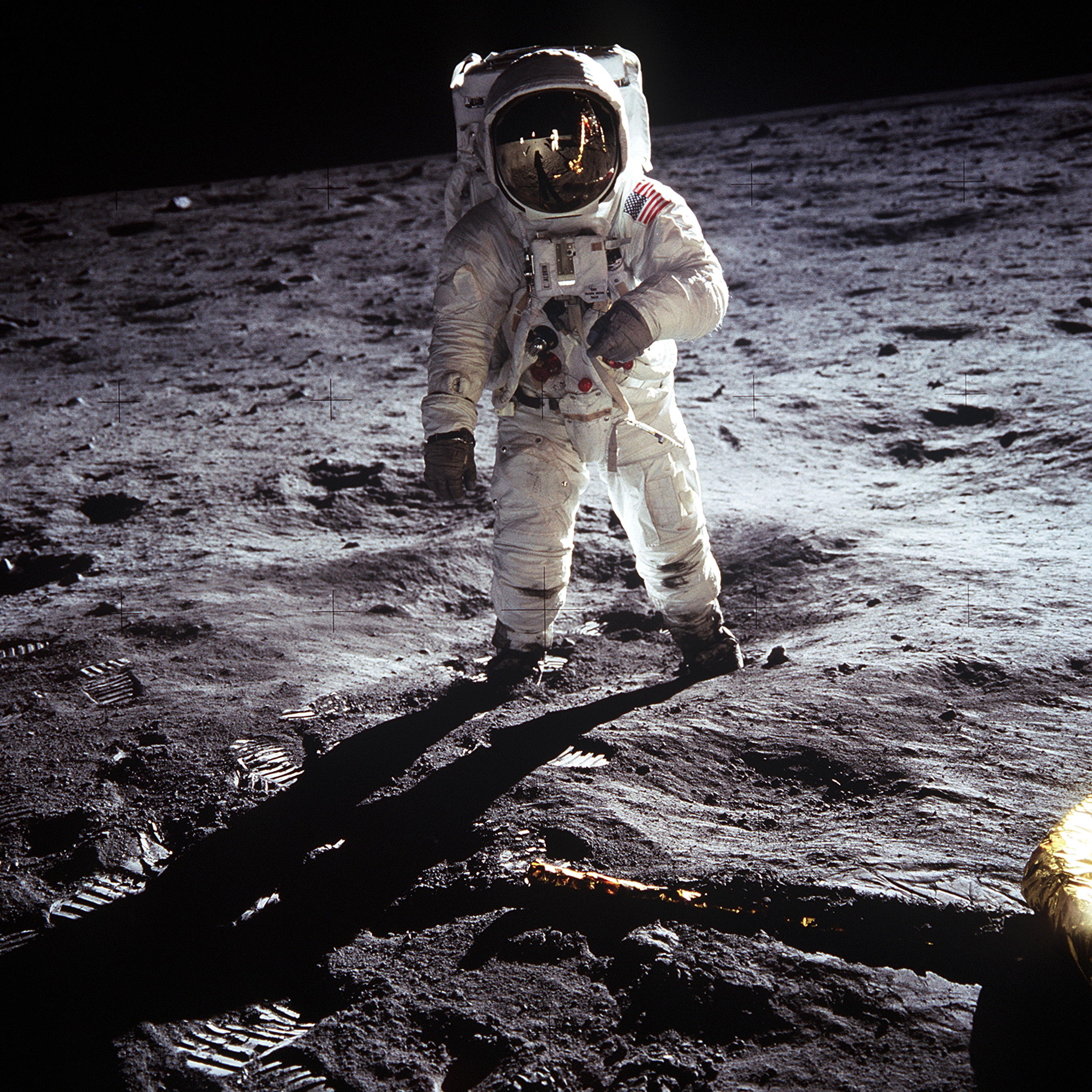
Buzz Aldrin walks on the moon on July 20, 1969. He is still alive--and dancing--while William Safire, H.R. Haldeman and President Nixon have all died.
The awesome Letters Of Note site has published a missive from July 18, 1969 that right-wing wordsmith William Safire sent to Nixon bagman H.R. Haldeman, in the event that Apollo 11 ran into difficulties and the astronauts were stranded to die on the moon. The following letter was to be read to the nation by President Nixon if such a tragedy occurred:
“Fate has ordained that the men who went to the moon to explore in peace will stay on the moon to rest in peace.
These brave men, Neil Armstrong and Edwin Aldrin, know that there is no hope for their recovery. But they also know that there is hope for mankind in their sacrifice.
These two men are laying down their lives in mankind’s most noble goal: the search for truth and understanding.
They will be mourned by their families and friends; they will be mourned by the nation; they will be mourned by the people of the world; they will be mourned by a Mother Earth that dared send two of her sons into the unknown.
In their exploration, they stirred the people of the world to feel as one; in their sacrifice, they bind more tightly the brotherhood of man.
In ancient days, men looked at the stars and saw their heroes in the constellations. In modern times, we do much the same, but our heroes are epic men of flesh and blood.
Others will follow, and surely find their way home. Man’s search will not be denied. But these men were the first, and they will remain the foremost in our hearts.
For every human being who looks up at the moon in the nights to come will know that there is some corner of another world that is forever mankind.”
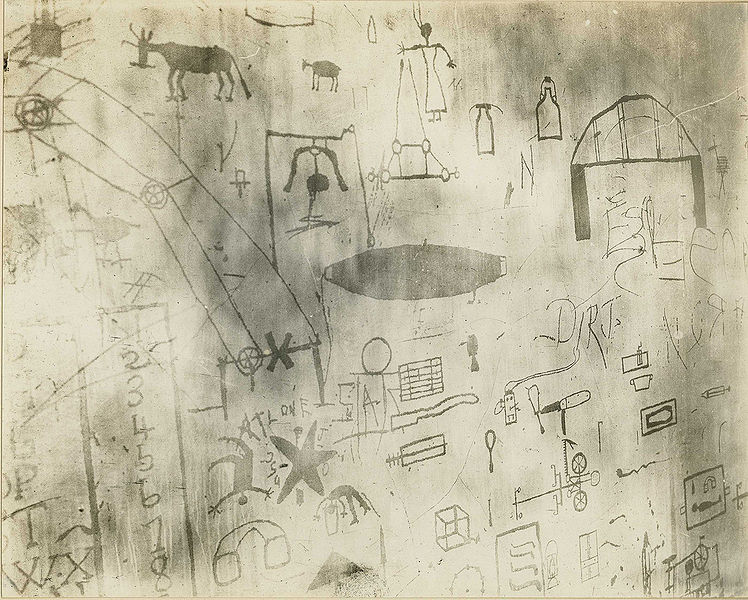
An early 20th-century schizophrenia patient used a pin or a fingernail to scratch this artwork into a hospital wall.
Schizophrenia has historically been blamed on everything from bad DNA to bad parenting (imagine the unfairness of that for a moment), but some in the scientific community are championing the idea that the illness stems from a virus that we all carry. An excerpt from a Discovery article about this theory:
“Schizophrenia is usually diagnosed between the ages of 15 and 25, but the person who becomes schizophrenic is sometimes recalled to have been different as a child or a toddler—more forgetful or shy or clumsy. Studies of family videos confirm this. Even more puzzling is the so-called birth-month effect: People born in winter or early spring are more likely than others to become schizophrenic later in life. It is a small increase, just 5 to 8 percent, but it is remarkably consistent, showing up in 250 studies. That same pattern is seen in people with bipolar disorder or multiple sclerosis.
‘The birth-month effect is one of the most clearly established facts about schizophrenia,’ says Fuller Torrey, director of the Stanley Medical Research Institute in Chevy Chase, Maryland. ‘It’s difficult to explain by genes, and it’s certainly difficult to explain by bad mothers.’
The facts of schizophrenia are so peculiar, in fact, that they have led Torrey and a growing number of other scientists to abandon the traditional explanations of the disease and embrace a startling alternative. Schizophrenia, they say, does not begin as a psychological disease. Schizophrenia begins with an infection.
The idea has sparked skepticism, but after decades of hunting, Torrey and his colleagues think they have finally found the infectious agent. You might call it an insanity virus. If Torrey is right, the culprit that triggers a lifetime of hallucinations—that tore apart the lives of writer Jack Kerouac, mathematician John Nash, and millions of others—is a virus that all of us carry in our bodies. ‘Some people laugh about the infection hypothesis,’ says Urs Meyer, a neuroimmunologist at the Swiss Federal Institute of Technology in Zurich. ‘But the impact that it has on researchers is much, much, much more than it was five years ago. And my prediction would be that it will gain even more impact in the future.'”
Tags: Fuller Torrey, Jack Kerouac, John Nash
Before we were wired beyond belief, a few hundred forward-thinking souls in San Francisco in 1981 got a jump on the future and gained access to the Examiner and Chronicle newspapers on their home computers (though it took them over two hours to receive the text of a single edition). As Steve Newman exclaims in this KRON report, “This is only the first step in newspapers by computer.” The tone of the piece suggests that newsprint might someday disappear, but that the actual newspaper companies would be fine. Of course, the rise of the Internet has been the bane of most of them, including the Examiner and Chronicle, which have both struggled while responding to the revolution that began in a small way on their home turf nearly 30 years ago.
Tags: Steve Newman
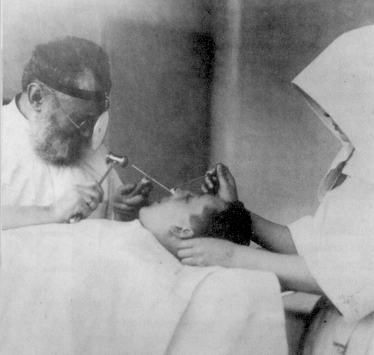
Rhinoplasty performed in Essex, Germany, in 1895. (Image by Klaus D.Peter.)
The still-novel idea of modern cosmetic surgery is enthusiastically broached in this September 24, 1896 article from the Brooklyn Daily Eagle, which was a reprinted piece from the London Mail. It’s subtitled, “Wonderful Possibilities Are Now Open to Modern Surgery.” An excerpt:
“The latest developments of modern surgical science are making it evident that good looks are no longer to be confined to those with a heritage to them, but may be purchased on the open market. It will, no doubt, be good news to the unhappy possessor of an uncompromising snub nose to be made acquainted with the fact that, for a fairly respectable sum of money, his nasal appendage can be converted into a thorough going aristocratic Wellington, with no nonsense about it, and the spinster lady, whose proboscis is of the parrot type, and whose matrimonial chances have constantly suffered, will hail with a good deal of satisfaction and possibly renewed hope the statement that a generous fee to the facial surgeon will transform the offending organ into the dearest of little Grecians in the world, while an extra payment will secure for her two or three coquettish dimples on the cheeks and chin.
The science of facial surgery is, of course, not exactly a new one. Experiments without number have been made in the London and continental hospitals for many years past. It is not very long ago that the operation of making a very decently formed nose for a young woman whose face had been mutilated in an accident was successfully performed at the Royal Free Hospital. The breastbone of a blackbird was cleverly inserted into the cartilage of the nose and the skin deftly drawn over it and sewn with such neatness that in a short time the seams made by the surgical needle completely healed.
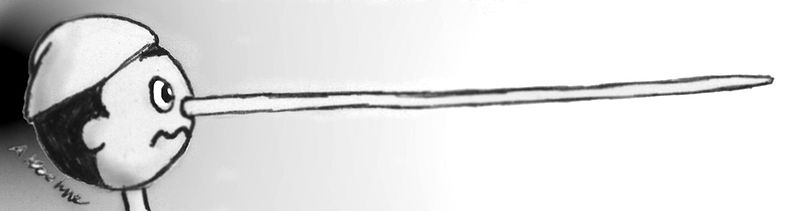
(Image by André Koehne.)
As might be expected, facial surgery came to us from America. There it is practiced in every large town, while a college for its special study exists near Philadelphia, granting diplomas and degrees for proficiency–genuine ones, too, it should be added.
That the science will make its way in England there is not much room for doubt. Already a private doctor living not a hundred miles from Bond street is making quite a reputation in the direction of facial surgery, and his handsome consulting rooms are thronged each day with crowds of wealthy patients, who are anxious to personally test his powers, and who go away eminently satisfied with themselves and convinced that if ‘beauty is but skin deep,’ it is a possession worth having, and, worth paying for.
So far, only those with the most unlimited purses are able to avail themselves of the doctor’s ability, the operations are of such a delicate nature, and require so much technical knowledge, mechanical skill, self-possession and nerve on the part of the operator, that no patient can grudge a generous fee.
The sensitive man, with a wart on the end of his nose, for instance, goes through life full of trembling self-consciousness. He feels that every glance is directed toward the terrible disfigurement, and he becomes nervously apologetic in his general bearing. Imagine what a heavenly vista of happiness and security must unfold itself to such a man, when under the magical knife, that accursed wart disappears forever, and how his gratitude can but be adequately rendered by a substantial expression of it.
 Electricity is a useful help to the facial surgeon, and by its aid all kinds of minor blemishes are removed, and tell-tale red noses completely cured.
The only drawback to obtaining a really complete transformation is the possibility of the question of identification arising. One can imagine the unenviable position of the man who, in the absence of his wife and family at the seaside, takes the opportunity of considerably improving his appearance by exchanging a somewhat bulbous nose of a deep shade for one of clear-cut and classical proportions, being confronted with the unfeigned astonishment of the partner of his bosom, and, perhaps. repudiated as ‘not being the man who led her to the altar!’ Such a situation would not be an easy one to solve. The advantages of the science, however, undoubtedly greatly outweigh its disadvantages.”
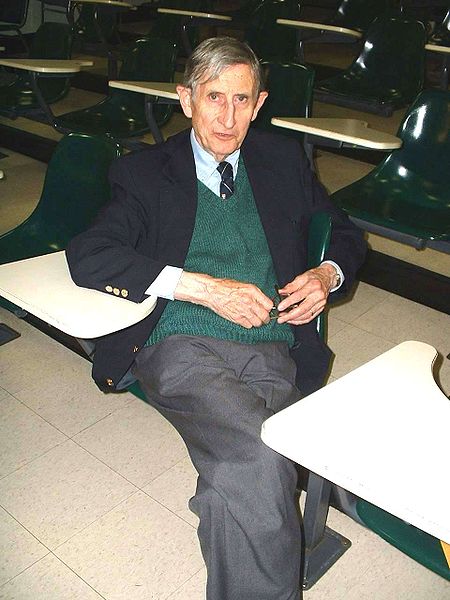
"Dyson and his colleagues did not want to delegate; they intended to go bombing into space themselves." (Image by Lumidek.)
Kenneth Brower has an article in The Atlantic in which he tries to get to the bottom of Freeman Dyson’s troubling views about climate change and environmental responsibility, terrain previously covered by the Times Magazine. The piece has some great info about how Dyson and a group of fellow scientists hoped five decades ago to blast themselves to Mars and Saturn with a nuclear-powered rocket, a plan that had to be scrapped after the signing of the Limited Test Ban Treaty in 1963. An excerpt:
“The period of his career that Dyson remembers most happily, the endeavor during which he believes he learned the most, began the year after Sputnik. In 1958, he took a leave of absence from the Institute for Advanced Study and moved to La Jolla, California, where he joined Project Orion, a group of 40 scientists and engineers working to build a spacecraft powered by nuclear bombs. The Orion men believed that rocketry was hopeless as a means of settling the universe. Only nuclear power had sufficient bang to propel the requisite payloads into space. The team called the concept ‘nuclear-pulse propulsion.’ From a hole at the center of a massive ‘pusher plate’ at the bottom of the craft, atom bombs would be dropped at intervals and detonated. The shock wave and debris from each blast would strike the pusher plate, driving the ship heavenward on a succession of blinding fireballs. Shock absorbers the size of grain silos would cushion the cabin and crew, smoothing out the cataclysmic bumpiness of the ride.
To the layperson, this seems exactly the sort of contraption that Wile E. Coyote, in his efforts to overtake Road Runner, habitually straps on before self-immolation. But the layperson is wrong, apparently. Specialists in the effects of nuclear explosions saw no reason Orion would not work. The Advanced Research Projects Agency, the precursor to NASA, underwrote the project, then NASA took it on, and nuclear-pulse propulsion briefly held its own against the chemical rockets of Wernher von Braun. Dyson and his colleagues did not want to delegate; they intended to go bombing into space themselves. Their schedule had them landing on Mars by 1965 and Saturn by 1970.”
Tags: Freeman Dyson, Kenneth Brower

"Don't follow leaders/Watch your parkin' meters." (Image by Quadell.)
In an article on Slate about the obsolescence of traditional parking meters, Tom Vanderbilt, author of Traffic, reveals where, when and why the device originated. An excerpt:
“Seventy-five years ago, the world’s first parking meter cast its thin, ominous shadow on the streets of Oklahoma City. The meter was the brainchild of Carlton C. Magee, a local publisher and Chamber of Commerce Traffic Committee chief, and he hoped it would solve the city’s chronic parking problems. In the pre-meter days, police would drive around with stopwatches and chalk, enforcing the city’s parking time limits by marking the tires of cars seen squatting for too long, but the system was ill-equipped to handle the ‘endemic overparking’ problem. Even worse, a survey found that at any given time, 80 percent of the city’s spots were occupied by employees of downtown businesses—the very same businesses complaining that lack of parking was driving away shoppers. Calling for an ‘efficient, impartial, and thoroughly practical aid to parking regulation,’ Magee held a student-design contest and launched his instrument.”
Tags: Carlton C. Magee, Tom Vanderbilt

Head is burning. (Image by Ferdinand Reus.)
The Telegraph has an article listing the ten weirdest scientific facts. (Thanks Newmark’s Door.) An excerpt:
“If the Sun were made of bananas, it would be just as hot.
The Sun is hot, as the more astute of you will have noticed. It is hot because its enormous weight – about a billion billion billion tons – creates vast gravity, putting its core under colossal pressure. Just as a bicycle pump gets warm when you pump it, the pressure increases the temperature. Enormous pressure leads to enormous temperature.
If, instead of hydrogen, you got a billion billion billion tons of bananas and hung it in space, it would create just as much pressure, and therefore just as high a temperature. So it would make very little difference to the heat whether you made the Sun out of hydrogen, or bananas, or patio furniture.”

Margaret Knight's paper bag innovations made her (likely) the first woman granted a U.S. patent.
Research at MoMA’s Counter Space blog has uncovered the 19th-century inventors who created various aspects of the brown paper bag, which we take for granted when we’re at the supermarket. If you think about it, the design, elegant and sturdy, is just about perfect. (Thanks Kottke.) An excerpt from the blog post:
“Francis Wolle, active in the early 1850s, is considered the first inventor of the modern paper bag. Based in Pennsylvania, he cofounded the Union Paper Bag Machine Company in 1869, as well as becoming ordained as a deacon and following passions in entomology and botany. Union was supported financially by wealthy manufacturers, who thereby secured rights to patents secured by the company and divvied up the country into market segments to avoid direct competition. One of these characters was industrialist George West of Saratoga County, New York, also known as the ‘Paper Bag King.’ Originally from England, he established himself in Ballston Spa, owned ten paper mills, and became a member of the New York State Assembly and the House of Representatives.
It was slightly later that a woman named Margaret Knight, working for another company, the Columbia Paper Bag Company of Springfield, MA, designed a machine that could produce flat/square-bottomed paper bags, a great improvement on the earlier, structurally weaker envelope-style bag design. As a result, it is Knight who is more widely recognized as the inventor of the paper bag in the general form of the one shown in Counter Space. She’s also believed to be the first woman to achieve a U.S. patent.
However, our paper bag also reflects the design developments of the following years (starting around 1883) made by Charles Stilwell of Massachusetts/Pennsylvania (originally Fremont, Ohio), who improved on Knight’s machine to produce flat-bottomed paper bags—now with pleated sides for easier folding and stacking (satchel-style)—more quickly and cost-effectively. This type was given the nickname ‘S.O.S.’ (self-opening-sack), and really provided the model for the mass-produced paper bags we know today.”
Tags: Charles Stilwell, Francis Wolle, George West
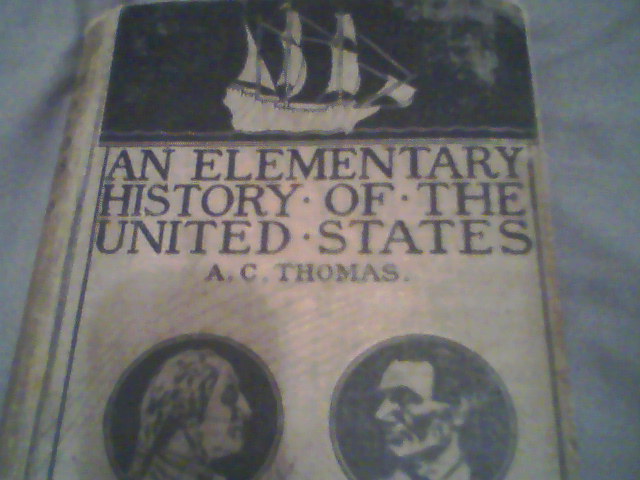
I briefly got my hands on a hardback copy of Allen C. Thomas’ 1900 primary-school book, An Elementary History of the United States, which covers the years from pre-Columbus times to the eve of the 20th-century. Thomas was a history professor at Haverford College. This book was owned in 1919 by a child named Bruce Alexander, who drew a red mustache on the illustration of George Washington.
One of the later chapters, entitled “Inventions,” recalls how Samuel Morse helped create the telegraph during the 1830s and 1840s. An excerpt:
“Morse at once saw that messages could be sent at great distances if wires were properly arranged. His invention was very simple, and there was very little about it that was original. After it was described, it seemed strange that scientific men had not thought of his method before.
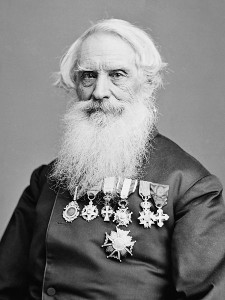
"Samuel F.B. Morse, an American artist, became much interested in electricity and magnetism."
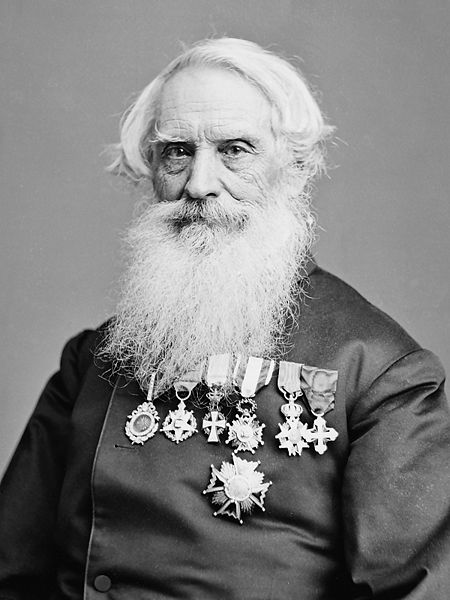
Morse, like almost all inventors, had much to contend with. He was poor, and had it not been for a young man named Alfred Vail, who persuaded his father to lend Morse some money, it is quite possible that there would have been failure after all.
Vail was an excellent mechanic, and helped very much in the construction of the instruments. He also secured for Morse a patent for the invention.
In order to bring his invention before the public, Morse asked Congress, at Washington, to give thirty thousand dollars, to be used in constructing a telegraph line between Baltimore and Washington, a distance of forty miles. Some members of Congress made all manner of sport of Morse’s project. One member proposed that the money should be spent in making a railroad to the moon.
There seemed little prospect that the bill granting the money would be passed. The story is told that Morse, weary and heart-sick, sat hour after hour in the gallery of the Senate Chamber, waiting for the bill to come up before Congress adjourned. When evening came and there seemed no chance for its passage, he went to his hotel utterly discouraged, and prepared to leave for New York early the next day, as his money was exhausted.
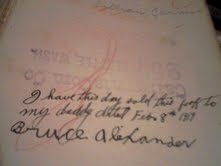
Written on inside cover: "I have this day sold this book to my daddy dated Feb. 8th 1919. Bruce Alexander."
The next morning, while he was at breakfast, a young lady came in and said, ‘I congratulate you.’ ‘Upon what?’ said Morse, who was feeling rather blue. ‘On the passage of your bill.’ ‘Impossible.’ ‘No,’ she said, ‘It was passed five minutes before the adjournment.’ ‘Well,’ said Morse, ‘you shall send the first message over the lines.’
The line was constructed with the money thus secured. When all was ready Morse kept his promise, and Miss Annie G. Ellsworth sent, at the suggestion of her mother, the words, ‘What hath God wrought!’ That was on May 25, 1844. It was not many years before there were telegraphs over all civilized lands.”
Tags: Alfred Vail, Allen C. Thomas, Annie G. Ellsworth, Bruce Alexander, George Washington, Samuel Morse
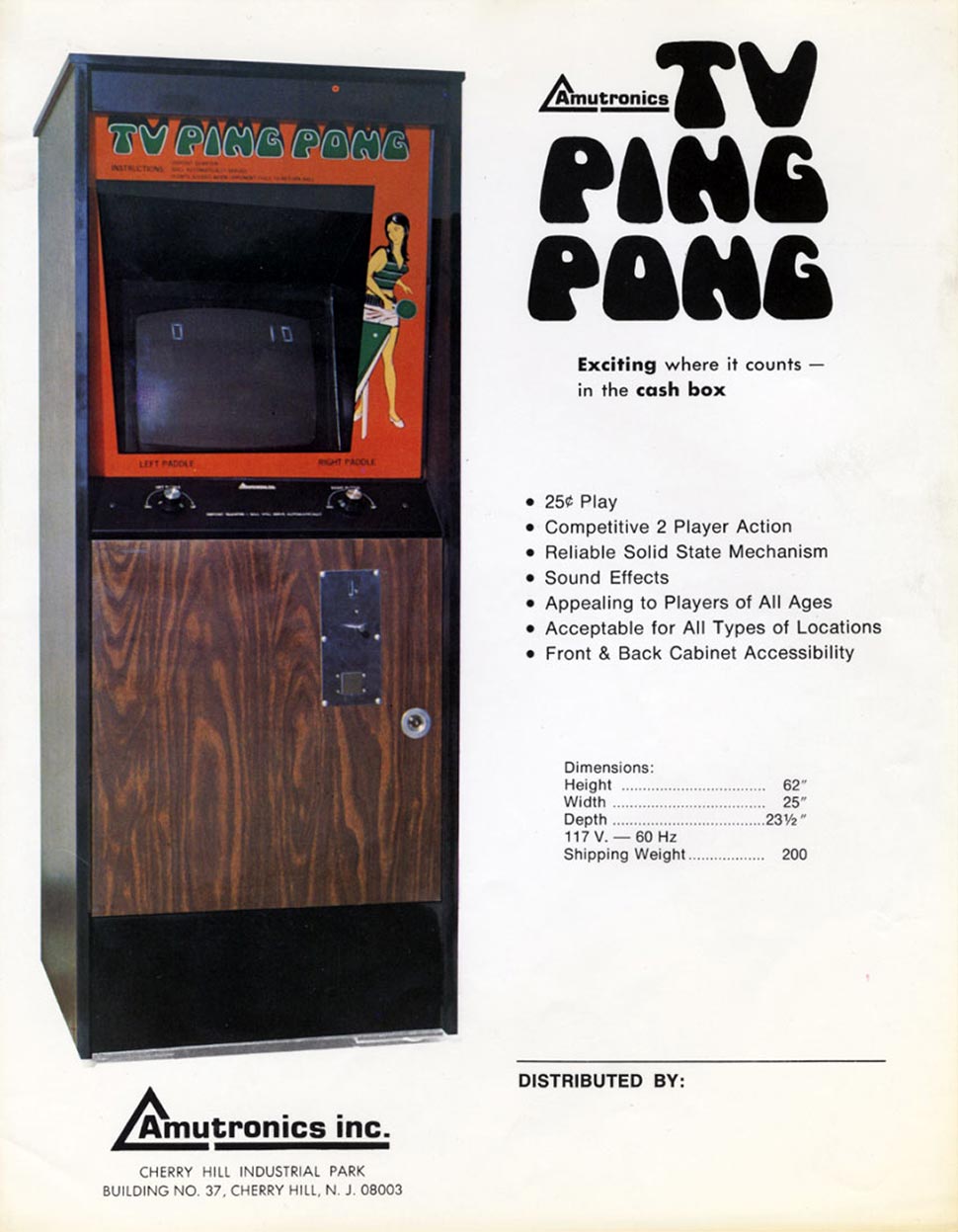
Pong was based on the Magnavox Odyssey, which was an analog home system that ran on batteries.
Boing Boing has published a great collection of old print ads for Pong (and its many knockoffs), the game that kicked off the digital quarter-sucking arcade craze. The site also provides historical context. An excerpt:
“In September 1972, Atari’s Nolan Bushnell and Allan Alcorn installed the prototype Pong machine at Andy Capp’s Tavern in Sunnyvale, California. The idea was to make a computer game that was ‘so simple that any drunk in any bar could play.’ And boy, did they ever.

Now, was Pong a hit because America loved Ping Pong so much that they wanted to play it on TV too? Or as media theorist Douglas Rushkoff has said, was it empowering because finally anyone could control what was on the TV? Either or neither way, people lined up for their chance to ‘Avoid missing ball for high score,’ as per the machine’s only instructions. Within just a few months, the Pong clone wars had begun.
Atari didn’t have the patent on the technology and very quickly the vast majority in the machines eating quarters around the country were knock-offs. Of course, Pong itself was ‘inspired’ by an electronic ping pong game that was in the Magnavox Odyssey home system. To keep up, Bushnell continued to innovate, as did everyone else. Call it a volley between King Pong and his brethren, while an invasion from space was on its way.”
Tags: Allan Alcorn, Nolan Bushnell
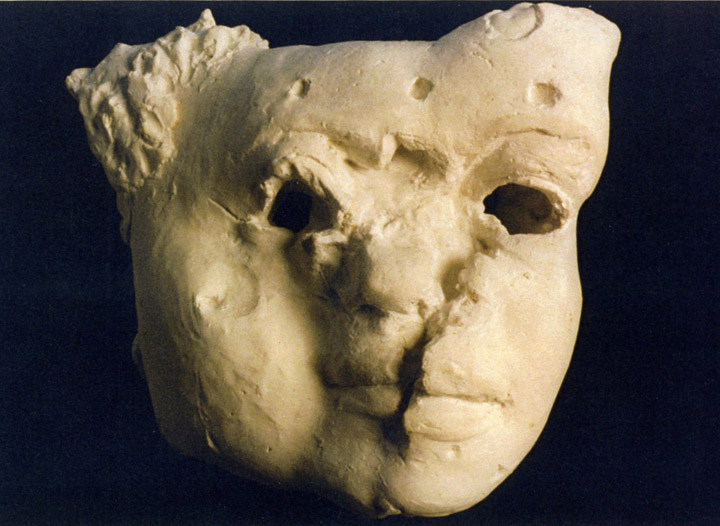
One of Frank Bender's many haunting sculptures.
Longform pointed me to a fascinating 2008 Telegraph article about the Vidocq Society, a Philadelphia-based organization, made up of volunteer law-enforcement professionals, many of them retired, who meet for lunch once a month and solve cold cases that have baffled local police across the country.
A founding member of the Vidocq Society who’s not a detective is the artist Frank Bender, who discovered an unlikely gift for crimefighting many years ago while studying anatomy at a morgue. An excerpt:
“Bender, 67, is a small, animated man with a snow-white beard and a constant twinkle in his eye. He now works as a sculptor and watercolorist, but at one time or another has been an advertising photographer and a commercial diver inspecting the hulls of tugboats in Philadelphia harbour. He fell into catching criminals by accident: In 1975 he was taking evening courses in painting at the Academy of Fine Arts in Philadelphia. To help him see ‘in the round’ he started attending sculpture classes, but there were no anatomy lessons available to evening students, so a friend in the medical examiner’s office offered to let him sit in on some autopsies to learn about the human form. ‘I go to the morgue. He shows me around. Bodies had been cut up, burnt. They had this one woman,’ Bender says, ‘her whole body was decomposed, they didn’t know what she had looked like or who she was.’
The woman had been shot in the head, the bullet smashing her skull open, but Bender told his friend, ‘just out of conversation’, that he could show him what the woman had looked like, and recreate the features of her face in a sculpture.
‘I just knew what people looked like,’ Bender tells me when we meet at his studio. Five months later the woman was identified from Bender’s bust as Anna Duval, an Arizona woman who had come to Philadelphia to collect money on a property deal that had gone sour. She had been executed by a Mafia contract killer who would not be convicted of the murder for another 20 years.
Bender had discovered an apparently intuitive gift for facial reconstruction and, as word spread of his success, was called first to work on more ‘skull-to-face’ cases; later, he began creating aged renderings for the FBI and Federal Marshals Service to help them find fugitive criminals.”
Tags: Frank Bender

Navajo reservations are one of the areas hard hit by unchecked infectious disease. (Image by jclarson.)
Miller-McCune has an incredibly distressing report about diseases, usually associated with third-world nations, that are flourishing in the poverty-stricken areas of the United States. They keep poor people within a cycle of poverty, and worse yet, epidemiologists at the Center for Disease Control haven’t been tracking the illnesses. (Thanks Instapaper.) An excerpt:
“Millions of poor Americans living in distressed regions of the country are chronically sick, afflicted by a host of hidden diseases that are not being monitored, diagnosed or treated, researchers say.
From Appalachia to the Mississippi Delta to the segregated inner cities of the Great Lakes and Northeast, they say, and from Navajo reservations to Latino communities along the U.S.-Mexico border, more than 20 chronic diseases are promoting the cycle of poverty in conditions of inadequate sanitation, unsafe water supplies and rundown housing.
‘These are forgotten diseases among forgotten people,’ said Peter Hotez, a microbiologist at George Washington University, president of the Washington, D.C.-based Sabin Vaccine Institute and co-founder of the institute’s Global Network for Neglected Tropical Disease Control. ‘If these were diseases among middle-class whites in the suburbs, we would not tolerate them. They are among America’s greatest health disparities, and they are largely unknown to the U.S. medical and health communities.’”
Tags: Peter Hotez
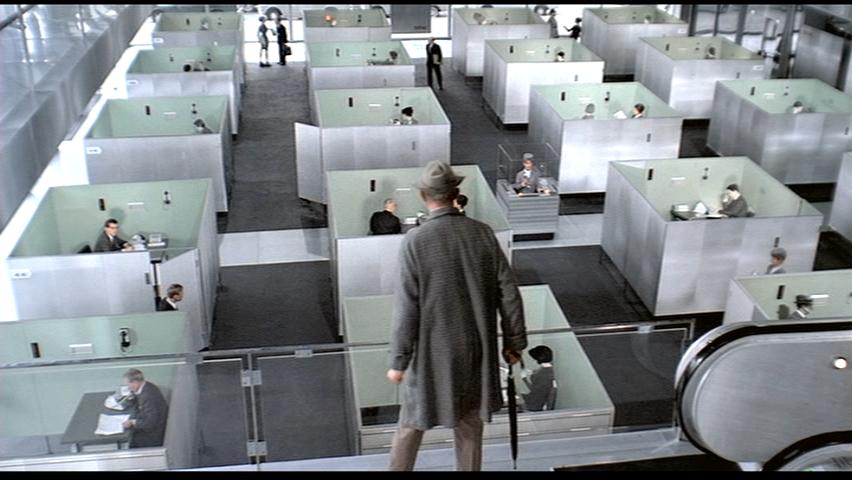
A film of protest but also one of reconciliation, Playtime is not only Jacques Tati’s masterpiece but also one of the biggest-hearted comedies ever made. Tati’s bumbling alter ego, Monsieur Hulot, is a man out of time, having grown at odds with Paris in the 1960s, with the arrival of modernity and technology. He staggers through a maze of confounding architecture, design and attitudes in a city he can no longer call his own.
Hulot attempts to visit a government official but grows discombobulated by the building’s odd furniture and space-age gadgets and winds up in a series of misadventures. He careers from an exposition of whirring products to a soulless, luxe apartment building to an excursion with a tourist group from America. Each sequence is beautifully calibrated so that Hulot is at the mercy of modern technology, as if he were Chaplin stuck in the gears of really well-designed machinery.
But all is not lost. One American tourist who hopes to experience the “real Paris” sees in Hulot a throwback to a grander time, and he begins to view the city with her enthusiasm. Together they find some magic in the margins, and Hulot learns how someone can more than make do even when it seems like he might be done.•
Tags: Jacques Tati