Science/Tech

You are currently browsing the archive for the Science/Tech category.

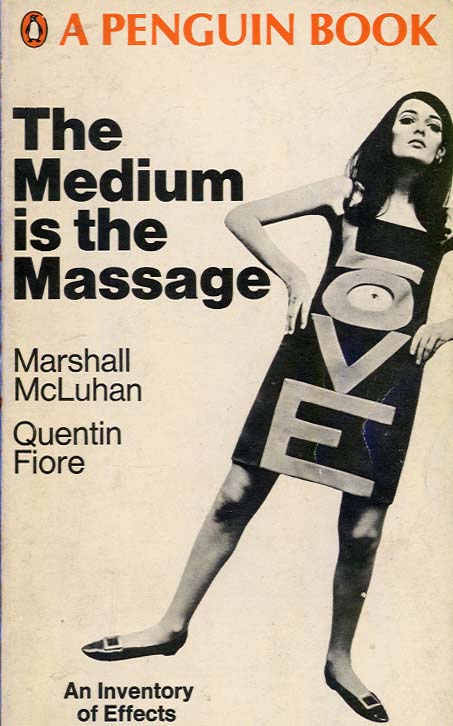
Quentin Fiore, the graphic designer who created the book's amazing look, is now 90.

Facebook wunderkind Mark Zuckerberg being named Time magazine’s Person of the Year made me recall an ominous passage from early in The Medium Is The Massage: An Inventory of Effects, from 1967. Not that I think that things are quite this dire, but Marshall McLuhan was pretty prophetic here. An excerpt:

“How much do you make? Have you ever contemplated suicide? Are you now or have you ever been…? I have here before me…Electrical information devices for universal, tyrannical womb-to-tomb surveillance are causing a very serious dilemma between our claim to privacy and the community’s need to know. The older, traditional ideas of private, isolated thoughts and actions–the patterns of mechanistic technologies–are very seriously threatened by new methods of instantaneous electric information retrieval by the electrically computerized dossier bank–that one big gossip column that is unforgiving, unforgetful and from which there is no redemption, no erasure of early ‘mistakes.’ We have already reached a point where remedial control, born out of knowledge of media and their total effects on all of us, must be exerted. How shall the new environment be programmed now that we have become so involved with each other, now that all of us have become the unwitting work force for social change? What’s that buzzzzzzzzzzzzzzzzzzzzzzzzzzzzzzzzing?”

Tags: , ,

As the mouse is replaced by the touch-pad in the contemporary world of computing, let’s look back to San Francisco in 1968 when the first mouse was given a demo by its inventor, Douglas Engelbart. “I don’t know why we call it a mouse,” he said. “It started that way, and we never did change it.” From Engelbart’s ibiblio entry:

Douglas Engelbart has always been ahead of his time, having ideas that seemed far-fetched at the time but later were taken for granted. For instance, as far back as the 1960s he was touting the use of computers for online conferencing and collaboration. Engelbart’s most famous invention is the computer mouse, also developed in the 1960s, but not used commercially until the 1980s. Like Vannevar Bush and J.C.R. Licklider, Engelbart wanted to use technology to augment human intellect. He saw technology, especially computers, as the answers to the problem of dealing with the ever more complex modern world and has dedicated his life to the pursuit of developing technology to augment human intellect.”

Tags: , ,

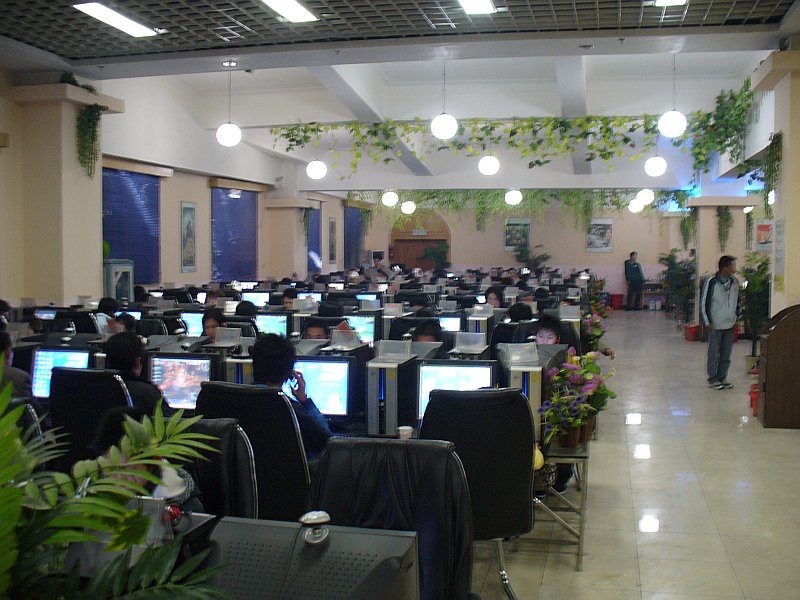
Because of marathon gaming sessions at Internet cafes in China, the gov’t banned all teens from the establishments. Image by Matthew Lyons/Game Gavel https://gamegavel.com.

Some parents in China became alarmed in recent years by their children overindulging in web-related activities, particularly marathon gaming sessions. That led to a market arising in Internet-addiction boot camps, and as often is the case, the cure was worse than the “disease.” Electroshock therapy was just the beginning of the madness. An excerpt from Christopher S. Stewart’s article on the topic  in Wired:

“One of the first signs that things had gotten out of hand in China’s Internet-addiction camps was the emergence of Uncle Yang — Yang Yongxin — a psychiatrist who opened a treatment center at a state-owned hospital in eastern Shandong Province in 2006. His camp was one of hundreds that had sprung up in China — many of them unregulated, uncredentialed, and relying on a grab bag of treatments: antidepressants, counseling, even intense physical exertion. (One sent its young clients on a 528-mile trek through Inner Mongolia.) What began as a fairly well-regarded and disciplined approach had spun into a growth industry, packed with untrained entrepreneurs.

Yang’s battery of therapies included electroshock — known as xing nao, or ‘brain waking.’ Electrodes were attached to his patients’ hands and temples, then shot through with 1 to 5 milliamps of electricity. One girl recalled wearing a mouth guard to prevent her from biting off her tongue. Some sessions apparently went on for a half hour; occasionally, a shock was said to leave burns. In an interview with a local paper, Yang defended the practice, saying, ‘It doesn’t cause any damage to the brain. But it is painful, quite painful!’

Yang was not a psychotherapist, nor was he licensed to administer electroshock. But that didn’t matter. He claimed to know what he was doing. ‘It will clear the mind,’ he promised. He charged almost $900 per month — a remarkable sum for a country in which the average monthly wage is around $400. Still, some 3,000 desperate parents sent their kids to him for four-month stints. The media hailed Yang as a ;national Web-addiction expert,’ recounting his heroic tales of life at his rehab center. Even after Yang’s methods were deemed excessive — in July, Chinese authorities banned electroshock as an Internet-addiction treatment, claiming the tactic required further study — his services were reportedly still in demand.”

Tags: ,

The introduction of push-button telephones at the 1962 World’s Fair in Seattle.

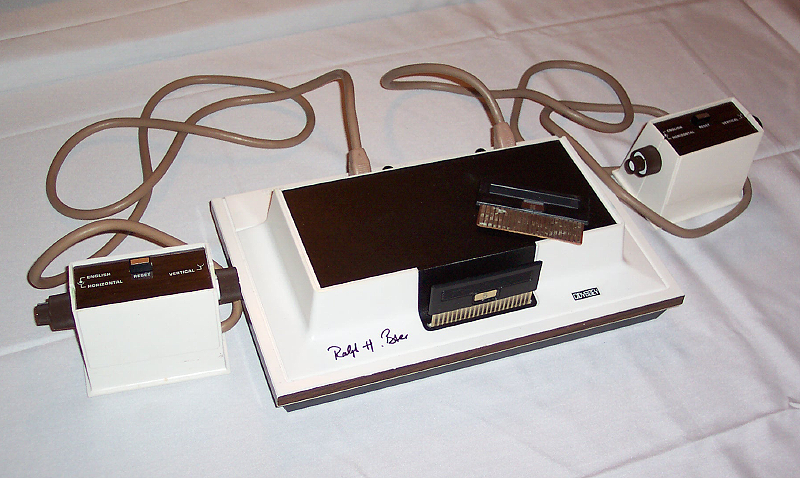
As this 1973 television commercial clearly illustrates, the first home video game console, the Magnavox Odyssey, was incredibly lame. There were no graphics for backgrounds, so you had to attach some sort of plastic sheet to your TV screen, and then you got to move around some sickly looking dots with a controller. But designer Ralph Baer‘s pioneering efforts were still incredible. His prototype (“brown box”) is today housed at the Smithsonian.

Ralph Baer autograph on lower left side of console. (Image by Wgungfu at en.wikipedia.)

Tags:

I was browsing Ray Kurzweil’s site and found a posting of predictions for the 21st century that the late science-fiction writer Arthur C. Clarke made back in 2001. Clarke, of course, gave us HAL, the rebellious computer from the 1968 novel, 2001: A Space Odyssey. Clarke made one mistake with his list: He gave specific dates when events would occur. That renders most of his predictions from the first decade of the century incorrect. But it might just mean that he is 20 or 50 or 80 years premature. Some of his predictions:

2009: A city in a third world country is devastated by an atomic bomb explosion.

2009: All nuclear weapons are destroyed.

2010: Despite protests against “big brother,” ubiquitous monitoring eliminates many forms of criminal activity.

2013: Prince Harry flies in space.

2019: There is a meteorite impact on Earth.

2020: Artificial Intelligence reaches human levels. There are now two intelligent species on Earth, one biological, and one nonbiological.

2021: The first human landing on Mars is achieved. There is an unpleasant surprise.

2023: Dinosaurs are cloned from fragments of DNA. A dinosaur zoo opens in Florida.

2040: The concept of human “work” is phased out.

2095: A true “space drive” is developed. The first humans are sent out to nearby star systems already visited by robots.

2100: History begins.

Tags: , , ,

Panels covered with photovoltaic cells. (Image by Björn Appel.)

Swedish architect and urban planner Mans Tham has a great idea for the Los Angeles freeways, but it really should apply to highways and building rooftops in every metropolitan area. Tham has proposed that L.A. incorporate photovoltaic cells (or solar cells) into its freeways in order to turn them into urban power plants. From a story on Autosinthenews:

“In an effort to make freeways more attractive and functional, Tham would like to see Los Angeles’ famed highways covered in photovoltaic cells to power the very city the freeway bisects.

Aside from providing extra electricity to cities throughout the region, the proposal could ‘bring green-tech jobs for farming, harvesting and processing to the very neighborhoods that today are the most disadvantaged by their proximity to the freeway.’

Tham estimates that if the Santa Monica Freeway was covered with solar panels between downtown L.A. and the coastline, it could provide 115 MW — enough electricity to power the needs of a city like Venice, California.

‘The possibility of producing energy within the city is much better than ruining a desert for a solar farm and then losing energy on expensive transmission lines,’ said Tham. ‘By letting infrastructure be a visually powerful part of the city, inside and out, its citizens are allowed to understand and cherish the complexity of their daily urban life.’”

Tags:

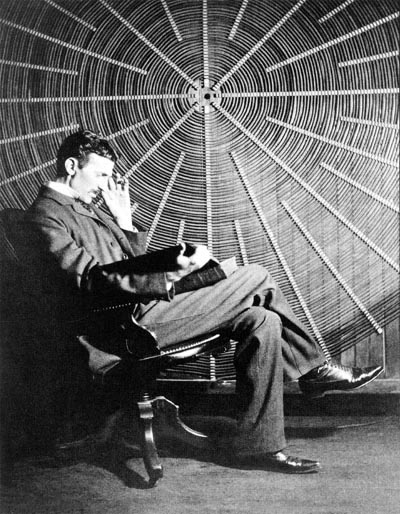
It was common knowledge in the 19th century: Thomas Edison was the far greater businessperson, but Nikola Tesla was the far greater genius. It must be noted, however, that Tesla wasn’t a genius at getting his ass to jury duty. A brief notice from the October 7, 1902 Brooklyn Daily Eagle:

For failing to answer to a summons for jury duty, Nikola Tesla, the electrician, was fined $100 by Judge Foster in General Sessions Manhattan this morning. Unless the electrician can give a good reason for his failure to appear in court he will have to pay the fine, the only other alternative being imprisonment in Ludlow street jail.”

Tags: ,

"Makes a great unusual gift." (Image by Joe Mabel.)

antique 100yr old taxidermy bug collection – $250 (Bellrose)

Makes a great unusual gift in original case circa 1900s an extensive collection of large beetles and bugs. Very interesting.

From the Voigt Lab site: "We are developing a basis by which cells can be programmed like robots to perform complex, coordinated tasks." (Image by Dr. Edwin P. Ewing, Jr. )

At Dailytech, Jason Mick has a smart article about scientists using E. Coli bacteria in the place of electriconic currents to operate microcomputers, which is the first time living organisms have been utilized in this way. An excerpt:

“In a newly published study in the journal NatureChristopher A. Voigt, PhD, and his colleagues at the University of California San Francisco, demonstrated how intercellular communications between genetically modified E. Coli bacteria could act as a crude computer.

The result is that bacteria can be enslaved to become part of a hive mind computer, performing the will of a central controller. Professor Voigt describes, ‘We think of electronic currents as doing computation, but any substrate can act like a computer, including gears, pipes of water, and cells.  Here, we’ve taken a colony of bacteria that are receiving two chemical signals from their neighbors, and have created the same logic gates that form the basis of silicon computing.’

Professor Voigt’s team is currently working towards building a bacteria computer capable of accepting commands in a formal language system, similar to how modern computers receive commands in assembly (translated to machine) language.”

Tags: ,

“What’s wrong with education cannot be fixed with technology.” (Image by Matthew Yohe.)

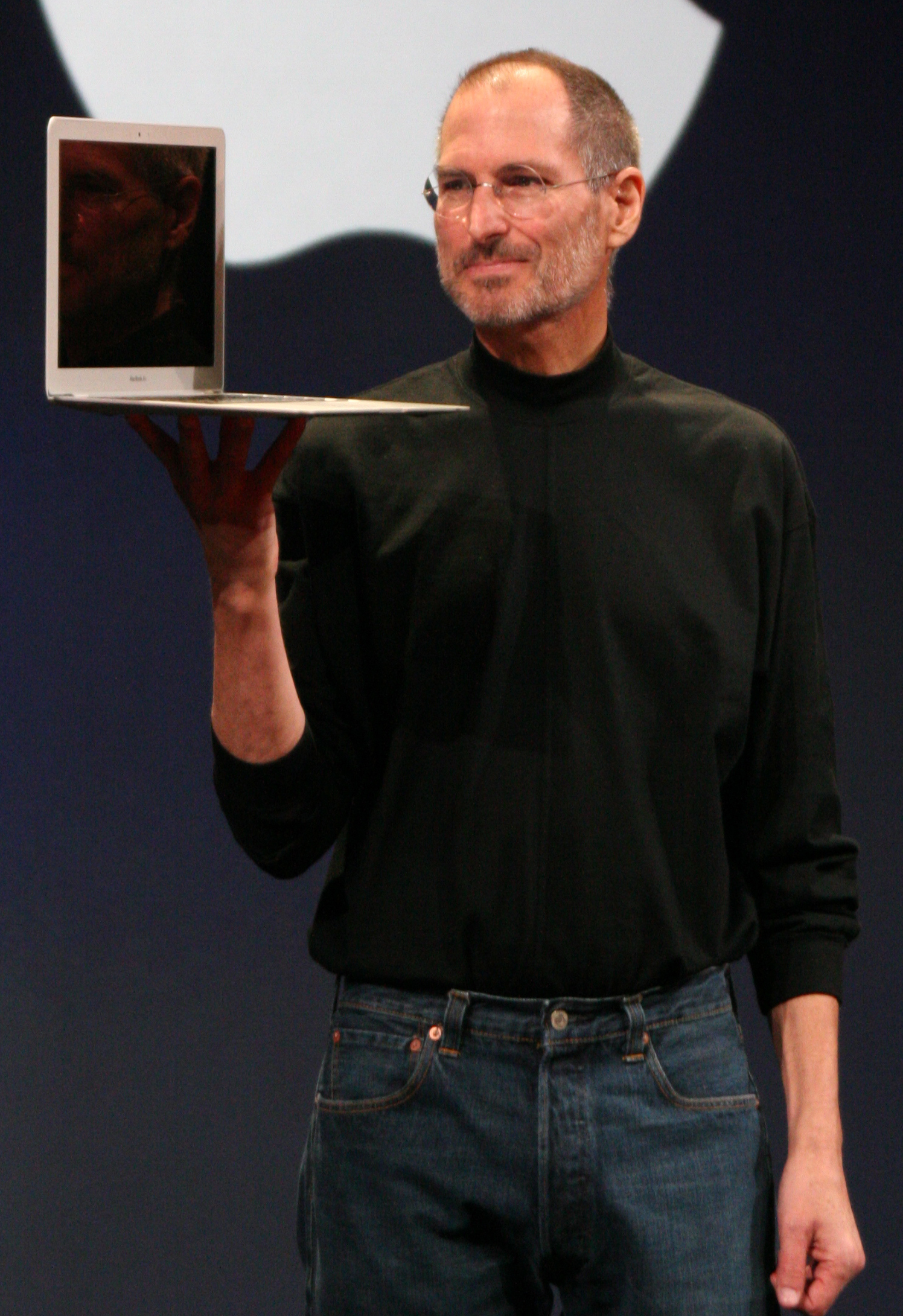
In a 1993 Wired interview conducted by Gary Wolf, Steve Jobs discussed the intersection of technology and education. I think what he said then about education in America is just about as true now, which is sad because it speaks to how little progress we’ve made. An excerpt:

Wired: Could technology help by improving education?

Steve Jobs: I used to think that technology could help education. I’ve probably spearheaded giving away more computer equipment to schools than anybody else on the planet. But I’ve had to come to the inevitable conclusion that the problem is not one that technology can hope to solve. What’s wrong with education cannot be fixed with technology. No amount of technology will make a dent.

It’s a political problem. The problems are sociopolitical. The problems are unions. You plot the growth of the NEA [National Education Association] and the dropping of SAT scores, and they’re inversely proportional. The problems are unions in the schools. The problem is bureaucracy. I’m one of these people who believes the best thing we could ever do is go to the full voucher system.

I have a 17-year-old daughter who went to a private school for a few years before high school. This private school is the best school I’ve seen in my life. It was judged one of the 100 best schools in America. It was phenomenal. The tuition was $5,500 a year, which is a lot of money for most parents. But the teachers were paid less than public school teachers – so it’s not about money at the teacher level. I asked the state treasurer that year what California pays on average to send kids to school, and I believe it was $4,400. While there are not many parents who could come up with $5,500 a year, there are many who could come up with $1,000 a year.
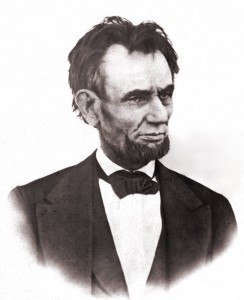


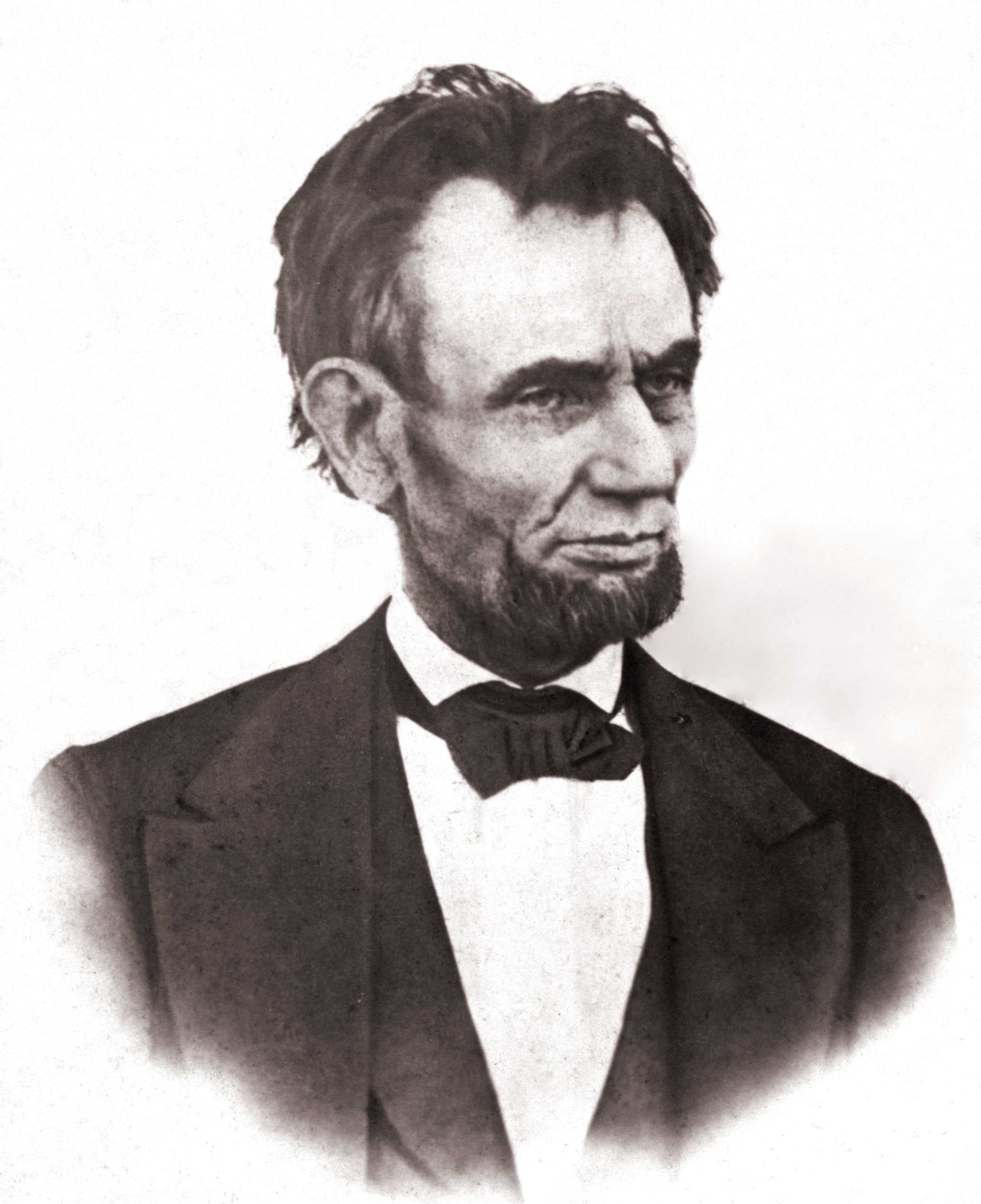
“Lincoln did not have a Web site at the log cabin where his parents home-schooled him, and he turned out pretty interesting.” (Image by Henry F. Warren.)

If we gave vouchers to parents for $4,400 a year, schools would be starting right and left. People would get out of college and say, ‘Let’s start a school.’ You could have a track at Stanford within the MBA program on how to be the businessperson of a school. And that MBA would get together with somebody else, and they’d start schools. And you’d have these young, idealistic people starting schools, working for pennies.

They’d do it because they’d be able to set the curriculum. When you have kids you think, What exactly do I want them to learn? Most of the stuff they study in school is completely useless. But some incredibly valuable things you don’t learn until you’re older – yet you could learn them when you’re younger. And you start to think, What would I do if I set a curriculum for a school?

God, how exciting that could be! But you can’t do it today. You’d be crazy to work in a school today. You don’t get to do what you want. You don’t get to pick your books, your curriculum. You get to teach one narrow specialization. Who would ever want to do that?

These are the solutions to our problems in education. Unfortunately, technology isn’t it. You’re not going to solve the problems by putting all knowledge onto CD-ROMs. We can put a Web site in every school – none of this is bad. It’s bad only if it lulls us into thinking we’re doing something to solve the problem with education.

Lincoln did not have a Web site at the log cabin where his parents home-schooled him, and he turned out pretty interesting. Historical precedent shows that we can turn out amazing human beings without technology. Precedent also shows that we can turn out very uninteresting human beings with technology.

It’s not as simple as you think when you’re in your 20s – that technology’s going to change the world. In some ways it will, in some ways it won’t.”
Tags: , ,

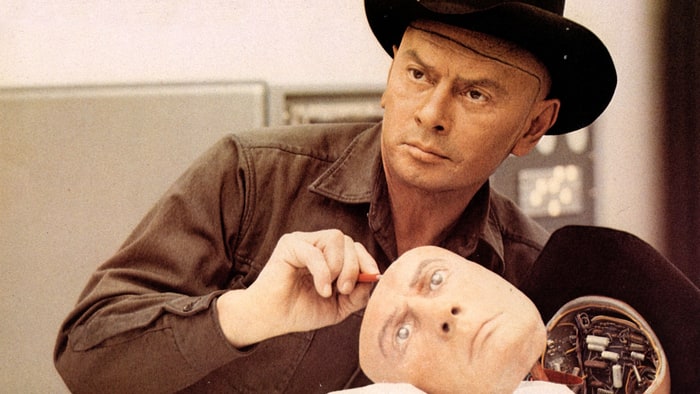
Michael Crichton’s 1973 sci-fi and Western mash-up is the best kind of genre film, one that uses familiar conventions to ruminate on the unconventional. In the case of Westworld, a futuristic theme park is the setting for discussion about how unprepared we are for that moment when artificial intelligence surpasses the human kind.

Delos is a $1,000-a-day wonderland, filled with lifelike robots, that makes real the violent and sexual fantasies of (mostly male) American tourists. “The vacation of the future today,” the company promises, offering consumers the opportunity to engage in orgies in the Roman Empire, sword fights in Medieval times or shootouts in the 1880s Wild West. Two Chicago guys (James Brolin and Richard Benjamin) head to Westworld, where they encounter a plethora of mechanical varmints and strumpets who are programmed to lay down–in gunfights or sexually–for their human “betters.”

But the technology inside the robots has continually improved, and they’ve begun showing signs that they’re just about done taking orders. In fact, the Singularity is nearer than anyone knows, and the bots begin to bite back. Pretty soon, humans are on the wrong end of jousts and duels as the tin machines become killing machines.

One particularly ornery automated gunslinger (Yul Brynner) seeks out Benjamin’s mild-mannered tourist, a lawyer who thought some harmless adventure would help him through a rough patch after a bitter divorce. At this point, the film puts aside its big ideas in favor of a mano a roboto faceoff. But no matter how this particular battle plays out, the war seems to have an unavoidable conclusion, one infused with a knowledge that we will no longer be able to control or understand. As one dejected scientist says resignedly about the robots run amok: “They’ve been designed by other computers…we don’t know exactly how they work.”•

Tags: , , , ,

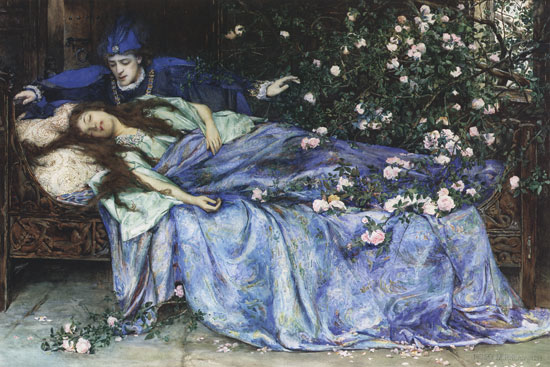
Kleine-Levin Syndrome is also known as "Sleeping Beauty Syndrome." (Image by Henry Maynell Rheam.)

It takes a lot more than a kiss to awaken Louise Ball, a 16-year-old British girl who suffers from a rare neurological disorder known as Kleine-Levin Syndrome, which causes her to sleep for ten days at a time. Her first episode of the illness, which more commonly afflicts males, occurred when she was 14. There is no cure. An excerpt from Frances Cronin’s BBC piece about her:

When she wakes up, it takes her a few days to fully come round, and her body is quite stiff so her dancing is affected for while.

‘I’ve never really got upset about it but I sometimes do think ‘why me’, because I’ve always been a normal healthy person. But all of a sudden it happened and there’s no reason why it happened and that sometimes frustrates me.

‘But I’ve got used to it now and learnt to live with it. I’m a special kid.’

The change in behaviour before and during a sleep episode is one of the most upsetting things for Louisa’s parents, who take it in turns to remain with her. Doctors have told the family it’s crucial to wake Louisa once a day to feed her and get her to the bathroom.

But Lottie admits it can take a while to get her to come round. ‘I’ve tried before to literally force her to wake up but she just starts swearing and gets so agitated and aggressive.'”

Tags: ,

It eventually lost out to VHS, but Betamax was the first home video cassette recorder that allowed you to tape shows off your television. Sony released the technology in 1975. Added bonus: Seinfeld’s fake mom is in the commercial.

Also from the article: "Hatfill has committed $1.5 million to building a floating genetic laboratory, a futuristic-looking vessel replete with a helicopter, an operating room to treat rural indigenous peoples, and a Cordon Bleu–trained chef."

Longform has chosen its favorite articles of 2010 and one them is David Freed’s very deserving, very horrifying, “The Wrong Man,” an account in the Atlantic of how an innocent person was wrongly suspected of the Anthrax attacks that occurred in the wake of 9/11. Dr. Steven J. Hatfill was a virologist and bioweapons expert who, in Kafka-esque fashion, had been traduced by hysteria, circumstance and incompetence. An excerpt:

“On the day al-Qaeda struck the World Trade Center and the Pentagon with hijacked jetliners, Hatfill was recovering from nasal surgery in his apartment outside the gates of Fort Detrick, Maryland, where USAMRIID is housed. We’re at war, he remembers thinking as he watched the news that day—but he had no idea that it was a war in which he himself would soon become collateral damage, as the FBI came to regard him as a homegrown bioterrorist, likely responsible for some of the most unsettling multiple murders in recent American history. His story provides a cautionary tale about how federal authorities, fueled by the general panic over terrorism, embraced conjecture and coincidence as evidence, and blindly pursued one suspect while the real anthrax killer roamed free for more than six years. Hatfill’s experience is also the wrenching saga of how an American citizen who saw himself as a patriot came to be vilified and presumed guilty, as his country turned against him.

‘It’s like death by a thousand cuts,’ Hatfill, who is now 56, says today. ‘There’s a sheer feeling of hopelessness. You can’t fight back. You have to just sit there and take it, day after day, the constant drip-drip-drip of innuendo, a punching bag for the government and the press. And the thing was, I couldn’t understand why it was happening to me. I mean, I was one of the good guys.'”

Tags:

Accumulating debt would never be difficult again.

Mixed-media sculpture of Manhattan.

Italian artist Franco Recchia twists discarded transistors, motherboards and other technological detritus into stunning sculptures of cityscapes. Junk is renewed and recycled into things of beauty, something actual cities need to do more and more. Look here to see additional Recchia cityscapes, which will soon be on display in New York at Agora Gallery. (Thanks Boing Boing.)

Pittsburgh, a city that wisely downsized and reimagined itself in the waning days of the Industrial Age, gets the Recchia treatment.

Tags:

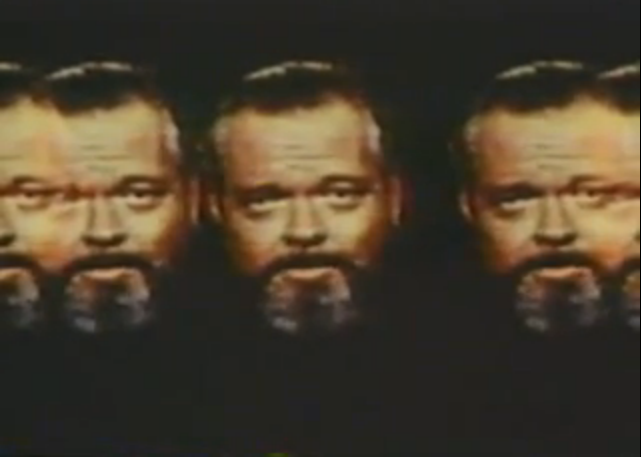
Orson Welles narrates this 1972 documentary that McGraw-Hill produced about sociologist Alvin Toffler‘s gargantuan 1970 bestseller, Future Shock. Toffler caused a sensation with his views about the human incapacity to adapt in the short term to remarkable change, in this case of the technological variety. The movie is odd and paranoid and overheated and fun.

Tags: ,

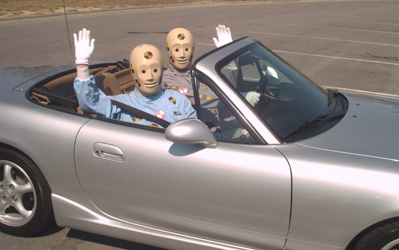
Too dumb to drive on their own, but very friendly.

Cnet has a Q&A with Atari co-founder Nolan Bushnell, who has returned to the board of the once-storied, long-struggling gaming company. In addition to comparing Atari to a successful child that graduated to drug addiction and jail as an adult, Bushnell waxes enthusiastic about auto-cars, the kind of vehicles that use software to do the driving. Google acknowledged recently that it has self-steering cars tooling around busy California streets and highways, monitoring traffic and god knows what else.

I know planes routinely use auto-pilot, but I think Bushnell is a little too sanguine about auto-cars in the near term, since a major psychological aspect of car ownership (in America at least) has to do with control and autonomy. (Thanks Newmark.) An excerpt:

Nolan Bushnell: But the biggest thing for the near future is auto-cars, which will change everything.

Cnet: Tell me about that. Why do you think they’ll change everything, and how so?

Nolan Bushnell: It’ll be within five years, somewhere. The costs are there right now. The Google car actually was cost-effective. Think of no traffic congestion, highways that can hold 30 times as much traffic. Half the energy costs. It just goes on and on. The only issue is how powerful will be the Luddites.

Cnet: What do you imagine would be the chief objection of the Luddites?

Nolan Bushnell: The Schumpeterian creative destruction of entrenched interests. For example. every Teamster, cab driver, UPS driver, all these drivers will need to be retrained. Insurance will drop to a fraction of what it costs now. People don’t understand how horrible the average driver is. The number of body shops will be 20 percent of today. It’ll be disruptive, and they will not go away without a fight. Of course, bars will do a great business because drunk driving will be OK.”

Tags:

In 1977, Bell Labs produced this commercial to introduce consumers to its new Call Forwarding phone technology. Call Waiting, Speed Calling and Three-Way Calling are mentioned almost as an afterthought by the announcer.

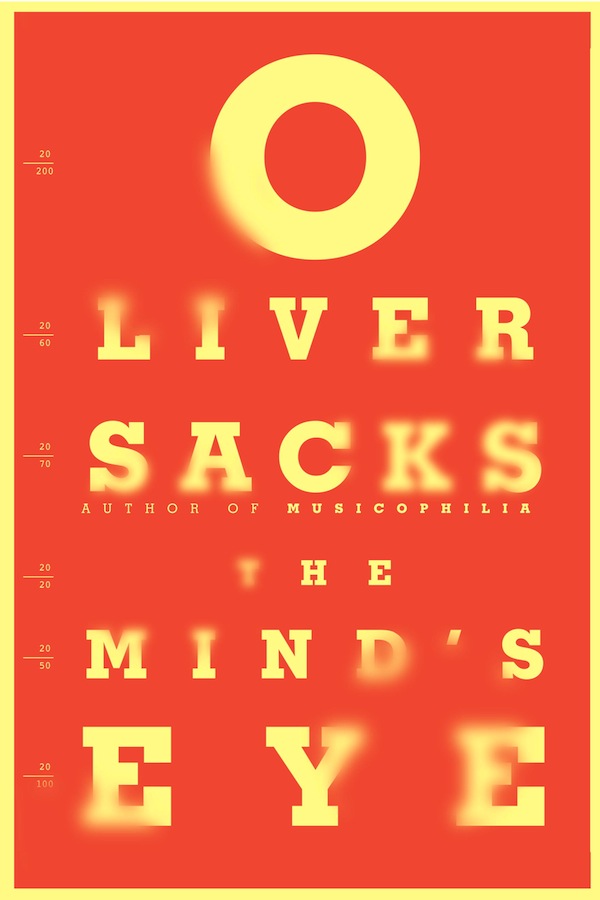
Sacks wrote about face-reognition disorders in the title piece of his 1985 collection, "The Man Who Mistook His Wife for a Hat."

I’ve mentioned before that I have a neurological glitch, called prosopagnosia or face-blindness, which causes me problems with face recognition. I can see faces just fine, but I have trouble identifying them out of context. I’m usually okay with people I see on a regular basis, less so with those I run into infrequently or haven’t seen in a long time. It causes countless misunderstandings.

Thankfully, I don’t have  a very severe level of face-blindness, but Oliver Sacks does. It’s so bad for the doctor that he actually can’t recognize himself in a mirror. The neurologist writes about dealing with the disorder in his latest excellent collection of case studies, The Mind’s Eye. An excerpt from his essay, “Face-Blindness”:

“I just assumed that I was very bad at recognizing faces as my friend Jonathan was very good–that this was just within the limits of normal variation, and that he and I just stood on opposite ends of a spectrum. It was only when I went to Australia to visit my older brother Marcus, whom I had scarcely seen in thirty-five years, and discovered that he, too, had exactly the same difficulties recognizing faces and places that it dawned on me that this was something beyond normal variation, that we both had a specific trait, a so-called prosopagnosia, probably with a distinctive genetic basis.

That there were others like me was brought home in various ways. The meeting of two people with prosopagnosia, in particular, can be very challenging. A few years ago I wrote to one of my colleagues to tell him that I admired his new book. His assistant then phoned Kate to arrange a meeting, and they settled on a weekend dinner at a restaurant in my neighborhood.

‘There may be a problem,’ Kate said. “Dr. Sacks cannot recognize anyone.’

‘It’s the same with Dr. W.,’ his assistant replied.

Somehow we did manage to meet and enjoyed dinner together. But I still have no idea what Dr. W. looks like, and he probably would not recognize me, either.”

Tags:

Found Footage Festival serves up this 1988 TV spot for Isaac Asimov’s Robots VCR Mystery Game. According to Board Game Geek, the action was set in the 23rd century, as a detective attempted to solve the first murder in 100 years.

Tags:

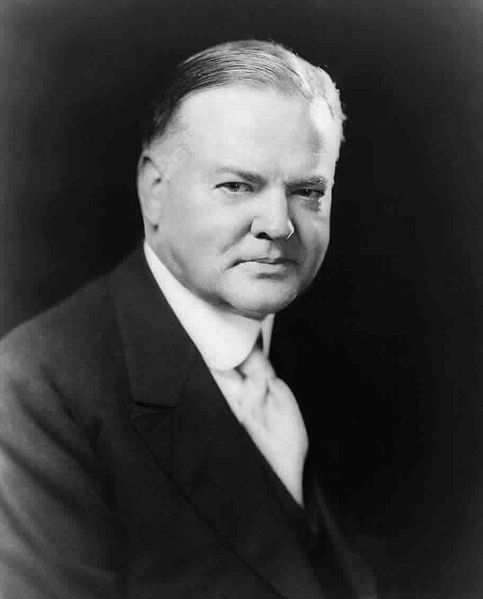
Herbert Hoover: Would it kill you to call?

This fun excerpt from Ammon Shea’s The Phone Book: The Curious History of the Book That Everyone Uses But No One Reads, comes courtesy of the great Marginal Revolution:

“The first American president to have a telephone on his desk was Herbert Hoover, who had one installed in 1929. The White House did have a telephone well before most of the country, as Rutherford B. Hayes had had one installed in the telegraph room of the executive mansion in 1878. It received little use at first, since so few other people had telephones at that time. The very first telephone book for the city of Washington, D.C. lists this presidential telephone simply as ‘No.1.'”

Tags: ,

Watching, always watching. (Image by noodlesnacks.com.)

In the future, we will be killed in new and interesting ways. Currently in development are weapons that are as fascinating as they are frightening. Business Insider has a rundown of ten such science fiction-ish weapons systems. One that’s being worked on right now that doesn’t commit murder–not yet, anyhow– is HI-MEMS, equal parts bug and bot, which is intended as a pesky reconnaissance agent. (Thanks Newmark’s Door.) An excerpt:

“The HI-MEMS is part insect, part machine. First, a micro-mechanical system is placed inside the insect during early stages of metamorphosis. The bugs operate similarly to a remote control car — the goal is to be able to control the bugs movement and location through the implanted microsystem. HI-MEMS will be used for gathering information using its sensors, such as a microphone or a gas detector.”

Boing Boing editors David Pescovitz, Xeni Jardin, Cory Doctorow and Mark Frauenfelder. (Image by Dave Bullock.)

Boing Boing, the king of personal blogs that aspire to any level of cerebralness, is sort of an accidental giant. It started as a tiny print zine during the ’80s and became the least likely giant-traffic blog on the web. In an article for Fast Company, Rob Walker profiles the four principals behind the site. An excerpt:

“‘Boing Boing is a holdover from a time when the best blogs were written by smart people who posted whatever was interesting to them,’ observes Jonah Peretti, founder of BuzzFeed. Sure, there are still many such blogs around, but the blogosphere overall has changed radically, with the dominant players falling into recognizable categories — tech (Gizmodo, Engadget), gossip (TMZ, Gawker), politics (the Huffington Post, Politico) — and generally created by teams of professionals looking for growth and profits. ‘The new generation of postpersonal blogs,’ Peretti adds, ‘are much bigger.’

Yet boingboing.net remains among the most popular 10 or 20 blogs around. According to Quantcast data, it gets about 2.5 million unique visitors a month, racking up 9.8 million page views, a traffic increase of around 20% over 2009. It attracts blue-chip advertisers such as American Express and Verizon. It makes a nice living for its founders and a handful of contract employees.

And what really makes it interesting is that it does this with a mix of material that remains as eclectic, strange, and sometimes nonsensical as the obscure personal blog it started out as. Sure, the site offers its take on big, hot-button topics like WikiLeaks or the latest Apple gadgetry. But just as prominent are headlines such as ‘And now, an important message regarding elves,’ or ‘Heavily stapled phone-pole,’ or, to cite a recent favorite of mine, ‘Monkey rides a goat’ (an animated GIF of exactly that).

How can this mishmash command an audience of millions? Particularly now, when the ‘postpersonal’ blogosphere offers slick, focused, comprehensive takes on any subject you can imagine? Maybe the founders’ insistence on keeping the site weird, loose, personal, and fundamentally unprofessional is exactly what keeps the crowd coming back. Boing Boing’s longevity hasn’t happened despite its refusal to get serious, but because of it.”

Tags: , , , , ,

« Older entries § Newer entries »