Science/Tech

You are currently browsing the archive for the Science/Tech category.

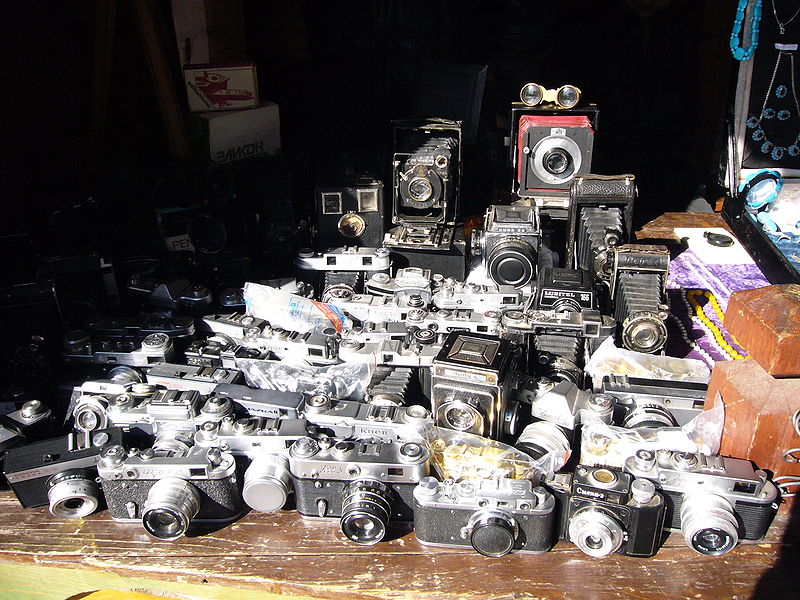
"High-resolution, low-cost cameras are proliferating." (Image by Leonid Dzhepko.)

An article by Steve Lohr in the New York Times looks at the positives and negatives involved in the coming proliferation of cameras that can recognize objects, gestures, situations and even faces. An excerpt:

“High-resolution, low-cost cameras are proliferating, found in products like smartphones and laptop computers. The cost of storing images is dropping, and new software algorithms for mining, matching and scrutinizing the flood of visual data are progressing swiftly.

A computer-vision system can watch a hospital room and remind doctors and nurses to wash their hands, or warn of restless patients who are in danger of falling out of bed. It can, through a computer-equipped mirror, read a man’s face to detect his heart rate and other vital signs. It can analyze a woman’s expressions as she watches a movie trailer or shops online, and help marketers tailor their offerings accordingly. Computer vision can also be used at shopping malls, schoolyards, subway platforms, office complexes and stadiums.

All of which could be helpful — or alarming.

‘Machines will definitely be able to observe us and understand us better,’ said Hartmut Neven, a computer scientist and vision expert at Google. ‘Where that leads is uncertain.’”

Tags: ,

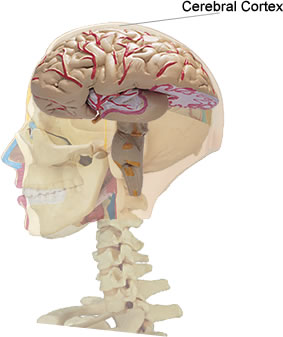
"We'll be able to plug informations streams directly into the cortex."

The Guardian had a fun feature in its Sunday January 2 edition, which it entitled “25 Predictions for the Next 20 Years.” Their tea-leaf reading seems a little aggressive, but the challenge of prognosticating is to force yourself to not play it safe. Some of the predictions have intriguing headings like “Russia will become a global food superpower” and “Technology creates smarter clothes.” An excerpt from the entry called “We’ll be able to plug information streams directly into the cortex”:

“By 2030, we are likely to have developed no-frills brain-machine interfaces, allowing the paralysed to dance in their thought-controlled exoskeleton suits. I sincerely hope we will not still be interfacing with computers via keyboards, one forlorn letter at a time.

I’d like to imagine we’ll have robots to do our bidding. But I predicted that 20 years ago, when I was a sanguine boy leaving Star Wars, and the smartest robot we have now is the Roomba vacuum cleaner. So I won’t be surprised if I’m wrong in another 25 years. Artificial intelligence has proved itself an unexpectedly difficult problem.

Maybe we will understand what’s happening when we immerse our heads into the colourful night blender of dreams. We will have cracked the secret of human memory by realising that it was never about storing things, but about the relationships between things. Will we have reached the singularity – the point at which computers surpass human intelligence and perhaps give us our comeuppance? We’ll probably be able to plug information streams directly into the cortex for those who want it badly enough to risk the surgery. There will be smart drugs to enhance learning and memory and a flourishing black market among ambitious students to obtain them.”

Technology creates smarter clothes’

"One of my mentors told me that my real mistake was trying to replicate my work. He told me doing that was just setting myself up for disappointment."

I fell behind in my New Yorker reading in December, so I just got to this intriguing Jonah Lehrer article about a puzzling problem for scientific researchers: the inability to replicate their landmark findings in subsequent studies. It seems that researchers regularly avoid rechecking their results because they know future tests may call their findings into question. Does that mean that their original studies were unintentionally biased, subjective in some way that they don’t understand? The troubling occurrence is called the “decline effect.” One of the subjects Lehrer discusses the situation with is Jonathan Schooler, a highly self-aware psychology professor at the University of Santa Barbara. An excerpt:

“Jonathan Schooler was a young graduate student at the University of Washington in the nineteen-eighties when he discovered a surprising new fact about language and memory. At the time, it was widely believed that the act of describing our memories improved them. But, in a series of clever experiments, Schooler demonstrated that subjects shown a face and asked to describe it were much less likely to recognize the face when shown it later than those who had simply looked at it. Schooler called the phenomenon ‘verbal overshadowing.’

The study turned him into an academic star. Since its initial publication, in 1990, it has been cited more than four hundred times. Before long, Schooler had extended the model to a variety of other tasks, such as remembering the taste of a wine, identifying the best strawberry jam, and solving difficult creative puzzles. In each instance, asking people to put their perceptions into words led to dramatic decreases in performance.

But while Schooler was publishing these results in highly reputable journals, a secret worry gnawed at him: it was proving difficult to replicate his earlier findings. ‘I’d often still see an effect, but the effect just wouldn’t be as strong,’ he told me. ‘It was as if verbal overshadowing, my big new idea, was getting weaker.’ At first, he assumed that he’d made an error in experimental design or a statistical miscalculation. But he couldn’t find anything wrong with his research. He then concluded that his initial batch of research subjects must have been unusually susceptible to verbal overshadowing. (John Davis, similarly, has speculated that part of the drop-off in the effectiveness of antipsychotics can be attributed to using subjects who suffer from milder forms of psychosis which are less likely to show dramatic improvement.) ‘It wasn’t a very satisfying explanation,’ Schooler says. ‘One of my mentors told me that my real mistake was trying to replicate my work. He told me doing that was just setting myself up for disappointment.’”

Tags: ,

Filed under “Really Bad Ideas” is this 1950s commercial in which a face cleanser proves its mettle by removing radioactive dirt from a model’s cheeks.

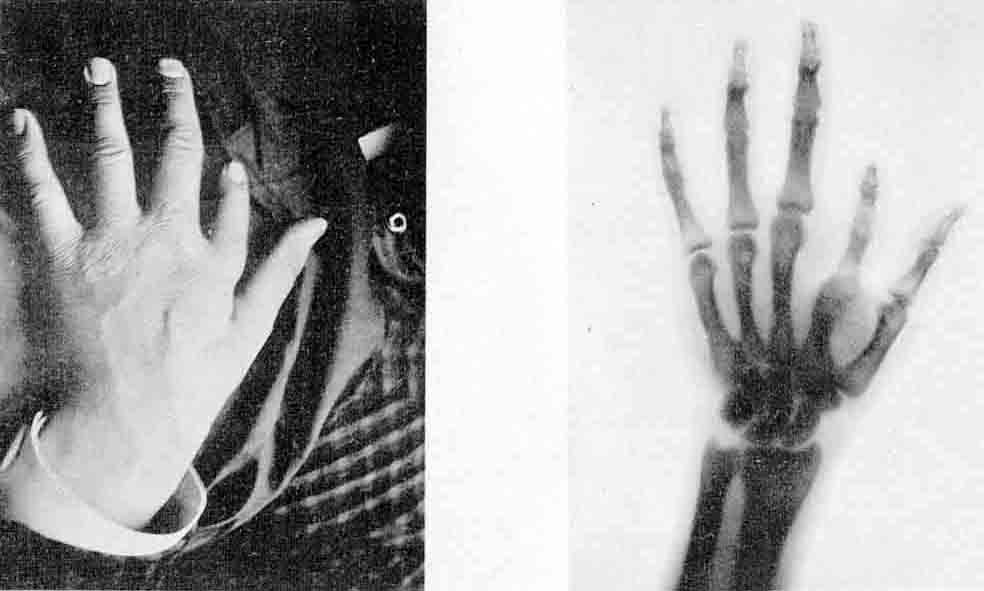
"Skeletons are shown within the flesh." (Image by Albert Londe.)

It was early in 1896 that X-rays became an important part of medical procedures, though researchers began working on its development as far back as 1875. German physics professor Wilhelm Röentgen ultimately got the credit for perfecting the process. In the February 10, 1896 Brooklyn Daily Eagle, the new invention is heralded for the major advancement it was. An excerpt:

“Until some man invents a camera that will take a picture around a corner the new utilization of the Cathode or Roentgen rays will suffice for wonder. In this process, as everyone knows by this time, objects that we have supposed to be opaque have been pierced by light so that objects within them have shown in shadowy mass on the photographic plate. A razor had been photographed inside of its case, skeletons are shown within the flesh and things have been revealed that were covered with black paper, wood, horn, rubber and thin plates of metal. Indeed, we begin to inquire if there is such a thing as opacity, now. All this is unexpected and curious, but to men most important for one thing: It opens the human body to examination. If something is wrong inside of one it may not be necessary to cut him open to find what. If the something is known it will save unnecessary cutting.

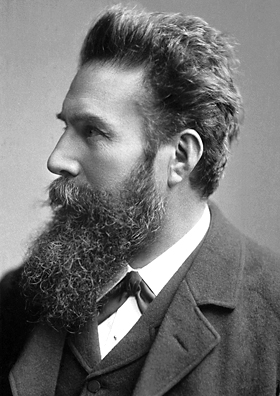
Wilhelm Röentgen, father of the X-ray. (Image by the Nobel foundation.)

To one who has never seen an operation by surgery, or has given small attention to such matters, it may seem as if it were easy to find the lodging place of a bullet or broken knife point in the flesh, but often the finding of a needle in a bundle of hay is an easy task compared with it. The hay, at all events, contains no nerves, no quivering muscles, no tough cartilage and tendon, no resisting bones: one does not have to be careful how he explores this way and that lest he cut an important nerve or sever an artery or tap a vein, And sometimes, after probing and reaching and cutting for half an hour the work is found to be too difficult and dangerous to continue; then the patient is made as easy as circumstances allow and told to resign himself to wearing the bullet or the knife point for the rest of his days.

By use of the X rays the bullet can be made to declare itself to the sight and the surgeon can go straight to it with his scalpel, and if the ball is found to lie in too close contact to an artery it can be left to encyst. In case of a compound fracture pieces of bone that may be driven into adjacent muscle may be promptly located and removed or replaced. Perhaps a higher sensitization can be obtained so that relatively opaque tumors, cancers, fungoid growths, ossifications or chalk deposits may be indicated in the picture and the surgeon will then be guided as to the mode of procedure. Appendicitis may be resolved into a case for surgical or for medical treatment according to what it shows of the degree of induration or suppuration or the presence of foreign and irritating bodies. Of all the recent advancement in surgery this of the employment of the cathode ray promises the most benefit.”

Tags:

Lon Safko is a social media expert today, but he’s also the innovator behind the first voice-activated computer, the SoftVoice Computer System. This 1986 news report documents his achievement and explains how a common injury inspired the creation, which now has a permanent home in the Smithsonian.

Tags:

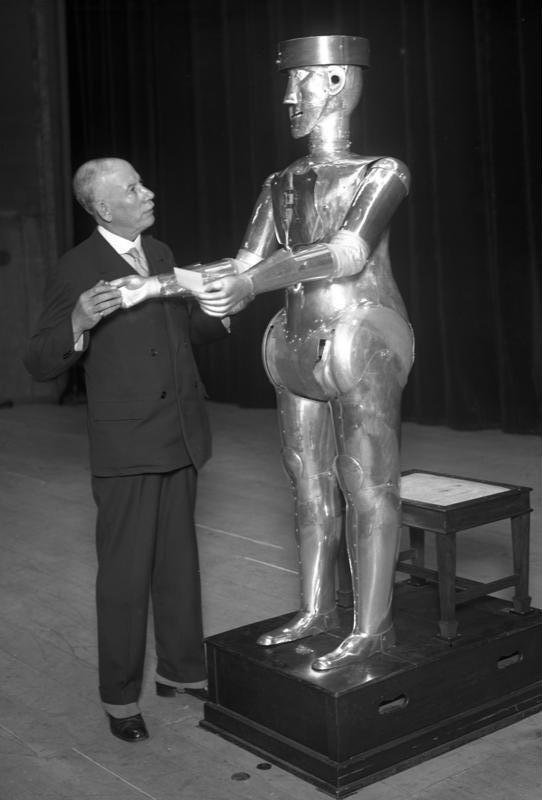
An old-school robot in 1932. Engkey is much more modern.

Yahoo! News has a report by Jung Ha-Won about English being taught to South Korean grade-school students by robots who are controlled remotely from the Philippines. It’s not being done so much out of necessity, but to jump start the South Korean robotics sector. (Thanks Marginal Revolution.) An excerpt:

“Almost 30 robots have started teaching English to youngsters in a South Korean city, education officials said Tuesday, in a pilot project designed to nurture the nascent robot industry.

Engkey, a white, egg-shaped robot developed by the Korea Institute of Science of Technology (KIST), began taking classes Monday at 21 elementary schools in the southeastern city of Daegu.

The 29 robots, about one metre (3.3 feet) high with a TV display panel for a face, wheeled around the classroom while speaking to the students, reading books to them and dancing to music by moving their head and arms.

The robots, which display an avatar face of a Caucasian woman, are controlled remotely by teachers of English in the Philippines — who can see and hear the children via a remote control system.

Cameras detect the Filipino teachers’ facial expressions and instantly reflect them on the avatar’s face, said Sagong Seong-Dae, a senior scientist at KIST.”

Tags: ,

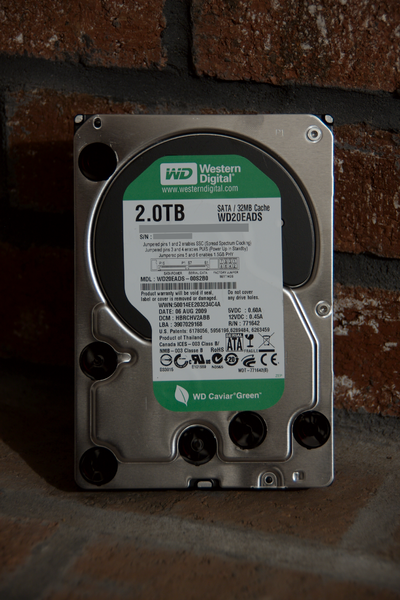
This 2 terrabyte hard-disk drive would have been worth $2 trillion in the 1950s. It costs about $100 on Amazon.

Moore’s Law (or something) must be working overtime because the price of a computer hard drive is ridiculously puny compared to what it was decades ago. The reduction is even more staggering than what you might think. An article by Lucas Mearian in Computerworld makes this point abundantly clear. An excerpt:

In the 1950s, storage hardware was measured in feet — and in tons. Back then, the era’s state-of-the-art computer drive was found in IBM’s RAMAC 305; it consisted of two refrigerator-size boxes that weighed about a ton each. One box held 40 24-inch dual-sided magnetic disk platters; a carriage with two recording heads suspended by compressed air moved up and down the stack to access the disks. The other cabinet contained the data processing unit, the magnetic process drum, magnetic core register and electronic logical and arithmetic circuits.

Today, we have flash drives, microdrives, and onboard solid-state drives that weigh almost nothing, hold gigabytes of data and cost — compared to the 1950s — very little. How cheap is storage now? A 1TB hard drive that sells for as little as $60 today would have been worth $1 trillion in the 1950s, when computer storage cost $1 per byte, according to Dag Spicer, senior curator of the Computer History Museum in Mountain View, Calif.”

Tags: ,

Of the three versions of Invasion of the Bodysnatchers, a story about enemies secretly living among us, Philip Kaufman’s 1978 version was the one that had the weakest sociological context to play off of. The 1956 original was made in the age when McCarthy and HUAC were conducting a witch hunt for alleged communists in our midst. The 2007 version was filmed in a time when terrorist sleeper cells were a reality. So why is Kaufman’s version, which largely is a satire about the rather mundane evil of the self-help industry, so much more effective than the others? Sometimes talent trumps context.

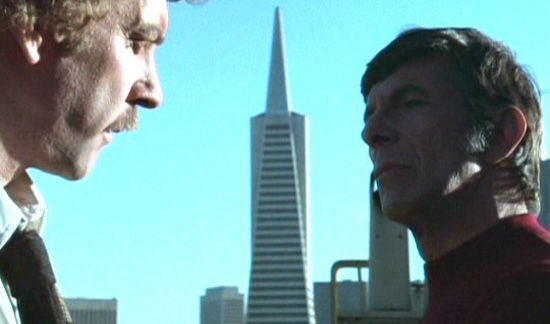
The Kaufman version stars Donald Sutherland as Matthew Bennell, a San Francisco Health Department inspector who spends his days making surprise visits to restaurants, trying to differentiate between capers and rat turds. His staid life in interrupted when his secret office crush, Elizabeth Driscoll (Brooke Adams), begins having problems with her boyfriend. The thing is, Elizabeth doesn’t only feel that her beau has changed suddenly and drastically, but that people all over San Francisco are becoming emotionless and creepy overnight. Matthew doesn’t agree initially but is forced to see her point after a number of shocking occurrences. Meanwhile, a personal-growth guru (Leonard Nimoy) uses feel-good palaver to try to calm every one down as the city falls into chaos. “You will be born again into an untroubled world,” Matthew is ominously told at one point, and he and Elizabeth and their friends realize they have to run for their lives before they too are transformed into drones.

Kaufman and cinematographer Michael Chapman, who would soon work his magic on Raging Bull, use San Fran’s quirky beauty to amazing advantage: every sloping sidewalk seems sinister, steam in an old dry cleaner becomes a fog of suspicion, each exotic flower doubles as a weapon. What results is one of the best genre pictures ever made, and one that wisely knows that paranoia knows no particular season and the fear that things aren’t what they appear to be never goes out of style.•

Tags: , , , , ,

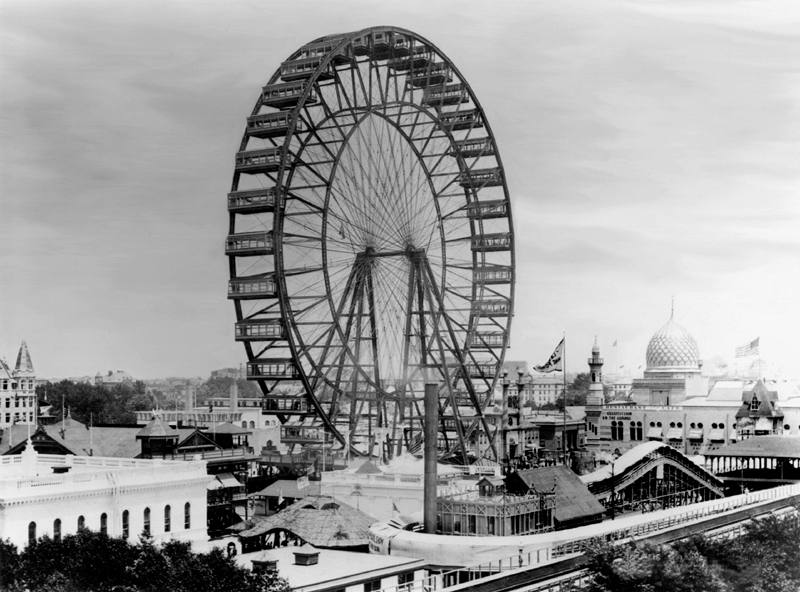
The first Ferris Wheel, at the Columbian Exposition in Chicago in 1893. It was 264 ft. high.

Guy de Maupassant is said to have lunched at the Eiffel Tower every day so that he could avoid looking at the edifice he so despised, and he wasn’t the only Parisian intellectual to hate on Gustave Eiffel’s “bridge to the sky.” French artists and thinkers railed against the tower even as it was in its planning stages as part of the Universal Exposition of 1889, claiming that it was a blight on the city.

But the Eiffel Tower was a huge hit during the fair, so much so that the planners of the 1893 World’s Columbian Exposition in Chicago felt that they needed to do something dramatic to compete with it. Daniel H. Burnham, Chief of Construction for the Columbian, searched futilely for an answer for a long time before George Ferris supplied him with one. An excerpt from Henry Petroski’s Remaking the World:

Burnham found himself at a banquet addressing architects and engineers, he praised the former but excoriated the latter for not having met the expectations of the people. Nothing had been proposed that displayed the originality or novelty to rival the Eiffel Tower. He wanted something new in engineering science, but felt the engineers were giving him only towers.

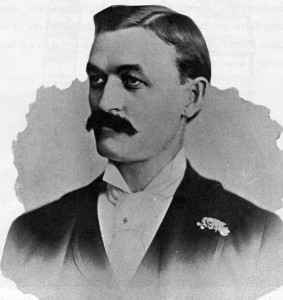
George Washington Gale Ferris, Jr.

Among the engineers at the banquet was the youngish George Washington Gale Ferris, Jr. He was born in Galesburg, Illinois, in 1859, and at the age of five moved with his family to western Nevada. There, while living on a ranch, he became fascinated with a large undershot water wheel, which raised buckets out of the Carson River to supply a trough for the horses. Ferris would later recall his fascination with the wheel’s action, but, according to some accounts, as a youngster he was not equally fascinated with formal education. … When Ferris would later be asked where the idea for his great wheel came from, he recalled that, a while after hearing Burnham’s challenge, he found himself at a Saturday afternoon dinner club made up mainly of world’s fair engineers.

According to Ferris, “I had been turning over every proposition I could think of. On four or five of these I had spent considerable time. What were they? Well, perhaps I’d better not say. Any way none of them were very satisfactory… It was at one of these dinners, down at a Chicago chop house, that I hit on the idea. I remember remarking that I would build a wheel, a monster. I got some paper and began sketching it out. I fixed the size, determined the construction, the number of cars we would run, the number of people it would hold, what we would charge, the plan of stopping six times in its first revolution and loading, and then making a complete turn–in short, before the dinner was over I had sketched out almost the entire detail, and my plan has never varied an item from that day. The wheel stands at the Plaissance at this moment as it stood before me then.”•

Tags: , , ,

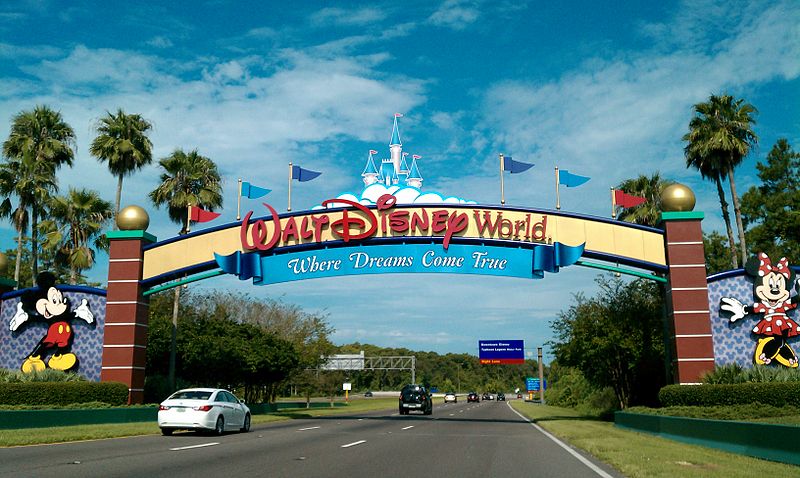
"Disney has spent the last year outfitting an underground, nerve center to address that most low-tech of problems, the wait." (Image by Jrobertiko.)

As speedier technology makes certain aspects of life almost instantaneous. others that require patience (e.g., long lines at amusement parks) become more annoying. In order to deal with their customers not wanting to wait around, Walt Disney World in Orlando has constructed a high-tech bunker in order to preempt any inconvenience for its visitors–and also to subtly and creepily control their actions. Brooks Barnes has an interesting article on the topic in the Business section of the New York Times. An excerpt:

“To handle over 30 million annual visitors — many of them during this busiest time of year for the megaresort — Disney World long ago turned the art of crowd control into a science. But the putative Happiest Place on Earth has decided it must figure out how to quicken the pace even more. A cultural shift toward impatience — fed by video games and smartphones — is demanding it, park managers say. To stay relevant to the entertain-me-right-this-second generation, Disney must evolve.

Walt Disney: Sadly, his head wasn't actually cryogenically frozen. Just a myth. (Image by NASA.)

And so it has spent the last year outfitting an underground, nerve center to address that most low-tech of problems, the wait. Located under Cinderella Castle, the new center uses video cameras, computer programs, digital park maps and other whiz-bang tools to spot gridlock before it forms and deploy countermeasures in real time.

In one corner, employees watch flat-screen televisions that depict various attractions in green, yellow and red outlines, with the colors representing wait-time gradations.

If Pirates of the Caribbean, the ride that sends people on a spirited voyage through the Spanish Main, suddenly blinks from green to yellow, the center might respond by alerting managers to launch more boats.”

Tags:

“Every home will have a computer plugged into a central brain,” the narrator predicts, very accurately, in this 1967 BBC clip. Thankfully, they don’t still sound like locomotives.

The Queens-born paleontologist, who died in 2002, lived in Soho for many years. (Image by Kathy Chapman)

The American Scientist list of  “100 or so Books that shaped a Century of Science” includes the following 20th-century volumes about evolutionary science:

Tags: , , , , , ,

The thinkers at IBM tend to be optimistic when conjuring the near future. In 2006, the company released a set of prognostications for 2010 that saw widespread real-time speech translation and the use of sensors to allow for the remote monitoring of patients’ health care. Not quite yet, huh?

Now the company has released five predictions for 2015 that seem just as ambitious. My favorite one is the idea that heat from data centers can be recycled and repurposed to provide heat and air conditioning for cities, conserving energy and lowering power costs. But those holographic cell phones also seem pretty great. The following video from IBM Labs shares the quintet of innovations that may be on our doorstep.


Let’s murder nature and replace it with plastic crap.

Lots of cool crap for the home that people in the ’50s thought that we would have today. The table-top dishwasher is excellent and very unnecessary.

"The Japanese auto industry isn’t likely to carve out a big slice of the U.S. market.” (Image by IFCAR.)

Listverse has compiled a number of embarrassing science, tech and business quotations that have proven very, very incorrect. “Experts” being wrong is always fun because it makes the rest of us feel less stupid. (Thanks Reddit.) Here are a few from the full list:

  • “With over 50 foreign cars already on sale here, the Japanese auto industry isn’t likely to carve out a big slice of the U.S. market.” — Business Week, August 2, 1968.
  • “That virus is a pussycat.” — Dr. Peter Duesberg, molecular-biology professor at U.C. Berkeley, on HIV, 1988.
  • “Within the next few decades, autos will have folding wings that can be spread when on a straight stretch of road so that the machine can take to the air.” — Eddie Rickenbacker, Popular Science, July 1924.
  • ‘The abdomen, the chest and the brain will forever be shut from the intrusion of the wise and humane surgeon.’ – Sir John Eric Ericson, Surgeon to Queen Victoria, 1873.
  • “Airplanes are interesting toys but of no military value.” — Marechal Ferdinand Foch, Professor of Strategy, Ecole Superieure de Guerre.

I posted the video of the touch-tone phone being demonstrated at the World’s Fair in Seattle in 1963. It took eight years, but that techonology was finally being sold to the masses in 1971 in this hyperbolic television spot.

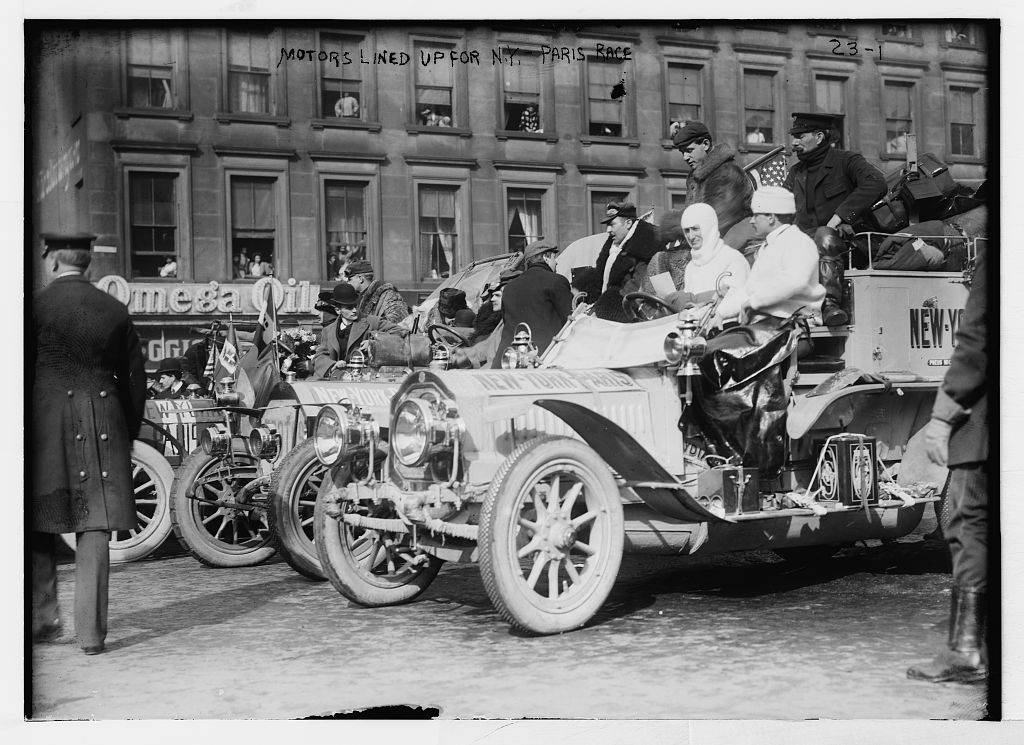
Times Square was the starting point for the Great Auto Race in 1908.

The steam locomotive and internal-combustion engine laid to rest what was left of the pioneer spirit of the Old West, but new transportations demanded new pioneers. Automobiles may have been a novel thing in 1908, but their drivers weren’t a timid breed. On February 12th of that year, six cars representing four nations (America, Germany, Italy and France) lined up in Times Square for the start of a treacherous competition that famously became known as the Great Auto Race.

Before this race, no car had ever crossed the U.S. during winter. And when the autos reached the end of the course in one continent, they were transported by ship for the next leg overseas. (Only three teams actually completed the transcontinental competition.) The winner was (spoiler alert) the Thomas Flyer crew from the United States. But the real victor was the automobile itself. The event, which was co-sponsored by the New York Times and Le Matin, received international press and cars began to be viewed favorably on a world stage.

I posted recently about Atari co-founder Nolan Bushnell’s passion for driver-less auto-cars. While the technology may be upon us, the dream has apparently been around since at least the 1950s.

Tags:

"New York, just like I pictured it, skyscrapers and everything." (Image by Dennis Afraz.)

Neuroscientist Jonah Lehrer had an excellent article in the New York Times Magazine this weekend, about Geoffrey West and Luis Bettencourt, theoretical physicists who are applying their science training to urban problems. (By the way, if you’ve never read Lehrer’s book, Proust Was a Neuroscientist, I highly recommend it). An excerpt:

“Along with Luis Bettencourt, another theoretical physicist who had abandoned conventional physics, and a team of disparate researchers, West began scouring libraries and government Web sites for relevant statistics. The scientists downloaded huge files from the Census Bureau, learned about the intricacies of German infrastructure and bought a thick and expensive almanac featuring the provincial cities of China. (Unfortunately, the book was in Mandarin.) They looked at a dizzying array of variables, from the total amount of electrical wire in Frankfurt to the number of college graduates in Boise. They amassed stats on gas stations and personal income, flu outbreaks and homicides, coffee shops and the walking speed of pedestrians.

"These are the laws, they say, that automatically emerge whenever people ‘agglomerate,’ cramming themselves into apartment buildings and subway cars." (Image by Rebecca Kennison.)

After two years of analysis, West and Bettencourt discovered that all of these urban variables could be described by a few exquisitely simple equations. For example, if they know the population of a metropolitan area in a given country, they can estimate, with approximately 85 percent accuracy, its average income and the dimensions of its sewer system. These are the laws, they say, that automatically emerge whenever people ‘agglomerate,’ cramming themselves into apartment buildings and subway cars. It doesn’t matter if the place is Manhattan or Manhattan, Kan.: the urban patterns remain the same. West isn’t shy about describing the magnitude of this accomplishment. ‘What we found are the constants that describe every city,’ he says. ‘I can take these laws and make precise predictions about the number of violent crimes and the surface area of roads in a city in Japan with 200,000 people. I don’t know anything about this city or even where it is or its history, but I can tell you all about it. And the reason I can do that is because every city is really the same.’ After a pause, as if reflecting on his hyperbole, West adds: ‘Look, we all know that every city is unique. That’s all we talk about when we talk about cities, those things that make New York different from L.A., or Tokyo different from Albuquerque. But focusing on those differences misses the point. Sure, there are differences, but different from what? We’ve found the what.'”
Tags: , ,

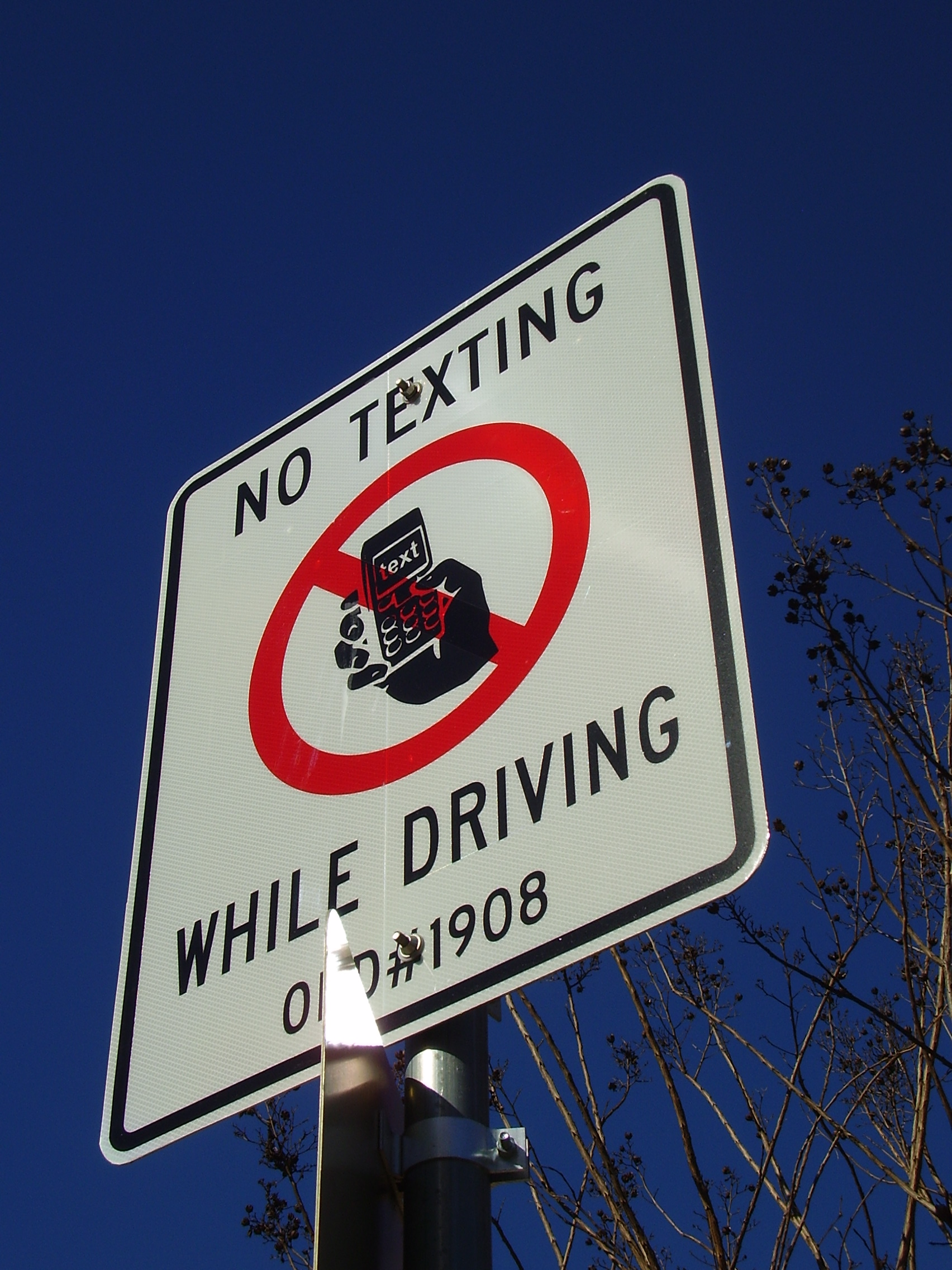
Sign in West University Place, Texas. (Image by WhisperToMe.)

Texting while driving is all the rage in scary headlines, but auto deaths in America have been reduced dramatically over the last five years, just as the handheld computing craze has exploded. What gives? Joseph B. White tries to uncover the answer in an article in the Wall Street Journal. It may be that technology (and other factors) are responsible for the decrease. An excerpt:

“So what’s helping to reduce deaths? Technology deserves some credit, according to the data. Deaths in side-impact crashes declined between 2005 and 2008 at a faster rate than the decline for deaths overall. That suggests that side airbags are helping more people survive crashes, the researchers found.

The Michigan study found a nearly 20% decline in deaths among young drivers, age 16 to 25. Among the possible reasons: the increasing number of states that use graduated licensing programs that delay granting full driving privileges until teens have more experience, and rising teen joblessness.

The exact role of the economy in declining highway deaths is a big unknown. Messrs. Sivak and Schoettle highlight pieces of data that suggest that as the economy slowed down, so did motorists.”

Tags:

It was in 1961 that IBM programmed a computer to sing for the first time. The computer was a UNIVAC and the tune was the cute 1892 ditty, “Daisy Bell.” It was in 1968 that HAL, the computer in 2001: A Space Odyssey crooned the same song in a creepy, sickly voice. The full lyrics, if you’d like to sing along:

“Daisy Daisy Give me your answer do

I’m half crazy all for the love of you

It won’t be a stylish marriage

I can’t afford a carriage

But you’ll look sweet upon the seat of a bicycle built for two”

Software designer Ivan Sutherland developed Sketchpad as part of his 1963 thesis at MIT. It is among the most influential programs ever written, opening the door for the development of the Graphical User Interface, which helped make computers amenable to the masses. This 20-minute program demonstrates how remarkably advanced the system was, transforming what had been an elaborate adding machine into an “intelligent” machine.

Tags:

"A middle-aged woman known as SM blithely reaches for poisonous snakes..." (Image by JamieS93.)

A rare genetic disorder called Urbach-Wiethe disease obliterates the capacity for the amygdala portion of the brain to cause a person to feel fear. Someone with this congenital condition never becomes afraid, even when it’s the best thing for their well-being. (Thanks Reddit.) An excerpt about the condition from Laura Sanders’ Science News article:

“A middle-aged woman known as SM blithely reaches for poisonous snakes, giggles in haunted houses and once, upon escaping the clutches of a knife-wielding man, didn’t run but calmly walked away. A rare kind of brain damage precludes her from experiencing fear of any sort, finds a study published online December 16 inCurrent Biology.

SM has an unusual genetic disorder called Urbach-Wiethe disease. In late childhood, this disease destroyed both sides of her amygdala, which is composed of two structures the shape and size of almonds, one on each side of the brain. Because of this brain damage, the woman knows no fear, the researchers found.

Experiments have strongly implicated the amygdala in fear processing. Many of these were conducted on animals with amygdala damage. ‘But one thing we’ve never known for sure, because they’re animals, is whether they can consciously feel fear,’ says study coauthor Justin Feinstein of the University of Iowa in Iowa City. ‘So we said, Let’s take a human patient who has this same sort of damage, and for the first time, actually figure out how they’re feeling.’

Feinstein and his colleagues sifted through SM’s past, looking for instances when she should have been scared. SM said she never felt fear, even when threatened with a knife or a gun. The researchers gave SM an electronic diary that she carried for three months to record her emotional state. Fear didn’t make an appearance in the list of emotions. On a battery of questionnaires, SM wrote that she wasn’t afraid of public speaking, death, her heart beating too fast or being judged negatively in a social setting.”

Tags: ,

« Older entries § Newer entries »