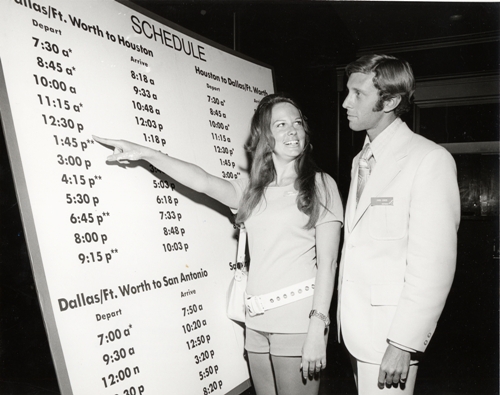
This Southwest Airlines TV commercial was part of the company’s “Remember” campaign from 1972. A note about the early days of the so-called “love airline” and its co-founder Herb Kelleher from CBS News:
“Kelleher is legendary in the airline industry for doing things differently than the competition. Before he found himself Southwest’s pitchman, Kelleher was a lawyer retained by the airline to get it off the ground – a fight that took him all the way to the U.S. Supreme Court. It seemed the last thing Southwest’s competitors wanted to see was a low-cost upstart doing nothing but flying around Texas in and out of Dallas Love Field.
In 1971, ‘the love airline’ took off. At first, Southwest was known for sexy flight attendants in hot pants, which got it the attention it needed.
‘You can have a low-cost carrier and people still don’t fly it because they don’t know about it,’ Kelleher said. ‘And so, the schtick kind of fit in with getting known.'”
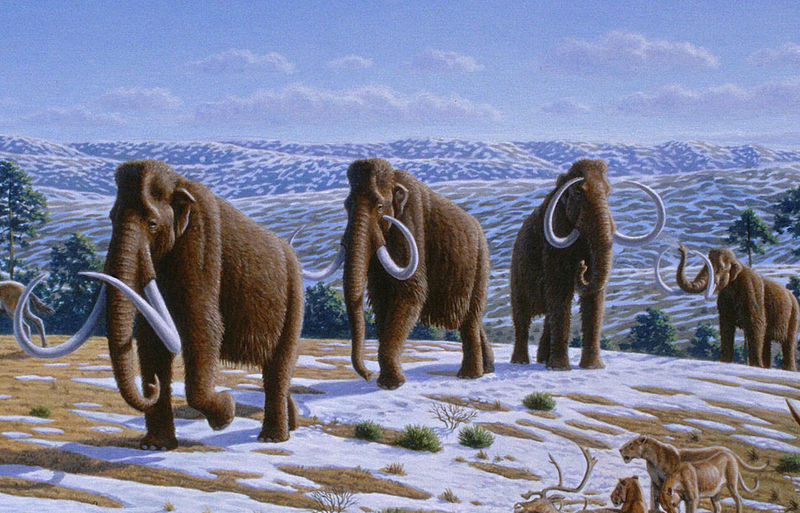
"All we need is a good sample of soft tissue from a frozen mammoth." (Image by Mauricio Antón.)
After 5,000 years of extinction, the Woolly Mammoth may be getting a new lease on life, as Japanese scientists believe they’ll be able to clone the humongous beasts within a few years. It sounds like such a terrible idea. (Thanks Newser.) An excerpt from a Telegraph article about the experiment:
“Previous efforts in the 1990s to recover nuclei in cells from the skin and muscle tissue from mammoths found in the Siberian permafrost failed because they had been too badly damaged by the extreme cold.
But a technique pioneered in 2008 by Dr. Teruhiko Wakayama, of the Riken Centre for Developmental Biology, was successful in cloning a mouse from the cells of another mouse that had been frozen for 16 years.
Now that hurdle has been overcome, Akira Iritani, a professor at Kyoto University, is reactivating his campaign to resurrect the species that died out 5,000 years ago.
‘Now the technical problems have been overcome, all we need is a good sample of soft tissue from a frozen mammoth,’ he told The Daily Telegraph.
He intends to use Dr Wakayama’s technique to identify the nuclei of viable mammoth cells before extracting the healthy ones.
‘The success rate in the cloning of cattle was poor until recently but now stands at about 30 per cent,’ he said. ‘I think we have a reasonable chance of success and a healthy mammoth could be born in four or five years.'”
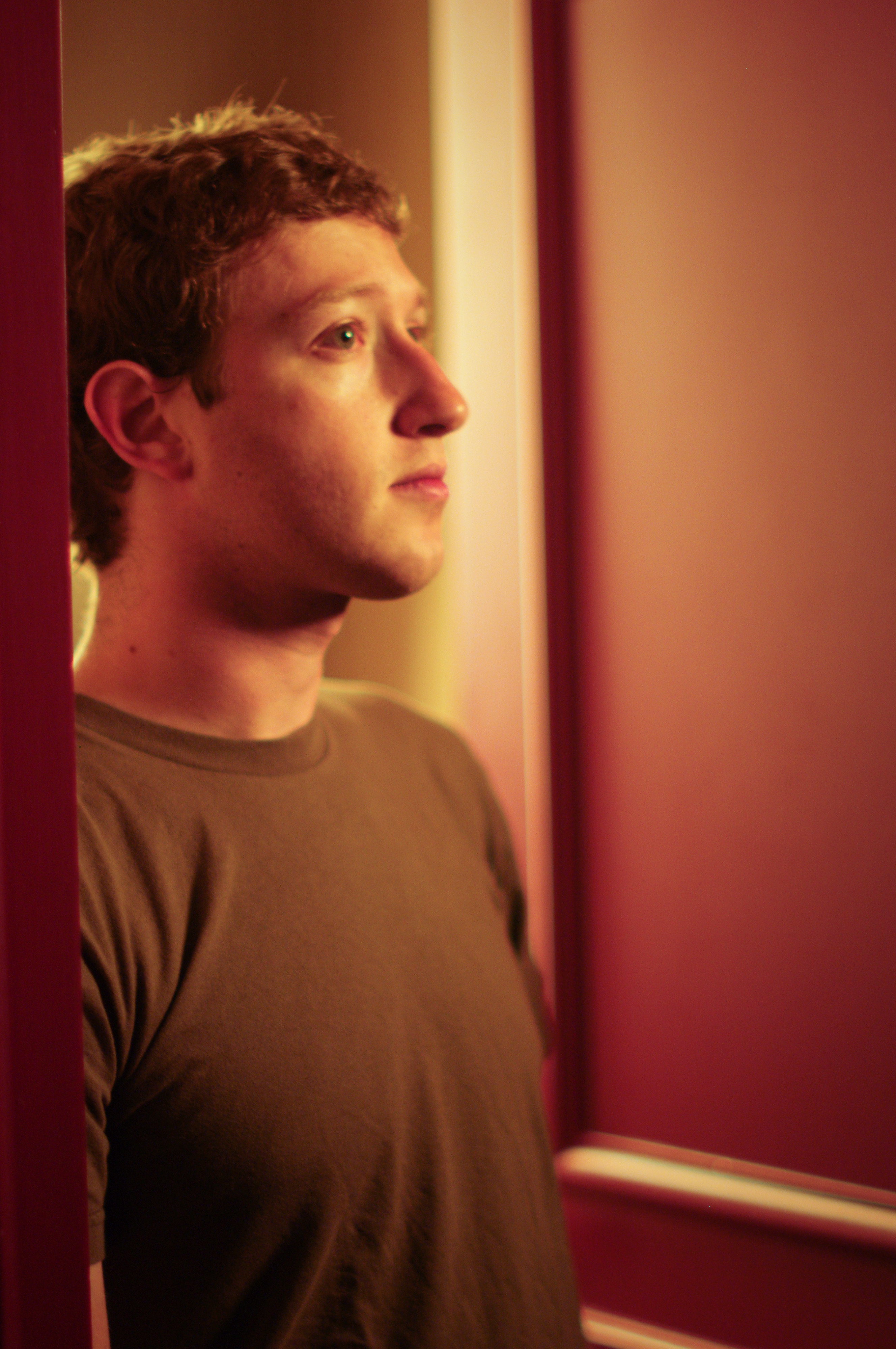
"It's really AOL with a different layout." (Image by Raphaël Labbé.)
I suppose I should be losing sleep over Facebook’s questionable practices regarding privacy, but I’m not. What really bothers me about Mark Zuckerberg’s toy is how utterly prosaic a product it is. Zuckerberg hasn’t come up with anything great or original; his chief accomplishments are recognizing a niche in the market and having the brass to not sell the company to a big media conglomerate that would have bungled the whole thing. Facebook isn’t a perfect design like the iPod but a creeping mediocrity with some utility. It’s a global high school yearbook, and its success largely stems from how uninventive it is. John C. Dvorak explains further in his new PCmag.com article, “Why I Don’t Use Facebook.” (Thanks Reddit.) An excerpt:
“Which begs the question as to why anyone would use Facebook when it is essentially AOL done right? The fastest growing group on Facebook are people in their 70’s. Oldsters are flocking to Facebook the way they once did with AOL. Facebook is a simple system for the masses that do not really care about technology and do not want to learn anything new except something easy like Facebook.
Whenever someone tells me to check out something on Facebook, I recall the heyday of AOL with its keywords. ‘Go to the Internet at www.blah.com or AOL keyword: blah. This was a common comment on the nightly news or in magazines. The AOL keyword is replaced by the Facebook page name.
There is no reason for anyone with any chops online to be remotely involved with Facebook, except to peruse it for lost relatives. So, next time you log on, remember it’s really AOL with a different layout.
A five-minute clip from a documentary about “visual futurist” artist Syd Mead, who, in addition to creating his own tech-friendly, optimistic work, has been a key force in the art department of many huge sci-fi films, including Blade Runner. In a 2009 interview, Mead addressed the future of our planet:
“Q: What do you think our future will look like? Can we expect something positive or negative?
Syd Mead: The future is what we try to make of it. Obviously we’re going through a earth warming period, which could be caused by our local star, the sun, or other reasons like the accumulation of carbon dioxide. But you have to remember that nature has treated this planet rather harshly several times before, take the asteroid for example that wiped out the dinosaurs.
You have to realize that over 80% of the scientists and engineers that have ever lived are alive right now. So if anything is going to be figured out we’re in a good position to do so now. I like to image a bright future, because that’s healthy. If you really believe that the world is coming to an end then it probably is – you’re helping.”
"Utilizing the concept of a compact, multilayered city, the Urbanscape is a dense, compact city core where facilities are located within close proximity of each other."
The target date is 2020 for the 30-square-kilometer planned Chinese community to be known as Tianjin Eco-City. A working laboratory of the newest green technologies and eye-popping gizmos, the community will be home to 350,000 residents. An excerpt from the development’s website:
“Eco-City will make use of the latest sustainable technologies such as solar power, wind power, rainwater recycling, and wastewater treatment/desalination of sea water. In order to reduce the city’s carbon emissions, residents will be encouraged to use an advanced light rail system, and China has also pledged that 90 percent of traffic within the city will be public transport. The development also features some beautiful public green spaces.
The city will be divided into seven distinct sectors – a Lifescape, an Eco-Valley, a Solarscape, an Urbanscape, a Windscape, an Earthscape and Eco-Corridors. Surrounded by greenery, the Lifescape will consist of a series of soil-topped mounds that will counteract the towering apartment buildings of the other communities. To the north of the Lifescape, the Solarscape will act as the administrative and civic center of the Eco-City. Demonstrating the concept of a compact, multilayered city, the Urbanscape will be the core of the Eco-City, featuring stacked programs interconnected by sky-bridges at multiple levels to make efficient use of vertical space. In contrast to the Urbanscape, the Earthscape will act as a sort of suburb of the city, with stepped architecture that will maximize public green space. Last but not least, the Windscape will transform Qingtuozi, a century-old village surrounded by a small lake, into a venue for citizens to relax and recreate.”
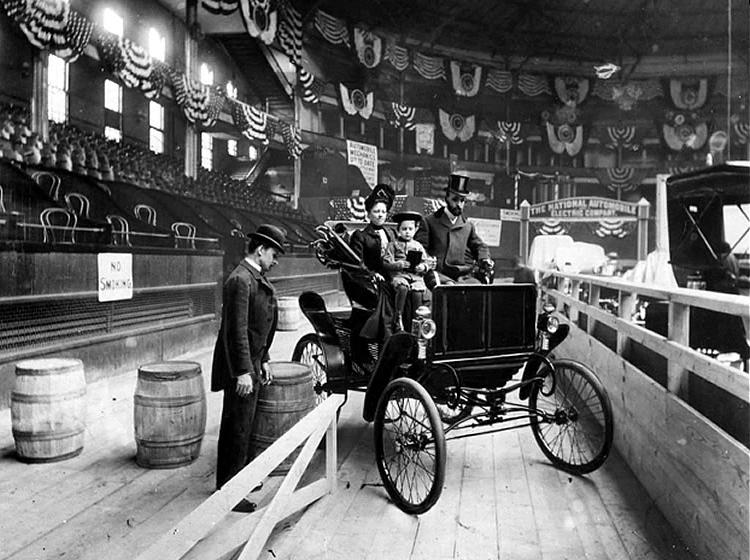
A ticket to the initial New York Auto Show in 1900 cost fifty cents, which would be more than $12 by today's standards.
The initial New York Auto Show took place in 1900 at Madison Square Garden. There had previously been joint bicycle and auto shows in the Garden (with bicycles in the starring role), but this was the first large-scale, modern car show of its kind in America. And it wasn’t all about internal combustion engines and fossil fuels. An excerpt about the event from the October 13, 1900 Brooklyn Daily Eagle:
“During the Automobile Show at Madison Square Garden, November 3 to 10, there will be contests of many kinds. The usefulness of the automobile in all kinds of going and under all conditions will be fully tested, and everybody will have an opportunity to see how the experienced chauffeur gets out of trouble. All the contests but these on Friday will be for vehicles on the show, and the programme, under the directions of the technical committee and the contests and exhibition committee of the Automobile Club of America, C.J. Field, chairman, will be as follows–
November 3: Brake contest and obstacle contest for steam vehicles.
November 5: Brake contest and obstacle contest for electric vehicles.
November 6: Brake contest and obstacle contest for gasoline vehicles.
November 9: Obstacle contest between electric cabs for hire, competition of electric delivery wagons.
November 10: Championship competition and obstacle contest between winners in steam, electric and gasoline, championship between winners of stopping competition in steam, electric and gasoline.”
The First Post has an interesting piece about a proposed “straddling bus” in China that will ride above traffic on stilts and be able to transport 1,000 passengers at a time. An excerpt:
“The bizarre-sounding idea is the brainchild of Shenzhen Huashi Future Parking Equipment company, which has developed a ‘3D Express Coach’ that stands four metres high and resembles a moving bridge.
The bus, which is actually a light-rail train, can travel at speeds of up to 60kmph and will be able to carry more than 1,000 passengers. Not only does it reduce congestion, it also cuts down on pollution as it is powered by electricity and solar energy.
And the idea is not as far fetched as it might appear. Work on special tracks for the buses is expected to begin in the Mentougou district in Beijing later this year. But the buses don’t come cheap, each vehicle will cost $75m.”
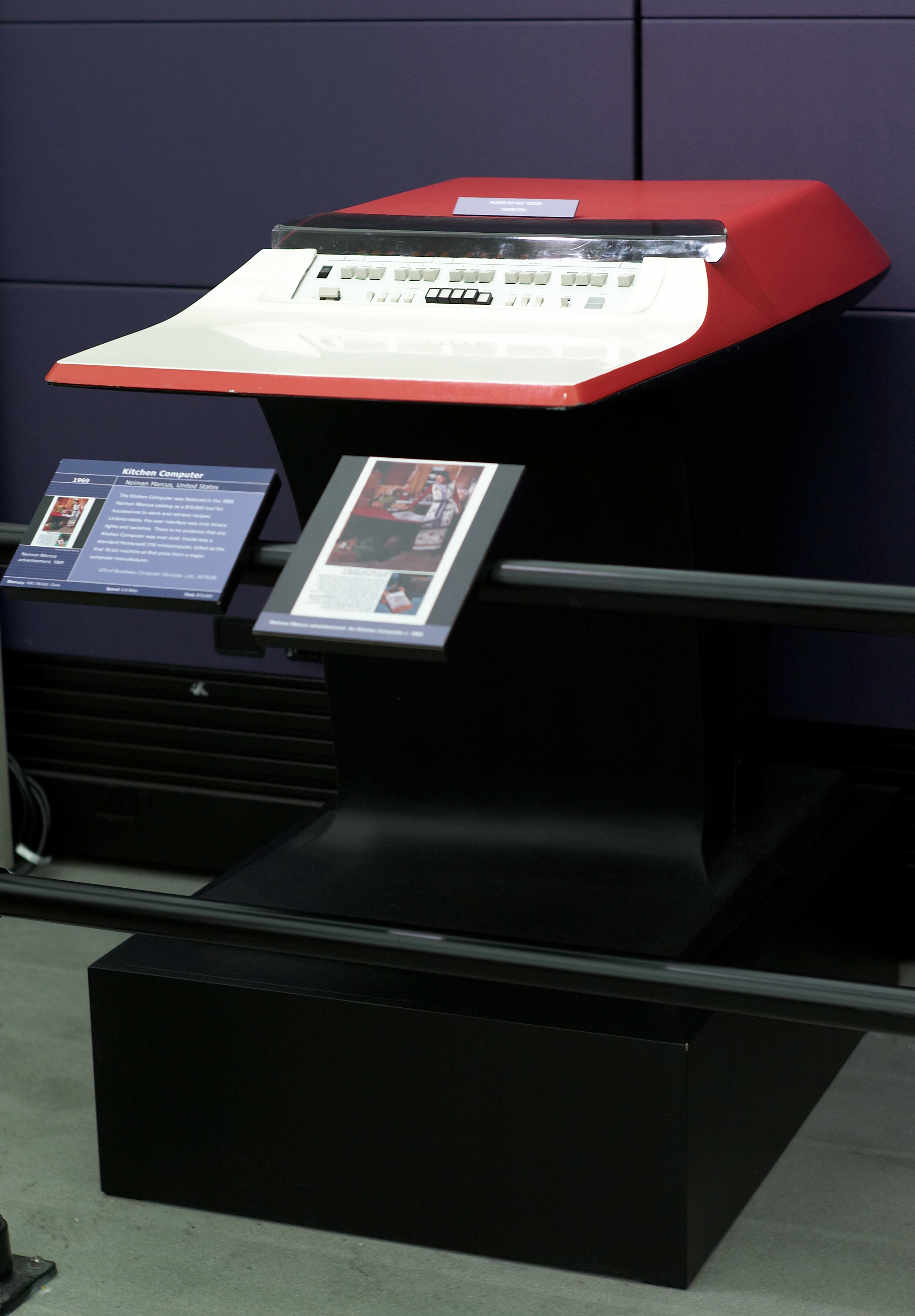
"If she can only cook as well as Honeywell can compute."
In a Wall Street Journalarticleabout an exhibit at theComputer History Museum,Deborah Gage recalls a pricey appliance, the Honeywell 316:
“…a short-lived experiment designed to help women store recipes, organize menus, and balance the family checkbook. As high and wide as a table, it weighed over 100 pounds, took two weeks to learn to program and was sold by Niemen Marcus for about $10,000 in 1969.”
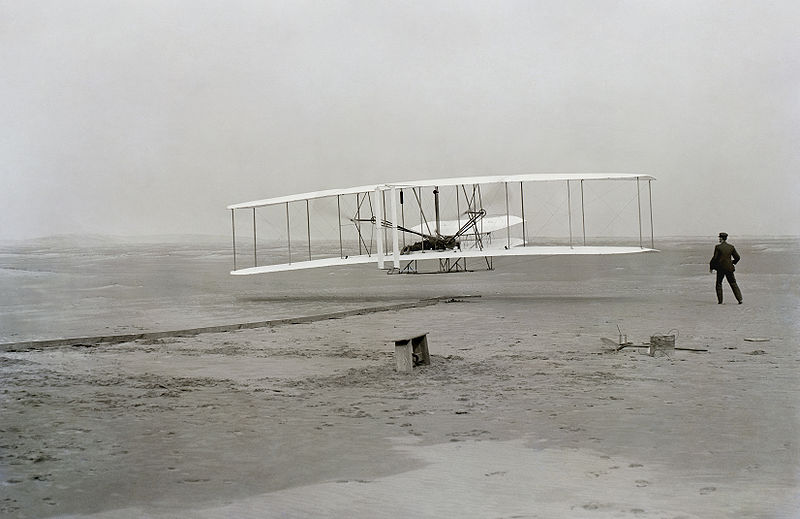
Letters of Note reprints the telegram the Wright Brothers sent to their father, who was a Bishop of the Church of the United Brethren in Christ, in 1903, after getting their Flyer to successfully make four sustained trips. The transcript:
Success four flights thursday morning all against twenty one mile wind started from Level with engine power alone average speed through air thirty one miles longest 57 seconds inform Press home Christmas.
Quebec researcher Jean-Christophe Laurence recently showed tech gadgets that have fallen into disuse (floppy disks, ColecoVision game cartridges, Fisher-Price turntables, etc.) to schoolchildren and asked them to figure out what they were once used for. “Oh, I though it was a bomb,” one child says when examining an 8-track player. Great stuff. (Thanks Reddit and Geekosystem.)
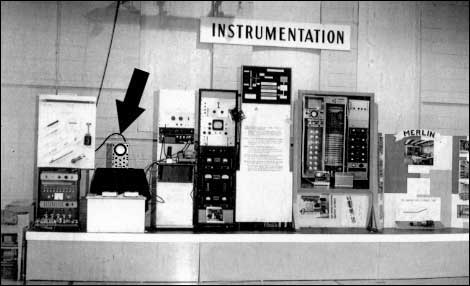
Depending on how you define OXO, Tennis for Two was either the first or second video game. A paddle contest displayed on an oscilloscope, the game was created by physicist and pinball fan William Higinbotham, who debuted it in 1958 at the Brookhaven National Laboratory on Long Island. Oh, and Higinbotham also helped build the first atomic bomb and later became an outspoken opponent of nukes. From his 1994 New York Times obituary:
“William A. Higinbotham, a physicist who developed electronic components for the first atomic bomb and then became a leading advocate of controlling nuclear weapons, died on Thursday at his home in Gainesville, Ga. He was 84.
The cause was emphysema, his family said.
Mr. Higinbotham was a group leader in electronics at Los Alamos, N.M., where the first atomic bomb was developed during World War II. But he soon helped establish a group of scientists, the Federation of American Scientists, that warned about the risks posed by nuclear weapons unless they were tightly controlled.
Mr. Higinbotham has also been called the grandfather of modern video games. In 1958, as a senior physicist at Brookhaven National Laboratory on Long Island, he built for the laboratory’s annual public show what was very possibly the first video game — a tennis game that was displayed on a tiny cathode ray tube.”
New York City has earthquakes, but they’re so minor we never feel them. In most instances, the earth prefers to swallow us up one by one. But it’s different in Los Angeles.
Among other earthquake-related topics, Ulin’s book looks at the thorny issue of earthquake prediction, by scientists and psychics, the concerned and the kooky. An excerpt about Linda Curtis, Seismological Secretary of the Southern California field office of the United States Geological Survey in Pasadena:
“Curtis is, in many ways, the USGS gatekeeper, the public affairs officer who serves as a frontline liaison with the community and the press. Her office sits directly across the hall from the conference room, and if you call the Survey, chances are it will be her low-key drawl you’ll hear on the line. In her late forties, dark-haired and good-humored, Curtis has been at the USGS since 1979, and in that time, she’s staked out her own odd territory as a collector of earthquake predictions, which come across the transom at sporadic but steady intervals, like small seismic jolts themselves.
‘I’ve been collecting almost since day one,’ she tells me on a warm July afternoon in her office, adding that it’s useful for USGS to keep records, if only to mollify the predictors, many of whom view the scientific establishment with frustration, paranoia even, at least as far as their theories are concerned.
‘Basically,’ she says, ‘we are just trying to protect our reputation. We don’t want to throw these predictions in the wastebasket, and then a week later…’ She chuckles softly, a rolling R sound as thick and throaty as a purr. ‘Say somebody predicted a seven in downtown L.A., and we ignored it. Can you imagine the reaction if it actually happened? So this is sort of a little bit of insurance. If you send us a prediction, we put it in the file.'”
••••••••••
“Plus–the city of Los Angeles and its millions of people”:
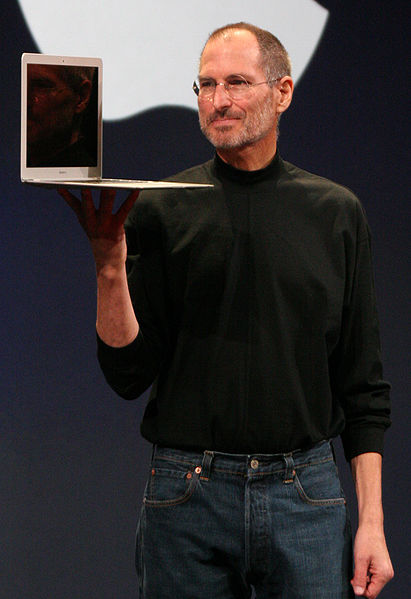
Jobs shows off the MacBook Air in 2008. (Image by Matthew Yohe.)
Steve Jobs shared his thoughts about what makes an entrepreneur successful in 1995. Even someone as brilliant as Jobs could have washed out without incredible diligence, but the creative brain he was born with is still far rarer than a great work ethic. (Thanks Newmark’s Door.) An excerpt:
“I’m convinced that about half of what separates the successful entrepreneurs from the non-successful ones is pure perseverance. It is so hard. You put so much of your life into this thing.
There are such rough moments in time that I think most people give up. I don’t blame them. Its really tough and it consumes your life. If you’ve got a family and you’re in the early days of a company, I can’t imagine how one could do it. It’s pretty much an eighteen-hour day job, seven days a week, for a while.”
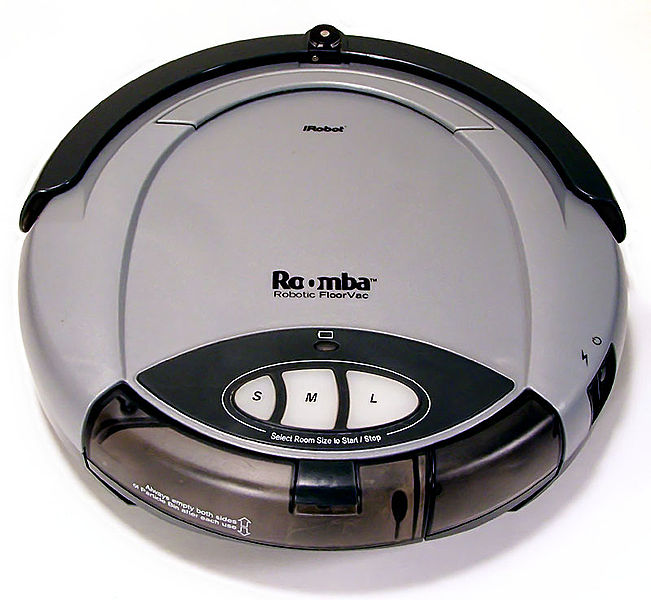
Roomba can't intellectualize vacuuming, but it gets the job done. (Image by Larry D. Moore.)
Steven Levy has an excellent piece, “The AI Revolution Is On,” in the current Wired. In it, Levy points out that artificial intelligence has turned out to be markedly different than what science in the ’50s and ’60s predicted. The reason is because yesterday’s scientists tried to make machines emulate the human brain. But since we still don’t really know how that organ operates, researchers threw away the playbook during the ’80s and have since focused on allowing computers to be “themselves.” An excerpt:
“AI researchers began to devise a raft of new techniques that were decidedly not modeled on human intelligence. By using probability-based algorithms to derive meaning from huge amounts of data, researchers discovered that they didn’t need to teach a computer how to accomplish a task; they could just show it what people did and let the machine figure out how to emulate that behavior under similar circumstances. They used genetic algorithms, which comb through randomly generated chunks of code, skim the highest-performing ones, and splice them together to spawn new code. As the process is repeated, the evolved programs become amazingly effective, often comparable to the output of the most experienced coders.
MIT’s Rodney Brooks also took a biologically inspired approach to robotics. His lab programmed six-legged buglike creatures by breaking down insect behavior into a series of simple commands—for instance, ‘If you run into an obstacle, lift your legs higher.’ When the programmers got the rules right, the gizmos could figure out for themselves how to navigate even complicated terrain. (It’s no coincidence that iRobot, the company Brooks cofounded with his MIT students, produced the Roomba autonomous vacuum cleaner, which doesn’t initially know the location of all the objects in a room or the best way to traverse it but knows how to keep itself moving.)
The fruits of the AI revolution are now all around us. Once researchers were freed from the burden of building a whole mind, they could construct a rich bestiary of digital fauna, which few would dispute possess something approaching intelligence. ‘If you told somebody in 1978, ‘You’re going to have this machine, and you’ll be able to type a few words and instantly get all of the world’s knowledge on that topic,’ they would probably consider that to be AI,’ Google cofounder Larry Page says. ‘That seems routine now, but it’s a really big deal.'”
“Here we are playing ping pong when we ought to be working,” says Ralph Baer, the inventor who subsequently created the Magnavox Odyssey home gaming system. The pre-Pong match takes place in Nashua, New Hampshire.
David Fincher is likely to receive an armful of Oscar nominations for The Social Network, but before he put himself on the map by directing Se7en, Fincher turned out the commercials for AT&T’s prescient 1990s “You Will” ad campaign. The compilation of spots below predicts teleconferencing, Skype, e-books, GPS, etc., though renewing a driver’s license at the ATM still sadly isn’t a reality. Tom Selleck provides the voiceover narration. (Thanks Reddit.)
"Looks more like a ship sitting upside down on the water." (Image by Alexander Remizov.)
If the world keeps getting warmer and the oceans rise, we’ll have issues much larger to deal with than booking a room in a luxury hotel. But Russian architect Alexander Remizov has nonetheless designed a pre-fab hotel that can be built on water as readily as on land. An excerpt from a Spiegel article about the waterborne lodging known as the “Ark”:
“The rising sea waters caused by global warming have inspired a Russian architect to design a hotel that could be built on water as well as land. The eco-friendly ‘Ark’ could be constructed in just a few months anywhere in the world, the designer says.
It’s called “The Ark”, but looks more like a ship sitting upside down on the water. A new design by Russian architect Alexander Remizov challenges the tradition of land-based hotel living and would provide a refuge in the future — should the world face a modern-day flood of Biblical proportions.
Remizov designed the hotel as part of a program on architecture and disaster relief through the International Union of Architects (UIA). He collaborated with a German design and engineering firm and the Moscow-based scientist Lev Britvin, who, according to Remizov, has developed energy-saving solutions for space stations. They are now searching for investors to make the design a reality.”
"In 1919, the first practice baby, named Dicky Domecon for 'domestic economy,' came to Cornell." (Image by Paul Goyette.)
Interesting post on the Cornell University website about “Practice Apartments,” which were college-sponsored living quarters in the early 1900s that a group female students shared with a baby that was “loaned out” by a local orphanage. The antiquated program’s aim was to give young women practical experience in “mothercrafting.” Loaner babies that went through the one-year experience were considered more desirable by prospective parents. (Thanks to Reddit and PlosBlogs.) An excerpt:
“Beginning in the early 1900s, collegiate home economics programs across the nation included ‘practice house’ programs designed to help female students learn ‘mothercraft,’ the scientific art of childrearing. At Cornell each semester, eight women students lived with a resident advisor in the ‘practice apartment,’ where they took turns performing a full range of homemaking activities in a scientific and cost-efficient manner.
In 1919, the first practice baby, named Dicky Domecon for ‘domestic economy,’ came to Cornell. Cornell secured infants through area orphanages and child welfare associations. Babies were nurtured by the students according to strict schedules and guidelines, and after a year, they were available for adoption. Prospective adoptive parents in this era desired Domecon babies because they had been raised according to the most up-to-date scientific principles.
Flora Rose, an early proponent of the program, believed that babies were essential to replicate the full domestic experience. Albert Mann, Dean of the College of Agriculture, called the apartments ‘essential laboratory practice for women students.’ As time passed, however, new research in child development pointed to the need for a primary bond with a single caregiver, and social changes in the lives of women made the practice house focus on domesticity seem old-fashioned. In addition, by the late 1960s, the ideology most prominent in the college favored hard science over practical applications. By 1969, the year the college changed its name, practice apartments were dropped from the Cornell curriculum.”