Science/Tech

You are currently browsing the archive for the Science/Tech category.

Numbers and those who crunch them are all the rage in sports today, but as this 1959 video of the Case Institute of Technology basketball team shows, it’s nothing new. The assistant coach was an undergraduate computer wizard named Don Knuth who fed data into an IBM 650 to help improve his school’s chances. Knuth went on to become a legend in the field of computing and is currently Professor Emeritus at Stanford University. An excerpt from an interview at computer history.org in which Knuth recalls the first time he saw a computer:

“Later on in my freshman year there arrived a machine that, at first,  I could see only through the glass window. They called it a computer. I think it was actually called the IBM 650 ‘Univac.’ That was a funny name, because Univac was a competing brand. One night a guy showed me how it worked, and gave me a chance to look at the manual. It was love at first sight. I could sit all night with that machine and play with it.”

Tags:

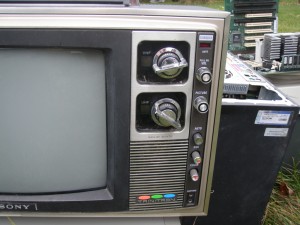
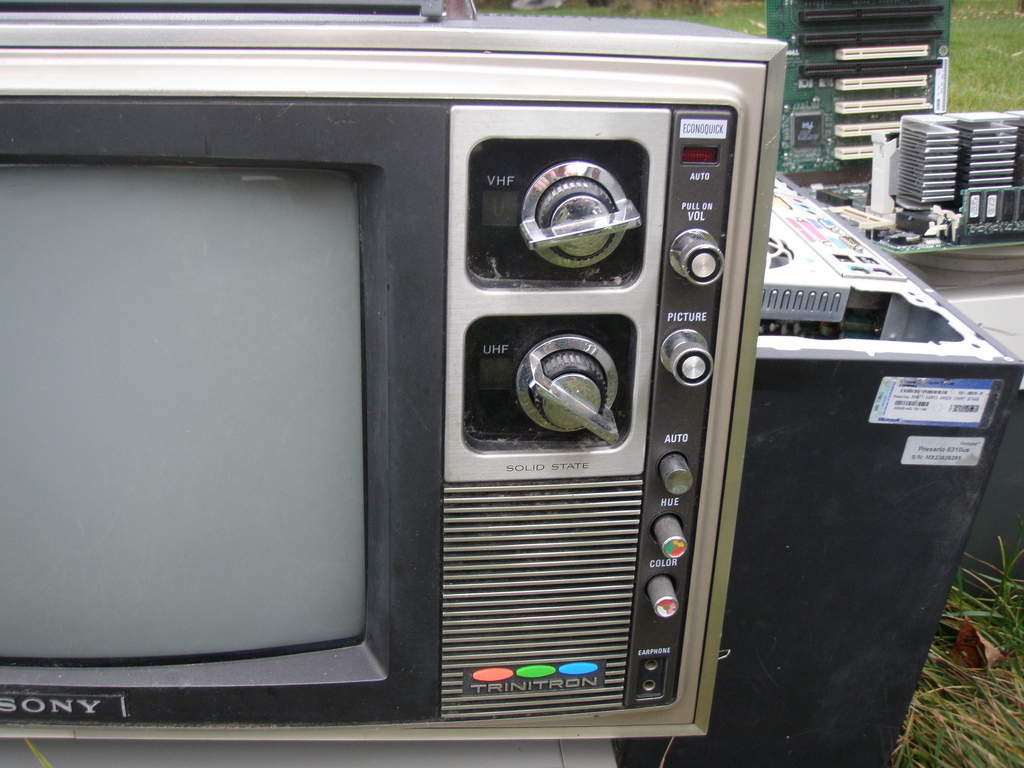
1970s tabletop Sony Trinitron TV. (Image by Daniel Christensen.)

Jeff Yang of the San Francisco Gate has written an article about how Steve Jobs Apple ethos was formed in large part because of his almost fetishistic devotion to former Sony CEO Masaru Ibuka. Ibuka didn’t worry about losing market share in the short run–he wanted, like Jobs subsequently would, to create transformative products and win the future. An excerpt:

“‘Ibuka was really the heart and soul of the company,’ says [Alan] Deutschman, who wrote about Sony’s elder statesman in his most recent book, Walk the Walk. ‘He was the one responsible for Sony’s sense of purpose. This was a company that was launched in a Tokyo that had been leveled by firebombing in World War II, that had experienced the kind of destruction associated with Hiroshima and Nagasaki, and whose residents were facing homelessness, hunger and desperation. And yet Ibuka laid out a mission statement for Sony that was aimed at changing the world.’

That statement was simple and to the point: ‘Sony will be the company that is most known for transforming the global image of Japanese goods as being of poor quality.’ It defined Sony by what it would not do — make bad products — making it something of an omission statement, if you will.
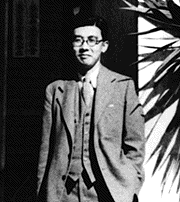
Masaru Ibuka: "We will only do breakthrough technology."

By way of example, Deutschman tells the story of how Sony entered the color TV marketplace, noting that in the Sixties, when color TV was going from 3% to 25% of the market, Sony was one of the few electronics companies that didn’t sell a color model. ‘People were telling Ibuka, ‘You have to come in to this market, everyone will take your market share,’ says Deutschman. ‘And Ibuka refused, saying, ‘No, we will only do great products. We will only do high quality goods. We will only do breakthrough technology.”

As a result, the company found itself in a precarious financial situation, losing out to its primary rivals — until it came upon the aperture-grille technology that Sony unveiled in 1966 as the core of the Trinitron TV. A full 25% brighter than its rivals, Trinitron became the best-selling color TV for the next quarter century.

‘At the time, Sony was committed to not releasing a crappy product just because the market was there; they waited until they had a truly revolutionary innovation, combined it with great design and then profited from it for long, long time,’ says Deutschman. ‘For decades, Sony was a perfect place for engineers to fully use their creativity, because it was focused on bringing real meaning and benefit to society by making great products.'”
Tags: , , ,

It’s that thing that’s about to devastate your medium, Bryant.

Tags: ,

Wired has a story by Spencer Ackerman about plants being engineered by biologist June Medford to detect explosives. Expect them to be in pots in our airports very soon. An excerpt:

“Picture this at an airport, perhaps in as soon as four years: A terrorist rolls through the sliding doors of a terminal with a bomb packed into his luggage (or his underwear). All of a sudden, the leafy, verdant gardenscape ringing the gates goes white as a sheet. That’s the proteins inside the plants telling authorities that they’ve picked up the chemical trace of the guy’s arsenal.

It only took a small engineering nudge to deputize a plant’s natural, evolutionary self-defense mechanisms for threat detection. ‘Plants can’t run and hide,’ says June Medford, the biologist who’s spent the last seven years figuring out how to deputize plants for counterterrorism. ‘If a bug comes by, it has to respond to it. And it already has the infrastructure to respond.’”

Tags: ,

IBM celebrates its century mark with a 30-minute film called “They Were There,” which was directed by Errol Morris and scored by Philip Glass. I interviewed Morris once, and I was depressed when he told me how much trouble he has raising money for his amazing documentaries. That’s probably true of every non-fiction filmmaker who isn’t Michael Moore. Well, at least there are coporate gigs to pay the bills.

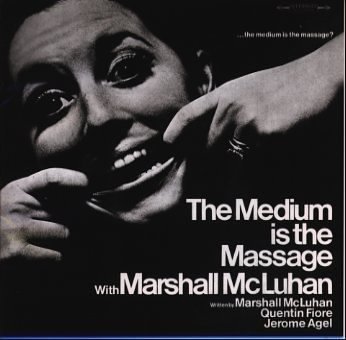
Boing Boing pointed me to a remarkable site called “Marshall McLuhan Speaks: Centennial 2011,” which celebrates what would have been the media philosopher’s 100th birthday. It contains clips of McLuhan opining about things he saw on the horizon that others didn’t. It’s amazing to think how celebrated and discredited McLuhan was in such short order during the ’60s and ’70s, but I think his ideas are mostly a good legacy. A transcript of McLuhan’s words from 1966, describing what sounds very much like the Internet:

“Instead of going out and buying a packaged book of which there have been 5,000 copies printed, you will go to the telephone, describe your interests, your needs, your problems, and they at once xerox, with the help of computers from the libraries of the world, all the latest material just for you personally, not as something to be put out on a bookshelf. They send you the package as a direct personal service. This is where we’re heading under electronic information conditions.”

More Afflictor posts about Marshall McLuhan:

Tags:

"The searcher after health and beauty must blow as large a bubble as she can while seated."

Society has come up with many ways to drive women crazy, but few of them involve blowing soap bubbles. One such instance is described in this groundbreaking health reporting in the September 27, 1902 issue of the Brooklyn Daily Eagle. An excerpt:

“The latest suggestion for acquiring health and beauty is to practice bubble blowing with a clay pipe. It is claimed that if a woman will adhere to the practice for a reasonable length of time she will find her cheeks have become plump and the contour of her neck decidedly improved. Blowing bubbles is a similar operation to the deep breathing exercises now so highly recommended, and the searcher after health and beauty must blow as large a bubble as she can while seated, blowing slowly and gradually, for fear of bursting the bubble. After a few minutes the exercise is repeated standing.

Then she lies flat on her back on the floor with chin as high as possible and blows as long as she can, the first bubble slowly and then as rapidly as possible.”

"No poop."


WANTED – USED DIAPERS! (carroll gardens)

We are a green building company seeking baby diapers. Urine is ok. No poop.

We use them as a base in our green roofs.

The diapers hold huge amounts of water and the urine is good fertilizer.

Turn the world green! Keep those diapers out of the landfill and help make green roofs!

As America fiddles, China continues to move into a more sustainable future, this time with a solar-powered train station in Nanjing that will allow for clean and efficient rail travel. (Thanks Reddit.) An excerpt from a post by Tracy McGill on the Metaefficient blog:

“Efficiency abounds in China as the world’s largest building integrated photovoltaic project prepares to power the railway station where some of the world’s fastest high speed trains pass through. China Sunergy, a solar cell and module manufacturer based in Nanjing, China, has recently signed a deal with CEEG (Nanjing) Solar Energy Research Institute to supply the 7MW solar modules for the Nanjing South Railway Station. When it’s finished, the Nanjing South Railway Station will be one of the most energy efficient public buildings in China.”

Reddit pointed me to this 1987 commercial for what was a really cool and inexpensive black-and-white camcorder for kids, the Fisher-Price PXL 2000. It was a handheld camera that recorded footage using audio cassettes. Intended as a toy, the lo-res pixelvision product was a flop with kids but became a popular, artsy cult item with adults, especially indie filmmakers and graphic designers. It was created by Andrew Bergman, who passed away in 2007 at the young age of 57. An excerpt from a remembrance of the ecelctic inventor from a Stickley Museum newsletter:

“Andy was born in Appleton, Wisconsin, and schooled at Carnegie Mellon and Southern Illinois University, where he taught with prolific innovator Buckminster Fuller. In 1992, he formed the Bergman Design Consortium, a force in the toy design industry. As a self-taught sculptor and furniture designer, Andy spent many summers at Haystack Mountain School of Crafts in Deer Island, Maine. Andy’s zest for life was abundant and was evident in his joyous creations.”

Tags: ,

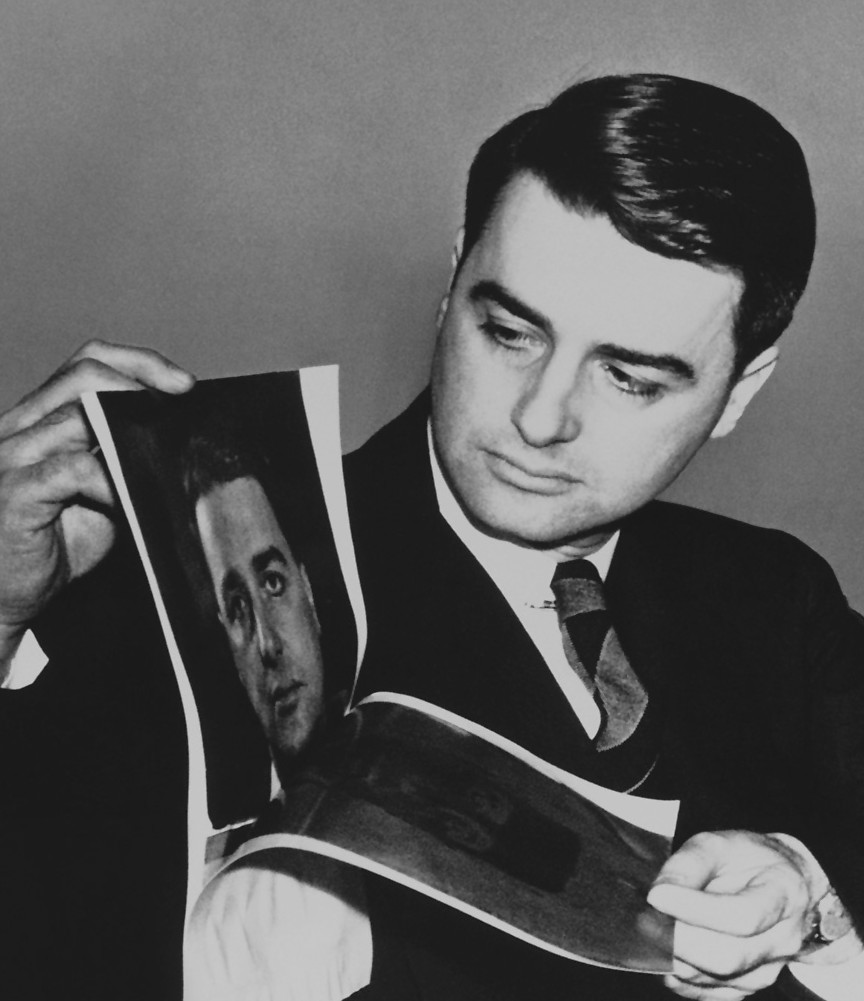
In 1972, scientist and Polaroid co-founder Dr. Edwin H. Land released the SX-70 collapsible instant camera, which featured a new type of self-developing film that required nothing of a photographer beyond a point and a click. In the October 27 issue of Life that year, Land unveiled his new invention and opined on the nature of creativity. In his description of the birth of the first Polaroid camera in the 1940s, he offers a pretty great explanation about the creative process in general. An excerpt:

Many people are creative but use their competence in ways so trivial that it takes them nowhere. Their kind of creativity is not cumulative. True creativity is characterized by a succession of acts each depending on the one before and suggesting the one after. This kind  of cumulative creativity led to the development of Polaroid photography.

One day when we were vacationing in Santa Fe in 1943 my daughter, Jennifer, who was then 3, asked me why she could not see the picture we had just taken of her. As I walked around that charming town, I undertook the task of solving the puzzle she had set for me.

Within the hour, the camera, the film and the physical chemistry became so clear that with a great sense of excitement I hurried to the place where a friend was staying, to describe to him in detail a dry camera which would give a picture immediately after exposure. In my mind it was so real that I spent several hours on this description.

Four years later we demonstrated the working system to the Optical Society of America. All that we at Polaroid had learned about making polarizers and plastics, and the properties of the viscous liquids, and the preparation of the microscopic crystals smaller than the wavelengths of light was preparation for that day in which I suddenly knew how to make a one-step photographic process. I learned enough about what would work in different fields to be able to design the camera and film in the space of that walk.•

___________________________

In 1970, Edwin H. Land gave a tour of the Polaroid company.

Tags:

"He was universally advised to take the boy at once to Paris and place him under the advisement of Pasteur."

Legendary French chemist and bacteriologist Louis Pasteur treated his first human patient for rabies, or “hydrophobia,” in 1885 after testing his vaccine on fewer than ten dogs. It was a bold move that proved successful in defeating what had been a killer virus. But his treatment hadn’t yet become widespread in the U.S. by the following year when four people were bitten by a rabid dog in Chicago. The only answer was to send them to France and Dr. Pasteur for treatment. The Brooklyn Daily Eagle reported the story on April 28, 1886. An excerpt:

“A big white dog, mad with rabies, appeared on Fulton street, in Pullman, yesterday afternoon. He was heated, but his tongue did not protrude. His jaws were covered with thick foam. The dog went along the street quietly until opposite the house of Al Klingel, a railroad switchman. There the brute turned, dashed across the street, seized Johnnie Klingel, aged 8, by the cheek. The animal then started down the street and meeting a little boy named Connors bit him severely in the hand. Then the dog retraced his way on the street, attacking everything that confronted him, but never turning aside. Meeting another boy, he seized him by the seat of the trousers and nearly tore the garment from the lad, but his teeth did not touch the flesh. A moment later an adventurous dog tried to make the acquaintance of his mad brother. A short fight ensued and the mad dog proceeded. Within a block he attacked another dog and sent the unfortunate away howling. By this time the street was aroused and Police Officer Kane and Cassenbrot pursued the dog to Kensington, where he ran into a saloon.

The officers took refuge on a card table and tried to shoot the dog but failed. The dog escaped from the saloon, followed by the officers. In the street a bold boy attacked the dog with a ball bat. He gave the animal one blow and then climbed the fence. Here the policeman overtook the brute, and Officer Kane fired. The ball struck in back of the dog’s head and he fell. Kane approached him and fired another ball into the dog’s body, thinking to make the killing sure, but the animal struggled up and attempted to escape. Again Kane fired, the shot breaking the dog’s leg. He fell, but once got to his feet and rushed upon Officer Cassenbrot. With a savage crunch he set his teeth in the man’s wrist, lacerating it terribly. Yelling like mad the officer shook him off, and as the dog gathered himself for another attack. Officer Kane fired a bullet into the brute’s mouth by killing him. A search was made for the two dogs bitten by the mad one. They were found and killed. Physicians were at once called to attend the two boys who were bitten. Their wounds were burned with caustic, but the physicians gave no hope of preventing hydrophobia. It was soon learned that the mad dog had been in Wildwood last Saturday. On that day he bit Percy Perkins, son of the Superintendent of the Pullman Iron and Steel Works. The boy is 12 years old. He was bitten on the end of the finger, and yesterday his hand and arm were much swollen and he was suffering great pain.

Mr. Perkins consulted with several physicians yesterday and he was universally advised to take the boy at once to Paris and place him under the advisement of Pasteur. Acting under this advice he made arrangements to start the boy with his mother for Paris to-day. The sympathy expressed in the village last night resulted in the circulation of a subscription paper to raise sufficient funds to send all the bitten children to Paris. A considerable amount of money was subscribed. Mr. Perkins had decided not to send his boy away until this evening, and it is probable the three wounded children will go together. Officer Cassenbrot’s wound is the most severe of any. What treatment he will receive has not been determined upon.”

Tags: , , , , , ,

"Books of the coming century will all be printed leaves of nickel, so light to hold that the reader can enjoy a small library in a single volume."

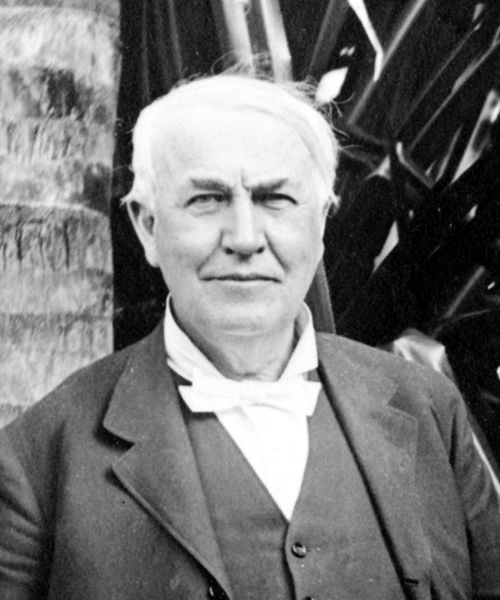
A fun post on John Boitnott’s blog recalls predictions for 2011 that Thomas Edison made 100 years ago. He was asked to prognosticate about the future on June 23, 1911 by the Miami Metropolis. Some hits, some misses, of course. (Thanks Reddit.) An excerpt:

Already, Mr. Edison tells us, the steam engine is emitting its last gasps. A century hence it will be as remote as antiquity as the lumbering coach of Tudor days, which took a week to travel from Yorkshire to London. In the year 2011 such railway trains as survive will be driven at incredible speed by electricity (which will also be the motive force of all the world’s machinery), generated by ‘hydraulic’ wheels.

But the traveler of the future, says a writer in Answers, will largely scorn such earth crawling. He will fly through the air, swifter than any swallow, at a speed of two hundred miles an hour, in colossal machines, which will enable him to breakfast in London, transact business in Paris and eat his luncheon in Cheapside.”

Tags: ,

A friction match, invented by John Walker, was originally called a "lucifer match." (Image by Sebastian Ritter.)

  • The first horse railroad was built in 1826-27.
  • The first lucifer match was made in 1829.
  • The first iron steamship was built in 1830.
  • The first steel pen was made in 1830.
  • Omnibuses were introduced in New York in 1830.

(Taken fron the 1893 Brooklyn Daily Eagle Almanac. Some dates seem questionable.)

Tags:

“Once we have computer outlets in every home, each of them hooked up to enormous libraries, where anyone can ask any question…everyone will enjoy learning.”

Tags:

"And, in their final form, the changing robots had developed a more robust gait."

Ray Kurzweil is a brilliant guy who seems maybe a little too optimistic about technological advances on our horizon. But he has an interesting post on his blog about robots that are being developed that start out as “tadpoles” and morph and change over their lives, which seems to help them learn how to walk better. An excerpt:

“In a first-of-its-kind experiment, University of Vermont roboticist Josh Bongard created both simulated and actual robots that, like tadpoles becoming frogs, change their body forms while learning how to walk. Over generations, his simulated robots also evolved, spending less time in ‘infant’ tadpole-like forms and more time in ‘adult’ four-legged forms.

These evolving populations of robots were able to learn to walk more rapidly than ones with fixed body forms. And, in their final form, the changing robots had developed a more robust gait — better able to deal with, say, being knocked with a stick — than the ones that had learned to walk using upright legs from the beginning.

‘This paper shows that body change, morphological change, actually helps us design better robots,’ Bongard says. ‘That’s never been attempted before.'”

Tags: ,

It seems the surest way to announce that your company, products and employees lack genius is to rely heavily on market research and focus groups. What you’re basically saying is that you know you can’t be ahead of the curve so you’d like someone else to help you just keep up. When Steve Jobs was working on the iPad and wanted to rely on touch screens rather than a stylus, his judgement was questioned, particularly because he didn’t do any market research. His response was: “It isn’t the consumers’ job to know what they want,” realizing on his own that moving from mouse to stylus wasn’t a bold step into the future. And I think most great things have been created by one or two people who just knew. There aren’t enough of those people to go around, so we get focus groups instead. (George Lois agrees with me.)

Jobs obviously wasn’t the first one attempt popularizing touch-screen. In the 1983 edition of Computer Chronicles below, Hewlett-Packard reps share their own touch-screen technology. I wonder what market research said about it back then. By the way: The younger host on your right is Gary Kildall.

Tags: ,

Septuagenarian Romanian inventor Justin Capra has designed seven unconventional flying machines, including a jetpack.

Tags:

"Jobs was being Jobs: He was telling the truth, he was simplifying the truth, he was exaggerating the truth, he was leaving part of the truth out." (Image by acaben.)

Tom Junod’s 2008 profile about Steve Jobs in Esquire becomes an even better read now for very unfortunate reasons. (Thanks Longform.) The article’s opening:

One day, Steve Jobs is going to die.

First, he is mortal. Second, the odds against him are not only actuarial — the inevitable odds we all face — they are clinical. Four years ago, he announced in a memo to his employees that he had undergone surgery, that the surgery was for the removal of a malignant tumor, that the tumor was on his pancreas, and that the surgery was, as he put it, successful. An exceptional man who specializes in exceptionalizing himself — he has been an economic force for thirty years, and it’s still hard to put him in a category, or even to say exactly what he does — he responded to his disease by exceptionalizing it as well. He was at pains to say that the pancreatic cancer he had was not that kind of pancreatic cancer — not the kind that kills you, without much room for exception, in six months or so — but rather ‘a very rare form of pancreatic cancer… which represents about 1 percent of the total cases…each year, and can be cured by surgical removal.’ Even in extremis, Jobs was being Jobs: He was telling the truth, he was simplifying the truth, he was exaggerating the truth, he was leaving part of the truth out. It is true that his cancer, originating not in the ductwork of the pancreas but rather in the islets of Langerhans, is slow growing and, in the words of one expert, can be addressed ‘with curative intent’; it is also true that even after surgery, the average patient lives about five years.”

Tags: ,

Vital experiment conducted by Bioastronautics Research.


Made in the wake of the chaos theory entering into public consciousnes, Errol Morris’ unorthodox 1997 documentary focuses on a quartet of men in disparate professions–a wild-animal trainer, a topiary gardener, a mole-rat specialist and a roboticist–trying in their own way to do what the chaos theorists were also attempting to accomplish–find the underlying sense of unity in ostensible disorder.

Gardener George Mendonςa uses his hedge clippers to transform bushes into leafy elephants, giraffes and bears. These painstaking creations take years to grow and can be undone by one severe rainstorm or snowfall. “You’re fighting the elements,” he says, “trying to get them to do what you want them to do. It’s a constant battle.” Also battling is zoologist Raymond A. Mendez, who puzzles over how to create a secure captivity for African mole-rats, whose teeth can chew through concrete. MIT robot scientist Rodney Brooks has to somehow make machines obey his wishes, realizing that every success he enjoys may be helping silicon-based life eventually supplant carbon-based humans.

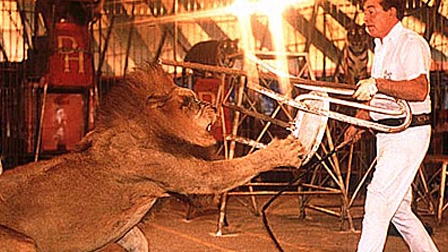
While these three men eagerly face their challenges and are largely willing to embrace the future, lion trainer Dave Hoover isn’t quite so cheerful about the the old guard being lost in the shuffle of new ideas: The chaos he faces isn’t only that unpredictable, maned creature in the cage with him, but also a more sophisticated world that isn’t quite so awed by a traveling circus. He pines for his mentor, Clyde Beatty, the legendary animal trainer, and the simpler days when the big top was greeted with a sense of wonder because people weren’t as connected to information and one another. Hoover knows that the accepted order has been undone, disproved and abandoned, to never return. New order, if it exists, must be discovered, and it may never be as grand.•

Tags: , , , ,

"She has spent some 15 years since that day studying this emerging breed of 'sociable robots.'" (Image by jeanbaptisteparis.)

Sherry Turkle fell in love with a robot once. It didn’t work out.

Turkle is the MIT professor whose 1995 book, Life on the Screen, was sanguine about the growing interaction between people and technology. But she had doubts after feeling her emotions stir for a robot named Cog she was working with at the university. The personal connection with the bot gave Turkle pause, making her wary that humans are growing reliant on gadgets not just for utility but also for the type of nourishment provided in the past by people.

While her love for Cog may say more about the academic herself than anyone else, Turkle doesn’t think so. She shared some of her fears of how artificial intelligence may soon replace human emotion with Jeffrey R. Young of the Chronicle. (Thanks A&L Daily.) An excerpt:

“She has spent some 15 years since that day studying this emerging breed of ‘sociable robots’—including toys like Furbies and new robotic pets for the elderly—and what she considers their seductive and potentially dangerous powers. She argues that robotics’ growing trend toward creating machines that act as if they were alive could lead people to place machines in roles she thinks only humans should occupy.

Her prediction: Companies will soon sell robots designed to baby-sit children, replace workers in nursing homes, and serve as companions for people with disabilities. All of which to Turkle is demeaning, ‘transgressive,’ and damaging to our collective sense of humanity. It’s not that she’s against robots as helpers—building cars, vacuuming floors, and helping to bathe the sick are one thing. She’s concerned about robots that want to be buddies, ‘implicitly promising an emotional connection they can never deliver.”

Tags: ,

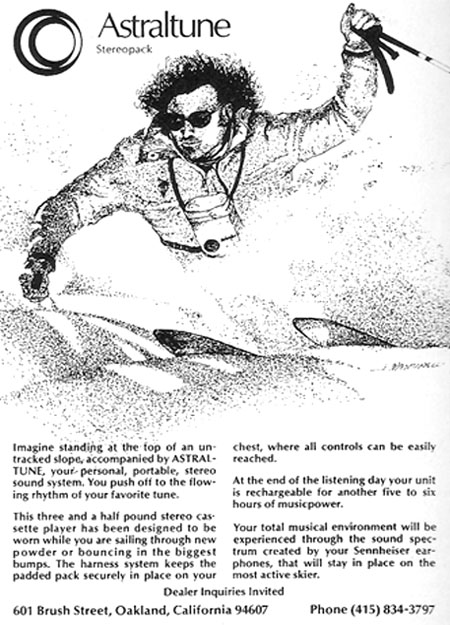
"The harness system keeps the padded pack securely in place on your chest."

Before the Sony Walkman and long before the iPod, the Astraltune was a personal music system, which was marketed to skiers who wanted some tunes on the slopes. It was the very first portable stereo cassette player, but the company somehow never patented the invention. The Finest Daily includes the Astraltune in a new list of firsts from the annals of gadgetry. (Thanks to justabuzz.) An excerpt:

“Most people think Sony’s Walkman paved the way to hearing loss for a generation of teenagers, but the original portable music player actually pre-dated the Walkman by almost five years. The Astraltune Stereopack debuted in Reno, Nevada in 1975 and it was aimed at freestyle skiers who wanted to groove out to their favorite tunes while hitting the slopes. It was a bulky 3-pound unit worn in a sack mounted on the chest, but it was the first time you had a power source, a cassette player and a headphone output in the same unit. The story doesn’t have a happy end though – the inventor(s) never patented their invention and today very few people remember it; Sony went on to dominate the personal stereo market for well over 15 years.”

Aftermath of the devastating San Francisco earthquake of 1906. (Image by H.D. Chadwick.)


From the February 2, 1867
Brooklyn Daily Eagle:

“California is troubled occasionally with slight shocks of earthquakes, but, as yet, has sustained no serious damage therefrom.

That of October, 1865, the most severe ever known, even by the oldest inhabitant, was in San Francisco, the cause of great alarm and some slight destruction of property. However, such a shock as that of 1865, may not occur again for a thousand years.”


Dr. Sidney Cohen is the one dispensing LSD to a patient in this 1950s video that was made at the Los Angeles Veterans Administration Hospital. *Thanks Reddit.) A decade later, in “Psychotherapy with LSD: Pro and Con,” Cohen was still largely singing the praises of acid. An excerpt:

“At a 1965 LSD conference Dr. Sidney Cohen, an American authority on LSD, summed up the claims made for LSD and LSD-like drugs by psychiatrists:

1. They reduce the patient’s defensiveness and allow repressed memories and conflictual material to come forth. The recall of these events is improved and the reaction is intense.

2. The emerging material is better understood because the patient sees the conflict as a visual image or in vivid visual symbols. It is accepted without being overwhelming because the detached state of awareness makes the emerging guilt feelings less devastating.

3. The patient feels closer to the therapist and it is easier for him to express his irrational feelings.

4. Alertness is not impaired and insights are retained after the drug has worn off.

Under skilled treatment procedures, the hallucinogens do seem to produce these effects and one more which is not often mentioned. That is a marked heightening of the patient’s suggestibility. Put in another way, the judgmental attitude of the patient toward the experience itself is diminished. This can be helpful, for insights are accepted without reservations and seem much more valid than under nondrug conditions.”

Tags:

« Older entries § Newer entries »