Science/Tech

You are currently browsing the archive for the Science/Tech category.

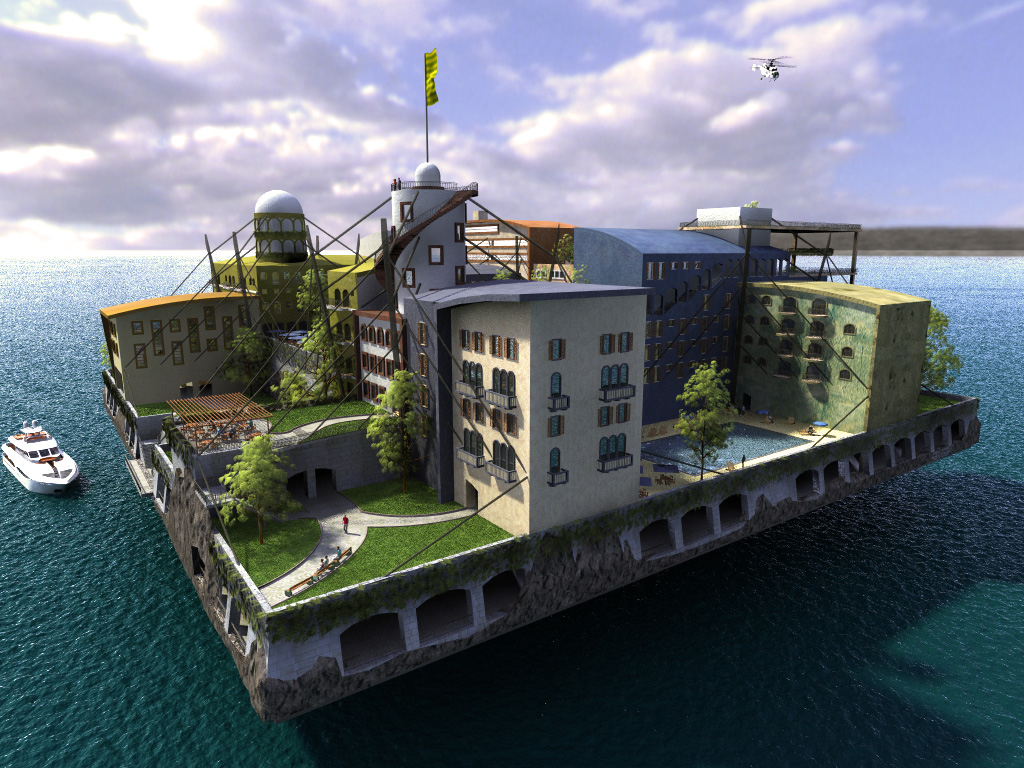
A seasteading design by Andras Gyorfi.

Seasteading sounds ridiculous to me, but what do I know? Ray Kurzweil’s blog has a transcript of “How to Create a Startup Country,” a speech on building nations on the ocean, presented by Patri Friedman:

“A startup country could be the world’s first trillion dollar business.

Now for humanity, this is a huge problem, but with our entrepreneur hats on, what a business opportunity! A startup country could be the world’s first trillion dollar business. But right now, there’s no way for an entrepreneur with a great idea for a startup country to make it happen. Unlike the software industry, where you can get started with just a laptop, to enter the government industry, you need a open space, a physical place that allows political experiments. But there is no such place — every piece of land in the world is claimed.

So there are no startup countries, there’s no channel for innovation of entrepreneurs … no wonder it’s a such a sad industry.

So why don’t we see more innovation in politics? Now, politics is a pretty emotionally charged subject. You’re not supposed to talk about that, or religion. So let’s take a new perspective. Let’s forget about left and right and instead, put on our entrepreneur hats. Let’s think of government as an industry, where countries are firms and citizens are customers.

This is not just any industry. This is the world’s biggest industry. The leading firm had 2009 revenues of 2.5 trillion dollars. Strangely, it’s also an industry legendary for poor performance. That leading firm lost 1.4 trillion. And that’s a top company. The worst companies kill many of their own customers. It’s a pretty sad industry!

The seasteading solution: let a thousand nations bloom

So that’s how we come to seasteading — homesteading the high seas. What we need is a new frontier, an open space for political experiments…and the next frontier is the ocean. With a little technical innovation to make this new frontier accessible, we can unleash enormous political innovation. Let a thousand nations bloom on the high seas, trying diverse political systems — essentially, a startup sector for government.”
Tags: ,

Of course, Iranians aren’t the only ones selling organs. (Thanks Reddit.)

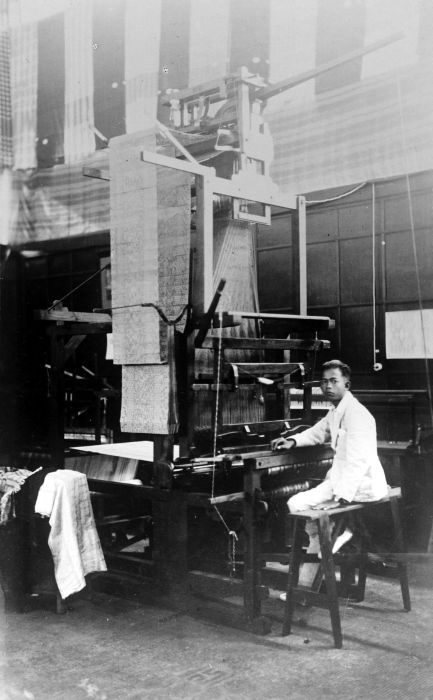
The Jacquard Weaving Loom was, "the first machine to use punched cards to control a series of sequences," according to "Life."

Life.com has a slideshow called “A Brief History of Computing,” which progresses from abacus to iPad in a few dozen images. See it here.

"Most people are fools, most authority is malignant, God does not exist, and everything is wrong." (Image by Tim Brailsford.)

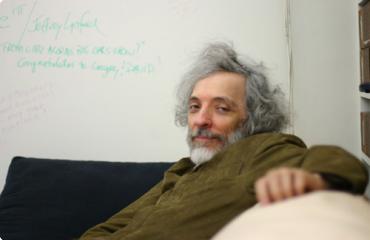
To dream big is to risk failing big, and nobody in the computer world dreamed bigger than visionary Ted Nelson. The information pioneer and philosopher coined the term “hypertext” in 1963 and spent the majority of his life frustratingly, unsuccessfully working on Project Xanadu, a system that attempted to link networked computers with a simple interface decades before the invention of the World Wide Web. Nelson’s tilting at virtual windmills was the subject of a devastating Wired article in 1995 by Gary Wolf. An excerpt:

Nelson’s life is so full of unfinished projects that it might fairly be said to be built from them, much as lace is built from holes or Philip Johnson’s glass house from windows. He has written an unfinished autobiography and produced an unfinished film. His houseboat in the San Francisco Bay is full of incomplete notes and unsigned letters. He founded a video-editing business, but has not yet seen it through to profitability. He has been at work on an overarching philosophy of everything called General Schematics, but the text remains in thousands of pieces, scattered on sheets of paper, file cards, and sticky notes.

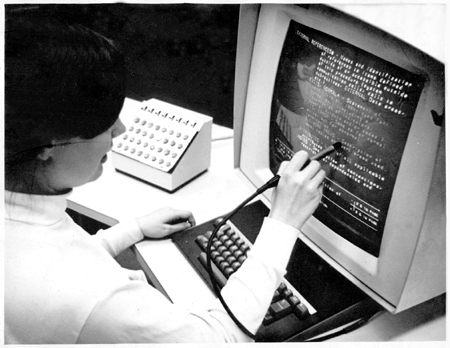
The Hypertext Editing System (HES), seen here being used at Brown University in 1969, was developed by Ted Nelson and others. (Image by Greg Lloyd.)

All the children of Nelson’s imagination do not have equal stature. Each is derived from the one, great, unfinished project for which he has finally achieved the fame he has pursued since his boyhood. During one of our many conversations, Nelson explained that he never succeeded as a filmmaker or businessman because ‘the first step to anything I ever wanted to do was Xanadu.’

Xanadu, a global hypertext publishing system, is the longest-running vaporware story in the history of the computer industry. It has been in development for more than 30 years. This long gestation period may not put it in the same category as the Great Wall of China, which was under construction for most of the 16th century and still failed to foil invaders, but, given the relative youth of commercial computing, Xanadu has set a record of futility that will be difficult for other companies to surpass. The fact that Nelson has had only since about 1960 to build his reputation as the king of unsuccessful software development makes Xanadu interesting for another reason: the project’s failure (or, viewed more optimistically, its long-delayed success) coincides almost exactly with the birth of hacker culture. Xanadu’s manic and highly publicized swerves from triumph to bankruptcy show a side of hackerdom that is as important, perhaps, as tales of billion-dollar companies born in garages.”

Tags: ,

No hands, just brains. (Thanks IEEE Spectrum.)

Computer scientist Bill Joy despised the violence of the Unabomber as any sane person would, so he felt great disquiet when he read a passage written by Ted Kaczynski and agreed with the domestic terrorist’s concerns for the future of humankind. In his famous 2000 Wired article, “Why the Future Doesn’t Need Us,” Joy meditates on the unease caused by his sympathies for the ideas of a madman. An excerpt:

“Part of the answer certainly lies in our attitude toward the new – in our bias toward instant familiarity and unquestioning acceptance. Accustomed to living with almost routine scientific breakthroughs, we have yet to come to terms with the fact that the most compelling 21st-century technologies – robotics, genetic engineering, and nanotechnology – pose a different threat than the technologies that have come before. Specifically, robots, engineered organisms, and nanobots share a dangerous amplifying factor: They can self-replicate. A bomb is blown up only once – but one bot can become many, and quickly get out of control.

Much of my work over the past 25 years has been on computer networking, where the sending and receiving of messages creates the opportunity for out-of-control replication. But while replication in a computer or a computer network can be a nuisance, at worst it disables a machine or takes down a network or network service. Uncontrolled self-replication in these newer technologies runs a much greater risk: a risk of substantial damage in the physical world.”

Tags: ,

On his site, Kevin Kelly’s opines on “Seeking Sustainable Disequilibrium,” which seems to be happening whether we seek it or not, as we ride the wave of the great paradigm shift through the Information Age. An excerpt:

“In the industrial perspective, the economy was a machine that was to be tweaked to optimal efficiency, and once finely tuned, maintained in productive harmony. Companies or industries especially productive of jobs or goods had to be protected and cherished at all costs, as if these firms were rare watches in a glass case.

As networks have permeated our world, the economy has come to resemble an ecology of organisms, interlinked and coevolving, constantly in flux, deeply tangled, ever expanding at its edges. As we know from recent ecological studies, no balance exists in nature; rather, as evolution proceeds, there is perpetual disruption as new species displace old, as natural biomes shift in their makeup, and as organisms and environments transform each other.

Even the archetypal glories of hardwood forests or coastal wetlands, with their apparent wondrous harmony of species, are temporary federations on the move. Harmony in nature is fleeting. Over relatively short periods of biological time, the mix of species churns, the location of ecosystems drift, and the roster of animals and plants changes as they come and go.

So it is with network perspective: companies come and go quickly, careers are patchworks of vocations, industries are indefinite groupings of fluctuating firms.”

Tags:

This is apparently real. Oy and vey. (Thanks Reddit.)

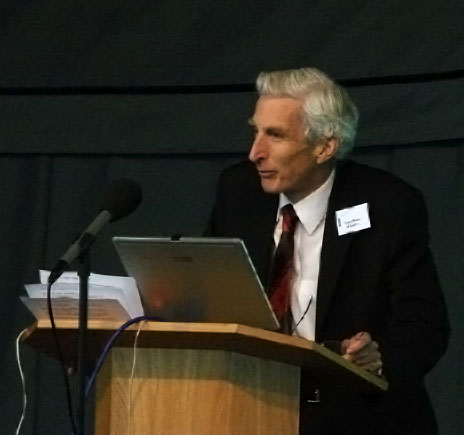
Lord Martin Rees is president of the Royal Society.

Newmark’s Door pointed me to “Ten Questions Science Must Answer,” a cool Guardian article by astronomer Martin Rees,  in which he asked scientists to produce the most pressing questions the discipline should be trying to answer. Manchester physicist Brian Cox has an interesting one.

Can we make a scientific way of thinking all pervasive?

This would be the greatest achievement for science over the coming centuries. I say this because I do not believe that we currently run our world according to evidence-based principles. If we did, we would be investing in an energy Manhattan project to quickly develop and deploy clean energy technologies. We would be investing far larger amounts of our GDP in the eradication of diseases such as malaria, and we would be learning to live and work in space – not as an interesting and extravagant sideline, but as an essential part of our long-term survival strategy.

One only has to look at the so-called controversies in areas such as climate science or the vaccination of our children to see that the rationalist project is far from triumphant at the turn of the 21st century – indeed, it is possible to argue that it is under threat. I believe that we will only be able to build a safer, fairer, more prosperous and more peaceful world when a majority of the population understand the methods of science and accept the guidance offered by an evidence-based investigation of the challenges ahead. Scientific education must therefore be the foundation upon which our future rests.”

Tags: ,

Affetto is a robot baby that moves its face like a human. “He” has been created so that researchers can learn about social development by studying people interacting with the bot. Still, pretty creepy. (Thanks IEEE Spectrum.)

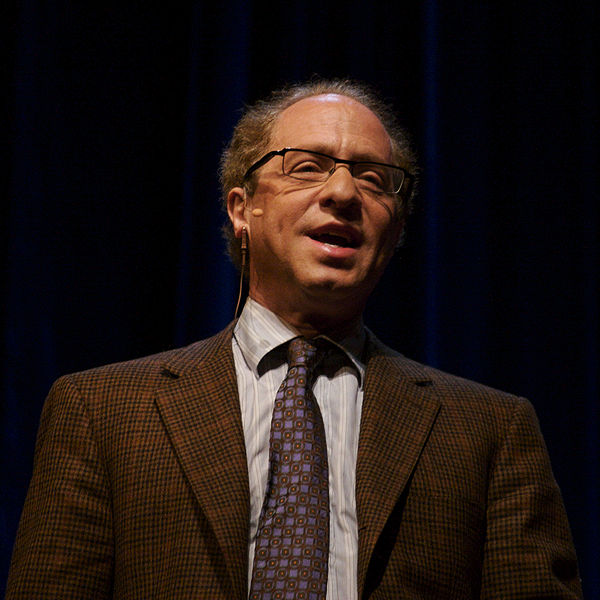
Ray Kurzweil: born and raised in Queens, New York. (Image by null0.")

The Week has a pretty good summation of Time‘s article about the always provocative Ray Kurzweil. The following part seems least likely of all to occur by 2045:

… And we will be able to bring the dead back to life
Kurzweil envisages a world in which biotechnology and nanotechnology are so advanced that the human genome ‘becomes just so much code to be bug-tested and optimized.’ Extending your life infinitely becomes reality, as does resurrecting failed organic material. ‘Death loses its sting once and for all.’ Kurzweil hopes to bring his dead father back to life.”

Tags:

Let’s call it a glorious stalemate.

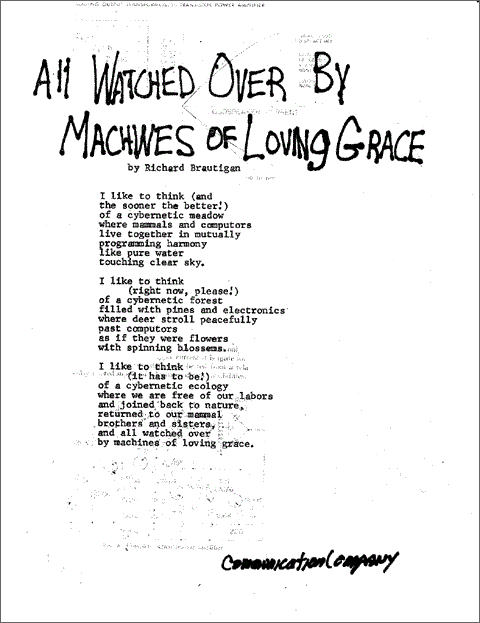
“All Watched Over
by Machines of Loving Grace”

by Richard Brautigan, 1968.

I’d like to think (and
the sooner the better!)
of a cybernetic meadow
where mammals and computers
live together in mutually
programming harmony
like pure water
touching clear sky.
I like to think
(right now, please!)
of a cybernetic forest
filled with pines and electronics
where deer stroll peacefully
past computers
as if they were flowers
with spinning blossoms.

I like to think
(it has to be!)
of a cybernetic ecology
where we are free of our labors
and joined back to nature,
returned to our mammal brothers and sisters,
and all watched over
by machines of loving grace.

Tags:

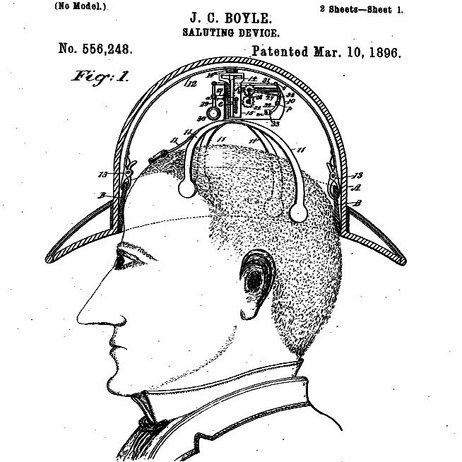
Robert Krulwich’s blog ran an image of James C. Boyle’s odd nineteenth-century invention known as the Saluting Device, which was an automated system that would tip men’s hats for them, no hands necessary. It never caught on. An excerpt from the 1896 patent:

“Be it known, that I, James C. Boyle, of Spokane, in the county of Spokane and State of Washington, have invented a new and improved Saluting Device, of which the following is a full, clear, and exact description.

This invention relates to a novel device for automatically effecting polite salutations by the elevation and rotation of the hat on the head of the saluting party when said person bows to the person or persons saluted, the actuation of the hat being produced by mechanism therein and without the use of hands in any manner.”

Tags: ,

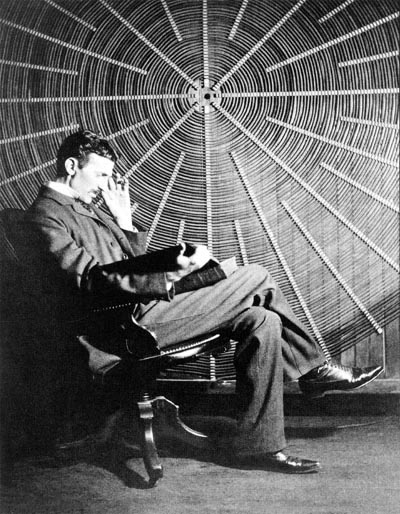
Nikola Tesla in his offices on East Houston Street in NYC.

Nikola Tesla prognosticating in the New York Times in 1909:

“It will soon be possible, for instance, for a business man in New York to dictate instructions and have them appear instantly in type in London or elsewhere. He will be able to call up from his desk and talk with any telephone subscriber in the world. It will only be necessary to carry an inexpensive instrument no bigger than a watch, which will enable its bearer to hear anywhere on sea or land for distances of thousands of miles. One may listen or transmit speech or song to the uttermost parts of the world. In the same way any kind of picture, drawing, or print can be transferred from one place to another. It will be possible to operate millions of such instruments from a single station. Thus it will be a simple matter to keep the uttermost parts of the world in instant contact with each other.”

Tags:

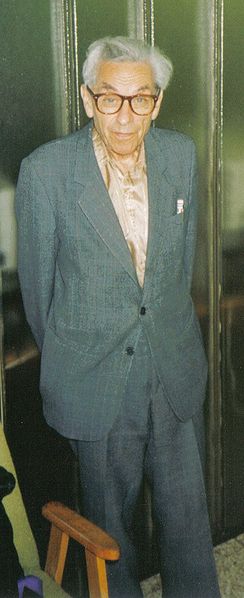
"He was a kind of mathematical troubadour." (Image by Kmhkmh.)

Even in a field marked by eccentricity, mathematician Paul Erdös was an odd number. The Hungarian published more papers than any other mathematician in history, even though he never really had an official post or a home or any money. He just traveled around the world, crashed with an array of academics and worked on seemingly unsolvable problems. He hardly slept or ate. This peripatetic pattern and self-abnegation continued until his death in 1996. An excerpt from Jeremy Bernstein’s 1998 Atlantic essay, which meditates on Paul Hoffman’s biography about the monomaniacal human computer, The Man Who Loved Only Numbers:

“Around 1950, when I was an undergraduate in mathematics at Harvard, my tutor George Mackey remarked that he was having a visitation from Paul Erdös.

I had never heard of Erdös (the correct pronunciation seems to have been ‘air-dish’ although I always used ‘air-dosh’), but Mackey explained that he was a kind of mathematical troubadour. He had no actual position — not because he was not offered them, but because they would interfere with his modus operandi.

Erdös migrated rapidly among 25 or so countries. He carried all his belongings in one small suitcase and a shopping bag, the greater part of which was filled with his mathematical papers and notebooks. He had no interest in clothes and even less in money. He needed three or four hours of sleep. He would arrive at a place and announce, ‘My brain is open,’ then proceed to collaborate with any and every mathematician who could keep up with him.

His collection of interesting unsolved problems in almost every field of mathematics, but especially in the theory of numbers where he probably did his most enduring work, seemed inexhaustible. What was exhaustible was the stamina of the mathematicians he landed on. Erdös would knock at a colleague’s door. ‘Hello’ he’d begin. ‘Let n be prime and letf(n) be defined as…’ After a few days of this, friends would be ready for a vacation.”

Paul Erdös tells an anecdote about a mathematician even odder than himself:

Tags: , , ,

Don’t quit your day job, you bucket of bolts. (Thanks Reddit.)

Watch this six-bladed baby take off.

Gregory Chudnovsky (pictured) and his brother, David, are Distinguished Industry Professors at NYU's Polytechnic Institute. (Image by Gregory Chudnovsky / NYU.)

The first two paragraphs of Mountains of Pi,” Richard Preston’s excellent 1992 New Yorker account of eccentric math geniuses, the Chudnovsky brothers, and their home-built supercomputer:

“Gregory Volfovich Chudnovsky recently built a supercomputer in his apartment from mail-order parts. Gregory Chudnovsky is a number theorist. His apartment is situated near the top floor of a run-down building on the West Side of Manhattan, in a neighborhood near Columbia University. Not long ago, a human corpse was found dumped at the end of the block. The world’s most powerful supercomputers include the Cray Y-MP C90, the Thinking Machines CM-5, the Hitachi S-820/80, the nCube, the Fujitsu parallel machine, the Kendall Square Research parallel machine, the nec SX-3, the Touchstone Delta, and Gregory Chudnovsky’s apartment. The apartment seems to be a kind of container for the supercomputer at least as much as it is a container for people.

Gregory Chudnovsky’s partner in the design and construction of the supercomputer was his older brother, David Volfovich Chudnovsky, who is also a mathematician, and who lives five blocks away from Gregory. The Chudnovsky brothers call their machine m zero. It occupies the former living room of Gregory’s apartment, and its tentacles reach into other rooms. The brothers claim that m zero is a ‘true, general-purpose supercomputer,’ and that it is as fast and powerful as a somewhat older Cray Y-MP, but it is not as fast as the latest of the Y-MP machines, the C90, an advanced supercomputer made by Cray Research. A Cray Y-MP C90 costs more than thirty million dollars. It is a black monolith, seven feet tall and eight feet across, in the shape of a squat cylinder, and is cooled by liquid freon. So far, the brothers have spent around seventy thousand dollars on parts for their supercomputer, and much of the money has come out of their wives’ pockets.”

Tags: , ,

From Geekersmagazine: “Scientists from Cornell, the University of Chicago and iRobot have created human-analogue hands using nothing but coffee grounds, party balloons and a vacuum pump.”

The stylus would be the size of a telephone pole. (Thanks Reddit.)

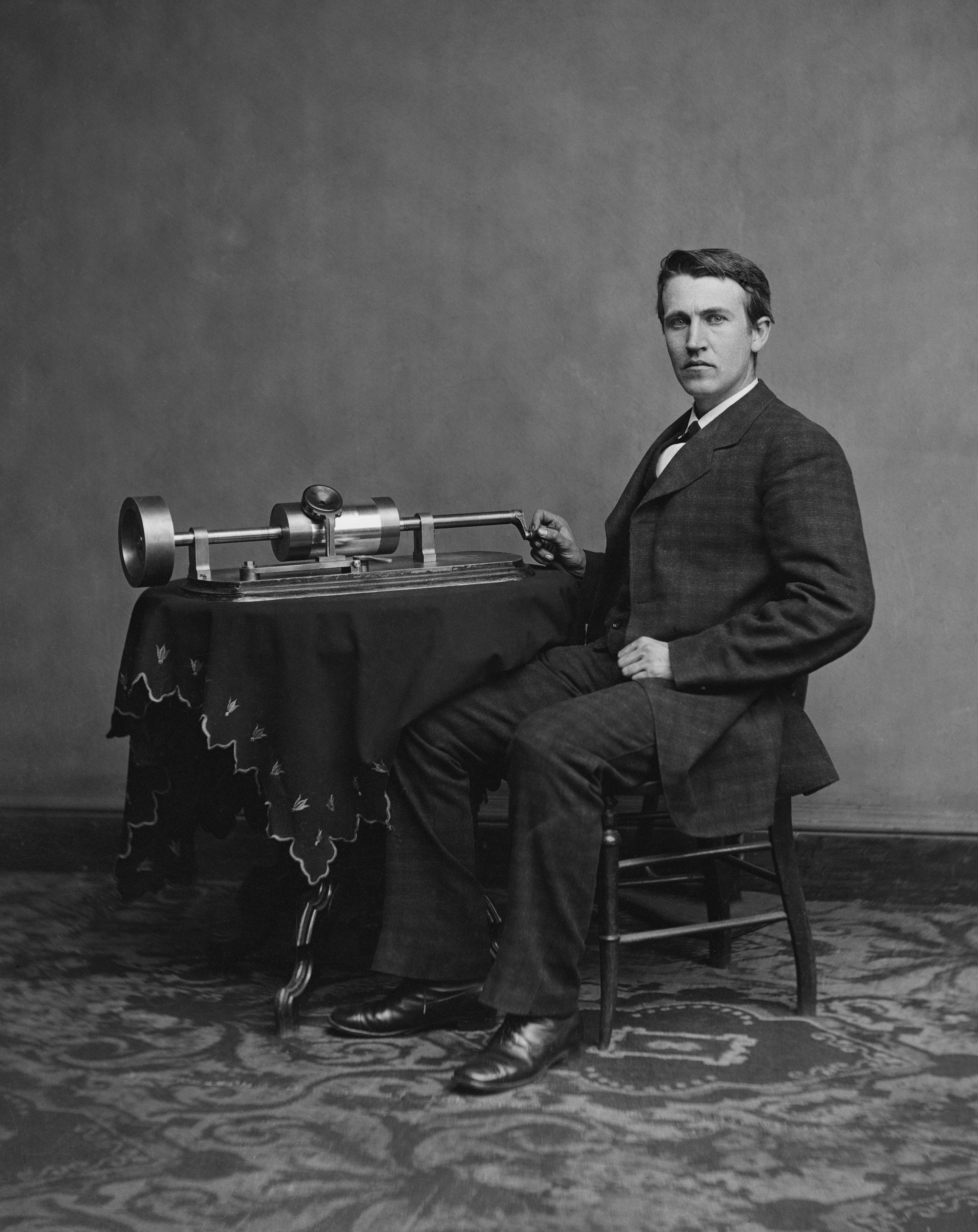
Thomas Edison with phonograph in 1868.

As we clasp hands and celebrate Thomas Edison’s birthday today, here’s a note about his modest beginnings in the December 1, 1898 issue of the Brooklyn Daily Eagle:

“When Thomas Edison was a boy he made a set of working telegraph instruments, not covering a small envelope in size, in his spare time. He fixed this on a line connecting the station at which he was at work and the town, using tenpenny nails for insulators; and in dry weather the tiny telegraph company worked very well, though things were apt to go wrong in rainy seasons. During the first months Edison and a boy friend who ran the line netted 31 cents from their venture–not a large amount, but enough to show that the instruments were of some use.”

Tags:

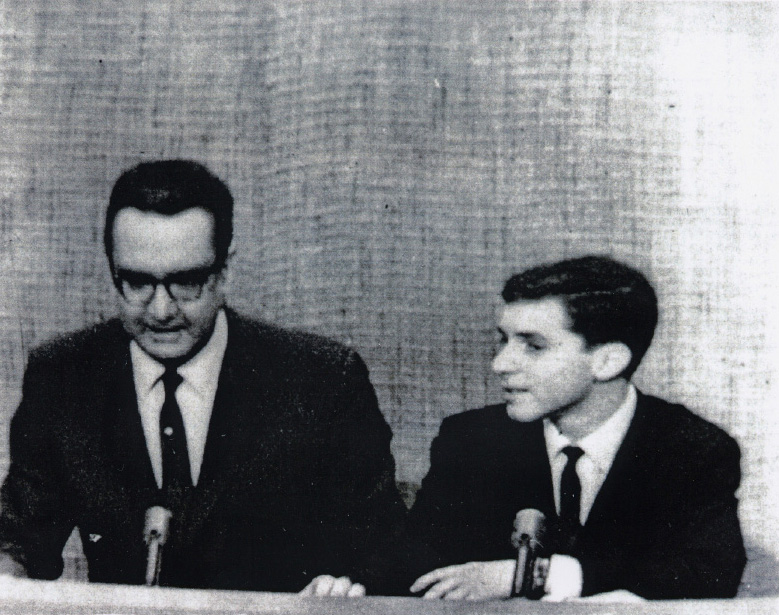
Singularity enthusiast Ray Kurzweil is profiled by Lev Grossman in a Time piece entitled, “2045: The Year Man Becomes Immortal.” In the article, the futurist predicts that the singularity–that moment when artificial intelligence surpasses human intelligence–will occur in 2045, which seems very ambitious. Grossman recalls that in 1965 a teenage Kurzweil appeared on the TV show I’ve Got a Secret to perform a piano piece composed by a computer he built.

Tags: ,

RoboCop: statuesque. (Image by MGM.)

Detroit may be down in the dumps, but the fine citizens aren’t letting Mayor Dave Bing‘s refusal to allocate funds for a RoboCop statue keep them from their dreams. They’ve begun a Kickstarter campaign to raise the necessary cash. (Thanks MLive and Reddit.) An excerpt:

“None of us have ever made a giant solid metal permanent sculpture before. It turns out to be a pretty expensive process (who would have thought?), but not too much for the world to fund. After talking to numerous sculptors and metal workers, the current game plan is this: We can take a relatively small figure of RoboCop (conceivably even an action figure), have it 3D scanned by lasers (cool!) and scale its form to create a light-weight model of any size we’d like, which can then be used to pour and cast liquid metal.”

Tags:

From Aaron Saenz on the Singularity Hub: “Robots have barely learned how to walk, but Vstone is already pushing them to run. The Japanese robot research and manufacturing firm has announced it is putting together the world’s first marathon for our mechanical offspring. The Robot Challenge will have bipedal bots racing around a 100m track for 422 laps either remotely controlled or operating completely autonomously by following a painted line.”

Tags:

« Older entries § Newer entries »