From Singularity Hub: “One of the most important concerns in integrating robots into human environments is keeping people safe. Yun demonstrates (towards the end of the clip) that Mahru has great compliance control. You can shake its hand, or push on its body, and the robot will give way. This keeps the robot from hurting you even if the guy operating Mahru turns out to be a psychopath.”
You are currently browsing the archive for the Science/Tech category.
Few magazines have made such a mark.
Tags: Kevin Kelly
"Google is staking its claim in a near-future world where nearly every computing device will have its own eyes and ears." (Image by Coolcaesar.)
By focusing research and development on speech recognition, machine translation and computer vision, Google is looking to be the brand leader in the next epoch of search engines, in which there will be a supercomputer in your pocket capable of conducting searches that are light years smarter than the current ones. An excerpt from “Inside Google’s Age of Augmented Reality,” Wade Roush’s article in Xconomy:
“Here’s how [Eric] Schmidt put it in his speech: ‘When I walk down the streets of Berlin, I love history, [and] what I want is, I want the computer, my smartphone, to be doing searches constantly. ‘Did you know this occurred here, this occurred there?’ Because it knows who I am, it knows what I care about, and it knows roughly where I am.’ And, as Schmidt might have added, the smartphone will know what he’s seeing. ‘So this notion of autonomous search, the ability to tell me things that I didn’t know but I probably am very interested in, is the next great stage, in my view, of search.’
This type of always-on, always-there search is, by definition, mobile. Indeed, Schmidt says Google search traffic from mobile devices grew by 50 percent in the first half of 2010, faster than every other kind of search. And by sometime between 2013 and 2015, analysts agree, the number of people accessing the Web from their phones and tablet devices will surpass the number using desktop and laptop PCs.
By pursuing a data-driven, cloud-based, ‘mobile first’ strategy, therefore, Google is staking its claim in a near-future world where nearly every computing device will have its own eyes and ears, and where the boundaries of the searchable will be much broader. ‘Google works on the visual information in the world, the spoken and textual and document information in the world,’ says Michael Cohen, Google’s speech technology leader. So in the long run, he says, technologies like speech recognition, machine translation, and computer vision ‘help flesh out the whole long-term vision of organizing literally all the world’s information and making it accessible. We never want you to be in a situation where you wish you could get at some of this information, but you can’t.'” (Thanks Longform.)
Tags: Eric Schmidt, Wade Roush
Go to the 3:20 mark to see the unveiling. (Thanks Reddit.)
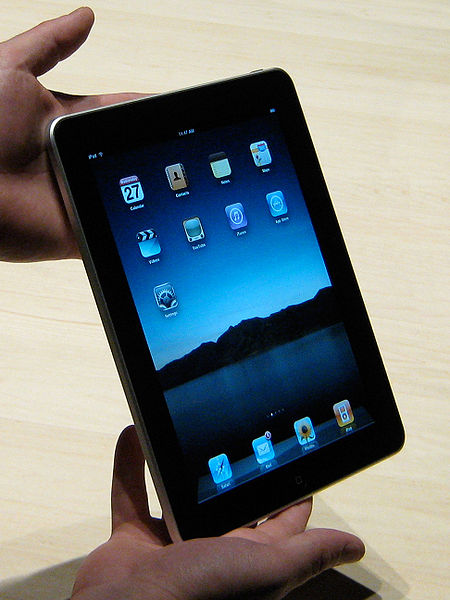
"Hey boy! I ain't playin' around!" (Image by Glenn Fleishman.)
Mad at your boyfriend? Sell me his iPad – $200 (Harlem / Morningside)
Is your boyfriend ignoring you? Is he spending too much time playing video games? Do you need to send him a message that says, “Hey boy! I ain’t playin’ around!” My ex put my iPhone in the washing machine by accident– you can be less passive aggressive about it and just sell it to me. A deal by Wednesday would work for me, otherwise I cannot do it because i will be leaving. My girl is a medical student in Ecuador and I am going down there on Thursday and would love to give her a useful tool for all the referencing she has to do.
I know you are mad. I will help you. I will come to you. I will even tell you that you are pretty and deserve better before I go.
From Gary Wolf’s 1993 Wired article about Marshall McLuhan, “The Wisdom of Saint Marshall, the Holy Fool”:
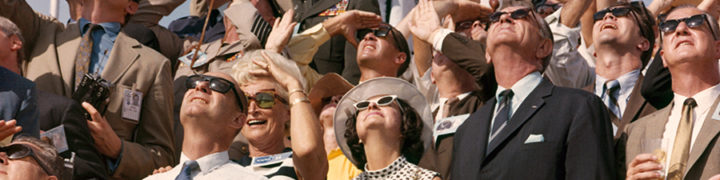
McLuhan did not want to live in the global village. The prospect frightened him. Print culture had produced rational man, in whom vision was the dominant sense. Print man lived in a world that was secular rather than sacred, specialized rather than holistic.
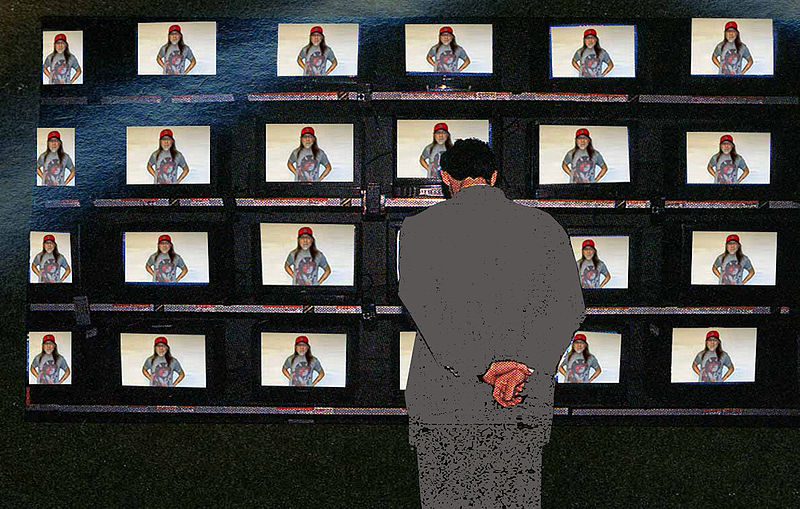
But when information travels at electronic speeds, the linear clarity of the print age is replaced by a feeling of “all-at-onceness.” Everything everywhere happens simultaneously. There is no clear order or sequence. This sudden collapse of space into a single unified field ‘dethrones the visual sense.’ This is what the global village means: we are all within reach of a single voice or the sound of tribal drums. For McLuhan, this future held a profound risk of mass terror and sudden panic.
The current idea of a global village as a place of universal harmony and industrious basket-weaving is a tourist’s fantasy. McLuhan gave in to the intoxication of this hope for a few years in the early ’60s, and it is evident throughout Understanding Media: The Extensions of Man, his most optimistic work. In that book, McLuhan sings of the furthest reaches of electronic culture, when computer technology has replaced language with instant nonverbal communication. He compares this mystical unification of humanity to the Christian Pentecost. But McLuhan soon realized that before the Pentecost comes suffering and crucifixion, and while we are all waiting for the Holy Ghost to descend, Jerusalem is likely to be scary as hell.•
Tags: Gary Wolf, Marshall McLuhan
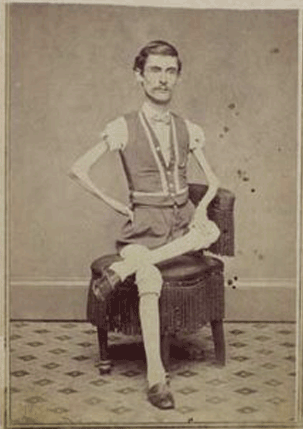
"A more repulsive sight to any lover of the 'human form divine' it would be difficult to imagine."
Isaac Sprague was a nineteenth-century dime museum performer who was billed as the “Living Skeleton.” He had some sort of progressive muscular disease and was invited into classrooms as well as sideshows, so that medical students could study his malady. Such a visit to academia was covered by the Brooklyn Daily Eagle in truly insulting fashion in its November 25, 1883 issue. An excerpt:
“Isaac Sprague, who is usually advertised in museums or traveling shows as the living skeleton, was exhibited yesterday to the students of the Rush Medical College, and was made the subject of a lecture by Dr. Henry M. Lyman. Several hundred students filled the tiers of seats that rose above each other to the roof of the amphitheatre, and in the small semicircle below sat the skeleton. A skeleton he was, indeed, for there did not appear to be a single vestige of flesh on his body, and the skin was drawn tightly over the bones. He wore a pair of trunks, leaving his legs, chest and arms nude, and a more repulsive sight to any lover of the ‘human form divine’ it would be difficult to imagine. The man’s spine was curved to one side and there was a tremulous pulsation in the neck over the right shoulder that produced an irritating effect upon an observer’s nerves. Sprague’s face is not attenuated in comparison with his body, and his neck seems to preserve some muscular tissues, but all the remainder is a mass of living articulated bones.
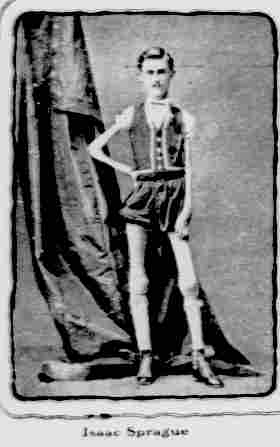 The skeleton said that he was forty-two years old and had been suffering from progressive muscular atrophy for thirty years. ‘Cases such as this,’ said the lecturer, ‘generally run their course in five years, and few have been known to exceed twenty years. It is safe to say that there is no case like the present one on record.’
‘Have you suffered much?’ the doctor asked.
‘No,’ said the skeleton in a voice almost as thin as his legs. ‘I have had almost no rheumatic pains; have suffered no loss of sleep; I can eat three hearty meals a day, and have been married twice and now have three children.’
The skeleton, in conclusion, told the students that he now weighs fifty pounds, which was half what he weighed when the disease began. He said, in an incidental and humorous way, that his wife weighed 172 pounds. He himself is five feet five and one half inches in height, and his boy, weighing 125 pounds, can carry his father about like a child.”
Tags: Dr. Henry M. Lyman, Isaac Sprague
From Aaron Saenz on the Singularity Hub: “Referred to as Geminoid-DK, the robot is a replica of Henrik Sharfe of Aalborg University in Denmark. This thing is amazing looking. Unlike many previous Geminoids we’ve seen in the past, Sharfe’s robotic copy is almost real enough to pass as human.”
Tags: Aaron Saenz, Henrik Sharfe
The Peel P50 weighs 132 pounds and seats two uncomfortably. (Thanks Autointhenews.)
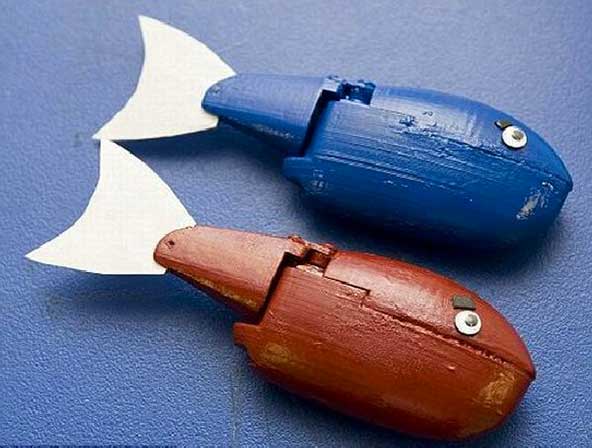
RoboFish. (Image by Polytechnic Institute of New York University.)
Live Science has an article about Rome-born NYU professor, Dr. Maurizio Porfiri, who has created robot fish that can lead schools of real fish away from natural and man-made disasters. The real ones respond well to their bot brothers because the fake fish have a remarkable capacity to mirror movements seen in nature. An excerpt:
“Porfiri posited that if he could enforce leadership by an external member—in this case, a robot that actively engages the group—he could influence the direction and behavior of schooling fish. This could prove a life-saving advantage for marine populations in the event of oil or chemical spills or other natural disasters. Porfiri also envisions the ability to lead fish away from man-made dangers like turbines.”
••••••••••
No video footage yet of Dr. Porfiri’s fish in action, but scientists at Essex University are also working on robot fish:
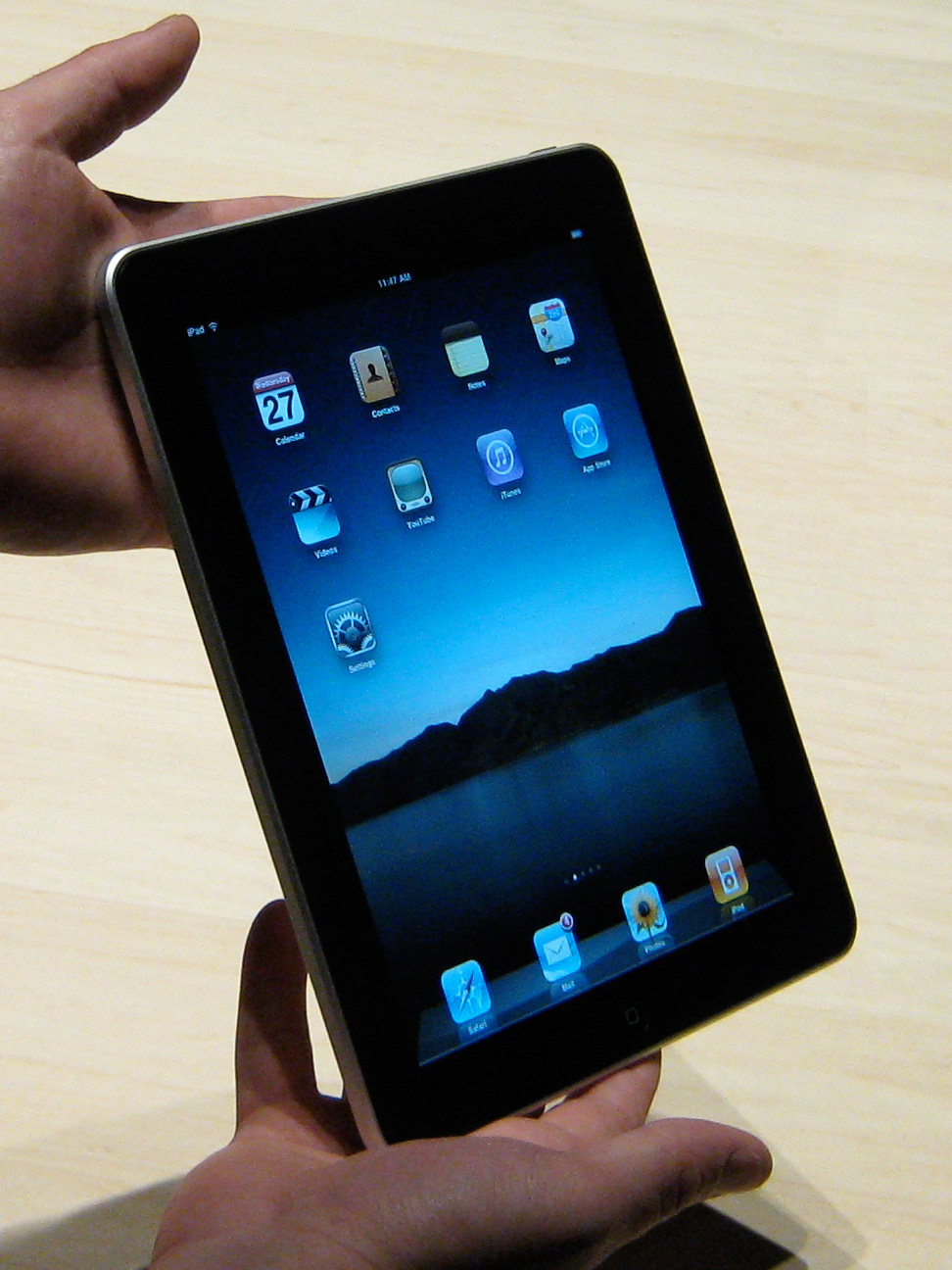
"Without that key component of sheer delight, the road for them is long and hard." (Image by Glenn Fleishman.)
Joshua Topolsky has an interesting post on Endgadget that looks at Apple’s attempt, with its category-defining iPad, to steer the conversation of computing into a Post-PC world. My biggest complaint about the iPad being the future of computing is that its minuscule size and touch keypad–amazing though they are–reduce the act of writing to an afterthought. It’s like we’re headed for a society in which sounds and flashes and glyphs supplant sentences–and we may very well be. An excerpt from Topolsky’s piece about the perils facing Apple’s competitors:
“But right now — in the tablet space at least — the problem for Motorola, Samsung, HP, RIM, and anyone else who is challenging Apple becomes infinitely more difficult. Almost any company could put together a more powerful or spec-heavy tablet, but all the horsepower in the world can’t help you if you don’t find a way to delight the average consumer. Those other tablet makers may have superior hardware (and in the case of the Xoom, some superior software as well), but without that key component of sheer delight, the road for them is long and hard. HP is getting close by touting features like Touch-to-Share, but against experiences like the new GarageBand for iOS and the 65,000 apps (and counting) that currently exist, it’s hard to see a clear path to sizable competition. That goes for Google and RIM as well.”
Tags: Joshua Topolsky

"Aeroplane."
- Telephone
- Wireless
- Aeroplane
- Radium
- Antiseptics and Antitoxins
- Spectrum Analysis
- X-rays
•Taken from the 1917 World Almanac.
I would punt this creepy thing clear across the mall, but I wonder if some people would like the “attention.” Regardless: yikes! (Thanks Singularity Hub.)
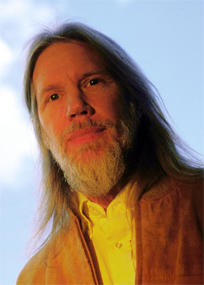
"A mathematician, a former peacenik, and an enemy of exclusive government control of encryption systems."
Whitfield Diffie created a tool to help him explain a product, but it was the tool itself that was the great product. To understand how Diffie never made a cent from his creation of the game-changing invention of PowerPoint, read this 2001 article by the excellent New Yorker writer Ian Parker. An excerpt:
“In 1980, though, it was clear that a future of widespread personal computers—and laser printers and screens that showed the very thing you were about to print—was tantalizingly close. In the Mountain View, California, laboratory of Bell-Northern Research, computer-research scientists had set up a great mainframe computer, a graphics workstation, a phototypesetter, and the earliest Canon laser printer, which was the size of a bathtub and took six men to carry into the building—together, a cumbersome approximation of what would later fit on a coffee table and cost a thousand dollars. With much trial and error, and jogging from one room to another, you could use this collection of machines as a kind of word processor.
Whitfield Diffie had access to this equipment. A mathematician, a former peacenik, and an enemy of exclusive government control of encryption systems, Diffie had secured a place for himself in computing legend in 1976, when he and a colleague, Martin Hellman, announced the discovery of a new method of protecting secrets electronically—public-key cryptography. At Bell-Northern, Diffie was researching the security of telephone systems. In 1981, preparing to give a presentation with 35-mm. slides, he wrote a little program, tinkering with some graphics software designed by a B.N.R. colleague, that allowed you to draw a black frame on a piece of paper. Diffie expanded it so that the page could show a number of frames, and text inside each frame, with space for commentary around them. In other words, he produced a storyboard—a slide show on paper—that could be sent to the designers who made up the slides, and that would also serve as a script for his lecture. (At this stage, he wasn’t photocopying what he had produced to make overhead transparencies, although scientists in other facilities were doing that.) With a few days’ effort, Diffie had pointed the way to PowerPoint.” (Thanks Longform.)
••••••••••
More about Whitfield Diffie from Steven Levy: “Mary Fischer loathed Whitfield Diffie on sight. He was a type she knew all too well, an MIT brainiac whose arrogance was a smoke screen for a massive personality disorder. The year of the meeting was 1969; the location a hardware store near Central Square in Cambridge, Massachusetts. Over his shoulder he carried a length of wire apparently destined for service as caging material for some sort of pet. This was a typical purchase for Diffie, whose exotic animal collection included a nine-foot python, a skunk, and a rare genetta genetta, a furry mongooselike creature whose gland secretions commonly evoked severe allergic reactions in people. It lived on a diet of live rats and at unpredictable moments would nip startled human admirers with needlelike fangs.”
Tags: Ian Parker, Mary Fischer, Steven Levy, Whitfield Diffie
UPDATE: Popular Science made a couple of crucial errors in its original story about Dr. Atala’s bio-printer presentation at TED. Thanks to Karen Richardson, who does publicity for Wake Forest, for sending me the corrections:
“Reports in the media that Dr. Anthony Atala printed a real kidney at the TED conference in Long Beach, Calif., are completely inaccurate. At the conference, Dr. Atala used a new type of technology to print a kidney-shaped mold and explained how one day – many years from now – the technology might be used to print actual organs.
At the conference, Atala was reunited with a former patient who received a laboratory-engineered bladder 10 years ago. News reports are incorrectly saying that he received a printed kidney.”
••••••••••
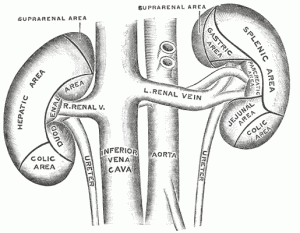
Bio-printing replacement organs and tissue is coming sooner than later, and that’s a great thing, since kidneys in particular are in great demand and short supply. Yesterday surgeon Anthony Atala of Wake Forest took the TED stage at Long Beach and “printed” a working human kidney. It’s a stunner, but the process has been in the testing phase for a decade. An excerpt from an Independent story:
“College student Luke Massella was among the first people to receive a printed kidney during experimental research a decade ago when he was just 10 years old.
He said he was born with Spina Bifida and his kidneys were not working.
‘Now, I’m in college and basically trying to live life like a normal kid,’ said Massella, who was reunited with Atala at TED.
‘This surgery saved my life and made me who I am today.'”
••••••••••
No footage yet of Dr. Atala’s demonstration from yesterday, but here he is discussing the topic at TED in 2010.
Tags: Anthony Atala, Luke Massella
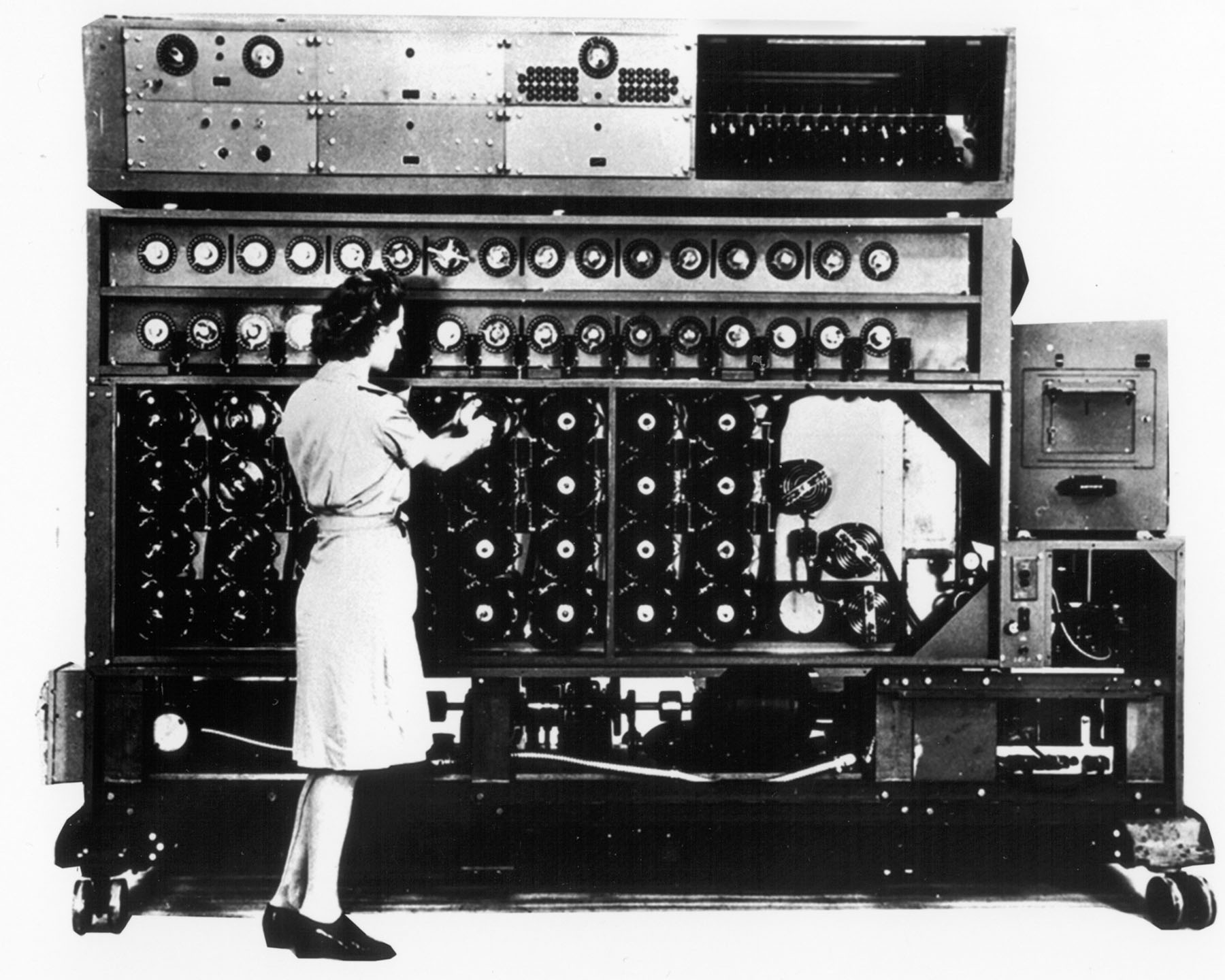
Kevin Kelly defines “technology” on his blog:
“I want to suggest a theory for technology, a framework that might provide a logic and context for this parade of new things in our lives. But I have to start with the fact that we have a warped idea of what technology is. A lot of us tend to think that technology is ‘anything that was invented after you were born.’ Or technology is: ‘anything that doesn’t work yet.’ As if only the new is what we are talking about.
But of course technology includes old inventions, like clocks and levers, and ancient materials that work very well, like concrete and bricks. The bulk of technology in our lives was invented long before we were born. Ordinary technology also contains intangible ‘stuff’ that we usually don’t see such as calendars, bookkeeping principles, law, and software. It includes large complex things like social organizations and cities. Technology is all this, the old, the invisible, the large and the new — the accumulated usefulness that our minds invent.”
Tags: Kevin Kelly
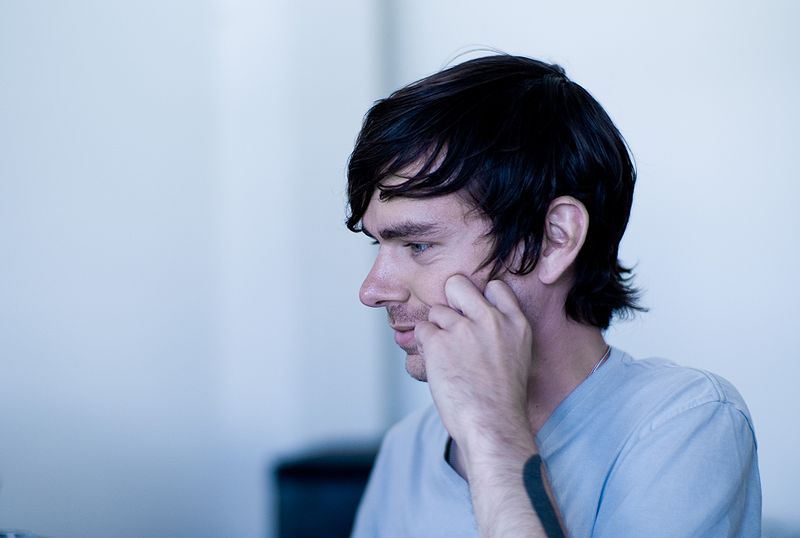
Kirkpatrick's article details Jack Dorsey's new company, Square, which has created a way for individuals to accept credit card payments with the aid of a cell phone attachment. (Image by Joi Ito.)
An explanation for how Twitter was created, from David Kirkpatrick’s smart Vanity Fair article about Jack Dorsey, the company’s founder and deposed CEO:
“Little Jack Dorsey was obsessed with maps of cities. He papered his walls with maps from magazines, transit maps, maps from gas stations. His parents had resisted joining the emigration to the suburbs, and their shy, skinny son supported them by becoming a passionate proponent of city life. He was mesmerized by locomotives, police cars, and taxis. He would drag his younger brother Danny to nearby rail yards, where they waited just to videotape a passing train.
When their father brought home the family’s first computer that year—an IBM PC Jr.—Jack immediately took to it. He had a talent for both math and art, and began to design his own maps using a graphics program. Soon, he taught himself programming to learn how to make little dots—representing trains and buses—scoot around the maps. He spent hours listening to police and ambulance radio frequencies, then plotted the emergency vehicles as they moved toward an accident or a hospital. As he evolved into a talented teenage programmer, he came to an oddly poetic view of this precise, orderly urban grid. ‘I wanted to play with how the city worked, so I could see it,’ Dorsey recalls.
His obsession with cities—and with programming—never abated. By early 2006, having dropped out of N.Y.U. and bouncing between jobs, he found himself working for a San Francisco software start-up called Odeo, which was going nowhere. One day he proposed an idea to his boss based on a notion that Dorsey had been noodling over for years. He was fascinated by the haiku of taxicab communication—the way drivers and dispatchers succinctly convey locations by radio. Dorsey suggested that his company create a service that would allow anyone to write a line or two about himself, using a cell phone’s keypad, and then send that message to anyone who wanted to receive it. The short text alert, for him, was a way to add a missing human element to the digital picture of a pulsing, populated city.”
••••••••••
Jack Dorsey’s first computer, the IBM PC Jr.
Tags: David Kirkpatrick, Jack Dorsey
The “Bubble Tree” costs about $12K and is designed by Pierre-Stéphane Dumas. (Thanks ShelterPop.)
Tags: Pierre-Stéphane Dumas
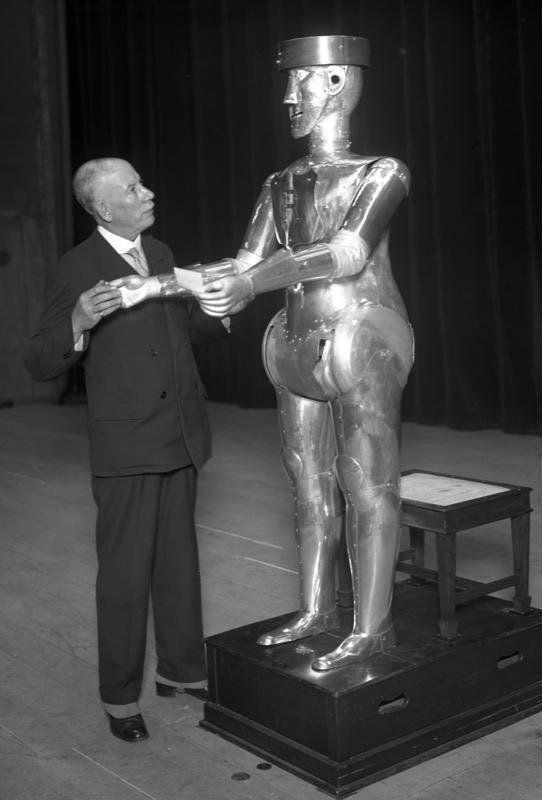
"That it could spin half-discernible essays on postmodern theory before it could be shown a chair and say, as most toddlers can, 'chair'?"
From “Mind vs. Machine,” an article in the Atlantic by Brian Christian.
“As for the prospects of AI, some people imagine the future of computing as a kind of heaven. Rallying behind an idea called ‘The Singularity,’ people like Ray Kurzweil (in The Singularity Is Near) and his cohort of believers envision a moment when we make smarter- than-us machines, which make machines smarter than themselves, and so on, and the whole thing accelerates exponentially toward a massive ultra-intelligence that we can barely fathom. Such a time will become, in their view, a kind of a techno-Rapture, in which humans can upload their consciousness onto the Internet and get assumed—if not bodily, than at least mentally—into an eternal, imperishable afterlife in the world of electricity.
Others imagine the future of computing as a kind of hell. Machines black out the sun, level our cities, seal us in hyperbaric chambers, and siphon our body heat forever.
I’m no futurist, but I suppose if anything, I prefer to think of the long-term future of AI as a kind of purgatory: a place where the flawed but good-hearted go to be purified—and tested—and come out better on the other side.
Who would have imagined that the computer’s earliest achievements would be in the domain of logical analysis, a capacity once held to be what made us most different from everything else on the planet? That it could fly a plane and guide a missile before it could ride a bike? That it could create plausible preludes in the style of Bach before it could make plausible small talk? That it could translate before it could paraphrase? That it could spin half-discernible essays on postmodern theory before it could be shown a chair and say, as most toddlers can, ‘chair’?
As computers have mastered rarefied domains once thought to be uniquely human, they simultaneously have failed to master the ground-floor basics of the human experience—spatial orientation, object recognition, natural language, adaptive goal-setting—and in so doing, have shown us how impressive, computationally and otherwise, such minute-to-minute fundamentals truly are.
We forget how impressive we are. Computers are reminding us.”
Tags: Brian Christian
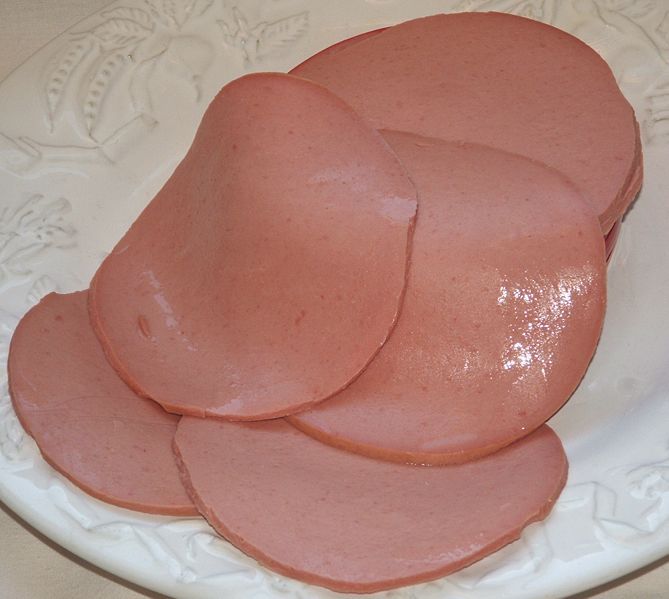
Even on a plate, bologna is horrifying.
From the Science section of the New York Times:
“Q. You know the five-second rule for dropped food? Is it really safe if you pick it up in time?
A. “The five-second rule probably should become the zero-second rule,” said Dr. Roy M. Gulick, chief of the division of infectious diseases at Weill Cornell Medical College. “Eating dropped food poses a risk for ingestion of bacteria and subsequent gastrointestinal disease, and the time the food sits on the floor does not change the risk.”
In general, if there are bacteria on the floor, they will cling to the food nearly immediately on contact, Dr. Gulick said. Factors that influence the risk and the rate of bacterial transfer include the type of floor; the type of food; the type of bacteria; and how long the bacteria have been on the floor.”
Tags: Dr. Roy M. Gulick
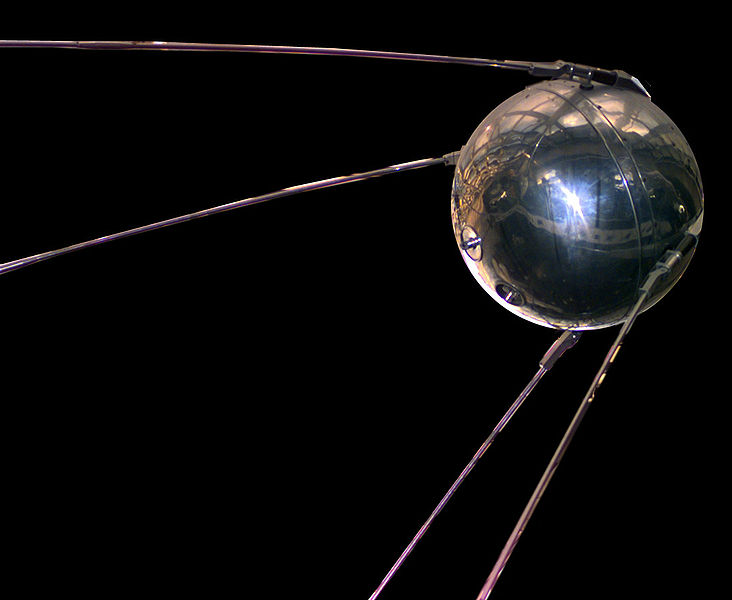
Sputnik, the first artificial satellite, gave Russia the early lead in the space race.
From Stewart Brand’s “Spacewar: Fanatic Life and Symbolic Death Among the Computer Bums,” published in Rolling Stone in 1972:
“After Russia’s Sputnik humiliated the US in the middle of the Fifties, America came back hard with the Mercury Program, John Glenn and all that, crash-funded through a new agency directly under the Secretary of Defense – ARPA (Advanced Research Projects Agency).
When the US space program was moved out of the military to become NASA, ARPA was left with a lot of funding momentum and not much program. Into this vacuum stepped J.C.R. Licklider among others, with the suggestion that since the Defense Department was the world’s largest user of computers, it would do well to support information-medium like computers.
So in 1963 a fraction of ARPA’s budget, some $5-8 million, went into a program called IPT, Information Processing Techniques, under the initial direction of Licklider and then of a 26-year-old named Ivan Sutherland. Sutherland, the developer of ‘Sketchpad’ at MIT, gave the agency its bias toward interactive graphics and its commitment to ‘blue sky mode’ re- search. The next director, Bob Taylor, then 32, doubled I PT’s . budget (while ARPA’s overall budget was shrinking) and administered a five-year golden age in computer research.
The beauty was, that being at the very top of the Defense Establishment, the agency had little Congressional scrutiny had little bureaucratic responsibility, able to take creative chances and protect long-term deep-goal projects. Alan Kay: ’90 percent of all good things that I can think of that have been done in computer science have been done funded by that agency. Chances that they would have been funded elsewhere are very low. The basic ARPA idea is that you find good people and you give them a lot of money and then you step back. If they don’t do good things in three years they get dropped – where ‘good’ is very much related to new or interesting.’
One of the accomplishments of ARPA-funded research during this time was time-sharing, Time-sharing is a routing technique that allows a large number of users to sit down ‘on-line’ with a. computer as if each were all alone with it. Naturally, timesharing was of no interest to computer manufacturers like IBM since it meant drastically morc efficient use of their hardware.”
••••••••••
Spotnik’s launch, October 4, 1957:

"We’re having an information explosion…and it’s certainly obvious that information is of no use unless it’s available."
From “The 15 Most Important Women in Tech History” on Maximum PC:
“Although Barbara Liskov is often named as the first woman to be awarded a Ph.D. in computer science, that honor actually goes to Sister Keller who beat Liskov to the punch by three years. After earning her Ph.D from the University of Wisconsin in 1965, Sister Keller went on to assist in the development of BASIC computer language at Dartmouth – which had previously held a ‘men only’ rule. Sister Keller, who also held a BS in Mathematics and an MS in Mathematics and Physics from DePaul University, felt that women should be involved in computer science (especially in the field of information specialist) and has been quoted as saying ‘We’re having an information explosion…and it’s certainly obvious that information is of no use unless it’s available.’ Also interested in advancements toward AI, Sister Keller founded – and directed – the computer science department at Clarke College for twenty years.”
Tags: Barbara Liskov, Sister Keller
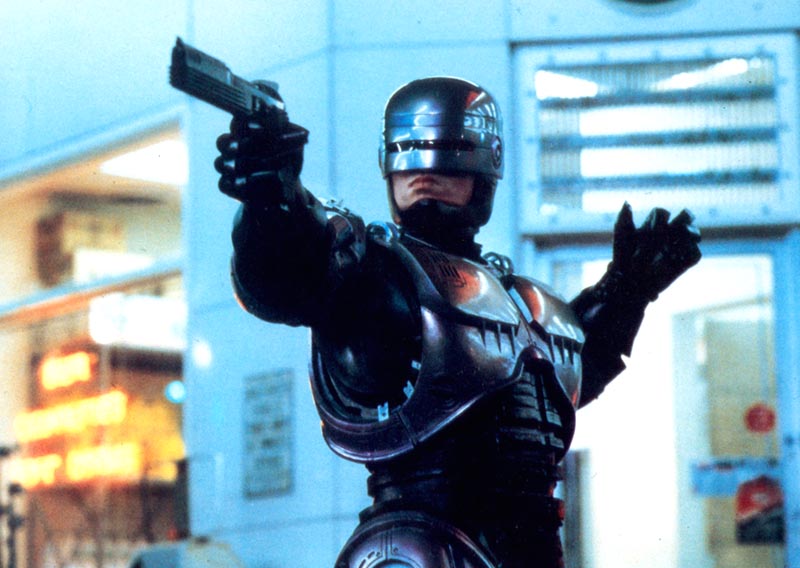
Released in 1987 in anticipation of an expected urban crime wave that never arrived in America, Paul Verhoeven’s near-future social satire nonetheless remains a sharp indictment of the practice of outsourcing justice and a reminder that weapons are made to be used.
“Old Detroit,” as it is called, is a necropolis only inhabited by predators and prey. But it is about to be bulldozed and replaced by the corporate urban center known as Delta City, courtesy of the greedy overlords at Omni Consumer Products. In order to clear the area of criminals so that they can start reaping profits, the fine folks at OCP have built a robotic crime fighter that they are about to unleash. But the bot badly malfunctions, gunning down an OCP exec. “I’m very disappointed,” says one of the corporate honchos in a hilariously deadpan line, as the employee lies dead on a conference table. But an ambitious, immoral fellow exec (Miguel Ferrer) has an answer. Create a cyborg that incorporates the best of technology with the human brain. He gets the opportunity to hatch his plot when a young cop named Murphy (Peter Weller) is shot to pieces by brutal thugs. Wires and microchips soon transform him into RoboCop. Of course, there are complications when the Singularity arrives, and the erstwhile Murphy soon becomes difficult to control.
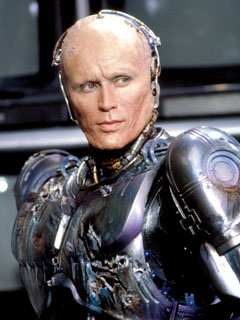 As mentioned, RoboCop was made at a moment when crime was rising in the country and every last expert was predicting a continued spike. That never happened (and some of the theories for the decline are controversial). But the film isn’t just concerned with momentary social problems. It also deftly sends up America’s lingering Cold War mentality, which demands that we police the entire world, even when we have to outsource much of the nasty business, as we’ve done recently in Iraq and Afghanistan. The Greek chorus of the film is a series of parodies of TV news and commercials that comment on the action; in one of the latter, a game called “Nukem” is advertised as the kind of good family fun in which “you get them before they get you.” That’s the mentality RoboCop employs when he initially goes rogue, rationalizing that “somewhere there is a crime happening.” There always is.•
Tags: Miguel Ferrer, Paul Werhoeven, Peter Weller
Has a flashlight, too.