Newsreel footage from 1930 of Helen Keller and Anne Sullivan.
You are currently browsing the archive for the Science/Tech category.
Tags: Anne Sullivan, Helen Keller

From a piece about the highly developed social behaviors of animals by Alexandra Horowitz and Ammon Shea in the Sunday Review of the New York Times:
“You’re at a dinner party. Your hostess regales you with a long, meandering tale of her recent back surgery. It ends with attempted humor: she laughs and glances at you. You laugh in response, trying to convey an appreciation for her humor that you don’t actually feel. Congratulations: you are now at the level of social politeness of chimpanzees.
In this study, the laughs of 59 chimps (yes, they do laugh) were recorded and the sounds analyzed. The researchers discovered that when one chimp laughed others sometimes engaged in “laugh replications” that lacked the full acoustic structure of spontaneous laughter. In other words, they were fake-laughing.”
••••••••••
They’re humoring us until they’re smart enough to make it their planet:
More simian posts:
Tags: Alexandra Horowitz, Ammon Shea

The opening of “The True Stories of Philip K. Dick,” a 1975 Paul Williams Rolling Stone article about the visionary sci-fi writer, who lived on speed and saw the future, died young and mostly a cult figure, and posthumously became the king of Hollywood:
“November 17, 1971. Philip K. Dick, a brilliant novelist well known in science fiction circles, unlocked the front door of his house in San Rafael, California, and turned on the living-room lights. His stereo was gone. The floor was covered with water and pieces of asbestos. The fireproof, 1100-pound asbestos-and-steel file cabinet that protected his precious manuscripts had been blown apart by powerful explosives.
‘Thank God,’ he thought to himself. ‘Thank God! I guess I’m not crazy after all.’
There’s something about ordinary reality that causes it to go all shimmery in the presence of Philip K. Dick. Phil Dick is a science fiction writer, has been for 24 years, and the common theme that runs through all his stories is, ‘Things are seldom what they seem’–a line Phil repeated several times during my three-day stay at his house last year. His lives in Fullerton, Orange County, California, obviously the natural place for a brilliant writer to go after being driven out of semi-suburban San Rafael by forces beyond his comprehension. The new house is less than ten miles from Disneyland.
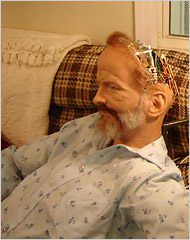 Philip K. Dick is unknown in America outside the science fiction subculture, but in Europe and especially France, he is widely regarded as one of the greatest living American novelists. Most of his 36 books are constantly in print in Germany, France and Britain, and Jean-Pierre Gorin, a respected French film director, is trying to raise money for a major Hollywood movie of a Phil Dick novel titled Ubik.
Perhaps Phil’s vision of America is just too accurate to be fully appreciated here. But Dick fans believe it’s a matter of timing. Most of them think Dick is now on the edge of a popularity surge similar to what happened to Kurt Vonnegut in the late Sixties. If so, a whirlwind of doubt, horror and laughter is stalking America, ready to blow off the pages of some of the most peculiar and loving books ever written in this country.”
Tags: Paul Williams, Philip K. Dick
As the perceptive Rob Walker notes in the Atlantic, the speed of product alterations has caused planned obsolesence to actually be craved by consumers:
“We’re all familiar with the sinister idea of ‘planned obsolescence,’ a corporate strategy of supplying the market with products specifically built not to last. Consumer-culture critic Annie Leonard describes such items as “designed for the dump”; she recounts reading industrial-design journals from the 1950s in which designers ‘actually discuss how fast can they make stuff break’ and still leave consumers with ‘enough faith in the product to go out and buy another one.’ When that doesn’t work, she says, the market suckers us with aesthetic tweaks that have no impact on functionality: the taller tail fins and shorter skirts of ‘perceived obsolescence.’
But the emerging prevalence—anecdotally, at least—of the gadget death wish suggests an intriguing possibility: where electronic gizmos are concerned, product obsolescence is becoming a demand-side phenomenon.”
••••••••••
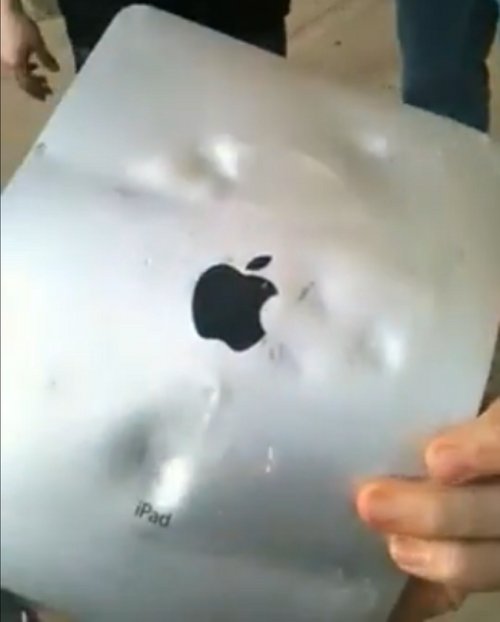
iPad that was run over in the street:
More Rob Walker posts:
Tags: Rob Walker
I never liked Star Trek or any sci-fi TV shows except for The Twilight Zone, but this is still fun. Nimoy, by the way, played a Little Italy street tough in 1952’s Kid Monk Baroni.
Tags: Leonard Nimoy
Kat Fatland argues that the Internet changing our brains isn’t necessarily evil at Good. An excerpt:
“Think about how many tools you use in your daily life without even thinking about it. You drive a car to work (or ride a bike… the principle is the same). You use your GPS device, cell phone, iPod, and other tech devices so flawlessly that, according to Ramachandran’s principle, they may as well be extensions of your very self.
Sound scary? It’s not. We’ve been using tools for centuries—it’s what distinguishes us from most species of lesser intelligence. And we haven’t just used tools, we’ve relied on them. In Clark’s book, he cites the wristwatch as an example. Human lives are drastically different now than they were before we had the ability to know the time right down to the minute. Before clocks were widespread, and people had only the sun or the church bells to tell them it was noon, scheduling was virtually nonexistent. Or think about the pen and paper. These tools have changed the very fabric of how we exist with each other in the world—and few would argue these changes have made our lives worse.”
Tags: Kat Fatland, V.S. Ramachandran
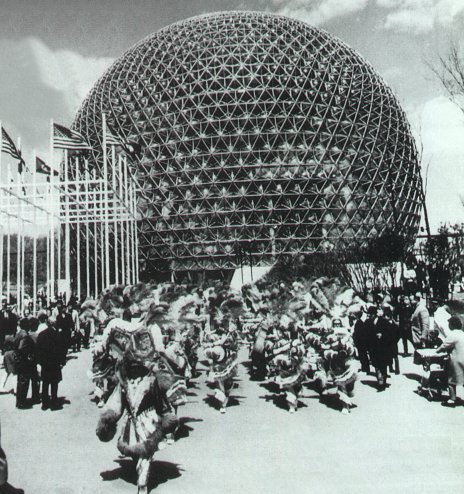
A Buckminster Fuller Geodesic Dome from the 1960s.
From Jennifer Kahn’s recent and fun New Yorker profile of tech visionary Jaron Lanier, who is best known for coining the term “virtual reality” and authoring the cautionary tome, You Are Not a Gadget:
“In Mesilla, Lanier’s father allowed him to design their new home. Lanier, who was eleven, chose a geodesic dome, and with his father’s assistance he drew up blueprints calculating the angles of the frame, plus plans for a squat, cantilevered spire that he envisaged as the entrance. (‘Clearly a subconscious phallic expression of some kind,’ he told me.) But the project proceeded slowly. ‘We’d get enough money to pour the foundation for one part of the house, and then, after a few weeks, we’d get enough to do another part,’ he recalls.
During the first two years that the dome was under construction, Lanier and his father lived in an unheated canvas Army tent that was stiflingly hot in summer and frigid in winter. Lanier remembers shivering uncontrollably at times, ‘like I was having a seizure.’ The family belongings, which included his mother’s grand piano and her antique furniture, were wrapped in plastic and heaped together on the ground outside the tent. ‘We sealed the piano in a bag, kind of,’ Lanier said. ‘It must have sat out there for a year.’”
“In Mesilla, Lanier’s father allowed him to design their new home. Lanier, who was eleven, chose a geodesic dome, and with his father’s assistance he drew up blueprints calculating the angles of the frame, plus plans for a squat, cantilevered spire that he envisaged as the entrance. (‘Clearly a subconscious phallic expression of some kind,’ he told me.) But the project proceeded slowly. ‘We’d get enough money to pour the foundation for one part of the house, and then, after a few weeks, we’d get enough to do another part,’ he recalls.During the first two years that the dome was under construction, Lanier and his father lived in an unheated canvas Army tent that was stiflingly hot in summer and frigid in winter. Lanier remembers shivering uncontrollably at times, “like I was having a seizure.” The family belongings, which included his mother’s grand piano and her antique furniture, were wrapped in plastic and heaped together on the ground outside the tent. ‘We sealed the piano in a bag, kind of,’ Lanier said. ‘It must have sat out there for a year.’”
••••••••••
Buckminster Fuller and Maharishi Mahesh Yogi conduct a press conference at Amherst in 1971:
Tesco creates virtual shopping opprtunities in subway stations in Korea.
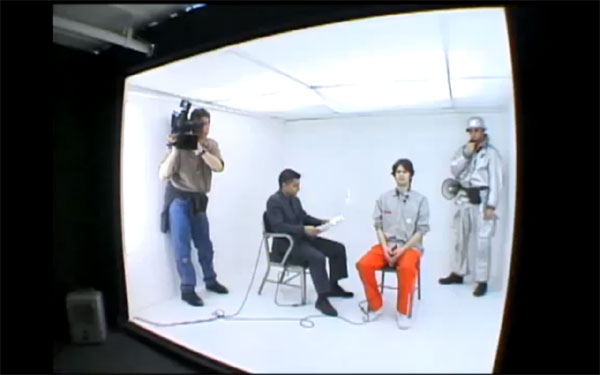
Pseudo.com founder and Web 1.0 wackjob Josh Harris, he of the sadistic yet prophetic “art projects,” is asked to anticipate the future in a really thorough article by Courtney Boyd Myers at The Next Web. An excerpt from his bleak and bold vision:
“What drove Harris crazy when he lived in a Truman Show like reality with his ‘fake girlfriend,’ other than losing his fortune, was when people online, his followers, started to get into his head and he was barely able to make a decision at any moment. Harris says that scenario was like a caveman version of what’s to come. With your day split into microparts, you will suffer from a psychic fracture. The issue won’t be about maintaining privacy. Your privacy will be long gone. The issue will be when your brain overloads, what in computer terms happens when the CPU goes into complete multi-tasking mode. And this is how we will enter the hive, also known as the Matrix. And that’s Harris’ Singularity. It’s just a matter of time, he says.
‘This is how you have to look at it. I try not to make judgements, it’s just a natural evolutionary process. I don’t know how they knew it but The Mayans were right: 2012 is the end of the world. The world isn’t going to blow up. But 2012 is the year when the Singularity’s effects will start to take place. When our lives become a collection of micro day parts. Unlike Isaac Asimov, who said his biggest regret is that he wouldn’t be alive for The Singularity, we actually are going to be present at the shift. It’ll start next year. It’ll seem like magic, just like television was magic, radio was magic, the telegraph was magic, and maybe even smoke signals were in their day. This is going to be real magic and we’re going to be alive to witness it.'”
Another Josh Harris post:
Tags: Courtney Boyd Myers, Josh Harris
Kids discuss LSD use during an experiment.
More People-on-LSD posts:
More about swarm robots, this time microchip-sized crafts designed by engineer Mason Peck at Cornell University, which can be used to inexpensively probe the outer reaches of space. They’re called Sprites. An excerpt from the Cornell page about them:
“Inspired by the success of the first Sputnik launch in 1957, we focus on a simple, feasible, but genuinely new design. For three weeks, the 23 inch diameter sphere of Sputnik I broadcast its internal temperature and pressure as it orbited and hinted at the potential of artificial satellites. A half century later, we expect to duplicate Sputnik’s achievement using less than one ten-millionth of its mass. Our design packages the traditional spacecraft systems (power, propulsion, communications, etc) onto a single silicon microchip smaller than a dime and unconstrained by onboard fuel.'” (Thanks Singularity Hub.)
••••••••••
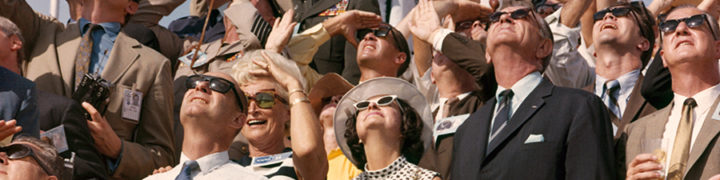
Americans amazed by Sputnik, 1957:
Tags: Mason Peck
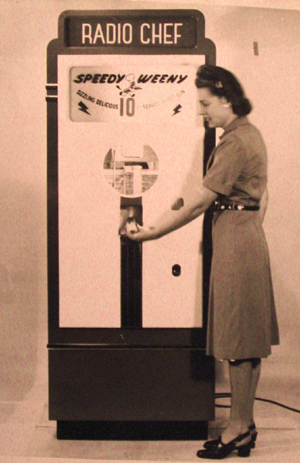
The Speedy Weenie machine used Devol’s microwave technology to dispense dogs. This photo was taken in his home.
Robotic arms that can grip and lift have been essential in everything from assembly lines to vending machines. Their creator, George Devol, who patented the invention in 1961 just passed away. An excerpt about the inventor’s beginnings from a New York Times obituary by Jeremy Pearce:
George Charles Devol Jr. was born Feb. 20, 1912, in Louisville, Ky. An experimenter from an early age, he studied mechanics and electronics in high school, but did not attend college. He worked for electronics companies in the 1920s, and in the early 1930s founded a small company, United Cinephone, to develop recording technology for movies.
That initial venture was not fruitful, and Mr. Devol turned his inventor’s hand to making devices that open doors automatically and other devices using machine controls. He also found a way to make laundry presses open or close when a worker approached. In 1939 United Cinephone installed automated photoelectric counters at the New York World’s Fair to count entering customers.
In the 1940s, Mr. Devol helped in an early application of the microwave oven, with the introduction of a machine for cooking and vending hot dogs, known as the “Speedy Weeny.”•
______________________________
Devol’s associate, Joseph F. Engelberger, demonstrates the technology for Johnny Carson in 1966, at the 9:09 mark.
Tags: George Devol, Joseph Engelberger
 The opening of “Lithium Dreams,” Lawrence Wright’s excellent 2010 New Yorker article about Bolivia’s chance for economic renaissance during the age of lightweight batteries:
“In southern Bolivia, there is a mountain called Cerro Rico—’the hill of wealth.’ It is a pale, bald rock, crisscrossed with dirt roads that climb the slope like shoelaces. More than four thousand mining tunnels have so thoroughly riddled its interior that the mountain is in danger of collapse. Its base is ringed with slums that spill into the old city of Potosí, a World Heritage site. Evo Morales, the President of Bolivia, recently told me that he and his countrymen see Potosí as ‘a symbol of plunder, of exploitation, of humiliation.’ The city represents a might-have-been Bolivia: a country that had capitalized on its astounding mineral wealth to become a major industrial power. Such a Bolivia could easily have been imagined in 1611, when Potosí was one of the biggest cities in the world, with a hundred and eighty thousand inhabitants—roughly the size of London at the time. Although Potosí began as a mining town, with the saloons and gaming houses that accompany men on the frontier, it soon had magnificent churches and theatres, and more than a dozen dance academies. From the middle of the sixteenth century until the middle of the seventeenth, half the silver produced in the New World came from Cerro Rico. Carlos Mesa, a historian who served as Bolivia’s President from 2003 to 2005, told me, ‘It was said throughout the Spanish empire, ‘This is worth a Potosí,’ when speaking of luck or riches.’ Potosí is now one of the poorest places in what has long been one of the poorest countries in South America.
Across the divide of the industrial revolution, there is another city whose promise of greatness now lies in ruins: Detroit. Even before the Curved Dash Oldsmobile rolled off the assembly line, in 1901, becoming the first mass-produced American car, Detroit was a showplace of labor, its huge factories producing iron, copper, freight cars, ships, pharmaceuticals, and beer. Following Oldsmobile’s lead, carmakers such as Ford, Packard, and Cadillac transformed the American economy. But Detroit’s triumph was remarkably short-lived. The city is half the size it was fifty years ago. Two of the Big Three carmakers, General Motors and Chrysler, went bankrupt in 2009, and all of them have cut their workforces drastically. Unemployment in Detroit is at fifteen per cent; the murder rate is the fourth highest in the country; and about a third of its citizens live in poverty. An estimated seventy thousand structures—houses, churches, factories, even skyscrapers—stand empty, many of them vandalized or burned. Parts of town are being farmed. Like Bolivia, Detroit is hoping for a second chance. And both of them are looking to a treasure that could revive their fortunes, and, incidentally, lead the world to a cleaner environment. That treasure is lithium.” (Thanks TETW.)
••••••••••
Bolivian President Evo Morales on the Daily Show in 2007:
Tags: Evo Morales, Lawrence Wright
Small robots are much cheaper to build than large ones, so getting wee ones to communicate with one another and do a task makes sense.
I had a phone conversation a few years back with the film critic Neal Gabler. I can’t remember what it was about, but I thought he was a really bright and nice guy. I disagree with a lot of “The Elusive Big Idea,’‘ his op-ed piece in yeaterday’s Sunday Times, but I think it’s a must read. The thing is, I agree with his basic premise that much of American culture is mired in rigid orthodoxy and regressing, but I don’t necessarily believe that there’s a paucity of big ideas or that the Internet is damaging our ability to hatch them.
It’s true that it doesn’t make any sense that we seem to be getting smarter and dumber all at once, given the free flow of information available to us all thanks to the Internet. I understand that the disparity between haves and have-nots in regards to financial wealth; that has to do with an alliance of monied interests and venal politicians. But there’s no excuse for such a divide in terms of ideas and imagination, even though there does seem to be one. That said, I don’t think the fault lies in technology like Gabler does, but in ourselves. The Internet may have exacerbated cultural amnesia and exploded egos, but it’s also leveled the playing field like nothing else since the printing press and been a huge gain for knowledge-sharing. There has probably never been a time in our history with more ideas circulating, and I think the troubling incivility and close-mindedness we see may be a reaction to that by people threatened by too many ideas, not too few. An excerpt from his essay:
 “It is no secret, especially here in America, that we live in a post-Enlightenment age in which rationality, science, evidence, logical argument and debate have lost the battle in many sectors, and perhaps even in society generally, to superstition, faith, opinion and orthodoxy. While we continue to make giant technological advances, we may be the first generation to have turned back the epochal clock — to have gone backward intellectually from advanced modes of thinking into old modes of belief. But post-Enlightenment and post-idea, while related, are not exactly the same.
Post-Enlightenment refers to a style of thinking that no longer deploys the techniques of rational thought. Post-idea refers to thinking that is no longer done, regardless of the style.
The post-idea world has been a long time coming, and many factors have contributed to it. There is the retreat in universities from the real world, and an encouragement of and reward for the narrowest specialization rather than for daring — for tending potted plants rather than planting forests.
There is the eclipse of the public intellectual in the general media by the pundit who substitutes outrageousness for thoughtfulness, and the concomitant decline of the essay in general-interest magazines. And there is the rise of an increasingly visual culture, especially among the young — a form in which ideas are more difficult to express.
But these factors, which began decades ago, were more likely harbingers of an approaching post-idea world than the chief causes of it. The real cause may be information itself. It may seem counterintuitive that at a time when we know more than we have ever known, we think about it less.
We live in the much vaunted Age of Information. Courtesy of the Internet, we seem to have immediate access to anything that anyone could ever want to know. We are certainly the most informed generation in history, at least quantitatively. There are trillions upon trillions of bytes out there in the ether — so much to gather and to think about.”
Tags: Neal Gabler
Doomsday-ish 1988 TV news report about a computer virus.
Walter Kirn went a little hyperbolic in his 2007 Atlantic essay about the high cost of multitasking in the Information Age, but it’s still a provocative piece. An excerpt;
“It isn’t working, it never has worked, and though we’re still pushing and driving to make it work and puzzled as to why we haven’t stopped yet, which makes us think we may go on forever, the stoppage or slowdown is coming nonetheless, and when it does, we’ll be startled for a moment, and then we’ll acknowledge that, way down deep inside ourselves (a place that we almost forgot even existed), we always knew it couldn’t work.
The scientists know this too, and they think they know why. Through a variety of experiments, many using functional magnetic resonance imaging to measure brain activity, they’ve torn the mask off multitasking and revealed its true face, which is blank and pale and drawn.
Multitasking messes with the brain in several ways. At the most basic level, the mental balancing acts that it requires—the constant switching and pivoting—energize regions of the brain that specialize in visual processing and physical coordination and simultaneously appear to shortchange some of the higher areas related to memory and learning. We concentrate on the act of concentration at the expense of whatever it is that we’re supposed to be concentrating on.
What does this mean in practice? Consider a recent experiment at UCLA, where researchers asked a group of 20-somethings to sort index cards in two trials, once in silence and once while simultaneously listening for specific tones in a series of randomly presented sounds. The subjects’ brains coped with the additional task by shifting responsibility from the hippocampus—which stores and recalls information—to the striatum, which takes care of rote, repetitive activities. Thanks to this switch, the subjects managed to sort the cards just as well with the musical distraction—but they had a much harder time remembering what, exactly, they’d been sorting once the experiment was over.
Even worse, certain studies find that multitasking boosts the level of stress-related hormones such as cortisol and adrenaline and wears down our systems through biochemical friction, prematurely aging us. In the short term, the confusion, fatigue, and chaos merely hamper our ability to focus and analyze, but in the long term, they may cause it to atrophy.”
Tags: Walter Kirn
About the Carter-Ford Presidential debate, in 1976.
Tags: Edwin Newman, Gerlad Ford, Jimmy Carter, Marshall McLuahn, Tom Brokaw
From “Human Skin Used As Computer Input Device,” Stuart Fox’s post at Innovation News Daily about the intermingling of flesh and silicon:
“Phones, makeup kiosks, car dashboards, televisions, rolls of paper, museum exhibits; it’s hard to find somethinghat hasn’t been transformed into a computer interface device. Soon, the back of your hand will join that list, as a new device debuted here at the SIGGRAPH interactive technology conference can instantly convert a patch of skin into a multitouch controller for a computer.
Designed by Kei Nakatsuma, a researcher at the University of Tokyo Department of Information Physics and Computing, this new touch interface uses infrared sensor technology to track a finger across the back of a hand, as if it was a digital stylus or mouse. The device itself fits onto a wristwatch-sized band, giving users an adaptable computer control wherever they go.
‘The advantage for using the back of your hand is that your skin can provide haptic (touch-based) feedback,’ Nakatsuma told Innovation News Daily.”
Tags: Kei Nakatsuma, Stuart Fox
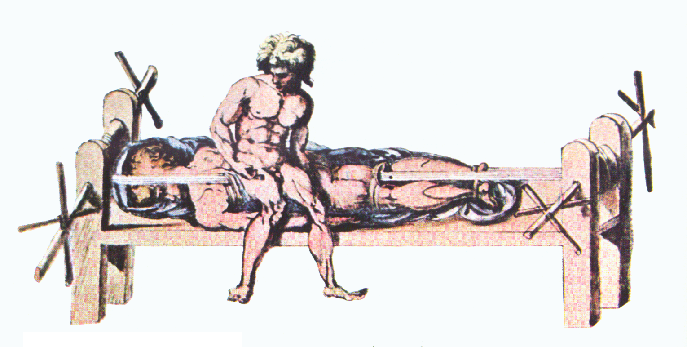
Dr. Jay Parkinson was a young physician who set up an innovative medical practice using all the modern tools of communication and information exchange and got only grief in return from the medical establishment. Just sad all around. An excerpt from his post (but read the whole thing):
“Upon finishing my second residency at Hopkins in Baltimore in September of 2007, I moved back to Williamsburg to start a new kind of practice:
- Patients would visit my website
- See my Google calendar
- Choose a time and input their symptoms
- My iphone would alert me
- I would make a house call
- They’d pay me via paypal
- We’d follow up by email, IM, videochat, or in person
It was simple, elegant, and affordable for me to start. But most importantly, it just made sense given how we all communicate and do business today. Starting a new practice was obviously challenging for me having never done so before, but my patients loved the experience— I was an accessible, affordable doctor in their neighborhood who communicated just like them.” (Thanks Marginal Revolution.)
Tags: Jay Parkinson
Discharged patients can have their progress tracked. (Thanks New Scientist.)
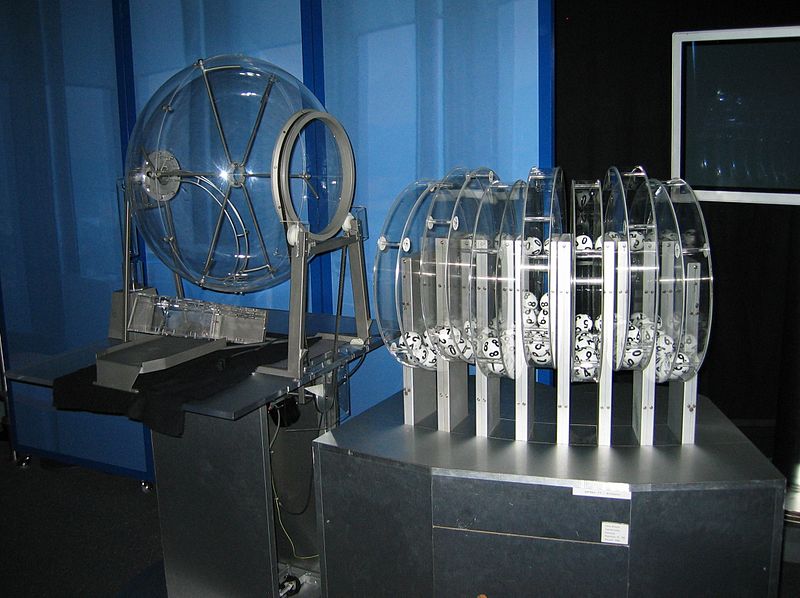
A fool and his money are soon parted, even if we’re talking about Lotto millions. Alex Tabarrok of Marginal Revolution wrote a post about the predictable results of lottery winners mishandling new-found wealth. In it, he links to a Mail Online story about a British trashman who blew through his lottery winnings and returned to hauling trash. An excerpt:
“He became the self-proclaimed king of the chavs after turning up to collect his £9.7million lottery win wearing an electronic offender’s tag.
But eight years on, having blown all that money, Michael Carroll is practising for a return to his old job as a binman.
The 26-year-old, who squandered his multi-million fortune on drugs, gambling and thousands of prostitutes, has since February claimed £42 a week in jobseeker’s allowance.
But he is keen to get off the dole and back to earning £200 a week collecting rubbish near his home in Downham Market, Norfolk.
The father of two told The People: ‘I can’t wait to stop signing on and start getting paid for doing a proper job like normal people.’”
••••••••••
Documentary about Lotto “winner” Michael Carroll;
Tags: Alex Tabarrok, Michael Carroll
From 1959.
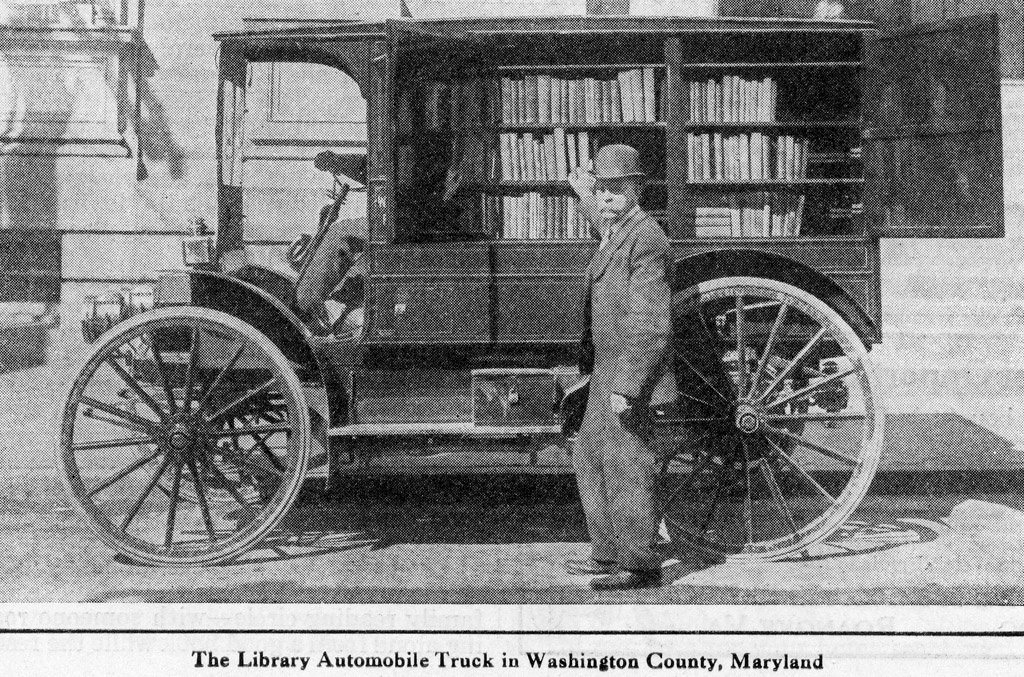
I recently quoted Craig Mod in a post about NYC’s attempt to catch up to Silican Valley as a tech center. Here’s an excerpt from “Post-Artifact Books and Publishing,” Mod’s blog post about the nature of books and what digital means for them in the future:
“Take a set of encyclopedias and ask, ‘How do I make this digital?’ You get a Microsoft Encarta CD. Take the philosophy of encyclopedia-making and ask, ‘How does digital change our engagement with this?’ You get Wikipedia.
When we think about digital’s effect on storytelling, we tend to grasp for the lowest hanging imaginative fruits. The common cliche is that digital will ‘bring stories to life.’ Words will move. Pictures become movies. Narratives will be choose-your-own-adventure. While digital does make all of this possible, these are the changes of least radical importance brought about by digitization of text. These are the answers to the question, ‘How do we change books to make them digital?’ The essence of digital’s effect on publishing requires a subtle shift towards the query: ‘How does digital change books?'”
Tags: Craig Mod
Perhaps everyone else knew that communicators on Star Trek inspired Martin Cooper to create the cell phone, but I didn’t.
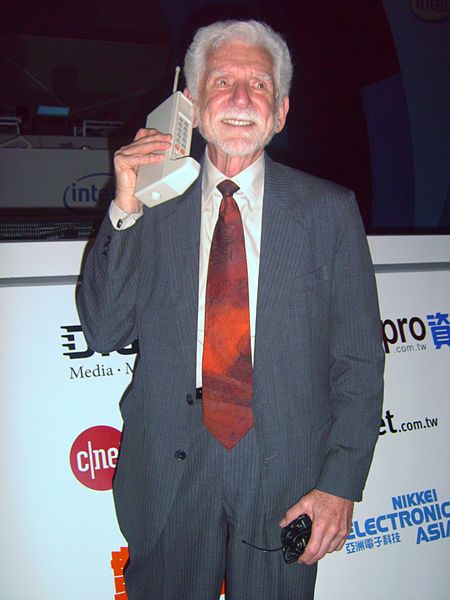
Dr. Martin Cooper, in 2007, with the first cell phone.
Tags: Martin Cooper