Cool vintage 1971 NASA film links the history of knowledge gathering in America, from Benjamin Franklin to space travel.
Related post:
Ideas and technology and politics and journalism and history and humor and some other stuff.
You are currently browsing the archive for the Science/Tech category.
Cool vintage 1971 NASA film links the history of knowledge gathering in America, from Benjamin Franklin to space travel.
Related post:

Gizmodo has a good post by Mat Honan which fleshes out what became obvious yesterday after Amazon’s dazzling Kindle Fire presentation: For the time being, Jeff Bezos will fill the void created by Steve Jobs stepping aside at Apple. Amazon has always been formidable, but a little blah. No more. An excerpt:
“And so when it was all over, the press, the great opinionator that drives purchasing decisions, was utterly flabbergasted. It was totally Jobsed, so to speak. Hypnotized and drawn in by the mind-blowing Bezos.
Much of that that is because of his passion. You can see it in his eyes, full of zeal and bordering on crazy. He isn’t just conning you, he believes in it. He feels strongly that he’s got the right product, at the right time. And so watch him and you will too.
And yet, it’s not just about his salesmanship. ‘Jeff Bezos is the new Ron Popeil‘ is a whole other story. He mirrors Apple’s former CEO in a host of other ways as well.
Most obviously, he’s a founder/CEO. Amazon is his. Yes, it’s a public company, but it goes where his vision takes it. It follows his mind into markets. Amazon is Jeff Bezos. Without him it would be adrift.”
••••••••••
“The instruction we find in books is like fire”:
Tags: Jeff Bezos, Mat Honan, Steve Jobs
In South Korea, Big Brother might actually be your big brother, or somebody’s big brother. The unemployed (and underemployed) have found a niche working as “paparazzi,” but not of the usual variety. Citizens are paid by the government to photograph anyone committing illegal acts. The opening of Choe Sang-Hun’s excellent New York Times article about the league of professional snitches:
“SEOUL, South Korea — With his debts mounting and his wages barely enough to cover the interest, Im Hyun-seok decided he needed a new job. The mild-mannered former English tutor joined South Korea’s growing ranks of camera-toting bounty hunters.
Known here sarcastically as paparazzi, people like Mr. Im stalk their prey and capture them on film. But it is not celebrities, politicians or even hardened criminals they pursue. Rather, they roam cities secretly videotaping fellow citizens breaking the law, deliver the evidence to government officials and collect the rewards.
‘Some people hate us,’ Mr. Im said. ‘But we’re only doing what the law encourages.’
The opportunities are everywhere: a factory releasing industrial waste into a river, a building owner keeping an emergency exit locked, doctors and lawyers not providing receipts for payment so that they can underreport their taxable income.”
Tags: Choe Sang-Hun, Im Hyun-seok

Nissan and Swiss university EPFL are attempting to build cars that can read the thoughts of the driver. From Physorg:
“‘The idea is to blend driver and vehicle intelligence together in such a way that eliminates conflicts between them, leading to a safer motoring environment,’ said Jose del R. Millan, a professor at Swiss technological university EPFL who is leading the project.
The project uses ‘brain activity measurement, eye movement patterns and by scanning the environment around the car in conjunction with the car’s ownsensors’ to forecast the driver’s next move.”
••••••••••
“You got me so I don’t know where I’m going”:
Tags: Jose del R. Millan

Steven Pinker, author of The Stuff of Thought among other provocative books, provides a history of violence–and its gradual decline–at Edge. An excerpt about the mitigating effect the printing press had on violence:
“By the 18th century a majority of men in England were literate.
Why should literacy matter? A number of the causes are summed up by the term ‘Enlightenment.’ For one thing, knowledge replaced superstition and ignorance: beliefs such as that Jews poisoned wells, heretics go to hell, witches cause crop failures, children are possessed, and Africans are brutish. As Voltaire said, ‘Those who can make you believe absurdities can make you commit atrocities.’
Also, literacy gives rise to cosmopolitanism. It is plausible that the reading of history, journalism, and fiction puts people into the habit of inhabiting other peoples’ minds, which could increase empathy and therefore make cruelty less appealing. This is a point I’ll return to later in the talk.”
••••••••••
Pinker talks the same topic at TED:
Tags: Stephen Colbert, Steven Pinker
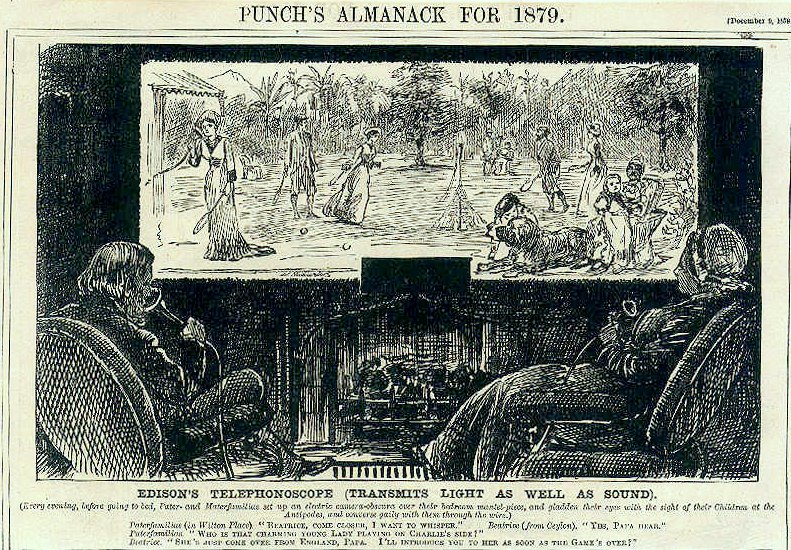
Representation of the Ur-videophone, from Punch’s Almanack.
Tags: Thomas Edison

Rats are now becoming cyborgs, getting brain implants, as reported by Linda Geddes in New Scientist:
“AN ARTIFICIAL cerebellum has restored lost brain function in rats, bringing the prospect of cyborg-style brain implants a step closer to reality. Such implants could eventually be used to replace areas of brain tissue damaged by stroke and other conditions, or even to enhance healthy brain function and restore learning processes that decline with age.
Cochlear implants and prosthetic limbs have already proved that it is possible to wire electrical devices into the brain and make sense of them, but such devices involve only one-way communication, either from the device to the brain or vice versa.
Now Matti Mintz of Tel Aviv University in Israel and his colleagues have created a synthetic cerebellum which can receive sensory inputs from the brainstem – a region that acts as a conduit for neuronal information from the rest of the body. Their device can interpret these inputs, and send a signal to a different region of the brainstem that prompts motor neurons to execute the appropriate movement.”
Tags: Linda Geddes, Matti Mintz

This classic 1963 photo profiles Hangar One at Moffett Federal Airfield in Northern California. The towering hangar looks like something that arrived mysteriously from both the future and the past, a man-made colossus that seems to be the result of some higher creature. One of the world’s largest free-standing structures, Hangar One is 200-feet tall and spans eight acres. It was built during the Depression to house the U.S.S. Macon dirigible, an aircraft carrier that was the biggest airship in the world when it launched in 1933. But damage caused by a storm in 1935 buried the Macon deep in the Pacific Ocean. Today, a restored Hangar One is used by NASA. From a 2006 Spiegel article about the wreck of the Macon:
“The tragedy unfolded unusually slowly for an aviation catastrophe: The crew fought to control the USS Macon for more than an hour. US naval officers threw fuel canisters overboard in an attempt to reduce the weight of their vessel. The canisters imploded on their way to the ocean floor. Meanwhile, the Macon — the largest rigid airship ever constructed in the United States — sank inexorably downward, the safety of the Moffett Field hangar just within reach.
The Macon hit the water surface only five kilometers (three miles) off the Californian coast, along the latitude of the Point Sur lighthouse near Monterey, on Feb. 12, 1935. The zeppelin broke apart and sank into the deep water. Two of the 83 crew members died — the low number of deaths is likely due to the fact that the Macon sank in slow motion.
Neither enemy fire nor sabotage was to blame for the giant airship’s doom (and a giant it was: longer than three 747 jets parked nose to tail). A heavy storm above the picturesque stretch of Californian coast known as Big Sur tore off the Macon’s vertical tail fin. The airship’s structural framework was so badly damaged that the Macon broke apart when it hit the water.”
••••••••••
Trial flight of the Macon, 1933:
Explaining the phsyics of the riderless bicycle. (Thanks Marginal Revolution.)
Architects use ‘bots to build. (Thanks IEEE Spectrum.)

From “Supercomputer Predicts Revolution,” Peter Murray’s Singularity Hub report about the prognosticating powers of software:
“A new type of software has been shown to predict revolutions by mining news reports around the world. Retrospectively mining the news for the past 30 years the software indicates points at which the likelihood for a revolution is high. When put to the test – bingo! – the software showed spikes just before the recent Egyptian and Libyan upheavals. It was also able to sift through world news to retrospectively pinpoint Osama Bin Ladin’s location to within 200 km. In the emerging science of ‘culturomics’ that tracks cultural trends through the written word, the software was the first to demonstrate that news coverage can be used to predict future events.”
Tags: Peter Murray

From Conor Friedersdorf”s Atlantic piece about energy-saving motion sensors, now widely used in Spain:
“In the vast majority of tapas bars and restaurants I patronized, and in train stations and other public places too, I’d open bathroom doors to find it dark inside, start to fumble for a light switch, and remember that practically every last light is now triggered by motion sensors, a cheap alternative to the status quo here: leaving the lights on all the time, whether anyone is in the bathroom or not.
The motion sensor was also put to use in at least one shopping mall that I visited in Valencia. With four or five stories of stores, it had a bunch of escalators to transport shoppers from one level to another. Instead of running them at full speed all the time, however, they slowed down considerably when no one was on the steps. Tripping an invisible beam while walking onto the bottom step, it sped up immediately to normal escalator speed, costing patrons no time and saving energy.”

From “Quantum Leap,” a 2006 Fortune interview with DARPA legend Stuart Wolf, about life in 2030:
“She awakes early on the morning of April 10, 2030, in the capable hands of her suburban Chicago apartment. All night, microscopic sensors in her bedside tables have monitored her breathing, heart rate, and brain activity.
The tiny blood sample she gave her bathroom sink last night has been analyzed for free radicals and precancerous cells; the appropriate preventative drugs will be delivered to her hotel in Atlanta this evening. It’s an expensive service, but as a gene therapist, Sharon Oja knows it’s worth it.
She steps into the shower. The tiles inside detect her presence and start displaying the day’s top headlines. The manned mission to Mars is going to launch ahead of schedule. U.S. military drones have destroyed another terrorist training camp using smart dust. A top Manhattan banker has been found guilty of fraud and sentenced to 10 years of low tech.
And today is the 20th anniversary of the very first quantum computer.
Sharon laughs. It is her 24th birthday, and she has little idea what the world was like before the qubits – the smallest pieces of quantum information – took over.”
Tags: Stuart Wolf

Sanjhih Pod City in Nothern Tapei, with its abandoned and worn Futuro houses, is like no other place on Earth. Construction began in 1978 on what was supposed to be a vacation paradise for the wealthy. But the project was abandoned while in progress, because of financial problems and the accidental death of many workers, which convinced people the property was haunted. An excerpt from a story about the futuristic ghost town in the Taipei Times:
“One of the designers behind the UFO houses spoke exclusively to the Taipei Times. Lin, who only gave his family name, said that there were lots of rumors about the site, but most of them were false.
‘First of all, the site is definitely not haunted,’ Lin said, in reference to oft-heard rumors that many people have seen ghosts near the complex or the high number of unexplained traffic accidents on the nearby road.
There were also rumors that more than 20,000 skeletons were discovered at the site when construction work began and that it was the scene of several murders.”
••••••••••
LED kite + UFO Houses, Taiwan:
From “Is Facebook Forever?” Rebecca J. Rosen’s Atlantic article about the overwhelming reach of the most popular social-networking site:
“Social-networking sites are fragile, as MySpace and Friendster proved. Unlike Yahoo! and AOL, whose users can get more or less the same experience if there are millions of others like them or if they are the last ones on Earth, social-networking sites can shrivel quickly if the perception rises that people are leaving. But even if Facebook does someday flag, its reach and its repository may mean a different kind of decline than those of the social networks before it. Those houses, once abandoned, fell apart. But Facebook may be more like the house you moved out of when you went to college — a house you still stop by to check in from time to time, see how the neighborhood is doing, say hi to old friends. It’s no longer where you live, or the place you call home, but it’s never quite gone either.”
Tags: Rebecca J. Rosen
Walt Disney discusses robotics, 1963.
Tags: Walt Disney
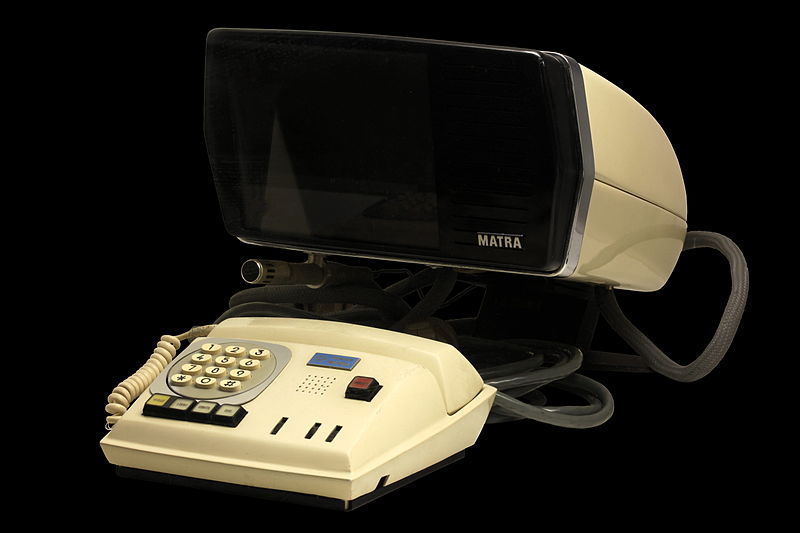
From Jan Hoffman’s new New York Times article about Skype-powered psychiatric sessions:
‘THE event reminder on Melissa Weinblatt’s iPhone buzzed: 15 minutes till her shrink appointment.
She mixed herself a mojito, added a sprig of mint, put on her sunglasses and headed outside to her friend’s pool. Settling into a lounge chair, she tapped the Skype app on her phone. Hundreds of miles away, her face popped up on her therapist’s computer monitor; he smiled back on her phone’s screen.
She took a sip of her cocktail. The session began.
Ms. Weinblatt, a 30-year-old high school teacher in Oregon, used to be in treatment the conventional way — with face-to-face office appointments. Now, with her new doctor, she said: ‘I can have a Skype therapy session with my morning coffee or before a night on the town with the girls. I can take a break from shopping for a session. I took my doctor with me through three states this summer!'”
••••••••••
“The unique service of the future, like the picture phone” (1960s):
Roger and Gene review the Mitsubishi VisiTel Visual Phone, 1988 (at 8:45):
Tags: Gene Siskel, Jan Hoffman, Melissa Weinblatt, Roger Ebert
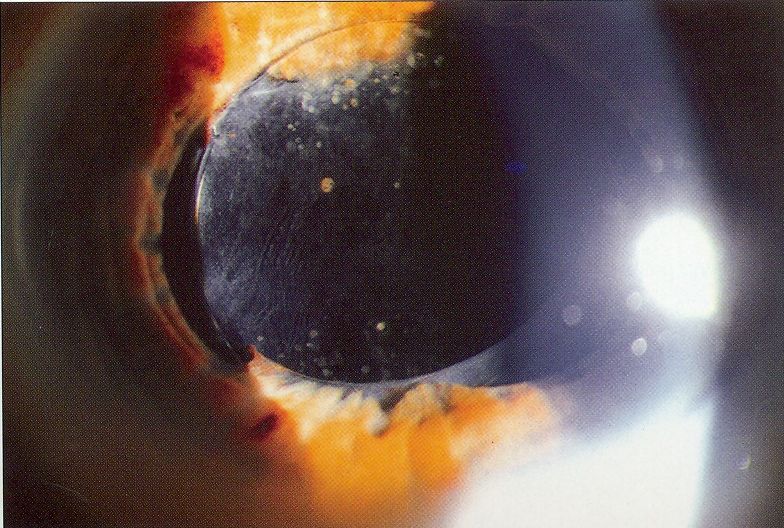
From Kate Moisse and ABC News comes this story about a breakthrough in our ability to visually reconstruct people’s memories:
“California scientists have found a way to see through another person’s eyes.
Researchers from UC Berkeley were able to reconstruct YouTube videos from viewers’ brain activity — a feat that might one day offer a glimpse into our dreams, memories and even fantasies.
‘This is a major leap toward reconstructing internal imagery,’ said Jack Gallant, professor of psychology and coauthor of a study published today in Current Biology. ‘We are opening a window into the movies in our minds.””
••••••••
“Reconstructing visual experiences from brain activities evoked by natural movies”:
Tags: Jack Gallant, Kate Moisse
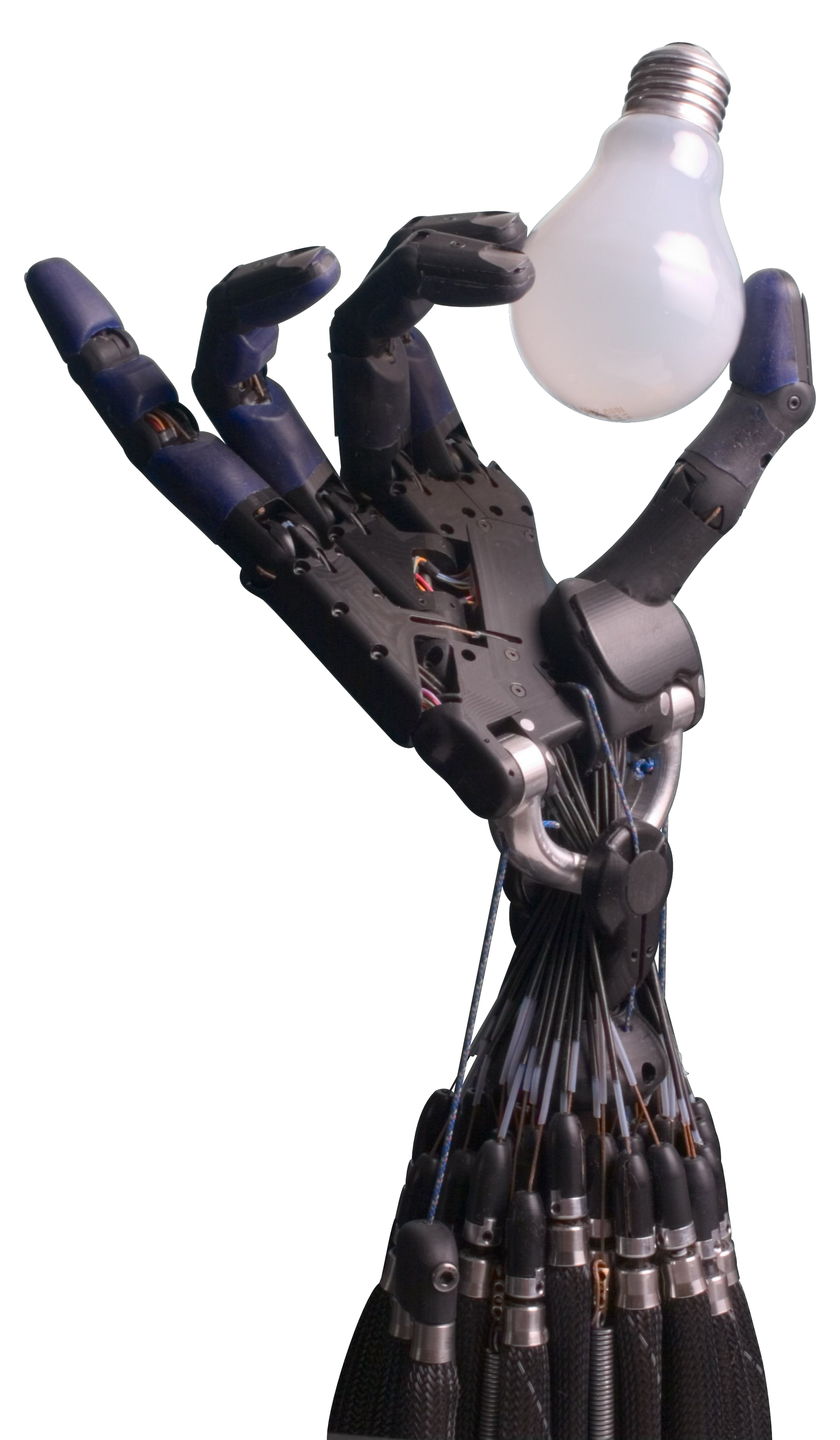
Robots in Singapore are getting fingerprints. From popsci:
“Researchers at the National University of Singapore are enhancing robots’ sense of touch by mimicking the ridged and contoured surfaces of human fingertips. Fingerprints, it turns out, don’t just give humans better grip but also carry out a sensitive type of signal processing. By imparting that same kind of signal processing to robots, we could reduce the processing loads to robots’ CPUs and help them better identify objects through their shapes.
Fingerprints provide a unique identifier and a better means to hold on to objects, but they also shape the ways we sense and perceive the world around us. When we touch something, the ridges alter the vibrations moving through our skin such that nerve endings can better receive them. This serves as a kind of signal processing that allows the skin in our fingertips to provide richer information to our central nervous system than skin on other parts of the body.”
••••••••••
Hymie the Robot, Get Smart:
“Living with Robots,” Honda:

From a 1999 Playboy interview with writer/director Michael Crichton, who fretted, to great financial success, over science outpacing ethics:
Playboy:
In Jurassic Park, you looked at the potential hazards of DNA research. What’s your view of cloning?
Michael Crichton:
I think we’re a long way from cloning people. But I am worried about scientific advances without consideration of their consequences. The history of medicine in my lifetime is one of technological advances that outstrip our ethical systems. We’ve never caught up. When I was in medical school—30-odd years ago—people were struggling to deal with mechanical-respiration systems. They were keeping alive people who a few years earlier would have died of natural causes. Suddenly people weren’t going to die of natural causes. They were either going to get on these machines and never get off or—or what? Were we going to turn the machines off? We had the machines well before we started the debate. Doctors were speaking quietly among themselves with a kind of resentment toward these machines. On the one hand, if somebody had a temporary disability, the machines could help get them over the hump. For accident victims—some of whom were very young—who could be saved if they pulled through the initial crisis, the technology saved lives. You could get them over the hump and then they would recover, and that was terrific.
But on the other hand, there was a category of people who were on their way out but could be kept alive. Before the machine, ‘pulling the plug’ actually meant opening the window too wide one night, and the patient would get pneumonia and die. That wasn’t going to happen now. We were being forced by technology to make decisions about the right to die—whether it’s a legal or religious issue—and many related matters. Some of them contradict longstanding ideas in an ethically protected world; we weren’t being forced to make hard decisions, because those decisions were being made for us—in this case, by the pneumococcus.
This is just one example of an ethical issue raised by technology. Cloning is another. If you’re knowledgeable about biotechnology, it’s possible to think of some terrifying scenarios. I don’t even like to discuss them. I know people doing biotechnology research who have decided not to pursue avenues of research because they think they’re too dangerous. But we go forward without sorting out the issues. I don’t believe that everything new is necessarily better. We go forward with the technology while the ethical issues are still up in the air, whether it’s the genetic variability of crop streams, which is a resource in times of plant plagues, to the assumption that we all have to be connected all the time. The technology is here so you must use it. Do you? Do you have to have your cell phone and your e-mail address and your Internet hookup? I was just on holiday in Scotland without e-mail. I had to notify people that I wouldn’t be checking my e-mail, because there’s an assumption that if I send you an e-mail, you’ll get it. Well, I won’t get it. I’m not plugged in, guys. Some people are horrified: “You’ve gone offline?” People feel so enslaved by technology that they will stop having sex to answer the telephone. What could be so important? Who’s calling, and who cares?•
Tags: Michael Crichton
Taking a spin on the omnidirectional treadmill.
Claude Shannon, who pretty much invented the Information Age, demonstrates one of his juggling machines in 1985.
Tags: Claude Shannon
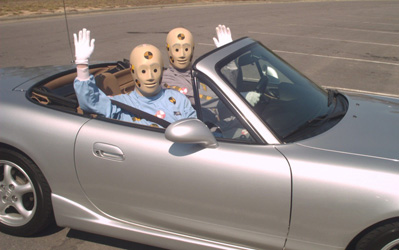
In the New York Review of Books, Christian Caryl explains the ramifications of the incredible rise of the drones:
“Drones are not remarkable because of their weaponry. There is nothing especially unusual about the missiles they carry, and even the largest models are relatively lightly armed. They are not fast or nimble. What makes them powerful is their ability to see and think. Most of the bigger drones now operated by the US military can take off, land, and fly by themselves. The operators can program a destination or a desired patrol area and then concentrate on the details of the mission while the aircraft takes care of everything else. Packed with sensors and sophisticated video technology, UAVs can see through clouds or in the dark. They can loiter for hours or even days over a target—just the sort of thing that bores human pilots to tears. Of course, the most significant fact about drones is precisely that they do not have pilots. In the unlikely event that a UAV is shot down, its operator can get up from his or her console and walk away.
So far, so good. But there are also quite a few things about drones that you might not have heard yet. Most Americans are probably unaware, for example, that theUS Air Force now trains more UAV operators each year than traditional pilots. (Indeed, the Air Force insists on referring to drones as “remotely piloted aircraft” in order to dispel any suspicions that it is moving out of the business of putting humans into the air.) As I write this, the US aerospace industry has for all practical purposes ceased research and development work on manned aircraft. All the projects now on the drawing board revolve around pilotless vehicles. Meanwhile, law enforcement agencies around the country eagerly await the moment when they can start operating their own UAVs. The Federal Aviation Administration is considering rules that will allow police departments to start using them within the next few years (perhaps as early as 2014). Soon, much sooner than you realize, your speeding tickets will be issued electronically to your cell phone from a drone hovering somewhere over the interstate. The US Customs Service has already used UAVs to sneak up on drug-smuggling boats that easily evade noisier conventional aircraft.”
Tags: Christian Caryl
A 1978 video that shows how the Chinese language, with it s many symbols, works on a typewriter. (Thanks Reddit.)
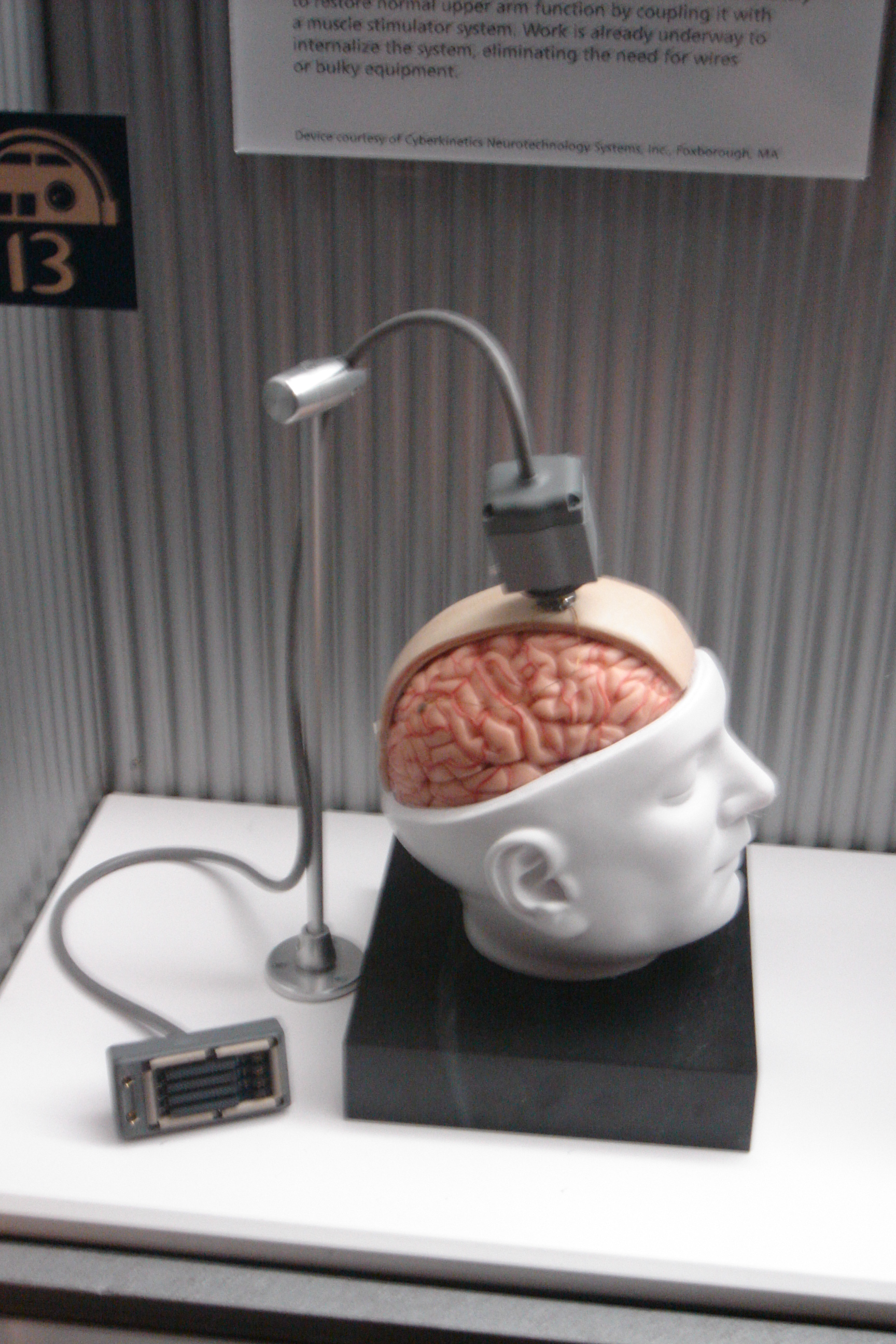
Mind and body have long been seen as disparate parts with the former located in the brain. But recent research suggests that the mind operates not just in our gray matter but in all our matter. The eloquent opening of Jonah Lehrer’s new Wall Street Journal piece on the topic:
“One of the deepest mysteries of the human mind is that it doesn’t feel like part of the body. Our consciousness seems to exist in an immaterial realm, distinct from the meat on our bones. We feel like the ghost, not like the machine.
This ancient paradox—it’s known as the mind-body problem—has long perplexed philosophers. It has also interested neuroscientists, who have traditionally argued that the three pounds of our brain are a sufficient explanation for the so-called soul. There is no mystery, just anatomy.
In recent years, however, a spate of research has put an interesting twist on this old conundrum. The problem is even more bewildering than we thought, for it’s not just the coiled cortex that gives rise to the mind—it’s the entire body. As the neuroscientist Antonio Damasio writes, ‘The mind is embodied, not just embrained.'”
••••••••••
Lehrer addresses concerns over the brain-changing effects of the Internet:
Tags: Jonah Lehrer