Science/Tech

You are currently browsing the archive for the Science/Tech category.

The sci-fi thriller Limitless asks questions about the type of neutrino-speed performance enhancement for humans that seems possible in the not-too-distant future, but it doesn’t ask the best and most important ones. Neil Burger’s movie is concerned with the complications that arise when a wonder drug that bestows superhuman abilities turns out to be less than wonderful, attended by side effects, glitches and downsides. The better questions to ask are: What will we do when such pills and (microchips) have no side effects at all? In which direction will we head when all signs are pointing up, and we can get there through no effort of our own? Will we see a pain-free ability to realize our human potential as something less than human?

Eddie (Bradley Cooper) is a depressed novelist with writer’s block and a broken heart. Kicked to the curb by his disappointed girlfriend (Abbie Cornish), he drinks and frets and dodges anyone he owes money to. But then the previously married author has a chance encounter with his erstwhile brother-in-law (Johnny Whitworth), a former coke dealer who claims to now be pushing FDA-approved wonder drugs for Big Pharma. He hands Eddie a bright, clear pill not yet available to the public, and it quickly changes the writer’s life. Eddie not only finishes his stalled novel in four days, but learns languages in a matter of minutes and becomes a wealthy titan on Wall Street. The world is suddenly wide open.

But there are extreme side effects for those who try to taper off, as Eddie learns when his stash begins to grow low. But what if the supply was as limitless as the capacity it allowed? When we have the ability to improve neurons, nerves and muscles at a whim, will the choice be obvious? Will some decide to stay behind? Will the change be so gradual that we won’t really notice the transformation? Those are the questions we should be asking.•

Tags: , , ,

"Now the scope of the protests are even wider, more global." (Image by David Shankbone.)

From a post on Kevin Kelly’s Technium blog, in which he meditates on the ever-decreasing centralization of political power in the Digital Age:

“There seems to be a global-scale protest underway. People, mostly young people, are bypassing the institutional voting system to try to force change through decentralized adhocracy and anarchy. The world saw something similar in the 1960s when student protests erupted in Europe and the US and the Americas all at the same time. Now the scope of the protests are even wider, more global, reaching from Arab Africa, to the Mid East, to East Asia, to the the heartland of Europe and the US.

In a clear-headed front-page article in the New York Times today, one factor in this global unrest is assigned to technology. In particular common communication technology is seen as enabling this protest to blossom (although not causes the protest).

I agree with the Times that more important than the technology which is embraced are the mind-habits, the framework, the ideology of the technology, which the protesters are trying to migrate into non-electronic situations.

Here is a bit from the middle of the article:

The critical mass of wiki and mapping tools, video and social networking sites, the communal news wire of Twitter and the ease of donations afforded by sites like PayPal makes coalitions of like-minded individuals instantly viable.‘You’re looking at a generation of 20- and 30-year-olds who are used to self-organizing,’ said Yochai Benkler, a director of the Berkman Center for Internet and Society at Harvard University. ‘They believe life can be more participatory, more decentralized, less dependent on the traditional models of organization, either in the state or the big company. Those were the dominant ways of doing things in the industrial economy, and they aren’t anymore.'”

Tags: ,

In “The End of the Future” at the National Review, Peter Thiel argues that technological progress is starting to run aground. The opening:

“Modern Western civilization stands on the twin plinths of science and technology. Taken together, these two interrelated domains reassure us that the 19th-century story of never-ending progress remains intact. Without them, the arguments that we are undergoing cultural decay — ranging from the collapse of art and literature after 1945 to the soft totalitarianism of political correctness in media and academia to the sordid worlds of reality television and popular entertainment — would gather far more force. Liberals often assert that science and technology remain essentially healthy; conservatives sometimes counter that these are false utopias; but the two sides of the culture wars silently agree that the accelerating development and application of the natural sciences continues apace.

Yet during the Great Recession, which began in 2008 and has no end in sight, these great expectations have been supplemented by a desperate necessity. We need high-paying jobs to avoid thinking about how to compete with China and India for low-paying jobs. We need rapid growth to meet the wishful expectations of our retirement plans and our runaway welfare states. We need science and technology to dig us out of our deep economic and financial hole, even though most of us cannot separate science from superstition or technology from magic. In our hearts and minds, we know that desperate optimism will not save us. Progress is neither automatic nor mechanistic; it is rare. Indeed, the unique history of the West proves the exception to the rule that most human beings through the millennia have existed in a naturally brutal, unchanging, and impoverished state. But there is no law that the exceptional rise of the West must continue. So we could do worse than to inquire into the widely held opinion that America is on the wrong track (and has been for some time), to wonder whether Progress is not doing as well as advertised, and perhaps to take exceptional measures to arrest and reverse any decline.” (Thanks Browser.)

Tags:


Tags:

From 1978.

Tags:

The opening of “Slow Scan To Moscow,” Adam Hochschild’s 1986 Mother Jones article about the growing electronic connectivity between people of the U.S. and the Soviet Union, two countries that were still locked in the Cold War:

“Joel Schatz has wire-rimmed glasses and an Old Testament-sized beard. A big head of curly black hair flecked with gray adds a few extra inches to his sixfoot-two frame. ‘This trip we’re about to take,’ he says enthusiastically, ‘is so important that I’ve even gotten a haircut.’ Its effects are not noticeable.

Joel is sitting in the study of his San Francisco apartment, where most of the furniture consists of pillows on the floor. The largest thing in sight is an enormous reflector telescope, which can be pivoted around on its pedestal and aimed out a high window, Joel explains, ‘to remind me of my place in the cosmos. We’re all voyagers out there.

‘If I had millions of dollars I’d build neighborhood observatories all over the world. And at each one I’d have good conga drums, so people could drum together as well as observe.’

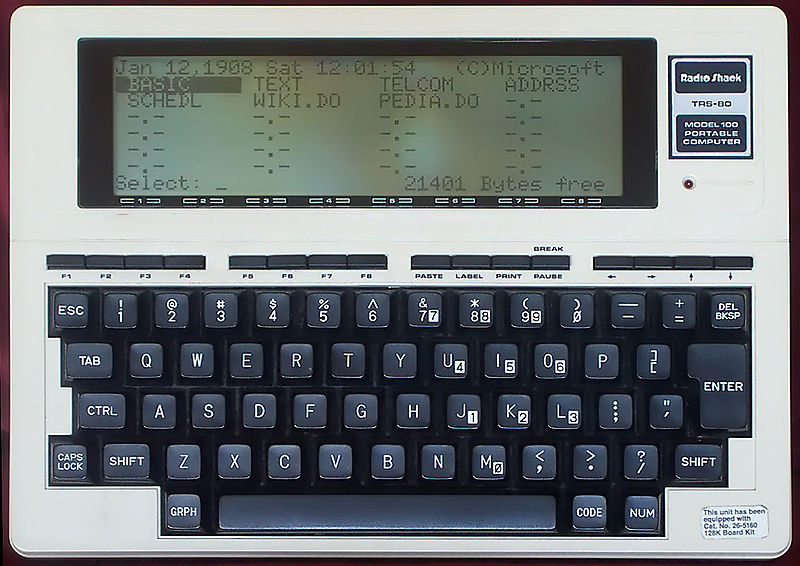
The object of Joel’s attention at this moment, however, as it is much of the time, is his four-pound, briefcase-size Radio Shack Tandy Model 100 portable computer. ‘I bought this machine for $399. For $1.82 a minute – $1.82! – I can send a telex message to Moscow. This technology is going to revolutionize human communications! Think what it will mean when you can get thousands of Americans and Soviets on the same computer network. Once scientists in both countries begin talking to each other on these machines they won’t be able to stop. And we’ll be taking a running leap over the governments on both sides.

‘I’m not a scientist,’ Joel adds. ‘I’ve only owned a computer for four months. I don’t understand how they work. I’ll leave that to other people. I’m just interested in how they can improve communication on this planet.'” (Thanks Longform.)

••••••••••

Radio Shack Tandy 102 portable computer, the final refresh of the 100 series:

Tags: ,

A message from the good people at Hanson Robokind.

Going a step or two further than Amazon with its Kindle Fire, the Indian government is hoping to bridge the digital gap between haves and have-nots with the Aakash, which is the lowest priced tablet in the world. Having access to seemingly infinite information hasn’t necessarily enriched Amercians  or made us significantly smarter–not yet anyhow–but those long denied the basics tend to use tools more aggressively than those of us in more comfortable situations. From Adam Clark Estes’ Atlantic Wire post:

“On Wednesday, Indian officials proudly touted the launch of the Aakash, a government-backed tablet that costs only $35 for students and $50 for everyone else. The WiFi-enable touchscreen device is the size of a paperback book, can handle video conferencing and comes with 4GB of storage. Some testers complained that it’s a little slow, but did you see the price? The government is giving away the first 100,000 to students for free. ‘This is not just for us. This is for all of you who are disempowered,’ Human Resource Development Minister Kapil Sibal said. ‘This is for all those who live on the fringes of society.’

The idealistic rhetoric behind the launch of what’s being billed as world’s cheapest tablet is not restricted to the Indian government. It seems like everyone has high hopes for the potential of ultra-cheap technology like the Aakash, which means ‘sky’ in Hindi. The Washington Post calls it the ‘tablet computer to lift villagers out of poverty,’ Suneet Singh Tuli, CEO of DataWind who’s manufacturing the tablets, boasted to the BBC, ‘We’ve created a product that will finally bring affordable computing and internet access to the masses.’ The inverse relationship between internet access and poverty is not a new idea. Sha Zukang, the United Nation’s Under Secretary-General for Economic and Social Affairs told the crowd at last year’s Internet Governance Forum, ‘Through both simple and sophisticated techniques, the internet can help eradicate poverty, educate people, sustain the environment and create healthier populations.'”

Tags:

Interesting idea from William J. Stuntz’s The Collapse of American Criminal Justice (via Tyler Cowen at Marginal Revolution), which argues that NYC is far more violent than it was a century ago, but we don’t notice because emergency medical care and surgical procedures have improved so markedly that there are fewer fatalities. The only caveat is that I’d be curious as to how exhaustive statistics were 100 years ago. The passage:

“New York is America’s safest large city, the city that saw crime fall the most and the fastest during the 1990s and the early part of this decade.  Yet New York’s murder rate is 80 percent higher now than it was at the beginning of the twentieth century — notwithstanding an imprisonment rate four times higher now than then.  That crime gap is misleadingly small; thanks to advances in emergency medicine, a large fraction of those early twentieth-century homicide victims would survive their wounds today.  Taking account of medical advances, New York is probably not twice as violent as a century ago, but several times more violent.  At best, the crime drop must be counted a pyrrhic victory.”

••••••••••

Bill the Butcher, old-school:

Tags: ,

Richard Feynman on nanotechnology in 1959.

••••••••••

“Let’s Get Small,” Steve Martin, 1976:

“I mentioned that, earlier in the show, a drug joke – and I hate to do that, because it creates a mess, and I’m not into drugs any more. I quit completely, and I hate people who are still into it. Well.. I do take one drug now – for fun – and, maybe you’ve heard of it, it’s a new thing, I don’t know if you have or not. It’s a new thing, it makes you small. [indicates size with fingers] About this big. And, you know, I’ll be home, sitting with my friends, and, uh.. we’ll be sitting around, and somebody will say, ‘Heeeyyy.. let’s get small!’ So, you know, we get small, and uh.. the only bad thing is if some tall people come over. You’re walking around going, ‘Ah hahaha..!’ Now, I know I shouldn’t get small when I’m driving.. but I was driving around the other day, and I said, ‘What the heck?’ You know? So I’m driving like.. [ extends arms high in the air like he’s reaching up to a giant steering wheel ] And, uh.. a cop pulls me over. And he makes me get out, he looks at me and he says, ‘Heyyy.. are you small’? I said, ”No-o-o! I’m not!’ He said, “Well, I’m gonna have to measure you.’ They have this little test they give you – they give you a balloon.. and if you can get inside of it, they know you’re small. Now, I’ve already talked it over with the cast – they’ve been working all week, it’s a tough thing to do, come out here live. Immediately after the show, we’re all gonna go out.. and get really small!”

Tags: ,

In World Policy, sci-fi writer Neal Stephenson vents about the diminishing of the American space program, and what it says about our nation’s capacity for executing large-scale, top-down, risk-heavy endeavors. The opening:

“My lifespan encompasses the era when the United States of America was capable of launching human beings into space. Some of my earliest memories are of sitting on a braided rug before a hulking black-and-white television, watching the early Gemini missions. This summer, at the age of 51—not even old—I watched on a flatscreen as the last Space Shuttle lifted off the pad.  I have followed the dwindling of the space program with sadness, even bitterness.  Where’s my donut-shaped space station? Where’s my ticket to Mars? Until recently, though, I have kept my feelings to myself. Space exploration has always had its detractors. To complain about its demise is to expose oneself to attack from those who have no sympathy that an affluent, middle-aged white American has not lived to see his boyhood fantasies fulfilled.  

Still, I worry that our inability to match the achievements of the 1960s space program might be symptomatic of a general failure of our society to get big things done. My parents and grandparents witnessed the creation of the airplane, the automobile, nuclear energy, and the computer to name only a few. Scientists and engineers who came of age during the first half of the 20th century could look forward to building things that would solve age-old problems, transform the landscape, build the economy, and provide jobs for the burgeoning middle class that was the basis for our stable democracy.” (Thanks Browser.)

••••••••••

“You became a learning machine”:

Tags:

I don’t agree with everything Ted Koppel says in this video about information overload, but it’s an interesting take.

Tags:

The Solyndra boondoggle is already a politicized hand grenade, but as anyone in venture capital will tell you, investing in the future doesn’t ensure return. Malfeasance should always be remedied, but fear of failure will guarantee no success. From “A Waste of Energy?‘ by the New Yorker‘s reliably lucid James Surowiecki:

‘Of course, some think the Solyndra failure shows that the government isn’t investing smartly. But, while government subsidies have built-in problems—most obviously, some money will go to projects that would have happened anyway—there’s little sign that the Department of Energy has handed out money recklessly: the vetting process, which relied on three thousand outside experts, was unusually rigorous. Solyndra was a wager that went wrong, but failure is integral to the business of investing in new companies; many venture capitalists will tell you that, of the companies they fund, they expect a third, if not more, to fail. By those standards, the government is actually doing pretty well so far: under the stimulus program, the D.O.E. has handed out nearly twenty billion dollars in loan guarantees to renewable-energy companies, and only Solyndra has defaulted, accounting for a small fraction of the money guaranteed. Solyndra’s failure isn’t a reason for the government to give up on alternative energy, any more than the failure of Pets.com during the Internet bubble means that venture capital should steer clear of tech projects.”

Tags:

I’m puzzled by a comment in Bill Keller’s cautionary Op-Ed piece in the New York Times yesterday about the likely near-future proliferation of online higher education. It’s the following line that irks me:

“And it’s not at all clear that online students learn the most important lesson of all: how to keep learning.”

College–on campus or online–is a good place to learn. If you want to be a professional (e.g., neurosurgeon, district court judge), it’s obviously essential. But one thing it’s not needed for is to teach people how to keep learning. Because of the Internet there’s more (and more vital) information available to people than at any time in the history of humankind. All it takes to become smart today is a basic education and the will to learn. The main thing is to not wait for the delivery of information through someone else’s “channel” (which might not be the best or deepest kind of info), but instead to seek it out. That only requires common sense, not an uncommon education. And considering how many unsophisticated thinkers emerge with college diplomas, it’s better to be an autodidact with a curious mind than a college graduate without one.•

AlphaDog, from the good people at Boston Dynamics. (Thanks Physorg.)

From the San Francisco Chronicle, a story about the complications that attend police officers wearing video cameras attached to their chests;

“In a Bay Area first, a fatal shooting by police in East Oakland was captured on video – not by a bystander with a camcorder or a smart phone but by the officer himself, who wore a city-issued camera on his chest.

Oakland police officials will not say what the footage from Sept. 25 depicts, citing an ongoing investigation. But the fact that the shooting was captured at all illustrates a profound change in law enforcement, with officers increasingly strapping on cameras along with their guns, radios and handcuffs.

The incident is already raising thorny questions, principally this: When an officer films his own killing of a suspect, should that officer be allowed to review the footage before making a statement to investigators?

Then there’s this: In the weeks and months ahead, will the video be made available to the public or the media?”


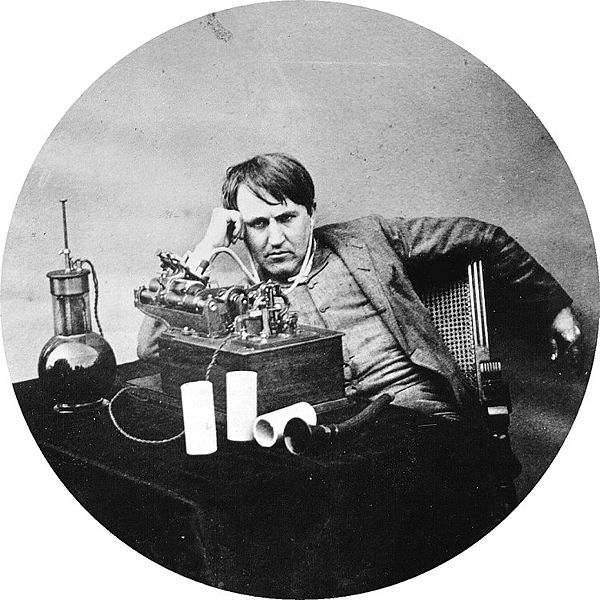
At the American, Vaclav Smil argues that Steve Jobs shouldn’t be compared to Thomas Edison. An excerpt:

“I have no desire to disparage or dismiss anything Jobs has done for his company, for its stockholders, or for millions of people who are incurably addicted to incessantly checking their  tiny Apple phones or washing their brains with endless streams of music—I just want to explain why Jobs is no Edison.

Any student of the history of technical progress must be struck by the difference between the epochal, first-order innovations that take place only infrequently and at unpredictable times and the myriad of subsequent second-order inventions, improvements, and perfections that could not have taken place without such a breakthrough and that both accompany and follow (sometimes with great rapidity, often rather tardily) the commercial maturation of that fundamental enabling advance. The oldest example of such a technical saltation was when our hominin ancestors began using stones to fashion other stones into sharp tools (axes, knives, and arrows). And there has been no more fundamental, epoch-making modern innovation than the large-scale commercial generation, transmission, distribution, and conversion of electricity.”

________________________

Edison talks:

Tags: , ,

I just stumbled ontoIn 2010, We Will Live On The Moon,” a 2009 Slate article by Paul Collins that recalls the dreamy, breathless futurism of the late, lamented science magazine, Omni, which was the brainchild of weathered pornographer Bob Guccione and his lucky bride, Kathy Keeton. An excerpt:

“But the only place you’ll find Omni for sale today is in a junk shop or on eBay. To look over old issues of Omni is to experience equal parts amazement (a science mag by Penthouse‘s founder interviews Richard Feynman?) and amusement (by 2010, robots will—yes!—”clean the rug, iron the clothes, and shovel the snow.’) It was in a 1981 Omni piece that William Gibson coined the word ‘cyberspace,’ while the provoking lede ‘For this I spent two thousand dollars? To kill imaginary Martians?’ exhorted Omni-readers to go online in 1983—where, they predicted, everything from entire libraries to consumer product reviews would soon migrate. A year later, the magazine ran one of the earliest accounts of telecommuting with Doug Garr’s ‘Home Is Where the Work Is,’ which might have also marked the first appearance of this deathless standby of modern reportage: ‘I went to work in my pajamas.’

Then again, that same issue predicted the first moon colony in 2010; supplied with ‘water in the shadowed craters of the moon’s north pole’ (not a bad guess), it might be attacked by ‘space-based Soviet particle-beam weapons.'”

••••••••••

Omni magazine commercial, 1978 (with voiceover by Guccione):

Tags: , ,

I don’t share Nick Carr’s angst over e-book readers not adopting the look and functionality of dead-tree books, but he eloquently makes a true point about a new medium initially mimicking–if only in spirit–what preceded it:

“The future arrives wearing the clothes of the past. The first book that came off a printing press – Gutenberg’s Bible – used a typeface that had been meticulously designed to look like a scribe’s handwriting:

The first TV shows were filmed radio broadcasts. The designers of personal computers used the metaphor of a desk for organizing information. The world wide web had ‘pages.’ The home pages of online newspapers mimicked the front pages of their print editions. As Richard Goldstein succinctly put it, ‘every novel technology draws from familiar forms until it establishes its own aesthetic.’ It’s tempting to look at the early form of a new media technology and assume that it will be the ultimate form, but that’s a big mistake. The transitional state is never the final state. Eventually, the clothes of the past are shed, and the true nature, the true aesthetic, of the new technology is revealed.

So it is with what we call ‘electronic books.’ Amazon’s original Kindle was explicitly designed to replicate as closely as possible the look and feel of a printed book.”

Tags:

Can your surgeon do this? (Thanks Wired.)

This classic (and spooky) 1970 photo, taken by an unnamed Denver Post reporter and now housed at the Library of Congress, shows a worker at the Rocky Mountain Arsenal using a caged rabbit to detect leaks of Sarin gas, which that plant produced. Poor bunny. An odorless, colorless, lethal nerve gas, Sarin was used in the 1995 terrorist attacks in the Tokyo’s subway system. Rabbits weren’t the only ones exposed to the deadly gas. An excerpt from a 2002 Telegraph article, which stated that sarin was tested on British soldiers as recently as 1983:

“One former soldier who underwent a Sarin test in 1983 alleges that Government scientists assured him that there had never been problems with the nerve agent during previous experiments. He says he was not told that Ronald Maddison, an airman, died minutes after being tested with Sarin in 1953.

Ian Foulkes, 38, who was then a private in the 28th Signal Regiment, said: ‘I specifically asked them what the long-term implications of taking part in the tests were because I was not happy about it. Of course if they had mentioned what happened to Ronald Maddison I would not have taken part.'”


Tags: ,

From the introduction of “Will Robots Steal Your Job?” a series of articles about the increasing IQ of artificial intelligence, by the resolutely excellent Farhad Manjoo at Slate:

“Artificial intelligence machines are getting so good, so quickly, that they’re poised to replace humans across a wide range of industries. In the next decade, we’ll see machines barge into areas of the economy that we’d never suspected possible—they’ll be diagnosing your diseases, dispensing your medicine, handling your lawsuits, making fundamental scientific discoveries, and even writing stories just like this one. Economic theory holds that as these industries are revolutionized by technology, prices for their services will decline, and society as a whole will benefit. As I conducted my research, I found this argument convincing—robotic lawyers, for instance, will bring cheap legal services to the masses who can’t afford lawyers today. But there’s a dark side, too: Imagine you’ve spent three years in law school, two more years clerking, and the last decade trying to make partner—and now here comes a machine that can do much of your $400-per-hour job faster, and for a fraction of the cost. What do you do now?”

••••••••••

“Bring it on”:

A 1986 CBS News report about a hole in the ozone layer. These “In the News” segments from the ’70s and ’80s were aimed at children and ran during breaks in cartoons on Saturday mornings. There is way more information available to kids (and everyone) today, but the delivery of it is seldom this impressive. Media functionality has grown exponentially more impressive while journalistic content has not followed.

The world was stunned when NASA announced last December that arsenic-based life existed on Earth, a finding that ran counter to everything we believed, suggesting a parallel life form was possible on our planet. Then the microbes hit the fan, and Felisa Wolfe-Simon, the young astrobiologist at the center of the discovery, was caught up in a firestorm. The opening of a Tom Clynes article on the controversy at Popsci:

“It is this mud, and the peculiar microbes in it, that have stuck Wolfe-Simon in the middle of one of the most extraordinary scientific disputes in recent memory. Last December, at a highly publicized NASA press briefing, Wolfe-Simon announced that her research team had isolated bacteria from Mono Lake, on the edge of California’s Eastern Sierra mountain range, that could subsist on arsenic in place of phosphorus, one of the elements considered essential for all life.

The research, financed mostly by NASA and published initially in the online edition of Science, jolted the scientific community. If confirmed, scientists said, the discovery would mean that this high mountain lake hosts a form of life distinct from all others known on Earth. It would open up the possibility of a shadow biosphere, composed of organisms that can survive using means that long-accepted rules of biochemistry cannot explain. And it would give Mono Lake, rather than Mars or one of Jupiter’s moons, the distinction of being the first place in our solar system where ‘alien’ life was discovered.

But within days, researchers began to question Wolfe-Simon’s methodology and conclusions. Many of them cast aside traditions of measured commentary in peer reviewed periodicals and voiced their criticism directly on blogs and Twitter. Then, as the conflict spilled into the mainstream, the scientific community witnessed something few would have predicted: meaningful public engagement over a serious scientific issue. For several days, at least, a good many water cooler conversations revolved around the metabolic capabilities of a Gammaproteobacterium.

Among academics, the debate devolved into something more vitriolic and personal. One researcher questioned whether Wolfe-Simon and her team were ‘bad scientists.’ Another called her work ‘science fiction.’ One blog post bore the title ‘Is Felisa Wolfe-Simon an Alien?'”

••••••••••

“A tiny microbe that can survive concentrations of arsenic that would kill all normal life dead”:

Tags: ,

A 1985 CBS News report about the 40th anniversary of two Japanese cities being destroyed by atom bombs during WWII.

« Older entries § Newer entries »