Politics

You are currently browsing the archive for the Politics category.

Tech-driven spying didn’t start in America recently–or even with Watergate–but the tools have grown exponentially cheaper and better over time. It has reached critical mass and won’t be completely tamed no matter the law. That doesn’t mean it’s right, just that it’s reality. The opening of “Big Brother Is Listening,” Ben H. Bagdikian’s 1964 Saturday Evening Post article:

“One evening last year, after most of the offices of the State Department Building were closed, two hard-working men let themselves into Room 3333 and began dismantling the telephone. They were Clarence J. Schneider, a technician, and Elmer Dewey Hill, a State Department electronics expert. Working under orders of John F. Reilly, Deputy Assistant Secretary of State for Security, the men changed some wires, reassembled the telephone and left. For two days the innocent-looking telephone in the office of Otto F. Otepka, Deputy Director of the Office of Security, doubled as a microphone, relaying everything which was said in the office, whether or not the phone was on the cradle. In a laboratory some distance away, diligent eavesdroppers recorded 12 separate conversations.

On July 9, four months later, Hill was put under oath by the Senate Internal Security subcommittee and asked, ‘Do you know of any single instance in which the [State] Department has ever listened in on the telephone of an employee?’ Hill answered, ‘I cannot recall such an instance.’

On August 6, Reilly was put under oath and asked, ‘Have you ever engaged in or ordered the bugging or tapping or otherwise compromising telephones or private conversations in the office of an employee of the State Department?’ Reilly’s answer was, ‘No, sir.’

The parties in this particular charade were engaged in some political in-fighting. Otepka, a security officer brought into the State Department in 1953, had risen to one of the top security evaluation jobs in Washington. But now he himself was under suspicion. His superiors believed that he was feeding classified information to a hostile Senate committee in order to embarrass his boss, Reilly. So Reilly had Otepka’s phone fixed to catch him in the act. He also had Otepka’s wastebaskets intercepted on the way to the incinerator and combed for incriminating material. Reilly says he lost interest in the phone tap after finding in the wastebasket a piece of carbon paper with the impression of 15 questions which Otepka had allegedly typed out for Senate investigators to ask Reilly.

At the time, these two men – Otepka and Reilly – were responsible for passing judgment on the loyalty, security and reliability of American diplomats. Hill and Reilly later ‘amplified’ their denials of eavesdropping by giving the facts and promptly resigned from the State Department. Otepka, charged with passing privileged documents without authority, carries on in a sort of limbo, marking time on the payroll while awaiting a hearing on his dismissal.

The story of Otto Otepka is part of the brave new world of white-collar eavesdropping in the United States Government. The eavesdropping may consist merely of a silent secretary’s taking down your words while you speak to her boss, or it may be a hidden microphone recording everything you say in what you think is a confidential interview. Some governmental eavesdropping is directed against espionage and crime, of course, but a great deal more is done for bureaucratic convenience and gamesmanship, either to spring a trap on a colleague or to avoid one. 

These days, consequently, if you telephone a Washington official of more than middling importance – or it he calls you – the odds are disturbingly high that a third person is listening in. They are almost as high that every important word you utter is being taken down in shorthand. And while lower, the odds are still significant that your entire conversation is being taped. 

In fact, Americans are so busy snooping on one another that it has almost been forgotten that Big Brother may not be an American at all. A European diplomat recently told of having discovered a man tinkering with the wall clock in his Foreign Office chamber at home; he immediately called his security men for fear the man was planting a microphone ‘for our Russian friends.’ A short time later, an American who works for the American military in Washington made an unexpected Saturday visit to his office and found a stranger in the process of dismantling his phone. The stranger had tools draped around his waist and said he was a telephone man checking phones. The American said later that he assumed a microphone was being planted. Asked who he thought responsible, he said, ‘Oh, I suppose one of our spooks’ – meaning a rival American military agency. Did it occur to him, as it had to the European, that the man could have been ‘one of our Russian friends’? The American thought about that for a moment. ‘Well, of course, it could have been,’ he admitted, ‘but I’m told our spooks do it so often, I just naturally assumed it was one of ours.”‘

Electronic snooping is not confined to Government, of course. Thanks to modern science, privacy is becoming more and more rare all over the world. Even a child can send away for a $15 device that picks up sounds in a room across the street. For $17.95 you can buy a machine that secretly tapes telephone conversations without touching a wire. And $150 buys a TV camera the size of a book that can spy on a room secretly while you watch on a distant monitor. Using these and other modern methods, American business has turned increasingly to espionage in recent years.”


Tags:

George Will, who is not a confirmed yahoo like many in his party, nonetheless sucks at math. Right before he predicted Romney would beat Obama in a landslide despite the polls saying the opposite, he also set Hillary Clinton’s chances of becoming President at a very low number. Clinton may or may not be elected to the highest office in the land, but his statement already seems foolish. From a September 24, 2012 interview on Alec Baldwin’s Here’s the Thing:

Alec Baldwin:

What do you think her political future is?

George Will:

Zero. There’s a whole generation of coming candidates. Andrew Cuomo in New York. Governor O’Malley in Maryland. Countless people. Paul Ryan. All kinds of good people out there.”

Tags: ,

Ron Paul, who has frequently been elected President of straw, seems like a good idea to some college kids and many baristas. Sacha Baron Cohen’s bedroom guest just did an Ask Me Anything on Reddit. A few exchanges follow. 

________________________

Question:

How do you feel about Texas banning the sale of Tesla cars? Doesn’t seem very American or Libertarian.

Ron Paul

It’s un-American and it’s unpatriotic and it’s bad economic policy, and it should not be any business of the government what car you can buy.

________________________

Question:

Is there anything that Obama has done that you DO support?

Ron Paul:

That’s a narrow question. How long since it’s been since I’ve strongly supported what ANY president have done? Unfortunately our Presidents and our Congress have been systematically moving in the wrong direction. They have been undermining our freedoms and bankrupting our country and supporting perpetual war.

________________________

Question:

What are your thoughts on free migration? Do you think restrictions against immigration violate the non-aggression principle? Do you agree with economists who say that the World’s GDP would increase by magnitudes if you allowed free migration?

Ron Paul:

That might be the ideal to seek and it should be talked about and maybe someday we can reach that. That is essentially what our 13 Colonies set up under the Constitution – we could move back and forth as freely as possible, and it’s worked out rather well. The problem that we have today deals with the economy and the Welfare State. Because if the doors are wide open and you let all individuals in, all individuals suddenly qualify for welfare benefits – and you are looking for lots of problems. In a free society that is prosperous, the doors should be open as wide as possible. Even today we could do that if we could say “Come and work, come and play, but you don’t get automatic citizenship or benefits.” Those open doors would be very beneficial to us, but it’s been messed up because of the demagoguery and welfare state. But in an ideal world, there would be an economic benefit to it.

________________________

Question:

While I highly agree with many of your policies, can you give us an official response on your stance of separation of church and state?

Ron Paul:

Yes. The church should never run the state. They should never be synonymous. And the state should never interfere with the church. The responsibility of the government should be to protect the right to free choice, whether it is religion, philosophy, or our personal habits.

________________________

Question:

Dr. Paul, we have seen the expansion of Libertarianism over the past several years. How much of it do you think is enabled by the internet, and what are your thoughts on the recent, repeated attempts to limit the freedom of the net and our right to privacy? 

Ron Paul: 

Well that’s a great threat – the attack on the internet – because the internet is our best vehicle. It has been the best thing for us to have to spread our message. So it has been VERY instrumental in being able to get the message of Libertarianism out. The other thing that has helped us with this message is the evident failure now of our Keynesian economic system which we’ve had now for close to 100 years, and also the obvious evidence that our foreign policy is a complete failure and people are looking for answers, especially the young people, because they see it deeply flawed.

________________________

Question:

Why did you name your son Rand?

Ron Paul:

My wife had the children and she had the privilege of naming the children. Afterwards there was a little bit of discussing with her husband, namely me. 

But his name is not after Ayn Rand. His name is RANDALL despite some things that have been around on the Internet. He was called “Randy” at home, and he became “Rand” after becoming a physician.

••••••••••

“So tell me, who are you wearing?”:

Tags: ,

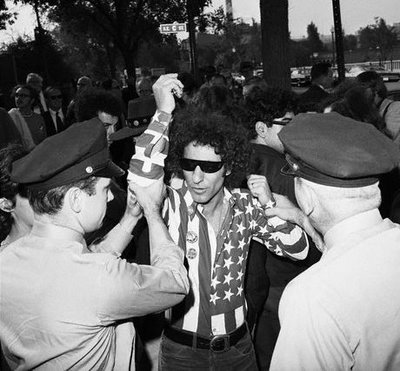
Like a lot of comedians, Abbie Hoffman was sad. After gaining international fame for railing against capitalism and the American war machine during the 1960s, he lived on the lam (wanted but not desired), was covered in an avalanche of blow, suffered from clinical depression and was unable to reinvent himself when he finally resurfaced. He didn’t want to live in the past but couldn’t seem to find a place in the present. His was a great trick that couldn’t be performed twice. Sad and broken, he took his own life in 1989. From the People article “A Troubled Rebel Chooses A Silent Death“:

“In the sunny, plant-filled apartment where Abbie Hoffman ended his life with a massive overdose of phenobarbital, the artifacts on the wall bespoke decades of rebellion: a poster of the Grateful Dead, another of a raised fist with the word STRIKE!, a bumper sticker reading VOTE REPUBLICAN. IT’S EASIER THAN THINKING, a photo of a young Hoffman wearing a Chicago policeman’s shirt.

Summoned to this corner of pastoral Bucks County, Pa., six years ago by an environmental group that wanted his help battling the diversion of the Delaware River water to cool a nuclear reactor, Hoffman told an interviewer in 1987 that he was happy to ‘live and die here fighting the Philadelphia Electric Company-it’s just like the ’60s for me.’

But it was not just like the ’60s. In that theatrical era, young Abbie Hoffman held center stage. A self-styled ‘Groucho Marxist’ and co-founder of the Youth International Party (supporters were dubbed yippies), which existed mostly in his imagination, he was the antiwar movement’s mad genius of media events. He disrupted business on the floor of the New York Stock Exchange by tossing dollar bills from the balcony. He rallied 50,000 anti-Vietnam War demonstrators to levitate the Pentagon. He nominated a pig—Pigasus—for President when thousands of protesters converged on Chicago to demonstrate at the 1968 Democratic Convention. The violence in the streets there led to the most famous political trial of the decade, as Hoffman and his Chicago Eight co-defendants were charged in 1969 with conspiracy to incite riot.

They ultimately beat the charges but not before turning Judge Julius Hoffman’s courtroom into a countercultural circus: Abbie somersaulted into court one day and wore judicial robes another. ‘Where do you reside?’ his lawyer asked him on the witness stand. ‘I live in Woodstock Nation,’ he replied. ‘It is a nation of alienated young people. We carry it around with us as a state of mind…. It is a nation dedicated to…the idea that people should have better means of exchange than property or money.’

Just what that ‘better means’ should be was never clearly spelled out, but it didn’t matter then. ‘F—the System!’ was program enough so long as it left room for lots of sex and drugs and rock and roll. ‘He used to say, ‘All I care about is who’s bringing the ice cream to the demonstration,’ recalls fellow yippie Jerry Rubin, 50. ‘Essentially, he wanted to have fun.’

Now, those alienated young people are no longer young, and Woodstock Nation is a memory. But  ‘Abbie wasn’t interested in nostalgia,’ says Al Giordano, 29, a journalist who knew him well. ‘He was interested in battling the power structure. He had learned that nostalgia is just another form of depression.’

The last thing Hoffman needed was more forms of depression.”

__________________________

Abbie makes gefilte fish, 1973:

Tags:

Crowd-scanning is still a chore for technologists, but you know it will be perfected–and soon. No more being just another face in the crowd, no more being lonely, no more being left alone. From Charlie Savage in the New York Times:

WASHINGTON — The federal government is making progress on developing a surveillance system that would pair computers with video cameras to scan crowds and automatically identify people by their faces, according to newly disclosed documents and interviews with researchers working on the project.

The Department of Homeland Security tested a crowd-scanning project called the Biometric Optical Surveillance System — or BOSS — last fall after two years of government-financed development. Although the system is not ready for use, researchers say they are making significant advances. That alarms privacy advocates, who say that now is the time for the government to establish oversight rules and limits on how it will someday be used.

There have been stabs for over a decade at building a system that would help match faces in a crowd with names on a watch list — whether in searching for terrorism suspects at high-profile events like a presidential inaugural parade, looking for criminal fugitives in places like Times Square or identifying card cheats in crowded casinos.

The automated matching of close-up photographs has improved greatly in recent years, and companies like Facebook have experimented with it using still pictures.”

Tags:

From “Why Silicon Valley Funds Instagrams, Not Hyperloops,” entrepreneur Jerzy Gangi’s astute critique of America’s contemporary idea factory:

“As an entrepreneur, I began to wonder, ‘Why hasn’t anyone proposed this already?’ It’s a great idea, but… Elon Musk can’t be the first person to think of it.

In doing some research online I found out that other American inventors have had similar designs and proposals for a decade. However, none of them were able to get taken seriously or obtain funding.

Why did that happen?

I want to tell you my answer.

MY THESIS

My thesis is simple. We haven’t seen Silicon Valley develop a company like Hyperloop — even though the plans have been out there for over a decade — because there’s a systemic failure in the startup ecosystem. In short, Silicon Valley has killed major innovation.

In all of the hype around companies like Facebook and Instagram — what really are just glorified websites — we’ve lost sight of some real innovation opportunities, most of which occur in the offline world.

The entire culture of Silicon Valley, and entrepreneurship around the globe, has taken on a groupthink that prevents truly novel inventions, like the Hyperloop, from reaching the market.

The result is a major loss. It’s a loss to our society. It’s a loss to our capital markets. It’s a loss to private investors. And it’s a loss to entrepreneurs.”

Tags:

I never knew about this: In 1963, the U.S. government apparently blasted a ring of copper around the Earth, fearful that the Soviet Union could compromise its communications abilities.The opening of an article on the topic from Joe Hanson at Wired:

“During the summer of 1963, Earth looked a tiny bit like Saturn.

The same year that Martin Luther King, Jr. marched on Washington and Beatlemania was born, the United States launched half a billion whisker-thin copper wires into orbit in an attempt to install a ring around the Earth. It was called Project West Ford, and it’s a perfect, if odd, example of the Cold War paranoia and military mentality at work in America’s early space program.

The Air Force and Department of Defense envisioned the West Ford ring as the largest radio antenna in human history. Its goal was to protect the nation’s long-range communications in the event of an attack from the increasingly belligerent Soviet Union.

During the late 1950’s, long-range communications relied on undersea cables or over-the-horizon radio. These were robust, but not invulnerable. Should the Soviets have attacked an undersea telephone or telegraph cable, America would only have been able to rely on radio broadcasts to communicate overseas. But the fidelity of the ionosphere, the layer of the atmosphere that makes most long-range radio broadcasts possible, is at the mercy of the sun: It is routinely disrupted by solar storms. The U.S. military had identified a problem.”

Tags:

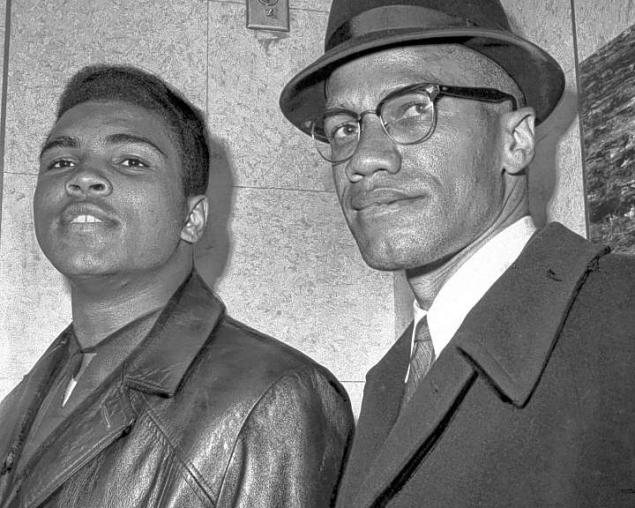
When bitterly trying to push buttons, Malcolm X said some ridiculous and hurtful things. But I think he said as many startlingly true things as any American in the second half of last century. He was at his best and worst in a 1963 Playboy interview, which was conducted by Alex Haley. An excerpt:

Playboy:

You say that white men are devils by nature. Was Christ a devil?


Malcolm X:

Christ wasn’t white. Christ was a black man.

Playboy: 

On what Scripture do you base this assertion?

Malcolm X:

Sir, Billy Graham has made the same statement in public. Why not ask him what Scripture he found it in? When Pope Pius XII died, LIFE magazine carried a picture of him in his privatestudy kneeling before a black Christ. What was the source of their information? All white people who have studied history and geography know that Christ was a black man. Only the poor, brainwashed American Negro has been made to believe that Christ was white, to maneuver him into worshiping the white man. After becoming a Muslim in prison, I read almost everything I could put my hands on in the prison library. I began to think back on everything I had read and especially with the histories, I realized that nearly all of them read by the general public have been made into white histories. I found out that the history-whitening process either had left out great things that black men had done, or some of the great black men had gotten whitened.

 Playboy: 

Would you list a few of these men?

Malcolm X:

Well, Hannibal, the most successful general that ever lived, was a black man. So was Beethoven; Beethoven’s father was one of the black moors that hired themselves out in Europe as professional soldiers. Haydn, Beethoven’s teacher, was of African descent. And Solomon. Great Biblical characters. Columbus, the discoverer of America, was a half-black man. Whole black empires, like the Moorish, have been whitened to hide the fact that a great black empire had conquered a white empire even before America was discovered. The Moorish civilization–black Africans–conquered and ruled Spain; they kept the light burning in Southern Europe. The word ‘Moor’ means ‘black,’ by the way. Egyptian civilization is a classic example of how the white man stole great African cultures and makes them appear today as white European. The black nation of Egypt is the only country that has a science named after its culture: Egyptology. The ancient Sumerians, a black-skinned people, occupied the Middle Eastern areas and were contemporary with the Egyptian civilization. The Incas, the Aztecs, the Mayans, all dark-skinned Indian people, had a highly developed culture here in America, in what is now Mexico and northern South America. These people had mastered agriculture at the time when European white people were still living in mud huts and eating weeds. But white children, or black children, or grownups here today in America don’t get to read this in the average books they are exposed to.

Playboy:  

Can you cite any authoritative historical documents for these observations? 

Malcolm X:

I can cite a great many, sir. You could start with Herodotus, the Greek historian. He outright described the Egyptians as ‘black, with woolly hair.’ And the American archaeologist and Egyptologist James Henry Breasted did the same thing. Read Pliny. Read any of the ancient Roman, Greek and, more recently, European anthropologists and archaeologists.”

Tags: ,

Julia Ioffe, who covers Russia for the New Republic, just did an Ask Me Anything at Reddit. A few exchanges follow.

__________________________

Question:

We who are not particularly knowledgeable about Russia still think of it as having a pretty sexist culture. Are women treated more inferior there than in other more ‘Westernized’ countries?

Julia Ioffe:

Yes! Omg, yes, yes, yes. Russia is still extremely sexist. I can write volumes on this, but, good lord. Basically, it’s a matriarchy parading around as a macho patriarchy. That said, the wage gap between men and women is smaller in Russia than in the U.S. And once a year, on International Women’s Day (March 8) Russian women get tons and tons of flowers — I guess to make up for being treated as cooks/strippers with uteruses the rest of the year.

________________________

Question:

Is there something about Russian Culture/Society that makes the country so prone to authoritarian dictatorship-esque regimes (Stalin, USSR, to Putin)?

Julia Ioffe:

I think Stalin set the stage for Putin, and the czars set the stage for Stalin. If the czars taught Russians that they were eternal subjects to the holy emperor and his Church, Stalin drove home the notion by jailing and killing millions and millions of Soviets, of making people afraid not just to speak up and resist, but to trust each other. The scars of what he did are there, but they’re fading in the generation born after the fall of the Soviet Union. I don’t know that it’s a cultural thing as much as it is hard, cruel historical training.

________________________

Question:

Do you think Putin is really this homophobic or is he just making a statement?

Julia Ioffe:

I don’t think Putin is any more homophobic than most Russians, which is pretty homophobic — Russians, like I said, are pretty ignorant about homosexuality and think it’s abnormal). I also don’t think it was his initiative. This law, unlike many, came up to the federal level after being introduced in cities around Russia, and Putin signed into law what the Duma gave him, which obviously signifies his approval: if he hadn’t approved, it would’ve never made it out of the lower chamber of the Russian parliament. That said, the law reflects a tone set by Putin by bringing the Orthodox Church, a very conservative institution, increasingly not just into public life but into the government. It’s all part of a pattern of looking for a more conservative, “Russian” national idea — whatever that means.

____________________________

Question:

What are your thoughts on 2014 Olympics? Should gay athletes not attend, attend but protest?

Julia Ioffe:

I think gay athletes should absolutely attend, kick ass, and show Russia and the rest of the largely homophobic world that they are an athletic force to be reckoned with.

__________________________

Question:

How serious of a threat is Islamic radicalization in Russia via both the Caucasus and the quickly growing Muslim population in other regions?

Will Putin’s often times heavy hand lead to instability via this particular demographic?

Julia Ioffe:

It’s a pretty serious threat, and I can’t say that the Russians are doing a good job fighting it. For one thing, they’ve installed a guy named Ramzan Kadyrov to run Chechnya (once torn up by war) and he’s running a pretty Islamist ship. (If you want proof, look at his Instagram account.) And Putin, who is in many ways hostage to him, can’t do much about it.

__________________________

Question:

What is the biggest misconception Americans have about Russian politics?

Julia Ioffe:

That Putin thinks ahead.•

Tags:

Tad Friend, the excellent California correspondent for the New Yorker, mercifully liberated from having to profile Ben Stiller’s narcissism, provides his two cents on Elon Musk’s Hyperloop plans. Here’s the glass-half-empty part:

“The bad news is that there’s no conceivable way that the system would cost just six billion dollars, or that one-way tickets would cost twenty dollars. Overpromise disease is endemic to Silicon Valley, but Musk has an aggravated case. When I wrote a profile of him, in 2009, he told me that a third-generation Tesla would be selling for less than thirty thousand dollars in 2014, the same year that he expected SpaceX’s Falcon 9 to begin ferrying tourists around the moon. Well, no and hell no. More worrisomely, he promised that you could start driving the Model S in western California ‘at breakfast and be halfway across the country by dinnertime.’ Musk is a lot better at math than I am, but he eventually acknowledged that by ‘dinnertime’ he really meant ‘the following morning’s breakfast’—if, again, you didn’t stop to go to the bathroom.

 Additional bad news is that California’s politicians are skeptical of the Hyperloop, as they’ve already committed to their own relatively slow high-speed rail system, now projected to be finished in 2029. And that no community in San Francisco or Los Angeles would want giant tubes running through it. And that, from the evidence of Musk’s own route map, he hasn’t figured out how to get the Hyperloop across the San Francisco Bay or any closer to downtown Los Angeles than about an hour north of it—which kind of kills the whole point. Also, earthquakes! The suggested route more or less parallels the San Andreas Fault. (Musk says that his flexible tube joints and dampered pylons would enable the system to absorb seismic shocks. But the worst place to be in an earthquake would be ripping along at barely-subsonic speeds twenty feet above the ground—in a system attached to it. Disaster-film auteurs are surely already storyboarding the money shot of Hyperloop pods disgorging onto a teeming freeway at seven hundred miles an hour.)

Finally, of course, no one knows if the thing would actually work.”

Tags: ,

We think we can control non-fiction that reads like fiction, but that point has passed. The dial will not turn back. The opening Sharon Weinberger’s new article at Wired:

MOSCOW — The future of U.S. anti-terrorism technology could lie near the end of a Moscow subway line in a circular dungeon-like room with a single door and no windows. Here, at the Psychotechnology Research Institute, human subjects submit to experiments aimed at manipulating their subconscious minds.

Elena Rusalkina, the silver-haired woman who runs the institute, gestured to the center of the claustrophobic room, where what looked like a dentist’s chair sits in front of a glowing computer monitor. ‘We’ve had volunteers, a lot of them,’ she said, the thick concrete walls muffling the noise from the college campus outside. ‘We worked out a program with (a psychiatric facility) to study criminals. There’s no way to falsify the results. There’s no subjectivism.’

The Department of Homeland Security (DHS) has gone to many strange places in its search for ways to identify terrorists before they attack, but perhaps none stranger than this lab on the outskirts of Russia’s capital. The institute has for years served as the center of an obscure field of human behavior study — dubbed psychoecology — that traces it roots back to Soviet-era mind control research.

What’s gotten DHS’ attention is the institute’s work on a system called Semantic Stimuli Response Measurements Technology, or SSRM Tek, a software-based mind reader that supposedly tests a subject’s involuntary response to subliminal messages.”

Tags:

I knew that Jimmy Carter had installed solar panels on the White House in the late 1970s, but I never realized that Ronald Reagan had them removed roughly a decade later. Dipshit. President Obama is putting them back as the solar-energy biz enjoys a renaissance. From Cyrus Farivar at Ars Technica:

“On Thursday, a White House official confirmed to the Washington Post that President Barack Obama would finally make good on a 2010 promise to install solar panels on the First Family’s residence. The panels are being installed this week.

Once complete, it would make Obama the first president since President Jimmy Carter to go green. Carter’s solar panels were installed in 1979, but President Ronald Reagan had them removed in 1986. It also makes the Obama family part of the rapidly expanding growth in solar energy across the United States.

According to new industry data from GTM Research, solar panels have fallen in price, and their installation and collective energy-generating capacity has consequently skyrocketed. Nearly two-thirds of the world’s existing solar panels have been installed in the last 2.5 years.”

Tags: , , ,

From Karen Weise’s Businessweek article about the inevitable gamesmanship between Elon Musk (with his Hyperloop) and the California High-Speed Rail Authority (and its bullet train):

“The contrast between Musk’s futuristic option for bridging Los Angeles and the Bay Area, and the much-delayed, over-budget, fast train that the state already has in the works, couldn’t have seemed starker or more striking. And that’s the point. Musk deliberately hopes his Hyperloop will disrupt current plans for the $68 billion railroad. ‘I don’t think we should do the high-speed rail thing,’ Musk told reporters. ‘It’s basically going to be California’s Amtrak,’ he said. He didn’t mean that as a compliment.

The California High-Speed Rail Authority was not amused. Chairman Dan Richard told the San Francisco Chronicle that while the Hyperloop sounds ‘great,’ it won’t be competition anytime soon: ‘It’s sort of like me saying, ‘Don’t buy a Tesla, because the Jetsons’ flying car is right around the corner.”

Richard said Musk greatly underestimates the costs of the Hyperloop, not to mention how hard it is to secure funding for mass transit and convince neighbors and environmentalists that such a system won’t be harmful. ‘While we have a lot of respect for his inventiveness, I think we could tell him a few things about the realities of building in California,’ Richard said.

Hyperloop might just be a drawing, and a far-fetched one at that, but as Southern California Public Radio points out, it’s already working in one regard—by reminding residents that California’s existing bullet train plan has plenty of shortfalls.

Tags: ,

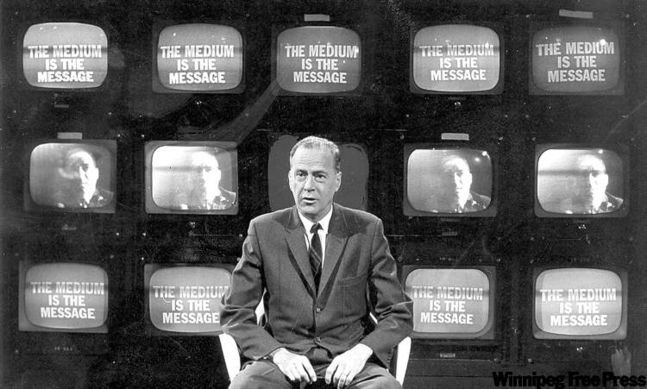
Michael J. Arlen wrote a very funny, and, I think, very unfair piece about Marshall McLuhan in the April 1, 1967 edition of the New Yorker (paywalled here). It was a response to an NBC Experiment in Television program which featured the thoughts of the media and cultural critic. Arlen depicts McLuhan as master of the obvious, which at least wasn’t the usual critique. But I think history scores it a solid win for McLuhan. From the piece:

“The NBC program provided a fairly broad embrace, as these things go. ‘The electric age is having a profound effect on us,’ intoned the narrator, paraphrasing McLuhan. ‘We are in a period of fantastic change…that is coming about at fantastic speed. Your life is changing dramatically! You are numb to it!’ And ‘The walls of your rooms are coming down. It is becoming a simple matter to wire and pick out of your homes your private, once solely personal life and record it. Bugging is the new means for gathering information.’ And ‘The family circle has widened, Mom and Dad! The world-pool of information constantly pouring in on your closely knit family is influencing them a lot more than you think.’ Well, O.K. But it all sounds too much like the revival preacher, who really doesn’t tell you anything about hellfire you didn’t know before but who tells it to you more forcefully, with all the right, meliorative vogue words (‘fantastic change…fantastic speed…dramatically…numb’), and so makes you feel appropriately important and guilty in the process.  In this instance, McLuhan tells us, the fire next time will be technological and lit by an electric circuit, but, having told us that, the preacher seems content to take up the collection and walk out of the church, leaving us with happy, flagellated expressions and a vague sense of having been in touch with an important truth–if we could only remember what it was.”

Tags: ,

From “When the NSA Comes to Town,” Justine Sharrock’s smart BuzzFeed report about the massive and mysterious NSA data center located in Bluffdale, Utah:

When I asked various people who have toured the building with the consortium what their impression was, the responses were vague and similar: ‘huge,’ ‘impressive.’

‘I was interested in the mythology of the NSA, and was asking questions, like, can they crack the hardest encryption and reading erased hard drives?’ says [Pete] Ashdown, Utah’s most vocal internet privacy activist. ‘I wish I had not been so starstruck. I would have asked the question, ‘How do you rectify what you are doing with the Constitution?’

It was a story I heard a lot in and around Bluffdale: When it started, we had no idea. Now it’s too late to change things.

‘Everything, of course, changed as more information about the NSA spying program was released,’ Ashdown says. ‘That kind of put the tour in a different light for me. I wasn’t really thinking about [NSA whistle-blower Russ Tice’s 2006 wiretapping revelations]. I remember hearing about that, but I didn’t put two and two together, realizing that they are storing all the information here.’

When Tice told me that the Utah Data Center was up and running, according to his sources — meaning that the NSA has the power for full content collection beyond metadata — I headed down to Utah to see it myself. I got close. I drove up the unmarked road toward the facility, past the unmanned gates, but got apprehended by two NSA police officers in dark sunglasses, driving white SUVs. They threatened me with federal charges for trespassing on restricted military property, but ultimately let me go.

‘I would not have suggested that, if you told me you were going to do it,’ Tice told me after he heard what I had done. ‘Bottom line, these are not people to be trifled with. They are dangerous people.’ He pointed out that things could have gone much, much worse.

An official tour was out of the question. The local NSA media spokesperson suggested I try to take photos from the periphery. She even suggested I go to the National Guard parking lot. But, more than the anonymous monoliths of the facility, the community surrounding the center was what grabbed my attention.

It was a microcosm of America’s relationship to the NSA scandal at large. There’s the data center, lurking in the background — visible but invisible, real and unreal — doing something that, for reasons that deserve far more explanation than they get, has been made literally unspeakable.”

Tags:

If you missed Margalit Fox’s great New York Times obituary about Garry Davis, a U.S. WWII veteran who renounced his American citizenship to become a citizen of the world, check it out. An excerpt:

“Garry Davis, a longtime peace advocate, former Broadway song-and-dance man and self-declared World Citizen No. 1, who is widely regarded as the dean of the One World movement, a quest to erase national boundaries that today has nearly a million adherents worldwide, died on Wednesday in Williston, Vt. He was 91, and though in recent years he had largely ceased his wanderings and settled in South Burlington, Vt., he continued to occupy the singular limbo between citizen and alien that he had cheerfully inhabited for 65 years.

‘I am not a man without a country,” Mr. Davis told Newsweek in 1978, ‘merely a man without nationality.’

Mr. Davis was not the first person to declare himself a world citizen, but he was inarguably the most visible, most vocal and most indefatigable.

The One World model has had its share of prominent adherents, among them Albert Schweitzer, Jean-Paul Sartre, Albert Einstein and E. B. White.

But where most advocates have been content to write and lecture, Mr. Davis was no armchair theorist: 60 years ago, he established the World Government of World Citizens, a self-proclaimed international governmental body that has issued documents — passports, identity cards, birth and marriage certificates — and occasional postage stamps and currency.

He periodically ran for president of the world, always unopposed.”

Tags: ,

At Amazon, David Blum, the editor of Kindle Singles, has a very smart (and completely free) interview with President Obama about the state of the economy. The President touches on the sweeping changes that automation has brought to the job market, though he doesn’t go nearly far enough in acknowledging the seismic shifts that are occurring. Globalization may have been just as disruptive thus far, but it’s automation that will ultimately have a deeper and more-lasting impact. And I don’t know that community college courses will remedy that. An excerpt:

President Obama:

Where I think we have fallen is in staying focused on the benefits of an economy where growth is broad based and everybody has opportunity. We have increasingly resigned ourselves to a ‘winner-take-all’ economy–again, driven a lot by technology and globalization, where folks at the very top are doing very well and the broad middle class of people, people trying to get into the middle class, are having a tougher and tougher time. You will see that in every profession. You see that in journalism. It used to be that there were local newspapers everywhere. If you wanted to be a journalist, you could really make a good living working for your hometown paper. Now you have a few newspapers that make a profit because they’re national brands, and journalists are having to scramble to piece together a living, in some cases as freelancers and without the same benefits that they had in a regular job for a paper. What’s true in journalism is true in manufacturing and is true in retail. What we have to recognize is that those old times aren’t coming back. We’re not going to suddenly eliminate globalization. We’re not going to eliminate technology. If people are going to book their vacation over the Internet, they’re not going to go down to a local travel agent. If that’s the case, then where are the new opportunities? Where are the new industries? With just a few modest, but really important, changes to government policy, we could be doing an awful lot better than we’re doing right now. American living standards would still be higher than folks a generation ago. People might have different jobs, so instead of a guy who had just graduated from college walking over to the local plant, like his dad did, and getting a good middle class job doing blue collar manufacturing work, now he might have to go to a community college and get more specialized training because he’s working as a computer technician. The opportunities are available. We just haven’t done a good job of making sure they’re accessible to all people.”

Tags: ,

The opening paragraph of an Economist piece which explains how Estonia became such an unlikely technology powerhouse: 

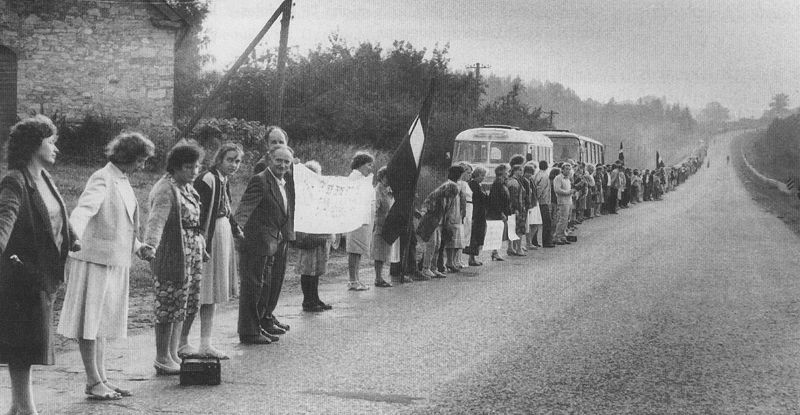
“WHEN Estonia regained its independence in 1991, after the collapse of the Soviet Union, less than half its population had a telephone line and its only independent link to the outside world was a Finnish mobile phone concealed in the foreign minister’s garden. Two decades later, it is a world leader in technology. Estonian geeks developed the code behind Skype, Hotmail and Kazaa (an early file-sharing network). In 2007 it became the first country to allow online voting in a general election. It has among the world’s zippiest broadband speeds and holds the record for start-ups per person. Its 1.3m citizens pay for parking spaces with their mobile phones and have their health records stored in the digital cloud. Filing an annual tax return online, as 95% of Estonians do, takes about five minutes. How did the smallest Baltic state develop such a strong tech culture?

From “This Charming Man,” Sasha Frere-Jones’ obliteration of Jay Z ‘s American Dream (and President Obama’s performance) at the New Yorker blog, which I don’t necessarily agree with but enjoyed reading nonetheless:

“But just like the politician that he occasionally texts, Jay Z is exactly who should disappoint us, unless our admiration is mute conformity and our optimism was a party smile. His friend has disappointed us by allowing a squeegee of surveillance to be dragged across America and approving the killing of foreign civilians with robots. Those civilians, in another country, see America the way Trayvon Martin saw George Zimmerman—a force they couldn’t stop physically creating a story they couldn’t fight historically. So what should Jay Z be doing instead of currying favor with critics in an art gallery? Maybe something like what his friend Kanye West thought up in the aftermath of Hurricane Katrina, when he blurted out, ‘George Bush doesn’t care about black people.’ Jay Z may be our most accomplished rapper but he rarely does anything to alienate anyone the way that West continually, and valuably, does. Which is probably why Carter represents athletes now, for profit and pleasure.

Hang on, hang on—no entertainer has to become a political figure because they are, well, de-facto political figures, right? (Jay Z prefers the word ‘influence,’ which he will admit to having.) Jay Z’s performance at the Pace Gallery, a transparent rewrite of Marina Abramović’s ‘The Artist Is Present,’ took place three days before the Zimmerman verdict, so what could he have done to leverage his influence? He could have ditched the idea of lip-synching to ‘Picasso Baby‘ (a weak retread of ’99 Problems’) and recreated the Zimmerman-Martin showdown with everyone in the room, following them around the perimeter of the gallery and scaring the shit out of them, eventually pulling a gun. And though that would have been the aggressive vision of a different artist, Jay Z is exactly the kind of figure who could weather the ensuing controversy, retaining all of his homes and maybe even his Samsung deal.”

Tags: , ,

Reza Aslan, the Muslim author of  Zealot: The Life and Times of Jesus of Nazarethwas welcomed warmly by Lauren Green at Fox News over the weekend. I’ll go the cynical route and guess that he knew what he was walking into and that it would be priceless promotion for his book. If so, good on him. Well played, sir. Aslan just did an Ask Me Anything at Reddit. A few exchanged follow.

____________________________

Question:

What do you think about the new direction the Pope is taking the Vatican in?

Reza Aslan:

I think this Pope is the best thing that has happened to Catholicism since Vatican II. Then again I’m biased as a proud product of a Jesuit education.

____________________________

Question:

Why did some cultures embrace monotheism, while others looked to polytheism?

Reza Aslan:

Monotheism is actually a very recent phenomenon. In the hundred thousand year history of human religious experience, monotheism is perhaps three thousand years old. That’s because the idea of a single god being responsible for both good and bad, light and dark, is something that the ancient mind had a very difficult time accepting. And no wonder! The only way that monotheism finally “stuck” is thru the concept of angels and demons. In other words, it was only when all the other “gods” were demoted into spiritual beings responsible for different aspects of the human condition that people were able to accept the idea one GOD in charge of all the lower spiritual beings.

____________________________

Question:

Serious question, if aliens visit earth, what happens to religion?

Reza Aslan:

We would simply absorb their reality into our religious traditions they we have done with every major scientific breakthrough (the earth revolves around the sun!).

____________________________

Question:

If you had to do it all over again, would you have used a pseudonym so that the focus would be more on the content of the book than on who is qualified to write it? Did you expect the media to react this way? Or did it take you by surprise?

Reza Aslan:

Yes. I would have written the book under the pseudonym: JK Rowling.

Tags: ,

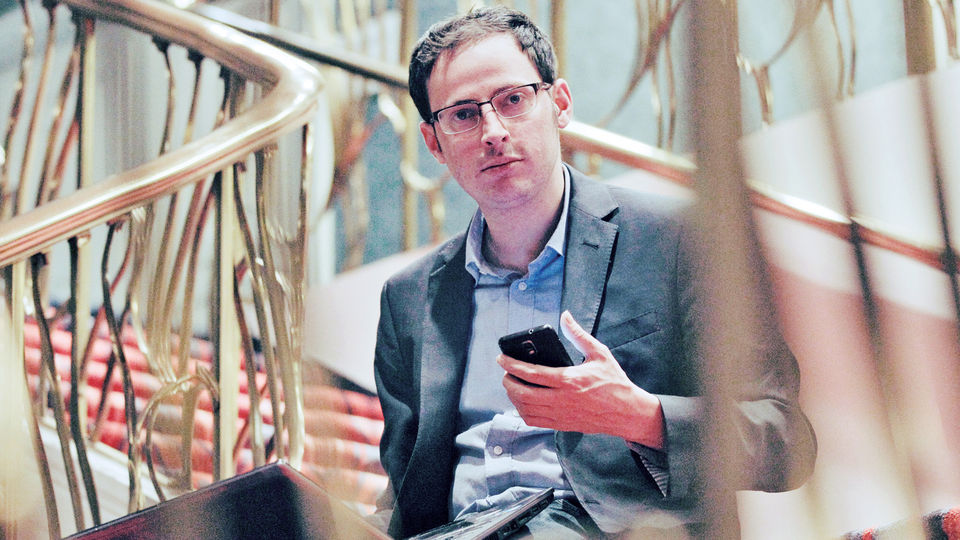
Star stats guy Nate Silver has left the New York Times for ESPN and other properties under the Disney umbrella. He just did an Ask Me Anything at Deadspin. A few exchanges follow.

___________________________

Question:

When will I die?

Nate Silver:

I’d guess that the median Deadspin commenter is a 34-year-old white male with middle-to-high income but also above-average alcohol consumption. So we’re taking about a remaining live expectancy of 47 years, give or take. My best guess is that you’ll die in 2060, perhaps just a few days before Sasha Obama wins her second term.

___________________________

Question:

What size staff do you envision the new 538 having? Are you going to be looking more for specialists or generalists?

Nate Silver

I think the goal is perhaps to have a site where we’re publishing 3-4 articles per weekday, plus perhaps some blogs and other quick-hit type stuff. What I’m not quite sure about is exactly how many people we’ll need to hire to make that happen, and what the mix of freelancers versus full-time staffers will be.

We are looking for people with a diverse set of interests, within reason. We’ll have people who specialize in sports, I’m sure, as opposed to politics or economics or culture. But I’m not sure that we’ll have people who specialize only in (say) baseball or golf, as opposed to sports more broadly.

And yes — we are taking resumes. (There’s no formal process for this yet, but it’s not too hard to find my email.) We’ve already gotten interest from some great quant-friendly journalists. What’s a little bit tougher to find is people who are journalism-friendly quants, if that makes sense — people who might be employed in (say) tech or finance or consulting right now but who can express themselves pretty well and who might be interested in a change of careers.

___________________________

Question:

Nate, what will you miss most about the political analysis you did for the Times and what will you miss the least?

Nate Silver:

To clarify, I’m not leaving political analysis. My guess is that it might still occupy 40-50% of my time personally, and that politics/elections might represent something like 30-40% of the content at the “new” 538. We’ll probably also hire at least one full-time politics writer/editor, along with some talented freelancers.

But to be honest — there’s not very much I’ll miss about pulling back from politics some. 2012 was an amazing year for me in any objective sense, but I still get sort of bitter and angry when I think about how hard it was to get people to accept some very basic statistical conclusions, and how personal things became.•

Tags:

I haven’t been to San Francisco in a few years, but most reports describe it as a burgeoning tech nightmare, with a gigantic income disparity and Google employees being separated from the general population by private buses and the like. From “The Dark Side of Startup City,” by Susie Cagle at the Grist:

“A Lyft car idling at every stoplight, a smartphone in every hand — and an eviction on every block.

Few cities have seen as much disruption as San Francisco has over the last 10 years. Once a hotbed of progressive political activism and engagement, the city is being remade in the image of the booming tech industry, headquartered in Silicon Valley to the south.

Rents in some of San Francisco’s most desirable neighborhoods have doubled in a year. Apartment construction has exploded in order to absorb the new residents. The city is developing so rapidly that Google’s streetview photos from 2011 are already well outdated.

The local government has embraced the disruption. Longtime residents, meanwhile, talk about fleeing or saving their city as though a hurricane is coming. But the hurricane has landed “

Tags:

From a pretty overheated Associated Press article about stem-cell research and the commingling of species:

“But the biological co-mingling of animal and human is now evolving into even more exotic and unsettling mixes of species, evoking the Greek myth of the monstrous chimera, which was part lion, part goat and part serpent.

In the past two years, scientists have created pigs with human blood, fused rabbit eggs with human DNA and injected human stem cells to make paralyzed mice walk.

Particularly worrisome to some scientists are the nightmare scenarios that could arise from the mixing of brain cells: What if a human mind somehow got trapped inside a sheep’s head?

The ‘idea that human neuronal cells might participate in ‘higher order’ brain functions in a nonhuman animal, however unlikely that may be, raises concerns that need to be considered,’ the academies report warned.”

The opening of a Guernica piece about the fall of Detroit and the rise of American income disparity, by that tiny communist Robert Reich:

“One way to view Detroit’s bankruptcy—the largest bankruptcy of any American city—is as a failure of political negotiations over how financial sacrifices should be divided among the city’s creditors, city workers, and municipal retirees—requiring a court to decide instead. It could also be seen as the inevitable culmination of decades of union agreements offering unaffordable pension and health benefits to city workers.

But there’s a more basic story here, and it’s being replicated across America: Americans are segregating by income more than ever before. Forty years ago, most cities (including Detroit) had a mixture of wealthy, middle-class, and poor residents. Now, each income group tends to lives separately, in its own city—with its own tax bases and philanthropies that support, at one extreme, excellent schools, resplendent parks, rapid-response security, efficient transportation, and other first-rate services; or, at the opposite extreme, terrible schools, dilapidated parks, high crime, and third-rate services.

The geo-political divide has become so palpable that being wealthy in America today means not having to come across anyone who isn’t.

Detroit is a devastatingly poor, mostly black, increasingly abandoned island in the midst of a sea of comparative affluence that’s mostly white. Its suburbs are among the richest in the nation.”

Tags:

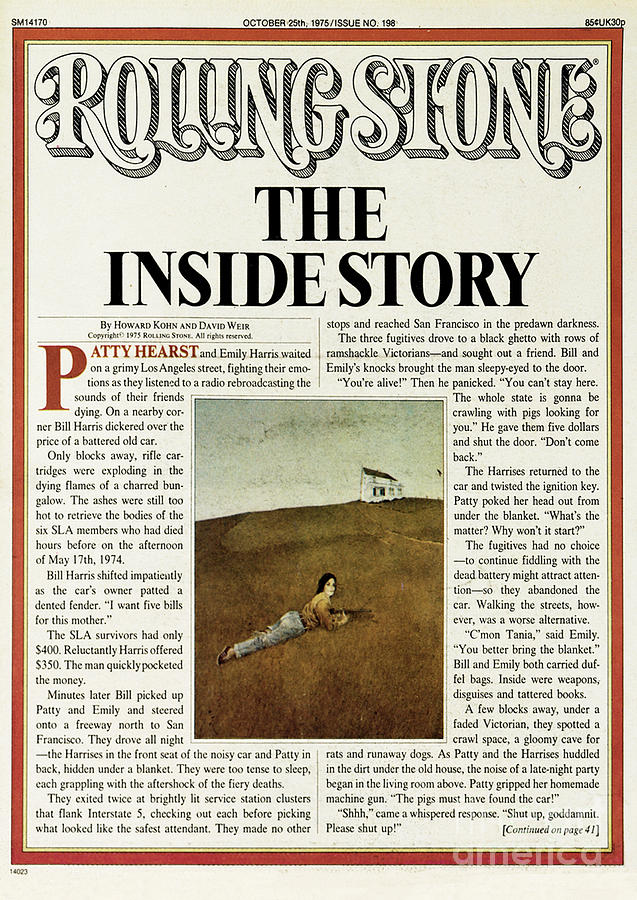
One of the most shocking episodes in the upside-down decade of the ’70s was the kidnapping of heiress Patty Hearst by the Symbionese Liberation Army, a violent and radical outgrowth of the tortured anti-war movement of the ’60s. The nation shuddered for the shanghaied scion, but soon Hearst was a full-fledged member of the SLA, knocking over banks, cursing the “pigs” and being pursued, along with her new “friends,” by the FBI. Was she brainwashed? Was she a traitor? Was she a rich girl acting out? 

I doubt Rolling Stone received too much grief for putting a terrorist on its cover back in 1975 (with an image that played off of Andrew Wyeth’s “Christina’s World”), since the magazine was then decidedly counterculture and un-glossy. From Howard Kohn and David Weir’s article

“The next day Patty ate her meals in the car. Even standing in line at a McDonalds was a risk. Millions had seen her picture on the evening news and the cover of Newsweek or heard her soft, distinctive voice on radio broadcasts of the S.L.A. communiqués.

For most of the previous four months she had been cooped up inside. Her excursions outside twice had ended in gunfire. Now she was driving across country through an FBI dragnet that already had employed more agents than any other civilian case.

The strain of the past months was showing. To Patty the passing world was populated by an army of undercover agents. Once, as Jack showed up to ease past a construction site, she ducked and whispered in a half shriek: ‘did you see that guy? I know he’s a pig.’

‘C’mon, he’s a highway flagman. Don’t be so uptight.’

When Jack pulled in for gas she frequently demanded he speed away as an attendant approached. ‘I don’t like the way he looks,’ she’d explain. ‘He looks like a pig.’

Patty’s repeated reviling of ‘pigs’ soon lead to a discussion about the political criterion for such a classification. Patty took the position that a pig was anyone who did not give wholehearted support to the S.L.A. Jane Fonda and Tom Hayden, for instance, were pigs because they’d criticized the S.L.A. tactics. Patty sounded like what she was — a new convert to radical thinking.”

« Older entries § Newer entries »