The (relative) mania surrounding Thomas Piketty and his unlikely bestseller, Capital in the Twenty-First Century, has stretched from spring to summer. From a report of his sold-out lecture on Monday in London by the Guardian’s Stuart Jeffries:
“Piketty wants us to realise that the 20th century was unusual: rapid, unrepeatable population increases that helped accelerate growth, combined with shocks (two world wars, the Great Depression) that reduced the value of capital and so kept inequalities low. These are exceptions in human history rather than the rules. The 21st century won’t be like the 20th, the professor predicts. If we don’t act, the accumulation of capital in the hands of the very few will resemble the norms in the early 19th or 18th centuries.
Someone asks Piketty if what Margaret Thatcher proposed in the 1980s was right, namely that if you reduce inequality you reduce growth. ‘I have no problem with inequality per se,’ he replies. ‘Up to a point it can be a motivation for growth. When inequalities grow more extreme, it can be no good for growth. It leads to the perpetuation of inequality. Over time that stops mobility from happening.'”
For all the flak the government takes–even by plenty of those in the government–its record of research investment is pretty spectacular. We’re not talking about only the Internet but the transistor itself, among many other innovations. As the anti-government forces have chipped away at such state-sponsored R&D, larger tech companies are trying to birth their own Bell Labs. From Claire Cain Miller at the New York Times:
“Silicon Valley, where toddler-aged companies regularly sell for billions, may be the most vibrant sector of the U.S. economy, fueling a boom in markets from housing to high-end toast (how many $4-a-slice artisanal bread bars does a place really need?). But as recent innovations — apps that summon cabs, say, or algorithms that make people click on ads — have been less than world-changing, there is a fear that the idea machine is slowing down. And while Silicon Valley mythology may suggest that modern-day innovation happens in garages and college dorm rooms, its own foundations were laid, in large part, through government research. But during the recession, government funding began to dwindle. The federal government now spends $126 billion a year on R. and D., according to the National Science Foundation. (It’s pocket change compared with the $267 billion that the private sector spends.) Asian economies now account for 34 percent of global spending; America’s share is 30 percent.
Perhaps more crucial, the invention of much of the stuff that really created jobs and energized the economy — the Internet, the mouse, smartphones, among countless other ideas — was institutionalized. Old-fashioned innovation factories, like Xerox PARC and Bell Labs, were financed by large companies and operated under the premise that scientists should be given large budgets, a supercomputer or two and plenty of time to make discoveries and work out the kinks of their quixotic creations. Back then, after all, Xerox and AT&T, their parent companies, made so much money that few shareholders cared about the cost. ‘It’s the unique ingredient of the U.S. business model — not just smart scientists in universities, but a critical mass of very smart scientists working in the neighborhood of commercial businesses,’ says Adrian Slywotzky, a partner at Oliver Wyman, the global management consulting firm. ‘Then that investment was cut way back.’ By the ’80s, AT&T was being taken apart by the government; Xerox PARC, like other labs, was diminished by impatient shareholders and, in some cases, the very technology it helped create.
Most of the insurgent tech companies, with their razor focus on advancing the Internet, were too preoccupied to set up their own innovation labs. They didn’t have much of an incentive either. Start-ups became so cheap to create — founders can just rent space in the cloud from Amazon instead of buying servers and buildings to house them — that it became easier and more efficient for big companies to simply buy new ideas rather than coming up with the framework for inventing them. Some of Google’s largest businesses, like Android and Maps, were acquired. ‘M. and A. is the new R. and D.’ became a popular catchphrase.
But in the past few years, the thinking has changed, and tech companies have begun looking to the past for answers. In 2010, Google opened Google X, where it is building driverless cars, Internet-connected glasses, balloons that deliver the Internet and other things straight out of science fiction.”
In “The view From the Year 2000,” a 1971 Life article, Buckminster Fuller, ever the technological positivist, saw skies that were blue and cloudless. Our gadgets have grown much more powerful, but we’re still waiting for his future to arrive. An excerpt:
“A lot of what you’re hearing today is absolute nonsense,” he said. “The population bomb. There is no population bomb! Industrialization is the answer to the population problem. In colonial times, the average American family had 13 children, but now that we can count on the little ones growing up healthy, the average is about two. That’s evolution working–where industrialization occurs, the birth rate simply goes down. Now, of course, you have the environmentalists telling you that you can’t industrialize any further because of pollution, which is more nonsense. Pollution is nothing but resources we’re not harvesting. We allow them to disperse because we’ve been ignorant of their value. But if we got onto a planning basis, the government could trap pollutants in the stacks and spillages and get back more money than this would cost out of the stockpiled chemistries they’d be collecting.
“Margaret Mead gets quite cross with me when I talk like this because she says people are doing very important things because they’re so worried and excited and I’m going to make them relax and stop doing those things. But we’re dealing with something much bigger than we’re accustomed to understanding, we’re on a very large course, indeed. You speak of racism, for example, and I tell you that there’s no such thing as race. The point is that racism is the product of tribalism and ignorance and both are falling victim to communications and world-around literacy.
“These social adjustments we’re witnessing are very big. They are marvelous, the most marvelous part of the whole show. They don’t get done overnight, but they’re actually happening so fast I can’t believe it. In my lifetime, I’ve seen a fantastic amount of change, and I know we’re going through something very extraordinary in the history of the world. We’re going through some great flume, and if we will only hold on and have patience and respect the integrity of the universe itself, we’ll make it beautifully together.”•
As our society becomes more automated, we can be very productive and wealthy in the aggregate with many people being left behind. Having tens of millions of new Americans with healthcare may help drive jobs in the short run, but diagnostics, like many other areas of current employment, will soon be left to the machines.
In the Wall Street Journal, Timothy Aeppel profiles economist frenemies Robert Gordon and Joel Mokyr, who see our financial future in starkly different ways. The opening:
“EVANSTON, Ill.— Robert Gordon, a curmudgeonly 73-year-old economist, believes our best days are over. After a century of life-changing innovations that spurred growth, he says, human progress is slowing to a crawl.
Joel Mokyr, a cheerful 67-year-old economist, imagines a coming age of new inventions, including gene therapies to prolong our life span and miracle seeds that can feed the world without fertilizers.
These big-name colleagues at Northwestern University represent opposite poles in the debate over the future of the 21st century economy: rapid innovation driven by robotic manufacturing, 3-D printing and cloud computing, versus years of job losses, stagnant wages and rising income inequality.
The divergent views are more than academic. For many Americans, the recession left behind the scars of lost jobs, lower wages and depressed home prices. The question is whether tough times are here for good. The answer depends on who you ask.
‘I think the rate of innovation is just getting faster and faster,’ Mr. Mokyr said over noodles and spicy chicken at a Thai restaurant near the campus where he and Mr. Gordon have taught for four decades.
‘What’s the evidence of that?’ snapped Mr. Gordon. ‘There isn’t any.’
The men get along fine when talk is limited to, say, faculty gossip. About the future, though, they bicker constantly. When Mr. Mokyr described life-prolonging medical advances, Mr. Gordon cut in: ‘Extending life without curing Alzheimer’s means people who can walk but can’t think.'”
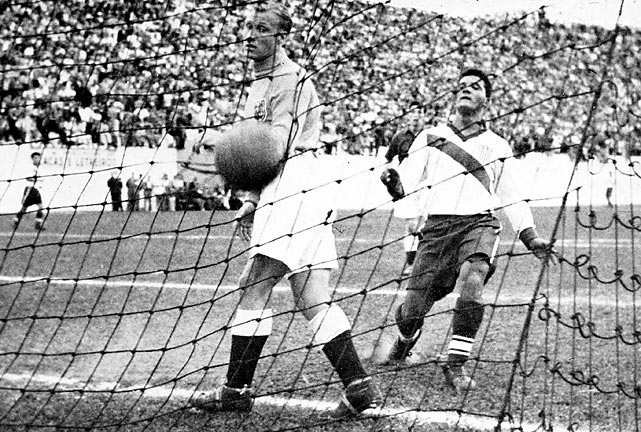
Two World Cup-related excerpts from Franklin Foer, New Republic editor and football fanatic. The first is from an Ask Me Anything at Reddit and the second from his excellent TNR article about the mixed legacy of Brazilian soccer, including a largely forgotten chapter in Pele’s life.
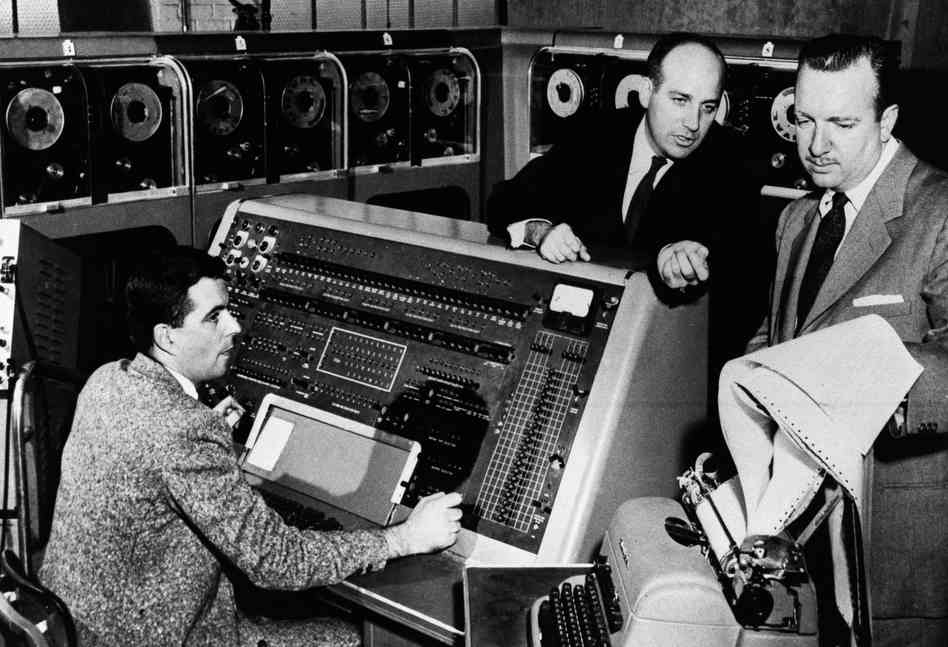
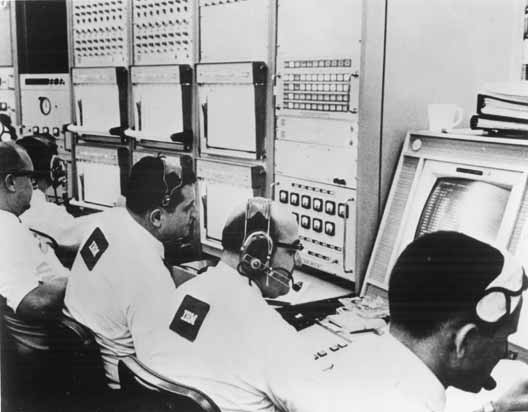
The Univac 1 computer got off to a good start in 1952 when it predicted that Eisenhower would win easily over Stevenson even though the press thought the reverse outcome was a near-certainty. It faltered a bit in the 1954 midterm Senate races and was mocked. (“Tilt!” was hollered in the newsroom by one wiseass when it became clear that the prognostications were errant.) But by the 1956 Presidential election, the computer once more nailed the Eisenhower triumph over Stevenson. No TV broadcast of any major election ever went without a computer again.
In this 1952 clip, Walter Cronkite cedes the floor the machine which at this early point in the night thought Eisenhower was a 100-1 favorite to win. Nervous CBS brass were so concerned that the “electronic brain” was wrong that they initially pretended it had mechanical difficulties and was being unresponsive.
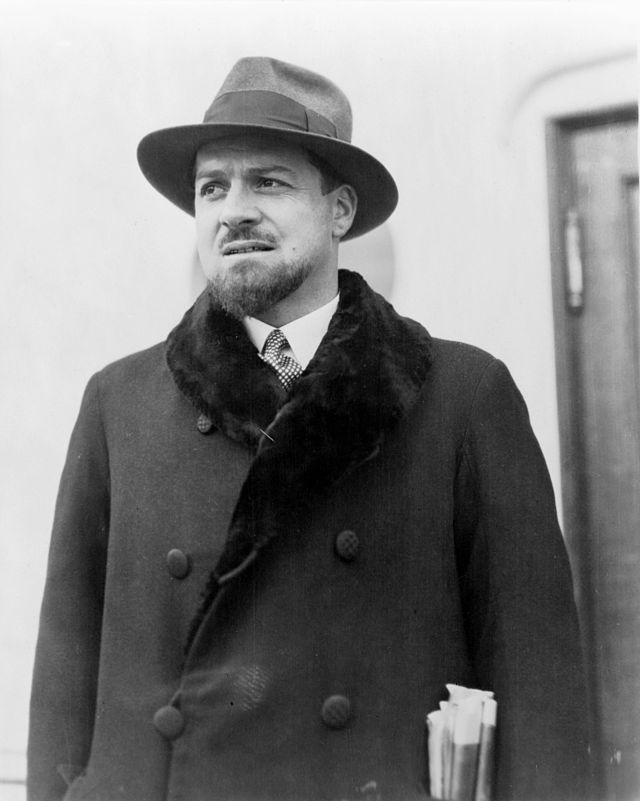
Italo Balbo, Mussolini’s Air Minister, created an experimental office environment that was a technocrat’s dream, humming with gizmos, even if it shared some of the fascist tendencies of his politics. There was an Automat-style lunchroom and a tubing system that delivered coffee to desks, which was wonderful provided you weren’t aging, sickly or disabled. Then you weren’t allowed to work there. An article from the February 23, 1933 Brooklyn Daily Eagle:
“Paris–Fascist Air Minister Italo Balbo of Italy, soon to fly to America with 20 planes, has hot coffee shot up to his office through pneumatic tubes. So in fact do all the 2,000 clerks and other personnel of his ministry.
This is but one of the fantasies that the 36-year-old, prematurely bearded air minister (possible successor to Mussolini) has incorporated in the newest of Rome’s government buildings.
In spite of his youth he is probably the dean of the world’s air ministers, since he is in his sixth year of office. To Claude Blanchard whom he showed around the building, he stated that he had deep dislike for ordinary government offices.
‘I have my manias, and I impose them,’ he laughed. ‘There is not a drawer in the building.’ He explained that his first four years in politics gave him a horror of desk drawers.
Blanchard describes the ministry as a combination of ‘factory, museum, laboratory, gymnasium, restaurant, bank, university and storehouse.’
Every desk has a telephone and a pneumatic tube such as department stores use to shoot change from customer to cashier and back. The elevators are endless chain affairs which never stop; and on and off which passengers leap while they are in motion.
No Gray Hairs In Sight
There are no paralytics or rheumatics in the ministry. Blanchard said that he did not see one gray hair.
Balbo, while visiting Chicago, 1933.
Balbo’s own office is a wide bright room, the walls of which are decorated with huge maps painted in the seventeenth century manner. While they were talking something like a steamboat whistle blew; and the minister invited the guest to lunch.
After a descent in the non-stop elevators they came out in an immense stand-up lunch room, in which everybody from the minister down to the workmen in aprons and overalls eat at once. They all pay for it, the minister and upper ranks paying 32 cents and the men in overalls seven. Forty-five minutes are allowed for lunch. Blanchard, between Balbo and a high staff officer, lined up at one of the long nickel and porcelain shelves, opened the small nickeled doors in front of him. There, kept hot by electricity, was the whole meal.
It was not a completely standardized meal. The menu had been circulated earlier in the morning and everybody had shot back his order by pneumatic tube.
In fifteen minutes the lunch was over and everybody flowed around to a colossal bar filled with glittering coffee ‘espresso’ machines. Each made his own coffee; and it was there that Balbo showed with some pride the system by which the clerks get coffee in their offices without leaving their desks. A clerk shoots an order down the tube with his desk number on it; and in a moment a sealed bottle with the coffee in it plops out of the tube.
It is a good ministry to work in. It closes at a quarter to four.”
It’s difficult to stress too much what a small election Eric Cantor-David Brat was in terms of reflecting any larger picture about America and how disproportionate the ramifications will likely be. The final vote tally was 36,120 for Brat and 28,907 for Cantor. That’s barely more than 65,000 ballots cast. It’s in no way a bellwether of America nor of Virginia outside of the 7th Congressional District. It probably says as much about universal dislike of the soon-to-be-deposed Majority Leader as anything else. But because of the stunning nature of the upset, it will likely tilt the GOP further right at a time when the Tea Party pull had been flagging. Smooth sailing for Lindsey Graham against party “purists” won’t make a ripple against Cantor’s Titanic. It certainly will make governance more difficult for President Obama for the rest of his term, but his goal of establishing a transformative administration rather than a transitional one has always been somewhat predicated on having a Democrat succeed him. This jolt to the right for Republicans makes that more likely, especially with the sharp demographic challenges that they have in national elections where gerrymandered districts can’s serve as a bulwark. Nothing could be more satisfying than Cantor being done in by the extremists he marshaled to scuttle good government, but his loss will likely be given far greater significance than it should.•
From “What Does Soccer Mean Today,” Ryan O’Hanlon’s Pacific Standard interview with writer Simon Kuper, an exchange about the effect of globalization on the world’s game, which has made interest somewhat shallower but much wider:
“Pacific Standard:
Some have said that this globalization has lessened the importance of the World Cup. Basically, anyone with an Internet connection can watch any game. And with club soccer, they’re watching better, more cohesive teams. Where do you see the World Cup fitting within all that?
Simon Kuper:
It’s still the most meaningful for players and for fans, so your career can be made in a minute. You score a brilliant goal or you score a terrible own goal at the World Cup, and that marks you for the rest of your life just because of the interest and the meaning that people attach to it is still much higher—even though all the things you say are true. What’s special about the World Cup—if you go back to before the World Cup in the U.S., very few Americans were interested, very few Chinese, Indians, Japanese, Indonesians, so really, the biggest countries in the world were excluded. And now each World Cup really is a World Cup, so in that sense it’s much more wider and deeper than it used to be. And I think that’s quite thrilling: The idea that when somebody plays, he’s watched by people literally all over the world. It’s the most uniting event in our planet’s history, given the increase in global communication. The World Cup in Brazil will be the biggest media event in history, judged by numbers of viewers and numbers of clicks, and there’s something majestic about that.”
Some will always leave the culture, go off by themselves or in pairs or groups. They’ll disappear into their own heads, create their own reality. For most it’s benign, but not for all. There are those who don’t want to live parallel to the larger society and come to believe they can end it. The deeper they retreat, the harder it is to reemerge. Instead they sometimes explode back into their former world, as in the case of Jerad and Amanda Miller committing acts of domestic terrorism in Las Vegas. It reminds me of a piece of reportage by Denis Johnson.
The writer was paranoid about both the government and the anti-government militia movement in 1990s America when he wrote the chilling article “The Militia in Me,” which appears in his non-fiction collection, Seek. The violence of Ruby Ridge and Waco and the horrific Oklahoma City bombing had shocked the nation into realizing the terror within, so Johnson traveled the U.S. and Canada to find out how and why militias had come to be. Three brief excerpts from the piece.
____________________
The people I talked with seemed to imply that the greatest threat to liberty came from a conspiracy, or several overlapping conspiracies, well known to everybody but me. As a framework for thought, this has its advantages. It’s quicker to call a thing a crime and ask Who did it? than to call it a failure and set about answering the question What happened?
____________________
I’m one among many, part of a disparate–sometimes better spelled “desperate”–people, self-centered, shortsighted, stubborn, sentimental, richer than anybody’s ever been, trying to get along in the most cataclysmic century in human history. Many of us are troubled that somewhere, somehow, the system meant to keep us free has experienced a failure. A few believe that someone has committed the crime of sabotaging everything.
Failures need correction. Crimes cry out for punishment. Some ask: How do we fix it? Others: Who do we kill?
____________________
They told me they made furniture out of antlers and drove around anywhere and everywhere, selling it. For the past month I’d been reading about the old days, missing them as if I had lived in them, and I said, “You sound like free Americans.”
“No,” the smaller man said and thereafter did all the talking, while the other, the blond driver changed my tire. “No American is free today.”
“Okay, I guess you’re right, but what do we do about that?”
“We fight till we are,” he said. “Till we’re free or we’re dead, one or the other.”
“Who’s going to do the fighting?”
“A whole lot of men. More than you’d imagine. We’ll fight till we’re dead or we’re free.”•
Critics of President Obama as a big-government champion certainly aren’t talking about about space exploration, which he seems content to leave to Elon Musk and other private market entities. There’s little doubt that Space X is more cost effective than NASA’s Space Launch System will be, but corporations can change course on projects based on economics, personnel and stock prices, whereas the government has to stay the course. Probably best to have a competition between public and private. That should be the new Space Race. From the Economist:
“SpaceX, the most successful of the private firms, is planning to build a super-heavy Falcon rocket of its own that would be even beefier than the SLS. If all goes to plan, the so-called Falcon XX could reach lunar orbit in the early 2020s and go on to Mars later in the decade, ten years ahead of the SLS. SpaceX already has the lowest launch costs in the industry. It is working on making its rockets reusable, which would cut prices even further. Some (admittedly speculative) estimates say that NASA could cut its costs by a factor of 25 or 50 by going with the Falcon XX rocket instead of the (non-reusable) SLS.
But this is not just an argument about money and jobs. The charitable interpretation of Congress’s plan is that it takes its inspiration from the greatness of the government-run Apollo programme. But Mr Musk is equally forceful when he says that ‘NASA’s most valuable role is to fund advanced science projects such as the Hubble space telescope or the Curiosity Mars rover—things that are valuable for humanity as a whole [and] where there’s not an obvious commercial transaction.’ The rest, in other words, including colonising Mars, Mr Musk’s ultimate aspiration, should be left to entrepreneurs.”
Before an automated workforce was a threat to employees, it was a real concern for management (of all kinds). The opening exchanges of a fascinating Salon conversation about technology, democracy, capitalism, and other subjects, between Thomas Frank and David Graeber:
“Thomas Frank:
Let’s start at the beginning: Keynes’ prediction, back in the 1930s, that before too long workers would have all sorts of leisure time because of improving productivity. Is there a history of this idea? I mean, others have argued this as well, correct?
David Graeber:
Well, radical elements in the labor movement began embracing such visions from quite early on. After the successful campaigns for the eight-hour day in the 1880s, people immediately started thinking, can we move this to seven, six, or less. Paul Lafargue, Marx’s son-in-law, and author of The Right to Be Lazy, was already calling for something along those lines in 1883. I have a Wobbly T-shirt with a turn-of-the-century style design that says ‘join the IWW for a new dawn,’ it has a sun rising over the rooftops, and on the sun is written, ‘four-day week, four-hour day.’ I don’t know how old the image really is but I’m guessing it’s from the Teens or the ’20s. In the 1930s, a lot of labor unions did move their industries to a 35-hour week. My mom was a garment worker at the time and that’s how she ended up getting involved in the ILGWU musical review Pins and Needles, because everyone had moved to a shorter week and the union started providing leisure activities.
Thomas Frank:
And when did this expectation finally start dying out?
David Graeber:
By the ‘60s, most people thought that robot factories, and ultimately, the elimination of all manual labor, was probably just a generation or two away. Everyone from the Situationists to the Yippies were saying ‘let the machines do all the work!’ and objecting to the very principle of 9-to-5 labor. In the ‘70s, there were actually a series of now-forgotten wildcat strikes by auto workers and others, in Detroit, I think Turin, and other places, basically saying, ‘we’re just tired of working so much.’
This sort of thing threw a lot of people in positions of power into a kind of moral panic. There were think-tanks set up to examine what to do—basically, how to maintain social control—in a society where more and more traditional forms of labor would soon be obsolete. A lot of the complaints you see in Alvin Toffler and similar figures in the early ‘70s—that rapid technological advance was throwing the social order into chaos—had to do with those anxieties: too much leisure had created the counter-culture and youth movements, what was going to happen when things got even more relaxed? It’s probably no coincidence that it was around that time that things began to turn around, both in the direction of technological research, away from automation and into information, medical, and military technologies (basically, technologies of social control), and also in the direction of market reforms that would send us back towards less secure employment, longer hours, greater work discipline.
Thomas Frank:
Today productivity continues to increase, but Americans work more hours per week than they used to, not fewer. Also, more than workers in other countries. Correct?
David Graeber:
The U.S., even under the New Deal, was always a lot stingier than most wealthy countries when it comes to time off: whether it’s maternity or paternity leave, or vacations and the like. But since the ‘70s, things have definitely been getting worse.”
Whether squaring off with Muhammad Ali, Henry Kissinger or a head-transplant surgeon, Oriana Fallaci was just crazy enough to survive them all–to thrive, even. Here’s an excerpt from a 1977 People interview by Sally Moore, which begins with a question that would never have been asked of a male journalist:
People:
Have you ever had a sexual relationship with an interview subject?
Oriana Fallaci:
No. That’s a matter of pride. They’ll never catch me at that one. The most humiliating thing a woman can be is a coquette. The world thinks, if a man sleeps with a woman he interviews, he’s a journalist. If a woman does it, she’s a whore.
People:
Do you ask very personal questions of people you interview?
Oriana Fallaci:
No—only of those in power. With them, you must do anything. They have no rights. I asked the Shah of Iran about his women, Golda offered to speak with love about her husband. Arafat? I don’t think he loves women, so there wasn’t any problem. Indira spoke about the problems of being a woman leader; it was tragic for her marriage.
People:
Why do people in power fascinate you?
Oriana Fallaci:
Because, you must remember, we’re not speaking of normal people but of those who rule our lives, command us, decide if we live or die, in freedom or in tyranny.
People:
Do you regret any of your interviews?
Oriana Fallaci:
Only that I’ve sometimes been too kind. When I fall in love with a character, as I did with Indira, I have reasons to regret. But then she wasn’t a dictator yet. Then there was that American Lieutenant [Robert] Frishman of the U.S. Navy, whom I interviewed in Hanoi. He was acting so cowardly in front of the North Vietnamese. It makes me crazy to see a man in chains, humiliated, so I was very good to him. Then he came home the hero. He pretended not to recognize me, and I got furious. I was kind with Thieu [South Vietnam’s ex-president], because the moment I saw him I judged him to be a victim of American policy. He was crying.
People:
Then where does your reputation for brutality come from?
Oriana Fallaci:
Americans invented a character that doesn’t exist. What I am—forgive an act of pride—is courageous. Most of our colleagues don’t have the guts to ask the right questions.•
Sometimes an extremist fringe in a country can actually be a good sign. Because it’s being routed by progress and good sense, such a faction makes noise that can be misheard as a rallying cry when it’s really a death rattle. But if such a group moves from the margins to the center, that’s cause for concern. Marine Le Pen, daughter of racist cuckoo clock Jean-Marie Le Pen and leader of France’s Far Right Front National Party, which enjoyed surprising success in the country’s recent elections, just sat for an interview with Mathieu von Rohr of Spiegel. The opening:
“Spiegel:
Ms. Le Pen, having won 25 percent of the French vote, your Front National party stands as one of the primary beneficiaries of the May 25 European Parliament election. How could such a thing come to pass?
Marine Le Pen:
The French want to regain control of their own country. They want to determine the course of their own economy and their immigration policies. They want their own laws to take precedence over those of the European Union. The French have understood that the EU does not live up to the utopia they were sold. It has distanced itself significantly from a democratic mode of operation.
Spiegel:
Yet, prior to the election, it was said that the establishment of lead candidates for the two biggest groups — Jean-Claude Juncker for the center-right and Martin Schulz for the center-left — would strengthen democracy in the EU.
Marine Le Pen:
That is totally bogus. Everybody knew that the parliament wouldn’t be making the final decision on the next president of the European Commission.
Spiegel:
Do you want to destroy Europe?
Marine Le Pen:
I want to destroy the EU, not Europe! I believe in a Europe of nation-states. I believe in Airbus and Ariane, in a Europe based on cooperation. But I don’t want this European Soviet Union.
Spiegel:
The EU is a vast project for peace. It has helped ensure 70 years without war on the Continent.
Marine Le Pen:
No. Europe is war. Economic war. It is the increase of hostilities between the countries. Germans are denigrated as being cruel, the Greeks as fraudsters, the French as lazy. Ms. Merkel can’t travel to any European country without being protected by hundreds of police. That is not brotherhood.”
The three historical things I’ve hoped to see in my life are an African-American President (done), a female U.S. President (soon, perhaps?) and a new-wave, large-scale women’s movement. The last decade there’s seemed to be a growing tide of feminist consciousness in America. And, no, there’s no way I can quantify that, but it seems to be happening. Will it coalesce into an organized movement?
Because I’m not on social media, I didn’t see the #YesAllWomen insta-campaign until a couple days after it happened, but I thought it was a great sign. Of course, the Digital Age is a double-edged sword for any movement: The connectedness has great utility, but the diffuse nature of culture makes it more difficult for a real movement to form. In our long-tail world, it’s hard for people, even connected ones, to be truly close together.
Here’s a really good New York-centric documentary that focuses on American feminism in the mid-1970s, featuring Rita Mae Brown, Betty Friedan and Margo Jefferson, among many other women.
At the Philosopher’s Beard, the whiskered one wonders whether capitalism as we know it has a future in an automated society, arguing for a universal basic income based on human decency, not employment status. An excerpt:
“Unless we intervene, the same economic system that has produced this astonishing prosperity will return us to the Dickensian world of winners and losers that characterised the beginning of capitalism, or worse. The problem is this, how will ordinary people earn a claim on the material prosperity of the capitalist economy if that economy doesn’t need our labour anymore?
The Crisis
The original industrial revolution was basically an energy revolution that replaced puny human brawn with fossil fuel powered machines that were orders of magnitude faster and stronger. Human workers were displaced into the new jobs created by this prosperity, some managing and servicing the machines that made actual things, but most into ‘services’, producing intangible goods such as education by cognitive efforts that the technological revolution in productivity couldn’t reach. We are now living through a second industrial revolution that is replacing puny human brains with machine intelligence. Any kind of work that can be routinised can be translated into instructions for computers to do, generally more cheaply and reliably than human employees can. That includes increasingly sophisticated cognitive labour like driving, legal discovery, medicine, and document translation. Even university lecturers are at risk of being replaced by technology, in the form of Massive Open Online Courses [previously], while the digital cloning of actors promises to allow filmmakers to cheaply manufacture whatever cast they please.
Just like the original industrial revolution this is creating large numbers of losers whose skills are no longer valued by the market. But this time it is not clear that new jobs will appear for these people to move into, for this time the machines can follow us nearly anywhere we try to go. This time technological unemployment may become a permanent fact that we have to deal with by changing how capitalism works. Our birthright as humans – the ability to produce things by our labour that others find valuable – may become economically worthless.”
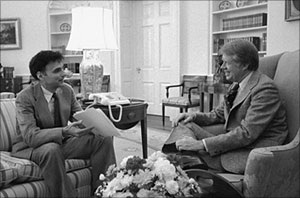
This prime 1972 episode of the Mike Douglas Show features John & Yoko as co-hosts. At the 34:20 mark, there’s an appearance by consumer advocate Ralph Nader, who has been right about so many things (airbags, corporate greed, conservation, etc.) and so wrong about one–the 2000 American Presidential election.
There was no difference between the two major-party candidates, Nader said, staying in the race until the end, which turned out to be very bitter for the country. The difference between Dubya and Al Gore was 4,500 U.S. troops dying or not, a 100,000 Iraqis dead or alive, a focus on environmentalism or business as usual as the clock kept running out. For some–perhaps for all–it was the difference between life and death. Adults who can’t see shades of gray always stun me, but it was the same impulses that drove Nader’s righteous career which led him to be the spoiler in 2000.
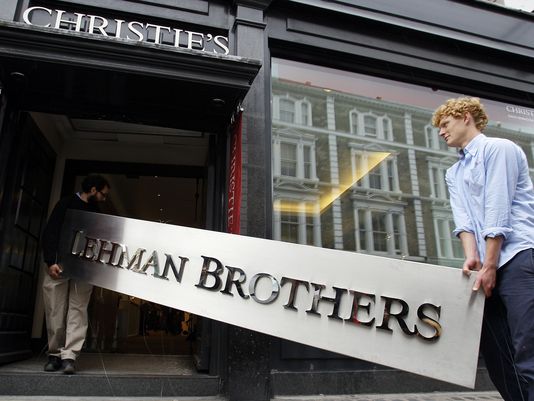
At the Financial Times,Tim Harford explainswhy (almost) nobody saw the financial collapse of 2008 coming and why economic predictions are usually so lacking:
“Why are forecasts so poor? The chief explanation is that the economy is complicated and we don’t understand it well enough to make forecasts. We don’t even fully understand recent economic history.
Ben Chu, economics editor of The Independent, recently took a look at the UK recession of the 1990s in the light of two decades of data revisions. From the vantage point of 1995, the economy in late 1992 was slightly smaller than the economy in early 1988. But today’s best guess is that the economy of late 1992 was almost 6 per cent larger than in early 1988. The Office for National Statistics has substantially revised its view.
Not only is it difficult to forecast the future, then – forecasting the past isn’t straightforward either. What chance does any prognosticator have?
A second explanation for forecasting’s fallibility is that there is little incentive to do better. The kind of institutional chief economist whose pronouncement makes it into Consensus Forecasts will stick to the middle of the road. Most countries, most of the time, are not in recession, so a safe strategy is never to forecast one. Of course there are the mavericks who receive media attention for making provocative predictions and are lionised when they are right. Their incentives are different but it is unclear that their overall track record is any better.”
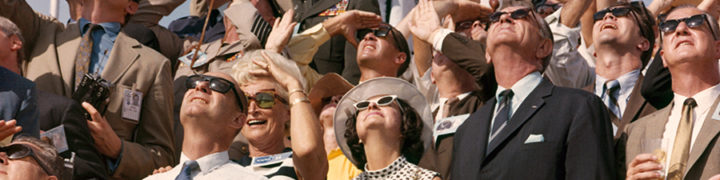
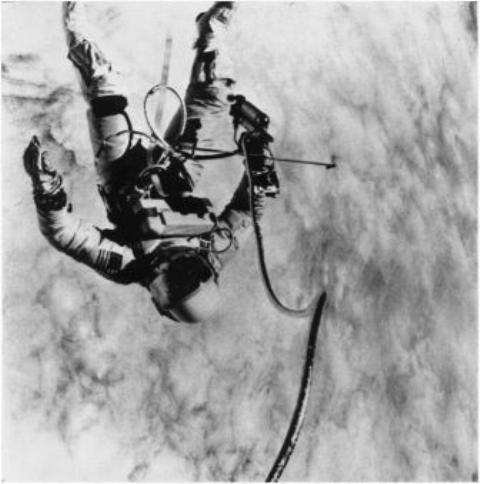
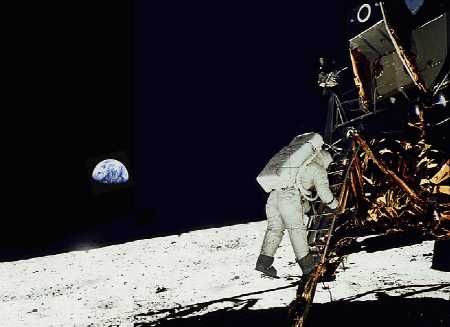
Norman Mailer pursued immortality through subjects as grand as his ego, and it was the Apollo 11 mission that was Moby Dick to his Ahab. He knew the beginning of space voyage was the end, in a sense, of humans, or, at least, of humans believing they were in the driver’s seat. Penguin Classics is republishing his great 1970 writing, Of a Fire on the Moon, 45 years after we touched down up there. Togetherwith Oriana Fallaci’s If The Sun Dies, you have an amazing account of that disorienting moment when technology, that barbarian, truly stormed the gates, as well as a great look at New Journalism’s early peak. Below are some of the posts that I’ve previously put up that refer to Mailer’s book.
_________________________
“It Was Not A Despair He Felt, Or Fear–It Was Anesthesia”
When he wrote about the coming computer revolution of the 1970s at the outset of the decade in Of a Fire on the Moon, Norman Mailer couldn’t have known that the dropouts and the rebels would be leading the charge. An excerpt of his somewhat nightmarish view of our technological future, some parts of which came true and some still in the offing:
“Now they asked him what he thought of the Seventies. He did not know. He thought of the Seventies and a blank like the windowless walls of the computer city came over his vision. When he conducted interviews with himself on the subject it was not a despair he felt, or fear–it was anesthesia. He had no intimations of what was to come, and that was conceivably worse than any sentiment of dread, for a sense of the future, no matter how melancholy, was preferable to none–it spoke of some sense of the continuation in the projects of one’s life. He was adrift. If he tried to conceive of a likely perspective in the decade before him, he saw not one structure to society but two: if the social world did not break down into revolutions and counterrevolutions, into police and military rules of order with sabotage, guerrilla war and enclaves of resistance, if none of this occurred, then there certainly would be a society of reason, but its reason would be the logic of the computer. In that society, legally accepted drugs would become necessary for accelerated cerebration, there would be inchings toward nuclear installation, a monotony of architectures, a pollution of nature which would arouse technologies of decontamination odious as deodorants, and transplanted hearts monitored like spaceships–the patients might be obliged to live in a compound reminiscent of a Mission Control Center where technicians could monitor on consoles the beatings of a thousand transplanted hearts. But in the society of computer-logic, the atmosphere would obviously be plastic, air-conditioned, sealed in bubble-domes below the smog, a prelude to living on space stations. People would die in such societies like fish expiring on a vinyl floor. So of course there would be another society, an irrational society of dropouts, the saintly, the mad, the militant and the young. There the art of the absurd would reign in defiance against the computer.”
_________________________
“Doubtless, Everybody Would Be Easier To Monitor”
Some more predictions from Norman Mailer’s 1970 Space Age reportage, Of a Fire on the Moon, which have come to fruition even without the aid of moon crystals:
“Thus the perspective of space factories returning the new imperialists of space a profit was now near to the reach of technology. Forget about diamonds! The value of crystals grown in space was incalculable: gravity would not be pulling on the crystal structure as it grew, so the molecule would line up in lattices free of shift or sheer. Such a perfect latticework would serve to carry messages for a perfect computer. Computers the size of a package of cigarettes would then be able to do the work of present computers the size of a trunk. So the mind could race ahead to see computers programming go-to-school routes in the nose of every kiddie car–the paranoid mind could see crystal transmitters sewn into the rump of ever juvenile delinquent–doubtless, everybody would be easier to monitor. Big Brother could get superseded by Moon Brother–the major monitor of them all might yet be sunk in a shaft on the back face of the lunar sphere.”
_________________________
“A Robot That Is Designed To Play Chess Might Also Want To Build A Spaceship”
In his 1970 Apollo 11 account, Of a Fire on the Moon, Norman Mailer realized that his rocket wasn’t the biggest after all, that the mission was a passing of the torch, that technology, an expression of the human mind, had diminished its creators. “Space travel proposed a future world of brains attached to wires,” Mailer wrote, his ego having suffered a TKO. And just as the Space Race ended the greater race began, the one between carbon and silicon, and it’s really just a matter of time before the pace grows too brisk for humans.
Supercomputers will ultimately be a threat to us, but we’re certainly doomed without them, so we have to navigate the future the best we can, even if it’s one not of our control. Gary Marcus addresses this and other issues in his latest New Yorker blog piece, “Why We Should Think About the Threat of Artificial Intelligence.” An excerpt:
“It’s likely that machines will be smarter than us before the end of the century—not just at chess or trivia questions but at just about everything, from mathematics and engineering to science and medicine. There might be a few jobs left for entertainers, writers, and other creative types, but computers will eventually be able to program themselves, absorb vast quantities of new information, and reason in ways that we carbon-based units can only dimly imagine. And they will be able to do it every second of every day, without sleep or coffee breaks.
For some people, that future is a wonderful thing. [Ray] Kurzweil has written about a rapturous singularity in which we merge with machines and upload our souls for immortality; Peter Diamandis has argued that advances in A.I. will be one key to ushering in a new era of ‘abundance,’ with enough food, water, and consumer gadgets for all. Skeptics like Eric Brynjolfsson and I have worried about the consequences of A.I. and robotics for employment. But even if you put aside the sort of worries about what super-advanced A.I. might do to the labor market, there’s another concern, too: that powerful A.I. might threaten us more directly, by battling us for resources.
Most people see that sort of fear as silly science-fiction drivel—the stuff of The Terminator and The Matrix. To the extent that we plan for our medium-term future, we worry about asteroids, the decline of fossil fuels, and global warming, not robots. But a dark new book by James Barrat, Our Final Invention: Artificial Intelligence and the End of the Human Era, lays out a strong case for why we should be at least a little worried.
Barrat’s core argument, which he borrows from the A.I. researcher Steve Omohundro, is that the drive for self-preservation and resource acquisition may be inherent in all goal-driven systems of a certain degree of intelligence. In Omohundro’s words, ‘if it is smart enough, a robot that is designed to play chess might also want to build a spaceship,’ in order to obtain more resources for whatever goals it might have.”
_________________________
“Hippies Will Be Refused Tourist Cards To Enter Mexico Unless They Take A Bath And Get Haircuts”
While Apollo 11 traveled to the moon and back in 1969, the astronauts were treated each day to a six-minute newscast from Mission Control about the happenings on Earth. Here’s one that was transcribed in Norman Mailer’s Of a Fire on the Moon, which made space travel seem quaint by comparison:
“Washington UPI:Vice President Spiro T. Agnewhas called for putting a man on Mars by the year 2000, but Democratic leaders replied that priority must go to needs on earth…Immigration officials in Nuevo Laredo announced Wednesday that hippies will be refused tourist cards to enter Mexico unless they take a bath and get haircuts…’The greatest adventure in the history of humanity has started,’ declared the French newspaper Le Figaro, which devoted four pages to reports from Cape Kennedy and diagrams of the mission…Hempstead, New York: Joe Namath officially reported to the New York Jets training camp at Hofstra University Wednesday following a closed-door meeting with his teammates over his differences with Pro Football Commissioner Pete Rozelle…London UPI: The House of Lords was assured Wednesday that a major American submarine would not ‘damage or assault’ the Loch Ness monster.”
_________________________
“There Was An Uneasy Silence, An Embarrassed Pall At The Unmentioned Word Of Nazi”
“What we are seeking in tomorrow’s trip is indeed that key to our future on earth.”
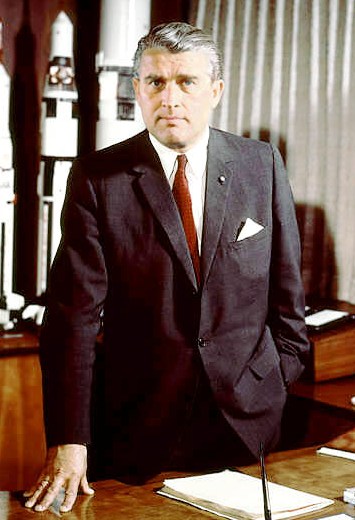
Norman Mailer’s book Of a Fire on the Moon, about American space exploration during the 1960s, was originally published as three long and personal articles for Life magazine in 1969: “A Fire on the Moon,” “The Psychology of Astronauts,” and “A Dream of the Future’s Face.” Mailer used space travel to examine America’s conflicted and tattered existence–and his own as well. In one segment, he reports on a banquet in which Wernher von Braun, the former Nazi rocket engineer who became a guiding light at NASA, meets with American businessmen on the eve of the Apollo 11 launch. An excerpt:
“Therefore, the audience was not to be at ease during his introduction, for the new speaker, who described himself as a ‘backup publisher,’ went into a little too much historical detail. ‘During the Thirties he was employed by the Ordinance Department of the German government developing liquid fuel rockets. During World War II he made very significant developments in rocketry for his government.’
A tension spread in this audience of corporation presidents and high executives, of astronauts, a few at any rate, and their families. There was an uneasy silence, an embarrassed pall at the unmentioned word of Nazi–it was the shoe which did not drop to the floor. So no more than a pitter-patter of clapping was aroused when the speaker went quickly on to say: ‘In 1955 he became an American citizen himself.’ It was only when Von Braun stood up at the end that the mood felt secure enough to shift. A particularly hearty and enthusiastic hand of applause swelled into a standing ovation. Nearly everybody stood up. Aquarius, who finally cast his vote by remaining seated, felt pressure not unrelated to refusing to stand up for The Star-Spangled Banner. It was as if the crowd with true American enthusiasm had finally declared, ‘Ah don’ care if he is some kind of ex-Nazi, he’s a good loyal patriotic American.’
Von Braun was. If patriotism is the ability to improve a nation’s morale, then Von Braun was a patriot. It was plain that some of these corporate executives loved him. In fact, they revered him. He was the high priest of their precise art–manufacture. If many too many an American product was accelerating into shoddy these years since the war, if planned obsolescence had all too often become a euphemism for sloppy workmanship, cynical cost-cutting, swollen advertising budgets, inefficiency and general indifference, then in one place at least, and for certain, America could be proud of a product. It was high as a castle and tooled more finely than the most exquisite watch.
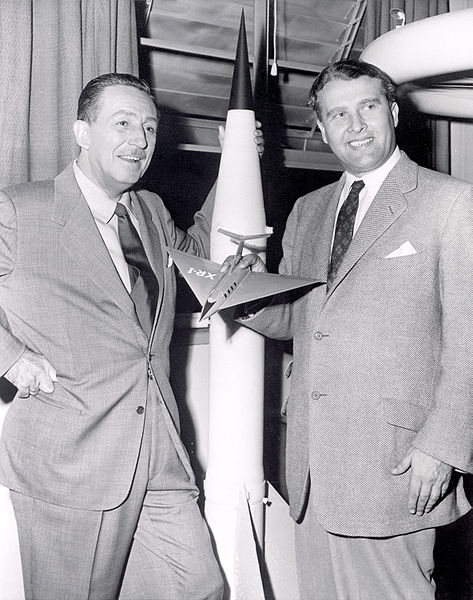
Walt Disney with Wernher von Braun.
Now the real and true tasty beef of capitalism got up to speak, the grease and guts of it, the veritable brawn, and spoke with fulsome language in his small and well-considered voice. He was with friends on this occasion, and so a savory and gravy of redolence came into his tone, his voice was not unmusical, it had overtones which hinted of angelic super-possibilities one could not otherwise lay on the line. He was when all was said like the head waiter of the largest hofbrau in heaven. ‘Honored guests, ladies and gentlemen,’ Von Braun began, ‘it is with a great deal of respect tonight that I meet you, the leaders, and the captains in the mainstream of American industry and life. Without your success in building and maintaining the economic foundations of this nation, the resources for mounting tomorrow’s expedition to the moon would never have been committed…. Tomorrow’s historic launch belongs to you and to the men and women who sit behind the desks and administer your companies’ activities, to the men who sweep the floor in your office buildings and to every American who walks the street of this productive land. It is an American triumph. Many times I have thanked God for allowing me to be a part of the history that will be made here today and tomorrow and in the next few days. Tonight I want to offer my gratitude to you and all Americans who have created the most fantastically progressive nation yet conceived and developed,’ He went on to talk of space as ‘the key to our future on earth,’ and echoes of his vision drifted through the stale tropical air of a banquet room after coffee–perhaps he was hinting at the discords and nihilism traveling in bands and brigands across the earth. ‘The key to our future on earth. I think we should see clearly from this statement that the Apollo 11 moon trip even from its inception was not intended as a one-time trip that would rest alone on the merits of a single journey. If our intention had been merely to bring back a handful of soil and rocks from the lunar gravel pit and then forget the whole thing’–he spoke almost with contempt of the meager resources of the moon–‘we would certainly be history’s biggest fools. But that is not our intention now–it never will be. What we are seeking in tomorrow’s trip is indeed that key to our future on earth. We are expanding the mind of man. We are extending this God-given brain and these God-given hands to their outermost limits and in so doing all mankind will benefit. All mankind will reap the harvest…. What we will have attained when Neil Armstrong steps down upon the moon is a completely new step in the evolution of man.'”
_________________________
Wernher von Braun inducted into the Space Camp Hall of Fame:
Tom Lehrer eviscerates Wernher von Braun in under 90 seconds:
Maya Angelou, who sadly has just passed away, appearing with Merv Griffin in 1982, voicing her concerns about the beginning of what she believed was a politicized class war on less-fortunate Americans, of Reaganomics trying to undo the gains of the New Deal and the Great Society.
If the sea level rises high enough, it will sink us all. But the first casualties of melting glaciers will likely be island nations. The opening of Stephen Leahy’s Vice article “The Nations Guaranteed to Be Swallowed By the Sea“:
“Imagine the street you live on is knee-deep in floodwater, and it’s ruining everything in sight, including your home. Now imagine that those awful floodwaters never, ever recede. Instead, the water just keeps rising and rising until your entire country drowns.
For a number of island nations, that’s ultimately the significance of the recent reports about the unstoppable melt of the massive ice sheets of Antarctica and Greenland, along with hundreds of glaciers.
‘We’ve already lost some island atolls. On others the rising sea is destroying homes, washing away coffins and skeletons from graves,’ Tony de Brum, the foreign minister of the Marshall Islands, told me. ‘Now with every full moon the high tides brings salt water into our streets. We’re moving further inland but can’t move much further.’
The Marshall Islands are located in the northern Pacific Ocean, and are home to some 70,000 people spread out over 24 low-lying coral atolls. Low-lying, as in six feet above sea level on average. Not only do rising seas flood and erode shorelines, they also make groundwater too salty too drink and ‘poison’ the land with salt so crops and even coconuts trees can’t grow.“
Technological positivist Marc Andreessen was Russ Roberts’ guest on a really good installment of the EconTalk podcast. The Netscape founder and venture capitalist sees the world as moving in the right direction in the macro, perhaps giving short shrift to those sinking in the short-term and mid-term turmoil that attends transformation. Notes on myriad discussion topics.
Google. Andreessen details how one of the most powerful companies on Earth had plenty of luck on its way to market dominance and its position as a latter-day Bell Labs. The search giant could have collapsed early on or been purchased, with Larry Page and Sergey Brin winding up as, say, Yahoo! middle managers. (“A fate worse than death,” as the host cleverly sums it up.) The guest recalls a fellow venture capital player calling the chief Google guys the “two most arrogant founders” he’d ever met.
Jobs lost to automation. The guest believes that with the delivery of smartphones into the hands of (eventually) seven billion people, that we’re at the tipping point of an economic boom and great job creation. He doesn’t qualify his remarks by saying that we’re in for rough times in the short run with jobs because of robotics. Andreesen also doesn’t address the possibility that we could have both an economic boom and a jobs shortfall.
Bitcoin. He’s over the moon for the crypto-currency company, saying it’s as revolutionary as the personal computer or the Internet. That seems like way too much hyperbole.
MOOCs. Andreesen points out that good universities will never be able to expand to meet a growing global population, so online courses will be essential if we’re to avoid a disastrous educational collapse.
Political upheavals. The one cloud the Netscape founder sees on the horizon is a barrage of political upheavals that will destabilize sections of the globe at times.
Journalism. Andreessen is sanguine about the future of journalism, believing that companies will adjust to post-monopolistic competition. He points out formerly profitable things about newspapers (classified ads, sports scores, movie times, etc.) that have been cannibalized by the Internet without guessing what will replace them for those faltering companies. If his argument was that nothing need replace them and these erstwhile powerful news corporations were no longer necessary since news distribution is now diffuse, I think that would probably be a stronger argument than suggesting that all but a few such companies are salvageable.•
Two pieces of 1970s propaganda for Libertarianism, an -ism I find perplexing.
A clip from the 1978 short, “Libra,” which imagined a 21st-century Libertarian space utopia, population 10,000, including its market-loving African-American leader. Um, wow.
This special version of 1975 film adaptation, The Incredible Bread Machine, is introduced by then-Secretary of the Treasury, William E. Simon, and features commentary by Milton Friedman and some of the book and film’s creators.
A really strange artifact, this 30-minute documentary directed by Theo Kamecke attempted to make Libertarianism sexy. The film’s writers (who appear onscreen as themselves) are six young, long-haired, hip proponents of the philosophy whose very presence sends the message that youth culture and free markets are not mutually exclusive. An incredible oversimplification of complex political and economic issues, the film contains the type of jaw-dropping anti-government propaganda that would give Ayn Rand a huge boner. But it’s still an odd and interesting remnant.
Muammar Gaddafi was friends with Steven Seagal and Seagal is friends with Vladimir Putin. Wonder what behavior would link three such men.
At the BBC Magazine, Nigerian-American basketball player Alex Owumi recalls unwittingly signing a contract to play point guard for the Gaddafi family team and getting caught in the crossfire of the Libyan civil war. The opening:
“It was a beautiful flat. Everything was state of the art and it was spacious, too. It had two big living rooms, three big bedrooms, flat screens everywhere. The couches had gold trim and were so big and heavy they were impossible to move. The door to the apartment was reinforced steel, like on a bank vault.
It was 27 December 2010 and I had just arrived in Benghazi, Libya’s second biggest city, to play basketball for a team called Al-Nasr Benghazi. I had stayed in some nice places playing for teams in Europe, but this seventh-floor apartment in the middle of town was something else. It was like the Taj Mahal.
I didn’t immediately notice the photographs dotted around the place – of Libyan leader Col Muammar Gaddafi and his grandchildren.
When I did, I phoned the team president – we called him Mr Ahmed – and he told me how it was. ‘The apartment belongs to Mutassim Gaddafi, the Colonel’s son,’ he said. ‘Al-Nasr is the Gaddafi club. You are playing for the Gaddafi family.’
Gaddafi! When I was a young kid growing up in Africa – I was born in Nigeria – Gaddafi was someone we all looked up to. He was always on the news and in the paper, helping out countries like Niger and Nigeria. I thought of him as one of the faces of Africa – him and Nelson Mandela. As a kid I wasn’t really aware of any of the bad things he was doing. Maybe I was too busy playing sports.
In my first practice with my new teammates there was a weird atmosphere.”
We will all be freed from toil, but freed to what? How do you reconcile a free-market economy with a highly automated one? From Angelo Young at IBT Times:
“As the 106,000 contract workers who lost their Nike jobs in the past year can attest, apparel manufacturers have decided that it’s cheaper to invest in technology than to hire even the world’s lowest-paid workers.
The relentless move toward industrial automation is undercutting vulnerable workers around the globe.
For years, China and India offered manufacturers a low-wage workforce. Production recently expanded around Asia to countries like Cambodia, Bangladesh and Vietnam as well.
But now, automation is allowing manufacturing to stop chasing cheap labor altogether. Automated production machines cut costs and immunize manufacturers from the dangers of a labor shortage.
‘I think this is going to accelerate,’ said Erik Brynjolfsson, professor at the MIT Sloan School of Management. ‘What we have is a situation where robots and automation do more and more tasks that are being done by low-wage labor in Asia and elsewhere in the world. People involved in repetitive work are very vulnerable to what’s happening.'”