
Excerpts

You are currently browsing the archive for the Excerpts category.

"That image of Murdoch dyeing his hair in the sink is indelible—though the coloring may not be."

Michael Idov of New York magazine has a really insightful, colorful profile of acerbic Gawker Media kingpin Nick Denton. The British-born blog titan has been able to predict the next wave in NYC’s tumultuous media landscape as well as anyone over the last few years. An excerpt:

“Eight years into Gawker Media’s existence, the standard line on Denton is still that he’s an outsider of sorts, a rude alien come to torment—and supplant—media civilization as we know it. If you’re Bill Keller, say, or Tina Brown—whose Daily Beast gets one-tenth of Gawker Media’s readership on a good month—it’s much easier to view Denton as an upstart thug from nowhere, as opposed to an equal who’s kicking your ass. That plays directly into Denton’s strategy: Thuggish is the reputation he wants. ‘If I am a cornerstone of the new Establishment, then there is no new Establishment worth talking about,’ he says. ‘The only interesting people are on the West Coast, ‘he adds, then launches into a series of classic shameless Gawker riffs on the old New York media titans. ‘People used to quake when Barry Diller picked up the phone. Now he’s laughable. That image of Murdoch dyeing his hair in the sink is indelible—though the coloring may not be. Sumner Redstone would only be of interest to Gawker readers if he were to soil his adult diapers—on-camera. But the hard truth is that the golden age of New York media is largely over.’”
Tags: , , , , ,

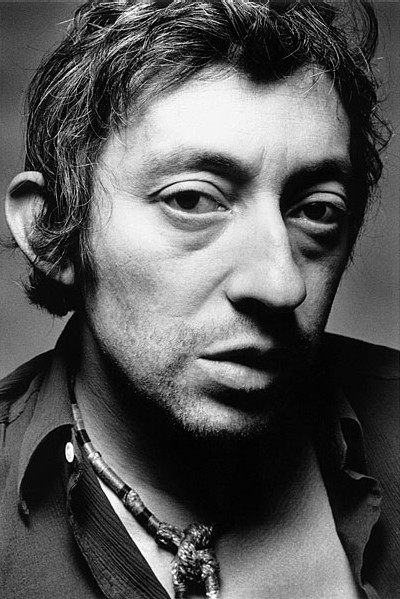
Serge Gainsbourg: "Ideal woman."

The French anti-fashion designer Isabel Marant is all the rage this year, and while I’m in no position to judge her work, I do know a really cheeky quote machine when I hear one. I came across a recent article about her on the Huffington Post, which reprinted her comment about the legendary late French film star and singer Serge Gainsbourg, who was also a crazy drunk.

Marant, whose mother was a model and father a businessman, has combined both her parents’ passions into a large and still-blooming career. She also says lots of contradictory, hypocritical and highly amusing things. (When I was collecting info about her, I also came across this announcement regarding her New York store that opened earlier this year; it was written by Leslie Price, a very bright former colleague who always seemed to know a million things about a million things.) Here’s an excerpt from an entertaining article about Marant in British fashion magazine Love:

“‘I like the way that in 1985 you decided, inspired by a teenage crush on Malcolm McLaren, to start making clothes out of dishcloths, and I like the way that you say ‘but the dishcloths are really nice in France’ as if that makes a difference…I like that way you say, ‘Big breasts and lips. No! I hate those girls. I hate famous women. My ideal woman is Serge Gainsbourg. Not that he was a woman.'”

Tags: , , ,

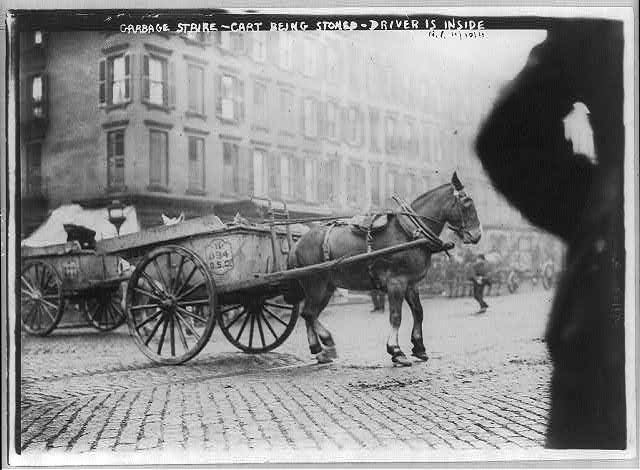
A New York City garbage cart in 1911. (Image by the Bain News Service.)

I had no idea that the New York Department of Sanitation had an Anthropologist-in-Residence until I came across a smart interview that Alex Carp did with Robin Nagle in The Believer. Nagle, also an NYU professor, has championed the building of  a Museum of Sanitation in NYC and wants people to think about something they’d rather quickly toss away: trash.  And she also wants the public to respect the important role that sanitation workers play in our lives. An excerpt from the interview:

The Believer: It seems garbage collection might present this weird moment where, on one hand, you have all of these metaphors and figurative meanings that people react to when they think of garbage, but you also have this very real person, driving the truck and collecting the bins—you, when you’ve been out working with DSNY—just doing her job.

Robin Nagle: Very much so. One of the categories of garbage has its own word in New York City, but it’s a category found everywhere that there is trash. There are things people will put out for discard: they’re done with it, they don’t want to see it again. Somebody else looks at that same object and says, ‘Whoa, wait a minute. That’s pretty nice. I want to keep that.’ Those two chairs you’re sitting in were on the curb to be thrown out. They’re pretty nice chairs. I’m happy to have them. In New York, that’s called mongo. It’s a noun and a verb: those are mongo. People who take things from the trash to keep are mongoing.

Which, by the way, is illegal. You’re not supposed to do it, just for the record.

Past treasures reach their end. (Image by Fruggo.)

Then I’m also looking at—when I’m on the street wearing my uniform, for example, and when I’m working with people who have worn that uniform for a decade or two decades or longer… What do they put on with the uniform that they don’t necessarily choose to wear, but that the public puts on them? Because there is the stigma of being a sanitation worker and picking up garbage every day…People assume they have low IQs; people assume they’re fake mafiosi, wannabe gangsters; people assume they’re disrespectable. Unlike, say, a cop or a firefighter. And I do believe very strongly it’s the most important uniformed force on the street, because New York City couldn’t be what we are if sanitation wasn’t out there every day doing the job pretty well….

And the health problems that sanitation’s solved by being out there are very, very real, and we get to forget about them. We don’t live with dysentery and yellow fever and scarlet fever and smallpox and cholera, those horrific diseases that came through in waves. People were out of their minds with terror when these things came through. And one of the ways that the problem was solved—there were several—but one of the most important was to clean the streets. Instances of communicable and preventable diseases dropped precipitously once the streets were cleaned. Childhood diseases that didn’t need to kill children, but did. New York had the highest infant mortality rates in the world for a long time in the middle of the nineteenth century. Those rates dropped. Life expectancy rose. When we cleaned the streets! It seems so simple, but it was never well done until the 1890s, when there was this very dramatic transformation.”

Tags: ,

Craig Newmark bowed to political pressure and closed down his site's Adult Services section. (Image by Sierra Communications.)

I know I’m a guy and not permitted by law to read Jezebel, but that site has the smartest and most honest take I’ve come across on the recent furor regarding Craigslist’s Adult Services section. The thought of people selling sex on Craigslist is as icky to me as it is anyone else. I think just buying a couch from the site would make me vomit. But here’s the question: Since it’s going to happen anyway, did law-enforcement officials who pressured the site into closing the section actually help or hurt the sex workers? Trying to maximize their safety and well-being should be the goal instead of empty moralizing, shouldn’t it? Jezebel wisely asked someone involved in the trade to write about the matter inA Sex Worker On Life After Craigslist.” An excerpt:

“Really, the women most affected by the shuttering of Adult Services are all the ‘non-pros’ — college students and young women freelancing in the sex trade for extra money. ‘It was the safest, easiest way for an independent woman to earn a little extra cash doing something she already enjoyed — without the risks or rigmarole that can go along with being a ‘pro,’ explained Vita, a 30-something, Ivy-leaguer who used CL between, and sometimes during, the low-paying ‘real jobs’ her MFA afforded her.

Despite the fact that the Attorneys General claim the site was a source of ‘misery’ for ‘women and children victimized by these ads,’ I couldn’t find anyone who actually used CL’s Adult Services and agreed. The greatest threat to sex workers is when they don’t have the ability to screen or have a say in the clients they see. This is particularly true for those who work for agencies whose bottom line is money. As independents, while the money can be very important, when it comes to instincts, you put your safety first.”

Tags:

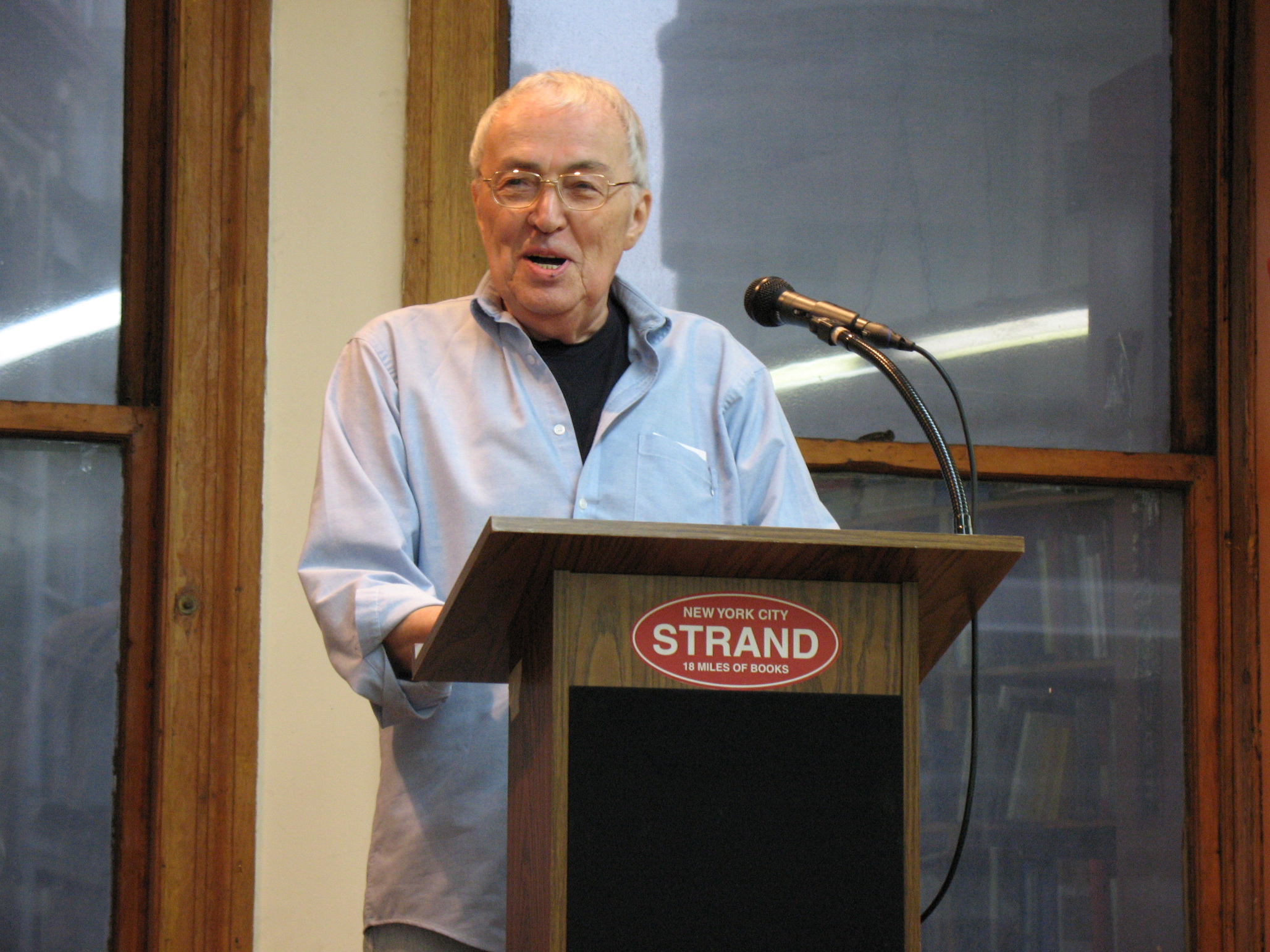
The late novelist David Markson gives a reading at the Strand bookstore in 2007. His personal library was sold to the Strand after his death. An Internet sensation ensued. (Image by Sleepyrobot.)

David Markson, the stubbornly inventive novelist who wrote the brilliant and challenging book, Wittgenstein’s Mistress, sadly passed away in June of this year. Eulogies were written by friends and admirers, but as can happen in our contemporary media landscape where everyone is seemingly connected, Markson has quickly had an unusual posthumous second act.

Markson’s personal library of 2,500 books was sold to the Strand bookstore in Manhattan, where they are being sold separately to individual customers. But one shopper noticed the name “David Markson” written inside the cover of a copy of Don DeLillo’s White Noise (also a great novel) and researched him. When she subsequently put his amusing notes from inside the book online, it mobilized an online community of book lovers who descended on the Strand to try to snare and share Markson’s other books and notes. Craig Fehrman of Boston.com provides the story:

A few weeks ago, Annecy Liddell was flipping through a used copy of Don DeLillo’s White Noise when she saw that the previous owner had written his name inside the cover: David Markson. Liddell bought the novel anyway and, when she got home, looked the name up on Wikipedia.

Markson, she discovered, was an important novelist himself–an experimental writer with a cult following in the literary world. David Foster Wallace considered Markson’s Wittgenstein’s Mistress–a novel that had been rejected by 54 publishers–‘pretty much the high point of experimental fiction in this country.’ When it turned out that Markson had written notes throughout Liddell’s copy of White Noise, she posted a Facebook update about her find. ”i wanted to call him up and tell him his notes are funny, but then i realized he DIED A MONTH AGO. bummer.”

The news of Liddell’s discovery quickly spread through Facebook and Twitter’s literary districts, and Markson’s fans realized that his personal library, about 2,500 books in all, had been sold off and was now anonymously scattered throughout The Strand, the vast Manhattan bookstore where Liddell had bought her book. And that’s when something remarkable happened: Markson’s fans began trying to reassemble his books. They used the Internet to coordinate trips to The Strand, to compile a list of their purchases, to swap scanned images of his notes, and to share tips. (The easiest way to spot a Markson book, they found, was to look for the high-quality hardcovers.) Markson’s fans told stories about watching strangers buy his books without understanding their origin, even after Strand clerks pointed out Markson’s signature. They also started asking questions, each one a variation on this: How could the books of one of this generation’s most interesting novelists end up on a bookstore’s dollar clearance carts?”


Tags: , ,

A September 12, 2010 article in the Los Angeles Times profiles the remarkable Richard J. Bing, a 100-year-old retired California physician and classical music composer who escaped Hitler and knew Lindbergh. An excerpt from the piece by Steve Lopez is followed by a short film about Bing that premiered at Sundance this year. (Thanks to Newmark’s Door.)

He said he’d retired at 93, as if that were normal. He said that he’d written hundreds of classical music compositions before medical school, that he slipped ‘out the back door’ to Switzerland when Hitler moved into power in Germany and that Charles Lindbergh had persuaded him to move to the U.S. in the 1930s to do heart-related research that might help Lindbergh’s ailing sister.

I Googled Bing’s name and it was all true. I had a Renaissance man on the line, his breathing labored but his mind sharp.

‘You should take a look at my video on YouTube,’ Dr. Bing suggested, and so I did, enjoying a short documentary on an amazing life that included a stint as education director at Huntington Hospital (Bing is still technically on the faculty at Caltech).

Twice last week, I went to Bing’s home, where he lives with a caretaker who comes running when Bing rings a call bell that plays the start of Beethoven’s Fifth. Bing, who made great contributions in heart research, has a failing heart, of all things, as well as skin cancer.

Bing said he’s grown mellower and more tolerant with age, which makes you wonder how he handled utility companies at 70 and 90. He said he most values his extended family of children, grandchildren and great-grandchildren. By day, he sits in an easy chair surrounded by great books and photos of loved ones, and he powers up his computer to write for medical journals.

‘Life, it’s in you,’ said Bing as his cat, Louis, climbed on top of the piano to catch the warm light coming through from the garden. ‘It’s a composite of all your organ systems telling you you won’t die,’ even as hard evidence to the contrary gathers darkly.

In one of the more poignant moments of the documentary, Bing says: ‘The time goes like a river with great speed, and all of a sudden you find yourself 100 years old. It seems to me that only a few years ago I was middle-aged, and only a few years ago was a child.'”

Tags: , , ,

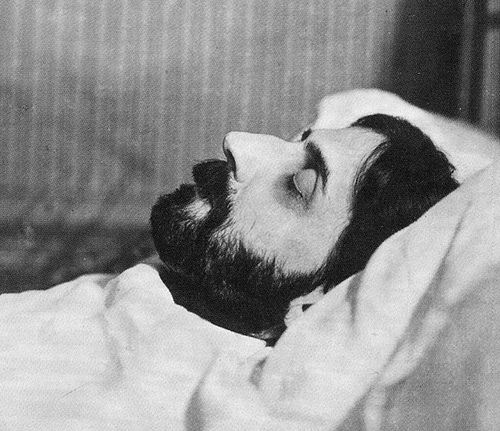
In A New York Life: Of Friends and Others, Brendan Gill provides a short profile of the artist Man Ray, who was born in Philadelphia in 1890. One of Ray’s most famous photos was of the newly dead writer Marcel Proust. Ray explains to Gill how that photo came about. An excerpt:

“As one  of those innumerable visitors to the shrine on the rue Férou, I asked Man Ray about his well-known photograph of Proust’s corpse, the eyes lying sunk into his skull, the chin and cheeks unshaven–never had a body looked more intensely (one might even say, Proust being Proust, more intently) dead–and he told me that it was Cocteau who had arranged for him to take it.

The year was 1922, a short while after Man Ray and Cocteau had met. As Man Ray told the story, surely not for the first time and surely not for the last, his telephone rang one Sunday morning, and it was Cocteau babbling in a high, distressed voice, “Venez toute de suite! Notre petit Marcel est mort!” Man Ray picked up what he called his ‘old shoe’ of a camera and made his way to Proust’s apartment, to which Cocteau admitted him.

The only available light came from a single electric light bulb of low wattage directly above Proust’s bed. Had that made it difficult, I inquired, to take the picture? The little god in his attic looked at me with good-humored scorn. ‘Certainly not!’ he exclaimed. ‘A corpse is the easiest thing in the world to photograph. The subject being motionless. I was able to set my camera for as long an exposure as I pleased. The results were, let me say, satisfactory.'”

Tags: , , ,

Someone told Tyler Cowen to fold his arms like this for the photo. (Image courtesy of Tyler Cowen.)

The economist Tyler Cowen offers as good a defense of liberal arts education as any on his blog, The Marginal Revolution. An excerpt:

“Liberal arts education forces us to decode systems of symbols.  We learn how complex systems of symbols can be and what is required to decode them and why that can be a pleasurable process.  That skill will come in handy for a large number of future career paths.  It will even help you enjoy TV shows more.

For related reasons, I believe that people who learn a second language as adults are especially good at understanding how other people might see things differently.

I am interested in food (among other topics), not only because of the food itself.  I also view it as an investment in understanding symbolic meaning, cultural codes of excellence, the transmission of ideas, and also how the details of an area fit together to form a coherent whole.  I believe this knowledge makes me smarter and wiser, although I am not sure which mass-produced formal test would pick up any effects.  I view this interest as continuing my liberal arts education, albeit through self-education.”

Tags:

"You don’t gain any wisdom as the years go by. You fall apart, is what happens." (Image by Colin Swan.)

In case you missed David Itzkoff’s September 14 New York Times Q&A with Woody Allen in conjunction with the release of You Will Meet A Tall Dark Stranger, here’s an excerpt of the 74-year-old director’s unsurprisingly bleak view of his golden years:

“Q. How do you feel about the aging process?

A. Well, I’m against it. [laughs] I think it has nothing to recommend it. You don’t gain any wisdom as the years go by. You fall apart, is what happens. People try and put a nice varnish on it, and say, well, you mellow. You come to understand life and accept things. But you’d trade all of that for being 35 again. I’ve experienced that thing where you wake up in the middle of the night and you start to think about your own mortality and envision it, and it gives you a little shiver. That’s what happens to Anthony Hopkins at the beginning of the movie, and from then on in, he did not want to hear from his more realistic wife, ‘Oh, you can’t keep doing that — you’re not young anymore.’ Yes, she’s right, but nobody wants to hear that.

Q. Has getting older changed your work in any way? Do you see a certain wistfulness emerging in your later films?

A. No, it’s too hit or miss. There’s no rhyme or reason to anything that I do. It’s whatever seems right at the time. I’ve never once in my life seen any film of mine after I put it out. Ever. I haven’t seen Take the Money and Run since 1968. I haven’t seen Annie Hall or Manhattan or any film I’ve made afterward. If I’m on the treadmill and I’m scooting through the channels, and I come across one of them, I go right past it instantly, because I feel it could only depress me. I would only feel, ‘Oh God, this is so awful, if I could only do that again.'”

Tags: ,

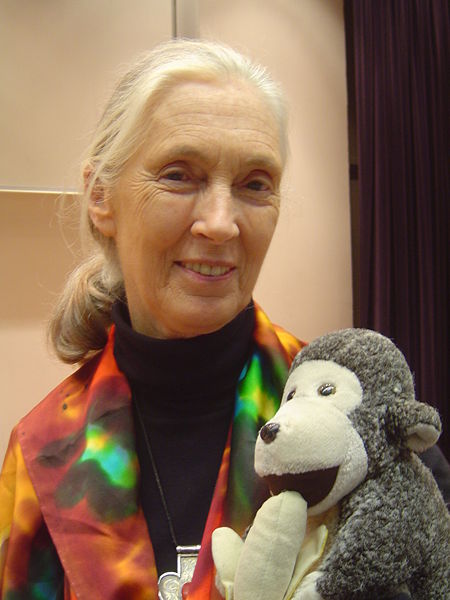
If Jane Goodall gets one more stuffed monkey as a gift, she will punch you right in the nose. She's nice, but stop.

Any list of the most significant people alive today would be incomplete without Jane Goodall’s name. Trained as a secretary in a time when women weren’t exactly encouraged to study science, she became one of the most significant anthropologists of her time. National Geographic has a celebration of Goodall’s five decades of work studying the Kasakela chimpanzee community in Gombe Stream National Park, Tanzania, putting its entire photographic collection of the scientist and her work online. (Thanks to boing boing for pointing me to the piece.) An excerpt from David Quammen’s excellent accompanying article:

A carving of David Greybeard, the first chimpanzee to befriend Jane Goodall.

Science history, with the charm of a fairy-tale legend, records some of the high points and iconic details of that saga. Young Miss Goodall had no scientific credentials when she began, not even an undergraduate degree. She was a bright, motivated secretarial school graduate from England who had always loved animals and dreamed of studying them in Africa. She came from a family of strong women, little money, and absent men. During the early weeks at Gombe she struggled, groping for a methodology, losing time to a fever that was probably malaria, hiking many miles in the forested mountains, and glimpsing few chimpanzees, until an elderly male with grizzled chin whiskers extended to her a tentative, startling gesture of trust. She named the old chimp David Greybeard. Thanks partly to him, she made three observations that rattled the comfortable wisdoms of physical anthropology: meat eating by chimps (who had been presumed vegetarian), tool use by chimps (in the form of plant stems probed into termite mounds), and toolmaking (stripping leaves from stems), supposedly a unique trait of human premeditation. Each of those discoveries further narrowed the perceived gap of intelligence and culture between Homo sapiens and Pan troglodytes.

The toolmaking observation was the most epochal of the three, causing a furor within anthropological circles because “man the toolmaker” held sway as an almost canonical definition of our species. Louis Leakey, thrilled by Jane’s news, wrote to her: “Now we must redefine ‘tool,’ redefine ‘man,’ or accept chimpanzees as humans.” It was a memorable line, marking a very important new stage in thinking about human essence. Another interesting point to remember is that, paradigm shifting or not, all three of those most celebrated discoveries were made by Jane (everyone calls her Jane; there is no sensible way not to call her Jane) within her first four months in the field. She got off to a fast start. But the real measure of her work at Gombe can’t be taken with such a short ruler.”

Tags: , , ,

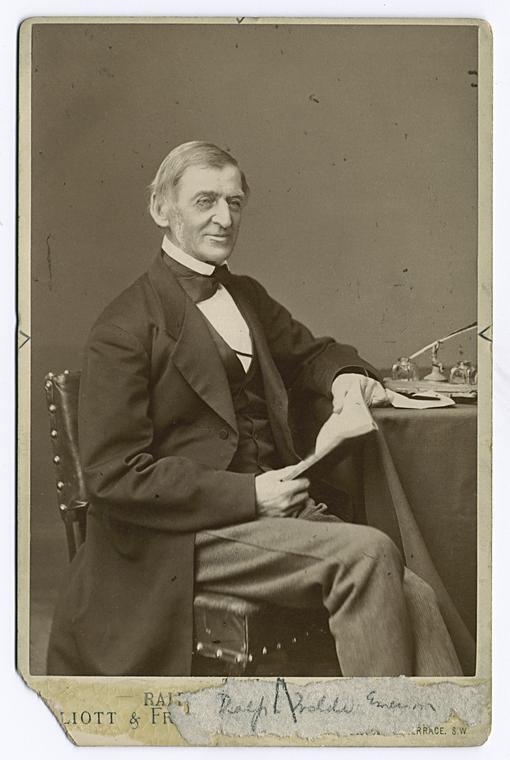
Ralph Waldo Emerson: "A foolish consistency is the hobgoblin of little minds."

The New York Times profiles the young, latter-day hippie couple, Taylor Bemis and Andrea Lieberg, who are currently caretakers of the Ralph Waldo Emerson House in Concord, Massachusetts. They’re 27, very sweet and a little clueless about the celebrated Transcendentalist, even though they seem like the type of people who would embrace his philosophy about individualism.

At any rate, here’s a brief description of the house’s history from Paige Williams’ article:

“Emerson and his second wife, Lidian, moved into the home in 1835. Over the next 47 years, they hosted a stream of distinguished guests at the house, fulfilling Emerson’s hope to ‘crowd so many books and papers and, if possible, wise friends, into it that it shall have as much wit as it can carry.’ Margaret Fuller, a pioneering feminist, spent hours talking with Emerson in his study. Louisa May Alcott practiced painting by copying the pictures that still hang on the Emersons’ walls. Henry David Thoreau lived with the family off and on for years and is believed to have stayed in what is now Ms. Lieberg and Mr. Bemis’s guest bedroom.

‘The ornament of a house is the friends who frequent it,’ Emerson wrote.”

Tags: , , ,

Most video stores charge about 50 cents a minute for tanning bed use. (Image by Evil Erin.)

The Hollywood Reporter has an odd and interesting article about the survival strategy of many of the 10,000 video-rental stores that remain in operation. Because of mail-order and streaming options from Netflix and Apple and rentals at cheap kiosks, the big-box rental places are gone or going. But more than a third of the indie stores that hope to survive the onslaught of online competition have added an interesting enticement: a tanning salon. The equipment isn’t cheap, but store owners are hoping it will draw in folks who’ll also buy lotions and rent a video. An excerpt:

At the rate big video-rental chains are closing up their shops, the 10,000 or so independently owned stores are getting creative to ensure they don’t suffer a similar fate. Combining movie rentals with tanning beds is one popular move.

More than 3,500 independently owned video-rental stores have added a tanning salon to their stores, estimated Ted Engen, president of the Video Buyers Group, an industry trade association.

A good tanning bed–one that consumers won’t mind paying about 50 cents a minute to use–can cost up to $15,000. Despite the hefty upfront cost and fattened energy bills, rental time combined with ancillary product sales like suntan lotion translate into a profitable business.”

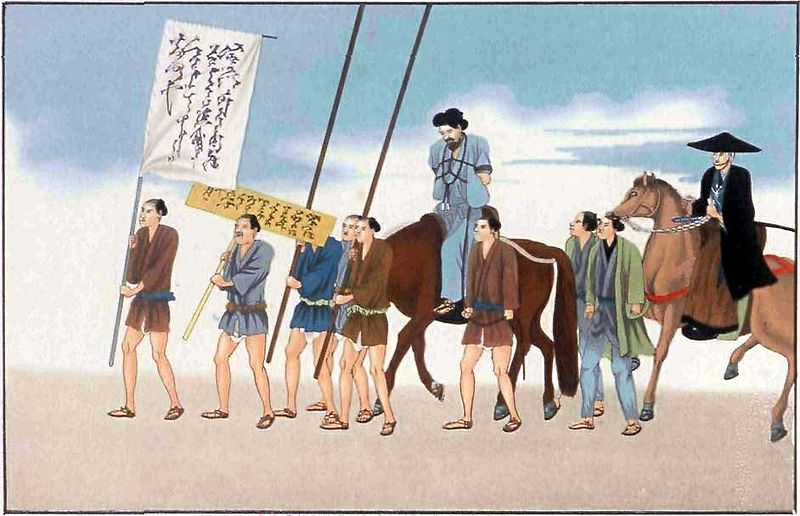
An 1867 depiction of a Japanese prisoner being transported to his execution.

Only two members in the Group of Eight industrialized nations have the death penalty–the United States and Japan. While the U.S. has a very public and very conflicted relationship with executions, Japan’s process has long been shrouded in secrecy and the cause of very little internal debate. Hiroko Tabuchi of the New York Times has an amazing and horrifying article that peeks behind the protocol and mindset that governs Japan’s system of executions, which allows for no possibility of pardon, and is often administered to convicts who’ve been coerced into confessions. It’s always perplexing when an entire nation goes along with a system that is so deeply flawed and unjust, but it happens all the time. An excerpt:

Japan also has a 99 percent conviction rate, a figure critics attribute to widespread use of forced confessions. A series of false convictions have surfaced in recent months, including one of a 63-year-old man who had served 17 years of a life sentence for the murder of a 4-year-old girl. He was released after prosecutors admitted that his confession was a fabrication made under duress and DNA tests showed he was innocent. Critics say there is a high possibility that some of those on death row are innocent.

Inmates on death row are not told when they will be executed until the last minute–a procedure Japanese officials say prevents panic among inmates–and their family members and lawyers are informed only afterward, as are the news media.

Inmates can remain on death row as long as 40 years, though executions over the past decade have occurred on average after about 5 years and 11 months on death row, according to the public broadcast channel NHK. The Justice Ministry has refused to disclose how it makes decisions to go ahead with executions.

A large majority of Japan’s population supports capital punishment. A recent government survey showed that 86 percent of respondents are in favor of state executions for the worst crimes.

‘Any debate should take into account the lifelong suffering that the victims’ families must bear,’ said Isao Okamura, whose wife was murdered over a work dispute in 1997, in an interview with NHK.

All executions are carried out by hanging.”

Tags: ,

A photo of Didion 30 years after this interview. (Image by David Shankbone.)

This 1978 Paris Review Q&A with Joan Didion had a sad coda when the interviewer Linda Kuehl died soon after the tapes were transcribed. From what I can gather online, Kuehl, who was writing a book about Billie Holiday at the time, committed suicide by jumping from a hotel window. Didion, who’s written so elegantly on the topic of death before and since, filled in for the late interviewer and wrote the opening paragraphs, crediting Kuehl’s intelligence for making her at ease, not something easily done. A few excerpts from the Q&A.

__________

Paris Review: You have said that writing is a hostile act; I have always wanted to ask you why.

Joan Didion: It’s hostile in that you’re trying to make somebody see something that way you see it, trying to impose your idea, your picture. It’s hostile to try to wrench around someone else’s mind that way. Quite often you want to tell somebody your dream, your nightmare. Well, nobody wants to hear about someone else’s dream, good or bad; nobody wants to walk around with it. The writer is always tricking the reader into listening to the dream.

__________

Paris Review: When did you know you wanted to write?

Joan Didion: I wrote stories from the time I was a little girl, but I didn’t want to be a writer. I wanted to be an actress. I didn’t realize then that it’s the same impulse. It’s make-believe. It’s performance. The only difference being that a writer can do it all alone. I was struck a few years ago when a friend of ours–an actress–was having dinner here with us and a couple of other writers. It suddenly occurred to me that she was the only person in the room who couldn’t plan what she was going to do. She had to wait  for someone to ask her, which is a strange way to live.

___________

Paris Review: What are the disadvantages, if any, of being a woman writer?

Joan Didion: When I was starting to write–in the late fifties, early sixties–there was a kind of social tradition in which male novelists could operate. Hard drinkers, bad livers. Wives, wars, big fish, Africa, Paris, no second acts. A man who wrote novels had a role in the world, and he could play that role and do whatever he wanted behind it. A woman who wrote novels had no particular role. Women who wrote novels were quite often perceived as invalids. Carson McCullers, Jane Bowles, Flannery O’ Connor, of course. Novels by women tended to be described, even by their publishers, as sensitive. I’m not sure this is true anymore, but it certainly was at the time, and I didn’t much like it. I dealt with it the same way I deal with everything. I just tended my own garden, didn’t pay much attention, behaved–I suppose–deviously. I mean I didn’t actually let too many people know what I was doing.


Tags: ,

Detroit boomed in the 1920s, as the Industrial Revolution and auto production soared.

Rome wasn’t built in a day, and Pittsburgh didn’t shrink in one. Decreasing the scale of a large, struggling city is as challenging, maybe even moreso, than growing one, and a city like Pittsburgh, which once had a thriving working-class economy based on steel, had to get smaller and savvier to survive over the last three decades.

Because of the housing collapse and other factors, quite a number of American cities–many in Michigan and Ohio–will likely need to reimagine themselves on a smaller scale now and in the future. Drake Bennett at Boston.com has an excellent article called “How to Shrink a City,” which looks at this phenomenon. An excerpt:

“Now a few planners and politicians are starting to try something new: embracing shrinking. Frankly admitting that these cities are not going to return to their former population size anytime soon, planners and activists and officials are starting to talk about what it might mean to shrink well. After decades of worrying about smart growth, they’re starting to think about smart shrinking, about how to create cities that are healthier because they are smaller. Losing size, in this line of thought, isn’t just a byproduct of economic malaise, but a strategy.

The resulting cities may need to look and feel very different–different, perhaps, from the common understanding of what a modern American city is. Rather than trying to lure back residents or entice businesses to build on vacant lots, cities may be better off finding totally new uses for land: large-scale urban farms, or wind turbines or geothermal wells, or letting large patches revert to nature. Instead of merely tolerating the artist communities that often spring up in marginal neighborhoods, cities might actively encourage them to colonize and reshape whole swaths of the urban landscape. Or they might consider selling off portions to private companies to manage.”

Tags:

Fry me. (Image by Marcus Wong.)

I know you can deep fry anything, but I had never heard about deep-fried beer until this recent article in the Dallas News (thanks to Marginal Revolution for the tip). It is the brainchild of Mark Zable, who entered his concoction in the State Fair of Texas over the Labor Day weekend. Zable’s delicacy indeed won the Most Creative award, while the Best Taste award went to the Texas Fried Frito Pie.

Here’s how and why Zable fries suds:

“Fried Beer is a beer-filled pretzel-like dough pocket that’s shaped like ravioli. Take a bite and the beer pours out. But don’t cry over spilled suds. Simply use the dough to soak up the rest of the brewski.

‘Why drink your beer when you can eat it?’ creator Mark Zable said.

For three years, Zable has been on a mission to concoct Fried Beer. He remembers staring at a bar menu in a restaurant. Calamari. Nachos. Fried cheese. Bor-ing.

‘Someone needs to figure out a way to fry beer,’ he thought.

Zable started experimenting. But the beer-and-dough concoction kept exploding once it hit the fryer. He kept getting burned. So he consulted with a food scientist–still, no luck. Then, earlier this year, he finally found the recipe for success.”

Tags:

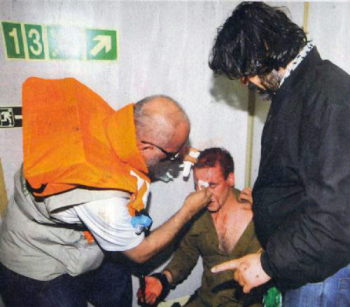
An Israeli Defense Forces soldier is treated for injuries during the Gaza Flotilla Raid.

Even though I occasionally make fun of the Huffington Post, they do some exceptional work. One example I just came across is a piece of eyewitness reportage from the Middle East that was written by a super-smart former colleague of mine named Kate Lowenstein. The piece, “The West Bank: A Firsthand Look,” is a really well-written account of the writer’s June trip to Ramallah in wake of the Gaza Flotilla Raid. You don’t have to agree with Lowenstein’s conclusions, but it’s hard not to be impressed by her unflinching account of what life in this border struggle looks like when we stop thinking of it in the abstract. An excerpt:

“Day one: Day trip to Old Hebron
According to the adolescent Palestinian boy who spent several minutes pedaling his wobbly bike alongside us as we walked, this cobblestoned, arched casbah contains 30,000 Palestinians, 500 Jewish settlers and 2,000 Israeli soldiers (I was able to confirm these approximations online, although the estimated number of settlers ranges from 400 to 800). That’s about a four-to-one ratio of soldiers to settlers, and, as my adult host explained, those soldiers are there exclusively to protect their Jewish charges from what they perceive as an Arab threat. This is especially important given that the Jewish settlers are methodically moving in on this Palestinian city, potentially making those Arabs pretty angry. The tension is palpable.

While in most parts of the West Bank, settlers take up residence in areas near Palestinian neighborhoods, in Old Hebron they are actually taking property, sealing off roads and choking traffic from what were once bustling Palestinian shops–and getting away with it because they have a military to support them. If you walk on many of the increasingly deserted Palestinian streets (there are separate ones designated for Jews only–an offense that apartheid South Africa didn’t even dare commit), you’ll see a strange net overhead, stretched from one side of the street to the other. Dotting that net are pieces of garbage–cups, plastic bags, food scraps, filthy pieces of odds and ends. I wouldn’t have believed it had I not seen it with my own eyes: the settlers–who have moved into the second floors of Palestinian buildings–make a habit of throwing their trash down at their Arab neighbors.”

Tags:

Oliver Sacks turned 77 in July. (Image by Erik Charlton.)

Steve Silberman of NeuroTribes has an interview with Dr. Oliver Sacks, in which the neurologist describes in painterly detail his realization that he had cancer. An excerpt:

Steve Silberman: Oliver, what happened to you just before Christmas in 2005?

Dr. Oliver Sacks: It was a Saturday, eight days before Christmas, the 17th. It seemed just an ordinary day. I got up, went for my usual swim, and decided to go to the cinema, but as soon as the previews started, I became aware of something bizarre happening–a sort of incandescent fluttering to my left, which I took to be a visual migraine. But then I became certain that it was in my eye and not in the brain, as a migraine would be. That really alarmed me. I thought, ‘What’s happening? Am I detaching a retina? Am I going blind?’

I didn’t know what I should do about it–whether I should go to an emergency room or phone up an ophthalmologist, or stay put and see if it all settled. I did the last of these, although I couldn’t concentrate on the film. I kept testing my visual field. Then I noticed that some of the little lights showing the way out of the cinema had disappeared in front of me.

Finally, after about 20 minutes, I burst out of the theater, hoping that in the world outside, everything would look real. But it was evident to me that there was still a triangular chunk of my visual field missing, going from about nine o’clock to eleven o’clock. I phoned up a friend who asked a few questions, suggested a few tests, and then said, ‘Get yourself to an ophthalmologist ASAP.’

I did so and told my story to the ophthalmologist. He took an ophthalmoscope, looked in my eye–and then I saw him stiffen. He put down the ophthalmoscope and looked at me in a different way, a serious and concerned way. He said, ‘I see pigmentation. There’s something behind the retina. It could be a hematoma or a tumor. If it’s a tumor, it could be benign or malignant.’ Then he said, ‘Let’s consider the worst case scenario.’ I don’t know what he said after that, because a voice in my head started shouting, ‘Cancer! Cancer! Cancer!'”

Tags: ,

"Stella Bugbee" is inscribed on the inside flap. The previous owner, I suppose. There's a designer by that name, but I don't know if it's the same person.

I gleaned this book a few blocks from my Brooklyn apartment just yesterday. It’s a beat-up hardback copy (sans dust jacket) of a Playboy compilation of interviews, fiction, reportage and humor from the era when Hefner put out a great publication that attracted the best writers. This collection features work from Woody Allen, Murray Kempton, Joyce Carol Oates and Vladimir Nabokov.

One brief, interesting piece from 1971, “World 42-Freaks 0,” recounts conservative author Garry Willis’ visit to a Canadian commune, where he mostly found “dope, dirt and self-indulgence.” An excerpt about a drug deal gone awry:

“A car door slams–Tony, back from taking Dani to the city. His hair is short, the Army crew cut still growing out: his tanned, thin arms are scribbled over with ‘good ole boy’ unsophisticated tattoos. His eyes light up at the sight of two motorcycles, and he kicks one off into the field, wheels slipping as he bangs off thin deciduous trees, then races halfway up the incline till the loose grass and leaves throw him, laughing crazily. the motor kicks and coughs itself to rest on the ground.

‘Bombed out of his head,’ Al mutters. ‘He was supposed to deal some dope in the city, but he got high on the first batch. Well, it always happens. When people first come over the border, they have to stay high for a couple of weeks before they can get themselves together.’ Tony deserted last week, when his company was preparing to ship out for Vietnam. ‘That mean we’ll have nothing but rice and salad for dinner tonight.'”

More Gleanings:

Stuck zipper. (Image by John Mathias.)

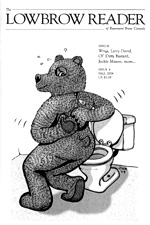
I used to work with the really witty journalist Jay Ruttenberg. In addition to his many other enterprises, he publishes a wry, wonderful zine called The Lowbrow Reader, which focuses on the world of comedy, gleefully mocking everything along the way. For anyone raised on Mad magazine, it’s so up your alley. (You can order back issues here.) And it’s fun knowing that someone is walking around in 2010, completely obsessed with Harpo Marx and the like.

Each cover has a play on the same disgusting theme: someone attempting to relieve himself or herself in a bathroom. But complications often ensue. In the cover on the right, a man dressed as a bear is stuck in his costume when he really needs to use the toilet. When I had my apartment painted a few years back, I walked in on one of the workers, who spoke no English, laughing heartily at this image. A guy in a bear costume trying desperately to take a dump is a universal language.

Inside this issue, you can read an essay from a woman who dated Jackie Mason and a critical consideration of the TV show Wings. (No, seriously.) There’s also a filthy, funny piece about the inner sanctum of Brooklyn rapper Ol’ Dirty Bastard (who passed away after this issue was published). The person describing ODB’s home is a talented writer named Margeaux Watson, also a former colleague, who visited the rapper’s lair to interview him in all his dirty, bastardly glory. An excerpt:

"It was the smell of Newport cigarettes, feet, ass, food and unbrushed teeth."

Lowbrow Reader: You’re probably one of the few women who has been inside Ol’ Dirty Bastard’s house and hasn’t returned with a venereal disease.

Margeaux Watson: Or a child.

Lowbrow Reader: Where does he live?

Margeaux Watson: He lives in Brooklyn. It’s an odd location–it’s not ghetto-ish, but it’s also not where you’d expect a star to live. In Brooklyn, most stars live in Brooklyn Heights, Williamsburg or Fort Greene. But he’s in more of a working-class, family neighborhood. A lot of brownstones and row houses; it’s not near a subway or an urban center.

Lowbrow Reader: What’s his house like?

Margeaux Watson: He lives in a brownstone. It’s been renovated, so it’s modern on the inside. It’s a narrow apartment, with white walls and hardwood floors. It’s surprisingly well-kept and pretty neat–except for its smell. It smelled bad.

Lowbrow Reader: Can you describe the odor?

Margeaux Watson: It was the smell of Newport cigarettes, feet, ass, food and unbrushed teeth. Just all-around funk. A bouquet of stink.”

Tags: , , , , ,

Ron Paul: Even I'm not that crazy.

From ronpaul.com:

The outcry over the building of the mosque, near ground zero, implies that Islam alone was responsible for the 9/11 attacks. According to those who are condemning the building of the mosque, the nineteen suicide terrorists on 9/11 spoke for all Muslims. This is like blaming all Christians for the wars of aggression and occupation because some Christians supported the neo-conservatives’ aggressive wars.

The House Speaker is now treading on a slippery slope by demanding a Congressional investigation to find out just who is funding the mosque—a bold rejection of property rights, 1st Amendment rights, and the Rule of Law—in order to look tough against Islam.

This is all about hate and Islamaphobia.

We now have an epidemic of “sunshine patriots” on both the right and the left who are all for freedom, as long as there’s no controversy and nobody is offended.

Political demagoguery rules when truth and liberty are ignored.”

Tags:

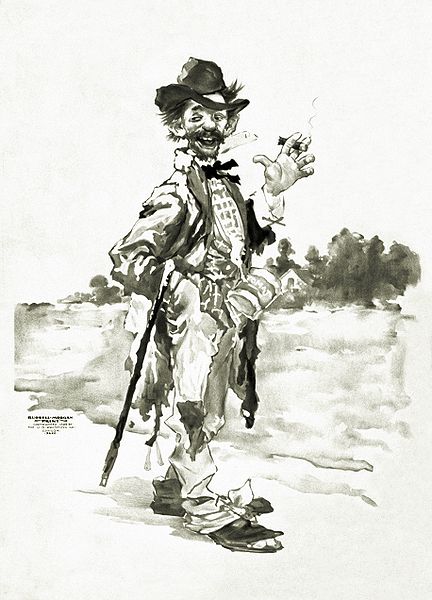
Fresno Slim's Bum Spit--the bum spit category leader since 1899.

I came across this funny McSweeney’s phony advice column, which was written by Alison Rosen, who was a very witty colleague of mine some time ago. She also has an Internet TV show called Alison Rosen Is Your New Best Friend, in which she talks non-stop into a camera. Seriously, she either can’t or won’t shut the fuck up. An excerpt from the McSweeney’s piece, Poverty Is Wonderful, which looks at the positive side of the economic decline:

•No one can accuse you of being a rich asshole
Go ahead, see how many rich assholes you can name. We could play this game all day if I didn’t have a croquet match in twenty. But the point is that everyone can list rich assholes. Poor people can be assholes too, but no one knows their name. Being poor is like being in the asshole witness protection program. That’s something money can’t buy.

•No one tries to use you for your money
Do you have any idea what it’s like to be pursued by only the most attractive and eligible members of the opposite sex? To be invited to countless galas? To spend every waking moment on a yacht? It’s empty, but you wouldn’t possibly understand. Heavy hangs the neck that wears the VIP laminate. But when someone visits your hovel or cardboard box you can be assured that they really like you for you. Or because you’re on their stoop.

•You don’t have to wonder what you’d do if you didn’t spend so much time making money
Go ahead and make that artistic masterpiece out of crushed cans and bum spit. Write your novel on Popsicle sticks. Stage a production of Cats featuring real cats.

•No awkward lying to beggars
Instead of averting your gaze and mumbling “no, sorry” to a panhandler who asks if you have spare change, you can confidently look the beggar square in the eye and feel great about not helping.

Tags: ,

Taking a break from e-mailing. (Image by Arcimboldo.)

The Japanese sport of sumo wrestling has always been a dicey business. The industry has been linked to yakuza, match fixing and illicit gambling. A recent betting scandal has convinced officials at the JSA (Japan Sumo Association) that they need to improve communication between themselves and the organization’s wrestlers. The problem? The rotund athletes’ fingers are so large that they aren’t able to execute keyboard strikes and remain in email contact with the supervisors. The solution? The JSA has purchased iPads for their beefy, large-fingered competitors, to make emailing easier for them. Thanks to Marginal Revolution for pointing me in the direction of this BBC article on the topic. An excerpt:

“The sport’s authorities were criticised for their clumsy efforts to investigate the scandals, in part due poor communication between sumo leaders. The iPads are intended to speed up communication between JSA officials, wrestlers and coaches, who have until now relied on telephone or fax.

‘We will hand out the newest iPads to all the sumo stables to swiftly communicate what we need to,’ JSA vice chairman Hiroyoshi Murayama said.

Many Japanese newspapers also reported that the iPad had been chosen because of its large touch-screen keys that can be easily prodded by the giant wrestlers. ‘When they try to send e-mail on mobile phones or PCs they often end up pressing two or three keys at once,’ said the daily Nikkan Sports.

Tags:

China: Like Los Angeles, but worse. (Image by Rgoogin.)

As China hurtles ahead like a rocket into its highly urban future, the country’s environmental and quality-of-life challenges mount. Formerly a rural culture in which bicycles ruled the road, China’s experiencing a proliferation of cars that’s overwhelmed its infrastructure. The Global Times has a story about a colossal nine-days-and-counting traffic jam across 100 kilometers of highway in the Huai’an section of Northern China. Traffic experts believe it could last, yikes, a month.

But the snarl has created insta-markets for entrepreneurs who have flocked to the area to serve the stranded drivers’ needs–and make a buck. An excerpt from the article:

For drivers, suffering the congestion on the Beijing-Tibet Expressway is nothing new. In a similar scene this July, traffic was also reduced to a crawl for nearly one month. Some killed time by playing cards, while some could only wait idly by. In the latest bout of congestion on the Huai’an section, a truck driver surnamed Huang, told the Global Times that he suffered ‘double blows.’

‘Instant noodles are sold at four times the original price while I wait in the congestion,’ he said. ‘Not only the congestion annoys me, but also those vendors,’ he joked.”

Tags:

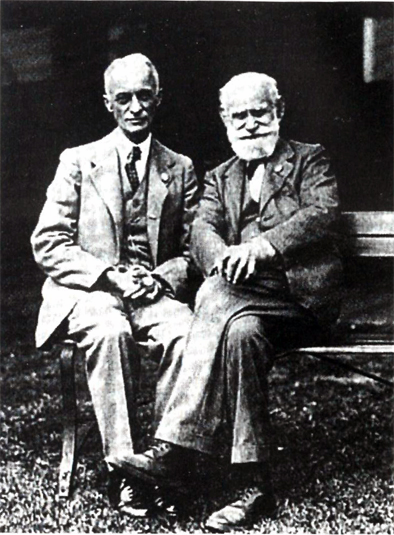
Dr. Cushing, left, with Ivan Pavlov, soon before the beaviorist was mauled and devoured by a dog he teased.

Pioneering Ohio-born neurosurgeon Dr. Harvey Cushing did many great things for mankind, including introducing blood-pressure measurement to America. He did one final great thing for science in 1939, when he bequeathed a large collection of cancerous brains he’d amassed to his alma mater Yale University. Yale did a pretty brainless thing when it allowed the collection and the meticulous notes that accompanied it to fall into disrepair. Thankfully, the invaluable medical remnants are once again in respectable shape after a $1.4 million renovation project. Dr. Randi Hutter Epstein has a good article about the project in the New York Times. The piece also makes it clear that despite Cushing’s talent and preparation, brain surgery during his career was still very much a work in progress. An excerpt:

Cushing became the first surgeon in history who could open what he referred to as ‘the closed box’ of the skull of living patients with a reasonable certainty that his operations would do more good than harm.

Sometimes doctors went into the brain and could not find the tumor. Sometimes they talked to patients during surgery. Dr. Cushing, for one, often used only the local anesthetic Novocain. (The brain itself does not have pain receptors, but having one’s skull cut open must have been agonizing.) Mr. Bliss writes that in 1910, midway through a 10-hour operation on the renowned physician and Army Gen. Leonard Wood, Cushing wanted to stop operating and continue another day, but General Wood–fully alert–begged him to continue.”

Click on photo to read memorial inscription.

Tags: , ,

« Older entries § Newer entries »