Excerpts

You are currently browsing the archive for the Excerpts category.

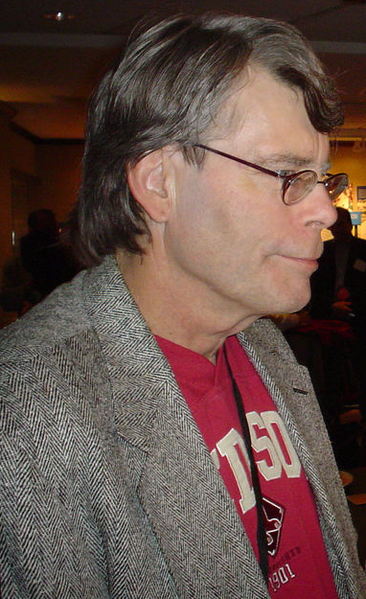
"Do you remember the days when people got up to manually turn the channels on their TVs? Nobody does that any more, and nobody would want to go back." (Image by Michael Femia.)

Jeffrey A. Trachtenberg of the Wall Street Journal interviewed author Stephen King on the future of e-books and physical books. A few excerpts:

The Wall Street Journal: Do we get the same reading experience with e-books?

Stephen King: I don’t know. I think it changes the reading experience, that it’s a little more ephemeral. And it’s tougher if you misplace a character. But I downloaded one 700-page book onto my Kindle that I was using for research. It didn’t have an index, but I was able to search by key words. And that’s something no physical book can do.

•••••

The Wall Street Journal: What about people who love physical books?

Stephen King: I’m one of them. I have thousands of books in my house. In a weird way, it’s embarrassing. I recently downloaded Ken Follett’s “Fall of Giants,” but I also bought a copy to put on the shelf. I want books as objects. It’s crazy, but there are people who collect stamps, too.

•••••

The Wall Street Journal: How much time do you spend reading digitally?

Stephen King: It’s approaching half of what I read. I recently bought a print edition of Henning Mankell’s Faceless Killers and the type was too small. A paper book is an object with a nice cover. You can swat flies with it, you can put it on the shelf. Do you remember the days when people got up to manually turn the channels on their TVs? Nobody does that any more, and nobody would want to go back. This is just something that is going to happen.

Tags: ,

Art Deco elevators at the Empire State Building. (Image by Fletcher6.)

Thanks to Newmark’s Door for pointing me in the direction of Robert Krulwich’s NPR blog which reveals, with the help of science writer Mary Roach, the best way to survive if you are in an elevator that plunges. An excerpt:

“What should you do? Jump? Squat? Lie Down? You want to know before it happens because when the moment comes you are not going to have time to go to the library.

Here’s an answer: It popped up in a footnote on the bottom of page 133 in Mary Roach’s latest (and very charming) book, Packing for Mars.

[T]he best way to survive in a falling elevator is to lie down on your back. Sitting is bad but better than standing, because buttocks are nature’s safety foam. Muscle and fat are compressible: they help absorb the G forces of the impact.

As for jumping up in the air just before the elevator hits bottom, it only delays the inevitable. Plus, then you might be squatting when you hit. In a 1960 Civil Aeromedical Research Institute study, squatting on a drop platform caused ‘severe knee pain’ at relatively low G forces. ‘Apparently the flexor muscles … acted as a fulcrum to pry open the knee joint,’ the researchers noted with interest and no apparent remorse.”

Tags: ,

Inmates favored Flannery O'Connor because her cover photo made her look "kind of busted up."

Avi Steinberg, a Harvard graduate with no direction in life, answered a Craigslist ad and became a librarian to male and female prison inmates in Boston. He learned what writers prisoners most like–Anne Frank, Sylvia Plath, Martina Cole–but also that maybe literacy can’t heal all deep-seated problems. He’s written about his experience in Running the Books: The Adventures of an Accidental Prison Librarian. (Thanks to Marginal Revolution.) An excerpt from a Guardian article about the book:

“Steinberg’s experiences seem to have made him somewhat wary of the notion that books have the power to transform – not least after the occasion when he was mugged in a park by an ex-con who boasted that he’d still got two overdue titles that Steinberg had issued to him. ‘Transformation was not necessarily the main story,’ he reflects. ‘It happened in some instances but they were notable exceptions. Prisoners weren’t there to transform themselves, or be transformed – but they would still come to the library.'”

Tags: , , ,

In 2004, when Bubba was still a fat, ruddy bastard.

Bill Clinton is on a strict vegan diet these days, which is bad news for certain restaurants. According to an amusing article by David Segal in the New York Times, eateries where the former President has stuffed his piehole continue to benefit from his visit for years. An excerpt:

Bill Clinton has dined at Bukhara, an upscale restaurant in New Delhi, on just two occasions, but the afterglow of those visits has never worn off. The clientele, it seems, won’t let it.

Since that first meal, in 2000, so many customers have uttered some variation of ‘Give us what the president had,’ that the restaurant has started serving a mixed-meat sampler — a one-off prepared for Mr. Clinton and his guests — as a nightly special. The Bill Clinton platter, as it is known, is an aromatic spread of mixed meats, lentils and oven-baked bread.

Price: 5,000 rupees, or about $110.

For those who can’t handle that much minced lamb and chicken tandoori, a night at Bukhara can still have a Clintonian cast. Just ask for ‘the Clinton table,’ the six-seater said to be Mr. Clinton’s perch of choice in the middle of the restaurant, with an unhindered view of the open-air kitchen.

But be sure to call ahead.”

Tags: ,

"A researcher using tweezers located and removed the problem: a 2-in. long moth."

Longform posted a link to a 1984 cover story from Time magazine about the growing importance of software designed for personal computers. It’s a pretty standard story of the era, but it contains one interesting fact: It explains how the phrase “computer bug” was coined. Maybe everyone else on the planet knows this story, but I didn’t. An excerpt:

Grace Hopper, one of the pioneer programmers, created COBOL (COmmon Business-Oriented Language), which is the most widely used programming language for mainframe computers.

Now 77, Hopper works at the U.S. Navy’s computer center in Washington. Since the 1982 retirement of Admiral Hyman Rickover at 82, Commodore Hopper is the Navy’s oldest officer on active duty.

She gets credit for coining the name of a ubiquitous computer phenomenon: the bug. In August 1945, while she and some associates were working at Harvard on an experimental machine called the Mark I, a circuit malfunctioned. A researcher using tweezers located and removed the problem: a 2-in. long moth. Hopper taped the offending insect into her logbook. Says she: ‘From then on, when anything went wrong with a computer, we said it had bugs in it.’

(The moth is still under tape along with records of the experiment at the U.S. Naval Surface Weapons Center in Dahlgren, Va.)”

••••••••••


Tags: ,

Margaret Thatcher gets the fun-house treatment from Lola Dupré.

Scottish visual artist Lola Dupré distorts images of historical figures and contemporary celebrities to create spectacularly deranged, provocative and funny portraits. Check out her photostream.  (Thanks to Boing Boing.) An excerpt from an interview Dupré did with Hi-Fructose:

“I find humour to be an important aspect of my work, especially when working with an image that is already very well known. The resulting manipulated image has an almost automatic sense of humour to it.

When I work on an image, the result is almost like a circus freak or a clown’s make-up: a distorted version of reality where the reality is still visible. This creates, in my opinion, either humour or horror. I am happy to express and elicit both, as this is a reflection of the reality of our lives and something we should talk about.”

Tags:

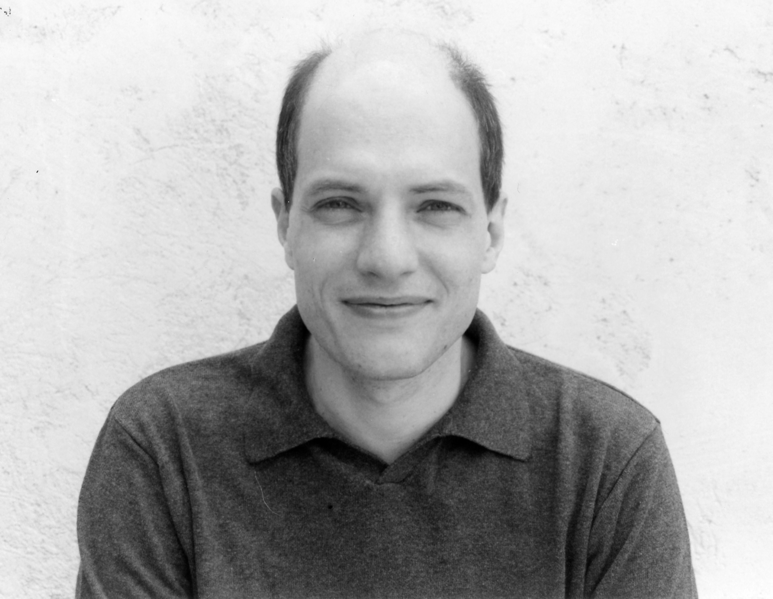
Alain de Botton is filthy rich due to a trust fund.

The Swiss-born British-based philosopher Alain de Botton spent a week as writer-in-residence in the middle of Terminal 5 at Heathrow Airport. It’s a loud, bustling place that wouldn’t seem conducive to writing, but oddly those are usually the best places to write. De Botton provides a pretty good explanation as to why it works this way. (Thanks to Boing Boing.) An excerpt:

“The best place I ever worked was Heathrow Terminal 5, where I had a desk right in the middle of the departures hall. I was invited to the airport to be a Writer in Residence (and later wrote a book about the experience, A Week at the Airport). The terminal turned out to be an ideal spot in which to do some work, for it rendered the idea of writing so unlikely as to make it possible again. Objectively good places to work rarely end up being so; in their faultlessness, quiet and well-equipped studies have a habit of rendering the fear of failure overwhelming. Original thoughts are like shy animals. We sometimes have to look the other way – towards a busy street or terminal – before they run out of their burrows.”

Tags:

Pink crosses memorialize women murdered in Ciudad Juarez. (Image by iose.)

According to an article from an Australian news service, a 20-year-old criminology student has been named Chief of Police in a Mexican border town near Ciudad Juárez, Mexico’s most violent city, simply because no one else wanted the job. It may sound like an offbeat human-interest story, but the violence in that city, particularly against women, has long been horrific. An excerpt:

A 20-YEAR-OLD female criminology student has been named police chief of a northern Mexican border town plagued by drug violence because no one else wanted the job.

Marisol Valles became director of municipal public security of Guadalupe ‘since she was the only person to accept the position,’ the mayor’s office of the town of some 10,000 people near the US border told local media yesterday.

Ms Valles is studying criminology in Mexico’s most violent city of Ciudad Juarez, some 60km west of Guadalupe.

Raging turf battles between rival drug gangs have left some 6500 people dead in Ciudad Juarez alone in the past three years.

Much of Chihuahua state has suffered from the spiral of drug violence, including in Guadalupe, where the mayor was murdered in June and police officers and security agents have been killed, some of them beheaded.”

Tags:

Ronald McDonald: Spraying people with his DNA. (Image by M.Minderhoud.)

The New York Times’ John Tagliabue has filed an interesting article about McDonald’s high-tech attempts at crime prevention at one of their Rotterdam restaurants. It involves employees activating an alarm that sprays criminals with DNA and alerts police that a crime is in progress. (Thanks to Gizmodo.) An excerpt:

At this McDonald’s the DNA liquid is contained in an orange box the size of a large paperback book, mounted over an entrance door. ‘You don’t smell it; you don’t see it; nobody knows it’s there,’ said Jean-Paul Fafie, who has managed the McDonald’s for the last 12 years.

The system and the all-important warning sign seem to have successfully warded off any potential robbers. But there were kinks to be worked out.

‘In the beginning, it went off many times, even when there was no robbery,’ Mr. Fafie said. ‘And the police came every time.’

The false alarms were caused by employees who forgot, or never knew, about the protocol for secretly activating the system — removing a 10 euro bill from a special bill clip kept behind the counter.

‘We didn’t train our counter people properly,’ Mr. Fafie said sheepishly. As for a potential thief, he said, “we hope he’ll think twice before coming in.’”

Tags: ,

The Walk of Ideas in Berlin. (Lienhard Schulz.)

The excellent writer Luc Sante has an interesting article, “The Book Collection That Devoured My Life,” in the Wall Street Journal, about his compulsive book-collecting. Sante isn’t a bibliophile with a yen for first editions; he’s just a guy who loves the printed word and can’t keep his hands off of anything with two covers, even if it’s a volume he’s unlikely to read. Sante also comments on the digitization of books and the ascension of e-readers. An excerpt:

These days it may appear that books, per se, are doomed. The electronic readers are ever lighter, smaller, and more sophisticated. Google is undertaking to scan and digitize every book in the world — not without some resistance. Steve Jobs was quoted as saying that even the reading devices are pointless, since according to him nobody reads anymore, at least not in the sense of sequentially taking in long and complex works. I have nothing against the readers, and may find myself buying one eventually — they’d come in very handy on trips, the way the iPod does. I’m all in favor of the comprehensive digitizing of the world’s books, since that would very much ease small points of research (and I’m not worried about losing control of my copyrights, since it’s unlikely many people would read entire books online that way). As far as the decline of reading goes, I am nervous, but also believe that matters of taste and inclination do swing around on long orbits.

But I would very much miss books as material objects were they to disappear. The tactility of books assists my memory, for one thing. I can’t remember the quote I’m searching for, or maybe even the title of the work that contains it, but I can remember that the book is green, that the margins are unusually wide, and that the quote lies two-thirds of the way down a right-hand page. If books all appear as nearly identical digital readouts, my memory will be impoverished. And packaging is of huge importance, too–the books I read because I liked their covers usually did not disappoint. In the world of books, all is contingency and serendipity. Books are much more than container vessels for ideas. They are very nearly living things, or at least are more than the sum of their parts.”

Tags: ,

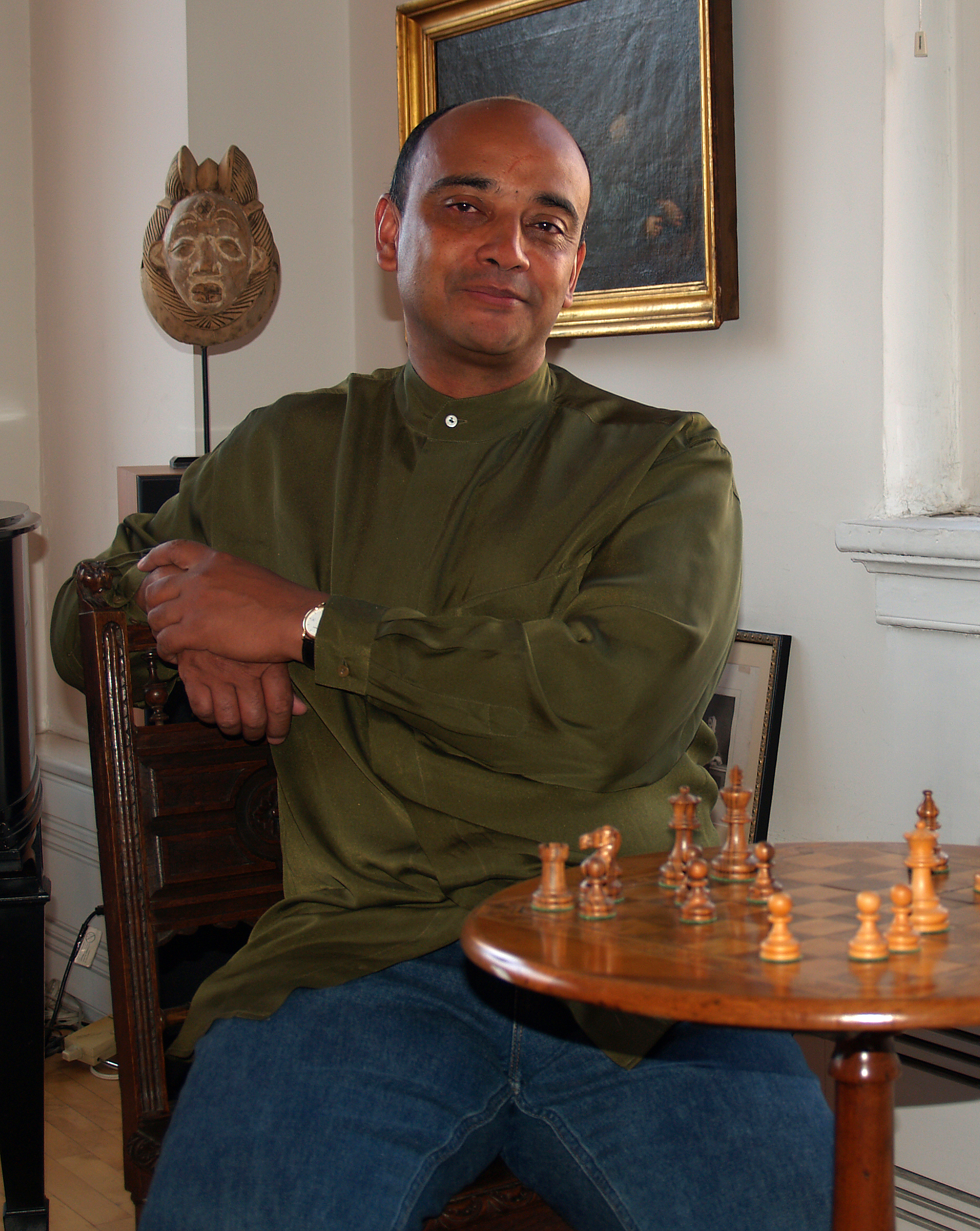
If he keeps thinking so much, Kwame Anthony Appiah's head will explode. (Image by David Shankbone.)

In a recent Washington Post article (“What Will Future Generations Condemn Us For?“), Cosmopolitanism author Kwame Anthony Appiah pinpoints contemporary behavior that he believes will be seen as shameful in the future. He settles on four topics. An excerpt about one troubling area:

Our Prison System

We already know that the massive waste of life in our prisons is morally troubling; those who defend the conditions of incarceration usually do so in non-moral terms (citing costs or the administrative difficulty of reforms); and we’re inclined to avert our eyes from the details. Check, check and check.

Roughly 1 percent of adults in this country are incarcerated. We have 4 percent of the world’s population but 25 percent of its prisoners. No other nation has as large a proportion of its population in prison; even China’s rate is less than half of ours. What’s more, the majority of our prisoners are non-violent offenders, many of them detained on drug charges. (Whether a country that was truly free would criminalize recreational drug use is a related question worth pondering.)

And the full extent of the punishment prisoners face isn’t detailed in any judge’s sentence. More than 100,000 inmates suffer sexual abuse, including rape, each year; some contract HIV as a result. Our country holds at least 25,000 prisoners in isolation in so-called supermax facilities, under conditions that many psychologists say amount to torture.”

Tags:

"It’s not that I want to demonize these technologies; they have allowed the human imagination to accomplish great things."

Werner Herzog, one of the most quotable people on the planet, delivered a mostly improvised speech in Milan, Italy, which is called “On the Absolute, the Sublime, and the Ecstatic Truth.” During the lecture he addressed how new technologies diminish our understanding of reality–but how there’s no going back. (Thanks to Arts & Letters Daily.) An excerpt:

“When I speak of assaults on our understanding of reality, I am referring to new technologies that, in the past twenty years, have become general articles of everyday use: the digital special effects that create new and imaginary realities in the cinema. It’s not that I want to demonize these technologies; they have allowed the human imagination to accomplish great things—for instance, reanimating dinosaurs convincingly on screen. But, when we consider all the possible forms of virtual reality that have become part of everyday life—in the Internet, in video games, and on reality TV; sometimes also in strange mixed forms—the question of what “real” reality is poses itself constantly afresh.

What is really going on in the reality TV show Survivor? Can we ever really trust a photograph, now that we know how easily everything can be faked with Photoshop? Will we ever be able to completely trust an email, when our twelve-year-old children can show us that what we’re seeing is probably an attempt to steal our identity, or perhaps a virus, a worm, or a “Trojan” that has wandered into our midst and adopted every one of our characteristics? Do I already exist somewhere, cloned, as many Doppelgänger, without knowing anything about it?

History offers one analogy to the extent of [change brought about by] the virtual, other world that we are now being confronted with. For centuries and centuries, warfare was essentially the same thing, clashing armies of knights, who fought with swords and shields. Then, one day, these warriors found themselves staring at each other across canons and weapons. Warfare was never the same. We also know that innovations in the development of military technology are irreversible. Here’s some evidence that may be of interest: in parts of Japan in the early seventeenth century, there was an attempt to do away with firearms, so that samurai could fight one another hand to hand, with swords again. This attempt was only very short-lived; it was impossible to sustain.

Tags:

Novelist Douglas Coupland has come up with a list called “The Radical Pessimist’s Guide to the Next 10 Years” for Toronto’s Globe and Mail. It is a dark and dystopian list of 45 things you need to know even if you’d rather not. Here are a few choice predictions:

43) Getting to work will provide vibrant and fun new challenges

Gravel roads, potholes, outhouses, overcrowded buses, short-term hired bodyguards, highwaymen, kidnapping, overnight camping in fields, snaggle-toothed crazy ladies casting spells on you, frightened villagers, organ thieves, exhibitionists and lots of healthy fresh air.

20) North America can easily fragment quickly as did the Eastern Bloc in 1989

Quebec will decide to quietly and quite pleasantly leave Canada. California contemplates splitting into two states, fiscal and non-fiscal. Cuba becomes a Club Med with weapons. The Hate States will form a coalition.

6) The middle class is over. It’s not coming back

Remember travel agents? Remember how they just kind of vanished one day?

That’s where all the other jobs that once made us middle-class are going – to that same, magical, class-killing, job-sucking wormhole into which travel-agency jobs vanished, never to return. However, this won’t stop people from self-identifying as middle-class, and as the years pass we’ll be entering a replay of the antebellum South, when people defined themselves by the social status of their ancestors three generations back. Enjoy the new monoclass!

3) The future is going to happen no matter what we do. The future will feel even faster than it does now

The next sets of triumphing technologies are going to happen, no matter who invents them or where or how. Not that technology alone dictates the future, but in the end it always leaves its mark. The only unknown factor is the pace at which new technologies will appear. This technological determinism, with its sense of constantly awaiting a new era-changing technology every day, is one of the hallmarks of the next decade.

1) It’s going to get worse

No silver linings and no lemonade. The elevator only goes down. The bright note is that the elevator will, at some point, stop.

Tags:

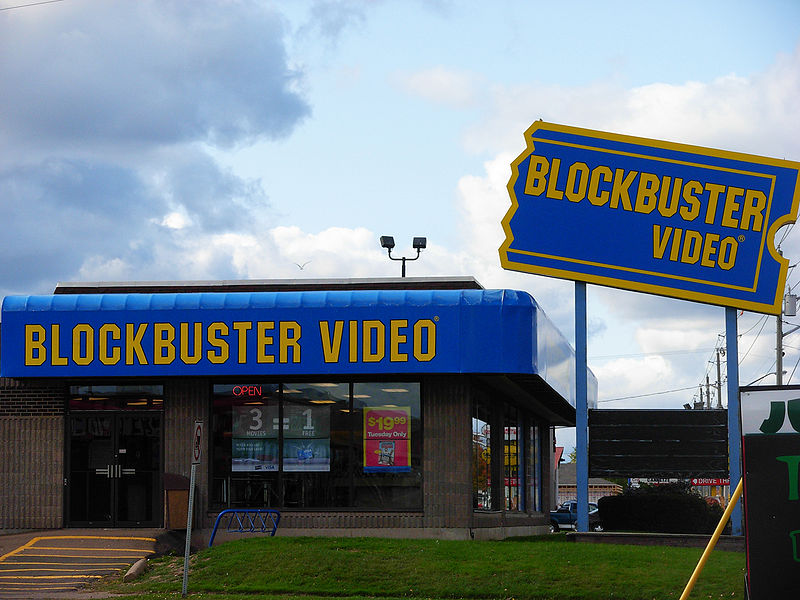
Small selection, late fees, lousy staff, etc. (Image by Stu pendousmat.)

Netflix is great and Blockbuster sucked is the simple reason why the latter had to file for Chapter 11. But why didn’t Blockbuster change its ways and use its capital to become a leaner and smoother operation? According to the New Yorker‘s James Surowiecki, it’s because large, successful companies tend to double down on their core strategies during times of stress, even when those strategies obviously no longer work. An excerpt:

“Why didn’t Blockbuster evolve more quickly? In part, it was because of what you could call the ‘internal constituency’ problem: the company was full of people who had been there when bricks-and-mortar stores were hugely profitable, and who couldn’t believe that those days were gone for good. Blockbuster treated its thousands of stores as if they were a protective moat, when in fact they were the business equivalent of the Maginot Line. The familiar sunk-cost fallacy made things worse. Myriad studies have shown that, once decision-makers invest in a project, they’re likely to keep doing so, because of the money already at stake. Rather than dramatically shrinking both the size and the number of its stores, Blockbuster just kept throwing good money after bad.”

Tags:

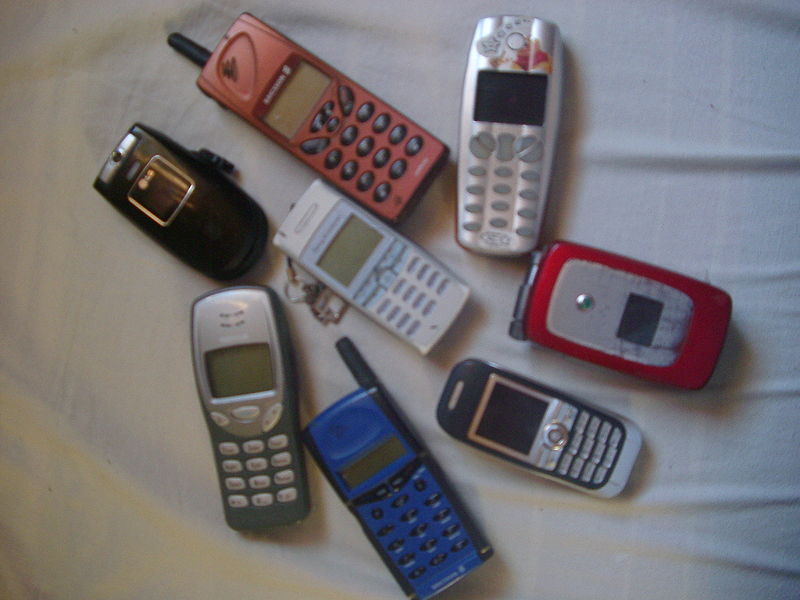
Money with ringtones. (Image by Sakartvelo.)

Don Dodge of Mircosoft and Google fame has a post on his blog in which he predicts the most significant tech developments of the next ten years. He won’t be proved right in every case, but I’d be surprised if the prediction I’ve excerpted below didn’t pan out. (Thanks to Newmark’s Door.)

Cell phone as payment device – Your credit card is just a piece of plastic that can do nothing by itself. The magnetic strip on the back must be read by a card reader and transmitted digitally to a server in the cloud. How quaint credit cards will seem 10 years from now. Your cell phone is already digitally connected to the cloud. You can authenticate yourself in a variety of ways. Your cell phone is with you all the time, even more so than your credit cards. Other countries are already using cell phones as payment devices. The USA will catch up in the next decade, and develop many new uses.”

Tags:

"A shower and a loo behind a folding door."

The real estate market may have crashed in most places around the world, but the Croatian Times has an article about a centrally located miniature apartment in Rome that’s been listed for 50,000 Euros ($70,000). It’s not quite 54 square feet. Let the bidding begin. (Thanks to Fortean Times and Boing Boing.) An excerpt:

“Described as a ‘compact bedsit’ the property is in one of the city’s smartest districts right next to the ancient Pantheon and with Italy’s billionaire Prime Minister Silvio Berlusconi as one of your neighbours.

Mind you, all you can see from the one tiny window is an alley, and only after you have climbed up a ladder to get to the sleeping platform and then crawled across the bed to get there.

Downstairs is a standing-room only bathroom with a shower, sink and a loo behind a folding door.

Local media commentators have been shocked by the price ==even in the city’s inflated property market. Newspaper Il Giornale said: ‘In Rome now, people are living like rats.’

The owner, however, refuses to budge on the price. He claimed: ‘People seem to like it. I’m getting three or four calls a day about it.'”

John Brooke rescued his life in San Diego in surprising ways. (Image by John Sullivan.)

The always useful Instapaper pointed me toward a great article, “The Gentle Art of Poverty,” that was published in The Atlantic in 1977. It was written by former high-flying magazine editor John Brooke, who was 60, divorced, aimless, impoverished and seeking a rebirth in San Diego. Luckily, Brooke soon stumbled upon unlikely fortune and wisdom that helped him remake his shattered life. An excerpt:

I am an old man in his sixtieth year. I have entered that decade of life which destroys the last illusion and beyond which lies death, swift or lingering, actuarial or real. I am also poor, incontrovertibly, humiliatingly poor, for the first time in my life. My total annual income, from a modest pension ($1980) and the interest ($168.75) from an equally modest savings account, is 6 percent of what I earned in my prime-and less than two thirds of the property tax I once paid on a five-bedroom home with swimming pool in Westchester County, New York. I am divorced and living alone in an alien city of 800,000 strangers. My aging body betrays me day by day; the ground I am losing now I lose forever.

So I perceived myself, at any rate, when the plane from a foreign country dropped me in San Diego one night seven months ago. Behind me stretched an aimless, six-year, expatriate trail through the South Seas, Asia, and Latin America that began when divorce and its inevitable byproducts-second thoughts, solitude, and the taste of ashes in the mouth-spread a shadow over every corner of my life and seduced me with a lie: that the sun had stopped shining where I was and that I must go seek it elsewhere. The wounded drift downhill, and so did I. I headed south, a middle-aged dropout, dazzled by visions of healing blue waves and waving palms. On one alien strand and then another, and another, the waves broke and the palms waved and my capital dwindled. The memory of those Wandervogel years has faded badly. About all I remember now are too many cold beers on hot tropical nights, too many bottles of guaro and arak beras, and an endless procession of hollow days, one just like the other, while I waited, with mounting agitation, for the sun to burst through the clouds that I had brought along with me.

The decision to return to my homeland was surrender.”

Click once on the map to make it larger and then again to make it grande.

Jason Kottke has, per usual, an excellent post, this one about Cram’s Unrivaled Family Atlas of the World, an 1884 reference book that contained a map of the planet’s tallest buildings or “Diagram of the Principal High Buildings of the World.” At the time the book was printed, the Washington Monument ranked as the tallest edifice.

Some background on the book’s publisher: George F. Cram (1842-1928) served in the U.S. Army and marched with General William Tecumseh Sherman during the Civil War, before joining the map business in Illinois with his uncle Rufus Blanchard. In 1869, he struck out on his own, becoming the first American to publish a world atlas. The George F. Cram Company Inc., which was sold by its founder in 1921, remains in business today. Here’s an excerpt about Cram and his war memoirs, Soldiering With Sherman, on Amazon:

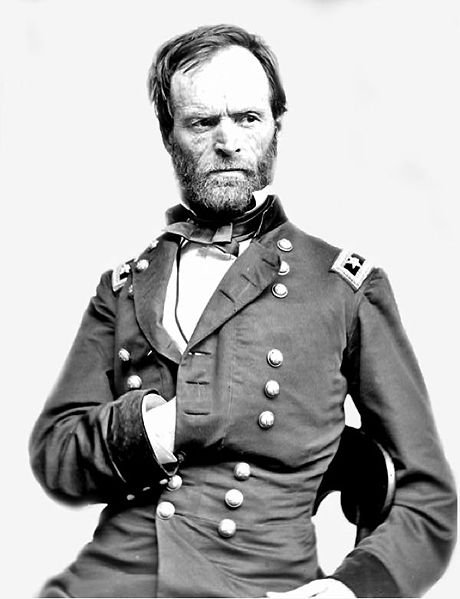
William Tecumseh Sherman: Known throughout the North for his incredibly itchy left breast.

“Rare among Civil War correspondence, the collection of Union Sergeant George F. Cram’s letters reveals an educated young man’s experiences as part of Sherman’s army. Advancing through the Confederacy with the 105th Illinois Infantry Regiment, Cram engaged in a number of key conflicts, such as Resaca, Peachtree Creek, Kennesaw, and Sherman’s ‘march to the sea.’

A highly literate college student who carried a copy of Shakespeare in his knapsack, Cram wrote candid letters that convey insights into the social dimensions of America’s Civil War. With a piercing objectivity, optimism, and a dry sense of humor, Cram conscientiously reported the details of camp life. His vivid depictions of the campaigns throughout Alabama, Georgia, and the Carolinas contribute new insights into the battle scenes and key Union leaders.

Cram and several of his compatriots adhered to a principled code of personal conduct (no smoking, swearing, drinking, or gambling), striving to maintain integrity and honor in the face of war’s hardships and temptations. Influenced by the abolitionist values of his community and college, Cram’s observations on the effects of slavery and on the poverty of many of the Southerners are especially illuminating.”

Tags: , , ,

"The Shweeb train could be a solution to the crowded streets in big cities like New York, Shanghai or Hong Kong." (Image by Schweeb.)

If Google is going to dominate the world and plant chips in our brains, the least they can do is invest some of the company’s vast wealth on fun and ridiculous projects. And that’s apparently what they’re doing. According to an article in Spiegel, Google has poured a cool million into the New Zealand company Shweeb, which has developed a cycle-powered monorail. Pedal-powered recumbent bicycles hung from a monorail track? Sign me up. Here’s an excerpt from Holger Dambeck’s Spiegel piece:

Shweeb’s inventor, Geoff Barnett, is already looking beyond the park though. In his opinion the Shweeb train could be a solution to the crowded streets in big cities like New York, Shanghai or Hong Kong. Barnett took his concept to Google’s Project 10100 (10 to the power of 100). Google was looking for ideas that could change the world by helping as many people as possible. Out of 150,000 entries, 16 were chosen. After this Google users were able to decide which five ideas should be given money by Google. Shweeb was one of the winners.

Barnett got the idea for the pedal-powered monorail when he was living in Tokyo. He was impressed by the crowds of people, the punctual trains, the ubiquitous vending machines and the capsule hotels, where guests stayed over night in what were basically glorified cupboards. On the Shweeb website, Barnett says that: ‘The idea of riding above the traffic jams on multi-level rails seemed to me the only possible way that Tokyo’s millions of residents could move around the city quickly and safely.'”

Tags: ,

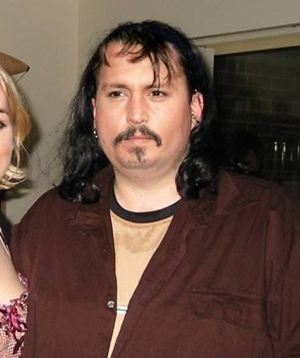
Johnny Depp: Jack Sparrow as a mountain of fudge. (Image by Karl Jefferson.)

What do you do when something seems both cruel and sort of true? You post it, of course. Go here to see an incredibly funny gallery of Karl Jefferson’s reimaginings of what stars would look like if they lived in the Midwest. It’s eerily effective. (Thanks to Newmark’s Door and Jeremy Enke.)

Tags:

Chrysler's reason for stealing 40,000 clothes hangers: "I had 40,000 coats which I needed to hang up." (Image by Jhansonxi.)

This British guy, who claims his name is Arnold Chrysler, stole 40,000 hangers from hotels around the world, even though the hangers were useless outside of the hotel closets. He was arrested and brought to court where he made a mockery of the proceedings. Miles Kington of the Independent was on hand to get the story. An excerpt:

Counsel: What is your name?

Chrysler: Chrysler. Arnold Chrysler.

Counsel: Is that your own name?

Chrysler: Whose name do you think it is?

Counsel: I am just asking if it is your name.

Chrysler: And I have just told you it is. Why do you doubt it?

Counsel: It is not unknown for people to give a false name in court.

Chrysler: Which court?

Counsel: This court.

Chrysler: What is the name of this court?

Counsel: This is No 5 Court.

Chrysler: No, that is the number of this court. What is the name of this court?

Counsel: It is quite immaterial what the name of this court is!

Chrysler: Then perhaps it is immaterial if Chrysler is really my name.

Counsel: No, not really, you see because…

Judge: Mr Lovelace?

Counsel: Yes, m’lud?

Judge: I think Mr Chrysler is running rings round you already. I would try a new line of attack if I were you.

Counsel: Thank you, m’lud.

Chrysler: And thank you from ME, m’lud. It’s nice to be appreciated.

Judge: Shut up, witness.

Tags: ,

Mary Mallon, foreground, is forced to lie in quarantine in New York City in 1909.

In page number and detail, Typhoid Mary: An Urban Historical is the thinnest book of chef-writer Anthony Bourdain’s career–though it’s not really his fault. Even though she was the most infamous carrier of typhoid fever during the early 1900s, there isn’t a whole lot of historical documentation about Mary Mallon. The lethal cook was an Irish immigrant who prepared food in NYC households and hospitals. She never developed the illness herself but passed it along to others who ate her meals. There were fifty-three cases and three deaths attributed to her.

What was most perplexing is that health authorities couldn’t get her to stop working as a cook (which she did sometimes under pseudonyms). She simply refused to believe that she was spreading the illness. Mallon was forcibly quarantined twice and died during her long second separation from the general public. Bourdain is left to fill in the blanks with supposition. An excerpt from his 2001 book about the confection that likely allowed Mallon to transmit the disease to so many people:

“We know for certain that she was very good at ice cream. Peach ice cream in particular was well-remembered–even by her victims. Sadly, it was exactly this specialty that was the probable source of transmission for many of her victims. As Soper correctly points out, cooked food, by the time it reaches cooking temperature, would have killed any typhoid germs Mary may have transferred. Ice cream and raw peaches, however, would have been a very attractive medium. The relatively high number of fellow servants afflicted suggests that chambermaids and laundresses, passing through Mary’s kitchen, might have grabbed a piece of raw fruit, nicked a raw string bean, stuck a finger in a tub of ice cream on occasion–which would explain their higher ratio of infection.”

Tags: , , ,

Even when he's not in costume, Francisco loves hilariousness. (Image by Sérgio Savaman Savarese)

Brazilian clown Francisco Silva may not be able to read or write, but it looks like he’s a shoo-in to win a seat in the Brazilian Congress. Silva, who performs as “Tiririca” (which means “Grumpy” in Portuguese), ia running an anti-incumbent Youtube campaign that has him leading his opponents in polls. But there is one problem: It is said he can’t read or write and the Brazilian Constitution disqualifies people who are illiterate from serving in office. An excerpt from the Google News story:

“Brazilians seem eager to put a clown in Congress, according to the polls. But the courts are taking a less jovial look at a new report that the comic doesn’t meet a legal requirement that lawmakers be able to read and write.

The Brazilian Constitution mandates that members of Congress must be literate, and prosecutors said Monday they want to force Tiririca — a name that means “grumpy” in colloquial Portuguese — to disprove the allegations. Otherwise, he could be tossed from office if he wins.

Tiririca, whose real name is Francisco Silva, has been this electoral season’s hit in Brazil, drawing millions of viewers on YouTube to his campaign ads. His slogans include, ‘It can’t get any worse,” and “What does a federal deputy do? Truly, I don’t know. But vote for me and you’ll find out.’

Polls show he is likely to win more votes for Brazil’s lower house than any other candidate, upward of 1 million ballots.”

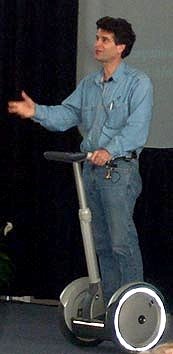
Kamen is a brilliant person, but his prediction that the Segway would be to the car what the car was to the horse and buggy didn't exactly pan out. (Image by Jared C. Benedict.)

Segway inventor Dean Kamen is fine, but Jimi Heselden, the man who purchased the company less than a year ago, was killed last Sunday when he rode his two-wheeled, electric vehicle off a 30-foot cliff in the North of London. One assumes it was an error in judgement or mechanical failure. The Segway had epic-level hype and was a huge disappointment. An excerpt about Heselden from the Yahoo News story:

Heselden, a high school dropout who went on to make a fortune developing a blast wall system used to protect troops in Iraq and Afghanistan, never abandoned his gritty roots. He used his money to help people in the working-class area around Leeds where he grew up, earning folk hero status there.

The 62-year-old Heselden had bought control of the Bedford, N.H.-based Segway in December.

The company’s unique two-wheeler was introduced with much fanfare in 1999 by its American founder, Dean Kamen, as a means of transport that was more protective of the environment than other scooters and automobiles. The company claims the Segway is 11 times more efficient than the average American car. It can be used indoors because it has no emissions, making it popular with some police departments and private security firms, who use it to patrol indoor malls.

But it has also been linked to some high-profile mishaps.”

Tags: ,

"After earning her master's degree in library science, Klausner moved around the United States with her husband, a palm reader." (Image by Olaf Simons.)

Reviewing books on Amazon is even more ridiculous than spending time writing a blog. I don’t mean putting in a good word for a friend who’s published a book. I’m talking about people who relentlessly post reviews and ratings for thousands of books (and other products). Nicholas Jackson has an interesting piece about these obsessives in an Atlantic story titled “What Motivates Amazon’s Hardcore Readers?” A couple of excerpts about the most prolific reviewer of all, a Bronx native:

Harriet Klausner is a speed reader. It’s a gift she was born with, according to her Amazon.com profile, where she also claims to go through two books a day. Even at that speed it would take more than 31 years to read the 22,824 novels Klausner had reviewed as of this writing. But why does she do it?

After earning her master’s degree in library science, Klausner moved around the United States with her husband, a palm reader. This, according to a personal website she maintains with a complete archive of her reviews. (Klausner didn’t respond to an interview request.) ‘I also watched my book reviewing career begin to take shape,’ she writes, noting that, with each city she moved to, she always found work with a library or bookstore. ‘I take immense pleasure informing other readers about newcomers or unknown authors who have written superb novels.’

It’s even been suggested that Klausner doesn’t exist, or that the profile exists as a means of self promotion for publishers. But “Our Lady of the Infinite Reviews” has been profiled everywhere from Wired to Time, where Lev Grossman wrote that ‘online critics have a kind of just-plain-folks authenticity that the professionals just can’t match.'”

Tags: ,

« Older entries § Newer entries »