Excerpts

You are currently browsing the archive for the Excerpts category.

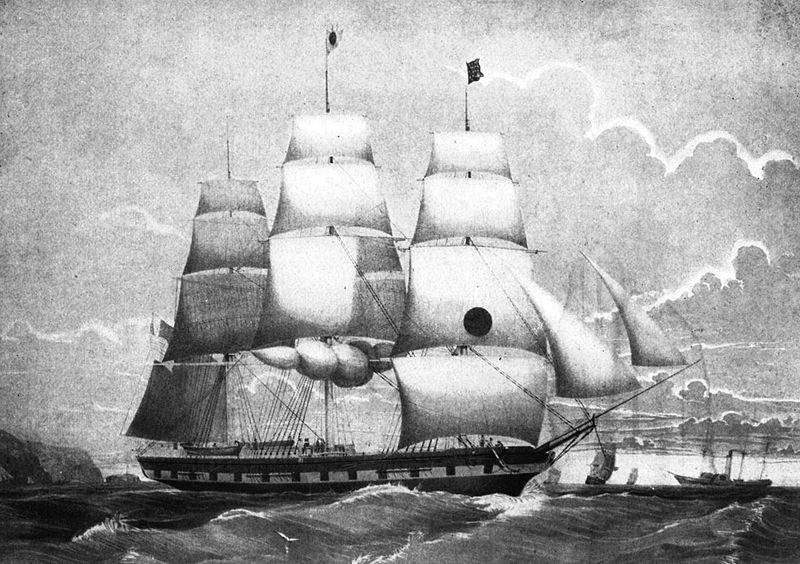
The "Montezuma," an example of a packet ship.

I found an interesting factoid in Edward L. Glaeser’s City Journal article about the role of entrepreneurship in New York City’s past, present and future. It seems that in the 19th-century, cargo ships didn’t set sail on any particular day but only when they had a full hull. That meant cargo could sit in a port for weeks, as the ship waited for more customers. Then someone had the idea that vessels should depart at scheduled times. Seems obvious, but it wasn’t. The person behind this innovation was Jeremiah Thompson, a Quaker businessman and a member of the free-slave group, the New York Manumission Society. An excerpt:

“Entrepreneurs have played a key role in every stage of New York’s development. During the early nineteenth century, when waterways were the lifelines of commerce, New York owed its expanding sea trade partly to natural advantages: a safe, centrally located harbor and a deep river that cut far into the American hinterland. But those advantages became important because of the vision and energy of entrepreneurs like Jeremiah Thompson, the gambling Quaker. Thompson immigrated to New York at 17 to work in the American branch of his family’s wool business. By the 1820s, he had established himself as America’s largest importer of English clothing, its largest exporter of raw cotton, and its third-largest issuer of bills of exchange.

As a global trader, Thompson was acutely aware of the shortcomings of the transatlantic ships of the time, which would stay in port until their hulls were filled with goods. (Imagine showing up at LaGuardia and having to sit around until the airline sold enough tickets to fill the entire flight to Frankfurt.) Thompson saw an opening and created the Black Ball packet line, whose ships set sail on a scheduled day every month, no matter how light their cargoes were. His innovation was a gamble, since sometimes his ships sailed with relatively empty hulls, which meant less income from the merchants who bought the space. But a virtuous circle developed: fixed schedules attracted more cargo, and more cargo made ships sailing on fixed schedules more profitable. Once Thompson was turning a profit, other packet lines, like the Yellow Ball and Swallowtail lines, entered the market. An 1827 letter to the New England Palladium described the significance of Thompson’s invention: ‘I consider Commerce by lines of ships, on fixed days, an invention of the age nearly as important as Steam Navigation and in its results as beneficial to New York, which has chiefly adopted it, as the Grand [Erie] Canal.'”
Tags: ,

"Dyson and his colleagues did not want to delegate; they intended to go bombing into space themselves." (Image by Lumidek.)

Kenneth Brower has an article in The Atlantic in which he tries to get to the bottom of Freeman Dyson’s troubling views about climate change and environmental responsibility, terrain previously covered by the Times Magazine. The piece has some great info about how Dyson and a group of fellow scientists hoped five decades ago to blast themselves to Mars and Saturn with a nuclear-powered rocket, a plan that had to be scrapped after the signing of the Limited Test Ban Treaty in 1963. An excerpt:

“The period of his career that Dyson remembers most happily, the endeavor during which he believes he learned the most, began the year after Sputnik. In 1958, he took a leave of absence from the Institute for Advanced Study and moved to La Jolla, California, where he joined Project Orion, a group of 40 scientists and engineers working to build a spacecraft powered by nuclear bombs. The Orion men believed that rocketry was hopeless as a means of settling the universe. Only nuclear power had sufficient bang to propel the requisite payloads into space. The team called the concept ‘nuclear-pulse propulsion.’ From a hole at the center of a massive ‘pusher plate’ at the bottom of the craft, atom bombs would be dropped at intervals and detonated. The shock wave and debris from each blast would strike the pusher plate, driving the ship heavenward on a succession of blinding fireballs. Shock absorbers the size of grain silos would cushion the cabin and crew, smoothing out the cataclysmic bumpiness of the ride.

To the layperson, this seems exactly the sort of contraption that Wile E. Coyote, in his efforts to overtake Road Runner, habitually straps on before self-immolation. But the layperson is wrong, apparently. Specialists in the effects of nuclear explosions saw no reason Orion would not work. The Advanced Research Projects Agency, the precursor to NASA, underwrote the project, then NASA took it on, and nuclear-pulse propulsion briefly held its own against the chemical rockets of Wernher von Braun. Dyson and his colleagues did not want to delegate; they intended to go bombing into space themselves. Their schedule had them landing on Mars by 1965 and Saturn by 1970.”

Tags: ,

"Don't follow leaders/Watch your parkin' meters." (Image by Quadell.)

In an article on Slate about the obsolescence of traditional parking meters, Tom Vanderbilt, author of Traffic, reveals where, when and why the device originated. An excerpt:

“Seventy-five years ago, the world’s first parking meter cast its thin, ominous shadow on the streets of Oklahoma City. The meter was the brainchild of Carlton C. Magee, a local publisher and Chamber of Commerce Traffic Committee chief, and he hoped it would solve the city’s chronic parking problems. In the pre-meter days, police would drive around with stopwatches and chalk, enforcing the city’s parking time limits by marking the tires of cars seen squatting for too long, but the system was ill-equipped to handle the ‘endemic overparking’ problem. Even worse, a survey found that at any given time, 80 percent of the city’s spots were occupied by employees of downtown businesses—the very same businesses complaining that lack of parking was driving away shoppers. Calling for an ‘efficient, impartial, and thoroughly practical aid to parking regulation,’ Magee held a student-design contest and launched his instrument.”

Tags: ,

Head is burning. (Image by Ferdinand Reus.)

The Telegraph has an article listing the ten weirdest scientific facts. (Thanks Newmark’s Door.) An excerpt:

“If the Sun were made of bananas, it would be just as hot.

The Sun is hot, as the more astute of you will have noticed. It is hot because its enormous weight – about a billion billion billion tons – creates vast gravity, putting its core under colossal pressure. Just as a bicycle pump gets warm when you pump it, the pressure increases the temperature. Enormous pressure leads to enormous temperature.

If, instead of hydrogen, you got a billion billion billion tons of bananas and hung it in space, it would create just as much pressure, and therefore just as high a temperature. So it would make very little difference to the heat whether you made the Sun out of hydrogen, or bananas, or patio furniture.”

I dreamt that I was riding a very, very pretty pony. (Image by Steve Jurvetson.)

Politico transcribed some tidbits from Ryan Secrest’s interview with President Obama. It was like Frost-Nixon if Frost was a complete douchebag, which he sort of was. Obama revealed his morning wake-up routine. An excerpt:

“[President Obama] confessed he hasn’t been getting much sleep lately and added that he doesn’t have an alarm clock — a White House operator calls to wake him up, ‘and if I don’t wake up the first time, they just keep on calling.'”

Tags: , ,

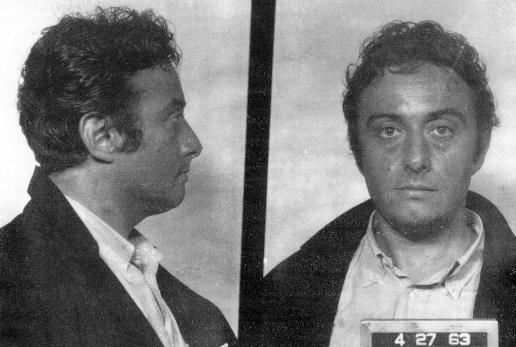
Booked in San Francisco for obscenity. Lenny Bruce was born Leonard Schneider in 1925 on Long Island.

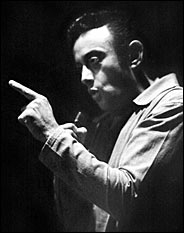
I watched the first episode of Hugh Hefner’s swinging variety show Playboy After Dark from 1959 not too long ago, and it featured a great appearance by Lenny Bruce. Most of the scant film footage of the disgracefully honest comedian doesn’t do him justice, showing him when he was a shell of himself, as heroin and legal troubles took their toll. It’s amazing how much other comics took from Bruce: everything from George Carlin’s obsession with the hypocrisy of words to Richard Lewis’s finger snapping as he delivers his punchlines. At one point, Bruce tells Hefner that “tragedy plus time equals comedy,” a line that is often attributed to either Woody Allen or Carol Burnett. My guess is it’s not Bruce’s line, either, but I bet he’s the one who introduced it to other comedians.

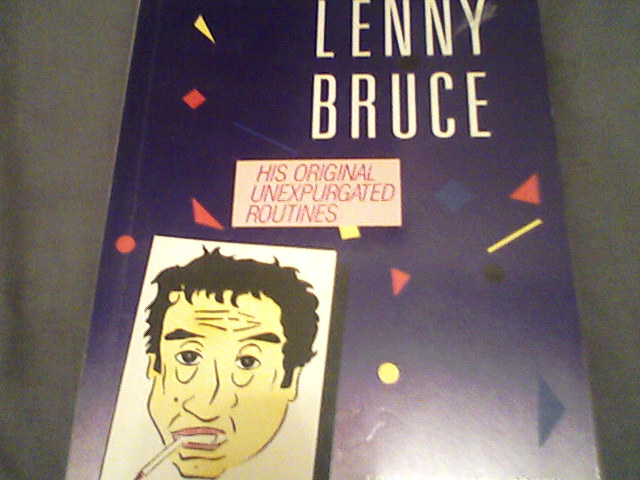
A few years back, I gleaned a copy of The Essential Lenny Bruce, a 1987 paperback compilation of his greatest bits and other fun stuff for Bruceophiles. Some of the material is very dated, but a lot of it reminds why a nightclub comedian was able to scare the hell out of authority figures in the ’50s and ’60s. One brief chapter, entitled “Chronicle,” provides an outline of the final seven turbulent years of Lenny’s life. An excerpt:

May, 1959, The New York Times:

“The newest and in some ways the most scarifyingly funny proponent of significance…to be found in a nightclub these days is Lenny Bruce, a sort of abstract-expressionist stand-up comedian paid $1750 a week to vent his outrage on the clientele.”

June 1960, The Reporter:

“The question is how far Bruce will go in further exposing his most enthusiastic audiences…to themselves. He has only begun to operate.”

September 29, 1961:

Busted for possession of narcotics, Philadelphia.

October 4, 1961:

Busted for obscenity, Jazz Workshop, San Francisco.

September, 1962:

Banned in Australia.

October 6, 1962:

Busted for possession of narcotics, Los Angeles.

October 24, 1962:

Busted for obscenity, Troubadour Theatre, Hollywood.

December, 1962:

Busted for obscenity, Gate of Horn, Chicago.

January, 1963:

Busted for possession of narcotics, Los Angeles.

April, 1963:

Barred from entering London, England.

March, 1964, The New York Post:

“Bruce stands up against all limitations of the flesh and spirit, and someday they are going to crush him for it.”

April, 1964:

Busted for obscenity, Cafe Au Go-Go, New York City.

October, 1965:

Declared a legally bankrupt pauper, San Francisco.

November 1965, Esquire:

“I saw his act…in Chicago…He looked nervous and shaky…wretched and broken…You thought of Dorothy Parker, who, when she saw Scott Fitzgerald’s sudden and too-youthful corpse, murmured, ‘The poor son of a bitch.'”

August 3, 1966:

Dead, Los Angeles.

Tags: , , , , , ,

Margaret Knight's paper bag innovations made her (likely) the first woman granted a U.S. patent.

Research at MoMA’s Counter Space blog has uncovered the 19th-century inventors who created various aspects of the brown paper bag, which we take for granted when we’re at the supermarket. If you think about it, the design, elegant and sturdy, is just about perfect. (Thanks Kottke.) An excerpt from the blog post:

Francis Wolle, active in the early 1850s, is considered the first inventor of the modern paper bag. Based in Pennsylvania, he cofounded the Union Paper Bag Machine Company in 1869, as well as becoming ordained as a deacon and following passions in entomology and botany. Union was supported financially by wealthy manufacturers, who thereby secured rights to patents secured by the company and divvied up the country into market segments to avoid direct competition. One of these characters was industrialist George West of Saratoga County, New York, also known as the ‘Paper Bag King.’ Originally from England, he established himself in Ballston Spa, owned ten paper mills, and became a member of the New York State Assembly and the House of Representatives.

It was slightly later that a woman named Margaret Knight, working for another company, the Columbia Paper Bag Company of Springfield, MA, designed a machine that could produce flat/square-bottomed paper bags, a great improvement on the earlier, structurally weaker envelope-style bag design. As a result, it is Knight who is more widely recognized as the inventor of the paper bag in the general form of the one shown in Counter Space. She’s also believed to be the first woman to achieve a U.S. patent.

However, our paper bag also reflects the design developments of the following years (starting around 1883) made by Charles Stilwell of Massachusetts/Pennsylvania (originally Fremont, Ohio), who improved on Knight’s machine to produce flat-bottomed paper bags—now with pleated sides for easier folding and stacking (satchel-style)—more quickly and cost-effectively. This type was given the nickname ‘S.O.S.’ (self-opening-sack), and really provided the model for the mass-produced paper bags we know today.”

Tags: , ,

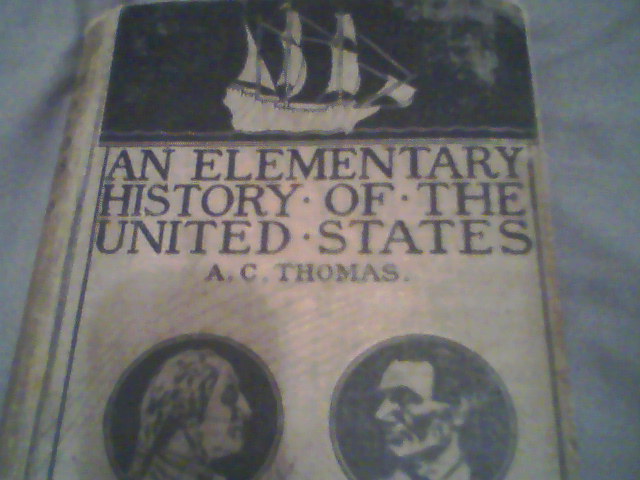
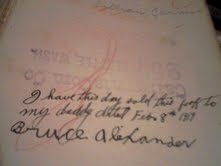
I briefly got my hands on a hardback copy of Allen C. Thomas’ 1900 primary-school book, An Elementary History of the United States, which covers the years from pre-Columbus times to the eve of the 20th-century. Thomas was a history professor at Haverford College. This book was owned in 1919 by a child named Bruce Alexander, who drew a red mustache on the illustration of George Washington.

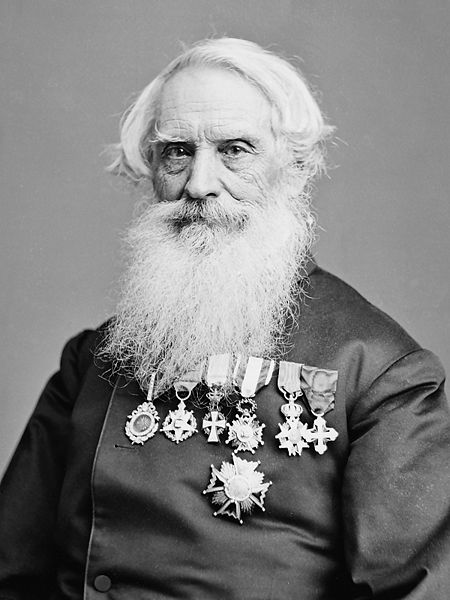
One of the later chapters, entitled “Inventions,” recalls how Samuel Morse helped create the telegraph during the 1830s and 1840s. An excerpt:

“Morse at once saw that messages could be sent at great distances if wires were properly arranged. His invention was very simple, and there was very little about it that was original. After it was described, it seemed strange that scientific men had not thought of his method before.

"Samuel F.B. Morse, an American artist, became much interested in electricity and magnetism."

Morse, like almost all inventors, had much to contend with. He was poor, and had it not been for a young man named Alfred Vail, who persuaded his father to lend Morse some money, it is quite possible that there would have been failure after all.

Vail was an excellent mechanic, and helped very much in the construction of the instruments. He also secured for Morse a patent for the invention.

In order to bring his invention before the public, Morse asked Congress, at Washington, to give thirty thousand dollars, to be used in constructing a telegraph line between Baltimore and Washington, a distance of forty miles. Some members of Congress made all manner of sport of Morse’s project. One member proposed that the money should be spent in making a railroad to the moon.

There seemed little prospect that the bill granting the money would be passed. The story is told that Morse, weary and heart-sick, sat hour after hour in the gallery of the Senate Chamber, waiting for the bill to come up before Congress adjourned. When evening came and there seemed no chance for its passage, he went to his hotel utterly discouraged, and prepared to leave for New York early the next day, as his money was exhausted.

Written on inside cover: "I have this day sold this book to my daddy dated Feb. 8th 1919. Bruce Alexander."

The next morning, while he was at breakfast, a young lady came in and said, ‘I congratulate you.’  ‘Upon what?’ said Morse, who was feeling rather blue. ‘On the passage of your bill.’ ‘Impossible.’ ‘No,’ she said, ‘It was passed five minutes before the adjournment.’ ‘Well,’ said Morse, ‘you shall send the first message over the lines.’

The line was constructed with the money thus secured. When all was ready Morse kept his promise, and Miss Annie G. Ellsworth sent, at the suggestion of her mother, the words, ‘What hath God wrought!’ That was on May 25, 1844. It was not many years before there were telegraphs over all civilized lands.”


Tags: , , , , ,

An example of Princess Hijab's work.

Princess Hijab is the mysterious Paris graffiti artist who defaces pictures of scantily clad models in street advertisements, covering their faces with veils and headscarves. The artist calls the process “hijabizing.” In a country that has banned traditional Muslim face coverings, the work has gotten plenty of attention, and people have wondered about the true nature of the protest. Angelique Chrisafis of the Guardian recently met with the artist, who apparently is not female, and tried to get to the bottom of it all. An excerpt from the article:

“Princess Hijab is deliberately cool and detached, but the one issue that really shakes her – and perhaps reveals a little of her true identity – is the place of minorities in France. Beyond the arguments about whether Muslim women should cover their heads, Sarkozy’s new ministry of ‘immigration and national identity’ and his national debate on what it means to be French has stigmatised the already discriminated and ghettoised young people of third- and fourth-generation immigrant descent. France has the largest Muslim population in Europe, but the prevailing anti-immigrant discourse, and what many view as a pointless burqa ban, has increased the feelings of marginalisation felt by young Muslims and minorities.

Princess Hijab sees herself as part of a new ‘graffiti of minorities’ reclaiming the streets. ‘If it was only about the burqa ban, my work wouldn’t have a resonance for very long. But I think the burqa ban has given a global visibility to the issue of integration in France,’ she says. ‘We definitely can’t keep closing off and putting groups in boxes, always reducing them to the same old questions about religion or urban violence. Education levels are better and we can’t have the old Manichean discourse any more.'”

Tags: ,

Pong was based on the Magnavox Odyssey, which was an analog home system that ran on batteries.

Boing Boing has published a great collection of old print ads for Pong (and its many knockoffs), the game that kicked off the digital quarter-sucking arcade craze. The site also provides historical context. An excerpt:

“In September 1972, Atari’s Nolan Bushnell and Allan Alcorn installed the prototype Pong machine at Andy Capp’s Tavern in Sunnyvale, California. The idea was to make a computer game that was ‘so simple that any drunk in any bar could play.’ And boy, did they ever.

Now, was Pong a hit because America loved Ping Pong so much that they wanted to play it on TV too? Or as media theorist Douglas Rushkoff has said, was it empowering because finally anyone could control what was on the TV? Either or neither way, people lined up for their chance to ‘Avoid missing ball for high score,’ as per the machine’s only instructions. Within just a few months, the Pong clone wars had begun.

Atari didn’t have the patent on the technology and very quickly the vast majority in the machines eating quarters around the country were knock-offs. Of course, Pong itself was ‘inspired’ by an electronic ping pong game that was in the Magnavox Odyssey home system. To keep up, Bushnell continued to innovate, as did everyone else. Call it a volley between King Pong and his brethren, while an invasion from space was on its way.”

Tags: ,

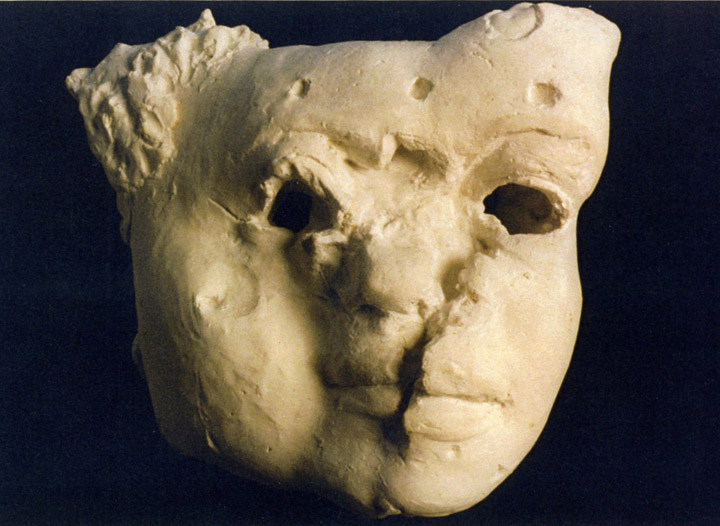
One of Frank Bender's many haunting sculptures.

Longform pointed me to a fascinating 2008 Telegraph article about the Vidocq Society, a Philadelphia-based organization, made up of volunteer law-enforcement professionals, many of them retired, who meet for lunch once a month and solve cold cases that have baffled local police across the country.

A founding member of the Vidocq Society who’s not a detective is the artist Frank Bender, who discovered an unlikely gift for crimefighting many years ago while studying anatomy at a morgue. An excerpt:

“Bender, 67, is a small, animated man with a snow-white beard and a constant twinkle in his eye. He now works as a sculptor and watercolorist, but at one time or another has been an advertising photographer and a commercial diver inspecting the hulls of tugboats in Philadelphia harbour. He fell into catching criminals by accident:  In 1975 he was taking evening courses in painting at the Academy of Fine Arts in Philadelphia. To help him see ‘in the round’ he started attending sculpture classes, but there were no anatomy lessons available to evening students, so a friend in the medical examiner’s office offered to let him sit in on some autopsies to learn about the human form. ‘I go to the morgue. He shows me around. Bodies had been cut up, burnt. They had this one woman,’ Bender says, ‘her whole body was decomposed, they didn’t know what she had looked like or who she was.’

The woman had been shot in the head, the bullet smashing her skull open, but Bender told his friend, ‘just out of conversation’, that he could show him what the woman had looked like, and recreate the features of her face in a sculpture.

‘I just knew what people looked like,’ Bender tells me when we meet at his studio. Five months later the woman was identified from Bender’s bust as Anna Duval, an Arizona woman who had come to Philadelphia to collect money on a property deal that had gone sour. She had been executed by a Mafia contract killer who would not be convicted of the murder for another 20 years.

Bender had discovered an apparently intuitive gift for facial reconstruction and, as word spread of his success, was called first to work on more ‘skull-to-face’ cases; later, he began creating aged renderings for the FBI and Federal Marshals Service to help them find fugitive criminals.”

Tags:

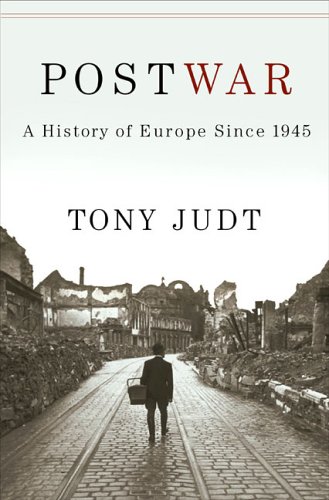
Tony Judt was a professor at NYU.

The great British-born historian Tony Judt, who passed away in August, had an excellent posthumous think-piece about New York’s current status as a global city in Sunday’s Times. An excerpt:

I arrived in New York just in time to experience the bittersweet taste of loss. In the arts the city led the world from 1945 through the 1970s. If you wanted to experience modern painting, music or dance, you came to the New York of Clement Greenberg, Leonard Bernstein and George Balanchine. Culture was more than an object of consumption: people thronged to New York to produce it too. Manhattan in those decades was the crossroads where original minds lingered — drawing others in their wake. Nothing else came close.

Jewish New York too is past its peak. Who now cares what Dissent or Commentary says to the world or each other? In 1977, Woody Allen could count on a wide audience for a joke about the two magazines merging and forming Dissentary (see Annie Hall). Today? A disproportionate amount of the energy invested in these and certain other small journals goes to the Israel question: perhaps the closest that Americans get to nombrilisme.

The intellectual gangs of New York have folded their knives and gone home to the suburbs — or else they fight it out in academic departments to the utter indifference of the rest of humanity. The same, of course, is true of the self-referential squabbles of the cultural elites of Russia or Argentina. But that is one reason neither Moscow nor Buenos Aires matters on the world stage. New York intellectuals once did, but most of them have gone the way of Viennese cafe society: they have become a parody of themselves, their institutions and controversies of predominantly local concern.

And yet, New York remains a world city.”

Tags: , , ,

Navajo reservations are one of the areas hard hit by unchecked infectious disease. (Image by jclarson.)

Miller-McCune has an incredibly distressing report about diseases, usually associated with third-world nations, that are flourishing in the poverty-stricken areas of the United States. They keep poor people within a cycle of poverty, and worse yet, epidemiologists at the Center for Disease Control haven’t been tracking the illnesses. (Thanks Instapaper.) An excerpt:

“Millions of poor Americans living in distressed regions of the country are chronically sick, afflicted by a host of hidden diseases that are not being monitored, diagnosed or treated, researchers say.

From Appalachia to the Mississippi Delta to the segregated inner cities of the Great Lakes and Northeast, they say, and from Navajo reservations to Latino communities along the U.S.-Mexico border, more than 20 chronic diseases are promoting the cycle of poverty in conditions of inadequate sanitation, unsafe water supplies and rundown housing.

‘These are forgotten diseases among forgotten people,’ said Peter Hotez, a microbiologist at George Washington University, president of the Washington, D.C.-based Sabin Vaccine Institute and co-founder of the institute’s Global Network for Neglected Tropical Disease Control. ‘If these were diseases among middle-class whites in the suburbs, we would not tolerate them. They are among America’s greatest health disparities, and they are largely unknown to the U.S. medical and health communities.’”

Tags:

Zoltan Mesko at Michigan. (Image by cgilmour.)

Billed by the Wall Street Journal as “the most interesting man in the NFL,” Romanian immigrant Zoltan Mesko was a standout punter at Michigan before being drafted by the New England Patriots. He has one of the more unusual backgrounds among NFLers. An excerpt from John U. Bacon’s WSJ piece:

“Of the dozens of rookies signed by NFL teams this summer, perhaps the most unlikely one is a 24-year-old punter from Romania who stands 6-foot-4 and sports what he calls ‘a buzz cut and a big, goofy smile.’

The wonderfully named Zoltan Mesko speaks five languages and grew up dreaming of being an aerospace engineer before graduating from Michigan with a business degree and a master’s in sports management. He got lured into football only after he smashed a ceiling light with a kick ball in his Twinsburg, Ohio, junior-high-school gym.

‘When I was 10 years old, I barely knew American football existed,’ he adds. ‘If you would’ve told me I’d get two degrees and a pro contract for kicking a ball in the air, I probably would have said, ‘Oh yeah? Are you going to disappear into thin air for your next act?'”

Tags: ,

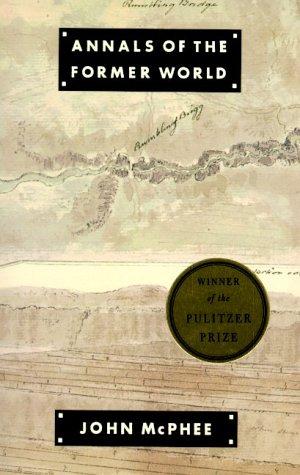
McPhee's geological history of North America.

Longtime New Yorker writer John McPhee covers many topics, including the future of the written word, in a Q&A with the Paris Review. (Thanks Marginal Revolution.) An excerpt:

The Paris Review: Do you worry about outlets diminishing for writers?

John McPhee: I’m really concerned about it. And nobody knows where it’s going—particularly in terms of the relationship of the Internet to the print media. But writing isn’t going to go away. There’s a big shake-up—the thing that comes to mind is that it’s like in a basketball game or a lacrosse game when the ball changes possession and the whole situation is unstable. But there’s a lot of opportunities in the unstable zone. We’re in that kind of zone with the Internet.

But it’s just unimaginable to me that writing itself would die out. OK, so where is it going to go? It’s a fluid force: it’ll come up through cracks, it’ll go around corners, it’ll pour down from the ceiling. And I would have counseled anybody ten, twenty, and thirty years ago the same thing I’m saying right now, which is, as a young writer, you should think about writing a book. I don’t think books are going to go away.”

Tags:

"A typical supermarket now offers more than 48,000 different items."

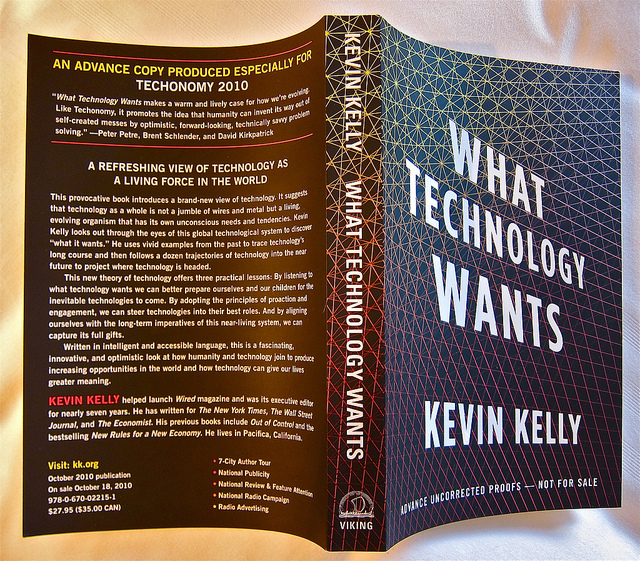
Jerry A. Coyne essentially hammers Kevin Kelly’s new book, What Techonology Wants, in today’s Sunday Times Book Review. Coyne is particularly peeved by what he perceives as Kelly tying technological progress to evolutionary determinism and the author’s personal religious beliefs. I’ve always like Kelly a lot, so I’ll make up my own mind when I read the book. But the numbers in this paragraph of the review caught my eye. An excerpt:

“In What Technology Wants, Kelly provides an engaging journey through the history of ‘the technium,’ a term he uses to describe the ‘global, massively interconnected system of technology vibrating around us,’ extending ‘beyond shiny hardware to include culture, art, social institutions and intellectual creations of all types.’ We learn, for instance, that our hunter-gatherer ancestors, despite their technological limitations, may have worked as little as three to four hours a day. Since then, the technium has grown exponentially: while colonial American households boasted fewer than 100 objects, Kelly’s own home contains, by his reckoning, more than 10,000. As Kelly is a gadget-phile by trade (and an affluent American to boot), this index probably inflates the current predominance of technology and its products, but a thoroughly mundane statistic makes the same point: a typical supermarket now offers more than 48,000 different items.”

Tags: ,

Lane Sutton is slightly older than this, but you get the idea. (Image by Wpedzich.)

A 13-year-old social media wunderkind from Massachusetts named Lane Sutton has been the subject of a couple of articles on boston.com. He runs his own website and uses words like “exponential.” Kids are being encouraged to be the next Mark Zuckerberg, and no one seems alarmed. (Thanks Newmark’s Door.) An excerpt from an article about him:

“Lane Sutton is tweeting from the second row of a social media conference at the Microsoft campus here in Kendall Square. He’s armed with an iPad and iPhone, and a consulting pitch he can deliver in a smooth minute.

Oh, yeah, and his mom’s sitting beside him. Sutton is 13.

‘We live in exponential times,’ he types in a Twitter post, quoting from the slide presentation. He adds, ‘The Internet is a place to meet, learn, act, react, and transact.’’

People are paying attention to this eighth-grader from Framingham, with his mop of dark, wavy hair and glasses. A budding entrepreneur and self-described geek (better than nerd, he says) Sutton runs www.KidCriticUSA.com, where he reviews restaurants, movies, gadgets, and books.

Hollywood A-lister Tom Cruise and more than 2,500 others follow him on Twitter; executives make time for him (like the head of online retailer Zappos); and his customer service gripe to Steve Jobs reaped a response from an assistant to the Apple chief executive.”

Tags:

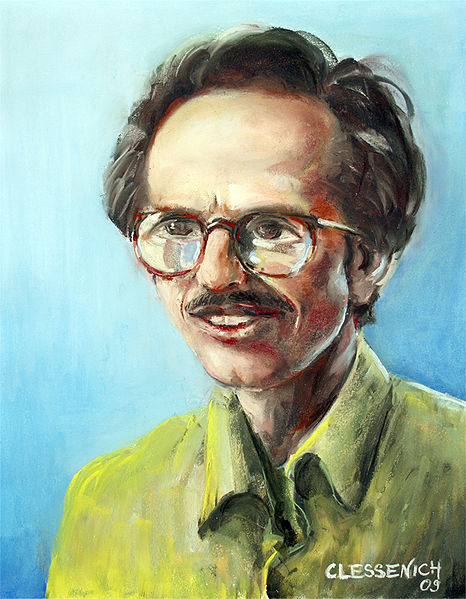
"Ewww. My dad is not like that to me at all, ever. We didn’t have orgies." (Image by Christian Lessenich.)

In this Sunday’s Times Magazine, Deborah Solomon takes a break from disemboweling the Lorraine Braccos of the world to interview artist Sophie Crumb, who discusses a new book of her work and her famous (and infamous) father, R. Crumb. An excerpt from the Q&A:

Deborah Solomon: You make him sound nurturing, but his most famous character and alter ego, Fritz the Cat, is a selfish, pot-smoking tomcat who is fond of orgies.

Sophie Crumb: Ewww. My dad is not like that to me at all, ever. We didn’t have orgies. He’s different toward me than he is with other people. Gentler. He’s the one who played Barbies with me. We had a name and a personality for each Barbie, and he gave each one a tone of voice.

Deborah Solomon: Is he attentive in other ways? Does he cook?

Sophie Crumb: He can’t do anything, except draw and play. He can’t drive. He can’t swim. He’s totally dyslexic. He’s left-handed. He can hardly see. He’s practically blind; his glasses are an inch thick. My mom did all the practical stuff, and she also drew. She had to be ‘the dad,’ the active, practical person.”

Tags: , , ,

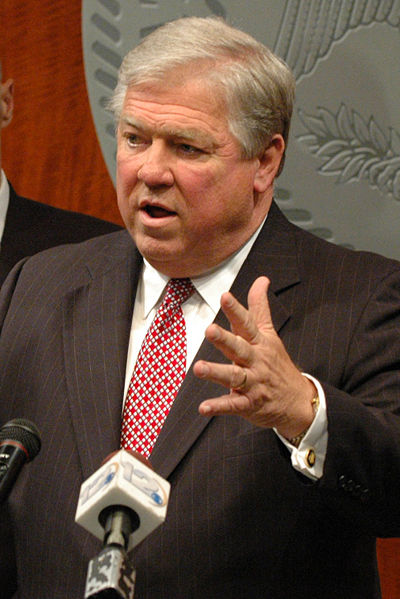
Mississippi Governor Haley Barbour: Desperate to be President. (Image by George Armstrong.)

Economist Tyler Cowen analyzes Tuesday’s election results pretty well on his blog. An excerpt:

“Just 32% of the Tea Party candidates won; admittedly that figure should be adjusted by the rate of incumbency (a lot of Tea Party candidates were challengers).  In any case, there was not a Tea Party tidal wave.  Sarah Palin as nominee is up a few points on InTrade.com, although I do not see why.  Haley Barbour is also up and Chris Christie is down considerably (why?).  Given that the Democrats did better than expected in the Senate, Obama’s reelection chances look better now than they did a week ago.  The Republican strategy is not dominating in broad constituency, MSM-reported, ‘lots of scrutiny’ races, even with an abysmal economy and a not so popular health care bill.  My mental model of Obama is that he will cut deals with the Republicans, even on (mostly) their terms, if indeed any deal is on the table.  I would be pleased if critics of the Obama presidency would indicate their managerial background and expertise, yet few do.  How many of them could manage a team of ten people with any success?”

Tags: , , , ,

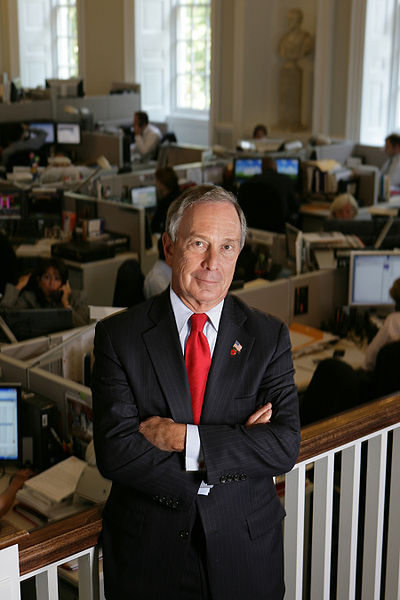
Mayor Bloomberg: I did good things and then my ego made everyone hate me. (Image by Rubenstein.)

Before Mayor Bloomberg absolutely refused to fucking leave after his second term was up and changed election laws to allow him to buy a third term, he did some popular things. The most popular may be initiating the 311 system, whereby NYC residents had to dial just three quick digits to lodge complaints and find out info about anything they wanted to know about their city. It reduced bureacracy and gave people a reliable bridge to their government.

What wasn’t fully anticipated at the time was that the information coming in with these calls might be more useful than the information going out. By tagging complaints and questions to particular areas, the city has become better equipped to solve problems, large and small. Steven Johnson has an interesting article in Wired on the topic, entitled “What A Hundred Million Calls to 311 Reveal Aboiut New York.” An excerpt:

“As useful as 311 is to ordinary New Yorkers, the most intriguing thing about the service is all the information it supplies back to the city. Each complaint is logged, tagged, and mapped to make it available for subsequent analysis. In some cases, 311 simply helps New York respond more intelligently to needs that were obvious to begin with. Holidays, for example, spark reliable surges in call volume, with questions about government closings and parking regulations. On snow days, call volume spikes precipitously, which 311 anticipates with recorded messages about school closings and parking rules.

Shut your piehole, Mister Softee. (Image by Rjsswf8.)

But the service also helps city leaders detect patterns that might otherwise have escaped notice. After the first survey of 311 complaints ranked excessive noise as the number one source of irritation among residents, the Bloomberg administration instituted a series of noise-abatement programs, going after the offenders whom callers complained about most often (that means you, Mister Softee). Similarly, clusters of public-drinking complaints in certain neighborhoods have led to crackdowns on illegal social clubs. Some of the discoveries have been subtle but brilliant. For example, officials now know that the first warm day of spring will bring a surge in use of the city’s chlorofluorocarbon recycling programs. The connection is logical once you think about it: The hot weather inspires people to upgrade their air conditioners, and they don’t want to just leave the old, Freon-filled units out on the street.

The 311 system has proved useful not just at detecting reliable patterns but also at providing insights when the normal patterns are disrupted. Clusters of calls about food-borne illness or sanitary problems from the same restaurant now trigger a rapid response from the city’s health department. And during emergencies, callers help provide real-time insight into what’s really happening. ‘When [New York Yankees pitcher] Cory Lidle crashed his plane into a building on the Upper East Side, we had a bulletin on all of our screens in less than an hour explaining that it was not an act of terrorism,’ [Executive Director Joseph] Morrisroe says. After US Airways flight 1549 crash-landed in the Hudson in 2009, a few callers dialed 311 asking what they should do with hand luggage they’d retrieved from the river. ‘We have lots of protocols and systems in place for emergencies like plane crashes,’ Morrisroe explains, ‘but we’d never thought about floating luggage.’ This is the beauty of 311. It thrives on the quotidian and predictable—the school-closing queries and pothole complaints—but it also plays well with black swans.”

Tags: , , ,

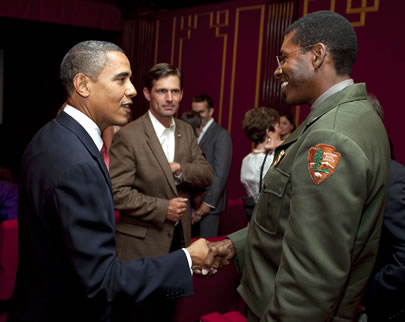
President Obama greets Ranger Shelton Johnson.

New York Times reporter Miryea Navarro has an interesting story about the racial make-up of visitors to U.S. National Parks, which is overwhelmingly white and underwhemlmingly African-American. While it’s not precisely clear why attendance is so homogenous, Shelton Johnson, a ranger for the National Parks Service, has enlisted Oprah Winfrey in trying to change the demographics. An excerpt:

“Yet no group avoids national parks as much as African-Americans. The 2000 survey found that blacks were three times as likely as whites to believe that park employees gave them poor service and that parks were ‘uncomfortable places.’

Park Service officials emphasize that the demographics vary, and that parks like theMartin Luther King Jr. National Historic Site in Atlanta and the Manzanar National Historic Site in Independence, Calif., site of a World War II detention camp for Japanese-Americans, draw diverse crowds.

But attendance tends to be more homogenously white at wilderness parks like Yosemite, where a 2009 survey found that 77 percent of the visitors were white, 11 percent Latino, 11 percent Asian and 1 percent black.

When Ms. Winfrey visited Yosemite this month to tape her show, Mr. Johnson said, he was not surprised to hear that it was her first trip to the park and her first time camping. He said he was more likely to meet someone from Finland or Israel in the park than from, say, Harlem or Oakland, Calif.

‘It’s something that’s pervasive in the culture — it doesn’t matter whether you’re Oprah or a postal worker,’ Mr. Johnson said.”

Tags: , ,

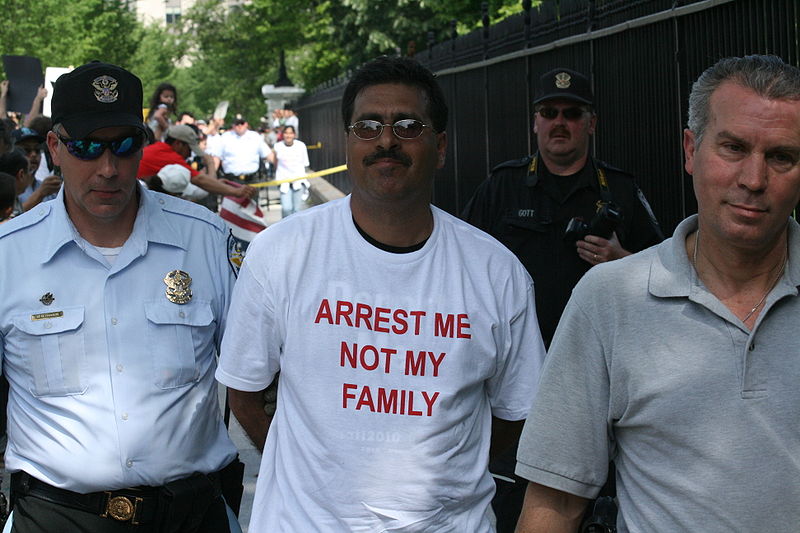
An immigration reform movement in D.C. in May. (Image by Arasmus Photo.)

The controversial Arizona immigration laws came about because of the unusual confluence of many things, but according to an NPR report, a good part of the impetus behind the legal change was due to the lobbying of the Arizona prison industry, which saw an economic opportunity in incarcerating female illegal immigrants and their children.  (Thanks to The Dish.) An excerpt:

“Last year, two men showed up in Benson, Ariz., a small desert town 60 miles from the Mexico border, offering a deal.

Glenn Nichols, the Benson city manager, remembers the pitch.

‘The gentleman that’s the main thrust of this thing has a huge turquoise ring on his finger,’ Nichols said. ‘He’s a great big huge guy and I equated him to a car salesman.’

What he was selling was a prison for women and children who were illegal immigrants.

‘They talk [about] how positive this was going to be for the community,’ Nichols said, ‘the amount of money that we would realize from each prisoner on a daily rate.’

But Nichols wasn’t buying. He asked them how would they possibly keep a prison full for years — decades even — with illegal immigrants?

‘They talked like they didn’t have any doubt they could fill it,’ Nichols said.

That’s because prison companies like this one had a plan — a new business model to lock up illegal immigrants. And the plan became Arizona’s immigration law.”

Tags:

A 19th-century political cartoon about American treatment of Chinese immigrants.

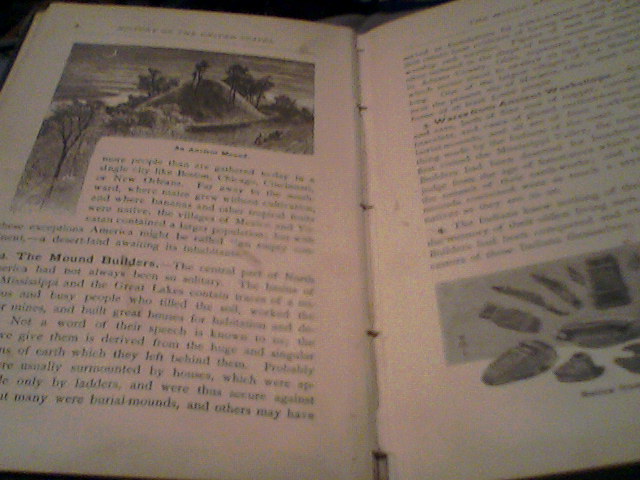
I briefly got my mitts on a crumbling copy of an 1881 book entitled, The Eclectic History of the United States, which was written by Mary Elsie Thalheimer. (Sadly, there’s very little info online about her.) The book features brief entries about America from prehistoric times, beginning with an entry about the Mound Builders, all the way up to the technological developments of the late 19th-century. The Eclectic History is generally pretty enlightened and toward the end, the book examines the backlash that was then going on against Chinese immigrants, which wasn’t much different from today’s backlash against Mexican immigrants. An excerpt:

“[Chinese laborers] already number more than 100,000 in America, of whom 75,000 are in the state of California alone. They cross the Pacific often in large companies under the direction of contractors, and find employment in the mines, in factories, in market-gardening, and domestic service. On the other hand, fear has arisen lest the relations of the ‘coolies’ with the contractors may abridge the personal liberty which the Government wishes to guarantee every inhabitant of the country; on the other, lest the habits of heathenism, which the immigrants have brought with them, may prove injurious to the morals of the community. It can not be said, however, that the noisiest opponents of the Chinese are the most orderly or the most Christian part of the population, while the ‘heathen’ very often sets a worthy example of quiet industry and obedience to law.

On inside flap: "Private Library of W.E, Snider. Book No. 588."

In the early months of 1879 a bill passed both houses of Congress setting aside part of the Burlingame treaty, and putting a check on further immigration from China. President Hayes vetoed the bill. considering the faith of the United States, pledged to the fulfillment of the treaty until both governments could agree to change it. This was effected in September of the following year, when treaties were made between the two governments, giving the United States the right to limit or suspend the immigration of Chinese laborers.

What no one fears or regrets is the presence of one hundred and four Chinese youth in our academies and colleges. Since the opening of the great Asiatic empire to intercourse with other nations, boys of good birth and talents have been sent to be educated in the United States at the expense of their own government. Their superintendent here is Yung Wing, a Chinese mandarin, who is himself a graduate of Yale College, and lately minister of China in Washington. The government of Japan has sent not only boys to American colleges, but young women to fit themselves for teachers of girls at home.”

Tags: , ,

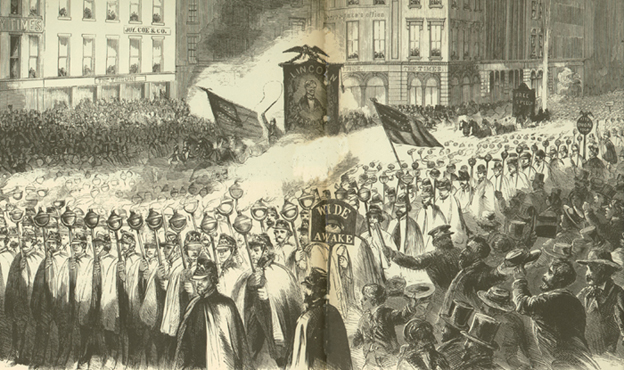
The Wide Awakes paramilitary group holds its Torch Rally in Manhattan in 1860. Violence ensued.

It’s been a crazy election cycle in the U.S., but it really can’t compare to the 1860 election madness in this country. As the Disunion blog at the New York Times points out, the final vote before the beginning of the Civil War was truly riotous and scary. (Thanks Kottke.) An excerpt from Adam Goodheart’s post:

“On the last Friday night before the 1860 election, Senator William H. Seward delivered a rousing Republican campaign address to a large outdoor gathering on 14th Street in Manhattan. Afterward, crowds of pro-LincolnWide Awakes‘ fanned out through the surrounding area. Wide Awakes, members of an organization with strong paramilitary overtones, could be a menacing sight: they wore military-style caps and shrouded themselves in long black capes made of a shiny fabric that reflected the flames of the torches they carried. Some strapped axes to their backs, in tribute to their rail-splitting hero.

According to the next day’s Times and other papers, things began to spin out of control when supporters of a rival presidential contender, John Bell, charged toward the Lincoln men, ‘calling them ‘negro stealers,’ ‘sons of b____s,’ &c.’ At the corner of 12th Street and Fourth Avenue, several dozen volunteer firemen — members of Engine Company 23 — joined the fray, swinging roundhouse blows with clubs and heavy iron wrenches that the Wide Awakes tried to parry with their torches. But the tide of battle turned when the young Republicans brought their Lincoln axes into play. They chased the enemy back into the company firehouse and promptly began smashing down its barricaded doors, as other idealistic marchers flung bricks and cobblestones.”

Tags: , , ,

As Johnson's great book "The Ghost Map" points out, physcial density can also lead to the rapid spread of bad things, like cholera.

I’ve always believed that companies that need to be highly creative in order to survive should be housed in small, cramped offices in buildings with other companies that are housed in small, cramped offices. It might not always be pretty or comfy, but I think the physical closeness of people and ideas spurs innovation. The excellent writer Steven Johnson agrees with me, in an article he’s written for the Financial Times, about New York City’s current tech-company explosion. (It’s linked to the publication of his new book, Where Good Ideas Come From: The Natural History of Innovation.) Physical density, he argues, is key. An excerpt:

“The physical density of the city also encourages innovation. Many start-ups, both now and during the first, late-1990s internet boom, share offices. This creates informal networks of influence, where ideas can pass from one company to the other over casual conversation at the espresso machine or water cooler. When we started outside.in, we shared a Brooklyn office with a documentary film company for its first year of existence. Today, our much larger office in Manhattan also houses three other smaller start-ups working on unrelated projects. By crowding together, we increase the likelihood of interesting ideas or talents crossing the companies’ borders. The proximity also helps to counter the natural volatility of start-ups: in outside.in’s early days, we ‘borrowed’ a few talented employees from the documentary film company, which was temporarily downsizing. When the projects picked up again, some of those employees moved back. Others had found a new calling in the web world and stayed with us.

Economists have a telling phrase for the kind of sharing that happens in these densely populated environments: ‘information spillover.’ When you share a civic culture with millions of people, good ideas have a tendency to flow from mind to mind, even when their creators try to keep them secret.”

Tags:

« Older entries § Newer entries »