Excerpts

You are currently browsing the archive for the Excerpts category.

Michael Crichton predicts the future (fairly poorly) in 1999: Printed matter will be fine, movies will soon be dead, communications will be consolidated into fewer hands. Well, he did foresee YouTube and large-scale terrorism in NYC.

Crichton, who was fascinated by science and often accused of being anti-science, commenting in a 1997 Playboy interview on technology creating moral quandries we’re not prepared for: “I think we’re a long way from cloning people. But I am worried about scientific advances without consideration of their consequences. The history of medicine in my lifetime is one of technological advances that outstrip our ethical systems. We’ve never caught up. When I was in medical school—30-odd years ago—people were struggling to deal with mechanical-respiration systems. They were keeping alive people who a few years earlier would have died of natural causes. Suddenly people weren’t going to die of natural causes. They were either going to get on these machines and never get off or—or what? Were we going to turn the machines off? We had the machines well before we started the debate. Doctors were speaking quietly among themselves with a kind of resentment toward these machines. On the one hand, if somebody had a temporary disability, the machines could help get them over the hump. For accident victims—some of whom were very young—who could be saved if they pulled through the initial crisis, the technology saved lives. You could get them over the hump and then they would recover, and that was terrific.

But on the other hand, there was a category of people who were on their way out but could be kept alive. Before the machine, ‘pulling the plug’ actually meant opening the window too wide one night, and the patient would get pneumonia and die. That wasn’t going to happen now. We were being forced by technology to make decisions about the right to die—whether it’s a legal or religious issue—and many related matters. Some of them contradict longstanding ideas in an ethically protected world; we weren’t being forced to make hard decisions, because those decisions were being made for us—in this case, by the pneumococcus.

This is just one example of an ethical issue raised by technology. Cloning is another. If you’re knowledgeable about biotechnology, it’s possible to think of some terrifying scenarios. I don’t even like to discuss them. I know people doing biotechnology research who have decided not to pursue avenues of research because they think they’re too dangerous. But we go forward without sorting out the issues. I don’t believe that everything new is necessarily better. We go forward with the technology while the ethical issues are still up in the air, whether it’s the genetic variability of crop streams, which is a resource in times of plant plagues, to the assumption that we all have to be connected all the time. The technology is here so you must use it. Do you? Do you have to have your cell phone and your e-mail address and your Internet hookup? I was just on holiday in Scotland without e-mail. I had to notify people that I wouldn’t be checking my e-mail, because there’s an assumption that if I send you an e-mail, you’ll get it. Well, I won’t get it. I’m not plugged in, guys. Some people are horrified: ‘You’ve gone offline?’ People feel so enslaved by technology that they will stop having sex to answer the telephone. What could be so important? Who’s calling, and who cares?”

 

Tags:

There are used paperback copies of the book on Amazon for as little as $1.62.

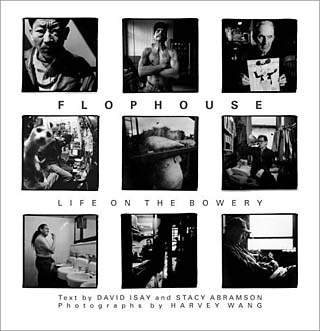
Photographer Harvey Wang and radio documentarian David Isay gravitate to those people, places and things that have passed into obsolescence in our culture and capture their essence before they become obsolete. They focus a good deal of attention on NYC, a place that changes rapidly, often driven more by the lure of the dollar than the pull of history. The two collaborated with Stacy Abramson on the great 2000 book, Flophouse: Life on the Bowery, which looked at the lowly boarding houses that still stood in that famous (and infamous) neighborhood like anachronisms with bedbugs. But despite their shabby shape, these lodgings were filled with the fascinating stories of the tenants, which Wang and Isay chronicled with great care. You can listen to audio documentaries about the flophouses here. The opening copy of the book:

“From the end of the nineteenth century through the middle of the twentieth, the Bowery was the world’s most infamous skid row. Under the shadow of the elevated Third Avenue line, the sixteen-block stretch of lower Manhattan was jammed with barber schools, bars, missions, men’s clothing stores, slop joints (cheap restaurants), flophouses, and tattoo parlors. The estimates vary, but in its heyday somewhere between 25,000 and 75,000 men slept on the Bowery each night.

Today the barber colleges are all gone. Al’s, the last rummy bar on the Bowery, closed in 1993. There are no tattoo parlors, no employment agencies, no pawnshops, no burlesque houses, no secondhand stores, no El train. All that remains of the skid-row Bowery are a single mission and a handful of flops, still offering the shabbiest hotel accommodations imaginable for as little as $4.50 a night.”

More Harvey Wang and David Isay posts:

Tags: , ,

A boarded-up Montgomery Ward store in Georgia. (Image by Caldorwards4.)

Really good article by David Streitfeld in the New York Times about the phenomenon of Groupon, a company running forward at a breakneck pace but still (wisely) looking over its shoulder. The Internet outfit inhabits the Chicago building made famous by Montgomery Ward, the once-powerful retailer which also changed the face of commerce in its own day. An excerpt:

“CHICAGO has revolutionized retailing before. In 1872, a dry-goods salesman named Aaron Montgomery Ward wearied of visiting far-flung stores, so he mailed descriptions of goods directly to rural residents. The orders were sent by a new delivery system that wreaked havoc on traditional commerce: the railroad.

Ward’s innovation was as much of a cultural achievement as a merchandising one — farmers read his catalogues for pleasure, dreaming of a better world. They were the foundation of a retail empire that lasted more than a century until the management failed one time too often to anticipate a shift in consumer tastes. Ward’s went bust a decade ago.

Groupon’s corporate headquarters are in the old Montgomery Ward building, which should be reminder enough of the dangers of neglecting the customer’s desires. But Mr. Mason, the chief executive, sought to underline the point by putting on the wall certain business magazine covers. They celebrate tech start-ups — the social network Friendster, the music site MySpace — at the moment they seemed poised for greatness, before they irrevocably stumbled.”

••••••••••

Montgomery Ward commercial, 1967:

Montgomery Ward commercial, 1982:

Montgomery Ward going-out-of-business commercial, 2001:

Tags: , ,

"They really are trying to get at what people think using how they talk."

Since language is available in critical mass all over the Internet, researchers will continue to mine this material to promote more efficient marketing or to determine the nature of our hearts and minds. The Atlantic has a new article about an intelligence branch of the government running a program designed to unravel how people around the globe use metaphors. An excerpt from Alexis Madrigal’s article:

“Every speaker in every language in the world uses them effortlessly, and the Intelligence Advanced Research Projects Activity wants know how what we say reflects our worldviews. They call it The Metaphor Program, and it is a unique effort within the government to probe how a people’s language reveals their mindset.

‘The Metaphor Program will exploit the fact that metaphors are pervasive in everyday talk and reveal the underlying beliefs and worldviews of members of a culture,’ declared an open solicitation for researchers released last week. A spokesperson for IARPA declined to comment at the time.

IARPA wants some computer scientists with experience in processing language in big chunks to come up with methods of pulling out a culture’s relationship with particular concepts. ‘They really are trying to get at what people think using how they talk,’ Benjamin Bergen, a cognitive scientist at the University of California, San Diego, told me. Bergen is one of a dozen or so lead researchers who are expected to vie for a research grant that could be worth tens of millions of dollars over five years, if the team scan show progress towards automatically tagging and processing metaphors across languages.”

Tags:

"He rereads what you probably haven't heard of, like Anton Chekhov's Sakhalin Island."

A couple of passages about the voracious reading habits of economist, excellent blogger and The Great Stagnation author Tyler Cowen, from a new Businessweek profile of him:

“When Tyler Cowen was 15, he became the New Jersey Open Chess Champion, at the time the youngest ever. At around the same age, he began reading seriously in the social sciences; he preferred philosophy. By 16 he had reached a chess rating of 2350, which today would put him close to the top 100 in the U.S. Shortly thereafter he gave up chess and philosophy for the same reason: little stability and poor benefits.

He’d been reading economics, though. He figured that economists were supposed to publish, and by age 19 he had placed two papers in respected journals. As a PhD candidate at Harvard, he published in the Journal of Political Economy and the American Economic Review. ‘They were weird, strange pieces,’ he says, ‘but still in good journals, top journals. That cemented my view that I could, you know, somehow fit in somewhere.’ I ask him what he was like, what made him doubt he could fit in.

‘I was like I am now.’

‘You’ve always been like that?’

‘Always. Age 3. Whatever.’

‘What did you do at age 3?’

‘Read a lot of books.'”

••••••••••

“Tyler Cowen has read what’s listed in Harold Bloom’s The Western Canon, though not, he concedes, every single last one of the Icelandic sagas. He rereads what you probably haven’t heard of, like Anton Chekhov’s Sakhalin Island. For the Brazil trip, in case he runs out of new books, he has also brought Neal Stephenson’s 1,100-page Cryptonomicon, which he has already read. Fiction slows him down, he says, which makes packing easier. He carries a Kindle but reads paper when he can; he says he’s invested too much time on the rhythm of how the eye tracks the page. Several people have told me the same story about Cowen: They have watched him read, and he scans a page as others might scan a headline.”

••••••••••

Cowen visits Big Think to discuss the free market and morality:

Tags:

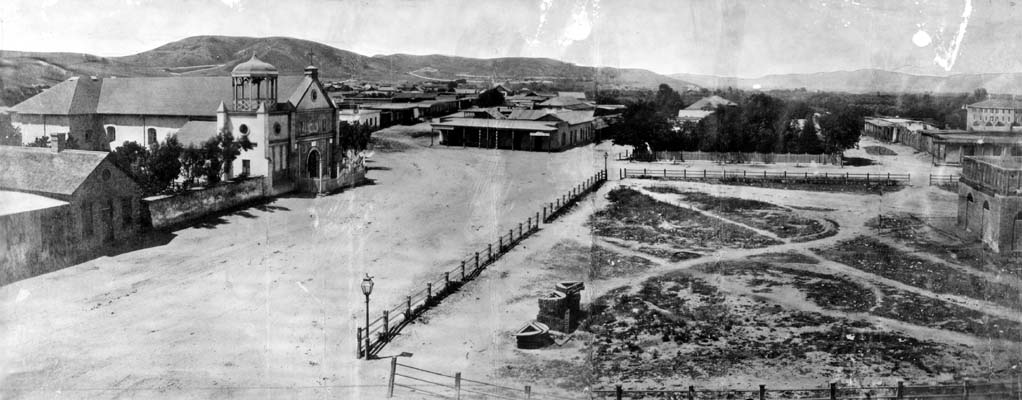
Mission Nuestra Señora Reina de los Angeles, 1869.

Bernard-Henri Lévy’s 2006 book, American Vertigo, received, via Garrison Keillor, one of the most famous and harshest slams ever in the New York Times Book Review. The French writer’s volume grew from a series of articles he penned for the Atlantic, which saw him retrace Tocqueville’s path across AmericaAn excerpt from one of the Atlantic pieces, in which Lévy looked at the unfathomable city known as Los Angeles:

“A legible city has to have a heart, and this heart must be pulsating. It has to have, somewhere, a starting point from which, one feels, the city was produced, and from which its mode of production is still intelligible today. It has to have a historical neighborhood, if you like, but one whose historicity continues to shape, engender, inspire, the rest of the urban space. But this place, too, is nonexistent. In Los Angeles there is nothing like the old neighborhoods from which you feel, almost physically, that the European cities, or even New York, have emerged. They do show me the old neighborhood. Kevin Starr, the excellent California historian, takes me not far from Chinatown, to Olivera Street and Old Plaza, which are supposed to be the nucleus of what was once called El Pueblo de Nuestra Señora la Reina de Los Angeles. But they are dead places. It’s a neighborhood frozen in time. However much Starr leaps from house to house, with his considerable bulk proving surprisingly agile, with his ink-blue too-warm suit and his bow tie that makes him look like a private eye out of Raymond Chandler, to explain to me how gargantuan Los Angeles was born from this tiny seed; for all this, something isn’t right. You don’t feel any possible common denominator between this stone museum, these relics, and the vital, luxuriant enormousness of the city. And the truth is that with its pedestrian islands and its restored façades, its profusion of typical restaurants and its stands selling authentic Mexican products, its wrought-iron bandstands, its cobblestones, the varnished wood of the Avila Adobe, which is supposed to be the first house in the neighborhood, this street makes me think of all the fake “heritage towns” that I keep running into in America.

For an illegible city is also a city without a history.

An unintelligible city is a city whose historicity is nothing more than an ageless remorse.

And a post-historical city is, I fear, a city about which one can predict with some certainty that it will die.”

••••••••••

Bernard-Henri Lévy on the Daily Show in 2006:

www.thedailyshow.com

Tags: , , ,

Bellevue Homeless Shelter, NYC. (Image by Beyond My Ken.)

Longreads pointed me in the direction of an amazing series of articles in Capital about homelessness in NYC during the Bloomberg years, which was written by Steven Boone, a former colleague of mine who was always an excellent writer and person. An excerpt fromOut, But Not Up: Homelessness In The Age Of Bloomberg“:

“Three months later, the last of my small savings ran out, and I went to my landlady in Castle Hill to tell her that I would be leaving at the end of the week, so that she could get a new room renter lined up right away. She asked where I was going. I lied, and told her I would stay with family until I got back on my feet. On Friday, I went to 30th Street Intake Shelter (better known as the Bellevue homeless shelter) for the first time and got assigned to Ready Willing and Able shelter in Brooklyn.

The next morning, I met my father to load his van up with my belongings and store them in an uncle’s garage. He asked me where I was going. I lied again.

This man was 72 years old, living in a small apartment with his wife and supplementing his fixed income by working in a high school cafeteria. All my life, he’d worked seven days a week—six for the U.S. Postal Service, and Sundays cleaning up at a beauty school. (Growing up, I used to be his assistant at the school, paid in movie money and donuts.)

Decades later, I hadn’t managed to do anything to ease his burden. All my adult life in New York, working simply meant paying the rent and keeping the lights on. So, to the extent that I was committed to living, I was committed to making the next transaction between us be a check for some outrageous sum of money, from me to him. If I told him as much, I knew what he would say: ‘Sport, I never cared that you kids would become king of the hill or any kind of bigshot, so long as I raised y’all to be good people in this world. That’s all I ever wanted, and I got what I wanted.’ And in fact that’s how he put it a couple years later, during one of our annual shy, stare-at-the-floor heart-to-hearts.”

Tags: ,

I was shopping in a supermarket recently and noticed a mountain of Quisp cereal, an erstwhile dead brand that was originally introduced in 1965. It reminded me of Rob Walker’s excellent 2008 Sunday Times Magazine article about River West Brands, a Chicago outfit that purchases and reivitalizes ghost products, including the sugar-coated flying saucer cereal, hoping to capitalize on nostalgia and brand familiarity. An excerpt from Walker’s article:

“River West’s offices, on the 36th floor of the Chicago Board of Trade Building, are sprinkled with the bric-a-brac of obscure products: a Quisp cereal box, Ipana toothpaste packages, Duz detergent bottles. On a wall of Paul Earle’s office is a framed, five-foot-by-three-foot sheet of uncut ‘Wacky Packages’ stickers — those 1970s trading-card-size brand-parody images that rendered the word Crust in the style of the Crest logo, for example. Earle has a Midwestern everyman quality about him: he’s compact, with a big and friendly let’s-get-along voice and a penchant for deadpan jokes. Only his designer-eyeglass frames deviate from his overall demeanor.

Earle loves brands. They are not mere commercial trademarks to him, but pieces of Americana. He seems not just nostalgic but almost hurt about the fate of the ‘castoff brands’ of the world. ‘If commerce is part of the American fabric, then brands are part of the American fabric,’ he said to me on one occasion. ‘When a brand goes away, a piece of Americana goes away.’

Earle’s professional entanglement with branding began at Saatchi & Saatchi, where he was a cog in a gigantic ad agency working for gigantic clients, like General Mills and Johnson & Johnson. That was in the mid-1990s, and he saw what happened as conglomerates merged: brands that didn’t have the potential for global scale got squeezed to the bottom shelf, or out of existence. He was attracted to the idea of working with ‘noncore’ brands, but when he figured out that big-agency economics made it impractical, he left Saatchi and went to the Kellogg School of Management at Northwestern University, and then took a brand-management job at Kraft.

At Kraft he observed the same mergers-and-consolidation process from a different angle, and he seems to have found it equally frustrating. ‘These are American icons with loyal consumers,’ he says. ‘It’s not their fault a $40 billion company doesn’t like them anymore. Consumers like them.’ He sees reviving brands as ‘a civic mission’ of sorts. ‘If it weren’t my job,’ he said, ‘it would be my hobby.’ He says this in a way that sounds not just plausible but hard to doubt.

Even so, he has set out to make this particular civic mission turn a profit. While he recognizes that a given brand might not be able to survive in the portfolio of a multinational, different sorts of business models might work to sustain it. As surely as the ownership of brands has consolidated through one megamerger after another, the consumer market seems to be moving in the opposite direction, with an individualism-fueled demand for almost unlimited variety.”

______________________

The cereal from Planet Q:

Tags: ,

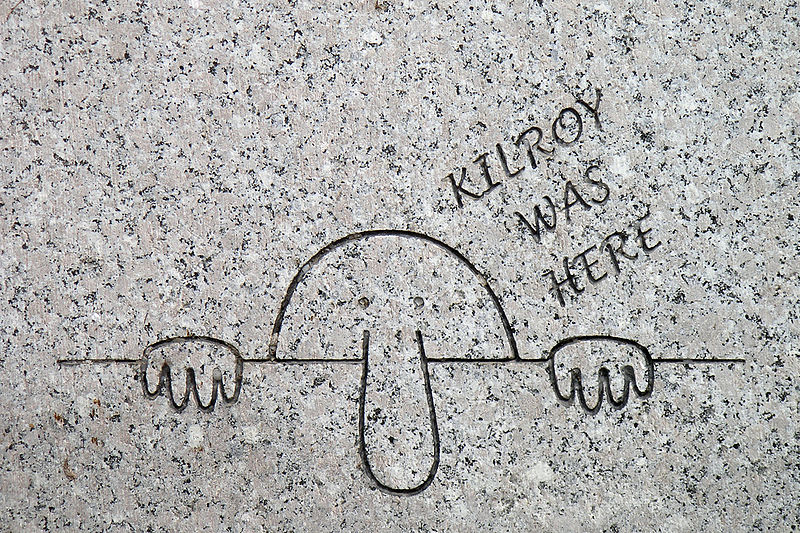
"American troops wrote 'Kilroy was here' on the walls of Europe in World War II in order to prove that somebody had been there." (Image by Luis Rubio.)

Matthew Hahn interviewed Hunter S. Thompson for The Atlantic in 1997, discussing the impact of the Internet on journalism and culture, among other matters. Thompson was particularly prescient about the ego-feeding nature of the Net. An excerpt:

Matthew Hahn: The Internet has been touted as a new mode of journalism — some even go so far as to say it might democratize journalism. Do you see a future for the Internet as a journalistic medium?

Hunter S. Thompson: Well, I don’t know. There is a line somewhere between democratizing journalism and every man a journalist. You can’t really believe what you read in the papers anyway, but there is at least some spectrum of reliability. Maybe it’s becoming like the TV talk shows or the tabloids where anything’s acceptable as long as it’s interesting.

I believe that the major operating ethic in American society right now, the most universal want and need is to be on TV. I’ve been on TV. I could be on TV all the time if I wanted to. But most people will never get on TV. It has to be a real breakthrough for them. And trouble is, people will do almost anything to get on it. You know, confess to crimes they haven’t committed. You don’t exist unless you’re on TV. Yeah, it’s a validation process. Faulkner said that American troops wrote ‘Kilroy was here’ on the walls of Europe in World War II in order to prove that somebody had been there — ‘I was here’ — and that the whole history of man is just an effort by people, writers, to just write your name on the great wall.

You can get on [the Internet] and all of a sudden you can write a story about me, or you can put it on top of my name. You can have your picture on there too. I don’t know the percentage of the Internet that’s valid, do you? Jesus, it’s scary. I don’t surf the Internet. I did for a while. I thought I’d have a little fun and learn something. I have an e-mail address. No one knows it. But I wouldn’t check it anyway, because it’s just too fucking much. You know, it’s the volume. The Internet is probably the first wave of people who have figured out a different way to catch up with TV — if you can’t be on TV, well at least you can reach 45 million people [on the Internet].”

Tags: ,

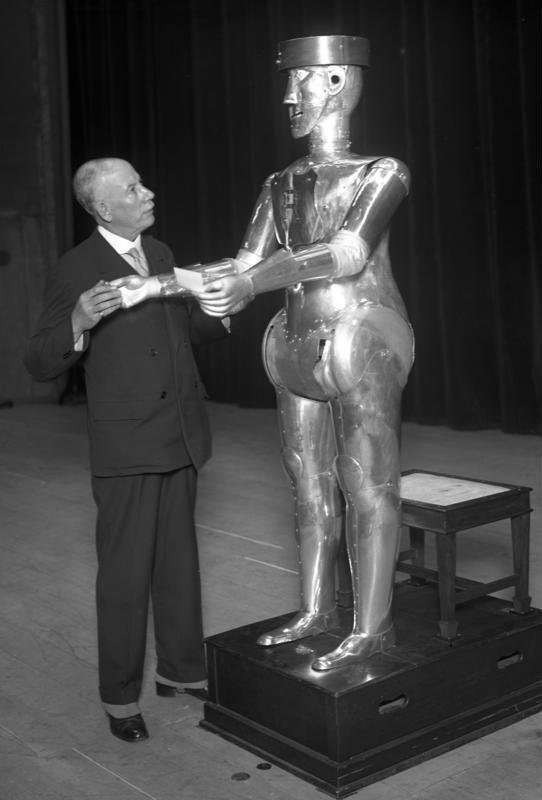
We’re so annoying even machines don’t want to talk to us. According to a BBC article, scientists are encouraging robots to develop their own words. An excerpt:

“The Lingodroid research project lets robots generate random sounds for the places they visit in both simulations and a real office.

The ‘words’ are shared and the robots play games to establish which sound represents which location.

The lexicon has proved so sophisticated that it can be used to help robots find places other robots direct them to.

The machines are being allowed to generate their own words because human language is so loaded with information that robots found it hard to understand, said project leader Dr Ruth Schulz from the University of Queensland.

‘Robot-robot languages take the human out of the loop,’ she said. ‘This is important because the robots demonstrate that they understand the meaning of the words they invent independent of humans.'”

Charles Mingus, Manhattan, July 4, 1976.

This classic 1976 photograph shows the tempestuous musical genius Charles Mingus playing in Manhattan as part of the celebration for the two hundredth anniversary of the signing of the Declaration of Independence.  Mingus would live just three more years, passing away from ALS in 1979. From a 1971 Ebony article about the musician’s memoir:

“In his offbeat autobiography, Beneath the Underdog: His World as Composed by Mingus, the noted composer, bassist and general enigma of that name contends that he is really three people. One man stands at dead center, cooly surveying his domain and expressing what he sees to the other two, one of whom is prone to strike out like a frightened animal while the other is gentle and painfully vulnerable. While it is not quite clear as to which self wrote this “Sex Machine” of a book (possibly it was the middle man since he speaks of himself in the third person), it is interesting to note that one might find elements of all these selves in this man’s music. Mingus composes and plays like a beleaguered genius challenging some nameless deity to account for the inequities imposed on the man by fate and other men–and to do so in no uncertain terms. He is a music of storm and constant questioning, beauty, brilliance and embracing tenderness, all of it molded on a framework of logical musical order. It is difficult to think of any ‘jazz’ artists, aside from Mingus’ idol, Duke Ellington, who is capable of creating such impressionistic tapestries of shimmering sound. In other words, Charles Mingus is one of the truly great ones, beneath the layer of legends surrounding his sexual exploits and eccentricities. His genius must be acknowledged.”

••••••••••

Silent super-8 footage of Battery Park celebration on July 4, 1976:

Tags:

“The Boy in the Bubble”

It was a slow day
And the sun was beating
On the soldiers by the side of the road
There was a bright light
A shattering of shop windows
The bomb in the baby carriage
Was wired to the radio
These are the days of miracle and wonder
This is the long distance call
The way the camera follows us in slo-mo
The way we look to us all
The way we look to a distant constellation
That’s dying in a corner of the sky
These are the days of miracle and wonder
And don’t cry baby, don’t cry
Don’t cry

"The bomb in the baby carriage is wired to the radio." (Image by Malene Thyssen.)

It was a dry wind
And it swept across the desert
And it curled into the circle of birth
And the dead sand
Falling on the children
The mothers and the fathers
And the automatic earth
These are the days of miracle and wonder
This is the long distance call
The way the camera follows us in slo-mo
The way we look to us all
The way we look to a distant constellation
That’s dying in a corner of the sky
These are the days of miracle and wonder
And don’t cry baby, don’t cry
Don’t cry

It’s a turn-around jump shot
It’s everybody jump start
It’s every generation throws a hero up the pop charts
Medicine is magical and magical is art
The boy in the bubble
And the baby with the baboon heart

And I believe
These are the days of lasers in the jungle
Lasers in the jungle somewhere
Staccato signals of constant information
A loose affiliation of millionaires
And billionaires and baby
These are the days of miracle and wonder
This is the long distance call
The way the camera follows us in slo-mo
The way we look to us all
The way we look to a distant constellation
That’s dying in a corner of the sky
These are the days of miracle and wonder
And don’t cry baby, don’t cry
Don’t cry

Tags:

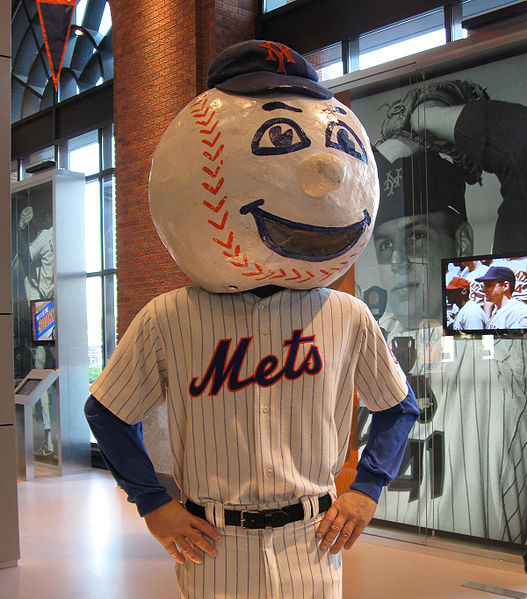
Much like team owner Fred Wilpon, Mr. Met is a balloon-headed symbol of mediocrity. (Image by richiek.)

Madoff-mired Mets owner Fred Wilpon, the handsomely attired and hapless dummkopf who, with help from his jugheaded scion, Jeff, has run the New York baseball team into the ground for half his adult life, is the focus of a new profile in the New Yorker by the reliably excellent Jeffrey Toobin. An excerpt:

“In the game against the Astros, Jose Reyes, leading off for the Mets, singled sharply up the middle, then stole second. ‘He’s a racehorse,’ Wilpon said. When Reyes started with the Mets, in 2003, just before his twentieth birthday, he was pegged as a future star. Injuries have limited him to a more pedestrian career, though he’s off to a good start this season. ‘He thinks he’s going to get Carl Crawford money,’ Wilpon said, referring to the Red Sox’ signing of the former Tampa Bay player to a seven-year, $142-million contract. ‘He’s had everything wrong with him,’ Wilpon said of Reyes. ‘He won’t get it.’

After the catcher, Josh Thole, struck out, David Wright came to the plate. Wright, the team’s marquee attraction, has started the season dreadfully at the plate. ‘He’s pressing,’ Wilpon said. ‘A really good kid. A very good player. Not a superstar.’

Wright walked.

When Carlos Beltran came up, I mentioned his prodigious post-season with the Astros in 2004, when he hit eight home runs, just before he went to the Mets as a free agent. Wilpon laughed, not happily. ‘We had some schmuck in New York who paid him based on that one series,’ he said, referring to himself. In the course of playing out his seven-year, $119-million contract with the Mets, Beltran, too, has been hobbled by injuries. ‘He’s sixty-five to seventy per cent of what he was.’ Beltran singled, loading the bases with one out.

Ike Davis, the sophomore first baseman and the one pleasant surprise for the Mets so far this season, was up next. ‘Good hitter,’ Wilpon said. ‘Shitty team—good hitter.’ Davis struck out. Angel Pagan flied out to right, ending the Mets’ threat. ‘Lousy clubs—that’s what happens.’ Wilpon sighed. The Astros put three runs on the board in the top of the second.

‘We’re snakebitten, baby,’ Wilpon said.”

••••••••••

Tags: , , , ,

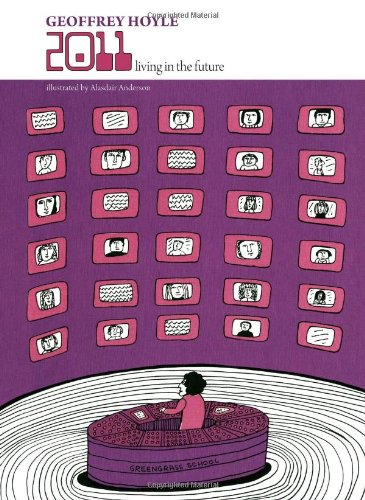
I have no love for science fiction as art or entertainment, but I really like the cultural visionary aspect of it. The Independent feeds that interest with an article by Simmy Richman about a sci-fi writer named Geoffrey Hoyle, who was asked in 1972 to write a book (2011: Living in the Future) for children that would predict what life would be like this year. His prognostications were amazingly correct. In the piece, Hoyle discusses what he got right and the aspects of contemporary life he simply doesn’t understand. An excerpt:

“‘Over the years politicians have added new thing to new thing and nobody has the intellect to wipe the slate clean and say, ‘What do we need?’ What have changed over the decades are the levels of bureaucracy, the control over our lives and the rise of the career politician with pop-star status. We live in a time where there’s a huge amount of disinformation and facts can be twisted to alarm or control. The original draft of the US constitution is 20 pages long; Brussels turns out thousands and thousands of pages – which says to me that no one knows how to make law [any more].’

So while Hoyle predicted both the large (the ubiquity of the computer, the invention of the smartphone and the microwave) and the small (Skype, home supermarket delivery, touchscreens and webcams) ways our lives have changed, he has no idea why the social model of Europe is still ‘tailored to the way people were living in 1947.'”

Tags: ,

Long tail. (Image by megan ann.)

The opening of Chris Anderson’s “The Long Tail,” his famous 2004 Wired article about a shift in consumerism, propelled by the Internet, which the author later expanded into a best seller of the same name:

In 1988, a British mountain climber named Joe Simpson wrote a book called Touching the Void a harrowing account of near death in the Peruvian Andes. It got good reviews but, only a modest success, it was soon forgotten. Then, a decade later, a strange thing happened. Jon Krakauer wrote Into Thin Air, another book about a mountain-climbing tragedy, which became a publishing sensation. Suddenly Touching the Void started to sell again.

Random House rushed out a new edition to keep up with demand. Booksellers began to promote it next to their Into Thin Air displays, and sales rose further. A revised paperback edition, which came out in January, spent 14 weeks on the New York Times bestseller list. That same month, IFC Films released a docudrama of the story to critical acclaim. Now Touching the Void outsells Into Thin Air more than two to one.

What happened? In short, Amazon.com recommendations. The online bookseller’s software noted patterns in buying behavior and suggested that readers who liked Into Thin Air would also like Touching the Void. People took the suggestion, agreed wholeheartedly, wrote rhapsodic reviews. More sales, more algorithm-fueled recommendations, and the positive feedback loop kicked in.

Particularly notable is that when Krakauer’s book hit shelves, Simpson’s was nearly out of print. A few years ago, readers of Krakauer would never even have learned about Simpson’s book – and if they had, they wouldn’t have been able to find it. Amazon changed that. It created the Touching the Void phenomenon by combining infinite shelf space with real-time information about buying trends and public opinion. The result: rising demand for an obscure book.

This is not just a virtue of online booksellers; it is an example of an entirely new economic model for the media and entertainment industries, one that is just beginning to show its power. Unlimited selection is revealing truths about what consumers want and how they want to get it in service after service, from DVDs at Netflix to music videos on Yahoo! Launch to songs in the iTunes Music Store and Rhapsody. People are going deep into the catalog, down the long, long list of available titles, far past what’s available at Blockbuster Video, Tower Records, and Barnes & Noble. And the more they find, the more they like. As they wander further from the beaten path, they discover their taste is not as mainstream as they thought (or as they had been led to believe by marketing, a lack of alternatives, and a hit-driven culture).”

••••••••••

Chris Anderson’s TED Talk about The Long Tail:

Tags:

"He thinks things are going in a bad direction."

FromThe Elephant in the Green Room,” Gabriel Sherman’s just-published New York magazine piece about FOX News honcho Roger Ailes, a ghastly man whose face looks as if it should be attached the hull of a ship:

“So it must have been disturbing to Ailes when the wheels started to come off Fox’s presidential-circus caravan. (Coincidentally or not, this happened more or less when Donald Trump jumped on: ‘They like me on the network,’ Trump told me. ‘I get ratings.’) The problem wasn’t that ratings had been slipping that much—Beck’s show declined by 30 percent from record highs, but the ratings were still nearly double those from before he joined the network. It was that, with an actual presidential election on the horizon, the Fox candidates’ poll numbers remain dismally low (Sarah Palin is polling 12 percent; Newt Gingrich and Rick Santorum, 10 percent and 2 percent, respectively). Ailes’s candidates-in- waiting were coming up small. And, for all his programming genius, he was more interested in a real narrative than a television narrative—he wanted to elect a president. All he had to do was watch Fox’s May 5 debate in South Carolina to see what a mess the field was—a mess partly created by the loudmouths he’d given airtime to and a tea party he’d nurtured. And, not incidentally, a strong Republican candidate would be good for his business, too. A few months ago, Ailes called Chris Christie and encouraged him to jump into the race. Last summer, he’d invited Christie to dinner at his upstate compound along with Rush Limbaugh, and like much of the GOP Establishment, he fell hard for Christie, who nevertheless politely turned down Ailes’s calls to run. Ailes had also hoped that David Petraeus would run for president, but Petraeus too has decided to sit this election out, choosing to stay on the counterterrorism front lines as the head of Barack Obama’s CIA. The truth is, for all the antics that often appear on his network, there is a seriousness that underlies Ailes’s own politics. He still speaks almost daily with George H. W. Bush, one of the GOP’s last great moderates, and a war hero, which especially impresses Ailes.

All the 2012 candidates know that Ailes is a crucial constituency. ‘You can’t run for the Republican nomination without talking to Roger,’ one GOPer told me. ‘Every single candidate has consulted with Roger.’ But he hasn’t found any of them, including the adults in the room—Jon Huntsman, Mitch Daniels, Mitt Romney—compelling. ‘He finds flaws in every one,’ says a person familiar with his thinking.

‘He thinks things are going in a bad direction,’ another Republican close to Ailes told me. ‘Roger is worried about the future of the country. He thinks the election of Obama is a disaster. He thinks Palin is an idiot. He thinks she’s stupid. He helped boost her up. People like Sarah Palin haven’t elevated the conservative movement.'”

Tags: , , ,

An experimental 17-minute BBC version. Better than Cronenberg’s 1996 adaptation, I think.


From a piece about Ballard in the Los Angeles Times by David L. Ulin: “If J.G. Ballard — the visionary British novelist who died Sunday of prostate cancer at age 78 — ends up being remembered, it will likely be as a science fiction writer who aspired to use genre as a vehicle for art. That’s true enough, in a certain small-bore manner, but it’s ultimately reductive, a way of categorizing Ballard that his entire career stood against.

A member of the New Wave science fiction movement of the 1960s, Ballard started out writing proto-environmental thrillers that highlighted the prescience of his imagination: The Wind From Nowhere posits a world-wide windstorm that becomes apocalyptic, while The Drowned World is about a planet swamped by risen sIt was really in the 1970s, however, that Ballard found his voice as a writer, focusing on the dangers of mechanization and socialization, the tension between the veneer of civilization and the animal brutality it sought to conceal. “

Tags: , ,

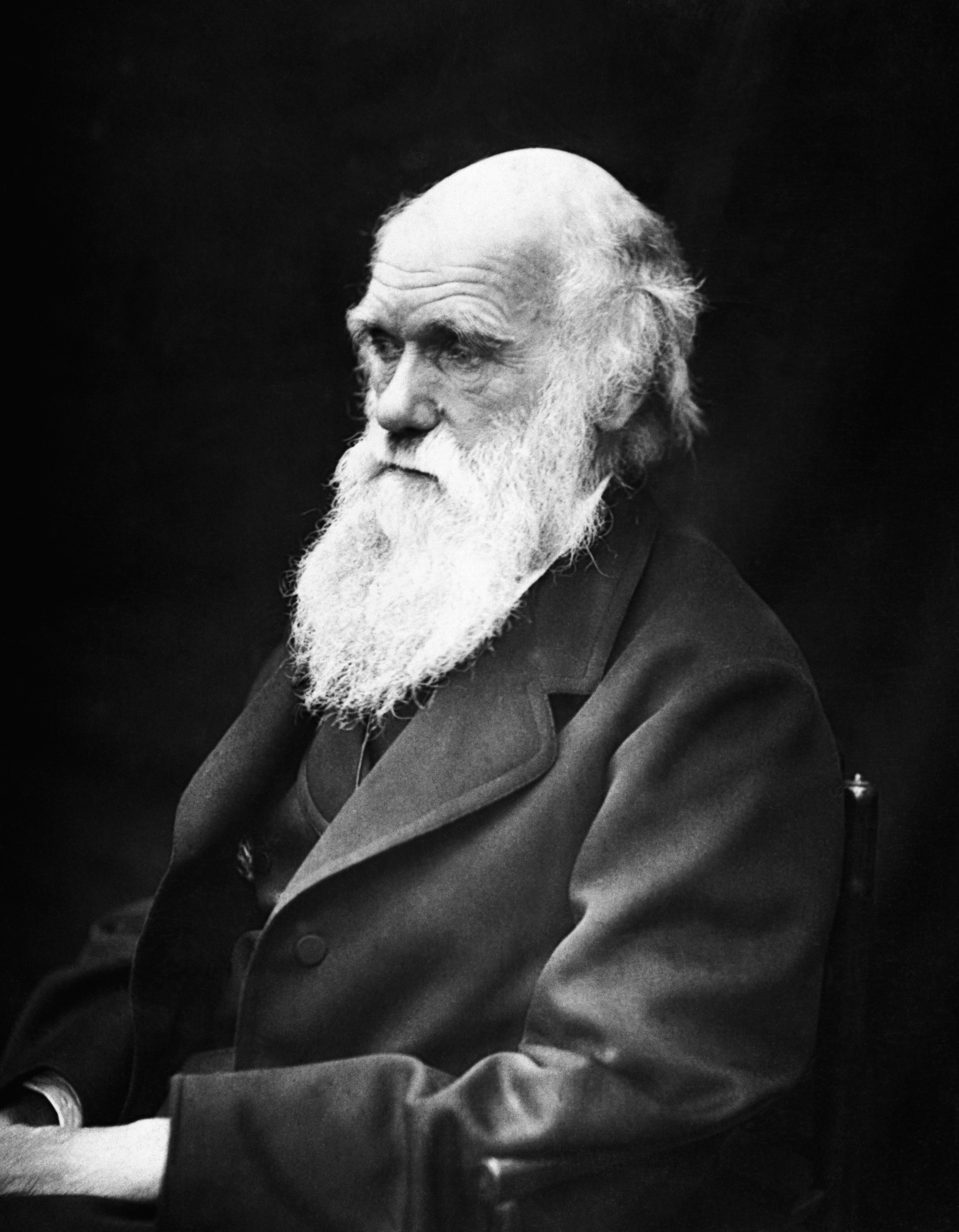
Charles Darwin: gassy mess.

On May 20, 1865, chronically ill Charles Darwin recorded the symptoms of his terrible stomach problems, which may been result of something called Cyclic Vomiting Syndrome:

“For 25 years extreme spasmodic daily & nightly flatulence: occasional vomiting, on two occasions prolonged during months. Vomiting preceded by shivering (hysterical crying) dying sensations (or half-faint). .  ringing in ears, treading on air and vision. (focus and black dots) . . . (nervousness when E. [Emma] leaves me)—What I vomit intensely acid slimy (sometimes bitter) consider teeth.” (Thanks Why Evolution Is True.)

Tags:

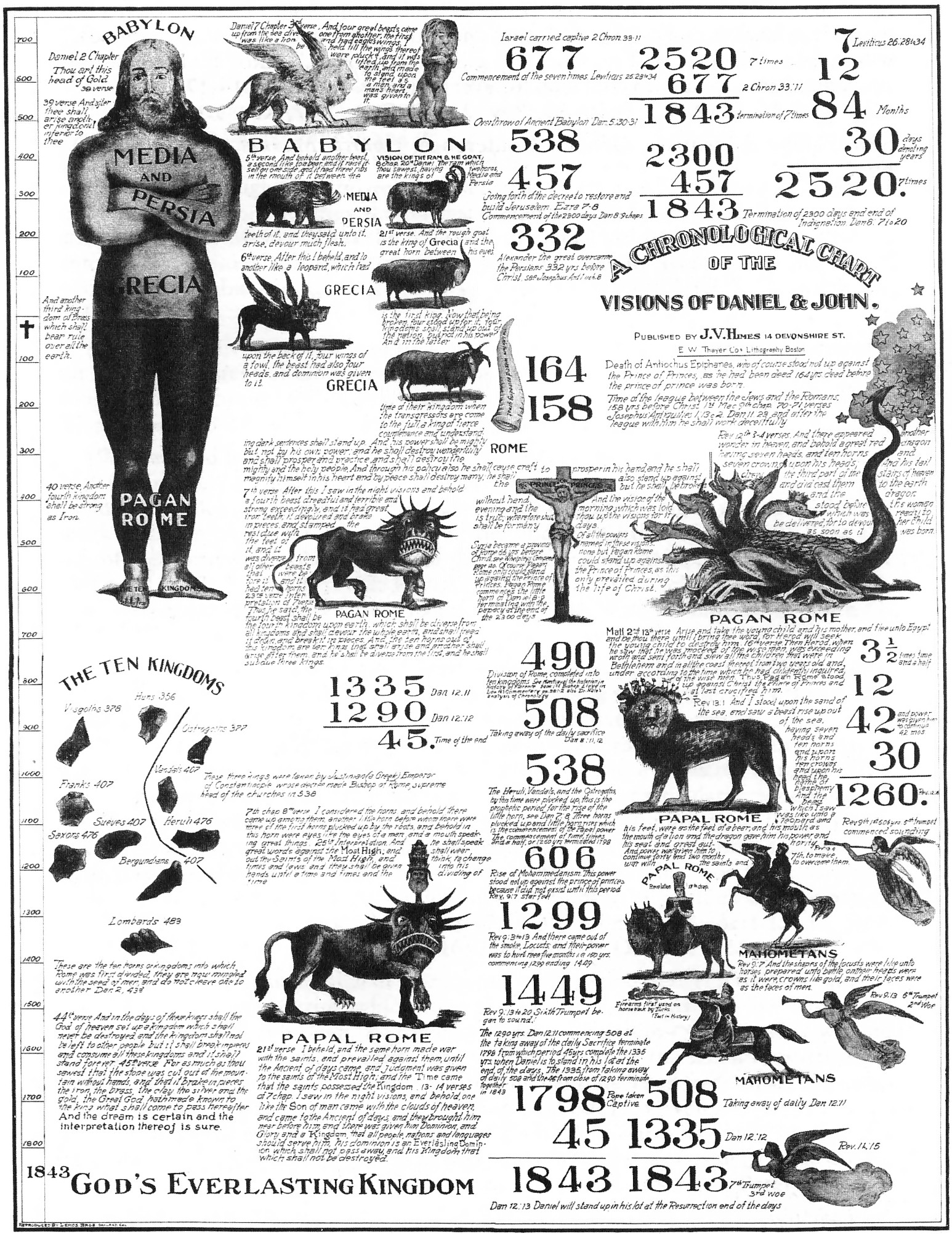
The Millerite chart "proved" the end was near in the 1840s.

The end is coming soon or sooner, sure, but Kathryn Schulz recalls a time in 1844 when the sky was also supposedly crashing into the sea:

“On the morning of October 22, 1844, a group of people gathered to await the end of the world. They met in homes, in churches, and in outdoor revival meetings, primarily in New York and New England but also throughout the United States and Canada, and as far away as England, Australia, and South America. Nobody knows how numerous they were. Some scholars put the number at 25,000 and some put it at over a million, but most believe it was in the hundreds of thousands. Whatever the figure, the assembled group was too large to be dismissed as a cult and too diverse to be described as a sect. The believers included Baptists, Methodists, Episcopalians, Lutherans, and members of various other Christian denominations, plus a handful of unaffiliated former atheists. They also included an almost perfect cross-section of mid-nineteenth-century society. Sociologists often argue that apocalyptic creeds appeal primarily to the poor and the disenfranchised – those for whom the afterlife promises more than life itself has ever offered. But on that day in 1844, judges, lawyers and doctors, farmers and factory workers and freed slaves, the educated and the ignorant, the wealthy and the impoverished: all of them gathered as one to await the Rapture

What this otherwise diverse group of people had in common was faith in the teachings of one William Miller, a do-it-yourself preacher who had analyzed the Bible and determined the date of the Second Coming. Miller was born in Massachusetts in 1782, the eldest of sixteen children and the grandson of a Baptist minister. When he was four, his family moved to upstate New York, where the nationwide religious revival that would become known as the Second Great Awakening was just beginning to stir. In later years, the part of the state near Miller’s home would be called the Burned-Over District, because it was so ablaze with religious conviction that there was scarcely anyone left to convert.” (Thanks Longreads.)

Tags: ,

In this week’s Sunday Times Magazine, Andrew Goldman has a smart interview with Jimmy Lai, the Chinese clothing retailer-cum-media mogul behind those insane (and insanely popular) animations of scandalous news stories. Lai’s explanation for what he does is honest and simple and blunt and a little depressing. An excerpt:

You own magazines and newspapers in Hong Kong and Taiwan and have been called the Rupert Murdoch of Asia — and yet you’re best known here for your company’s very enjoyable and weird animated re-enactments of news events. The one you did for Tiger Woods’s Thanksgiving-weekend car accident got more than five million YouTube views. Why did you get into animation?

I started the animations because print media was going into a sunset business environment. It’s obvious that we have arrived at an era of images. I thought that if I could speed up the production of animation, I could make a big business out of recreating the amazing images of the news, because what we get on TV is always the last bit of image. What happened before that image is always missing.

You mean that all we ever see is the wreckage after the plane crash, not the crash itself?

Exactly. We don’t see the pilot flying the plane drunk and what happened in the cabin. If somebody jumped off a roof, we only see the body even though we know that eight months ago, the guy might have gone to Macau, lost a lot of money in a casino, was chased by a loan shark, so he got depressed and decided to jump off a roof.

So you envision these animations as a substitute for reading news?

Exactly. If I hold an image in front of you, you can right away assimilate a story that may take me 20 minutes to explain or take you 10 minutes to read.”

••••••••••

Tags: , ,

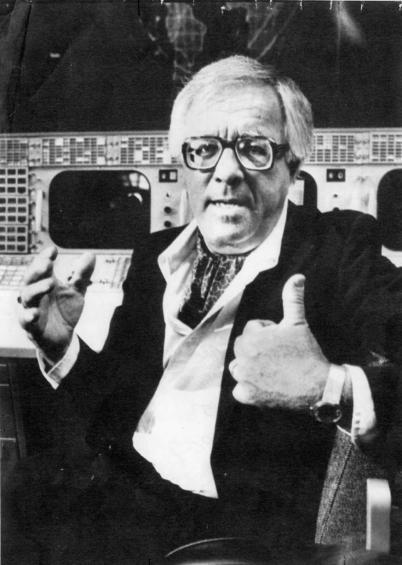
Ray Bradbury interviewed by Mike Wallace on the night of the first moon landing. He was ebullient, of course, but probably somewhat more restrained than Arthur C. Clarke and Robert A. Heinlein.

Tags: ,

A passage from Thinking in the Rain,” Susan Orlean’s 2007 New Yorker profile of Steve Hollinger, a sculptor of found and often unusual materials:

“One day last year, Hollinger walked around his neighborhood carrying another one of his surprises. The neighborhood is Fort Point Channel, a cluster of decommissioned factory buildings in downtown Boston which now house hundreds of artists, so it is commonplace to see residents kitted out in attire not sold at Talbots, carrying objects that appear extraterrestrial. Even so, Hollinger attracted attention. He had spent the previous month mostly locked in his apartment, furiously teaching himself the principles of aerodynamics, the physics of hydrology, and the basics of how to operate a Singer sewing machine, and he was at last testing what he had been working on — a reimagined, reinvented umbrella, with gutters and airfoils and the elegant drift of a bird’s wing. ‘I knew I was on to something,’ he says now. ‘I was hardly outside for five minutes before someone stopped me and said, ‘Where can I get one of those?’

Hollinger is not, per se, an umbrella man; he is a sculptor who makes assemblages out of found materials. They are often kinetic and frequently reference other media: a solar-powered flip-book movie of Hollinger doing a war dance, which you view through a prism in a large cement block, or perhaps a series of photo emulsions peeled off Polaroids showing trees being immolated in a nuclear test in the nineteen-sixties, or twenty-five atom-shaped spheres made of photo-sensitive tape, suspended between sheets of plate glass and a frame of barn wood. His sculpture has been displayed widely and is well respected, but it is his work as an inventor that pays most of his bills. He grew up in suburban Connecticut, but both his parents are artists, and bohemian enough to have found his unusual interests — breaking thermometers in order to add to his collection of mercury, for instance — the sign of a lively mind. He went on to study computer programming at SUNY Albany. When he graduated, in 1984, he worked first at Telex, a computer company in North Carolina, and then at Wang Laboratories, in Massachusetts, developing imaging-technology software. In 1989, he decided to become an inventor.”

••••••••••

A Hollinger solar-powered mixed-media work:

Tags: ,

Excellent new post by Robin Hanson on the Overcoming Bias site explaining why autopsies are conducted so rarely as opposed to a few decades ago. Problems can’t be fixed if they’re disappeared, and our squeamishness on the topic probably allows hospitals to get away with the practice. An excerpt:

“What if the airline industry lobbied to end the practice of routinely investigating the cause of each airline crash? After all, if there is no investigation, it will be hard to show an airline was at fault. You might imagine there’d be a public outcry. But in 1970 the US medical profession did essentially the same thing, and few complained:

Today, hospitals perform autopsies on only about 5 percent of patients who die, down from roughly 50 percent in the 1960s. … Autopsies play a critical role in helping to advance understanding of the progress of a disease and the effectiveness of various treatments. At the same time, they may identify medical conditions that clinicians and high-tech imaging miss or misdiagnose. …

In 1998 the Journal of the American Medical Association reported that autopsy results showed that clinicians misdiagnosed the cause of death up to 40 percent of the time. … Until 1970, hospitals had to autopsy at least 20 percent of their patients in order to remain accredited. Once that requirement was dropped, autopsy rates began to fall, due to lack of direct funding, fear of litigation and increasing reliance on technology as a diagnostic tool, among other reasons. … Today, about 40 percent of hospitals don’t perform autopsies at all.” (Thanks Marginal Revolution.)

Tags:

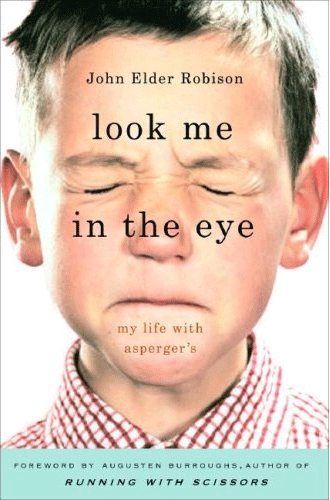
Excellent post on the NeuroTribes blog by Steve Silberman about John Elder Robison, an author and auto mechanic with Asperger syndrome. An excerpt:

“John Elder Robison would stand out in a crowd even if he didn’t have Asperger syndrome. A gruff, powerfully built, tirelessly curious, blue-eyed bear of a man, he hurtles down a San Diego sidewalk toward a promising Mexican restaurant like an unstoppable force of nature. ‘What’s keepin’ you stragglers?’ he calls back to the shorter-legged ambulators dawdling in his wake.

As they catch up, Robison utters his all-purpose sound of approval — ‘Woof!’ — which he utters often, being a man in his middle years who is finally at peace with himself after a difficult coming-of-age. For the acclaimed author of the 2007 New York Times bestseller Look Me in the Eye, a diagnosis of Autism Spectrum Disorder in mid-life was liberating, giving a name to the nagging feeling that he was somehow different from nearly everyone around him.”

••••••••••

Robison speaking at GoogleTalks:

Tags: ,

The great Open Culture points out that the much-loved 1963-1988 nature TV program, Mutual of Omaha’s Wild Kingdom, has a Youtube channel with some great footage. Hosted by zoologists Marlin Perkins and Jim Fowler, the show raised environmental awareness and made it perfectly clear that the ecosystem was not something to be tampered with. And in years before cable and the Internet, this program, along with Wide World of Sports, introduced Cold War-era Americans to far-flung corners of the world they were supposed to ignore or fear.

Watch the “Land of Quaking Earth” episode, which features a reel-to-reel tape player and a monkey in a yellow suit slapping the crap out of an owl:

A wild tale about the normally mild-mannered Perkins from the Canadian Broadcasting Corporation site: “Of course, asking the difficult question can be hazardous to a host’s health. In 1982, the fifth estate investigated whether the many nature documentaries interfered with nature for dramatic purposes. Bob McKeown reported how a Disney documentary showing the phenomenon of lemmings plunging to their death over cliffs had in fact been the same film footage spliced together to give the appearance of mass suicide. When McKeown interviewed zoologist Marlin Perkins, host of Wild Kingdom about truth and fiction on wildlife programmes, he clearly hit a raw nerve. The octogenarian Perkins firmly asked for the camera to be turned off, then punched a shocked McKeown in the face.”

Tags: , ,

« Older entries § Newer entries »